REVIEW 4 major objections 5 minor 11 references
Estimating skeleton-based gait abnormality index by sparse deep auto-encoder
T0 review · 4 major / 5 minor · reviewed 2026-08-14 · deepseek-v4-flash
Pith's one-line read A gait abnormality index can be derived from single skeleton postures alone: sparse deep autoencoders trained only on normal gait score each frame by reconstruction error, and a per-axis weighted, sequence-averaged index separates normal…
desk verdict A clean, honest per-axis sparse-autoencoder gait index, but the 'best ability' claim rests on a four-subject split and a tie with the one-class SVM baseline. read the letter →
The pith
A machine-rendered reading of the paper's core claim, the machinery that carries it, and where it could break.
The reading
What carries the argument
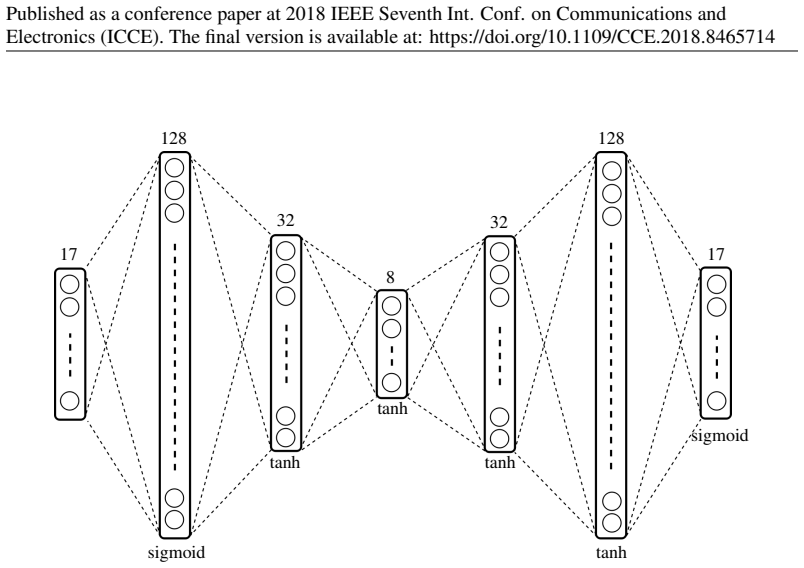
The load-bearing object is a trio of fully connected sparse autoencoders with a 17-128-32-8-32-128-17 structure, one for each coordinate axis, trained by backpropagation on normal skeletons with a loss combining mean-square reconstruction error, a Kullback-Leibler sparsity penalty with target activation $\rho=0.05$ on the second layer, and $\ell^2$ weight decay. The mechanism is one-class reconstruction: an autoencoder trained only on normal postures reconstructs them well and abnormal postures poorly, so reconstruction error translates directly into an abnormality index. The index is the weighted sum of the three per-axis errors with weight $w_k = e^{-1}_k / \sum_k e_k$, which emphasizes axis models with lower training error; temporal context enters only as post-processing, by averaging the frame indices over a segment of 20 frames or the whole 1200-frame sequence.
What would settle it
Train the same three autoencoders on normal skeletons only, then test on gait sequences in which the pose sequence is normal but the temporal pattern is altered, for example identical poses with abnormal cadence, hesitation, or phase asymmetry, or the same subjects walking at a different treadmill speed. If the per-sequence weighted index does not separate these from normal walks (AUC near 0.5), the central claim that abnormality is contained in individual postures would be refuted.
Extended reading notes
Core claim
The paper establishes that the normality of a walking posture is largely contained in the single skeleton itself: after discarding eight joints and normalizing each coordinate axis separately to $[0,1]$, a skeleton is fed to three axis-wise deep autoencoders, and the mean squared reconstruction error is a usable per-frame abnormality index. A weighted sum of the three per-axis errors, with weights inversely related to each model's training-set error, outperforms the plain sum, and averaging the per-frame indices over a segment or the whole sequence reduces noise. The central experimental claim is that this unsupervised, feature-free pipeline outperforms a reimplemented hand-crafted skeleton-based HMM baseline and matches a reimplemented silhouette-based one-class SVM baseline, reaching a per-sequence classification error of 0.139.
Load-bearing premise
The key assumption is that abnormal gait leaves a visible mark inside a single normalized skeleton pose, so that after per-axis min-max normalization a normal-trained autoencoder's per-frame reconstruction error separates normal from abnormal movement; if the abnormality lives mainly in timing, coordination, speed, or absolute body geometry, the normalization and frame-wise scoring erase it.
Editorial extensions
If this is right
- Screening for gait abnormalities no longer requires labeled abnormal examples: only normal walking skeletons are needed for training, and any deviation that changes joint coordinates becomes detectable as higher reconstruction error.
- Because the index is computed per frame, the method can run online: a stream of skeleton frames yields a continually updated abnormality score, with temporal averaging used only to suppress noise.
- The per-axis weighted fusion gives an explicit role to each coordinate direction; in a frontal Kinect view, sideways (X) and vertical (Y) joint motion carry more abnormality information than depth (Z).
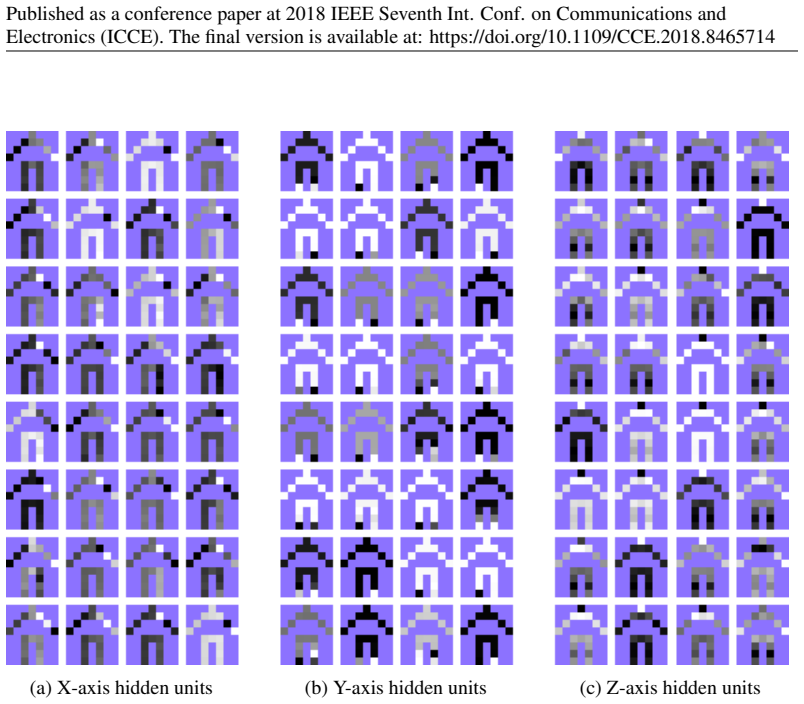
- The sparse middle-layer units act as interpretable joint-difference filters, so the same architecture that produces the index also yields a visualization of which joints and axes drive the abnormality signal.
- For gait-type classification, the per-sequence weighted index (AUC 0.945, EER 0.139) supersedes the plain index sum and both reimplemented baselines on the reported dataset.
Reading between the lines
- Because normalization scales each skeleton's per-axis coordinates to [0,1], the index is invariant to uniform body-size rescaling; a natural extension would be to test whether the same threshold holds across subjects with very different limb lengths, which the small nine-subject dataset cannot establish.
- The paper's low weight on the Z-axis suggests the method depends on viewing geometry: with a side view, where most gait motion is along the optical axis, the axis weighting learned for a frontal view would likely need re-estimation.
- The frame-wise scores could be fed into a temporal model such as an HMM or recurrent network instead of averaged, which might capture cadence- or coordination-based abnormalities that per-frame reconstruction error alone misses.
- Thresholding individual sparse hidden-unit activations could yield a per-joint abnormality map, a clinically useful extension the paper does not pursue.
Signed reviews
Editorial analysis
A structured set of objections, weighed in public.
Referee Report
Summary. The paper proposes an unsupervised gait abnormality index from Kinect skeleton data. Each skeleton is preprocessed by discarding 8 joints and min-max normalizing coordinates per axis; three sparse deep autoencoders are trained on normal walking skeletons only, one per coordinate axis. The abnormality index is a weighted sum of per-axis reconstruction errors (Eq. 2), and per-segment/per-sequence indices are obtained by averaging per-frame scores. The authors evaluate classification of normal vs. eight simulated abnormal gaits from 9 volunteers, comparing with a HMM baseline and a one-class SVM baseline. They report AUC and EER values, with the per-sequence weighted-sum index reaching AUC 0.945 and EER 0.139, and conclude that this weighted-sum index gives the best classification ability.
Significance. If the result holds, the paper offers a simple, unsupervised alternative to hand-crafted gait features, and the per-axis decomposition with sparsity constraints could aid interpretability. Strengths include a one-class formulation that matches practical settings where abnormal gaits are rare and diverse, and explicit comparison with two reimplemented baselines on a common subject split. However, the evidence supporting the central claim is currently thin: all evaluations rely on a single split with four test subjects, and the headline comparison with the one-class SVM baseline is a tie. The significance of the work would be substantially higher if the evaluation uncertainty were quantified and the claimed superiority were supported by statistically meaningful comparisons.
major comments (4)
- [Section 3.3, Table 2] In Table 2, the per-sequence classification error of 'Ours (weighted sum)' is 0.139, identical to that of the One-class SVM [1]. The sentence in Section 3.3 that 'our index estimation that used a weighted sum gave the best ability of classification' is therefore not supported by the paper's own numbers; the method ties the baseline on this metric. Please provide error bars, a statistical comparison, or a clearly qualified claim.
- [Sections 3.1 and 3.2, Tables 1 and 2] The evaluation uses a single subject-wise split (5 training, 4 test subjects) and reports point estimates only. The 36 per-sequence scores are not independent because they come from 4 subjects, so the effective sample size for subject generalization is 4, not 36. A single reclassified sequence changes the error rate by about 0.028, which is comparable to or larger than the differences among per-sequence rows in Table 2. I request confidence intervals, leave-one-subject-out cross-validation, or bootstrapping over subjects before the reported AUC/EER can be interpreted as evidence of superiority.
- [Sections 2.1 and 2.3] The method rests on the assumption that gait abnormality is visible in per-skeleton joint positions after per-axis min-max normalization of each skeleton. The paper states this assumption but does not test it. If abnormality is largely a temporal dynamics phenomenon or is related to absolute body or joint positions, this preprocessing could remove the signal. An ablation comparing raw or body-size-normalized coordinates, or a quantitative test of the per-frame assumption, would strengthen the claim.
- [Section 2.2 and Eq. (2)] Several load-bearing hyperparameters are fixed without sensitivity analysis: the sparsity target rho=0.05, the segment length of 20, and the KL/L2 penalty coefficients are not varied, and the optimization details are not reported. In addition, Eq. (2) is typeset ambiguously: as written, w_k = e^{-1}_k sum_k e_k does not define the normalized weights described in the text. Please clarify the formula and report the chosen weighting scheme.
minor comments (5)
- [Section 2.2] The paper says tanh is assigned to two-thirds of the layers, but it does not specify which of the hidden layers use tanh and which use sigmoid; please state the architecture precisely.
- [Figure 3] The batch-loss curves would be much easier to interpret with labeled axes and a legend; without them, the claim that the Z-model loss is less stable is difficult to verify from the figure.
- [Table 2] The HMM row has no per-frame entry; please indicate why this value is unavailable or state explicitly that the method requires a sequence input.
- [Section 3.3] The reimplementations of [1] and [3] are not described in enough detail to be reproduced; please provide the number of HMM states, k-means parameters, one-class SVM kernel and hyperparameters, and any tuning procedure.
- [Conclusion] The final paragraph mentions Procrustes analysis as future work, but since coordinate normalization is central to the proposed preprocessing, a sensitivity experiment with an alternative normalization would be more informative than a future-work note.
Circularity Check
No circularity: the abnormality index is an unsupervised reconstruction-error score computed from label-free weights.
full rationale
The derivation chain is self-contained. Each autoencoder is trained only on normal skeletons, and the abnormality index is defined as a weighted sum of reconstruction errors on held-out skeletons. No class labels are used in training or in computing the weights of Eq. (2); those weights are derived from training-set reconstruction errors only. The claim that abnormal inputs produce high reconstruction error is an empirical assumption, not a definitional equivalence. The only self-citation is the authors' earlier HMM work [3], which appears solely as a baseline for comparison rather than as a load-bearing premise or uniqueness theorem. The numerical comparison in Table 2 is weak (a tie with the one-class SVM at 0.139 per-sequence error, based on only four test subjects), but that is a statistical-evidence concern, not circularity. No fitted parameter is renamed as a prediction, and no central result reduces to its own input by construction.
Assumptions & free parameters
free parameters (3)
- Sparsity target rho =
0.05
- Per-segment window length =
20
- KL penalty and L2 regularization coefficients =
not reported
assumptions (4)
- domain assumption Normal walking skeletons form a representative one-class description, and abnormal gaits produce higher autoencoder reconstruction error.
- ad hoc to paper Per-skeleton, per-axis min-max normalization to [0,1] preserves the gait abnormality signal.
- domain assumption Simulated abnormalities such as sole padding and ankle weights are a valid proxy for real gait abnormality.
- ad hoc to paper Coordinates along X, Y, and Z can be treated independently by three autoencoders.
Cite this review
Pith. "Pith review of Estimating skeleton-based gait abnormality index by sparse deep auto-encoder." pith.science (2026). https://pith.science/paper/ZDPREM25
@misc{pith2026190807415,
  author       = {Pith},
  title        = {Pith review of: Estimating skeleton-based gait abnormality index by sparse deep auto-encoder},
  year         = {2026},
  howpublished = {\url{https://pith.science/paper/ZDPREM25}},
  note         = {Machine review of arXiv:1908.07415}
}
read the original abstract
This paper proposes an approach estimating a gait abnormality index based on skeletal information provided by a depth camera. Differently from related works where the extraction of hand-crafted features is required to describe gait characteristics, our method automatically performs that stage with the support of a deep auto-encoder. In order to get visually interpretable features, we embedded a constraint of sparsity into the model. Similarly to most gait-related studies, the temporal factor is also considered as a post-processing in our system. This method provided promising results when experimenting on a dataset containing nearly one hundred thousand skeleton samples.
Figures


Figures from the paper (1 more)
Reference graph
Works this paper leans on
-
[1]
Automatic detection of abnormal gait
Christian Bauckhage, John K Tsotsos, and Frank E Bunn. Automatic detection of abnormal gait. Image and Vision Computing, 27 0 (1): 0 108--115, 2009
work page 2009
-
[2]
Stanford university cs231n: Convolutional neural networks for visual recognition
Fei-Fei Li, Andrej Karpathy, and Justin Johnson. Stanford university cs231n: Convolutional neural networks for visual recognition. Neural networks, 1, 2016
work page 2016
-
[3]
Skeleton-based abnormal gait detection
Trong-Nguyen Nguyen, Huu-Hung Huynh, and Jean Meunier. Skeleton-based abnormal gait detection. Sensors, 16 0 (11): 0 1792, 2016. ISSN 1424-8220. doi:10.3390/s16111792. URL http://www.mdpi.com/1424-8220/16/11/1792
-
[4]
Online quality assessment of human movement from skeleton data
Adeline Paiement, Lili Tao, Sion Hannuna, Massimo Camplani, Dima Damen, and Majid Mirmehdi. Online quality assessment of human movement from skeleton data. In Proceedings of British Machine Vision Conference, 2014
2014
-
[5]
J. Shotton, A. Fitzgibbon, M. Cook, T. Sharp, M. Finocchio, R. Moore, A. Kipman, and A. Blake. Real-time human pose recognition in parts from single depth images. In CVPR 2011, pp.\ 1297--1304, June 2011. doi:10.1109/CVPR.2011.5995316
-
[6]
J. Shotton, R. Girshick, A. Fitzgibbon, T. Sharp, M. Cook, M. Finocchio, R. Moore, P. Kohli, A. Criminisi, A. Kipman, and A. Blake. Efficient human pose estimation from single depth images. IEEE Transactions on Pattern Analysis and Machine Intelligence, 35 0 (12): 0 2821--2840, Dec 2013. ISSN 0162-8828. doi:10.1109/TPAMI.2012.241
-
[7]
Lili Tao, Adeline Paiement, Dima Damen, Majid Mirmehdi, Sion Hannuna, Massimo Camplani, Tilo Burghardt, and Ian Craddock. A comparative study of pose representation and dynamics modelling for online motion quality assessment. Computer Vision and Image Understanding, 148: 0 136--152, 2016
work page 2016
-
[8]
write newline
" write newline "" before.all 'output.state := FUNCTION n.dashify 't := "" t empty not t #1 #1 substring "-" = t #1 #2 substring "--" = not "--" * t #2 global.max substring 't := t #1 #1 substring "-" = "-" * t #2 global.max substring 't := while if t #1 #1 substring * t #2 global.max substring 't := if while FUNCTION format.date year duplicate empty "emp...
Show all 11 references
-
[9]
@esa (Ref
\@ifxundefined[1] #1\@undefined \@firstoftwo \@secondoftwo \@ifnum[1] #1 \@firstoftwo \@secondoftwo \@ifx[1] #1 \@firstoftwo \@secondoftwo [2] @ #1 \@temptokena #2 #1 @ \@temptokena \@ifclassloaded agu2001 natbib The agu2001 class already includes natbib coding, so you should ...
-
[10]
\@lbibitem[] @bibitem@first@sw\@secondoftwo \@lbibitem[#1]#2 \@extra@b@citeb \@ifundefined br@#2\@extra@b@citeb \@namedef br@#2 \@nameuse br@#2\@extra@b@citeb \@ifundefined b@#2\@extra@b@citeb @num @parse #2 @tmp #1 NAT@b@open@#2 NAT@b@shut@#2 \@ifnum @merge>\@ne @bibitem@firs...
-
[11]
J. \, S. Bell
@open @close @open @close and [1] URL: #1 \@ifundefined chapter * \@mkboth \@ifxundefined @sectionbib * \@mkboth * \@mkboth\@gobbletwo \@ifclassloaded amsart * \@ifclassloaded amsbook * \@ifxundefined @heading @heading NAT@ctr thebibliography [1] @ \@biblabel @NAT@ctr \@bibset...
2017
Reviewed August 14, 2026 · model on record in the stance chip above.
Discussion (0). Continue with ORCID to comment.