REVIEW 4 major objections 5 minor 40 references
Effective transport properties of conformal Voronoi-bounded columns via recurrent boundary element expansions
T0 review · 4 major / 5 minor · reviewed 2026-08-14 · deepseek-v4-flash
Pith's one-line read Centroidal Voronoi cells sit closer to optimal transport bounds than random or semi-regular lattices.
desk verdict Solid method paper whose main VT ordering claims rest on an underspecified and likely biased small-sample ensemble; the regular-lattice checks earn it a referee. read the letter →
The pith
A machine-rendered reading of the paper's core claim, the machinery that carries it, and where it could break.
The reading
What carries the argument
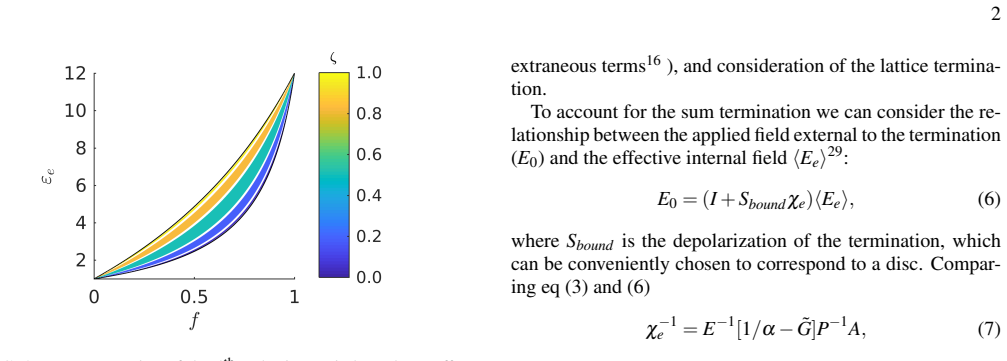
The load-bearing object is the sequence of recurrent geometric coefficients $q_m = P\tilde{G}^m E_n/A$, obtained from a Neumann series for the surface charge density; these coefficients determine the susceptibility series coefficients $a_m$, and the third-order parameter $\zeta = 4a_3/[f(1-f)] - (1-f)$ is extracted from $a_3$. The numerical engine is a boundary-element implementation of the interaction operator $\tilde{G}$, with self-singularity closure, lattice summation, a termination correction to remove finite-cell depolarization, and conformal mapping to produce smooth inclusion shapes.
What would settle it
Compute $\zeta$ for several hundred independently seeded periodic centroidal and random Voronoi cells at a fixed fill factor and compare ensemble means; if random cells do not lie above centroidal cells in mean $\zeta$, the ordering in Figs. 4-6 is a small-sample artifact. Separately, recomputing $\zeta$ for triangular inclusions near $f=1$ with an independent high-order solver would settle the claimed correction: the revised curve should approach $\zeta\approx0.2043$.
Extended reading notes
Core claim
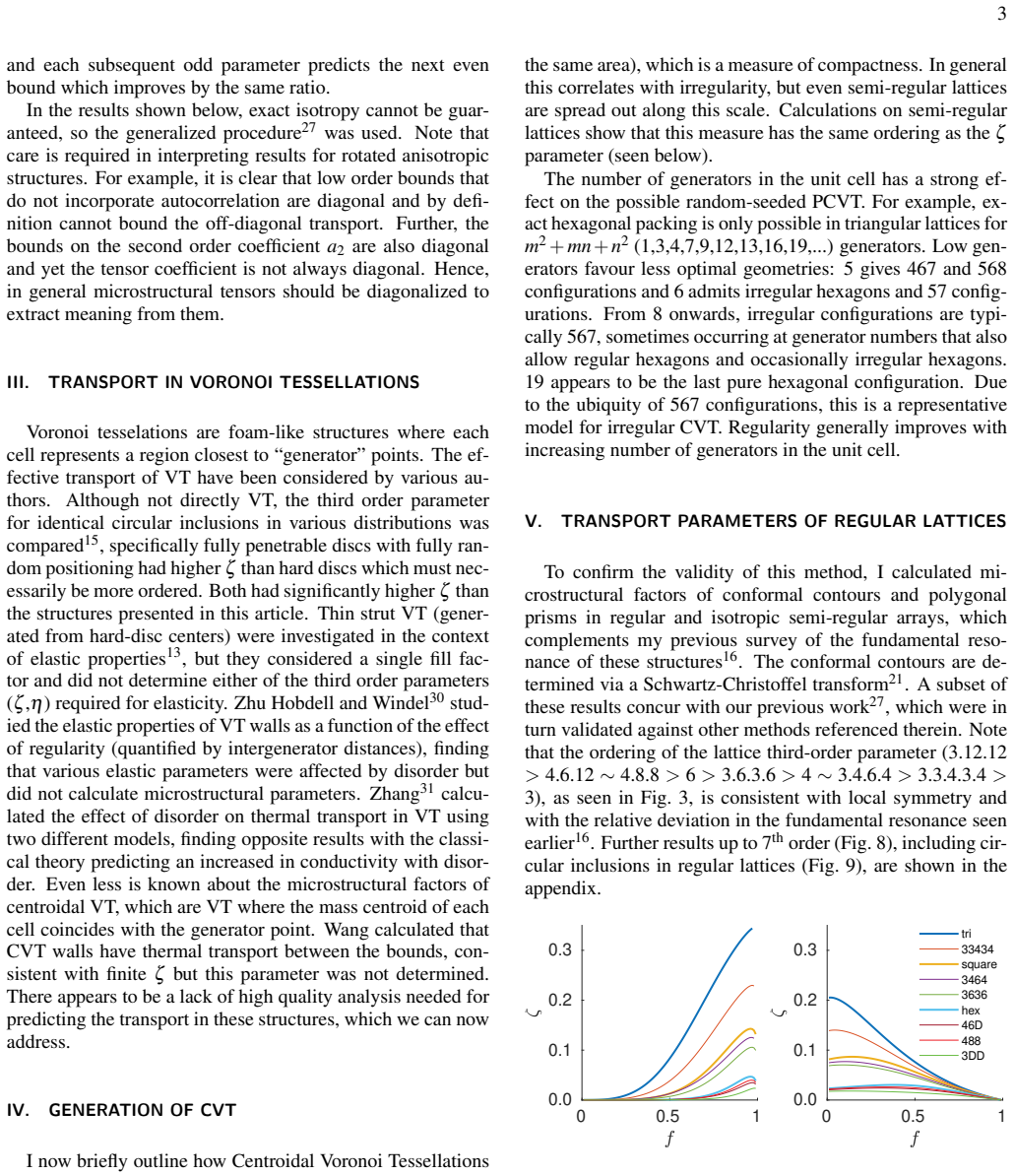
The central claim is that a recurrent boundary-element expansion can determine high-order microstructural parameters accurately enough to rank realistic random geometries, and that it reveals a systematic ordering: centroidal Voronoi tessellations have smaller $\zeta$ than random Voronoi tessellations, and are closer to the Hashin-Strikman bounds than comparable semi-regular lattices at the same compactness. The paper also claims that earlier third-order values for triangular inclusions are inaccurate, because they do not converge to the known vertex limit $\zeta|_{f=1}=0.2043$ at high fill factor.
Load-bearing premise
The results assume that the handful of periodic Voronoi cells used, as few as five to eight generators, represent the whole population of random and centroidal Voronoi tessellations at each fill factor.
Editorial extensions
If this is right
- For composites modeled as Voronoi foams, centroidal cells make the effective conductivity closer to its low-order bounds than random cells do, so transport predictions for CVT-based structures carry less uncertainty at fixed fill factor.
- Cell compactness can act as a rough geometric proxy for $\zeta$ in conformal inclusions, allowing candidate microstructures to be ranked without a full field solve.
- The claimed correction to triangular-lattice $\zeta$ values changes the benchmark data used to validate computations on sharp-cornered inclusions.
- Semi-regular lattices that mix hexagons with triangles or squares have higher $\zeta$ than Voronoi structures of comparable compactness, so Voronoi foam is the better candidate when near-optimal transport is wanted.
- Because even-order parameters are trivial and the first odd parameter is the fill factor, the third-order parameter is the first shape-sensitive quantity, which is why the paper's ordering of $\zeta$ is the headline result.
Reading between the lines
- The paper does not directly test applications, but if its $\zeta$ ordering survives larger ensembles, centroidal Voronoi microstructures become natural candidates for hyperuniform-like disordered media where reproducible near-optimal transport is desirable.
- An extension the paper leaves implicit is to push the recurrent coefficients into Padé approximants of the effective permittivity, which would address high-contrast or near-percolation cases where the bare series is unreliable.
- A concrete test of the triangular-lattice claim: recompute $\zeta$ for triangular inclusions at fill factors near 1 with an independent high-order solver; agreement with the revised curve would confirm the reported error, while agreement with the older values would refute it.
Signed reviews
Editorial analysis
A structured set of objections, weighed in public.
Referee Report
Summary. The paper develops a recurrent boundary element method for computing high-order microstructural parameters that appear in series expansions of the effective transport properties of two-dimensional composites. The method is applied to conformal and polygonal inclusions in regular and semi-regular lattices and to periodic centroidal and random Voronoi tessellations (VT). The main claims are that centroidal VT have a smaller third-order parameter ζ than random VT, that CVT lie closer to the Hashin-Strikman bounds than comparable semi-regular lattices at equal compactness, and that previously reported third-order values for triangular inclusion lattices are inaccurate.
Significance. If the claims hold, the paper would provide a useful computational tool for high-order microstructural parameters of piecewise smooth inclusion shapes and would supply one of the first systematic comparisons of VT microstructural parameters, with implications for predicting effective transport in disordered cellular materials. The agreement of the regular-lattice results with earlier calculations in the literature gives some confidence in the numerical method. However, the central VT comparison rests on statistical and ensemble assumptions that are not documented, and the triangular-lattice correction is asserted without quantitative evidence, so the significance is conditional on these points being addressed.
major comments (4)
- [IV and VI; Figs. 4–6] The central comparative claim that CVT have smaller ζ than random VT and are closer to the Hashin-Strikman bounds than comparable semi-regular lattices is not statistically supported as presented. Section IV reports generator counts of only 5–19 and never states how many independent periodic realizations were averaged for each fill factor. Figures 4–6 show means and standard-deviation bands, but with such small periodic cells the means and the ordering between CVT, random VT, and lattice structures may be dominated by finite-size or boundary artifacts. Please report the number of realizations per fill factor, the distribution across seeds, and a convergence study in the generator count N; without this the VT ordering in the paper is not established.
- [IV] The sentence '19 appears to be the last pure hexagonal configuration' is mathematically incorrect: N = 37 = 4^2 + 4·3 + 3^2 is an Eisenstein norm, so larger periodic all-hexagonal CVTs exist. If the ensemble was restricted on the basis of this belief, the reported CVT statistics may not be representative of the large-cell CVT ensemble. This is a load-bearing point for the CVT-vs-VT comparison in Section VI and should be corrected, preferably with a systematic check at larger generator counts.
- [V] The claim that previously reported third-order values for triangular inclusion lattices are inaccurate is not supported by the data shown. The text describes a commercial electrostatic FEM calculation with 'much better sampling' and careful inspection of the limiting behavior, but no tabulated values, comparison curves, or quantitative error estimates appear in the paper or appendix. Because this correction is stated as a finding in the abstract and conclusion, the FEM comparison data (or at least a quantitative table of ζ versus fill factor for the triangular case) should be provided.
- [II, Eq. (12)] Equation (12) is the central coefficient recurrence on which the method rests, yet its derivation is not shown: the text jumps from the Neumann series in Eqs. (10)–(11) to the closed-form binomial sum. Since the paper's methodological contribution is the recurrent boundary-element implementation, this step should be derived explicitly or the reader should be pointed to a complete derivation; otherwise the correctness of the recurrence, especially the m-dependence, cannot be verified from the manuscript.
minor comments (5)
- [I] The phrase 'This article discusses presents the recurrent formulation' contains a duplicated verb; 'presents' alone would be correct.
- [Fig. 5 caption] The caption says 'confocal inclusions' while the text throughout refers to 'conformal inclusions'; please correct the caption.
- [II, Eq. (14)] The notation ε_f, ε_1−ζ, and related expressions in Eq. (14) is used before being defined; one sentence defining these combinations would improve readability.
- [Throughout] The spelling 'tesselations' should be 'tessellations' in several places, including the title of Section III.
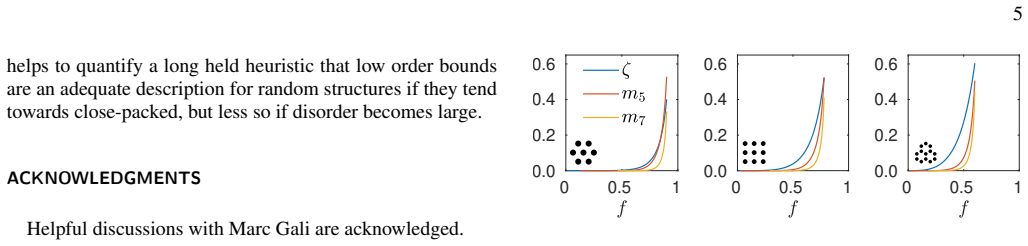
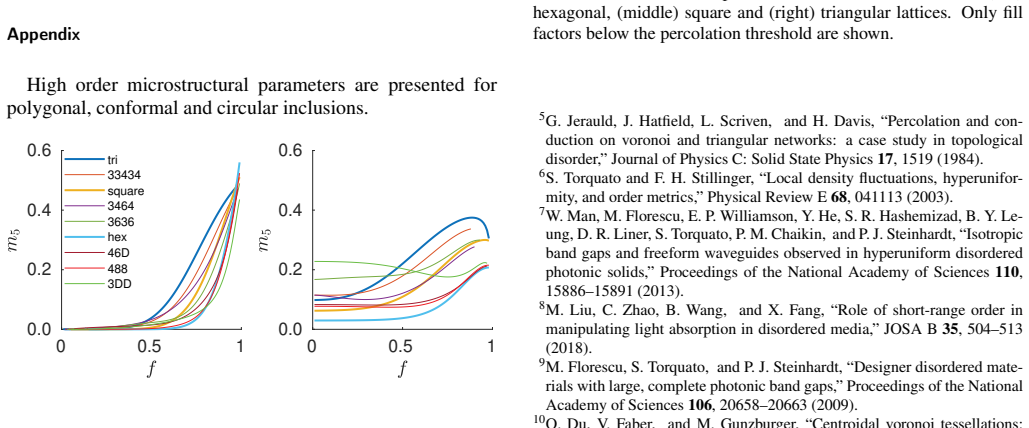
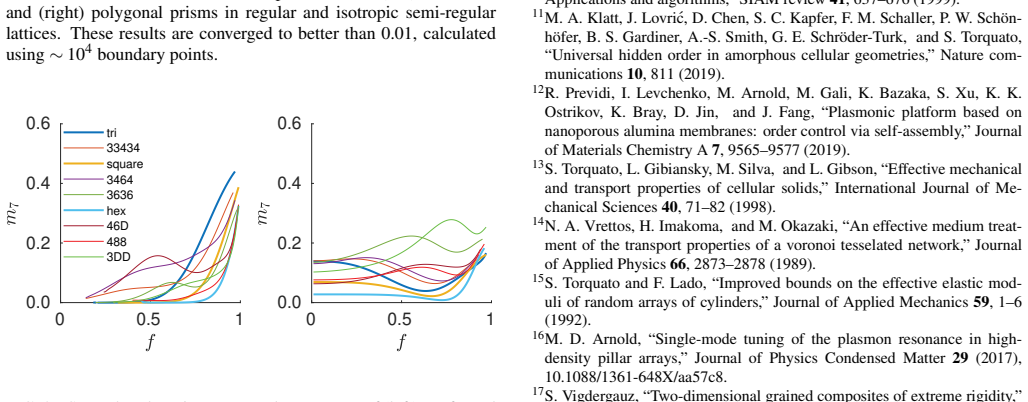
- [Appendix, Figs. 7–9] The text states that the fifth-order results in Fig. 7 are converged to better than 0.01, but no analogous convergence statement is given for the seventh-order results in Fig. 8 or the circular-inclusion results in Fig. 9; please clarify the accuracy of those figures.
Circularity Check
No significant circularity: the BEM-recurrent microstructural parameters are computed from boundary integrals for each geometry, not fitted to the conclusions.
full rationale
The paper's central chain (Section II) derives the recurrent boundary-element series for the geometric coefficients q_m (Eq. 11) and the series coefficients a_m (Eq. 12), then defines the third-order parameter zeta (Eq. 13) from a_3. These objects are obtained by direct quadrature on BEM surface discretizations for each lattice or Voronoi cell; no parameter is fitted to any target zeta value, ordering, or bound. The comparative statements in Sections V and VI compare these independently computed zeta values across geometries, so the ordering 'CVT < random VT' and 'VT closer to the bounds than semi-regular lattices' is an output, not an input. The author's self-citations to Refs. 16 and 27 supply a lattice-sum implementation and a generalized anisotropic version of the bound/extraction procedure, but they are prior methodological works whose assumptions do not include the Voronoi results; the paper also checks against an independent commercial electrostatic FEM when correcting Hyun and Torquato (Section V). Potential weaknesses such as the unspecified number of VT realizations or the claim that 19 is the last pure hexagonal configuration are statistical or correctness concerns, not circularity: they do not reduce any equation of the paper to itself. Under the standard that a non-finding is appropriate when the derivation is self-contained, the circularity score is 0.
Assumptions & free parameters
assumptions (5)
- domain assumption The power series for the effective permittivity (Eq. 1) is well-defined and the recurrent coefficients a_m are meaningful for the geometries and contrasts studied.
- domain assumption The Neumann series in Eq. (10) converges, or is at least useful as an asymptotic expansion, allowing the geometric coefficients q_m to be computed by iterating the boundary integral operator.
- domain assumption The periodic Voronoi tessellation supercells with small generator counts are statistically representative of infinite random and centroidal Voronoi tessellations.
- domain assumption The third-order parameter formula (Eq. 13) applies because the Voronoi tessellations are isotropic on average; individual finite cells may be anisotropic.
- standard math The boundary element interaction operator G in Eq. (5) is correctly regularized via closure and Weierstrass elliptic lattice summation, as cited from prior work.
Cite this review
Pith. "Pith review of Effective transport properties of conformal Voronoi-bounded columns via recurrent boundary element expansions." pith.science (2026). https://pith.science/paper/ZEMIQQOT
@misc{pith2026190807714,
  author       = {Pith},
  title        = {Pith review of: Effective transport properties of conformal Voronoi-bounded columns via recurrent boundary element expansions},
  year         = {2026},
  howpublished = {\url{https://pith.science/paper/ZEMIQQOT}},
  note         = {Machine review of arXiv:1908.07714}
}
read the original abstract
Effective transport properties of heterogeneous structures are predicted by geometric microstructural parameters, but these can be difficult to calculate. Here, a boundary element code with a recurrent series method accurately and efficiently determines the high order parameters of polygonal and conformal prisms in regular two-dimensional lattices and Voronoi tessellations (VT). This reveals that proximity to simpler estimates is associated with: centroidal VT (cf random VT), compactness, and VT structures (cf similarly compact semi-regular lattices). An error in previously reported values for triangular lattices is noted.
Figures

Figures from the paper (6 more)


Reference graph
Works this paper leans on
-
[1]
merlin.mbs aapmrev4-1.bst 2010-07-25 4.21a (PWD, AO, DPC) hacked
FUNCTION id.bst "merlin.mbs aapmrev4-1.bst 2010-07-25 4.21a (PWD, AO, DPC) hacked" ENTRY address archive archivePrefix author bookaddress booktitle chapter collaboration doi edition editor eid eprint howpublished institution isbn issn journal key language month note number organization pages primaryClass publisher school SLACcitation series title translat...
2010
-
[2]
merlin.mbs aipauth4-1.bst 2010-07-25 4.21a (PWD, AO, DPC) hacked
FUNCTION id.bst "merlin.mbs aipauth4-1.bst 2010-07-25 4.21a (PWD, AO, DPC) hacked" ENTRY address archive archivePrefix author bookaddress booktitle chapter collaboration doi edition editor eid eprint howpublished institution isbn issn journal key language month note number organization pages primaryClass publisher school SLACcitation series title translat...
2010
-
[3]
merlin.mbs aipnum4-1.bst 2010-07-25 4.21a (PWD, AO, DPC) hacked
FUNCTION id.bst "merlin.mbs aipnum4-1.bst 2010-07-25 4.21a (PWD, AO, DPC) hacked" ENTRY address archive archivePrefix author bookaddress booktitle chapter collaboration doi edition editor eid eprint howpublished institution isbn issn journal key language month note number organization pages primaryClass publisher school SLACcitation series title translati...
2010
-
[4]
merlin.mbs apsrev4-1.bst 2010-07-25 4.21a (PWD, AO, DPC) hacked
FUNCTION id.bst "merlin.mbs apsrev4-1.bst 2010-07-25 4.21a (PWD, AO, DPC) hacked" ENTRY address archive archivePrefix author bookaddress booktitle chapter collaboration doi edition editor eid eprint howpublished institution isbn issn journal key language month note number organization pages primaryClass publisher school SLACcitation series title translati...
2010
-
[5]
merlin.mbs apsrmp4-1.bst 2010-07-25 4.21a (PWD, AO, DPC) hacked
FUNCTION id.bst "merlin.mbs apsrmp4-1.bst 2010-07-25 4.21a (PWD, AO, DPC) hacked" ENTRY address archive archivePrefix author bookaddress booktitle chapter collaboration doi edition editor eid eprint howpublished institution isbn issn journal key language month note number organization pages primaryClass publisher school SLACcitation series title translati...
2010
-
[6]
author author S. Torquato ,\ @noop title Random Heterogeneous Materials: Microstructure and Macroscopic Properties \ ( publisher Springer-Verlag ,\ address New York ,\ year 2002 ) NoStop
work page 2002
-
[7]
author author G. W. \ Milton ,\ @noop title The Theory of Composites \ ( publisher Cambridge University Press ,\ year 2002 ) NoStop
work page 2002
-
[8]
author author A. P. \ Roberts \ and\ author M. Teubner ,\ title title Transport properties of heterogeneous materials derived from Gaussian random fields: Bonds and simulation , \ @noop journal journal Physical Review E \ volume 51 ,\ pages 4141--4154 ( year 1995 ) NoStop
work page 1995
Show all 40 references
-
[9]
Winterfeld , author L
author author P. Winterfeld , author L. Scriven , \ and\ author H. Davis ,\ title title Percolation and conductivity of random two-dimensional composites , \ @noop journal journal Journal of Physics C: Solid State Physics \ volume 14 ,\ pages 2361 ( year 1981 ) NoStop
1981
-
[10]
Jerauld , author J
author author G. Jerauld , author J. Hatfield , author L. Scriven , \ and\ author H. Davis ,\ title title Percolation and conduction on voronoi and triangular networks: a case study in topological disorder , \ @noop journal journal Journal of Physics C: Solid State Physics \ v...
1984
-
[11]
Torquato \ and\ author F
author author S. Torquato \ and\ author F. H. \ Stillinger ,\ title title Local density fluctuations, hyperuniformity, and order metrics , \ @noop journal journal Physical Review E \ volume 68 ,\ pages 041113 ( year 2003 ) NoStop
2003
-
[12]
Man , author M
author author W. Man , author M. Florescu , author E. P. \ Williamson , author Y. He , author S. R. \ Hashemizad , author B. Y. \ Leung , author D. R. \ Liner , author S. Torquato , author P. M. \ Chaikin , \ and\ author P. J. \ Steinhardt ,\ title title Isotropic band gaps an...
2013
-
[13]
Liu , author C
author author M. Liu , author C. Zhao , author B. Wang , \ and\ author X. Fang ,\ title title Role of short-range order in manipulating light absorption in disordered media , \ @noop journal journal JOSA B \ volume 35 ,\ pages 504--513 ( year 2018 ) NoStop
2018
-
[14]
Florescu , author S
author author M. Florescu , author S. Torquato , \ and\ author P. J. \ Steinhardt ,\ title title Designer disordered materials with large, complete photonic band gaps , \ @noop journal journal Proceedings of the National Academy of Sciences \ volume 106 ,\ pages 20658--20663 (...
2009
-
[15]
Du , author V
author author Q. Du , author V. Faber , \ and\ author M. Gunzburger ,\ title title Centroidal voronoi tessellations: Applications and algorithms , \ @noop journal journal SIAM review \ volume 41 ,\ pages 637--676 ( year 1999 ) NoStop
1999
-
[16]
o nh \"o fer , author B. S. \ Gardiner , author A.-S. \ Smith , author G. E. \ Schr \
author author M. A. \ Klatt , author J. Lovri \'c , author D. Chen , author S. C. \ Kapfer , author F. M. \ Schaller , author P. W. \ Sch \"o nh \"o fer , author B. S. \ Gardiner , author A.-S. \ Smith , author G. E. \ Schr \"o der-Turk , \ and\ author S. Torquato ,\ title tit...
2019
-
[17]
Previdi , author I
author author R. Previdi , author I. Levchenko , author M. Arnold , author M. Gali , author K. Bazaka , author S. Xu , author K. K. \ Ostrikov , author K. Bray , author D. Jin , \ and\ author J. Fang ,\ title title Plasmonic platform based on nanoporous alumina membranes: orde...
2019
-
[18]
Torquato , author L
author author S. Torquato , author L. Gibiansky , author M. Silva , \ and\ author L. Gibson ,\ title title Effective mechanical and transport properties of cellular solids , \ @noop journal journal International Journal of Mechanical Sciences \ volume 40 ,\ pages 71--82 ( year...
1998
-
[19]
author author N. A. \ Vrettos , author H. Imakoma , \ and\ author M. Okazaki ,\ title title An effective medium treatment of the transport properties of a voronoi tesselated network , \ @noop journal journal Journal of Applied Physics \ volume 66 ,\ pages 2873--2878 ( year 198...
1989
-
[20]
Torquato \ and\ author F
author author S. Torquato \ and\ author F. Lado ,\ title title Improved bounds on the effective elastic moduli of random arrays of cylinders , \ @noop journal journal Journal of Applied Mechanics \ volume 59 ,\ pages 1--6 ( year 1992 ) NoStop
1992
-
[21]
author author M. D. \ Arnold ,\ title title Single-mode tuning of the plasmon resonance in high-density pillar arrays , \ 10.1088/1361-648X/aa57c8 journal journal Journal of Physics Condensed Matter \ volume 29 ( year 2017 ),\ 10.1088/1361-648X/aa57c8 NoStop
2017 doi
-
[22]
author author S. Vigdergauz ,\ title title Two-dimensional grained composites of extreme rigidity , \ @noop journal journal Journal of applied mechanics \ volume 61 ,\ pages 390--394 ( year 1994 ) NoStop
1994
-
[23]
author author S. Vigdergauz ,\ title title Rhombic lattice of equi-stress inclusions in an elastic plate , \ @noop journal journal Quarterly journal of mechanics and applied mathematics \ volume 49 ,\ pages 565--580 ( year 1996 ) NoStop
1996
-
[24]
author author S. Vigdergauz ,\ title title Energy-minimizing inclusions in a planar elastic structure with macroisotropy , \ @noop journal journal Structural optimization \ volume 17 ,\ pages 104--112 ( year 1999 ) NoStop
1999
-
[25]
Hyun \ and\ author S
author author S. Hyun \ and\ author S. Torquato ,\ title title Optimal and manufacturable two-dimensional, kagome-like cellular solids , \ @noop journal journal Journal of Materials Research \ volume 17 ,\ pages 137--144 ( year 2002 ) NoStop
2002
-
[26]
author author T. A. \ Driscoll ,\ title title Algorithm 756: A matlab toolbox for schwarz-christoffel mapping , \ @noop journal journal ACM Transactions on Mathematical Software (TOMS) \ volume 22 ,\ pages 168--186 ( year 1996 ) NoStop
1996
-
[27]
author author D. J. \ Bergman ,\ title title Dielectric constant of a two-component granular composite: A practical scheme for calculating the pole spectrum , \ 10.1103/PhysRevB.19.2359 journal journal Physical Review B \ volume 19 ,\ pages 2359--2368 ( year 1979 ) NoStop
-
[28]
Djordjevi \'c , author J
author author B. Djordjevi \'c , author J. Hetherington , \ and\ author M. Thorpe ,\ title title Spectral function for a conducting sheet containing circular inclusions , \ @noop journal journal Physical Review B \ volume 53 ,\ pages 14862 ( year 1996 ) NoStop
1996
-
[29]
author author W. F. \ Brown ,\ title title Solid Mixture Permittivities , \ 10.1063/1.1742339 journal journal The Journal of Chemical Physics \ volume 23 ,\ pages 1514--1517 ( year 1955 ) NoStop
1955 doi
-
[30]
author author A. K. \ Sen \ and\ author S. Torquato ,\ title title Effective Conductivity of Anisotropic 2-Phase Composite Media , \ @noop journal journal Physical Review B \ volume 39 ,\ pages 4504--4515 ( year 1989 ) NoStop
1989
-
[31]
author author C. Engstr \" o m ,\ title title Bounds on the effective tensor and the structural parameters for anisotropic two-phase composite material , \ 10.1088/0022-3727/38/19/019 journal journal Journal of Physics D: Applied Physics \ volume 38 ,\ pages 3695--3702 ( year ...
-
[32]
author author M. A. \ Gal\' \ and\ author M. D. \ Arnold ,\ title title Recurrent approach to effective material properties with application to anisotropic binarized random fields , \ 10.1103/PhysRevB.99.054210 journal journal Phys. Rev. B \ volume 99 ,\ pages 054210 ( year 20...
-
[33]
author author I. D. \ Mayergoyz , author D. R. \ Fredkin , \ and\ author Z. Zhang ,\ title title Electrostatic (plasmon) resonances in nanoparticles , \ @noop journal journal Physical Review B \ volume 72 ,\ pages 155412 ( year 2005 ) NoStop
2005
-
[34]
author author R. C. \ Jones ,\ title title A generalization of the dielectric ellipsoid problem , \ @noop journal journal Physical Review \ volume 68 ,\ pages 93 ( year 1945 ) NoStop
1945
-
[35]
Zhu , author J
author author H. Zhu , author J. Hobdell , \ and\ author A. Windle ,\ title title Effects of cell irregularity on the elastic properties of 2d voronoi honeycombs , \ @noop journal journal Journal of the Mechanics and Physics of Solids \ volume 49 ,\ pages 857--870 ( year 2001 ) NoStop
2001
-
[36]
author author J. Zhang ,\ title title Effects of cell irregularity on the thermal conductivity of carbon honeycombs , \ @noop journal journal Carbon \ volume 131 ,\ pages 127--136 ( year 2018 ) NoStop
2018
-
[37]
Zhang , author M
author author J. Zhang , author M. Emelianenko , \ and\ author Q. Du ,\ title title Periodic centroidal voronoi tessellations. \ @noop journal journal International Journal of Numerical Analysis & Modeling \ volume 9 ( year 2012 ) NoStop
2012
-
[38]
Hyun \ and\ author S
author author S. Hyun \ and\ author S. Torquato ,\ title title Effective elastic and transport properties of regular honeycombs for all densities , \ 10.1557/JMR.2000.0285 journal journal Journal of Materials Research \ volume 15 ,\ pages 1985--1993 ( year 2000 ) NoStop
-
[39]
author author J. H. \ Hetherington \ and\ author M. F. \ Thorpe ,\ title title The Conductivity of a Sheet Containing Inclusions with Sharp Corners , \ @noop journal journal Proceedings: Mathematical and Physical Scences \ volume 438 ,\ pages 591--604 ( year 1992 ) NoStop
1992
-
[40]
Eischen \ and\ author S
author author J. Eischen \ and\ author S. Torquato ,\ title title Determining elastic behavior of composites by the boundary element method , \ @noop journal journal Journal of applied physics \ volume 74 ,\ pages 159--170 ( year 1993 ) NoStop
1993
Reviewed August 14, 2026 · model on record in the stance chip above.
Discussion (0). Continue with ORCID to comment.