The Simplicity Paradox: Why Evolution Does Not Produce Universally Complex Agents
Pith reviewed 2026-06-26 19:22 UTC · model grok-4.3
The pith
Evolution favors populations with mostly simple agents and a few specialized complex decision-makers rather than universally complex ones.
A machine-rendered reading of the paper's core claim, the machinery that carries it, and where it could break.
Core claim
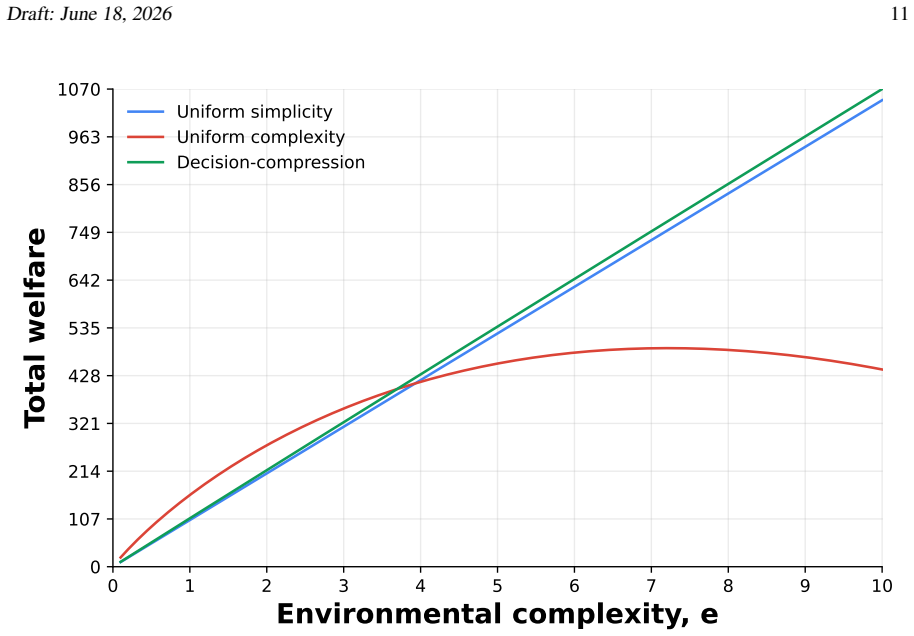
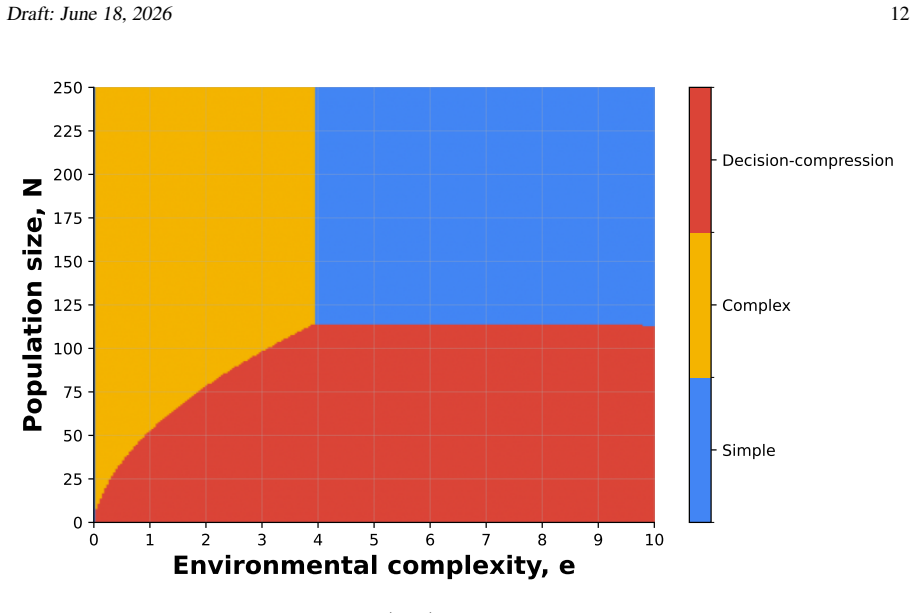
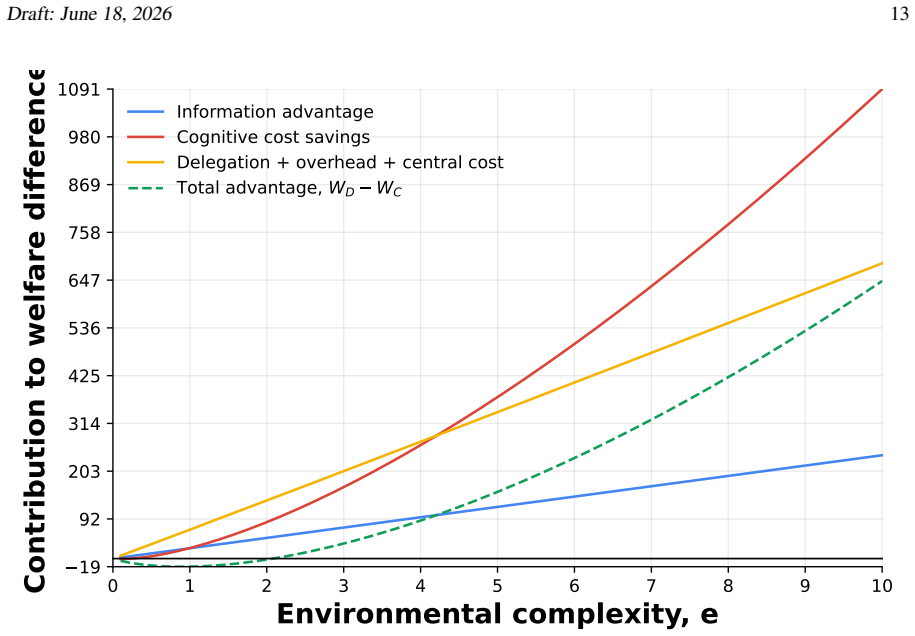
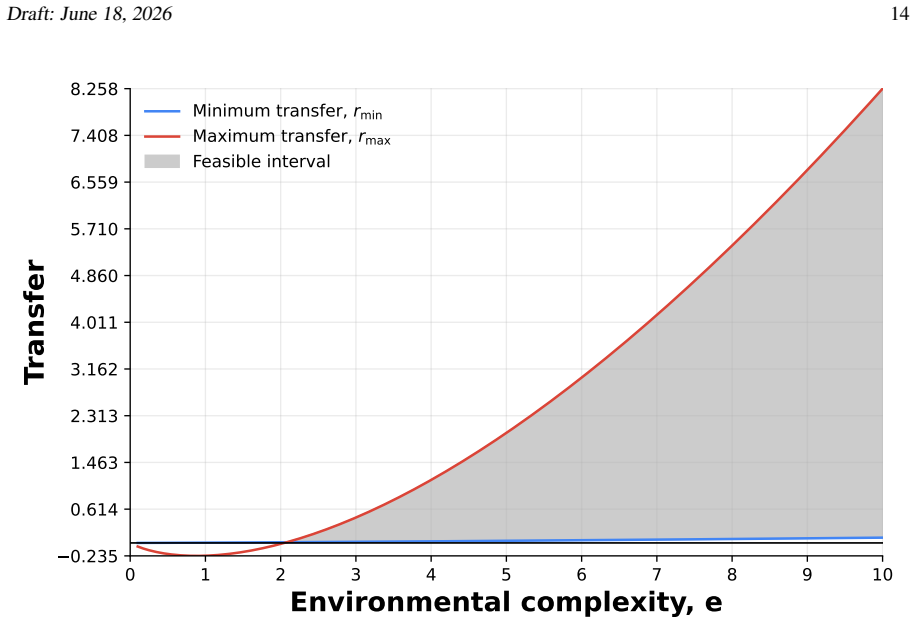
The central claim is that selection in complex environments can favor cognitive division of labour over uniform complexity. Societies composed of mostly simple agents plus a specialized decision-making centre dominate societies of uniformly complex agents when the costs saved by distributed simplicity exceed the utility lost through reduced autonomy and imperfect delegation. The specialised centre need not confront a volunteer's dilemma because its private payoff can exceed the payoff available under universal complexity via rents, status, control, or superior information.
What carries the argument
The cost-utility trade-off formalized by comparing uniform-complexity societies against heterogeneous societies that contain simple agents and one specialised decision-making centre.
If this is right
- Heterogeneous populations can achieve lower total decision costs than uniform ones while preserving most knowledge value.
- Bounded rationality and delegation become stable outcomes of selection rather than evolutionary failures.
- Hierarchy and markets emerge as mechanisms that separate simple and complex roles.
- Cultural evolution can sustain simplicity as a precondition for scalable social organization.
- Specialized agents persist because their private gains do not require universal adoption of complexity.
Where Pith is reading between the lines
- The same logic could be tested in artificial multi-agent systems where most agents use heuristics and a few handle planning.
- It predicts that the share of specialists should rise with environmental complexity but remain a minority.
- The model implies that attempts to force universal complexity, such as mandatory detailed education for all, may reduce overall welfare.
Load-bearing premise
The specialised decision-maker can obtain private payoffs higher than those available under universal complexity through rents, status, control or superior information.
What would settle it
Empirical observation that populations converge toward uniformly complex agents, without any persistent minority of specialists, as environmental complexity increases.
Figures
read the original abstract
It has been well established that information improves decisions, pushing the population forward as more information becomes available. Nevertheless, a wide range of empirical evidence shows that humans avoid complexity, delegate judgement, and prefer simplified social worlds. This tension raises an evolutionary puzzle: if knowledge is economically valuable and therefore evolutionarily beneficial, why do populations not converge towards universally informed and complex agents? In this study, we propose a theory of cognitive economy in which information has positive utility but costly acquisition, processing, and coordination. In complex environments, selection can favour heterogeneous populations: most individuals use low-cost heuristics and simplified choice architectures, whereas a minority of agents or institutions specialize in information processing. This cognitive division of labour reduces decision costs while preserving much of the value created by knowledge. We formalize this trade-off by comparing societies of uniformly complex agents with societies containing simpler agents and a specialized decision-making centre. The latter can dominate when the costs saved by distributed simplicity exceed the utility lost through reduced individual autonomy and imperfect delegation. Crucially, the specialized decision-maker need not face a volunteer's dilemma, because its private payoff can exceed that available under universal complexity through rents, status, control or superior information. The framework links bounded rationality, rational inattention, hierarchy, markets, and cultural evolution, and suggests that simplicity is not a failure of adaptation but a precondition for scalable social organization.
Editorial analysis
A structured set of objections, weighed in public.
Referee Report
Summary. The manuscript proposes a theory of cognitive economy to explain why evolution does not produce universally complex agents despite information's value. It argues that selection in complex environments favors heterogeneous populations: most agents rely on low-cost heuristics and simplified architectures, while a minority or institutions specialize in information processing. This division of labor is formalized via a static comparison of uniformly complex societies against those with simpler agents plus a specialized decision-making center; the latter dominates when cost savings exceed lost utility from reduced autonomy and imperfect delegation. The specialist avoids the volunteer's dilemma because its private payoff can exceed universal-complexity payoffs via rents, status, control, or superior information. The framework connects bounded rationality, rational inattention, hierarchy, markets, and cultural evolution.
Significance. If the formal trade-off comparison can be shown to support evolutionary stability, the result would offer a coherent account of why simplicity persists and scales in social systems. It reframes observed human preferences for delegation and heuristics as adaptive rather than deficient, with potential to integrate disparate literatures on information costs and institutional design.
major comments (1)
- [Abstract] Abstract (formalization paragraph): the central claim that heterogeneous populations are evolutionarily favored rests on the assertion that 'the specialized decision-maker need not face a volunteer's dilemma, because its private payoff can exceed that available under universal complexity through rents, status, control or superior information.' This is stated without derivation from the described static society comparison of decision costs versus lost autonomy/utility. Without an explicit model of individual-level incentives, replicator dynamics, or a selection mechanism into the specialist role, the comparison alone does not establish that heterogeneity is stable or that any agent bears the specialization cost rather than free-riding.
Simulated Author's Rebuttal
We thank the referee for this precise observation on the scope of our formal argument. We address the comment below.
read point-by-point responses
-
Referee: [Abstract] Abstract (formalization paragraph): the central claim that heterogeneous populations are evolutionarily favored rests on the assertion that 'the specialized decision-maker need not face a volunteer's dilemma, because its private payoff can exceed that available under universal complexity through rents, status, control or superior information.' This is stated without derivation from the described static society comparison of decision costs versus lost autonomy/utility. Without an explicit model of individual-level incentives, replicator dynamics, or a selection mechanism into the specialist role, the comparison alone does not establish that heterogeneity is stable or that any agent bears the specialization cost rather than free-riding.
Authors: We agree that the manuscript's core formalization is a static welfare comparison between uniform-complexity and heterogeneous societies, and that this comparison alone does not derive individual incentives or demonstrate evolutionary stability via replicator dynamics. The statement on the specialist's private payoff is presented as a conceptual resolution to the volunteer's dilemma rather than a result formally extracted from the cost-utility equations. In revision we will (i) rephrase the abstract and introduction to state explicitly that the analysis identifies conditions under which heterogeneity yields lower aggregate decision costs for given utility loss, without claiming evolutionary stability, and (ii) add a limitations paragraph noting the absence of an explicit selection mechanism and identifying full dynamic modeling as future work. revision: yes
Circularity Check
No circularity; derivation remains self-contained without reduction to inputs.
full rationale
The provided abstract outlines a proposed theory comparing uniform-complexity societies to heterogeneous ones with a specialized center, asserting that private payoffs (rents, status, etc.) allow the specialist to avoid the volunteer's dilemma. No equations, formal derivations, or self-citations are quoted that would reduce any prediction or uniqueness claim to a fitted input or prior self-result by construction. The framework is presented as linking existing concepts (bounded rationality, hierarchy) via a static cost-utility trade-off, with no evidence of self-definitional loops or renamed empirical patterns. This meets the default expectation of no significant circularity.
Axiom & Free-Parameter Ledger
Reference graph
Works this paper leans on
-
[1]
Equivalent comparisons of experiments.The Annals of Mathematical Statistics, 24(2):265–272, 1953
David Blackwell. Equivalent comparisons of experiments.The Annals of Mathematical Statistics, 24(2):265–272, 1953
1953
-
[2]
Information and economic analysis: a perspective.The Economic Journal, 95(Supplement):21–41, 1985
Joseph E Stiglitz. Information and economic analysis: a perspective.The Economic Journal, 95(Supplement):21–41, 1985
1985
-
[3]
University of Illinois Press, 2024
Dan Schiller.How to think about information. University of Illinois Press, 2024
2024
-
[4]
bayesian
John C. Harsanyi. Games with incomplete information played by “bayesian” players, i: The basic model. Management Science, 14(3):159–182, 1967
1967
-
[5]
Eugene F. Fama. Efficient capital markets: A review of theory and empirical work.The Journal of Finance, 25(2):383–417, 1970
1970
-
[6]
Sasha R. X. Dall, Luc-Alain Giraldeau, Ola Olsson, John M. McNamara, and David W. Stephens. Infor- mation and its use by animals in evolutionary ecology.Trends in Ecology & Evolution, 20(4):187–193, 2005
2005
-
[7]
Economic aspects of the detection of new strains in a multi-strain epidemiological–mathematical model.Chaos, Solitons & Fractals, 165:112823, 2022
Labib Shami and Teddy Lazebnik. Economic aspects of the detection of new strains in a multi-strain epidemiological–mathematical model.Chaos, Solitons & Fractals, 165:112823, 2022
2022
-
[8]
George J. Stigler. The economics of information.Journal of Political Economy, 69(3):213–225, 1961
1961
-
[9]
Christopher A. Sims. Implications of rational inattention.Journal of Monetary Economics, 50(3):665–690, 2003
2003
-
[10]
Grossman and Joseph E
Sanford J. Grossman and Joseph E. Stiglitz. On the impossibility of informationally efficient markets.The American Economic Review, 70(3):393–408, 1980
1980
-
[11]
Would rational voters acquire costly information?Journal of Economic Theory, 129(1):225–251, 2006
C ´esar Martinelli. Would rational voters acquire costly information?Journal of Economic Theory, 129(1):225–251, 2006
2006
-
[12]
What is bounded rationality? InRoutledge handbook of bounded rationality, pages 55–69
Gerd Gigerenzer. What is bounded rationality? InRoutledge handbook of bounded rationality, pages 55–69. Routledge, 2020
2020
-
[13]
Human decision making with bounded rationality
Baocheng Geng, Qunwei Li, and Pramod K Varshney. Human decision making with bounded rationality. In ICASSP 2022-2022 IEEE International Conference on Acoustics, Speech and Signal Processing (ICASSP), pages 5493–5497. IEEE, 2022
2022
-
[14]
Herbert A. Simon. A behavioral model of rational choice.The Quarterly Journal of Economics, 69(1):99– 118, 1955
1955
-
[15]
George A. Miller. The magical number seven, plus or minus two: Some limits on our capacity for processing information.Psychological Review, 63(2):81–97, 1956
1956
-
[16]
Benchmarks for models of short-term and working memory.Psychological bulletin, 144(9):885, 2018
Klaus Oberauer, Stephan Lewandowsky, Edward Awh, Gordon DA Brown, Andrew Conway, Nelson Cowan, Christopher Donkin, Simon Farrell, Graham J Hitch, Mark J Hurlstone, et al. Benchmarks for models of short-term and working memory.Psychological bulletin, 144(9):885, 2018
2018
-
[17]
Judgment under uncertainty: Heuristics and biases.Science, 185(4157):1124–1131, 1974
Amos Tversky and Daniel Kahneman. Judgment under uncertainty: Heuristics and biases.Science, 185(4157):1124–1131, 1974. Draft: June 18, 2026 18
1974
-
[18]
Shah and Daniel M
Anuj K. Shah and Daniel M. Oppenheimer. Heuristics made easy: An effort-reduction framework.Psycho- logical Bulletin, 134(2):207–222, 2008
2008
-
[19]
McGuire, Zev B
Wouter Kool, Joseph T. McGuire, Zev B. Rosen, and Matthew M. Botvinick. Decision making and the avoidance of cognitive demand.Journal of Experimental Psychology: General, 139(4):665–682, 2010
2010
-
[20]
Iyengar and Mark R
Sheena S. Iyengar and Mark R. Lepper. When choice is demotivating: Can one desire too much of a good thing?Journal of Personality and Social Psychology, 79(6):995–1006, 2000
2000
-
[21]
Galbraith
Jay R. Galbraith. Organization design: An information processing view.Interfaces, 4(3):28–36, 1974
1974
-
[22]
The firm as a communication network.The Quarterly Journal of Economics, 109(4):809–839, 1994
Patrick Bolton and Mathias Dewatripont. The firm as a communication network.The Quarterly Journal of Economics, 109(4):809–839, 1994
1994
-
[23]
Hierarchies and the organization of knowledge in production.Journal of Political Economy, 108(5):874–904, 2000
Luis Garicano. Hierarchies and the organization of knowledge in production.Journal of Political Economy, 108(5):874–904, 2000
2000
-
[24]
Formal and real authority in organizations.Journal of Political Economy, 105(1):1–29, 1997
Philippe Aghion and Jean Tirole. Formal and real authority in organizations.Journal of Political Economy, 105(1):1–29, 1997
1997
-
[25]
North.Institutions, Institutional Change and Economic Performance
Douglass C. North.Institutions, Institutional Change and Economic Performance. Cambridge University Press, Cambridge, 1990
1990
-
[26]
Friedrich A. Hayek. The use of knowledge in society.The American Economic Review, 35(4):519–530, 1945
1945
-
[27]
C ´edric Perret, Emma Hart, and Simon T. Powers. From disorganized equality to efficient hierarchy: How group size drives the evolution of hierarchy in human societies.Proceedings of the Royal Society B: Bio- logical Sciences, 287(1928):20200693, 2020
1928
-
[28]
Becker and Kevin M
Gary S. Becker and Kevin M. Murphy. The division of labor, coordination costs, and knowledge.The Quarterly Journal of Economics, 107(4):1137–1160, 1992
1992
-
[29]
V olunteer’s dilemma.Journal of Conflict Resolution, 29(4):605–610, 1985
Andreas Diekmann. V olunteer’s dilemma.Journal of Conflict Resolution, 29(4):605–610, 1985
1985
-
[30]
Aiello and Peter Wheeler
Leslie C. Aiello and Peter Wheeler. The expensive-tissue hypothesis: The brain and the digestive system in human and primate evolution.Current Anthropology, 36(2):199–221, 1995
1995
-
[31]
Laughlin, Rob R
Simon B. Laughlin, Rob R. de Ruyter van Steveninck, and John C. Anderson. The metabolic cost of neural information.Nature Neuroscience, 1:36–41, 1998
1998
-
[32]
Costs of memory: Ideas and predictions.Journal of Theoretical Biology, 197(1):41–50, 1999
Reuven Dukas. Costs of memory: Ideas and predictions.Journal of Theoretical Biology, 197(1):41–50, 1999
1999
-
[33]
Goldstein
Gerd Gigerenzer and Daniel G. Goldstein. Reasoning the fast and frugal way: Models of bounded rational- ity.Psychological Review, 103(4):650–669, 1996
1996
-
[34]
Does algorithmic trading reduce information acquisition?The Review of Financial Studies, 31(6):2184–2226, 2018
Brian M Weller. Does algorithmic trading reduce information acquisition?The Review of Financial Studies, 31(6):2184–2226, 2018
2018
-
[35]
James G. March. Bounded rationality, ambiguity, and the engineering of choice.The Bell Journal of Economics, 9(2):587–608, 1978
1978
-
[36]
Why bounded rationality?Journal of Economic Literature, 34(2):669–700, 1996
John Conlisk. Why bounded rationality?Journal of Economic Literature, 34(2):669–700, 1996
1996
-
[37]
Rationality for economists?Journal of Risk and Uncertainty, 19:73–105, 1999
Daniel McFadden. Rationality for economists?Journal of Risk and Uncertainty, 19:73–105, 1999
1999
-
[38]
Psychology and economics: Evidence from the field.Journal of Economic Literature, 47(2):315–372, 2009
Stefano DellaVigna. Psychology and economics: Evidence from the field.Journal of Economic Literature, 47(2):315–372, 2009. Draft: June 18, 2026 19
2009
-
[39]
Cyert and James G
Richard M. Cyert and James G. March.A Behavioral Theory of the Firm. Prentice-Hall, Englewood Cliffs, NJ, 1963
1963
-
[40]
Simon.Human Problem Solving
Allen Newell and Herbert A. Simon.Human Problem Solving. Prentice-Hall, Englewood Cliffs, NJ, 1972
1972
-
[41]
Payne, James R
John W. Payne, James R. Bettman, and Eric J. Johnson.The Adaptive Decision Maker. Cambridge Univer- sity Press, Cambridge, 1993
1993
-
[42]
MIT Press, Cambridge, MA, 2001
Gerd Gigerenzer and Reinhard Selten, editors.Bounded Rationality: The Adaptive Toolbox. MIT Press, Cambridge, MA, 2001
2001
-
[43]
Camerer, Teck-Hua Ho, and Juin-Kuan Chong
Colin F. Camerer, Teck-Hua Ho, and Juin-Kuan Chong. A cognitive hierarchy model of games.The Quarterly Journal of Economics, 119(3):861–898, 2004
2004
-
[44]
A sparsity-based model of bounded rationality.The Quarterly Journal of Economics, 129(4):1661–1710, 2014
Xavier Gabaix. A sparsity-based model of bounded rationality.The Quarterly Journal of Economics, 129(4):1661–1710, 2014
2014
-
[45]
Rational inattention to discrete choices: A new foundation for the multinomial logit model.American Economic Review, 105(1):272–298, 2015
Filip Mat ˇejka and Alisdair McKay. Rational inattention to discrete choices: A new foundation for the multinomial logit model.American Economic Review, 105(1):272–298, 2015
2015
-
[46]
Revealed preference, rational inattention, and costly information acquisi- tion.American Economic Review, 105(7):2183–2203, 2015
Andrew Caplin and Mark Dean. Revealed preference, rational inattention, and costly information acquisi- tion.American Economic Review, 105(7):2183–2203, 2015
2015
-
[47]
Rational inattention, optimal consideration sets, and stochas- tic choice.The Review of Economic Studies, 86(3):1061–1094, 2019
Andrew Caplin, Mark Dean, and John Leahy. Rational inattention, optimal consideration sets, and stochas- tic choice.The Review of Economic Studies, 86(3):1061–1094, 2019
2019
-
[48]
Behavioral inattention
Xavier Gabaix. Behavioral inattention. In B. Douglas Bernheim, Stefano DellaVigna, and David Laibson, editors,Handbook of Behavioral Economics: Applications and Foundations 1, volume 2, pages 261–343. Elsevier, 2019
2019
-
[49]
Prospect theory as efficient perceptual distortion.American Economic Review, 102(3):41–46, 2012
Michael Woodford. Prospect theory as efficient perceptual distortion.American Economic Review, 102(3):41–46, 2012
2012
-
[50]
Salience and taxation: Theory and evidence.American Eco- nomic Review, 99(4):1145–1177, 2009
Raj Chetty, Adam Looney, and Kory Kroft. Salience and taxation: Theory and evidence.American Eco- nomic Review, 99(4):1145–1177, 2009
2009
-
[51]
Pope, and Justin R
Nicola Lacetera, Devin G. Pope, and Justin R. Sydnor. Heuristic thinking and limited attention in the car market.American Economic Review, 102(5):2206–2236, 2012
2012
-
[52]
Cognitive reflection and decision making.Journal of Economic Perspectives, 19(4):25– 42, 2005
Shane Frederick. Cognitive reflection and decision making.Journal of Economic Perspectives, 19(4):25– 42, 2005
2005
-
[53]
Prentice-Hall, Englewood Cliffs, NJ, 1973
Daniel Kahneman.Attention and Effort. Prentice-Hall, Englewood Cliffs, NJ, 1973
1973
-
[54]
Andrew Westbrook and Todd S. Braver. Cognitive effort: A neuroeconomic approach.Cognitive, Affective, & Behavioral Neuroscience, 15(2):395–415, 2015
2015
-
[55]
Botvinick, and Jonathan D
Amitai Shenhav, Matthew M. Botvinick, and Jonathan D. Cohen. The expected value of control: An integrative theory of anterior cingulate cortex function.Neuron, 79(2):217–240, 2013
2013
-
[56]
Botvinick and Todd S
Matthew M. Botvinick and Todd S. Braver. Motivation and cognitive control: From behavior to neural mechanism.Annual Review of Psychology, 66:83–113, 2015
2015
-
[57]
Kable, and Justus Myers
Robert Kurzban, Angela Duckworth, Joseph W. Kable, and Justus Myers. An opportunity cost model of subjective effort and task performance.Behavioral and Brain Sciences, 36(6):661–679, 2013
2013
-
[58]
Griffiths, Falk Lieder, and Noah D
Thomas L. Griffiths, Falk Lieder, and Noah D. Goodman. Rational use of cognitive resources: Levels of analysis between the computational and the algorithmic.Topics in Cognitive Science, 7(2):217–229, 2015. Draft: June 18, 2026 20
2015
-
[59]
Griffiths
Falk Lieder and Thomas L. Griffiths. Resource-rational analysis: Understanding human cognition as the optimal use of limited computational resources.Behavioral and Brain Sciences, 43:e1, 2020
2020
-
[60]
Pedro A. Ortega, Daniel A. Braun, Justin Dyer, Kee-Eung Kim, and Naftali Tishby. Information-theoretic bounded rationality.arXiv preprint arXiv:1512.06789, 2015
Pith/arXiv arXiv 2015
-
[61]
Computational complexity and human decision-making.Trends in Cognitive Sciences, 21(12):917–929, 2017
Peter Bossaerts and Carsten Murawski. Computational complexity and human decision-making.Trends in Cognitive Sciences, 21(12):917–929, 2017
2017
-
[62]
Armen A. Alchian. Uncertainty, evolution, and economic theory.Journal of Political Economy, 58(3):211– 221, 1950
1950
-
[63]
Nelson and Sidney G
Richard R. Nelson and Sidney G. Winter.An Evolutionary Theory of Economic Change. Harvard University Press, Cambridge, MA, 1982
1982
-
[64]
Robson and Hillard S
Arthur J. Robson and Hillard S. Kaplan. The evolution of human life expectancy and intelligence in hunter- gatherer economies.American Economic Review, 93(1):150–169, 2003
2003
-
[65]
Magdalena Hurtado
Hillard Kaplan, Kim Hill, Jane Lancaster, and A. Magdalena Hurtado. A theory of human life history evolution: Diet, intelligence, and longevity.Evolutionary Anthropology, 9(4):156–185, 2000
2000
-
[66]
van Schaik
Karin Isler and Carel P. van Schaik. The expensive brain: A framework for explaining evolutionary changes in brain size.Journal of Human Evolution, 57(4):392–400, 2009
2009
-
[67]
van Schaik, and Karin Isler
Ana Navarrete, Carel P. van Schaik, and Karin Isler. Energetics and the evolution of human brain size. Nature, 480:91–93, 2011
2011
-
[68]
Laughlin
David Attwell and Simon B. Laughlin. An energy budget for signaling in the grey matter of the brain. Journal of Cerebral Blood Flow & Metabolism, 21(10):1133–1145, 2001
2001
-
[69]
Laughlin and Terrence J
Simon B. Laughlin and Terrence J. Sejnowski. Communication in neuronal networks.Science, 301(5641):1870–1874, 2003
2003
-
[70]
Niven and Simon B
Jeremy E. Niven and Simon B. Laughlin. Energy limitation as a selective pressure on the evolution of sensory systems.Journal of Experimental Biology, 211(11):1792–1804, 2008
2008
-
[71]
Mink, Robert J
Jonathan W. Mink, Robert J. Blumenschine, and Donald B. Adams. Ratio of central nervous system to body metabolism in vertebrates: Its constancy and functional basis.American Journal of Physiology, 241(3):R203–R212, 1981
1981
-
[72]
Are bigger brains better?Current Biology, 19(21):R995–R1008, 2009
Lars Chittka and Jeremy Niven. Are bigger brains better?Current Biology, 19(21):R995–R1008, 2009
2009
-
[73]
Frederic Mery and Tadeusz J. Kawecki. A fitness cost of learning ability in drosophila melanogaster. Proceedings of the Royal Society B: Biological Sciences, 270(1532):2465–2469, 2003
2003
-
[74]
Maklakov, and Niclas Kolm
Alexander Kotrschal, Bj ¨orn Rogell, Alexandra Bundsen, Bengt Svensson, Susanne Zajitschek, Inga Br¨annstr¨om, Simone Immler, Alexei A. Maklakov, and Niclas Kolm. Artificial selection on relative brain size in the guppy reveals costs and benefits of evolving a larger brain.Current Biology, 23(2):168–171, 2013
2013
-
[75]
Niven and Sarah M
Jeremy E. Niven and Sarah M. Farris. Miniaturization of nervous systems and neurons.Current Biology, 18(8):R323–R329, 2008
2008
-
[76]
Environmental complexity and the evolution of cognition.The Evolution of Intelli- gence, pages 233–249, 2002
Peter Godfrey-Smith. Environmental complexity and the evolution of cognition.The Evolution of Intelli- gence, pages 233–249, 2002
2002
-
[77]
Robin I. M. Dunbar and Susanne Shultz. Evolution in the social brain.Science, 317(5843):1344–1347, 2007. Draft: June 18, 2026 21
2007
-
[78]
Byrne and Andrew Whiten, editors.Machiavellian Intelligence: Social Expertise and the Evolution of Intellect in Monkeys, Apes, and Humans
Richard W. Byrne and Andrew Whiten, editors.Machiavellian Intelligence: Social Expertise and the Evolution of Intellect in Monkeys, Apes, and Humans. Oxford University Press, Oxford, 1988
1988
-
[79]
Reader and Kevin N
Simon M. Reader and Kevin N. Laland. Social intelligence, innovation, and enhanced brain size in primates. Proceedings of the National Academy of Sciences, 99(7):4436–4441, 2002
2002
-
[80]
Duncan, Tim M
Daniel Sol, Richard P. Duncan, Tim M. Blackburn, Phillip Cassey, and Louis Lefebvre. Big brains, en- hanced cognition, and response of birds to novel environments.Proceedings of the National Academy of Sciences, 102(15):5460–5465, 2005
2005
discussion (0)
Sign in with ORCID, Apple, or X to comment. Anyone can read and Pith papers without signing in.