REVIEW 4 major objections 5 minor 147 references
$CP$ violation in the $HZZ$ vertex and left-right asymmetries
T0 review · 4 major / 5 minor · reviewed 2026-08-09 · deepseek-v4-flash
Pith's one-line read Flavor-changing top-quark couplings can make the HZZ vertex violate CP far more strongly than the Standard Model allows.
desk verdict Competent, incremental FCNC one-loop calculation of h3^V in HZZ/ZZH; the headline 10^-6 is an overstatement of the paper's own figures and the claimed enhancement rests on a hand-picked coupling phase product. read the letter →
The pith
A machine-rendered reading of the paper's core claim, the machinery that carries it, and where it could break.
The reading
What carries the argument
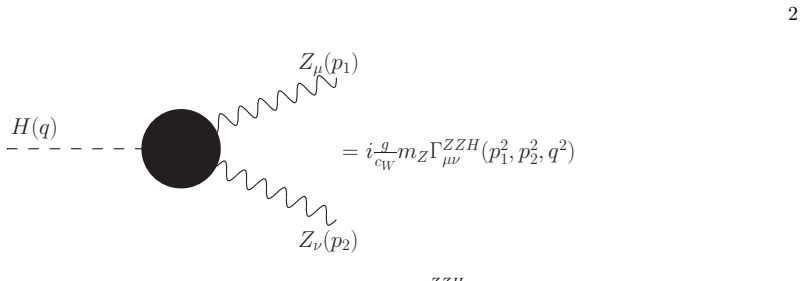
The machinery is the one-loop evaluation of the HZZ and ZZH vertex form factors $h_2^V$ and $h_3^V$ from the effective FCNC Lagrangian with complex couplings $g_V, g_A, g_S, g_P$, expressed in terms of Passarino-Veltman scalar functions $B_0$ and $C_0$. Type-I diagrams contain only Z-mediated FCNC and yield $h_3^V \propto \mathrm{Im}[g_V g_A^*]$ times loop functions $\tilde{F}^V$; type-II diagrams add Higgs-mediated FCNC and yield four combinations of products such as $\mathrm{Im}[g_V g_S^*]$. The left-right asymmetries $A^V_{LR}$ are then written in terms of the real and imaginary parts of $h_1^V$ and $h_3^V$, with the new $A^Z_{LR}$ for $Z^* \to ZH$ derived from polarized decay amplitudes; the longitudinal polarization amplitude has no $h_3^Z$ dependence, so only transverse polarizations carry the CP-violating signal. The numerical size of $h_3^V$ is set by assuming that the complex products of couplings saturate the current LHC limits.
What would settle it
Measure the left-right asymmetry in $H^*\to ZZ\to 4\ell$ events above 180 GeV with sufficient precision: if $A^H_{LR}$ stays within the SM range of roughly $10^{-8}$--$10^{-9}$ and shows no threshold structure at $2m_t$, the type-I FCNC contribution at the assumed coupling size is excluded. Equivalently, a dedicated bound on $\mathrm{Im}[g_{tc}^V g_{tc}^{A*}]$ below $10^{-6}$ from $t\to Zq$ angular observables would falsify the magnitude claim.
Extended reading notes
Core claim
The central claim is that complex flavor-changing couplings in an effective Lagrangian with terms $\bar{f}_j \gamma^\mu(g_V^{ij}-g_A^{ij}\gamma_5)f_i Z_\mu$ and $H \bar{f}_j(g_S^{ij}+g_P^{ij}\gamma_5)f_i$ induce the CP-violating form factor $h_3^V$ ($V=H,Z$) at one loop through two classes of diagrams: type I, with only Z-mediated FCNC, and type II, with both Z- and Higgs-mediated FCNC. In the type-I case $h_3^V$ is proportional to $\mathrm{Im}[g_V g_A^*]$; in type II it involves products such as $\mathrm{Im}[g_V g_S^*]$, $\mathrm{Im}[g_V g_P^*]$, $\mathrm{Im}[g_A g_S^*]$, and $\mathrm{Im}[g_A g_P^*]$, and a pseudoscalar coupling can produce CP violation even without flavor violation. Saturating the LHC bounds $|g_{tc}^V|, |g_{tc}^A| \le 0.0095$ and $|g_{tc}^S|, |g_{tc}^P| \le 0.25$ GeV, the authors find $h_3^H$ and $h_3^Z$ of order $10^{-8}$ (type I) and $10^{-7}$ (type II), three to four orders of magnitude above the SM estimate of about $10^{-11}$, while the CP-conserving $h_2^V$ stays well below the SM value. They further claim that the resulting left-right asymmetries $A^H_{LR}$ and $A^Z_{LR}$ can be one to five orders of magnitude larger than SM predictions, and that the imaginary (absorptive) parts of the form factors play a significant role in these observables.
Load-bearing premise
The numerical size of the predicted CP-violating form factor and asymmetries rests on assuming that the complex product $\mathrm{Im}[g_{tc}^V g_{tc}^{A*}]$ (and similar coupling products) can be as large as about $10^{-5}$, saturating current LHC bounds; if the underlying phase is smaller, all the claimed enhancements shrink proportionally.
Editorial extensions
If this is right
- A nonzero $A^H_{LR}$ or $A^Z_{LR}$ would be a direct signature of CP violation in the HZZ vertex, which the SM predicts to be extremely small.
- The $Z^* \to ZH$ process becomes a new channel for probing CP violation through polarized Z bosons, complementing $H^* \to ZZ$.
- The absorptive parts of $h_1^V$ and $h_3^V$ materially affect the asymmetries and should be included in experimental analyses rather than neglected.
- Even without flavor violation, a pseudoscalar coupling in the effective theory can generate CP violation in the HZZ vertex, widening the class of models that could produce the effect.
- Present LHC sensitivity to polarized ZZ ratios would need to improve by at least two orders of magnitude to see $h_3^H \sim 10^{-5}$ effects at low $m_{4\ell}$, so the predicted $10^{-7}$--$10^{-8}$ values are beyond current reach.
Reading between the lines
- The paper leaves implicit that if the same complex phases generate the top-quark chromoelectric dipole moment, the size of $h_3^V$ may be correlated with bounds from neutron and electron electric dipole moments, offering an indirect test of the assumed $10^{-5}$ phase product.
- The $A^Z_{LR}$ asymmetry could also be probed in associated $ZH$ production at a future lepton collider, where the off-shell Z kinematics are cleaner than at the LHC and the background is lower.
- A concrete extension would be to measure the sign and energy dependence of $A^Z_{LR}$: the paper's formulas predict a specific threshold behavior at $2m_t$ that distinguishes type-I from type-II contributions.
- If future LHC data bound $\mathrm{Im}[g_{tc}^V g_{tc}^{A*}]$ below $10^{-6}$, the claimed enhancements would disappear, converting the predicted signal into a limit on the FCNC phase rather than evidence for CP violation.
Editorial analysis
A structured set of objections, weighed in public.
Referee Report
Summary. The paper computes one-loop contributions to the HZZ form factors h_2^V and h_3^V (V=H,Z) arising from FCNC couplings of the Z and Higgs bosons to top-charm quarks, using the effective Lagrangian of Eq. (6) and Passarino-Veltman reduction. Two diagram classes are identified: Type I, with only Z-mediated FCNC, and Type II, with both Z- and H-mediated FCNC. The authors find that h_2^V receives only small corrections, while h_3^V can be as large as about 10^-8 (Type I) or 10^-7 (Type II), three to four orders of magnitude above the Standard Model estimate of about 10^-11. They further derive a left-right asymmetry A^Z_LR for Z* -> ZH, analogous to the previously studied A^H_LR for H* -> ZZ, and evaluate both asymmetries numerically. The paper also discusses the projected LHC sensitivity to these asymmetries and concludes that observing them would require substantial improvements in polarized-observable sensitivity.
Significance. If the calculation is correct, the paper provides a useful new model-independent set of analytic expressions for FCNC-induced contributions to the HZZ vertex, and it introduces the A^Z_LR asymmetry for Z* -> ZH for the first time. The central mechanism, that complex FCNC couplings can induce h_3^V at one loop with an imaginary part comparable to the real part, is plausible and consistent with existing literature on off-shell gauge-boson vertices. The paper also correctly identifies that the size of the effect is set by the imaginary products of the FCNC couplings, and it uses the current LHC bounds on |g^tc_V|, |g^tc_A|, |g^tc_S|, and |g^tc_P| to define benchmark values. However, the headline numerical claims are not predictions: they are direct rescalings of hand-picked complex coupling products, and the abstract overstates the body's own maximum values by about a factor of three. The paper's own sensitivity discussion in Sec. IV.C indicates that even h_3^H ~ 10^-5 would require two orders of magnitude better sensitivity than projected for Run 3, so the benchmark values 10^-7 to 10^-8 are observationally inaccessible in the near term.
major comments (4)
- [Abstract and Sec. V] The abstract states that h_3^V can reach values 'as high as 10^-6, five orders of magnitude larger than in the SM,' but the body's numerical results are at most about 3.5 x 10^-7 (Figs. 7 and 9) and the conclusions summarize h_3^V as 10^-8 and 10^-7 for Type I and II, three and four orders above the SM. The abstract should be corrected to match the values actually obtained and discussed in the text; as written, it overstates the paper's own result by roughly a factor of three.
- [Sec. IV.A.1 and Eq. (10)] The claimed enhancement of h_3^V is linearly proportional to Im[g^tc_V g^tc_A*] through Eq. (10), and the numerical value Im[g^tc_V g^tc_A*] ~ 10^-5 is not derived from data or from a model but is taken as a benchmark that saturates the independent magnitude bounds of Eq. (7). Equations (7) and (8) bound only the absolute values of the couplings and say nothing about their phases; therefore the magnitude of h_3^V and of the asymmetries in Figs. 10 and 11 is an input choice, not a prediction. If the physical phase product is one order of magnitude smaller, the claimed enhancement shrinks by the same factor and the asymmetries drop correspondingly. The manuscript should state this explicitly throughout and should avoid wording that presents the benchmark as a definitive prediction.
- [Sec. II.A.1 and Sec. II.A.2] The text asserts that the functions A_V^V, A_A^V, F^V, R_i^V, and T_i^V are 'free of divergences,' but no proof or demonstration is provided. Since the one-loop integrals B0 and C0 individually contain ultraviolet divergences, the finite-ness of the combinations is a nontrivial load-bearing point: if any of the quoted combinations were divergent, the numerical values in Sec. IV would not be meaningful. The authors should either include the explicit cancellation or show the Passarino-Veltman reduction steps that remove the divergent parts.
- [Sec. IV.C] The paper's own sensitivity analysis undermines the phenomenological claim that 'significant deviations from SM predictions may occur.' The text states that observing CP-violating effects of order h_3^H ~ 10^-5 would require improving the sensitivity on R_L,R by at least two orders of magnitude relative to the projected Run-3 reach of Ref. [70]. Since the new FCNC contributions computed here are two to three orders of magnitude smaller (10^-7 to 10^-8), the asymmetries in Figs. 10 and 11 are far below the estimated observable level. This should be stated plainly in the conclusions rather than implying imminent measurability.
minor comments (5)
- [Sec. IV.A.2] In the paragraph discussing h_2^Z and h_3^Z at high P, the text says 'the magnitudes of the real and absorptive parts become similar but of order 10 6.' The exponent is missing a minus sign and should read 10^-6, consistent with Fig. 5.
- [Appendix A.2, Eq. (A24)] In the expression for T^Z_1, the last term is written as 'Cjii' without an argument. It should presumably be Cjii(P^2), matching the other terms.
- [Appendix A.2, Eqs. (A16)-(A19)] The functions R^Z_i are defined with argument Q^2 in Eq. (A16) and following lines, while the corresponding Z*ZH kinematics depend on P^2; the notation should be made consistent to avoid confusion.
- [Fig. 12 caption] The horizontal axis label in the right panel is garbled as 'm_4/uni2113' instead of m_4ℓ; the same caption also omits the minus signs in the legend entries for h_3^H.
- [Sec. IV.B, Scenario I] The values Re[g_r g_S*] = 0.00237 GeV and Im[g_r g_S*] = 0.00237 GeV are quoted without stating that they arise from the product of the upper bounds |g_r| <= 0.0095 and |g_S| <= 0.25 GeV; stating this explicitly would clarify that these are extreme benchmark points, not central values.
Circularity Check
No significant circularity: the FCNC h3 values are conditional rescalings of externally bounded coupling products, not fitted outputs.
full rationale
The paper's central derivation is self-contained rather than circular. The CP-violating form factors h3^V(I) and h3^V(II) are computed as one-loop Feynman-diagram amplitudes expressed in Passarino-Veltman functions, Eqs. (10) and (12), with no parameters fitted to h3 data or to the left-right asymmetries. The numerical sizes are direct rescalings of assumed FCNC coupling products such as Im[g_tc^V g_tc^{A*}], with the paper stating 'From the limits in Eq. (7), we estimate that Im[g_V g_A^*] can reach values of order 10^{-5}' and then using that benchmark to quote h3 values. This is a conditional estimate, not a fitted reproduction of the output observable, so it does not meet the standard for fitted input being renamed a prediction. The SM comparison value h3 ~ 10^{-11} is taken from Soni and Xu [22], an external source, and the SM h1 input from Ref. [21] is prior published work used as an ingredient rather than as proof of the new FCNC contribution. Self-citations such as Refs. [21] and [66] supply standard-model inputs or previously derived formulas, not the load-bearing claim that FCNC couplings induce h3. The abstract's 10^{-6} wording versus the figures' ~3.5 x 10^{-7} maximum, and the paper's own sensitivity caveat that h3 ~ 10^{-5} would need two orders of magnitude better sensitivity, are correctness or presentation concerns, not circularity. The derivation chain therefore does not reduce by construction to its own inputs.
Assumptions & free parameters
free parameters (2)
- Im[g_tc_V g_tc_A*] (type I) =
-8e-5 and 1e-5
- Type II scenario coupling products (Re/Im of g_r g_S* and g_r g_P*) =
0.00237 GeV or 0.0011 GeV with various signs
assumptions (4)
- domain assumption The effective FCNC Lagrangian (6) with independent complex couplings is a valid low-energy description at one loop
- domain assumption SM one-loop values for h1^V and b_hat_Z from Ref. [21] are correct
- domain assumption Top-quark FCNC couplings dominate all numerical results
- standard math Passarino-Veltman reduction and Cutkosky cutting rules
Cite this review
Pith. "Pith review of $CP$ violation in the $HZZ$ vertex and left-right asymmetries." pith.science (2026). https://pith.science/paper/ZF2LUGLK
@misc{pith2026250118807,
  author       = {Pith},
  title        = {Pith review of: $CP$ violation in the $HZZ$ vertex and left-right asymmetries},
  year         = {2026},
  howpublished = {\url{https://pith.science/paper/ZF2LUGLK}},
  note         = {Machine review of arXiv:2501.18807}
}
abstract
We investigate new contributions to the $HZZ$ vertex from the Flavor Changing Neutral Current (FCNC) involving the Higgs and $Z$ bosons. Our calculations reveal that the form factors $h_2^V$ and $h_3^V$ ($V=H$, $Z$) can be induced through these couplings, and we present our results in terms of the Passarino-Veltman scalar functions. Using the current limits on $H\overline{t}c$ and $Z\overline{t}c$ couplings, we determine that the new contributions to the $CP$-conserving form factor $h_2^V$ are small compared to the Standard Model (SM) predictions. However, for the $CP$-violating form factor $h_3^V$, the contributions can reach values as high as $10^{-6}$, five orders of magnitude larger than in the SM. Furthermore, we examine how these results influence the left-right asymmetries in the processes $H^\ast\to ZZ$ and $Z^\ast\to ZH$. Our findings suggest that significant deviations from SM predictions may occur when considering FCNC contributions.
Figures


Figures from the paper (9 more)


Reference graph
Works this paper leans on
-
[70]
Role of angular observables in probing non-standard $HZZ$ couplings at an electron-proton collider
P. Sharma and A. Shivaji, Role of angular observables in probing non-standard HZZ couplings at an electron-proton collider, (2025), arXiv:2506.02558 [hep-ph]. 27
work page Pith review arXiv 2025
-
[1]
Diagrams type I By considering all the contributing Feynman diagrams from Fig. 2, we obtained the FCNC contribution to the CP -conserving form factor hV 2 , which can be expressed as hV 2 (I) = − g2mZNf 4π2cW mW ( gij V 2AV V (K 2, m2 i , m2 j ) + gij A 2AV A(K 2, m2 i , m2 j ) ) , V = H, Z, K = Q, P, (9) where Nf corresponds to the number of colors. The ...
-
[2]
Diagrams Type II From diagrams of type II in Fig. 3, the resulting contribution to the CP -conserving form factor can be expressed as hV 2 (II ) = − g2mZNf 2π2cW mW ( gV Re h gij V g∗ S i RV 1 (K 2, mi, mj) + gARe h gij V g∗ P i RV 2 (K 2, mi, mj) + gARe h gij A g∗ S i RV 3 (K 2, mi, mj) + gV Re h gij A g∗ P i RV 4 (K 2, mi, mj) ) , V = H, Z, K = Q, P, (1...
-
[3]
4, we present the behavior of the real and imaginary parts of hH 2 (I) (left plot) and ˆhH 3 (I) (right plot) as a function of Q
H ∗ZZ vertex In Fig. 4, we present the behavior of the real and imaginary parts of hH 2 (I) (left plot) and ˆhH 3 (I) (right plot) as a function of Q. Our analysis focuses solely on the Ztc contributions, while the contributions from lighter fermions will be addressed later. The absorptive parts emerge when the particles in the loop that couple to the V ∗...
-
[4]
Z ∗ZH vertex We now show the behavior of hZ 2 (I) (left plot) and ˆhZ 3 (I) (right plot) as a function of P , in Fig. 5. For hZ 2 , we observe a pattern similar to the previous case. Both the real and imaginary parts reach magnitudes of order 10 −6, with the absorptive part dominating at high energies. However, for values of P less than 2mt, the magnitude...
-
[5]
2×10 −4 1.4×10 −4 1.6×10 −4 | ̂ h Z 3 | Z ∗ ZH R eal Imaginary FIG. 5. The FCNC contributions of the type I to the form factors hZ 2 (left plot) and ˆhZ 3 (right plot) as a function of P . We only consider the Ztc coupling. B. Contributions of Type II The form factors obtained from diagrams of type II require a different approach, as they can be expressed...
-
[6]
6, we show the behavior of hH 2 (II ) as a function of Q for the scenarios I − III
H ∗ZZ In Fig. 6, we show the behavior of hH 2 (II ) as a function of Q for the scenarios I − III . At low values of Q, the dominant contributions correspond to the real part, while the absorptive part is of a similar order of magnitude. This behavior differs from that observed in contributions of type I, where the imaginary part becomes relevant only for ...
-
[7]
2×10 −7 1.4×10 −7 1.6×10 −7 | h H 3 | Scenario III 200 300 400 500 600 700 800 900 1000 Q [GeV] 0.0 5.0×10 −8 1.0×10 −7 1.5×10 −7 2.0×10 −7 2.5×10 −7 3.0×10 −7 3.5×10 −7 4.0×10 −7 | h H 3 | Scenario IV FIG. 7. FCNC contributions of the type II to the hH 3 form factor as a function of Q. For the values of the different couplings, we consider the scenarios ...
Show all 147 references
-
[8]
Z ∗ZH For the case of an off-shell Z boson, we present the behavior of hZ 2 (II ) as a function of P in Fig. 8. We note that the magnitudes of the real and absorptive parts are comparable, with the imaginary part dominating at high energies. The largest values occur in scenari...
-
[9]
2×10 −7 | h Z 3 | Scenario III 300 400 500 600 700 800 900 1000 P [GeV] 0.0 5.0×10 −8 1.0×10 −7 1.5×10 −7 2.0×10 −7 2.5×10 −7 | h Z 3 | Scenario IV FIG. 9. FCNC contributions of the type II to the hZ 3 form factor as a function of P . For the values of the different couplings,...
-
[10]
10, we present the AV LR (V = H, Z) asymmetries as a function of Q and P , considering the FCNC contributions of type I
Type I In Fig. 10, we present the AV LR (V = H, Z) asymmetries as a function of Q and P , considering the FCNC contributions of type I. Using the upper bounds stated in Eq. (7), we find that Im gtc V gtc A can reach magnitudes of 13 order 10−5. Accordingly, we utilize values o...
-
[11]
11 the AV LR (V = H, Z) asymmetries for the contributions of type II
Type II Similar to the previous case, we draw in Fig. 11 the AV LR (V = H, Z) asymmetries for the contributions of type II. We have examined the four scenarios introduced in Sec. IV B. In both asymmetries, the scenario II is negligible, while the remaining scenarios yield valu...
-
[12]
Diagrams type I The functions AV V and AV A (V = H, Z) for contributions of Type I are given as follows: AH V (Q2, m2 i , m2 j ) = 1 Q2 (Q2 − 4m2 Z) 2 (h 4m2 i m2 i − m2 j 4m2 Z − Q2 i Bii(0) + h 4m2 j m2 j − m2 i 4m2 Z − Q2 i Bjj (0) + h 2Q4 (mi − mj) 2 − 4Q2 m2 Z −4mimj + m2...
-
[13]
Diagrams type II The functions RV 1,2,3,4 (V = H, Z) for contributions of Type II are given as follows: RH 1 (Q2, mi, mj) = 1 Q4 (Q2 − 4m2 Z) 2 ( m2 Z h 6m2 i mj Q2 − 2m2 Z − mi 6m2 j Q2 − 2m2 Z − 10Q2m2 Z + Q4 + 6m3 i Q2 − 2m2 Z + 3mj Q2 − 2m2 j Q2 − 2m2 Z i Bii(m2 Z) + Q2m2 ...
-
[14]
Chatrchyan et al
S. Chatrchyan et al. (CMS), Observation of a New Boson at a Mass of 125 GeV with the CMS Experiment at the LHC, Phys. Lett. B 716, 30 (2012), arXiv:1207.7235 [hep-ex]
2012 arXiv
-
[15]
Aad et al
G. Aad et al. (ATLAS), Observation of a new particle in the search for the Standard Model Higgs boson with the ATLAS detector at the LHC, Phys. Lett. B 716, 1 (2012), arXiv:1207.7214 [hep-ex]
2012 arXiv
-
[16]
Englert and R
F. Englert and R. Brout, Broken symmetry and the mass of gauge vector mesons, Phys. Rev. Lett. 13, 321 (1964)
1964
-
[17]
G. S. Guralnik, C. R. Hagen, and T. W. B. Kibble, Global conservation laws and massless particles, Phys. Rev. Lett. 13, 585 (1964)
1964
-
[18]
P. W. Higgs, Broken symmetries and the masses of gauge bosons, Phys. Rev. Lett. 13, 508 (1964)
1964
-
[19]
Aad et al
G. Aad et al. (ATLAS), A detailed map of Higgs boson interactions by the ATLAS experiment ten years after the discovery, Nature 607, 52 (2022), [Erratum: Nature 612, E24 (2022)], arXiv:2207.00092 [hep-ex]
2022 arXiv
-
[20]
Tumasyan et al
A. Tumasyan et al. (CMS), A portrait of the Higgs boson by the CMS experiment ten years after the discovery., Nature 607, 60 (2022), [Erratum: Nature 623, (2023)], arXiv:2207.00043 [hep-ex]
2022 arXiv
-
[21]
Tumasyan et al
A. Tumasyan et al. (CMS), Search for Higgs boson decays to a Z boson and a photon in proton-proton collisions at √s = 13 TeV, JHEP 05, 233, arXiv:2204.12945 [hep-ex]
-
[22]
Aad et al
G. Aad et al. (ATLAS, CMS), Evidence for the Higgs Boson Decay to a Z Boson and a Photon at the LHC, Phys. Rev. Lett. 132, 021803 (2024), arXiv:2309.03501 [hep-ex]
2024 arXiv
-
[23]
Tumasyan et al
A. Tumasyan et al. (CMS), Measurement of the Higgs boson width and evidence of its off-shell contributions to ZZ production, Nature Phys. 18, 1329 (2022), arXiv:2202.06923 [hep-ex]
2022 arXiv
-
[24]
Aad et al
G. Aad et al. (ATLAS), Evidence of off-shell Higgs boson production from ZZ leptonic decay channels and constraints on its total width with the ATLAS detector, Phys. Lett. B 846, 138223 (2023), arXiv:2304.01532 [hep-ex]
2023 arXiv
-
[25]
Caola and K
F. Caola and K. Melnikov, Constraining the Higgs boson width with ZZ production at the LHC, Phys. Rev. D 88, 054024 (2013), arXiv:1307.4935 [hep-ph]
2013 arXiv
-
[26]
J. M. Campbell, R. K. Ellis, and C. Williams, Bounding the Higgs Width at the LHC Using Full Analytic Results for gg → e−e+µ−µ+, JHEP 04, 060, arXiv:1311.3589 [hep-ph]
-
[27]
J. A. Aguilar-Saavedra, A. Bernal, J. A. Casas, and J. M. Moreno, Testing entanglement and Bell inequalities inH → ZZ , Phys. Rev. D 107, 016012 (2023), arXiv:2209.13441 [hep-ph]
2023 arXiv
-
[28]
Bernal, P
A. Bernal, P. Caban, and J. Rembieli´ nski, Entanglement and Bell inequalities violation in H → ZZ with anomalous coupling, Eur. Phys. J. C 83, 1050 (2023), arXiv:2307.13496 [hep-ph]
2023 arXiv
-
[29]
J. A. Aguilar-Saavedra, Tripartite entanglement in H →ZZ,WW decays, Phys. Rev. D 109, 113004 (2024), arXiv:2403.13942 [hep-ph]
2024 arXiv
-
[30]
Bernal, P
A. Bernal, P. Caban, and J. Rembieli´ nski, Entanglement and Bell inequality violation in vector diboson systems produced in decays of spin-0 particles, (2024), arXiv:2405.16525 [hep-ph]
2024 arXiv
-
[31]
Sullivan, Constraining New Physics with h → V V Tomography, (2024), arXiv:2410.10980 [hep-ph]
M. Sullivan, Constraining New Physics with h → V V Tomography, (2024), arXiv:2410.10980 [hep-ph]
2024 arXiv
-
[32]
B. A. Kniehl, Radiative corrections for H → ZZ in the standard model, Nucl. Phys. B 352, 1 (1991)
1991
-
[33]
K. H. Phan, D. T. Tran, and A. T. Nguyen, One-loop off-shell decay H ∗ → ZZ at future colliders, Commun. in Phys. 33, 369 (2023), arXiv:2209.12410 [hep-ph]
2023 arXiv
-
[34]
A. I. Hern´ andez-Ju´ arez, G. Tavares-Velasco, and A. Fern´ andez-T´ ellez, New evaluation of theHZZ coupling: Direct bounds on anomalous contributions and CP -violating effects via a new asymmetry, Phys. Rev. D 107, 115031 (2023), arXiv:2301.13127 [hep-ph]
2023 arXiv
-
[35]
Soni and R
A. Soni and R. M. Xu, Probing CP violation via Higgs decays to four leptons, Phys. Rev. D 48, 5259 (1993), arXiv:hep- ph/9301225
1993
-
[36]
A. M. Sirunyan et al. (CMS), Constraints on anomalous Higgs boson couplings to vector bosons and fermions in its production and decay using the four-lepton final state, Phys. Rev. D 104, 052004 (2021), arXiv:2104.12152 [hep-ex]
2021 arXiv
-
[37]
Tumasyan et al
A. Tumasyan et al. (CMS), Constraints on anomalous Higgs boson couplings to vector bosons and fermions from the production of Higgs bosons using the τ τfinal state, Phys. Rev. D 108, 032013 (2023), arXiv:2205.05120 [hep-ex]. 26
2023 arXiv
-
[38]
A. M. Sirunyan et al. (CMS), Constraints on anomalous Higgs boson couplings using production and decay information in the four-lepton final state, Phys. Lett. B 775, 1 (2017), arXiv:1707.00541 [hep-ex]
2017 arXiv
-
[39]
A. M. Sirunyan et al. (CMS), Measurements of the Higgs boson width and anomalous HV V couplings from on-shell and off-shell production in the four-lepton final state, Phys. Rev. D 99, 112003 (2019), arXiv:1901.00174 [hep-ex]
2019 arXiv
-
[40]
Bolognesi, Y
S. Bolognesi, Y. Gao, A. V. Gritsan, K. Melnikov, M. Schulze, N. V. Tran, and A. Whitbeck, On the Spin and Parity of a Single-Produced Resonance at the LHC, Phys. Rev. D 86, 095031 (2012), arXiv:1208.4018 [hep-ph]
2012 arXiv
-
[41]
Anderson et al., Constraining Anomalous HV V Interactions at Proton and Lepton Colliders, Phys
I. Anderson et al., Constraining Anomalous HV V Interactions at Proton and Lepton Colliders, Phys. Rev. D 89, 035007 (2014), arXiv:1309.4819 [hep-ph]
2014 arXiv
-
[42]
S ¸ahin, Search for the anomalousZZH couplings at the CLIC, Mod
B. S ¸ahin, Search for the anomalousZZH couplings at the CLIC, Mod. Phys. Lett. A 34, 1950299 (2019)
2019
-
[43]
A. V. Gritsan, J. Roskes, U. Sarica, M. Schulze, M. Xiao, and Y. Zhou, New features in the JHU generator frame- work: constraining Higgs boson properties from on-shell and off-shell production, Phys. Rev. D 102, 056022 (2020), arXiv:2002.09888 [hep-ph]
2020 arXiv
-
[44]
Gon¸ calves, T
D. Gon¸ calves, T. Han, S. Ching Iris Leung, and H. Qin, Off-shell Higgs couplings in H ∗ → ZZ → ℓℓνν , Phys. Lett. B 817, 136329 (2021), arXiv:2012.05272 [hep-ph]
2021 arXiv
-
[45]
Azatov et al
A. Azatov et al. , Off-shell Higgs Interpretations Task Force: Models and Effective Field Theories Subgroup Report 10.17181/LHCHWG-2022-001 (2022), arXiv:2203.02418 [hep-ph]
2022 arXiv
-
[46]
A. T. Nguyen, D. T. Tran, and K. H. Phan, Effects of one-loop on-shell and off-shell decay H∗ →V V at future lepton colliders, J. Phys. Conf. Ser. 2485, 012001 (2023), arXiv:2209.13153 [hep-ph]
2023 arXiv
-
[47]
B. A. Kniehl, Radiative corrections for associated ZH production at future e+e− colliders, Z. Phys. C 55, 605 (1992)
1992
-
[48]
Hagiwara and M
K. Hagiwara and M. L. Stong, Probing the scalar sector in e+e− → f ¯f H, Z. Phys. C 62, 99 (1994), arXiv:hep-ph/9309248
1994 arXiv
-
[49]
Hagiwara, S
K. Hagiwara, S. Ishihara, J. Kamoshita, and B. A. Kniehl, Prospects of measuring general Higgs couplings at e+e− linear colliders, Eur. Phys. J. C 14, 457 (2000), arXiv:hep-ph/0002043
2000 arXiv
-
[50]
B. A. Kniehl, Theoretical aspects of standard model Higgs boson physics at a future e+e− linear collider, Int. J. Mod. Phys. A 17, 1457 (2002), arXiv:hep-ph/0112023
2002 arXiv
-
[51]
S. S. Biswal, R. M. Godbole, R. K. Singh, and D. Choudhury, Signatures of anomalous V V Hinteractions at a linear collider, Phys. Rev. D 73, 035001 (2006), [Erratum: Phys.Rev.D 74, 039904 (2006)], arXiv:hep-ph/0509070
2006 arXiv
-
[52]
Choudhury and Mamta, Anomalous Higgs Couplings at an e gamma Collider, Phys
D. Choudhury and Mamta, Anomalous Higgs Couplings at an e gamma Collider, Phys. Rev. D 74, 115019 (2006), arXiv:hep-ph/0608293
2006 arXiv
-
[53]
R. M. Godbole, D. J. Miller, and M. M. Muhlleitner, Aspects of CP violation in the HZZ coupling at the LHC, JHEP 12, 031, arXiv:0708.0458 [hep-ph]
-
[54]
Dutta, K
S. Dutta, K. Hagiwara, and Y. Matsumoto, Measuring the Higgs-Vector boson Couplings at Linear e+e− Collider, Phys. Rev. D 78, 115016 (2008), arXiv:0808.0477 [hep-ph]
2008 arXiv
-
[55]
S. D. Rindani and P. Sharma, Angular distributions as a probe of anomalous ZZH and γZH interactions at a linear collider with polarized beams, Phys. Rev. D 79, 075007 (2009), arXiv:0901.2821 [hep-ph]
2009 arXiv
-
[56]
I. T. Cakir, O. Cakir, A. Senol, and A. T. Tasci, Probing Anomalous HZZ Couplings at the LHeC, Mod. Phys. Lett. A 28, 1350142 (2013), arXiv:1304.3616 [hep-ph]
2013 arXiv
-
[57]
K. Rao, S. D. Rindani, and P. Sarmah, Probing anomalous gauge-Higgs couplings using Z boson polarization at e+e− colliders, Nucl. Phys. B 950, 114840 (2020), arXiv:1904.06663 [hep-ph]
2020 arXiv
-
[58]
Kumar, P
S. Kumar, P. Poulose, R. Rahaman, and R. K. Singh, Measuring Higgs self-couplings in the presence of VVH and VVHH at the ILC, Int. J. Mod. Phys. A 34, 1950094 (2019), arXiv:1905.06601 [hep-ph]
2019 arXiv
-
[59]
K. Rao, S. D. Rindani, and P. Sarmah, Study of anomalous gauge-Higgs couplings using Z boson polarization at LHC, Nucl. Phys. B 964, 115317 (2021), arXiv:2009.00980 [hep-ph]
2021 arXiv
-
[60]
K. Rao, S. D. Rindani, P. Sarmah, and B. Singh, Use of Z polarization in e+e− → ZH to measure the triple-Higgs coupling, Nucl. Phys. B 975, 115649 (2022), arXiv:2109.11134 [hep-ph]
2022 arXiv
-
[61]
L. Chen, G. Heinrich, S. P. Jones, M. Kerner, J. Klappert, and J. Schlenk, ZH production in gluon fusion: two-loop amplitudes with full top quark mass dependence, JHEP 03, 125, arXiv:2011.12325 [hep-ph]
2011 arXiv
-
[62]
Bizo´ n, F
W. Bizo´ n, F. Caola, K. Melnikov, and R. R¨ ontsch, Anomalous couplings in associated VH production with Higgs boson decay to massive b quarks at NNLO in QCD, Phys. Rev. D 105, 014023 (2022), arXiv:2106.06328 [hep-ph]
2022 arXiv
-
[63]
Sharma and A
P. Sharma and A. Shivaji, Probing non-standard HV V (V = W , Z) couplings in single Higgs production at future electron-proton collider, JHEP 10, 108, arXiv:2207.03862 [hep-ph]
-
[64]
K. Rao, S. D. Rindani, P. Sarmah, and B. Singh, Polarized Z cross sections in Higgsstrahlung for the determination of anomalous ZZH couplings, (2022), arXiv:2202.10215 [hep-ph]
2022
-
[65]
Bittar and G
P. Bittar and G. Burdman, Form Factors in Higgs Couplings from Physics Beyond the Standard Model, (2022), arXiv:2204.07094 [hep-ph]
2022 arXiv
-
[66]
A. V. Gritsan et al. , Snowmass White Paper: Prospects of CP-violation measurements with the Higgs boson at future experiments, (2022), arXiv:2205.07715 [hep-ex]
2022 arXiv
-
[67]
X. Chen, X. Guan, C.-Q. He, Z. Li, X. Liu, and Y.-Q. Ma, Complete two-loop electroweak corrections to e+e− → HZ , (2022), arXiv:2209.14953 [hep-ph]
2022 arXiv
-
[68]
K. Rao, S. D. Rindani, P. Sarmah, and B. Singh, Z polarization at an e+e− collider and properties of decay-lepton angular asymmetries, Proc. Indian Natl. Sci. Acad. 90, 664 (2024), arXiv:2311.13473 [hep-ph]
2024 arXiv
-
[69]
D. T. Tran and K. H. Phan, One-loop formulas for H → Zν lνl for l = e, µ, τ in ’t Hooft-Veltman gauge*, Chin. Phys. C 47, 053106 (2023), arXiv:2211.15116 [hep-ph]
2023 arXiv
-
[71]
B. Das, P. Sharma, and A. Shivaji, NLO QCD effects on angular observables in e−p → e−(νe)Hj in presence of non- standard HV V couplings, (2025), arXiv:2506.21472 [hep-ph]
2025
-
[72]
Djouadi, J
A. Djouadi, J. Kalinowski, and M. Spira, Hdecay: a program for higgs boson decays in the standard model and its supersymmetric extension, Computer Physics Communications 108, 56?74 (1998)
1998
-
[73]
Bredenstein, A
A. Bredenstein, A. Denner, S. Dittmaier, and M. M. Weber, Precise predictions for the Higgs-boson decay H → W W/ZZ→ 4 leptons, Phys. Rev. D 74, 013004 (2006)
2006
-
[74]
Hagiwara, R
K. Hagiwara, R. D. Peccei, D. Zeppenfeld, and K. Hikasa, Probing the Weak Boson Sector in e+e− → W +W −, Nucl. Phys. B 282, 253 (1987)
1987
-
[75]
Chang, W.-K
D. Chang, W.-K. Keung, and I. Phillips, CP violation in top pair production at an e+e− collider, Nuclear Physics B 408, 286 (1993), arXiv:hep-ph/9209267
1993 arXiv
-
[76]
Ilakovac, B
A. Ilakovac, B. A. Kniehl, and A. Pilaftsis, CP violation induced by heavy Majorana neutrinos in the decays of Higgs scalars into top quark, W and Z boson pairs, Phys. Lett. B 317, 609 (1993), arXiv:hep-ph/9308318
1993 arXiv
-
[77]
Grzadkowski, CP violation in H → tt decays at e+e− colliders, Phys
B. Grzadkowski, CP violation in H → tt decays at e+e− colliders, Phys. Lett. B 338, 71 (1994), arXiv:hep-ph/9404330
1994 arXiv
-
[78]
Q.-H. Cao, B. Yan, C. P. Yuan, and Y. Zhang, Probing Zt¯t couplings using Z boson polarization in ZZ production at hadron colliders, Phys. Rev. D 102, 055010 (2020), arXiv:2004.02031 [hep-ph]
2020 arXiv
-
[79]
A. I. Hern´ andez-Ju´ arez, R. Gait´ an, and G. Tavares-Velasco, Polarized and unpolarized off-shellH ∗→ZZ → 4ℓ decay above the 2mZ threshold*, Chin. Phys. C 48, 113103 (2024), arXiv:2402.18497 [hep-ph]
2024 arXiv
-
[80]
Ballestrero, E
A. Ballestrero, E. Maina, and G. Pelliccioli, Polarized vector boson scattering in the fully leptonic WZ and ZZ channels at the LHC, JHEP 09, 087, arXiv:1907.04722 [hep-ph]
1907 arXiv
-
[81]
Maina, Vector boson polarizations in the decay of the Standard Model Higgs, Phys
E. Maina, Vector boson polarizations in the decay of the Standard Model Higgs, Phys. Lett. B 818, 136360 (2021), arXiv:2007.12080 [hep-ph]
2021 arXiv
-
[82]
Maina and G
E. Maina and G. Pelliccioli, Polarized Z bosons from the decay of a Higgs boson produced in association with two jets at the LHC, Eur. Phys. J. C 81, 989 (2021), arXiv:2105.07972 [hep-ph]
2021 arXiv
-
[83]
Javurkova, R
M. Javurkova, R. Ruiz, R. C. L. de S´ a, and J. Sandesara, Polarized ZZ pairs in gluon fusion and vector boson fusion at the LHC, Phys. Lett. B 855, 138787 (2024), arXiv:2401.17365 [hep-ph]
2024 arXiv
-
[84]
Grossi, G
M. Grossi, G. Pelliccioli, and A. Vicini, From angular coefficients to quantum observables: a phenomenological appraisal in di-boson systems, (2024), arXiv:2409.16731 [hep-ph]
2024 arXiv
-
[85]
Aad et al
G. Aad et al. (ATLAS), Evidence of pair production of longitudinally polarised vector bosons and study of CP properties in ZZ → 4ℓ events with the ATLAS detector at √s = 13 TeV, JHEP 12, 107, arXiv:2310.04350 [hep-ex]
-
[86]
Aad et al
G. Aad et al. (ATLAS), Observation of gauge boson joint-polarisation states in W ±Z production from pp collisions at s=13 TeV with the ATLAS detector, Phys. Lett. B 843, 137895 (2023), arXiv:2211.09435 [hep-ex]
2023 arXiv
-
[87]
Aaij et al
R. Aaij et al. (LHCb), First Measurement of the Z →µ+µ- Angular Coefficients in the Forward Region of pp Collisions at s=13 TeV, Phys. Rev. Lett. 129, 091801 (2022), arXiv:2203.01602 [hep-ex]
2022
-
[88]
Aad et al
G. Aad et al. (ATLAS), Measurement of the angular coefficients in Z-boson events using electron and muon pairs from data taken at √s = 8 TeV with the ATLAS detector, JHEP 08, 159, arXiv:1606.00689 [hep-ex]
-
[89]
Aad et al
G. Aad et al. (ATLAS), A precise measurement of the Z-boson double-differential transverse momentum and rapidity distributions in the full phase space of the decay leptons with the ATLAS experiment at √s = 8 TeV, Eur. Phys. J. C 84, 315 (2024), arXiv:2309.09318 [hep-ex]
2024 arXiv
-
[90]
Khachatryan et al
V. Khachatryan et al. (CMS), Angular coefficients of Z bosons produced in pp collisions at √s = 8 TeV and decaying to µ+µ− as a function of transverse momentum and rapidity, Phys. Lett. B 750, 154 (2015), arXiv:1504.03512 [hep-ex]
2015 arXiv
-
[91]
A. M. Sirunyan et al. (CMS), Measurements of production cross sections of polarized same-sign W boson pairs in asso- ciation with two jets in proton-proton collisions at √s = 13 TeV, Phys. Lett. B 812, 136018 (2021), arXiv:2009.09429 [hep-ex]
2021 arXiv
-
[92]
Chatrchyan et al
S. Chatrchyan et al. (CMS), Measurement of the Polarization of W Bosons with Large Transverse Momenta in W+Jets Events at the LHC, Phys. Rev. Lett. 107, 021802 (2011), arXiv:1104.3829 [hep-ex]
2011 arXiv
-
[93]
Aad et al
G. Aad et al. (ATLAS), Measurement of the polarisation of W bosons produced with large transverse momentum in pp collisions at √s = 7 TeV with the ATLAS experiment, Eur. Phys. J. C 72, 2001 (2012), arXiv:1203.2165 [hep-ex]
2012 arXiv
-
[94]
Aaboud et al
M. Aaboud et al. (ATLAS), Measurement of W ±Z production cross sections and gauge boson polarisation in pp collisions at √s = 13 TeV with the ATLAS detector, Eur. Phys. J. C 79, 535 (2019), arXiv:1902.05759 [hep-ex]
2019 arXiv
-
[95]
Khachatryan et al
V. Khachatryan et al. (CMS), Measurement of the W boson helicity fractions in the decays of top quark pairs to lepton + jets final states produced in pp collisions at √s = 8TeV, Phys. Lett. B 762, 512 (2016), arXiv:1605.09047 [hep-ex]
2016 arXiv
-
[96]
Aaboud et al
M. Aaboud et al. (ATLAS), Measurement of the W boson polarisation in t¯t events from pp collisions at √s = 8 TeV in the lepton + jets channel with ATLAS, Eur. Phys. J. C 77, 264 (2017), [Erratum: Eur.Phys.J.C 79, 19 (2019)], arXiv:1612.02577 [hep-ex]
2017 arXiv
-
[97]
Aad et al
G. Aad et al. (CMS, ATLAS), Combination of the W boson polarization measurements in top quark decays using ATLAS and CMS data at √s = 8 TeV, JHEP 08 (08), 051, arXiv:2005.03799 [hep-ex]
2005 arXiv
-
[98]
Aad et al
G. Aad et al. (ATLAS), Measurement of the polarisation of W bosons produced in top-quark decays using dilepton events at s=13 TeV with the ATLAS experiment, Phys. Lett. B 843, 137829 (2023), arXiv:2209.14903 [hep-ex]
2023 arXiv
-
[99]
Buarque Franzosi, O
D. Buarque Franzosi, O. Mattelaer, R. Ruiz, and S. Shil, Automated predictions from polarized matrix elements, JHEP 04, 082, arXiv:1912.01725 [hep-ph]
1912 arXiv
-
[100]
Hoppe, M
M. Hoppe, M. Sch¨ onherr, and F. Siegert, Polarised cross sections for vector boson production with Sherpa, JHEP 04, 001, arXiv:2310.14803 [hep-ph]
-
[101]
Harnik, J
R. Harnik, J. Kopp, and J. Zupan, Flavor Violating Higgs Decays, JHEP 03, 026, arXiv:1209.1397 [hep-ph]
-
[102]
Buchalla, G
G. Buchalla, G. Hiller, and G. Isidori, Phenomenology of nonstandard Z couplings in exclusive semileptonic b → s 28 transitions, Phys. Rev. D 63, 014015 (2000), arXiv:hep-ph/0006136
2000 arXiv
-
[103]
Mohanta, Implications of the non-universal Z boson in FCNC mediated rare decays, Phys
R. Mohanta, Implications of the non-universal Z boson in FCNC mediated rare decays, Phys. Rev. D 71, 114013 (2005), arXiv:hep-ph/0503225
2005 arXiv
-
[104]
Silverman, Z mediated B - anti-B mixing and B meson CP violating asymmetries in the light of new FCNC bounds, Phys
D. Silverman, Z mediated B - anti-B mixing and B meson CP violating asymmetries in the light of new FCNC bounds, Phys. Rev. D 45, 1800 (1992)
1992
-
[105]
A. J. Buras and L. Silvestrini, Upper bounds on K — > pi neutrino anti-neutrino and K(L) — > pi0 e+ e- from epsilon- prime / epsilon and K(L) — > mu+ mu-, Nucl. Phys. B 546, 299 (1999), arXiv:hep-ph/9811471
1999 arXiv
-
[106]
A. K. Giri and R. Mohanta, New physics effects on the CP asymmetries in B — > phi K(S) and B — > eta-prime K(S) decays, Phys. Rev. D 68, 014020 (2003), arXiv:hep-ph/0306041
2003 arXiv
-
[107]
Mohanta, Effect of FCNC mediated Z boson on lepton flavor violating decays, Eur
R. Mohanta, Effect of FCNC mediated Z boson on lepton flavor violating decays, Eur. Phys. J. C 71, 1625 (2011), arXiv:1011.4184 [hep-ph]
2011 arXiv
-
[108]
Aad et al
G. Aad et al. (ATLAS), Search for the lepton flavor violating decay Z →eµ in pp collisions at √s TeV with the ATLAS detector, Phys. Rev. D 90, 072010 (2014), arXiv:1408.5774 [hep-ex]
2014 arXiv
-
[109]
Khachatryan et al
V. Khachatryan et al. (CMS), Search for Lepton-Flavour-Violating Decays of the Higgs Boson, Phys. Lett. B 749, 337 (2015), arXiv:1502.07400 [hep-ex]
2015 arXiv
-
[110]
Aaboud et al
M. Aaboud et al. (ATLAS), A search for lepton-flavor-violating decays of the Z boson into a τ -lepton and a light lepton with the ATLAS detector, Phys. Rev. D 98, 092010 (2018), arXiv:1804.09568 [hep-ex]
2018 arXiv
-
[111]
A. M. Sirunyan et al. (CMS), Search for lepton-flavor violating decays of the Higgs boson in the µτ and eτ final states in proton-proton collisions at √s = 13 TeV, Phys. Rev. D 104, 032013 (2021), arXiv:2105.03007 [hep-ex]
2021 arXiv
-
[112]
Aad et al
G. Aad et al. (ATLAS), Search for the charged-lepton-flavor-violating decay Z → eµ in pp collisions at √s = 13 TeV with the ATLAS detector, Phys. Rev. D 108, 032015 (2023), arXiv:2204.10783 [hep-ex]
2023 arXiv
-
[113]
Aad et al
G. Aad et al. (ATLAS), Search for flavor-changing neutral-current couplings between the top quark and the Z boson with proton-proton collisions at √s = 13 TeV with the ATLAS detector, Phys. Rev. D 108, 032019 (2023), arXiv:2301.11605 [hep-ex]
2023 arXiv
-
[114]
Aad et al
G. Aad et al. (ATLAS), Search for flavour-changing neutral tqH interactions with H → γγ in pp collisions at √s = 13 TeV using the ATLAS detector, JHEP 12, 195, arXiv:2309.12817 [hep-ex]
-
[115]
J. A. Aguilar-Saavedra, Top flavor-changing neutral interactions: Theoretical expectations and experimental detection, Acta Phys. Polon. B 35, 2695 (2004), arXiv:hep-ph/0409342
2004 arXiv
-
[116]
K. J. Abraham, K. Whisnant, J. M. Yang, and B.-L. Young, Probing R violating top quark decays at hadron colliders, Phys. Rev. D 63, 034011 (2001), arXiv:hep-ph/0007280
2001 arXiv
-
[117]
Eilam, A
G. Eilam, A. Gemintern, T. Han, J. M. Yang, and X. Zhang, Top quark rare decay t → ch in R-parity violating SUSY, Phys. Lett. B 510, 227 (2001), arXiv:hep-ph/0102037
2001 arXiv
-
[118]
J. A. Aguilar-Saavedra, Effects of mixing with quark singlets, Phys. Rev. D 67, 035003 (2003), [Erratum: Phys.Rev.D 69, 099901 (2004)], arXiv:hep-ph/0210112
2003 arXiv
-
[119]
Grossman, Y
Y. Grossman, Y. Nir, J. Thaler, T. Volansky, and J. Zupan, Probing minimal flavor violation at the LHC, Phys. Rev. D 76, 096006 (2007), arXiv:0706.1845 [hep-ph]
2007 arXiv
-
[120]
J. A. Aguilar-Saavedra, Zt, gamma t and t production at hadron colliders via strong flavour-changing neutral couplings, Nucl. Phys. B 837, 122 (2010), arXiv:1003.3173 [hep-ph]
2010 arXiv
-
[121]
J. A. Aguilar-Saavedra, R. Benbrik, S. Heinemeyer, and M. P´ erez-Victoria, Handbook of vectorlike quarks: Mixing and single production, Phys. Rev. D 88, 094010 (2013), arXiv:1306.0572 [hep-ph]
2013 arXiv
-
[122]
Gait´ an, R
R. Gait´ an, R. Martinez, J. H. M. de Oca, and E. A. Garc´ es, SM Higgs boson and t → cZ decays in the 2HDM type III with CP violation, Phys. Rev. D 98, 035031 (2018), arXiv:1710.04262 [hep-ph]
2018 arXiv
-
[123]
Badziak and K
M. Badziak and K. Harigaya, Asymptotically Free Natural Supersymmetric Twin Higgs Model, Phys. Rev. Lett. 120, 211803 (2018), arXiv:1711.11040 [hep-ph]
2018 arXiv
-
[124]
Liu and S
Y.-B. Liu and S. Moretti, Probing the top-Higgs boson FCNC couplings via the h → γγ channel at the HE-LHC and FCC-hh, Phys. Rev. D 101, 075029 (2020), arXiv:2002.05311 [hep-ph]
2020 arXiv
-
[125]
Hou and T
W.-S. Hou and T. Modak, Probing Top Changing Neutral Higgs Couplings at Colliders, Mod. Phys. Lett. A 36, 2130006 (2021), arXiv:2012.05735 [hep-ph]
2021 arXiv
-
[126]
Liu and S
Y.-B. Liu and S. Moretti, Probing tqZ anomalous couplings in the trilepton signal at the HL-LHC, HE-LHC and FCC-hh, Chin. Phys. C 45, 043110 (2021), arXiv:2010.05148 [hep-ph]
2021 arXiv
-
[127]
Chen and T
C.-H. Chen and T. Nomura, Scotogenic top-quark FCNC decays, Phys. Rev. D 106, 095005 (2022), arXiv:2204.01214 [hep-ph]
2022 arXiv
-
[128]
Chen, C.-W
C.-H. Chen, C.-W. Chiang, and C.-W. Su, Top-quark FCNC decays, LFVs, lepton g − 2, and W mass anomaly with inert charged Higgses, J. Phys. G 51, 085001 (2024), arXiv:2301.07070 [hep-ph]
2024 arXiv
-
[129]
A. I. Hern´ andez-Ju´ arez, G. Tavares-Velasco, and R. Gait´ an, Non-diagonal contributions toZγV ∗ vertex, polarizations and bounds on Ztq couplings, (2022), arXiv:2203.16819 [hep-ph]
2022
-
[130]
A. I. Hern´ andez-Ju´ arez, R. Gait´ an, and R. Martinez,H → Zγ decay and CP violation, Phys. Rev. D 111, 015001 (2025), arXiv:2405.03094 [hep-ph]
2025 arXiv
-
[131]
Mertig, M
R. Mertig, M. Bohm, and A. Denner, FEYN CALC: Computer algebraic calculation of Feynman amplitudes, Comput. Phys. Commun. 64, 345 (1991)
1991
-
[132]
Shtabovenko, R
V. Shtabovenko, R. Mertig, and F. Orellana, New Developments in FeynCalc 9.0, Comput. Phys. Commun. 207, 432 (2016), arXiv:1601.01167 [hep-ph]
2016 arXiv
-
[133]
Shtabovenko, R
V. Shtabovenko, R. Mertig, and F. Orellana, FeynCalc 9.3: New features and improvements, Comput. Phys. Commun. 256, 107478 (2020), arXiv:2001.04407 [hep-ph]. 29
2020 arXiv
-
[134]
Shtabovenko, R
V. Shtabovenko, R. Mertig, and F. Orellana, FeynCalc 10: Do multiloop integrals dream of computer codes?, Comput. Phys. Commun. 306, 109357 (2025), arXiv:2312.14089 [hep-ph]
2025 arXiv
-
[135]
Hahn and M
T. Hahn and M. Perez-Victoria, Automatized one loop calculations in four-dimensions and D-dimensions, Comput. Phys. Commun. 118, 153 (1999), arXiv:hep-ph/9807565
1999 arXiv
-
[136]
R. E. Cutkosky, Singularities and discontinuities of Feynman amplitudes, J. Math. Phys. 1, 429 (1960)
1960
-
[137]
A. I. Hern´ andez-Ju´ arez, A. Moyotl, and G. Tavares-Velasco, Bounds on the absorptive parts of the chromomagnetic and chromoelectric dipole moments of the top quark from LHC data, Eur. Phys. J. Plus 137, 925 (2022), arXiv:2109.09978 [hep-ph]
2022 arXiv
-
[138]
G. J. Gounaris, J. Layssac, and F. M. Renard, New and standard physics contributions to anomalousZ and γ selfcouplings, Phys. Rev. D 62, 073013 (2000), arXiv:hep-ph/0003143
2000 arXiv
-
[139]
A. I. Hern´ andez-Ju´ arez, A. Moyotl, and G. Tavares-Velasco, Contributions toZZV ∗ (V = γ, Z, Z′) couplings from CP violating flavor changing couplings, Eur. Phys. J. C 81, 304 (2021), arXiv:2102.02197 [hep-ph]
2021 arXiv
-
[140]
A. I. Hern´ andez-Ju´ arez, G. Tavares-Velasco, and A. Moyotl, Chromomagnetic and chromoelectric dipole moments of quarks in the reduced 331 model, Chin. Phys. C 45, 113101 (2021), arXiv:2012.09883 [hep-ph]
2021 arXiv
-
[141]
A. I. Hern´ andez-Ju´ arez, A. Moyotl, and G. Tavares-Velasco, New estimate of the chromomagnetic dipole moment of quarks in the standard model, Eur. Phys. J. Plus 136, 262 (2021), arXiv:2009.11955 [hep-ph]
2021 arXiv
-
[142]
Aad et al
G. Aad et al. (ATLAS), Higgs boson production cross-section measurements and their EFT interpretation in the 4ℓ decay channel at √s =13 TeV with the ATLAS detector, Eur. Phys. J. C 80, 957 (2020), [Erratum: Eur.Phys.J.C 81, 29 (2021), Erratum: Eur.Phys.J.C 81, 398 (2021)], arX...
2020 arXiv
-
[143]
Denner and G
A. Denner and G. Pelliccioli, NLO EW and QCD corrections to polarized ZZ production in the four-charged-lepton channel at the LHC, JHEP 10, 097, arXiv:2107.06579 [hep-ph]
-
[144]
Pelliccioli and G
G. Pelliccioli and G. Zanderighi, Polarised-boson pairs at the LHC with NLOPS accuracy, Eur. Phys. J. C 84, 16 (2024), arXiv:2311.05220 [hep-ph]
2024 arXiv
-
[145]
T. N. Dao and D. N. Le, NLO electroweak corrections to doubly-polarized W +W − production at the LHC, Eur. Phys. J. C 84, 244 (2024), arXiv:2311.17027 [hep-ph]
2024 arXiv
-
[146]
T. N. Dao and D. N. Le, Polarized W +W − pairs at the LHC: Effects from bottom-quark induced processes at NLO QCD + EW, Eur. Phys. J. C 85, 108 (2025), arXiv:2409.06396 [hep-ph]
2025 arXiv
-
[147]
Carrivale et al
C. Carrivale et al. , Precise Standard-Model predictions for polarised Z-boson pair production and decay at the LHC, (2025), arXiv:2505.09686 [hep-ph]
2025 arXiv
Reviewed August 9, 2026 · model on record in the stance chip above.
Discussion (0). Continue with ORCID to comment.