CMOS Implementation of Field Programmable Spiking Neural Network for Hardware Reservoir Computing
Pith reviewed 2026-05-21 22:53 UTC · model grok-4.3
The pith
A CMOS field-programmable spiking neural network implements hardware reservoir computing with low energy use.
A machine-rendered reading of the paper's core claim, the machinery that carries it, and where it could break.
Core claim
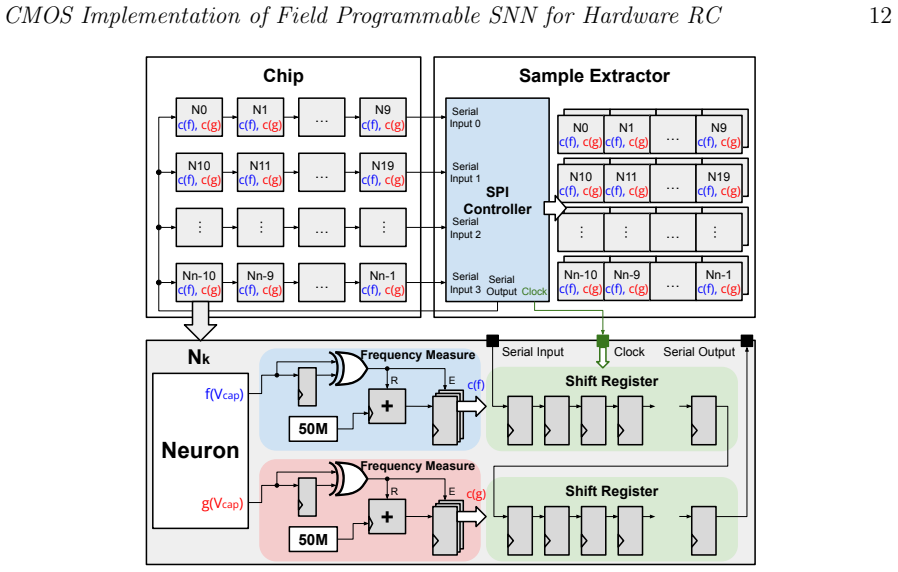
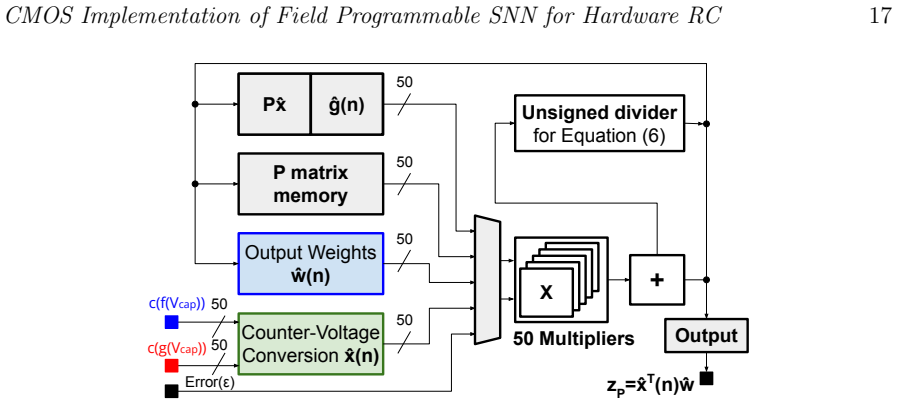
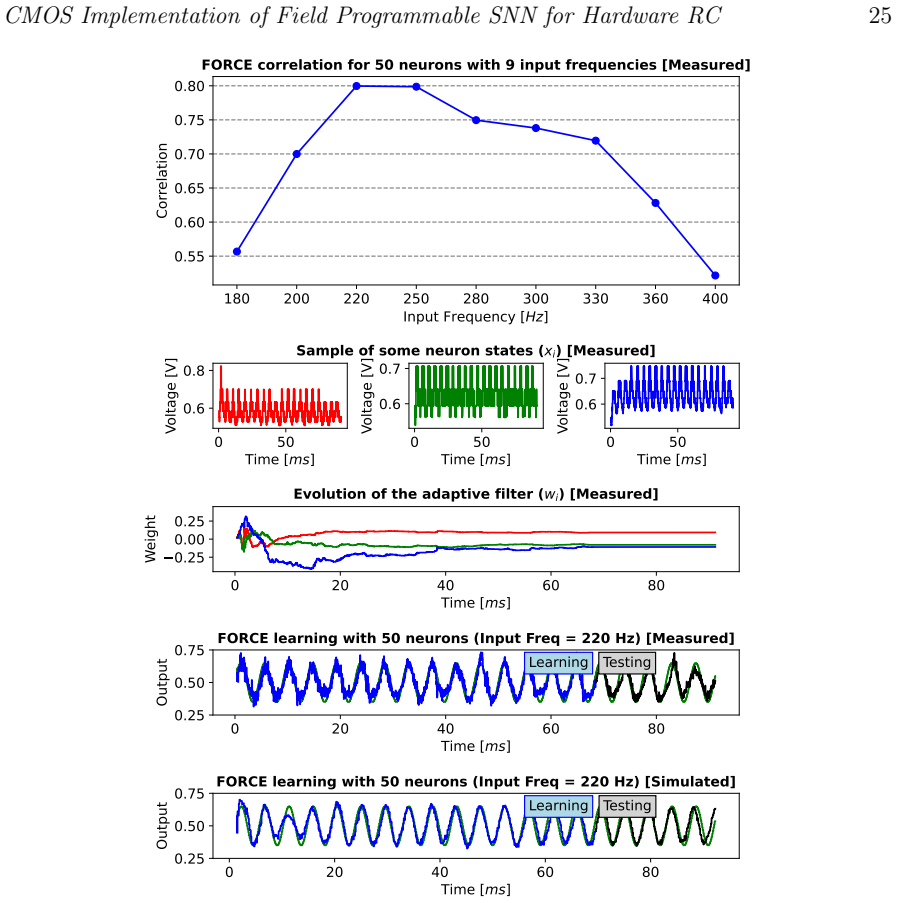
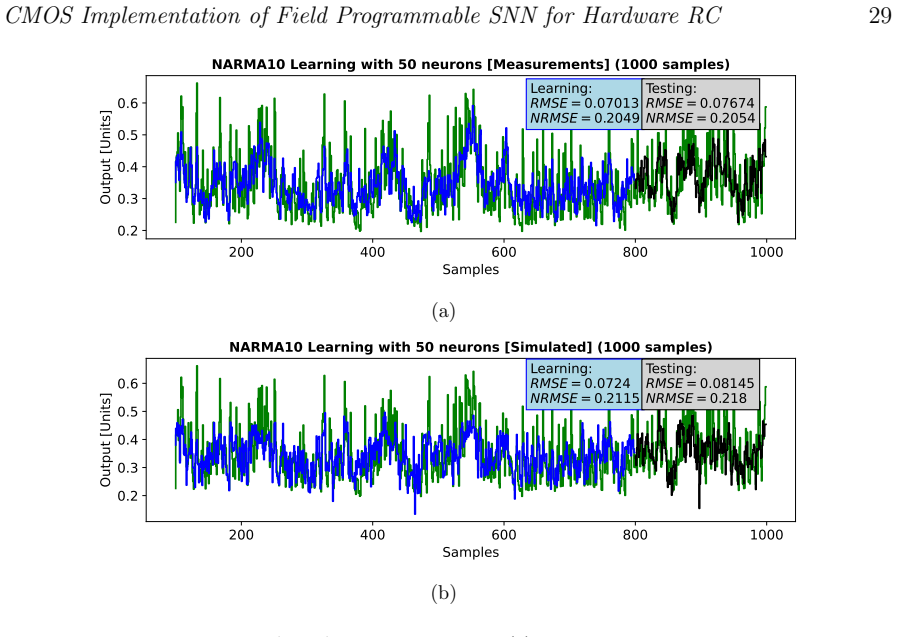
The authors demonstrate a novel CMOS-implemented field-programmable neural network architecture for hardware reservoir computing. We propose a Leaky Integrate-and-Fire neuron circuit with integrated voltage-controlled oscillators and programmable weighted interconnections via an on-chip FPGA framework, enabling arbitrary reservoir configurations. The system demonstrates effective implementation of the FORCE algorithm learning, linear and non-linear memory capacity benchmarks, and NARMA10 tasks, both in simulation and actual chip measurements, achieving compact area utilization around 540 NAND2-equivalent units and low energy consumption of 21.7 pJ/pulse without requiring ADCs.
What carries the argument
Leaky Integrate-and-Fire neuron circuit with integrated voltage-controlled oscillators combined with on-chip FPGA framework for programmable weighted interconnections that enable arbitrary reservoir configurations.
If this is right
- The architecture supports real-time learning and inference in neuromorphic systems.
- It enables system-on-chip integration for reservoir computing applications.
- The design provides high configurability and digital interfacing for scalable neuromorphic hardware.
- It delivers low-power operation suitable for edge deployment of temporal processing tasks.
Where Pith is reading between the lines
- Local hardware processing could address privacy concerns by keeping data on-device rather than sending it to remote servers.
- The absence of ADCs may simplify direct connection to digital control logic in mixed-signal systems.
- The approach could extend to other time-series prediction problems common in sensor networks if the reservoir size scales with the FPGA resources.
Load-bearing premise
The on-chip FPGA framework and LIF-VCO neuron circuits can realize arbitrary reservoir configurations with sufficient stability and low enough noise to support the reported learning performance without post-fabrication tuning or external calibration.
What would settle it
Chip measurements that fail to match simulation results on the NARMA10 task or memory capacity benchmarks without external calibration or tuning would show the central claim does not hold.
Figures









read the original abstract
The increasing complexity and energy demands of large-scale neural networks, such as Deep Neural Networks (DNNs) and Large Language Models (LLMs), challenge their practical deployment in edge applications due to high power consumption, area requirements, and privacy concerns. Spiking Neural Networks (SNNs), particularly in analog implementations, offer a promising low-power alternative but suffer from noise sensitivity and connectivity limitations. This work presents a novel CMOS-implemented field-programmable neural network architecture for hardware reservoir computing. We propose a Leaky Integrate-and-Fire (LIF) neuron circuit with integrated voltage-controlled oscillators (VCOs) and programmable weighted interconnections via an on-chip FPGA framework, enabling arbitrary reservoir configurations. The system demonstrates effective implementation of the FORCE algorithm learning, linear and non-linear memory capacity benchmarks, and NARMA10 tasks, both in simulation and actual chip measurements. The neuron design achieves compact area utilization (around 540 NAND2-equivalent units) and low energy consumption (21.7 pJ/pulse) without requiring ADCs for information readout, making it ideal for system-on-chip integration of reservoir computing. This architecture paves the way for scalable, energy-efficient neuromorphic systems capable of performing real-time learning and inference with high configurability and digital interfacing.
Editorial analysis
A structured set of objections, weighed in public.
Referee Report
Summary. The manuscript presents a CMOS implementation of a field-programmable spiking neural network for hardware reservoir computing. It uses LIF neurons integrated with VCOs for readout and an on-chip FPGA framework for programmable weighted interconnections to enable arbitrary reservoir configurations. The work reports successful demonstration of the FORCE learning algorithm, linear and non-linear memory capacity benchmarks, and NARMA10 tasks in both simulation and actual chip measurements, while emphasizing compact area utilization (540 NAND2-equivalent units) and low energy consumption (21.7 pJ/pulse) without requiring ADCs, positioning the design as suitable for system-on-chip neuromorphic integration.
Significance. If the on-chip measurements prove robust and reproducible, this architecture could meaningfully advance energy-efficient, configurable reservoir computing hardware for edge applications. The compact LIF-VCO design and FPGA-based programmability address key limitations in analog SNN implementations, offering a pathway to scalable, low-power real-time learning systems that mitigate the power and area demands of conventional DNNs.
major comments (2)
- [Abstract] Abstract: The central claim of effective chip measurements for FORCE learning, linear/non-linear memory capacity, and NARMA10 tasks is not supported by error bars, dataset sizes, or quantitative comparisons to simulation results; without these the evidence for hardware performance remains limited and potentially affected by unstated selection or calibration effects.
- [Circuit and Architecture Description] Neuron and system description: The LIF-VCO circuits and FPGA framework are presented as realizing arbitrary reservoir configurations with sufficient stability, yet no quantification of threshold mismatch, VCO jitter, or reservoir-state stability under CMOS process variation is provided; this is load-bearing for the claim that the design supports the reported learning performance without post-fabrication tuning or external calibration.
minor comments (2)
- [Abstract] The abstract and results sections would benefit from explicit statements of the CMOS process node and supply voltage used for the reported area and energy figures.
- [Results] Figure captions for measurement results should include the number of trials or runs averaged to allow assessment of variability.
Simulated Author's Rebuttal
We thank the referee for the constructive comments and the positive assessment of the work's potential. We address each major comment below and outline the revisions we will make to strengthen the presentation of the hardware results and circuit analysis.
read point-by-point responses
-
Referee: [Abstract] Abstract: The central claim of effective chip measurements for FORCE learning, linear/non-linear memory capacity, and NARMA10 tasks is not supported by error bars, dataset sizes, or quantitative comparisons to simulation results; without these the evidence for hardware performance remains limited and potentially affected by unstated selection or calibration effects.
Authors: We agree that the abstract would benefit from clearer indication of the supporting quantitative evidence. The main text already reports results from multiple experimental runs on the fabricated chip with standard deviations shown in the relevant figures and tables for the FORCE learning, memory capacity, and NARMA10 tasks. In the revised manuscript we will update the abstract to reference these details explicitly (including dataset sizes of 2000 samples per task and direct side-by-side simulation-versus-hardware metrics). All presented hardware data come from complete measurement sets without post-selection or external calibration beyond the on-chip FPGA configuration. revision: yes
-
Referee: [Circuit and Architecture Description] Neuron and system description: The LIF-VCO circuits and FPGA framework are presented as realizing arbitrary reservoir configurations with sufficient stability, yet no quantification of threshold mismatch, VCO jitter, or reservoir-state stability under CMOS process variation is provided; this is load-bearing for the claim that the design supports the reported learning performance without post-fabrication tuning or external calibration.
Authors: We concur that explicit quantification of device-level variations would reinforce the robustness claims. The architecture uses the on-chip FPGA to realize arbitrary weighted connections digitally, which inherently compensates for analog mismatches without external tuning. In the revision we will add a short subsection reporting measured VCO jitter and observed neuron-to-neuron threshold spread from the fabricated chip, together with evidence that reservoir-state stability is maintained across the demonstrated tasks. A comprehensive Monte-Carlo process-variation study, however, was not performed in the original work. revision: partial
Circularity Check
No circularity: hardware implementation and measurement report
full rationale
This is an implementation-focused paper describing a CMOS LIF-VCO neuron circuit, FPGA-programmable interconnections, and measured performance on FORCE learning, memory capacity, and NARMA10 tasks in both simulation and silicon. No derivation chain, first-principles equations, or predictions are presented that reduce claimed results to fitted parameters or self-citations by construction. Performance claims rest on direct circuit measurements and task benchmarks rather than any self-referential mathematical reduction, satisfying the self-contained criterion with no load-bearing circular steps.
Axiom & Free-Parameter Ledger
axioms (1)
- domain assumption Standard CMOS process parameters and analog circuit models hold without unexpected parasitic effects dominating the LIF and VCO dynamics.
Reference graph
Works this paper leans on
-
[1]
de Vries A 2023Joule72191–2194 ISSN 2542-4351 URL https://www.sciencedirect.com/science/article/pii/S2542435123003653
-
[2]
Maass W 1997Neural Networks101659–1671 ISSN 0893-6080 URL https://www.sciencedirect.com/science/article/pii/S0893608097000117
-
[3]
Pfeiffer M and Pfeil T 2018Frontiers in neuroscience12774
-
[4]
Merolla P A, Arthur J V, Alvarez-Icaza R, Cassidy A S, Sawada J, Akopyan F, Jackson B L, Imam N, Guo C, Nakamura Yet al.2014Science345668–673
-
[5]
Furber S B, Galluppi F, Temple S and Plana L A 2014Proceedings of the IEEE102652–665
-
[6]
Esser S K, Merolla P A, Arthur J V, Cassidy A S, Appuswamy R, Andreopoulos A, Berg D J, McKinstry J L, Melano T, Barch D R, di Nolfo C, Datta P, Amir A, Taba B, Flickner M D and Modha D S 2016Proceedings of the National Academy of Sciences113 11441–11446 (Preprinthttps://www.pnas.org/doi/pdf/10.1073/pnas.1604850113) URL https://www.pnas.org/doi/abs/10.107...
-
[7]
Pfeil T, Gr¨ ubl A, Jeltsch S, M¨ uller E, M¨ uller P, Petrovici M A, Schmuker M, Br¨ uderle D, Schemmel J and Meier K 2013Frontiers in neuroscience711
-
[8]
Moriya S, Yamamoto H, Sato S, Yuminaka Y, Horio Y and Madrenas J 2022 A fully analog cmos implementation of a two-variable spiking neuron in the subthreshold region and its network operation2022 International Joint Conference on Neural Networks (IJCNN)(IEEE) pp 1–7
work page 2022
- [9]
-
[10]
Benjamin B V, Gao P, McQuinn E, Choudhary S, Chandrasekaran A R, Bussat J M, Alvarez-Icaza R, Arthur J V, Merolla P A and Boahen K 2014Proceedings of the IEEE102699–716
-
[11]
Azghadi M R, Moradi S, Fasnacht D B, Ozdas M S and Indiveri G 2015ACM Journal on Emerging Technologies in Computing Systems (JETC)121–18
-
[12]
Qiao N, Mostafa H, Corradi F, Osswald M, Stefanini F, Sumislawska D and Indiveri G 2015 Frontiers in neuroscience9141
work page 2015
-
[13]
Mitra S, Fusi S and Indiveri G 2008IEEE transactions on biomedical circuits and systems332–42
-
[14]
Chen X, Byambadorj Z, Yajima T, Inoue H, Inoue I H and Iizuka T 2023Applied Physics Letters 122
-
[15]
Roy K, Jaiswal A and Panda P 2019Nature575607–617 ISSN 1476-4687 URL https://doi.org/10.1038/s41586-019-1677-2 CMOS Implementation of Field Programmable SNN for Hardware RC32
-
[16]
Davies M, Srinivasa N, Lin T H, Chinya G, Cao Y, Choday S H, Dimou G, Joshi P, Imam N, Jain S, Liao Y, Lin C K, Lines A, Liu R, Mathaikutty D, McCoy S, Paul A, Tse J, Venkataramanan G, Weng Y H, Wild A, Yang Y and Wang H 2018IEEE Micro3882–99
-
[17]
Joubert A, Belhadj B, Temam O and H´ eliot R 2012 Hardware spiking neurons design: Analog or digital?The 2012 International Joint Conference on Neural Networks (IJCNN)(IEEE) pp 1–5
work page 2012
-
[18]
Wijekoon J H and Dudek P 2008Neural Networks21524–534
-
[19]
Linares-Barranco B, S´ anchez-Sinencio E, Rodr´ ıguez-Vazquez ´A and Huertas J L 1991IEEE Journal of Solid-State Circuits26956–965
-
[20]
Mahowald M and Douglas R 1991Nature354515–518
-
[21]
Wu X, Saxena V, Zhu K and Balagopal S 2015IEEE Transactions on Circuits and Systems II: Express Briefs621088–1092
-
[22]
Hasan M M and Holleman J 2020 Low power compact analog spiking neuron circuit using exponential positive feedback with adaptation and bursting capability2020 IEEE 63rd International Midwest Symposium on Circuits and Systems (MWSCAS)(IEEE) pp 452–455
work page 2020
-
[23]
Tamura Y, Moriya S, Kato T, Sakuraba M, Horio Y and Sato S 2019 An izhikevich model neuron mos circuit for low voltage operationArtificial Neural Networks and Machine Learning–ICANN 2019: Theoretical Neural Computation: 28th International Conference on Artificial Neural Networks, Munich, Germany, September 17–19, 2019, Proceedings, Part I 28(Springer) pp 718–723
work page 2019
-
[24]
Yang Z, Huang Y, Zhu J and Ye T T 2020 Analog circuit implementation of lif and stdp models for spiking neural networksProceedings of the 2020 on Great Lakes Symposium on VLSIpp 469–474
work page 2020
-
[25]
Farquhar E and Hasler P 2005IEEE Transactions on Circuits and Systems I: Regular Papers52 477–488
-
[26]
Wang R, Thakur C S, Hamilton T J, Tapson J and van Schaik A 2015 A compact avlsi conductance- based silicon neuron2015 IEEE Biomedical Circuits and Systems Conference (BioCAS)(IEEE) pp 1–4
work page 2015
-
[27]
Soriano M C, Ort´ ın S, Keuninckx L, Appeltant L, Danckaert J, Pesquera L and Van der Sande G 2014IEEE transactions on neural networks and learning systems26388–393
-
[28]
Jaeger H 2001Bonn, Germany: German National Research Center for Information Technology GMD Technical Report14813
-
[29]
Lukoˇ seviˇ cius M and Jaeger H 2009Computer science review3127–149
-
[30]
Vlachas P R, Pathak J, Hunt B R, Sapsis T P, Girvan M, Ott E and Koumoutsakos P 2020Neural Networks126191–217
-
[31]
Appeltant L, Soriano M C, Van der Sande G, Danckaert J, Massar S, Dambre J, Schrauwen B, Mirasso C R and Fischer I 2011Nature communications2468
-
[32]
Zhao C, Li J, Liu L, Koutha L S, Liu J and Yi Y 2016 Novel spike based reservoir node design with high performance spike delay loopProceedings of the 3rd ACM International Conference on Nanoscale Computing and Communicationpp 1–5
work page 2016
-
[33]
Express252401–2412 URL https://opg.optica.org/oe/abstract.cfm?URI=oe-25-3-2401
Bueno J, Brunner D, Soriano M C and Fischer I 2017Opt. Express252401–2412 URL https://opg.optica.org/oe/abstract.cfm?URI=oe-25-3-2401
-
[34]
Duport F, Schneider B, Smerieri A, Haelterman M and Massar S 2012Optics express2022783– 22795
-
[35]
Paquot Y, Duport F, Smerieri A, Dambre J, Schrauwen B, Haelterman M and Massar S 2012 Scientific reports2287
work page 2012
-
[36]
Martinenghi R, Rybalko S, Jacquot M, Chembo Y K and Larger L 2012Physical review letters 108244101
-
[37]
Kanao T, Suto H, Mizushima K, Goto H, Tanamoto T and Nagasawa T 2019Physical Review Applied12024052
-
[38]
Nakane R, Hirose A and Tanaka G 2021Physical Review Research3033243
-
[39]
Toprasertpong K, Nako E, Wang Z, Nakane R, Takenaka M and Takagi S 2022Communications CMOS Implementation of Field Programmable SNN for Hardware RC33 Engineering121
-
[40]
Du C, Cai F, Zidan M A, Ma W, Lee S H and Lu W D 2017Nature communications82204
-
[41]
Moon J, Ma W, Shin J H, Cai F, Du C, Lee S H and Lu W D 2019Nature Electronics2480–487
-
[42]
Zhong Y, Tang J, Li X, Liang X, Liu Z, Li Y, Xi Y, Yao P, Hao Z, Gao Bet al.2022Nature Electronics5672–681
-
[43]
Fernando C and Sojakka S 2003 Pattern recognition in a bucketEuropean conference on artificial life(Springer) pp 588–597
work page 2003
- [44]
-
[45]
Liang X, Zhong Y, Tang J, Liu Z, Yao P, Sun K, Zhang Q, Gao B, Heidari H, Qian Het al.2022 Nature communications131549
work page 2022
-
[46]
Zhang W, Gao B, Tang J, Yao P, Yu S, Chang M F, Yoo H J, Qian H and Wu H 2020Nature Electronics3371–382 ISSN 2520-1131 URLhttps://doi.org/10.1038/s41928-020-0435-7
-
[47]
Tanaka G, Yamane T, H´ eroux J B, Nakane R, Kanazawa N, Takeda S, Numata H, Nakano D and Hirose A 2019Neural Networks115100–123
-
[48]
Abe Y, Nakada K, Hagiwara N, Suzuki E, Suda K, Mochizuki S i, Terasaki Y, Sasaki T and Asai T 2024Scientific Reports1410966 ISSN 2045-2322 URL https://doi.org/10.1038/s41598-024-61880-z
-
[49]
Shafiee A, Nag A, Muralimanohar N, Balasubramonian R, Strachan J P, Hu M, Williams R S and Srikumar V 2016 Isaac: A convolutional neural network accelerator with in-situ analog arithmetic in crossbars2016 ACM/IEEE 43rd Annual International Symposium on Computer Architecture (ISCA)pp 14–26
work page 2016
-
[50]
Li C, Hu M, Li Y, Jiang H, Ge N, Montgomery E, Zhang J, Song W, D´ avila N, Graves C E, Li Z, Strachan J P, Lin P, Wang Z, Barnell M, Wu Q, Williams R S, Yang J J and Xia Q 2018Nature Electronics152–59 ISSN 2520-1131 URLhttps://doi.org/10.1038/s41928-017-0002-z
- [51]
-
[52]
Jaeger H 2001 Short term memory in echo state networks URL https://publica.fraunhofer.de/handle/publica/291107
work page 2001
-
[53]
Dambre J, Verstraeten D, Schrauwen B and Massar S 2012Scientific Reports2514 ISSN 2045-2322 URLhttps://doi.org/10.1038/srep00514
-
[54]
Atiya A and Parlos A 2000IEEE Transactions on Neural Networks11697–709
-
[55]
Nicola W and Clopath C 2017Nature Communications82208 ISSN 2041-1723 URL https://doi.org/10.1038/s41467-017-01827-3
-
[56]
Jaeger H 2012 Long short-term memory in echo state networks: Details of a simulation study Tech. rep. Jacobs University Bremen
work page 2012
-
[57]
Caluwaerts K, Wyffels F, Dieleman S and Schrauwen B 2013 The spectral radius remains a valid indicator of the echo state property for large reservoirsThe 2013 International Joint Conference on Neural Networks (IJCNN)pp 1–6
work page 2013
-
[58]
Nicola W and Clopath C 2017Nature communications82208
-
[59]
Tang X, Giacomin E, Chauviere B, Alacchi A and Gaillardon P E 2020IEEE Micro4041–48
-
[60]
Rose J, Luu J, Yu C W, Densmore O, Goeders J, Somerville A, Kent K B, Jamieson P and Anderson J 2012 The VTR project: architecture and CAD for FPGAs from verilog to routingProceedings of the ACM/SIGDA International Symposium on Field Programmable Gate ArraysFPGA ’12 (New York, NY, USA: Association for Computing Machinery) p 77–86 ISBN 9781450311557 URLhtt...
-
[61]
Luu J, Goeders J, Wainberg M, Somerville A, Yu T, Nasartschuk K, Nasr M, Wang S, Liu T, Ahmed N, Kent K B, Anderson J, Rose J and Betz V 2014ACM Trans. Reconfigurable Technol. Syst.7ISSN 1936-7406 URLhttps://doi.org/10.1145/2617593
-
[62]
Sussillo D and Abbott L F 2009Neuron63544–557 CMOS Implementation of Field Programmable SNN for Hardware RC34
-
[63]
Haykin S 2002Adaptative Filter Theory(Upper Saddle River: Prentice Hall))
-
[64]
Terasic Technologies Inc 2015TR4 User ManualTerasic
-
[65]
K¨ oster F, Ehlert D and L¨ udge K 2020Cognitive Computation151419–1426 ISSN 1866-9964 URL http://dx.doi.org/10.1007/s12559-020-09733-5
-
[66]
Rodan A and Tino P 2011IEEE Transactions on Neural Networks22131–144
discussion (0)
Sign in with ORCID, Apple, or X to comment. Anyone can read and Pith papers without signing in.