REVIEW 3 major objections 6 minor 1 cited by
Dark Matter and CP Violation in Some Symmetry-Constrained 3HDMs
T0 review · 3 major / 6 minor · reviewed 2026-08-07 · deepseek-v4-flash
Pith's one-line read The $S_3$-symmetric three-Higgs-doublet model, after all constraints, leaves a viable dark matter candidate in the 28.9–41.9 GeV window and none above about 500 GeV.
desk verdict A careful thesis compiling four peer-reviewed 3HDM papers, but the advertised DM window is halo-profile dependent and the author says so. read the letter →
The pith
A machine-rendered reading of the paper's core claim, the machinery that carries it, and where it could break.
The reading
What carries the argument
The load-bearing object is the $S_3$-symmetric three-Higgs-doublet scalar potential, written in irreducible representations (one singlet, one pseudosinglet, one doublet) and organised into vacuum implementations labelled by their real or complex character, such as R-II-1a, C-III-a and C-V. The symmetry reduces the number of free couplings, and where a remnant $Z_2$ survives spontaneous symmetry breaking it protects one inert doublet as the dark matter candidate; the paper's mass predictions follow from scanning the constrained parameter space. For continuous symmetries, the analogous stabiliser is an unbroken $U(1)\times U(1)$, which the paper shows forces mass-degenerate neutral states and gives two independent inert sectors, the origin of the multi-component dark matter.
What would settle it
For the C-III-a model, compute the annihilation cross section of the 28.9–41.9 GeV candidate into Standard Model states for the surviving parameter points and compare with gamma-ray limits on dwarf spheroidal galaxies assuming a standard cuspy halo profile: if the predicted flux exceeds the observed upper limit, the claimed viable window is excluded. For the $U(1)\times U(1)$ model, a falsifying observation would be a dark sector with only one stable component and no second mass scale, or a scalar spectrum without the predicted mass-degenerate neutral states.
Extended reading notes
Core claim
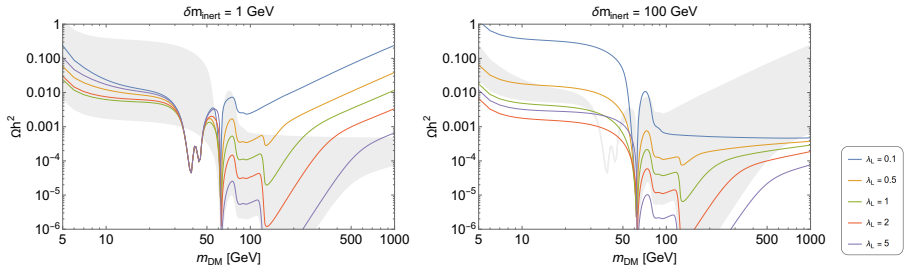
The central claim is that the symmetry-constrained scalar sector does most of the model-building work, so that dark matter masses are not scanned over freely but are predicted by the implementation. After applying perturbativity, stability, unitarity, electroweak oblique-parameter and experimental constraints in the C-III-a implementation of the $S_3$-symmetric 3HDM, the viable dark matter region lies between about 28.9 and 41.9 GeV; the thesis attributes the absence of heavy candidates above about 500 GeV to the symmetry making some scalar interactions proportional to masses rather than free parameters. In the $U(1)\times U(1)$-symmetric 3HDM, the unbroken continuous symmetry stabilises two inert scalar sectors, giving multi-component dark matter with two independent mass scales and numerically allowed masses from about 45 GeV to 2000 GeV, with the decays of heavier inert states into lighter ones adjustable and able to shift the relic density. On the CP side, the paper claims that different $S_3$ assignments for quarks and different vacuum structures produce distinct CP phenomenology, that spontaneous CP violation arises in real-coupling vacua, and that the most general complex vacuum (C-V) can generate the CKM matrix from vacuum phases without unwanted massless scalars while allowing very light neutral scalars.
Load-bearing premise
The load-bearing premise is that the dark matter halo density profile used for indirect-detection bounds is the right one, since the thesis concedes that with a different halo profile the C-III-a model can be completely ruled out.
Editorial extensions
If this is right
- If the C-III-a result holds, dark matter should be a light scalar of mass 28.9–41.9 GeV, below the usual inert-doublet window and potentially invisible to collider and indirect searches depending on the halo profile.
- The $S_3$ implementations predict the absence of heavy dark matter above about 500 GeV, so a confirmed heavy thermal candidate would distinguish them from the Inert Doublet Model.
- In the $U(1)\times U(1)$ 3HDM, dark matter must be multi-component with two mass scales between about 45 GeV and 2000 GeV, and the heavier component's decays into the lighter one can change the relic density.
- The CP-violating C-V vacuum offers a way to generate the CKM phase from vacuum expectation values with no massless scalars, and permits O(MeV) neutral scalars that may evade detection while affecting cosmology or rare decays.
Reading between the lines
- A direct extension: the 28.9–41.9 GeV window gives a concrete target for low-threshold direct-detection experiments and for Higgs invisible-width measurements; a null result in both would effectively shift the burden onto the halo-profile assumption.
- The pattern that symmetry makes some scalar couplings proportional to masses may be generic: other tightly constrained multi-doublet scalar sectors could similarly exclude heavy thermal WIMPs, not by tuning but by symmetry alone.
- If astronomical data ever fixes the Milky Way halo profile, the C-III-a window would become a sharp yes/no test of the model, converting what is now an astrophysical input into a discovery or exclusion channel.
- For the $U(1)\times U(1)$ model, multi-component dark matter with two mass scales could be probed by structure-formation observables such as small-scale clustering differences between the two components, which the paper does not calculate.
Editorial analysis
A structured set of objections, weighed in public.
Referee Report
Summary. This is a PhD-thesis-style arXiv posting (hep-ph) that compiles four of the author's peer-reviewed papers on three-Higgs-doublet models (JHEP 2022, PRD 2022, JHEP 2023, JHEP 2024). In a unified notation it develops the S3-symmetric 3HDM scalar potential, its vacuum taxonomy (real/complex vacua with real/complex couplings; explicit versus spontaneous CP violation; accidental continuous symmetries; fermion assignments under S3), and a numerical dark-matter analysis of two implementations, R-II-1a (real vacuum) and C-III-a (complex vacuum). The headline results are a 'viable' dark-matter mass window of 28.9–41.9 GeV in C-III-a after theoretical and experimental cuts, the absence of dark-matter candidates heavier than about 500 GeV in the S3 implementations (attributed to mass–coupling proportionality), and, in the continuous-symmetry part, a classification of 3HDM stabilizations with a numerical study of the U(1)xU(1) model proposing a two-component dark sector with masses from about 45 GeV to 2000 GeV. A third theme is CP violation through the C-V vacuum, which can generate the CKM phase without unwanted massless scalars and can accommodate O(MeV) neutral scalars.
Significance. If the claims hold, the thesis provides a comprehensive, symmetry-constrained classification of 3HDM vacua with several falsifiable predictions: a light dark-matter window (28.9–41.9 GeV) distinct from typical inert-doublet ranges, a structurally motivated absence of dark matter above roughly 500 GeV in the S3 implementations, and a two-scale multi-component dark-matter spectrum in the U(1)xU(1) model, with mass-degenerate states as a model-discriminating signature. The strengths are the systematic and transparent taxonomy of vacua, the careful identification of which configurations yield explicit versus spontaneous CP violation (including a C-V solution with no massless scalars), and the honest disclosure in the Preface of the halo-profile sensitivity of the indirect-detection bounds. The numerical pipeline is standard (potential minimization, mass-squared matrices, freeze-out relic density, perturbativity/stability/unitarity/oblique cuts) and the constituent results have passed peer review in JHEP and PRD; the thesis-level added value is the synthesis and the comparative claims. The principal weakness is the conditional character of the headline mass window, discussed below.
major comments (3)
- [Preface, p. xii; Abstract] The headline claim of the Preface—'a viable dark matter mass region was identified between approximately 28.9–41.9 GeV' for the C-III-a implementation—is not robust to the assumed dark-matter halo density profile, and the manuscript itself immediately concedes that 'depending on the dark matter halo distribution profile applied to the indirect dark matter detection constraints, this model may be completely ruled out.' The indirect-detection constraints enter as Cut 3 of the numerical pipeline (§6.5.3) and are computed from dwarf-spheroidal J-factors, which differ by roughly an order of magnitude among the standard profiles (NFW, Einasto, cored). In the material available to this reader, no fiducial profile is identified for the stated window, and no scan or marginalization over this uncertainty is presented. Because the window is also the basis of the abstract's comparative claim of 'different dark matter mass ranges,' it must be either explicitly conditioned on the assumed profile (naming the profile and showing the resulting constraint curve) or supplemented by a sensitivity scan over standard profiles. Pending that, the wording 'viable dark matter mass region' overstates the result; a formulation such as 'viable for the adopted benchmark halo profile' would correctly convey its status. Please also clarify whether direct-detection bounds, which are typically decisive for a 30–40 GeV candidate with Higgs-mediated scattering, are included among the applied constraints and, if so, where they are described.
- [Preface, p. xii; §6.2–§6.5] The second headline claim—the 'lack of heavy dark matter candidates—typically heavier than 500 GeV in the Inert DoubleT Model' in both S3 implementations—is attributed to the structural property that 'some of the scalar interactions [are] proportional to masses rather than being free parameters.' This proportionality is a strong, falsifiable statement and is the thesis's justification for why the S3 models differ from the Inert Doublet Model, but the Preface never points to the specific relation. The relevant couplings should be exhibited explicitly (identifying which quartic couplings in §§6.2–6.4 are fixed in terms of physical masses by the S3-symmetric potential and its vacuum) and, ideally, their effect on the annihilation cross section should be shown. Alternatively, the claim should be softened to a numerical observation of the scanned parameter space. It would also strengthen the analysis to demonstrate that m_DM > 500 GeV is excluded by the physics (e.g., over-abundance for the mass-proportional couplings) rather than by the boundary of the scan performed in §6.5; a plot of the relic density versus m_DM through the heavy region would settle this.
- [Preface, p. xiii; §7.14–§7.15] The continuous-symmetry claim—a multi-component dark sector in the U(1)xU(1) 3HDM with 'two independent mass scales' and allowed masses 'from about 45 GeV up to 2000 GeV'—needs a more precise statement of the relic-density computation. If the stabilizing U(1)xU(1) symmetry is exact, the lightest states of both sectors are absolutely stable and the final abundances are set by a coupled two-component Boltzmann system. The Preface's statement that 'the decays of the heavier inert states into the lighter ones ... can be adjusted, potentially altering the predicted relic density' is ambiguous as written, since a stable heavier state cannot decay into the lighter sector; the relevant processes must be number-changing or semi-annihilation reactions whose rates are controlled by specific quartic couplings. The thesis should name those processes, state which assumption fixes the relative abundances of the two stable species, and present the 45–2000 GeV range together with the assumption under which it is obtained, so the reader can distinguish a parameter-space statement from a robust prediction.
minor comments (6)
- [§1.1] The sentence 'Apart from the spin-one gauge bosons, there are spin-one bosons. These are referred to as scalar bosons' should read 'spin-zero bosons'; as printed, the sentence is self-contradictory.
- [Introduction, first paragraph] The sentence 'Among the simplest extensions capable of addressing many of its shortcomings the multi-Higgs-doublet models' is a fragment and is missing the verb 'are.'
- [§1.7.6 and §1.7.7] Equations (1.7.58) and (1.7.73), and the surrounding discussion of the Lee–Quigg–Thacker bound, contain corrupted square-root symbols ('/radicaltp/radicalvertex/radicalvertex√') in the posted version, so the decay width and the bounds (about 1008 GeV and about 713 GeV) are unreadable; the document should be regenerated from the LaTeX source so that the radicals render properly.
- [§2.2] The sentence introducing eq. (2.2.5)—'Let us consider a particle with mass m_χ^{-2} ~ <sigma_ann v>'—is dimensionally inconsistent with the relation that follows (rho_chi/rho ~ x/(M_Planck m_chi <sigma v>)); the intended scaling should be corrected so that the text and the equation agree.
- [§3.6] The remark after eq. (3.6.19)—'Notice that in the first line we want a new doublet to be invariant under the action of D2(a), i.e., "it" does not hold information about being constructed out of the pseudosinglet representation'—is unclear and should be rephrased.
- [Figure 2.1 caption] The caption of Figure 2.1 contains a typo: 'temeprature' should be 'temperature.'
Circularity Check
No circularity: the dark matter mass windows are outputs of an externally benchmarked parameter scan, not fits to the claimed ranges; the halo-profile caveat is a robustness issue, not a circular reduction.
full rationale
The thesis's central claims are parameter-space statements about S3-symmetric and U(1)xU(1)-symmetric 3HDMs. The scalar potentials, minimization conditions, mass-squared matrices, and interaction vertices are derived within the thesis (Chapters 5-7), and the relic-density target is the external Planck measurement. The constraints applied (perturbativity, stability, unitarity, oblique parameters, direct and indirect detection) are standard external benchmarks. The 28.9-41.9 GeV window for C-III-a is presented as an output of a scan with cuts, not as a parameter fitted to that window, so no fitted input is renamed as a prediction. The Preface's explicit concession that 'depending on the dark matter halo distribution profile applied to the indirect dark matter detection constraints, this model may be completely ruled out' identifies an astrophysical modeling sensitivity that sits between the scalar-sector calculation and the viability statement; it is a robustness caveat, not a circular reduction, because the scalar-sector calculation itself does not assume the window. Self-citation is present (the thesis is based on four of the author's papers), but the numerical analyses and mass matrices are substantially reproduced in the thesis itself, and no load-bearing step reduces to an unverified self-citation. No equation is exhibited that equals its input by construction, and no parameter is fitted to the claimed mass ranges. Therefore no significant circularity is found.
Assumptions & free parameters
free parameters (3)
- Scalar quartic couplings lambda_i of the S3-symmetric potential =
scanned ranges (values in Chs. 5-6)
- Bilinear mass parameters mu^2_i of the scalar potential =
scanned ranges
- Yukawa representation assignments and vacuum phases =
S3 singlet/doublet choices and complex phases
assumptions (4)
- domain assumption Standard freeze-out thermal relic formalism (Boltzmann equation) determines the dark matter abundance
- domain assumption The classified vacuum implementations are the relevant global minima of the S3-symmetric potential
- standard math S3 representation theory (character table, tensor products, invariant construction as developed in Ch. 3)
- domain assumption Renormalizable dimension-4 scalar potential and standard CP classification (explicit versus spontaneous)
Cite this review
Pith. "Pith review of Dark Matter and CP Violation in Some Symmetry-Constrained 3HDMs." pith.science (2026). https://pith.science/paper/ZFJXZT6R
@misc{pith2026250608197,
  author       = {Pith},
  title        = {Pith review of: Dark Matter and CP Violation in Some Symmetry-Constrained 3HDMs},
  year         = {2026},
  howpublished = {\url{https://pith.science/paper/ZFJXZT6R}},
  note         = {Machine review of arXiv:2506.08197}
}
abstract
Multi-Higgs-doublet models can accommodate a dark matter candidate. An underlying symmetry not only ensures the candidate's stability but also helps control the number of free parameters. We consider two scenarios. First, we explore dark matter candidates in the $S_3$-symmetric three-Higgs-doublet model. Notably, our findings reveal that the cases we discuss allow for different dark matter mass ranges compared to other candidates within three-Higgs-doublet models. Additionally, we investigate an alternative to conventional stabilisation via discrete symmetries by examining stabilisation through continuous symmetries. This alternative approach exhibits a unique characteristic-the emergence of mass-degenerate states. We also explore the impact of CP violation in the $S_3$-symmetric three-Higgs-doublet model. Our analysis investigates how different representations of quarks under the $S_3$ group, combined with various vacuum configurations, lead to distinct phenomenological consequences, including the possibility of very light neutral scalars.
Figures


Figures from the paper (33 more)




Forward citations
Cited by 1 Pith paper
-
The Hilbert Series and the Flavor Invariants of the 3HDM
The full multigraded Hilbert series of the 3HDM is computed in closed form, and a basis of SU(3)-invariant operators is constructed up to cubic order in the quartic couplings.
Reference graph
Works this paper leans on
-
[1]
D. Emmanuel-Costa, O. M. Ogreid, P. Osland and M. N. Rebelo,Spontaneous symmetry breaking in theS 3-symmetric scalar sector,JHEP02(2016) 154, [1601.04654]
arXiv 2016
- [2]
-
[3]
Navas et al.,Review of particle physics,Phys
S. Navas et al.,Review of particle physics,Phys. Rev. D110(2024) 030001
2024
-
[4]
J. R. Andersen et al.,Handbook of LHC Higgs Cross Sections: 3. Higgs Properties, 1307.1347. [5]A detailed map of Higgs boson interactions by the ATLAS experiment ten years after the discovery,Nature607(2022) 52–59, [2207.00092]. [6]A portrait of the Higgs boson by the CMS experiment ten years after the discovery, Nature607(2022) 60–68, [2207.00043]
arXiv 2022
-
[7]
Planck image gallery
P. Collaboration, “Planck image gallery. ” https://www.cosmos.esa.int/web/planck/picture-gallery, July 2018
2018
-
[8]
B. D. Fields, K. A. Olive, T.-H. Yeh and C. Young,Big-Bang Nucleosynthesis after Planck,JCAP03(2020) 010, [1912.01132]
arXiv 2020
-
[9]
A. Kunˇ cinas, O. M. Ogreid, P. Osland and M. N. Rebelo,Complex S 3-symmetric 3HDM,JHEP07(2023) 013, [2302.07210]
arXiv 2023
-
[10]
A. Belyaev, G. Cacciapaglia, I. P. Ivanov, F. Rojas-Abatte and M. Thomas, Anatomy of the Inert Two Higgs Doublet Model in the light of the LHC and non-LHC Dark Matter Searches,Phys. Rev.D97(2018) 035011, [1612.00511]
arXiv 2018
Show all 299 references
-
[11]
Kalinowski, W
J. Kalinowski, W. Kotlarski, T. Robens, D. Sokolowska and A. F. Zarnecki, Benchmarking the Inert Doublet Model fore +e− colliders,JHEP12(2018) 081, [1809.07712]
2018 arXiv
-
[12]
Merchand and M
M. Merchand and M. Sher,Constraints on the Parameter Space in an Inert Doublet Model with two Active Doublets,JHEP03(2020) 108, [1911.06477]
2020 arXiv
-
[13]
V. Keus, S. F. King, S. Moretti and D. Sokolowska,Dark Matter with Two Inert Doublets plus One Higgs Doublet,JHEP11(2014) 016, [1407.7859]. 242
2014 arXiv
-
[14]
V. Keus, S. F. King and S. Moretti,Phenomenology of the inert (2+1) and (4+2) Higgs doublet models,Phys. Rev. D90(2014) 075015, [1408.0796]
2014 arXiv
-
[15]
V. Keus, S. F. King, S. Moretti and D. Sokolowska,Observable Heavy Higgs Dark Matter,JHEP11(2015) 003, [1507.08433]
2015 arXiv
-
[16]
Cordero, J
A. Cordero, J. Hernandez-Sanchez, V. Keus, S. F. King, S. Moretti, D. Rojas et al.,Dark Matter Signals at the LHC from a 3HDM,JHEP05(2018) 030, [1712.09598]
2018 arXiv
-
[17]
A. Dey, V. Keus, S. Moretti and C. Shepherd-Themistocleous,A smoking gun signature of the 3HDM,JHEP07(2024) 038, [2310.06593]
2024 arXiv
-
[18]
Cordero-Cid, J
A. Cordero-Cid, J. Hern´ andez-S´ anchez, V. Keus, S. F. King, S. Moretti, D. Rojas et al.,CP violating scalar Dark Matter,JHEP12(2016) 014, [1608.01673]
2016 arXiv
-
[19]
Cordero-Cid, J
A. Cordero-Cid, J. Hern´ andez-S´ anchez, V. Keus, S. Moretti, D. Rojas and D. Soko/suppress lowska,Lepton collider indirect signatures of dark CP-violation,Eur. Phys. J. C80(2020) 135, [1812.00820]
2020 arXiv
-
[20]
Cordero-Cid, J
A. Cordero-Cid, J. Hern´ andez-S´ anchez, V. Keus, S. Moretti, D. Rojas-Ciofalo and D. Soko/suppress lowska,Collider signatures of darkCP-violation,Phys. Rev. D101(2020) 095023, [2002.04616]
2020 arXiv
-
[21]
R. Boto, P. N. Figueiredo, J. C. Romao and J. P. Silva,Novel two component dark matter features in the Z 2 ×Z 2 3HDM,JHEP11(2024) 108, [2407.15933]
2024 arXiv
-
[22]
Aranda, D
A. Aranda, D. Hern´ andez-Otero, J. Hern´ andez-Sanchez, V. Keus, S. Moretti, D. Rojas-Ciofalo et al.,Z 3 symmetric inert ( 2+1 )-Higgs-doublet model,Phys. Rev. D103(2021) 015023, [1907.12470]
2021 arXiv
-
[23]
Hern´ andez-Otero, J
D. Hern´ andez-Otero, J. Hern´ andez-S´ anchez, S. Moretti and T. Shindou,TheZ3 soft breaking in the I(2+1)HDM and its probes at present and future colliders, 2203.06323
-
[24]
Khater, A
W. Khater, A. Kunˇ cinas, O. M. Ogreid, P. Osland and M. N. Rebelo,Dark matter in three-Higgs-doublet models with S 3 symmetry,JHEP01(2022) 120, [2108.07026]
2022 arXiv
-
[25]
Kunˇ cinas, O
A. Kunˇ cinas, O. M. Ogreid, P. Osland and M. N. Rebelo,Dark matter in a CP-violating three-Higgs-doublet model with S3 symmetry,Phys. Rev. D106 (2022) 075002, [2204.05684]
2022 arXiv
-
[26]
Kunˇ cinas, P
A. Kunˇ cinas, P. Osland and M. N. Rebelo,U(1)-charged Dark Matter in three-Higgs-doublet models,JHEP11(2024) 086, [2408.02728]
2024 arXiv
-
[27]
Aad et al.,CPProperties of Higgs Boson Interactions with Top Quarks in the t¯tHandtHProcesses UsingH→γγwith the ATLAS Detector,Phys
G. Aad et al.,CPProperties of Higgs Boson Interactions with Top Quarks in the t¯tHandtHProcesses UsingH→γγwith the ATLAS Detector,Phys. Rev. Lett. 125(2020) 061802, [2004.04545]. 243
2020 arXiv
-
[28]
Tumasyan et al.,Analysis of theCPstructure of the Yukawa coupling between the Higgs boson andτleptons in proton-proton collisions at √s= 13 TeV,JHEP 06(2022) 012, [2110.04836]
A. Tumasyan et al.,Analysis of theCPstructure of the Yukawa coupling between the Higgs boson andτleptons in proton-proton collisions at √s= 13 TeV,JHEP 06(2022) 012, [2110.04836]
2022 arXiv
-
[29]
Kunˇ cinas, O
A. Kunˇ cinas, O. M. Ogreid, P. Osland and M. N. Rebelo,Revisiting two dark matter candidates inS 3-symmetric three-Higgs-doublet models,PoS DISCRETE2022(2024) 031, [2301.12194]
2024 arXiv
-
[31]
Aalbers et al.,Dark Matter Search Results from 4.2 Tonne-Years of Exposure of the LUX-ZEPLIN (LZ) Experiment,2410.17036
J. Aalbers et al.,Dark Matter Search Results from 4.2 Tonne-Years of Exposure of the LUX-ZEPLIN (LZ) Experiment,2410.17036
-
[32]
Aprile et al.,Projected WIMP sensitivity of the XENONnT dark matter experiment,JCAP11(2020) 031, [2007.08796]
E. Aprile et al.,Projected WIMP sensitivity of the XENONnT dark matter experiment,JCAP11(2020) 031, [2007.08796]
2020 arXiv
-
[33]
I. P. Ivanov, private communication
-
[34]
Aad et al.,Observation of a new particle in the search for the Standard Model Higgs boson with the ATLAS detector at the LHC,Phys
G. Aad et al.,Observation of a new particle in the search for the Standard Model Higgs boson with the ATLAS detector at the LHC,Phys. Lett. B716(2012) 1–29, [1207.7214]
2012 arXiv
-
[35]
Chatrchyan et al.,Observation of a New Boson at a Mass of 125 GeV with the CMS Experiment at the LHC,Phys
S. Chatrchyan et al.,Observation of a New Boson at a Mass of 125 GeV with the CMS Experiment at the LHC,Phys. Lett. B716(2012) 30–61, [1207.7235]
2012 arXiv
-
[36]
P. A. M. Dirac,Quantum theory of emission and absorption of radiation,Proc. Roy. Soc. Lond. A114(1927) 243
1927
-
[37]
P. A. M. Dirac,The quantum theory of the electron,Proc. Roy. Soc. Lond. A117 (1928) 610–624
1928
-
[38]
P. A. M. Dirac,A Theory of Electrons and Protons,Proc. Roy. Soc. Lond. A126 (1930) 360–365
1930
-
[39]
P. A. M. Dirac,Quantised singularities in the electromagnetic field,,Proc. Roy. Soc. Lond. A133(1931) 60–72
1931
-
[40]
Weyl,Gravitation and the electron,Proceedings of the National Academy of Sciences15(1929) 323–334
H. Weyl,Gravitation and the electron,Proceedings of the National Academy of Sciences15(1929) 323–334
1929
-
[41]
C. D. Anderson,The Positive Electron,Phys. Rev.43(1933) 491–494
1933
-
[42]
Yang and R
C.-N. Yang and R. L. Mills,Conservation of Isotopic Spin and Isotopic Gauge Invariance,Phys. Rev.96(1954) 191–195
1954
-
[43]
S. L. Glashow,The renormalizability of vector meson interactions,Nucl. Phys.10 (1959) 107–117
1959
-
[44]
Salam and J
A. Salam and J. C. Ward,Weak and electromagnetic interactions,Nuovo Cim.11 (1959) 568–577. 244
1959
-
[45]
S. L. Glashow,Partial Symmetries of Weak Interactions,Nucl. Phys.22(1961) 579–588
1961
-
[46]
Englert and R
F. Englert and R. Brout,Broken Symmetry and the Mass of Gauge Vector Mesons,Phys. Rev. Lett.13(1964) 321–323
1964
-
[47]
P. W. Higgs,Broken Symmetries and the Masses of Gauge Bosons,Phys. Rev. Lett.13(1964) 508–509
1964
-
[48]
G. S. Guralnik, C. R. Hagen and T. W. B. Kibble,Global Conservation Laws and Massless Particles,Phys. Rev. Lett.13(1964) 585–587
1964
-
[49]
Weinberg,A Model of Leptons,Phys
S. Weinberg,A Model of Leptons,Phys. Rev. Lett.19(1967) 1264–1266
1967
-
[50]
Salam,Weak and Electromagnetic Interactions,Conf
A. Salam,Weak and Electromagnetic Interactions,Conf. Proc. C680519(1968) 367–377
1968
-
[51]
Yukawa,On the Interaction of Elementary Particles I,Proc
H. Yukawa,On the Interaction of Elementary Particles I,Proc. Phys. Math. Soc. Jap.17(1935) 48–57
1935
-
[52]
C. M. G. Lattes, H. Muirhead, G. P. S. Occhialini and C. F. Powell,Processes Involving Charged Mesons,Nature159(1947) 694–697
1947
-
[53]
Gell-Mann,A Schematic Model of Baryons and Mesons,Phys
M. Gell-Mann,A Schematic Model of Baryons and Mesons,Phys. Lett.8(1964) 214–215
1964
-
[54]
Zweig,An SU(3) model for strong interaction symmetry and its breaking
G. Zweig,An SU(3) model for strong interaction symmetry and its breaking. Version 1. 1, 1964. 10.17181/CERN-TH-401
1964 doi
-
[55]
Zweig,An SU(3) model for strong interaction symmetry and its breaking
G. Zweig,An SU(3) model for strong interaction symmetry and its breaking. Version 2. 2, 1964. 10.17181/CERN-TH-412
1964 doi
-
[56]
Fritzsch, M
H. Fritzsch, M. Gell-Mann and H. Leutwyler,Advantages of the Color Octet Gluon Picture,Phys. Lett. B47(1973) 365–368
1973
-
[57]
D. J. Gross and F. Wilczek,Ultraviolet Behavior of Nonabelian Gauge Theories, Phys. Rev. Lett.30(1973) 1343–1346
1973
-
[58]
H. D. Politzer,Reliable Perturbative Results for Strong Interactions?,Phys. Rev. Lett.30(1973) 1346–1349
1973
-
[59]
Iliopoulos,From Many Models to ONE THEORY,2501.10233
J. Iliopoulos,From Many Models to ONE THEORY,2501.10233
-
[60]
Cheng and L.-F
T.-P. Cheng and L.-F. Li,Gauge Theory of Elementary Particle Physics. Oxford University Press, Oxford, UK, 1984
1984
-
[61]
Langacker,The standard model and beyond
P. Langacker,The standard model and beyond. Boca Raton, USA: CRC Pr. (2010) 663 p, 2010
2010
-
[62]
P. B. Pal,An Introductory Course of Particle Physics. CRC Press, 7, 2014, 10.1201/b17199
2014 doi
-
[63]
Pais,Some Remarks on the V-Particles,Phys
A. Pais,Some Remarks on the V-Particles,Phys. Rev.86(1952) 663–672. 245
1952
-
[64]
Gell-Mann,Isotopic Spin and New Unstable Particles,Phys
M. Gell-Mann,Isotopic Spin and New Unstable Particles,Phys. Rev.92(1953) 833–834
1953
-
[65]
Nakano and K
T. Nakano and K. Nishijima,Charge Independence for V-particles,Prog. Theor. Phys.10(1953) 581–582
1953
-
[66]
C. S. Wu, E. Ambler, R. W. Hayward, D. D. Hoppes and R. P. Hudson, Experimental Test of Parity Conservation inβDecay,Phys. Rev.105(1957) 1413–1414
1957
-
[67]
R. L. Garwin, L. M. Lederman and M. Weinrich,Observations of the Failure of Conservation of Parity and Charge Conjugation in Meson Decays: The Magnetic Moment of the Free Muon,Phys. Rev.105(1957) 1415–1417
1957
-
[68]
J. I. Friedman and V. L. Telegdi,Nuclear Emulsion Evidence for Parity Nonconservation in the Decay Chainπ +→µ +→e +,Phys. Rev.106(1957) 1290–1293
1957
-
[69]
R. P. Feynman and M. Gell-Mann,Theory of Fermi interaction,Phys. Rev.109 (1958) 193–198
1958
-
[70]
E. C. G. Sudarshan and R. e. Marshak,Chirality invariance and the universal Fermi interaction,Phys. Rev.109(1958) 1860–1860
1958
-
[71]
V. L. Ginzburg and L. D. Landau,On the Theory of superconductivity,Zh. Eksp. Teor. Fiz.20(1950) 1064–1082
1950
-
[72]
Meissner and R
W. Meissner and R. Ochsenfeld,Ein neuer Effekt bei Eintritt der Supraleitf¨ ahigkeit,Naturwiss.21(1933) 787–788
1933
-
[73]
Nambu,Quasiparticles and Gauge Invariance in the Theory of Superconductivity,Phys
Y. Nambu,Quasiparticles and Gauge Invariance in the Theory of Superconductivity,Phys. Rev.117(1960) 648–663
1960
-
[74]
Goldstone,Field Theories with Superconductor Solutions,Nuovo Cim.19 (1961) 154–164
J. Goldstone,Field Theories with Superconductor Solutions,Nuovo Cim.19 (1961) 154–164
1961
-
[75]
’t Hooft,Renormalizable Lagrangians for Massive Yang-Mills Fields,Nucl
G. ’t Hooft,Renormalizable Lagrangians for Massive Yang-Mills Fields,Nucl. Phys.B35(1971) 167–188
1971
-
[76]
Goldstone, A
J. Goldstone, A. Salam and S. Weinberg,Broken Symmetries,Phys. Rev.127 (1962) 965–970
1962
-
[77]
S. R. Coleman and E. J. Weinberg,Radiative Corrections as the Origin of Spontaneous Symmetry Breaking,Phys. Rev. D7(1973) 1888–1910
1973
-
[78]
S. L. Glashow and S. Weinberg,Natural Conservation Laws for Neutral Currents, Phys. Rev. D15(1977) 1958
1977
-
[79]
E. A. Paschos,Diagonal Neutral Currents,Phys. Rev. D15(1977) 1966
1977
-
[80]
Cabibbo,Unitary Symmetry and Leptonic Decays,Phys
N. Cabibbo,Unitary Symmetry and Leptonic Decays,Phys. Rev. Lett.10(1963) 531–533. 246
1963
-
[81]
Kobayashi and T
M. Kobayashi and T. Maskawa,CP Violation in the Renormalizable Theory of Weak Interaction,Prog. Theor. Phys.49(1973) 652–657
1973
-
[82]
Chau and W.-Y
L.-L. Chau and W.-Y. Keung,Comments on the Parametrization of the Kobayashi-Maskawa Matrix,Phys. Rev. Lett.53(1984) 1802
1984
-
[83]
Belfatto, R
B. Belfatto, R. Beradze and Z. Berezhiani,The CKM unitarity problem: A trace of new physics at the TeV scale?,Eur. Phys. J. C80(2020) 149, [1906.02714]
2020 arXiv
-
[84]
A. M. Coutinho, A. Crivellin and C. A. Manzari,Global Fit to Modified Neutrino Couplings and the Cabibbo-Angle Anomaly,Phys. Rev. Lett.125(2020) 071802, [1912.08823]
2020 arXiv
-
[85]
Crivellin and M
A. Crivellin and M. Hoferichter,βDecays as Sensitive Probes of Lepton Flavor Universality,Phys. Rev. Lett.125(2020) 111801, [2002.07184]
2020 arXiv
-
[86]
S. L. Glashow, J. Iliopoulos and L. Maiani,Weak Interactions with Lepton-Hadron Symmetry,Phys. Rev. D2(1970) 1285–1292
1970
-
[87]
Pontecorvo,Neutrino Experiments and the Problem of Conservation of Leptonic Charge,Sov
B. Pontecorvo,Neutrino Experiments and the Problem of Conservation of Leptonic Charge,Sov. Phys. JETP26(1968) 984–988
1968
-
[88]
Z. Maki, M. Nakagawa and S. Sakata,Remarks on the unified model of elementary particles,Prog. Theor. Phys.28(1962) 870–880
1962
-
[89]
Esteban, M
I. Esteban, M. C. Gonzalez-Garcia, M. Maltoni, I. Martinez-Soler, J. P. Pinheiro and T. Schwetz,NuFit-6.0: Updated global analysis of three-flavor neutrino oscillations,2410.05380
-
[90]
J. F. Gunion, H. E. Haber, G. L. Kane and S. Dawson,The Higgs Hunter’s Guide, vol. 80. 2000, 10.1201/9780429496448
2000 doi
-
[91]
Carena and H
M. Carena and H. E. Haber,Higgs Boson Theory and Phenomenology,Prog. Part. Nucl. Phys.50(2003) 63–152, [hep-ph/0208209]
2003 arXiv
-
[92]
Djouadi,The Anatomy of electro-weak symmetry breaking
A. Djouadi,The Anatomy of electro-weak symmetry breaking. I: The Higgs boson in the standard model,Phys. Rept.457(2008) 1–216, [hep-ph/0503172]
2008 arXiv
-
[93]
Denner, S
A. Denner, S. Heinemeyer, I. Puljak, D. Rebuzzi and M. Spira,Standard Model Higgs-Boson Branching Ratios with Uncertainties,Eur. Phys. J. C71(2011) 1753, [1107.5909]
2011 arXiv
-
[94]
de Florian et al.,Handbook of LHC Higgs Cross Sections: 4
D. de Florian et al.,Handbook of LHC Higgs Cross Sections: 4. Deciphering the Nature of the Higgs Sector,1610.07922
-
[95]
Aad et al.,Evidence for the Higgs Boson Decay to a Z Boson and a Photon at the LHC,Phys
G. Aad et al.,Evidence for the Higgs Boson Decay to a Z Boson and a Photon at the LHC,Phys. Rev. Lett.132(2024) 021803, [2309.03501]
2024 arXiv
-
[96]
Spira, A
M. Spira, A. Djouadi, D. Graudenz and P. M. Zerwas,Higgs boson production at the LHC,Nucl. Phys. B453(1995) 17–82, [hep-ph/9504378]
1995 arXiv
-
[97]
Jacob and G
M. Jacob and G. C. Wick,On the general theory of collisions for particles with spin,Annals Phys.7(1959) 404–428. 247
1959
-
[98]
A. P. Balachandran and J. Nuyts,Simultaneous partial-wave expansion in the Mandelstamm variables: Crossing symmetry for partial waves,Phys. Rev.172 (1968) 1821–1827
1968
-
[99]
Luscher and P
M. Luscher and P. Weisz,Is There a Strong Interaction Sector in the Standard Lattice Higgs Model?,Phys. Lett.B212(1988) 472–478
1988
-
[100]
J. M. Cornwall, D. N. Levin and G. Tiktopoulos,Derivation of Gauge Invariance from High-Energy Unitarity Bounds on the s Matrix,Phys. Rev.D10(1974) 1145
1974
-
[101]
C. E. Vayonakis,Born Helicity Amplitudes and Cross-Sections in Nonabelian Gauge Theories,Lett. Nuovo Cim.17(1976) 383
1976
-
[102]
B. W. Lee, C. Quigg and H. Thacker,Weak Interactions at Very High-Energies: The Role of the Higgs Boson Mass,Phys. Rev. D16(1977) 1519
1977
-
[103]
M. S. Chanowitz and M. K. Gaillard,The TeV Physics of Strongly Interacting W’s and Z’s,Nucl. Phys. B261(1985) 379–431
1985
-
[104]
B. W. Lee, C. Quigg and H. B. Thacker,The Strength of Weak Interactions at Very High-Energies and the Higgs Boson Mass,Phys. Rev. Lett.38(1977) 883–885
1977
-
[105]
D. A. Ross and M. J. G. Veltman,Neutral Currents in Neutrino Experiments, Nucl. Phys.B95(1975) 135–147
1975
-
[106]
Sikivie, L
P. Sikivie, L. Susskind, M. B. Voloshin and V. I. Zakharov,Isospin Breaking in Technicolor Models,Nucl. Phys. B173(1980) 189–207
1980
-
[107]
Langacker,Grand Unified Theories and Proton Decay,Phys
P. Langacker,Grand Unified Theories and Proton Decay,Phys. Rept.72(1981) 185
1981
-
[108]
M. E. Peskin and T. Takeuchi,A New constraint on a strongly interacting Higgs sector,Phys. Rev. Lett.65(1990) 964–967
1990
-
[109]
M. E. Peskin and T. Takeuchi,Estimation of oblique electroweak corrections,Phys. Rev. D46(1992) 381–409
1992
-
[110]
’t Hooft,Dimensional regularization and the renormalization group,Nucl
G. ’t Hooft,Dimensional regularization and the renormalization group,Nucl. Phys. B61(1973) 455–468
1973
-
[111]
Weinberg,New approach to the renormalization group,Phys
S. Weinberg,New approach to the renormalization group,Phys. Rev. D8(1973) 3497–3509
1973
-
[112]
Bauer and T
M. Bauer and T. Plehn,Yet Another Introduction to Dark Matter: The Particle Physics Approach, vol. 959 ofLecture Notes in Physics. Springer, 2019, 10.1007/978-3-030-16234-4
2019 doi
-
[113]
Martin, C
J. Martin, C. Ringeval and V. Vennin,Encyclopædia Inflationaris: Opiparous Edition,Phys. Dark Univ.5-6(2014) 75–235, [1303.3787]
2014 arXiv
-
[114]
B. W. Lee and S. Weinberg,Cosmological Lower Bound on Heavy Neutrino Masses,Phys. Rev. Lett.39(1977) 165–168. 248
1977
-
[115]
Sasaki, T
M. Sasaki, T. Suyama, T. Tanaka and S. Yokoyama,Primordial black holes—perspectives in gravitational wave astronomy,Class. Quant. Grav.35 (2018) 063001, [1801.05235]
2018 arXiv
-
[116]
Carr and F
B. Carr and F. Kuhnel,Primordial Black Holes as Dark Matter: Recent Developments,Ann. Rev. Nucl. Part. Sci.70(2020) 355–394, [2006.02838]
2020 arXiv
-
[117]
A. M. Green and B. J. Kavanagh,Primordial Black Holes as a dark matter candidate,J. Phys. G48(2021) 043001, [2007.10722]
2021 arXiv
-
[118]
Moroi, H
T. Moroi, H. Murayama and M. Yamaguchi,Cosmological constraints on the light stable gravitino,Phys. Lett. B303(1993) 289–294
1993
-
[119]
J. L. Feng, S. Su and F. Takayama,Supergravity with a gravitino LSP,Phys. Rev. D70(2004) 075019, [hep-ph/0404231]
2004 arXiv
-
[120]
V. S. Rychkov and A. Strumia,Thermal production of gravitinos,Phys. Rev. D75 (2007) 075011, [hep-ph/0701104]
2007 arXiv
-
[121]
Ellwanger, C
U. Ellwanger, C. Hugonie and A. M. Teixeira,The Next-to-Minimal Supersymmetric Standard Model,Phys. Rept.496(2010) 1–77, [0910.1785]
2010 arXiv
-
[122]
Lesgourgues and S
J. Lesgourgues and S. Pastor,Massive neutrinos and cosmology,Phys. Rept.429 (2006) 307–379, [astro-ph/0603494]
2006 arXiv
-
[123]
Boyarsky, O
A. Boyarsky, O. Ruchayskiy and M. Shaposhnikov,The Role of sterile neutrinos in cosmology and astrophysics,Ann. Rev. Nucl. Part. Sci.59(2009) 191–214, [0901.0011]
2009 arXiv
-
[124]
Boyarsky, M
A. Boyarsky, M. Drewes, T. Lasserre, S. Mertens and O. Ruchayskiy,Sterile neutrino Dark Matter,Prog. Part. Nucl. Phys.104(2019) 1–45, [1807.07938]
2019 arXiv
-
[125]
Bringmann, P
T. Bringmann, P. F. Depta, M. Hufnagel, J. Kersten, J. T. Ruderman and K. Schmidt-Hoberg,Minimal sterile neutrino dark matter,Phys. Rev. D107 (2023) L071702, [2206.10630]
2023 arXiv
-
[126]
J. E. Kim and G. Carosi,Axions and the Strong CP Problem,Rev. Mod. Phys.82 (2010) 557–602, [0807.3125]
2010 arXiv
-
[127]
Jaeckel and A
J. Jaeckel and A. Ringwald,The Low-Energy Frontier of Particle Physics,Ann. Rev. Nucl. Part. Sci.60(2010) 405–437, [1002.0329]
2010 arXiv
-
[128]
Arias, D
P. Arias, D. Cadamuro, M. Goodsell, J. Jaeckel, J. Redondo and A. Ringwald, WISPy Cold Dark Matter,JCAP06(2012) 013, [1201.5902]
2012 arXiv
-
[129]
D. J. E. Marsh,Axion Cosmology,Phys. Rept.643(2016) 1–79, [1510.07633]
2016 arXiv
-
[130]
I. G. Irastorza and J. Redondo,New experimental approaches in the search for axion-like particles,Prog. Part. Nucl. Phys.102(2018) 89–159, [1801.08127]
2018 arXiv
-
[131]
E. G. M. Ferreira,Ultra-light dark matter,Astron. Astrophys. Rev.29(2021) 7, [2005.03254]. 249
2021 arXiv
-
[132]
Burnell and G
F. Burnell and G. D. Kribs,The Abundance of Kaluza-Klein dark matter with coannihilation,Phys. Rev. D73(2006) 015001, [hep-ph/0509118]
2006 arXiv
-
[133]
Kong and K
K. Kong and K. T. Matchev,Precise calculation of the relic density of Kaluza-Klein dark matter in universal extra dimensions,JHEP01(2006) 038, [hep-ph/0509119]
2006 arXiv
-
[134]
Hooper and S
D. Hooper and S. Profumo,Dark Matter and Collider Phenomenology of Universal Extra Dimensions,Phys. Rept.453(2007) 29–115, [hep-ph/0701197]
2007 arXiv
-
[135]
Belanger, M
G. Belanger, M. Kakizaki and A. Pukhov,Dark matter in UED: The Role of the second KK level,JCAP02(2011) 009, [1012.2577]
2011 arXiv
-
[136]
R. H. Sanders and S. S. McGaugh,Modified Newtonian dynamics as an alternative to dark matter,Ann. Rev. Astron. Astrophys.40(2002) 263–317, [astro-ph/0204521]
2002 arXiv
-
[137]
J. D. Bekenstein,Relativistic gravitation theory for the MOND paradigm,Phys. Rev. D70(2004) 083509, [astro-ph/0403694]
2004 arXiv
-
[138]
Clifton, P
T. Clifton, P. G. Ferreira, A. Padilla and C. Skordis,Modified Gravity and Cosmology,Phys. Rept.513(2012) 1–189, [1106.2476]
2012 arXiv
-
[139]
Bertone and D
G. Bertone and D. Hooper,History of dark matter,Rev. Mod. Phys.90(2018) 045002, [1605.04909]
2018 arXiv
-
[140]
Arcadi, M
G. Arcadi, M. Dutra, P. Ghosh, M. Lindner, Y. Mambrini, M. Pierre et al.,The waning of the WIMP? A review of models, searches, and constraints,Eur. Phys. J. C78(2018) 203, [1703.07364]
2018 arXiv
-
[141]
Roszkowski, E
L. Roszkowski, E. M. Sessolo and S. Trojanowski,WIMP dark matter candidates and searches—current status and future prospects,Rept. Prog. Phys.81(2018) 066201, [1707.06277]
2018 arXiv
- [142]
-
[143]
E. D. Carlson, M. E. Machacek and L. J. Hall,Self-interacting dark matter, Astrophys. J.398(1992) 43–52
1992
-
[144]
Moroi and L
T. Moroi and L. Randall,Wino cold dark matter from anomaly mediated SUSY breaking,Nucl. Phys. B570(2000) 455–472, [hep-ph/9906527]
2000 arXiv
-
[145]
W. B. Lin, D. H. Huang, X. Zhang and R. H. Brandenberger,Nonthermal production of WIMPs and the subgalactic structure of the universe,Phys. Rev. Lett.86(2001) 954, [astro-ph/0009003]
2001 arXiv
-
[146]
McDonald,Thermally generated gauge singlet scalars as selfinteracting dark matter,Phys
J. McDonald,Thermally generated gauge singlet scalars as selfinteracting dark matter,Phys. Rev. Lett.88(2002) 091304, [hep-ph/0106249]
2002 arXiv
-
[147]
L. J. Hall, K. Jedamzik, J. March-Russell and S. M. West,Freeze-In Production of FIMP Dark Matter,JHEP03(2010) 080, [0911.1120]. 250
2010 arXiv
-
[148]
Petraki and R
K. Petraki and R. R. Volkas,Review of asymmetric dark matter,Int. J. Mod. Phys. A28(2013) 1330028, [1305.4939]
2013 arXiv
-
[149]
K. M. Zurek,Asymmetric Dark Matter: Theories, Signatures, and Constraints, Phys. Rept.537(2014) 91–121, [1308.0338]
2014 arXiv
-
[150]
B. Li, T. Rindler-Daller and P. R. Shapiro,Cosmological Constraints on Bose-Einstein-Condensed Scalar Field Dark Matter,Phys. Rev. D89(2014) 083536, [1310.6061]
2014 arXiv
-
[151]
Hochberg, E
Y. Hochberg, E. Kuflik, T. Volansky and J. G. Wacker,Mechanism for Thermal Relic Dark Matter of Strongly Interacting Massive Particles,Phys. Rev. Lett.113 (2014) 171301, [1402.5143]
2014 arXiv
-
[152]
R. T. Co, F. D’Eramo, L. J. Hall and D. Pappadopulo,Freeze-In Dark Matter with Displaced Signatures at Colliders,JCAP12(2015) 024, [1506.07532]
2015 arXiv
-
[153]
Kuflik, M
E. Kuflik, M. Perelstein, N. R.-L. Lorier and Y.-D. Tsai,Elastically Decoupling Dark Matter,Phys. Rev. Lett.116(2016) 221302, [1512.04545]
2016 arXiv
-
[154]
Pappadopulo, J
D. Pappadopulo, J. T. Ruderman and G. Trevisan,Dark matter freeze-out in a nonrelativistic sector,Phys. Rev. D94(2016) 035005, [1602.04219]
2016 arXiv
-
[155]
Tulin and H.-B
S. Tulin and H.-B. Yu,Dark Matter Self-interactions and Small Scale Structure, Phys. Rept.730(2018) 1–57, [1705.02358]
2018 arXiv
-
[156]
E. D. Kramer, E. Kuflik, N. Levi, N. J. Outmezguine and J. T. Ruderman,Heavy Thermal Dark Matter from a New Collision Mechanism,Phys. Rev. Lett.126 (2021) 081802, [2003.04900]
2021 arXiv
-
[157]
R. T. D’Agnolo, D. Liu, J. T. Ruderman and P.-J. Wang,Forbidden dark matter annihilations into Standard Model particles,JHEP06(2021) 103, [2012.11766]
2021 arXiv
-
[158]
Bringmann, P
T. Bringmann, P. F. Depta, M. Hufnagel, J. T. Ruderman and K. Schmidt-Hoberg,Dark Matter from Exponential Growth,Phys. Rev. Lett.127 (2021) 191802, [2103.16572]
2021 arXiv
-
[159]
Puetter, J
L. Puetter, J. T. Ruderman, E. Salvioni and B. Shakya,Bouncing dark matter, Phys. Rev. D109(2024) 023032, [2208.08453]
2024 arXiv
-
[160]
de Bernardis et al.,A Flat universe from high resolution maps of the cosmic microwave background radiation,Nature404(2000) 955–959, [astro-ph/0004404]
P. de Bernardis et al.,A Flat universe from high resolution maps of the cosmic microwave background radiation,Nature404(2000) 955–959, [astro-ph/0004404]
2000 arXiv
-
[161]
Hinshaw et al.,Nine-Year Wilkinson Microwave Anisotropy Probe (WMAP) Observations: Cosmological Parameter Results,Astrophys
G. Hinshaw et al.,Nine-Year Wilkinson Microwave Anisotropy Probe (WMAP) Observations: Cosmological Parameter Results,Astrophys. J. Suppl.208(2013) 19, [1212.5226]
2013 arXiv
-
[162]
Aghanim et al.,Planck 2018 results
N. Aghanim et al.,Planck 2018 results. VI. Cosmological parameters,Astron. Astrophys.641(2020) A6, [1807.06209]
2020 arXiv
-
[163]
N. A. Bahcall, L. M. Lubin and V. Dorman,Where is the dark matter?,Astrophys. J. Lett.447(1995) L81, [astro-ph/9506041]. 251
1995 arXiv
-
[164]
Verde et al.,The 2dF Galaxy Redshift Survey: The Bias of galaxies and the density of the Universe,Mon
L. Verde et al.,The 2dF Galaxy Redshift Survey: The Bias of galaxies and the density of the Universe,Mon. Not. Roy. Astron. Soc.335(2002) 432, [astro-ph/0112161]
2002 arXiv
-
[165]
Nesseris and L
S. Nesseris and L. Perivolaropoulos,Testing Lambda CDM with the Growth Function delta(a): Current Constraints,Phys. Rev. D77(2008) 023504, [0710.1092]
2008 arXiv
-
[166]
G. E. Addison, G. Hinshaw and M. Halpern,Cosmological constraints from baryon acoustic oscillations and clustering of large-scale structure,Mon. Not. Roy. Astron. Soc.436(2013) 1674–1683, [1304.6984]
2013 arXiv
-
[167]
S. More, H. Miyatake, R. Mandelbaum, M. Takada, D. Spergel, J. Brownstein et al.,The Weak Lensing Signal and the Clustering of BOSS Galaxies II: Astrophysical and Cosmological Constraints,Astrophys. J.806(2015) 2, [1407.1856]
2015 arXiv
-
[168]
A. G. Riess et al.,Observational evidence from supernovae for an accelerating universe and a cosmological constant,Astron. J.116(1998) 1009–1038, [astro-ph/9805201]
1998 arXiv
-
[169]
Perlmutter et al.,Measurements ofΩandΛfrom 42 high redshift supernovae, Astrophys
S. Perlmutter et al.,Measurements ofΩandΛfrom 42 high redshift supernovae, Astrophys. J.517(1999) 565–586, [astro-ph/9812133]
1999 arXiv
-
[170]
Zwicky,Die Rotverschiebung von extragalaktischen Nebeln,Helv
F. Zwicky,Die Rotverschiebung von extragalaktischen Nebeln,Helv. Phys. Acta6 (1933) 110–127
1933
-
[171]
Trimble,Existence and Nature of Dark Matter in the Universe,Ann
V. Trimble,Existence and Nature of Dark Matter in the Universe,Ann. Rev. Astron. Astrophys.25(1987) 425–472
1987
-
[172]
Sofue and V
Y. Sofue and V. Rubin,Rotation curves of spiral galaxies,Ann. Rev. Astron. Astrophys.39(2001) 137–174, [astro-ph/0010594]
2001 arXiv
-
[173]
Clowe, M
D. Clowe, M. Bradac, A. H. Gonzalez, M. Markevitch, S. W. Randall, C. Jones et al.,A direct empirical proof of the existence of dark matter,Astrophys. J. Lett. 648(2006) L109–L113, [astro-ph/0608407]
2006 arXiv
-
[174]
S. W. Allen, A. E. Evrard and A. B. Mantz,Cosmological Parameters from Observations of Galaxy Clusters,Ann. Rev. Astron. Astrophys.49(2011) 409–470, [1103.4829]
2011 arXiv
-
[175]
Salucci,The distribution of dark matter in galaxies,Astron
P. Salucci,The distribution of dark matter in galaxies,Astron. Astrophys. Rev.27 (2019) 2, [1811.08843]
2019 arXiv
-
[176]
J. D. Simon,The Faintest Dwarf Galaxies,Ann. Rev. Astron. Astrophys.57 (2019) 375–415, [1901.05465]
2019 arXiv
-
[177]
S. D. McDermott, H.-B. Yu and K. M. Zurek,Turning off the Lights: How Dark is Dark Matter?,Phys. Rev. D83(2011) 063509, [1011.2907]
2011 arXiv
-
[178]
Dolgov, S
A. Dolgov, S. Dubovsky, G. Rubtsov and I. Tkachev,Constraints on millicharged particles from Planck data,Phys. Rev. D88(2013) 117701, [1310.2376]. 252
2013 arXiv
-
[179]
S. W. Randall, M. Markevitch, D. Clowe, A. H. Gonzalez and M. Bradac, Constraints on the Self-Interaction Cross-Section of Dark Matter from Numerical Simulations of the Merging Galaxy Cluster 1E 0657-56,Astrophys. J.679(2008) 1173–1180, [0704.0261]
2008 arXiv
-
[180]
Harvey, R
D. Harvey, R. Massey, T. Kitching, A. Taylor and E. Tittley,The non-gravitational interactions of dark matter in colliding galaxy clusters,Science 347(2015) 1462–1465, [1503.07675]. [181]CMB Simulator. [https://plancksatellite.org.uk/cmb-sim/]. [182]CMB Analyzer. [https://lamb...
2015 arXiv
-
[183]
Tremaine and J
S. Tremaine and J. Gunn,Dynamical Role of Light Neutral Leptons in Cosmology, Phys. Rev. Lett.42(1979) 407–410
1979
-
[184]
S. D. White, C. Frenk and M. Davis,Clustering in a Neutrino Dominated Universe,Astrophys. J. Lett.274(1983) L1–L5
1983
-
[185]
Abazajian,Linear cosmological structure limits on warm dark matter,Phys
K. Abazajian,Linear cosmological structure limits on warm dark matter,Phys. Rev. D73(2006) 063513, [astro-ph/0512631]
2006 arXiv
-
[186]
M. Viel, G. D. Becker, J. S. Bolton and M. G. Haehnelt,Warm dark matter as a solution to the small scale crisis: New constraints from high redshift Lyman-α forest data,Phys. Rev. D88(2013) 043502, [1306.2314]
2013 arXiv
-
[187]
Schneider, D
A. Schneider, D. Anderhalden, A. Maccio and J. Diemand,Warm dark matter does not do better than cold dark matter in solving small-scale inconsistencies, Mon. Not. Roy. Astron. Soc.441(2014) 6, [1309.5960]
2014 arXiv
-
[188]
M. R. Lovell, V. Eke, C. S. Frenk, L. Gao, A. Jenkins, T. Theuns et al.,The Haloes of Bright Satellite Galaxies in a Warm Dark Matter Universe,Mon. Not. Roy. Astron. Soc.420(2012) 2318–2324, [1104.2929]
2012 arXiv
-
[189]
Ghigna, B
S. Ghigna, B. Moore, F. Governato, G. Lake, T. R. Quinn and J. Stadel,Dark matter halos within clusters,Mon. Not. Roy. Astron. Soc.300(1998) 146–162, [astro-ph/9801192]
1998 arXiv
-
[190]
Moore, S
B. Moore, S. Ghigna, F. Governato, G. Lake, T. R. Quinn, J. Stadel et al.,Dark matter substructure within galactic halos,Astrophys. J. Lett.524(1999) L19–L22, [astro-ph/9907411]
1999 arXiv
-
[191]
A. A. Klypin, A. V. Kravtsov, O. Valenzuela and F. Prada,Where are the missing Galactic satellites?,Astrophys. J.522(1999) 82–92, [astro-ph/9901240]
1999 arXiv
-
[192]
Baer, K.-Y
H. Baer, K.-Y. Choi, J. E. Kim and L. Roszkowski,Dark matter production in the early Universe: beyond the thermal WIMP paradigm,Phys. Rept.555(2015) 1–60, [1407.0017]
2015 arXiv
-
[193]
Bringmann et al.,DarkBit: A GAMBIT module for computing dark matter observables and likelihoods,Eur
T. Bringmann et al.,DarkBit: A GAMBIT module for computing dark matter observables and likelihoods,Eur. Phys. J. C77(2017) 831, [1705.07920]. 253
2017 arXiv
-
[194]
Gondolo, J
P. Gondolo, J. Edsjo, P. Ullio, L. Bergstrom, M. Schelke and E. A. Baltz, DarkSUSY: Computing supersymmetric dark matter properties numerically,JCAP 07(2004) 008, [astro-ph/0406204]
2004 arXiv
-
[195]
B´ elanger, F
G. B´ elanger, F. Boudjema, A. Pukhov and A. Semenov,micrOMEGAs: Version 1.3,Comput. Phys. Commun.174(2006) 577–604, [hep-ph/0405253]
2006 arXiv
-
[196]
Kawasaki, K
M. Kawasaki, K. Kohri and T. Moroi,Hadronic decay of late - decaying particles and Big-Bang Nucleosynthesis,Phys. Lett. B625(2005) 7–12, [astro-ph/0402490]
2005 arXiv
-
[197]
Kawasaki, K
M. Kawasaki, K. Kohri and T. Moroi,Big-Bang nucleosynthesis and hadronic decay of long-lived massive particles,Phys. Rev. D71(2005) 083502, [astro-ph/0408426]
2005 arXiv
-
[198]
Jedamzik,Big bang nucleosynthesis constraints on hadronically and electromagnetically decaying relic neutral particles,Phys
K. Jedamzik,Big bang nucleosynthesis constraints on hadronically and electromagnetically decaying relic neutral particles,Phys. Rev. D74(2006) 103509, [hep-ph/0604251]
2006 arXiv
-
[199]
Hoyle,On Nuclear Reactions Occuring in Very Hot Stars
F. Hoyle,On Nuclear Reactions Occuring in Very Hot Stars. 1. The Synthesis of Elements from Carbon to Nickel,Astrophys. J. Suppl.1(1954) 121–146
1954
-
[200]
M. E. Burbidge, G. Burbidge, W. A. Fowler and F. Hoyle,Synthesis of the elements in stars,Rev. Mod. Phys.29(1957) 547–650
1957
-
[201]
A. Coc, E. Vangioni-Flam, P. Descouvemont, A. Adahchour and C. Angulo, Updated Big Bang nucleosynthesis confronted to WMAP observations and to the abundance of light elements,Astrophys. J.600(2004) 544–552, [astro-ph/0309480]
2004 arXiv
-
[202]
Angulo et al.,TheBe 7(d,p)2αcross section at big bang energies and the primordialLi 7 abundances,Astrophys
C. Angulo et al.,TheBe 7(d,p)2αcross section at big bang energies and the primordialLi 7 abundances,Astrophys. J. Lett.630(2005) L105–L108, [astro-ph/0508454]
2005 arXiv
-
[203]
R. H. Cyburt, B. D. Fields and K. A. Olive,An Update on the big bang nucleosynthesis prediction for Li-7: The problem worsens,JCAP11(2008) 012, [0808.2818]
2008 arXiv
-
[204]
B. D. Fields,The primordial lithium problem,Ann. Rev. Nucl. Part. Sci.61 (2011) 47–68, [1203.3551]
2011 arXiv
-
[205]
Joshi,Elements of Group Theory for Physicists
A. Joshi,Elements of Group Theory for Physicists. New Age International, 1997
1997
-
[206]
Jones,Groups, Representations and Physics
H. Jones,Groups, Representations and Physics. CRC Press, 2020
2020
-
[207]
James and M
G. James and M. Liebeck,Representations and Characters of Groups. Cambridge University Press, 2 ed., 2001
2001
-
[208]
M. V. Sapir,Some group theory problems,0704.2899
-
[209]
Cocke, S
W. Cocke, S. Goldstein and M. Stemper,A Database of Groups with Equivalent Character Tables,1907.07633. 254 [210]GAP – Groups, Algorithms, and Programming, Version 4.13.1, https: // www. gap-system. org, 2024
1907 arXiv
-
[211]
Ishimori, T
H. Ishimori, T. Kobayashi, H. Ohki, Y. Shimizu, H. Okada and M. Tanimoto, Non-Abelian Discrete Symmetries in Particle Physics,Prog. Theor. Phys. Suppl. 183(2010) 1–163, [1003.3552]
2010 arXiv
-
[212]
Espinoza, E
C. Espinoza, E. A. Garc´ es, M. Mondrag´ on and H. Reyes-Gonz´ alez,TheS3 Symmetric Model with a Dark Scalar,Phys. Lett. B788(2019) 185–191, [1804.01879]
2019 arXiv
-
[213]
Espinoza and M
C. Espinoza and M. Mondrag´ on,Prospects of Indirect Detection for the Heavy S3 Dark Doublet,2008.11792
2008 arXiv
-
[214]
Shao and I
J. Shao and I. P. Ivanov,Symmetries for the 4HDM: extensions of cyclic groups, JHEP10(2023) 070, [2305.05207]
2023 arXiv
-
[215]
J. Shao, I. P. Ivanov and M. Korhonen,Symmetries for the 4HDM: II. Extensions by rephasing groups,J. Phys. A57(2024) 385401, [2404.10349]
2024 arXiv
-
[216]
N. J. A. Sloane,Error-correcting codes and invariant theory: New applications of a nineteenth-century technique,The American Mathematical Monthly84(1977) 82–107
1977
-
[217]
Patera, R
J. Patera, R. T. Sharp and P. Winternitz,Polynomial irreducible tensors for point groups,Journal of Mathematical Physics19(11, 1978) 2362–2376
1978
-
[218]
Derman,Flavor Unification,τDecay andbDecay Within the Six Quark Six Lepton Weinberg-Salam Model,Phys
E. Derman,Flavor Unification,τDecay andbDecay Within the Six Quark Six Lepton Weinberg-Salam Model,Phys. Rev. D19(1979) 317–329
1979
-
[219]
Derman and H.-S
E. Derman and H.-S. Tsao,SU(2) X U(1) X S(n) Flavor Dynamics and a Bound on the Number of Flavors,Phys. Rev. D20(1979) 1207
1979
-
[220]
T. D. Lee,A Theory of Spontaneous T Violation,Phys. Rev. D8(1973) 1226–1239
1973
-
[221]
G. C. Branco, P. M. Ferreira, L. Lavoura, M. N. Rebelo, M. Sher and J. P. Silva, Theory and phenomenology of two-Higgs-doublet models,Phys. Rept.516(2012) 1–102, [1106.0034]
2012 arXiv
-
[222]
S. P. Martin,A Supersymmetry primer,Adv. Ser. Direct. High Energy Phys.18 (1998) 1–98, [hep-ph/9709356]
1998 arXiv
-
[223]
Djouadi,The Anatomy of electro-weak symmetry breaking
A. Djouadi,The Anatomy of electro-weak symmetry breaking. II. The Higgs bosons in the minimal supersymmetric model,Phys. Rept.459(2008) 1–241, [hep-ph/0503173]
2008 arXiv
-
[224]
N. G. Deshpande and E. Ma,Pattern of Symmetry Breaking with Two Higgs Doublets,Phys. Rev.D18(1978) 2574
1978
-
[225]
Silveira and A
V. Silveira and A. Zee,Scalar Phantoms,Phys. Lett.161B(1985) 136–140. 255
1985
-
[226]
Barbieri, L
R. Barbieri, L. J. Hall and V. S. Rychkov,Improved naturalness with a heavy Higgs: An Alternative road to LHC physics,Phys. Rev.D74(2006) 015007, [hep-ph/0603188]
2006 arXiv
-
[227]
Lopez Honorez, E
L. Lopez Honorez, E. Nezri, J. F. Oliver and M. H. G. Tytgat,The Inert Doublet Model: An Archetype for Dark Matter,JCAP0702(2007) 028, [hep-ph/0612275]
2007 arXiv
-
[228]
G. C. Branco,Spontaneous CP Nonconservation and Natural Flavor Conservation: A Minimal Model,Phys. Rev. D22(1980) 2901
1980
-
[229]
G. C. Branco and M. N. Rebelo,The Higgs Mass in a Model With Two Scalar Doublets and Spontaneous CP Violation,Phys. Lett. B160(1985) 117–120
1985
-
[230]
Weinberg,Unitarity Constraints on CP Nonconservation in Higgs Exchange, Phys
S. Weinberg,Unitarity Constraints on CP Nonconservation in Higgs Exchange, Phys. Rev. D42(1990) 860–866
1990
-
[231]
Pilaftsis and C
A. Pilaftsis and C. E. M. Wagner,Higgs bosons in the minimal supersymmetric standard model with explicit CP violation,Nucl. Phys. B553(1999) 3–42, [hep-ph/9902371]
1999 arXiv
-
[232]
M. B. Gavela, P. Hernandez, J. Orloff and O. Pene,Standard model CP violation and baryon asymmetry,Mod. Phys. Lett. A9(1994) 795–810, [hep-ph/9312215]
1994 arXiv
-
[233]
Farakos, K
K. Farakos, K. Kajantie, K. Rummukainen and M. E. Shaposhnikov,3-D physics and the electroweak phase transition: Perturbation theory,Nucl. Phys. B425 (1994) 67–109, [hep-ph/9404201]
1994 arXiv
-
[234]
M. B. Gavela, P. Hernandez, J. Orloff, O. Pene and C. Quimbay,Standard model CP violation and baryon asymmetry. Part 2: Finite temperature,Nucl. Phys. B 430(1994) 382–426, [hep-ph/9406289]
1994 arXiv
-
[235]
Turok and J
N. Turok and J. Zadrozny,Electroweak baryogenesis in the two doublet model, Nucl. Phys. B358(1991) 471–493
1991
-
[236]
Funakubo, A
K. Funakubo, A. Kakuto and K. Takenaga,The Effective potential of electroweak theory with two massless Higgs doublets at finite temperature,Prog. Theor. Phys. 91(1994) 341–352, [hep-ph/9310267]
1994 arXiv
-
[237]
Joyce, T
M. Joyce, T. Prokopec and N. Turok,Nonlocal electroweak baryogenesis. Part 2: The Classical regime,Phys. Rev. D53(1996) 2958–2980, [hep-ph/9410282]
1996 arXiv
-
[238]
J. M. Cline, K. Kainulainen and A. P. Vischer,Dynamics of two Higgs doublet CP violation and baryogenesis at the electroweak phase transition,Phys. Rev. D54 (1996) 2451–2472, [hep-ph/9506284]
1996 arXiv
-
[239]
J. M. Cline and P.-A. Lemieux,Electroweak phase transition in two Higgs doublet models,Phys. Rev. D55(1997) 3873–3881, [hep-ph/9609240]
1997 arXiv
-
[240]
Fromme, S
L. Fromme, S. J. Huber and M. Seniuch,Baryogenesis in the two-Higgs doublet model,JHEP11(2006) 038, [hep-ph/0605242]. 256
2006 arXiv
-
[241]
R. D. Peccei and H. R. Quinn,CP Conservation in the Presence of Instantons, Phys. Rev. Lett.38(1977) 1440–1443
1977
-
[242]
R. D. Peccei and H. R. Quinn,Constraints Imposed by CP Conservation in the Presence of Instantons,Phys. Rev. D16(1977) 1791–1797
1977
-
[243]
Weinberg,A New Light Boson?,Phys
S. Weinberg,A New Light Boson?,Phys. Rev. Lett.40(1978) 223–226
1978
-
[244]
Wilczek,Problem of StrongPandTInvariance in the Presence of Instantons, Phys
F. Wilczek,Problem of StrongPandTInvariance in the Presence of Instantons, Phys. Rev. Lett.40(1978) 279–282
1978
-
[245]
Tao,Radiative seesaw mechanism at weak scale,Phys
Z.-j. Tao,Radiative seesaw mechanism at weak scale,Phys. Rev. D54(1996) 5693–5697, [hep-ph/9603309]
1996 arXiv
-
[246]
Barbieri and A
R. Barbieri and A. Strumia,The ’LEP paradox’, in4th Rencontres du Vietnam: Physics at Extreme Energies (Particle Physics and Astrophysics), 7, 2000. hep-ph/0007265
2000 arXiv
-
[247]
Ma,Verifiable radiative seesaw mechanism of neutrino mass and dark matter, Phys
E. Ma,Verifiable radiative seesaw mechanism of neutrino mass and dark matter, Phys. Rev.D73(2006) 077301, [hep-ph/0601225]
2006 arXiv
-
[248]
Ma,Common origin of neutrino mass, dark matter, and baryogenesis,Mod
E. Ma,Common origin of neutrino mass, dark matter, and baryogenesis,Mod. Phys. Lett. A21(2006) 1777–1782, [hep-ph/0605180]
2006 arXiv
-
[249]
J. A. Casas, J. R. Espinosa and I. Hidalgo,Expectations for LHC from naturalness: modified versus SM Higgs sector,Nucl. Phys. B777(2007) 226–252, [hep-ph/0607279]
2007 arXiv
-
[250]
Hambye and M
T. Hambye and M. H. G. Tytgat,Electroweak symmetry breaking induced by dark matter,Phys. Lett.B659(2008) 651–655, [0707.0633]
2008 arXiv
-
[251]
Pomarol and R
A. Pomarol and R. Vega,Constraints on CP violation in the Higgs sector from the rho parameter,Nucl. Phys. B413(1994) 3–15, [hep-ph/9305272]
1994 arXiv
-
[252]
I. P. Ivanov,Two-Higgs-doublet model from the group-theoretic perspective,Phys. Lett. B632(2006) 360–365, [hep-ph/0507132]
2006 arXiv
-
[253]
I. P. Ivanov,Minkowski space structure of the Higgs potential in 2HDM,Phys. Rev. D75(2007) 035001, [hep-ph/0609018]
2007 arXiv
-
[254]
J. M. Gerard and M. Herquet,A Twisted custodial symmetry in the two-Higgs-doublet model,Phys. Rev. Lett.98(2007) 251802, [hep-ph/0703051]
2007 arXiv
-
[255]
I. P. Ivanov,Minkowski space structure of the Higgs potential in 2HDM. II. Minima, symmetries, and topology,Phys. Rev. D77(2008) 015017, [0710.3490]
2008 arXiv
-
[256]
P. M. Ferreira, H. E. Haber and J. P. Silva,Generalized CP symmetries and special regions of parameter space in the two-Higgs-doublet model,Phys. Rev. D79 (2009) 116004, [0902.1537]
2009 arXiv
-
[257]
P. M. Ferreira, H. E. Haber, M. Maniatis, O. Nachtmann and J. P. Silva, Geometric picture of generalized-CP and Higgs-family transformations in the two-Higgs-doublet model,Int. J. Mod. Phys. A26(2011) 769–808, [1010.0935]. 257
2011 arXiv
-
[258]
R. A. Battye, G. D. Brawn and A. Pilaftsis,Vacuum Topology of the Two Higgs Doublet Model,JHEP08(2011) 020, [1106.3482]
2011 arXiv
-
[259]
Pilaftsis,On the Classification of Accidental Symmetries of the Two Higgs Doublet Model Potential,Phys
A. Pilaftsis,On the Classification of Accidental Symmetries of the Two Higgs Doublet Model Potential,Phys. Lett. B706(2012) 465–469, [1109.3787]
2012 arXiv
-
[260]
P. S. Bhupal Dev and A. Pilaftsis,Maximally Symmetric Two Higgs Doublet Model with Natural Standard Model Alignment,JHEP12(2014) 024, [1408.3405]
2014 arXiv
-
[261]
Pilaftsis,Symmetries for standard model alignment in multi-Higgs doublet models,Phys
A. Pilaftsis,Symmetries for standard model alignment in multi-Higgs doublet models,Phys. Rev. D93(2016) 075012, [1602.02017]
2016 arXiv
-
[262]
H. E. Haber, O. M. Ogreid, P. Osland and M. N. Rebelo,Symmetries and Mass Degeneracies in the Scalar Sector,JHEP01(2019) 042, [1808.08629]
2019 arXiv
-
[263]
Darvishi and A
N. Darvishi and A. Pilaftsis,Classifying Accidental Symmetries in Multi-Higgs Doublet Models,Phys. Rev. D101(2020) 095008, [1912.00887]
2020 arXiv
-
[264]
M. P. Bento, R. Boto, J. P. Silva and A. Trautner,A fully basis invariant Symmetry Map of the 2HDM,JHEP21(2020) 229, [2009.01264]
2020 arXiv
-
[265]
P. M. Ferreira, B. Grzadkowski, O. M. Ogreid and P. Osland,Symmetries of the 2HDM: an invariant formulation and consequences,JHEP02(2021) 196, [2010.13698]
2021 arXiv
-
[266]
P. M. Ferreira, B. Grzadkowski, O. M. Ogreid and P. Osland,Softly broken symmetries in the 2HDM – an invariant formulation,JHEP01(2023) 143, [2209.00152]
2023 arXiv
-
[267]
P. M. Ferreira, B. Grzadkowski, O. M. Ogreid and P. Osland,New symmetries of the two-Higgs-doublet model,Eur. Phys. J. C84(2024) 234, [2306.02410]
2024 arXiv
-
[268]
D¨ oring and A
C. D¨ oring and A. Trautner,Symmetries from outer automorphisms and unorthodox group extensions,2410.11052
- [269]
-
[270]
Kallosh, A
R. Kallosh, A. D. Linde, D. A. Linde and L. Susskind,Gravity and global symmetries,Phys. Rev. D52(1995) 912–935, [hep-th/9502069]
1995 arXiv
-
[271]
Banks and N
T. Banks and N. Seiberg,Symmetries and Strings in Field Theory and Gravity, Phys. Rev. D83(2011) 084019, [1011.5120]
2011 arXiv
-
[272]
Harlow and H
D. Harlow and H. Ooguri,Constraints on Symmetries from Holography,Phys. Rev. Lett.122(2019) 191601, [1810.05337]
2019 arXiv
-
[273]
Harlow and H
D. Harlow and H. Ooguri,Symmetries in quantum field theory and quantum gravity,Commun. Math. Phys.383(2021) 1669–1804, [1810.05338]
2021 arXiv
-
[274]
H. E. Haber and R. Hempfling,The Renormalization group improved Higgs sector of the minimal supersymmetric model,Phys. Rev. D48(1993) 4280–4309, [hep-ph/9307201]. 258
1993 arXiv
-
[275]
Y. L. Wu and L. Wolfenstein,Sources of CP violation in the two Higgs doublet model,Phys. Rev. Lett.73(1994) 1762–1764, [hep-ph/9409421]
1994 arXiv
-
[276]
Davidson and H
S. Davidson and H. E. Haber,Basis-independent methods for the two-Higgs-doublet model,Phys. Rev. D72(2005) 035004, [hep-ph/0504050]
2005 arXiv
-
[277]
Olaussen, P
K. Olaussen, P. Osland and M. A. Solberg,Symmetry and Mass Degeneration in Multi-Higgs-Doublet Models,JHEP07(2011) 020, [1007.1424]
2011 arXiv
-
[278]
F. J. Botella and J. P. Silva,Jarlskog - like invariants for theories with scalars and fermions,hep-ph/9411288
-
[279]
G. C. Branco, L. Lavoura and J. P. Silva,CP Violation, vol. 103. 1999, 10.1093/oso/9780198503996.001.0001
1999
-
[280]
C. C. Nishi,CP violation conditions in N-Higgs-doublet potentials,Phys. Rev. D 74(2006) 036003, [hep-ph/0605153]
2006 arXiv
-
[281]
C. C. Nishi,The Structure of potentials with N Higgs doublets,Phys. Rev. D76 (2007) 055013, [0706.2685]
2007 arXiv
-
[282]
I. P. Ivanov and C. C. Nishi,Properties of the general NHDM. I. The Orbit space, Phys. Rev. D82(2010) 015014, [1004.1799]
2010 arXiv
-
[283]
Maniatis and O
M. Maniatis and O. Nachtmann,Stability and symmetry breaking in the general three-Higgs-doublet model,JHEP02(2015) 058, [1408.6833]
2015 arXiv
-
[284]
Velhinho, R
J. Velhinho, R. Santos and A. Barroso,Tree level vacuum stability in two Higgs doublet models,Phys. Lett. B322(1994) 213–218
1994
-
[285]
Nagel,New aspects of gauge-boson couplings and the Higgs sector
F. Nagel,New aspects of gauge-boson couplings and the Higgs sector. PhD thesis, University of Heidelberg, 2004. [10.11588/heidok.00004803]
2004 doi
-
[286]
Maniatis, A
M. Maniatis, A. von Manteuffel, O. Nachtmann and F. Nagel,Stability and symmetry breaking in the general two-Higgs-doublet model,Eur. Phys. J. C48 (2006) 805–823, [hep-ph/0605184]
2006 arXiv
-
[287]
Maniatis, A
M. Maniatis, A. von Manteuffel and O. Nachtmann,Determining the global minimum of Higgs potentials via Groebner bases: Applied to the NMSSM,Eur. Phys. J. C49(2007) 1067–1076, [hep-ph/0608314]
2007 arXiv
-
[288]
Maniatis, A
M. Maniatis, A. von Manteuffel and O. Nachtmann,CP violation in the general two-Higgs-doublet model: A Geometric view,Eur. Phys. J. C57(2008) 719–738, [0707.3344]
2008 arXiv
-
[289]
C. C. Nishi,Physical parameters and basis transformations in the Two-Higgs-Doublet model,Phys. Rev. D77(2008) 055009, [0712.4260]
2008 arXiv
-
[290]
V. V. Dixit and M. Sher,Variation of the Fermi Constant and Primordial Nucleosynthesis,Phys. Rev. D37(1988) 1097. 259
1988
-
[291]
Kujat and R
J. Kujat and R. J. Scherrer,The Effect of time variation in the Higgs vacuum expectation value on the cosmic microwave background,Phys. Rev. D62(2000) 023510, [astro-ph/9912174]
2000 arXiv
-
[292]
Uzan,The Fundamental Constants and Their Variation: Observational Status and Theoretical Motivations,Rev
J.-P. Uzan,The Fundamental Constants and Their Variation: Observational Status and Theoretical Motivations,Rev. Mod. Phys.75(2003) 403, [hep-ph/0205340]
2003 arXiv
-
[293]
Yoo and R
J. Yoo and R. J. Scherrer,Big bang nucleosynthesis and cosmic microwave background constraints on the time variation of the Higgs vacuum expectation value,Phys. Rev. D67(2003) 043517, [astro-ph/0211545]
2003 arXiv
-
[294]
Casadio, P
R. Casadio, P. L. Iafelice and G. P. Vacca,Non-adiabatic quantum effects from a Standard Model time-dependent Higgs vev,Nucl. Phys. B783(2007) 1–30, [hep-th/0702175]
2007 arXiv
-
[295]
L. W. H. Fung, L. Li, T. Liu, H. N. Luu, Y.-C. Qiu and S. H. H. Tye,Axi-Higgs cosmology,JCAP08(2021) 057, [2102.11257]
2021 arXiv
-
[296]
M. Aoki, S. Kanemura, K. Tsumura and K. Yagyu,Models of Yukawa interaction in the two Higgs doublet model, and their collider phenomenology,Phys. Rev. D 80(2009) 015017, [0902.4665]
2009 arXiv
-
[297]
Eriksson, J
D. Eriksson, J. Rathsman and O. Stal,2HDMC: Two-Higgs-Doublet Model Calculator Physics and Manual,Comput. Phys. Commun.181(2010) 189–205, [0902.0851]
2010 arXiv
-
[298]
H. E. Haber and D. O’Neil,Basis-independent methods for the two-Higgs-doublet model. II. The Significance of tanβ,Phys. Rev. D74(2006) 015018, [hep-ph/0602242]
2006 arXiv
-
[299]
Pich and P
A. Pich and P. Tuzon,Yukawa Alignment in the Two-Higgs-Doublet Model,Phys. Rev. D80(2009) 091702, [0908.1554]
2009 arXiv
-
[300]
P. M. Ferreira, L. Lavoura and J. P. Silva,Renormalization-group constraints on Yukawa alignment in multi-Higgs-doublet models,Phys. Lett. B688(2010) 341–344, [1001.2561]
2010 arXiv
-
[301]
Bijnens, J
J. Bijnens, J. Lu and J. Rathsman,Constraining General Two Higgs Doublet Models by the Evolution of Yukawa Couplings,JHEP05(2012) 118, [1111.5760]
2012 arXiv
-
[302]
Celis, V
A. Celis, V. Ilisie and A. Pich,LHC constraints on two-Higgs doublet models, JHEP07(2013) 053, [1302.4022]
2013 arXiv
-
[303]
T. D. Lee and G. C. Wick,Space Inversion, Time Reversal, and Other Discrete Symmetries in Local Field Theories,Phys. Rev.148(1966) 1385–1404
1966
-
[304]
Ecker, W
G. Ecker, W. Grimus and W. Konetschny,Quark Mass Matrices in Left-right Symmetric Gauge Theories,Nucl. Phys. B191(1981) 465–492
1981
-
[305]
Ecker, W
G. Ecker, W. Grimus and H. Neufeld,A Standard Form for Generalized CP Transformations,J. Phys. A20(1987) L807. 260
1987
Reviewed August 7, 2026 · model on record in the stance chip above.
Discussion (0). Sign in to comment.