PDE-constrained optimization for virtual sensing in structural dynamics: Full-field displacement and force recovery from sparse sensors
Reviewed by Pith2026-06-30 01:57 UTCgrok-4.3pith:ZFQWJG5Zopen to challenge →
The pith
PDE-constrained optimization recovers full-field displacements and forces from sparse sensors by enforcing the elastodynamic equation as a constraint.
A machine-rendered reading of the paper's core claim, the machinery that carries it, and where it could break.
Core claim
By casting virtual sensing as an optimization problem with the elastodynamic PDE as an equality constraint and the force as the variable to be determined, the framework recovers full-field displacements and forces that satisfy both the physics and the sparse data, achieving sub-percent accuracy and outperforming modal methods by factors of 2 to 17 in displacement error.
What carries the argument
PDE-constrained optimization in which the elastodynamic equation serves as an equality constraint, the force distribution is the optimization variable, and gradients are computed by reverse-mode automatic differentiation through the PDE solver.
If this is right
- Displacement recovery errors are reduced by factors of 2 to 17 compared to modal expansion across all tested geometries.
- Force distributions are recovered simultaneously through the PDE constraint rather than derived from truncated modal coordinates.
- Sub-percent accuracy is obtained on complex geometries including a representative reactor pressure vessel.
- GPU acceleration through the JAX stage offsets the computational cost of the optimization relative to CPU implementations.
Where Pith is reading between the lines
- The same constrained-optimization structure could be applied to other linear PDE-governed systems such as heat conduction or acoustics if the forward solver is available.
- When independent full-field data become available, the recovered force fields could serve as an additional consistency check beyond displacement error alone.
- Real-time deployment would require further reduction of the online solve time or warm-starting strategies for successive time windows.
Load-bearing premise
The elastodynamic PDE is assumed to be an exact and complete model of the structure with no modeling error, and the Tikhonov-regularized inverse problem is assumed to admit a unique physically meaningful solution from the given sparse measurements.
What would settle it
Application of the method to a physical structure whose material properties, boundary conditions, or damping deviate from those assumed in the PDE model, followed by comparison of recovered fields against independent full-field measurements.
Figures




read the original abstract
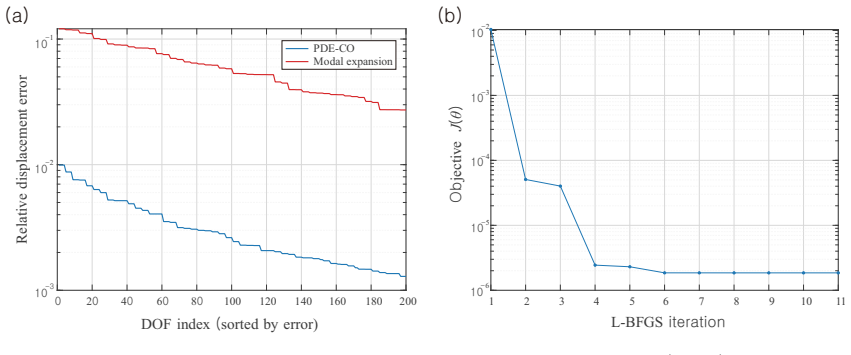
Virtual sensing -- recovering full-field structural response from sparse sensor measurements -- is a fundamental challenge in structural health monitoring. This study formulates virtual sensing as a PDE-constrained optimization (PDE-CO) problem, where the governing elastodynamic equation serves as an equality constraint, the applied force distribution is the optimization variable, and the full-field displacement and force are jointly recovered. Gradients of the Tikhonov-regularized objective are computed via reverse-mode automatic differentiation through the forward PDE solver, and L-BFGS iteratively finds the optimal state. The framework couples an offline FEniCSx stage for finite element assembly with an online GPU-accelerated JAX stage, and is verified on three examples of increasing complexity: a cantilever plate, a $90^\circ$ elbow pipe, and a reactor pressure vessel (RPV) representative of a 300~MW pressurized nuclear reactor. PDE-CO consistently outperforms modal expansion across all three cases, reducing displacement errors by factors of $2$ to $17\times$ with sub-percent accuracy on every example. Unlike modal expansion, where force is derived by back-calculation from truncated modal coordinates and is not jointly optimized, PDE-CO recovers displacement and force simultaneously through the PDE constraint; the increased computational cost is offset by GPU acceleration delivering up to $64.8\times$ speedup over CPU.
Editorial analysis
A structured set of objections, weighed in public.
Referee Report
Summary. The paper formulates virtual sensing as a PDE-constrained optimization problem in which the linear elastodynamic PDE is imposed as an equality constraint, the force distribution is the decision variable, and full-field displacement and force are recovered jointly via Tikhonov-regularized L-BFGS minimization with gradients obtained by reverse-mode automatic differentiation. The method is implemented by coupling an offline FEniCSx finite-element stage with an online JAX/GPU stage and is demonstrated on three synthetic examples of increasing geometric complexity (cantilever plate, 90° elbow pipe, reactor pressure vessel). The central claim is that PDE-CO reduces displacement error by factors of 2–17× relative to modal expansion while achieving sub-percent accuracy on every example.
Significance. If the performance advantage survives modeling mismatch, the joint PDE-constrained recovery of displacement and force would be a useful addition to structural-health-monitoring toolkits. The hybrid FEniCSx–JAX implementation and explicit GPU timing results are concrete strengths that support reproducibility of the computational workflow.
major comments (2)
- [Numerical examples (the three cases described in the abstract and §4)] All three numerical examples generate the synthetic sensor data by solving exactly the same linear elastodynamic PDE (identical geometry, material properties, boundary conditions, and forcing) that is subsequently enforced as the equality constraint in the optimization. Because the inverse problem is therefore well-posed by construction once Tikhonov regularization is applied, the reported 2–17× error reductions cannot be interpreted as evidence that the same advantage will persist when the true structure deviates from the model (unmodeled damping, spatially varying moduli, geometric imperfections, or sensor-noise statistics not captured by the forward operator). This verification gap directly affects the headline claim of consistent outperformance.
- [Optimization formulation and numerical results] The Tikhonov regularization parameter is listed as a free hyper-parameter whose value is not derived from first principles. The sub-percent accuracy figures and the factor-of-2–17 improvement are therefore conditional on a specific choice of this parameter; no sensitivity study or a-priori selection rule is supplied that would allow the reader to assess how much of the reported gain is attributable to favorable tuning versus the PDE constraint itself.
minor comments (1)
- [Abstract and §3] The abstract states that force is recovered simultaneously through the PDE constraint, yet the precise definition of the force variable (distributed body force versus boundary traction) and its discretization are not restated in the results section; a short clarifying sentence would remove ambiguity when comparing to modal-expansion force back-calculation.
Simulated Author's Rebuttal
We thank the referee for the constructive comments. We address each major point below, acknowledging where the examples are verification studies and where additional analysis can strengthen the presentation.
read point-by-point responses
-
Referee: [Numerical examples (the three cases described in the abstract and §4)] All three numerical examples generate the synthetic sensor data by solving exactly the same linear elastodynamic PDE (identical geometry, material properties, boundary conditions, and forcing) that is subsequently enforced as the equality constraint in the optimization. Because the inverse problem is therefore well-posed by construction once Tikhonov regularization is applied, the reported 2–17× error reductions cannot be interpreted as evidence that the same advantage will persist when the true structure deviates from the model (unmodeled damping, spatially varying moduli, geometric imperfections, or sensor-noise statistics not captured by the forward operator). This verification gap directly affects the headline claim of consistent outperformance.
Authors: We agree that the three examples constitute verification studies in which sensor data are generated from the identical PDE later used as the equality constraint. This controlled setting isolates the contribution of the PDE constraint and joint recovery of displacement and force, yielding the reported 2–17× error reductions relative to modal expansion under exact model match. The manuscript’s claims are confined to these synthetic cases; we do not assert robustness to model mismatch. A clarifying sentence will be added to §4 and the discussion to state explicitly that the results are verification results on consistent forward/inverse models. The PDE-CO formulation itself remains applicable to approximate models, but quantitative performance under mismatch is outside the scope of the present work. revision: partial
-
Referee: [Optimization formulation and numerical results] The Tikhonov regularization parameter is listed as a free hyper-parameter whose value is not derived from first principles. The sub-percent accuracy figures and the factor-of-2–17 improvement are therefore conditional on a specific choice of this parameter; no sensitivity study or a-priori selection rule is supplied that would allow the reader to assess how much of the reported gain is attributable to favorable tuning versus the PDE constraint itself.
Authors: The regularization parameter λ is chosen empirically for each example to achieve the reported accuracy. We will add a short sensitivity study (new figure or table in §4) showing displacement and force error versus λ for the cantilever-plate case, together with a brief statement that, in the absence of ground truth, λ may be selected by the discrepancy principle or cross-validation on held-out sensors. This addition will make the dependence on λ explicit without altering the core claims. revision: yes
Circularity Check
No significant circularity; method and validation are self-contained
full rationale
The paper formulates virtual sensing as a PDE-constrained optimization problem that treats the standard linear elastodynamic PDE as an external equality constraint, recovers force and displacement jointly via Tikhonov-regularized L-BFGS with reverse-mode AD, and compares against modal expansion on three synthetic examples. No equation or claim reduces to a fitted parameter renamed as a prediction, no self-citation supplies a load-bearing uniqueness theorem, and no ansatz is smuggled in; the numerical tests use data generated from the same PDE only to verify consistency when the model is exact, which is a standard and independent check against the modal baseline rather than a tautological reduction of the reported error-reduction factors. The derivation therefore rests on externally known PDEs and off-the-shelf solvers without internal circularity.
Axiom & Free-Parameter Ledger
free parameters (1)
- Tikhonov regularization parameter
axioms (1)
- domain assumption The structure obeys the linear elastodynamic PDE without modeling error.
Reference graph
Works this paper leans on
-
[1]
Bradbury, James and Frostig, Roy and Hawkins, Peter and Johnson, Matthew James and Leary, Chris and Maclaurin, Dougal and Necula, George and Paszke, Adam and Vander
-
[2]
1998 , publisher=
Rank-Deficient and Discrete Ill-Posed Problems: Numerical Aspects of Linear Inversion , author=. 1998 , publisher=
1998
-
[3]
2020 , publisher=
Virtanen, Pauli and Gommers, Ralf and Oliphant, Travis E and Haberland, Matt and Reddy, Tyler and Cournapeau, David and Burovski, Evgeni and Peterson, Pearu and Weckesser, Warren and Bright, Jonathan and others , journal=. 2020 , publisher=
2020
-
[4]
Adjoint Method versus Physics-Informed Neural Networks in
Zhang, Zhen and Alla, Alessandro and Karniadakis, George Em , journal=. Adjoint Method versus Physics-Informed Neural Networks in
-
[5]
Inverse Problems , volume=
Solution of inverse problems in elasticity imaging using the adjoint method , author=. Inverse Problems , volume=. 2003 , publisher=
2003
-
[6]
Structural and Multidisciplinary Optimization , volume=
Adjoint-based analysis and optimization of beam-like structures subjected to dynamic loads , author=. Structural and Multidisciplinary Optimization , volume=. 2021 , publisher=
2021
-
[7]
Computer Methods in Applied Mechanics and Engineering , volume=
Adjoint-based determination of weaknesses in structures , author=. Computer Methods in Applied Mechanics and Engineering , volume=. 2023 , publisher=
2023
-
[8]
Computers & Structures , volume=
Virtual sensing for real-time strain field estimation and its verification on a laboratory-scale jacket structure under water waves , author=. Computers & Structures , volume=. 2024 , publisher=
2024
-
[9]
Mechanical Systems and Signal Processing , volume=
Virtual sensing of structural vibrations using dynamic substructuring , author=. Mechanical Systems and Signal Processing , volume=. 2016 , publisher=
2016
-
[10]
Sensors , volume=
Strain Virtual Sensing for Structural Health Monitoring under Variable Loads , author=. Sensors , volume=. 2023 , publisher=
2023
-
[11]
International journal for numerical methods in engineering , volume=
Gmsh: A 3-D finite element mesh generator with built-in pre-and post-processing facilities , author=. International journal for numerical methods in engineering , volume=. 2009 , publisher=
2009
-
[12]
Engineering Failure Analysis , volume=
A review of theoretical analysis techniques for cracking and corrosive degradation of film-substrate systems , author=. Engineering Failure Analysis , volume=. 2017 , publisher=
2017
-
[13]
2004 , publisher=
Thin film materials: stress, defect formation and surface evolution , author=. 2004 , publisher=
2004
-
[14]
Journal of applied polymer science , volume=
Evaluation and simulation of the peel behavior of polyethylene/polybutene-1 peel systems , author=. Journal of applied polymer science , volume=. 2009 , publisher=
2009
-
[15]
Journal of the Mechanics and Physics of Solids , volume=
Initiation and arrest of cracks from corners in multi-chip semiconductor devices , author=. Journal of the Mechanics and Physics of Solids , volume=. 2024 , publisher=
2024
-
[16]
ACS nano , volume=
Transfer printing methods for flexible thin film solar cells: Basic concepts and working principles , author=. ACS nano , volume=. 2014 , publisher=
2014
-
[17]
Progress in Materials Science , volume=
Flexible CIGS, CdTe and a-Si: H based thin film solar cells: A review , author=. Progress in Materials Science , volume=. 2020 , publisher=
2020
-
[18]
Journal of The Electrochemical Society , volume=
Crack pattern formation in thin film lithium-ion battery electrodes , author=. Journal of The Electrochemical Society , volume=. 2011 , publisher=
2011
-
[19]
Chemical reviews , volume=
Approaching practically accessible solid-state batteries: stability issues related to solid electrolytes and interfaces , author=. Chemical reviews , volume=. 2019 , publisher=
2019
-
[20]
Nature Energy , volume=
High electronic conductivity as the origin of lithium dendrite formation within solid electrolytes , author=. Nature Energy , volume=. 2019 , publisher=
2019
-
[21]
Acta Materialia , volume=
A new methodology for characterizing traction-separation relations for interfacial delamination of thermal barrier coatings , author=. Acta Materialia , volume=. 2014 , publisher=
2014
-
[22]
Engineering Fracture Mechanics , volume=
Numerical analyses of the residual stress and top coat cracking behavior in thermal barrier coatings under cyclic thermal loading , author=. Engineering Fracture Mechanics , volume=. 2018 , publisher=
2018
-
[23]
Composite Structures , volume=
Investigation of the fracture behaviors of windshield laminated glass used in high-speed trains , author=. Composite Structures , volume=. 2019 , publisher=
2019
-
[24]
International Journal of Fracture , volume=
Fatigue and fracture assessment for reliability in electronics packaging , author=. International Journal of Fracture , volume=. 2008 , publisher=
2008
-
[25]
Computer methods in applied mechanics and engineering , volume=
A phase-field approach to model fracture of arterial walls: theory and finite element analysis , author=. Computer methods in applied mechanics and engineering , volume=. 2016 , publisher=
2016
-
[26]
Journal of the Mechanics and Physics of Solids , volume=
A mechanobiological model for damage-induced growth in arterial tissue with application to in-stent restenosis , author=. Journal of the Mechanics and Physics of Solids , volume=. 2017 , publisher=
2017
-
[27]
International Journal of Mechanical Sciences , volume=
Numerical and experimental studies on crack nucleation and propagation in thin films , author=. International Journal of Mechanical Sciences , volume=. 2023 , publisher=
2023
-
[28]
Computer Methods in Applied Mechanics and Engineering , volume=
Multiscale computational modeling of arterial micromechanics: A review , author=. Computer Methods in Applied Mechanics and Engineering , volume=. 2024 , publisher=
2024
-
[29]
Advances in applied mechanics , volume=
Mixed mode cracking in layered materials , author=. Advances in applied mechanics , volume=. 1991 , publisher=
1991
-
[30]
Journal of the Mechanics and Physics of Solids , volume=
Nonlinear analyses of wrinkles in a film bonded to a compliant substrate , author=. Journal of the Mechanics and Physics of Solids , volume=. 2005 , publisher=
2005
-
[31]
Journal of Vacuum Science & Technology A , volume=
Stress in thin films and coatings: Current status, challenges, and prospects , author=. Journal of Vacuum Science & Technology A , volume=. 2018 , publisher=
2018
-
[32]
Acta materialia , volume=
Effects of the substrate on the determination of thin film mechanical properties by nanoindentation , author=. Acta materialia , volume=. 2002 , publisher=
2002
-
[33]
Journal of Materials Research , volume=
Measuring substrate-independent modulus of thin films , author=. Journal of Materials Research , volume=. 2011 , publisher=
2011
-
[34]
Applied surface science , volume=
Investigation on periodic cracking of elastic film/substrate system by the extended finite element method , author=. Applied surface science , volume=. 2011 , publisher=
2011
-
[35]
Theoretical and Applied Fracture Mechanics , volume=
A thermodynamically consistent phase field model for brittle fracture in graded coatings under thermo-mechanical loading , author=. Theoretical and Applied Fracture Mechanics , volume=. 2024 , publisher=
2024
-
[36]
Journal of the Mechanics and Physics of Solids , volume=
A variational model for fracture and debonding of thin films under in-plane loadings , author=. Journal of the Mechanics and Physics of Solids , volume=. 2014 , publisher=
2014
-
[37]
International Journal of Pressure Vessels and Piping , volume=
Fracture analysis of thin films on compliant substrates: A numerical study using the phase field approach of fracture , author=. International Journal of Pressure Vessels and Piping , volume=. 2019 , publisher=
2019
-
[38]
Computer Methods in Applied Mechanics and Engineering , volume=
A phase-field model of fracture with frictionless contact and random fracture properties: Application to thin-film fracture and soil desiccation , author=. Computer Methods in Applied Mechanics and Engineering , volume=. 2020 , publisher=
2020
-
[39]
International Journal of Engineering Science , volume=
A phase field fracture model for ultra-thin micro-/nano-films with surface effects , author=. International Journal of Engineering Science , volume=. 2024 , publisher=
2024
-
[40]
Journal of the Mechanics and Physics of Solids , volume=
Revisiting brittle fracture as an energy minimization problem , author=. Journal of the Mechanics and Physics of Solids , volume=. 1998 , publisher=
1998
-
[41]
International journal for numerical methods in engineering , volume=
Thermodynamically consistent phase-field models of fracture: Variational principles and multi-field FE implementations , author=. International journal for numerical methods in engineering , volume=. 2010 , publisher=
2010
-
[42]
Computer Methods in Applied Mechanics and Engineering , volume=
A phase-field description of dynamic brittle fracture , author=. Computer Methods in Applied Mechanics and Engineering , volume=. 2012 , publisher=
2012
-
[43]
Philosophical Transactions of the Royal Society A , volume=
An assessment of phase field fracture: crack initiation and growth , author=. Philosophical Transactions of the Royal Society A , volume=. 2021 , publisher=
2021
-
[44]
Engineering Fracture Mechanics , volume=
A review on phase field models for fracture and fatigue , author=. Engineering Fracture Mechanics , volume=. 2023 , publisher=
2023
-
[45]
2000 , publisher=
Nonlinear solid mechanics II , author=. 2000 , publisher=
2000
-
[46]
Journal of the Mechanics and Physics of Solids , volume=
On boundary potential energies in deformational and configurational mechanics , author=. Journal of the Mechanics and Physics of Solids , volume=. 2008 , publisher=
2008
-
[47]
Soft Matter , year=
A model for 3D deformation and reconstruction of contractile microtissues , author=. Soft Matter , year=
-
[48]
Extreme Mechanics Letters , volume=
A model for mechanosensitive cell migration in dynamically morphing soft tissues , author=. Extreme Mechanics Letters , volume=. 2023 , publisher=
2023
-
[49]
The phenomena of rupture and flow in solids , author=
VI. The phenomena of rupture and flow in solids , author=. Philosophical transactions of the royal society of london. Series A, containing papers of a mathematical or physical character , volume=. 1921 , publisher=
1921
-
[50]
Phase field modeling of fracture in multi-physics problems. Part I. Balance of crack surface and failure criteria for brittle crack propagation in thermo-elastic solids , author=. Computer Methods in Applied Mechanics and Engineering , volume=. 2015 , publisher=
2015
-
[51]
Journal of the Mechanics and Physics of Solids , volume=
A unified phase-field theory for the mechanics of damage and quasi-brittle failure , author=. Journal of the Mechanics and Physics of Solids , volume=. 2017 , publisher=
2017
-
[52]
Computer Methods in Applied Mechanics and Engineering , volume=
Investigation of driving forces in a phase field approach to mixed mode fracture of concrete , author=. Computer Methods in Applied Mechanics and Engineering , volume=. 2023 , publisher=
2023
-
[53]
Computational Mechanics , volume=
A unifying finite strain modeling framework for anisotropic mixed-mode fracture in soft materials , author=. Computational Mechanics , volume=. 2024 , publisher=
2024
-
[54]
Computational Mechanics , year=
A finite element implementation of finite deformation surface and bulk poroelasticity , author=. Computational Mechanics , year=
-
[55]
Journal of the Mechanics and Physics of Solids , volume=
A theory for fracture of polymeric gels , author=. Journal of the Mechanics and Physics of Solids , volume=. 2018 , publisher=
2018
-
[56]
Computer Methods in Applied Mechanics and Engineering , volume=
Phase field modeling of fracture in nonlinearly elastic solids via energy decomposition , author=. Computer Methods in Applied Mechanics and Engineering , volume=. 2019 , publisher=
2019
-
[57]
Journal of the Mechanics and Physics of Solids , volume=
Large strained fracture of nearly incompressible hyperelastic materials: enhanced assumed strain methods and energy decomposition , author=. Journal of the Mechanics and Physics of Solids , volume=. 2020 , publisher=
2020
-
[58]
Journal of elasticity and the physical science of solids , volume=
A new constitutive framework for arterial wall mechanics and a comparative study of material models , author=. Journal of elasticity and the physical science of solids , volume=. 2000 , publisher=
2000
-
[59]
Part II: The three-dimensional case , author=
A finite element framework for continua with boundary energies. Part II: The three-dimensional case , author=. Computer Methods in Applied Mechanics and Engineering , volume=. 2010 , publisher=
2010
-
[60]
Computer Methods in Applied Mechanics and Engineering , volume=
Mixed displacement--pressure-phase field framework for finite strain fracture of nearly incompressible hyperelastic materials , author=. Computer Methods in Applied Mechanics and Engineering , volume=. 2022 , publisher=
2022
-
[61]
2012 , publisher =
Automated Solution of Differential Equations by the Finite Element Method , author =. 2012 , publisher =
2012
-
[62]
Martin S. Aln. The. 2015 , journal =
2015
-
[63]
International Journal of Non-Linear Mechanics , volume=
A phase-field fracture model for 3D film-substrate systems , author=. International Journal of Non-Linear Mechanics , volume=. 2025 , publisher=
2025
-
[64]
Continuum Mechanics and Thermodynamics , volume=
Phase field modeling of anisotropic fracture , author=. Continuum Mechanics and Thermodynamics , volume=. 2024 , publisher=
2024
-
[65]
Engineering Fracture Mechanics , volume=
A phase-field length scale insensitive mode-dependent fracture model for brittle failure , author=. Engineering Fracture Mechanics , volume=. 2024 , publisher=
2024
-
[66]
Computer Methods in Applied Mechanics and Engineering , volume=
A variationally consistent phase-field anisotropic damage model for fracture , author=. Computer Methods in Applied Mechanics and Engineering , volume=. 2020 , publisher=
2020
-
[67]
International Journal of Plasticity , volume=
An extended gradient damage model for anisotropic fracture , author=. International Journal of Plasticity , volume=. 2024 , publisher=
2024
-
[68]
2012 , publisher=
The finite element method: linear static and dynamic finite element analysis , author=. 2012 , publisher=
2012
-
[69]
Computers & Fluids , volume=
A numerical solution of the Navier-Stokes equations using the finite element technique , author=. Computers & Fluids , volume=. 1973 , publisher=
1973
-
[70]
Balay, Satish and Abhyankar, Shrirang and Adams, Mark and Brown, Jed and Brune, Peter and Buschelman, Kris and Dalcin, Lisandro and Dener, Alp and Eijkhout, Victor and Gropp, W and others , year=
-
[71]
International journal of fracture , volume=
Measuring the fracture toughness of ultra-thin films with application to AlTa coatings , author=. International journal of fracture , volume=. 2007 , publisher=
2007
-
[72]
2014 , publisher=
Nonlinear finite elements for continua and structures , author=. 2014 , publisher=
2014
-
[73]
Zenodo , year=
Numerical tours of computational mechanics with fenics , author=. Zenodo , year=
-
[74]
2003 , publisher=
Thin films on glass , author=. 2003 , publisher=
2003
-
[75]
1978 , issn =
Surface stress in solids , journal =. 1978 , issn =
1978
-
[76]
Mechanics Research Communications , volume=
Effect of residual surface stress on the fracture of nanoscale materials , author=. Mechanics Research Communications , volume=. 2012 , publisher=
2012
-
[77]
1998 , publisher=
Approximation of free-discontinuity problems , author=. 1998 , publisher=
1998
-
[78]
Journal of the Mechanics and Physics of Solids , volume=
Regularized formulation of the variational brittle fracture with unilateral contact: Numerical experiments , author=. Journal of the Mechanics and Physics of Solids , volume=. 2009 , publisher=
2009
-
[79]
Communications on Pure and Applied Mathematics , volume=
Approximation of functionals depending on jumps by elliptic functionals via -convergence , author=. Communications on Pure and Applied Mathematics , volume=. 1990 , doi=
1990
-
[80]
Bollettino dell'Unione Matematica Italiana
On the approximation of free discontinuity problems , author=. Bollettino dell'Unione Matematica Italiana. B , volume=
discussion (0)
Sign in with ORCID, Apple, or X to comment. Anyone can read and Pith papers without signing in.