Vector-Like Lepton Pair Production With Polarized Beams at Linear Colliders:Sensitivity Projections and Chirality Observables
Pith reviewed 2026-06-30 09:50 UTC · model grok-4.3
The pith
Polarized beams distinguish vector-like lepton doublets via charged-neutral rate and asymmetry differences at linear colliders.
A machine-rendered reading of the paper's core claim, the machinery that carries it, and where it could break.
Core claim
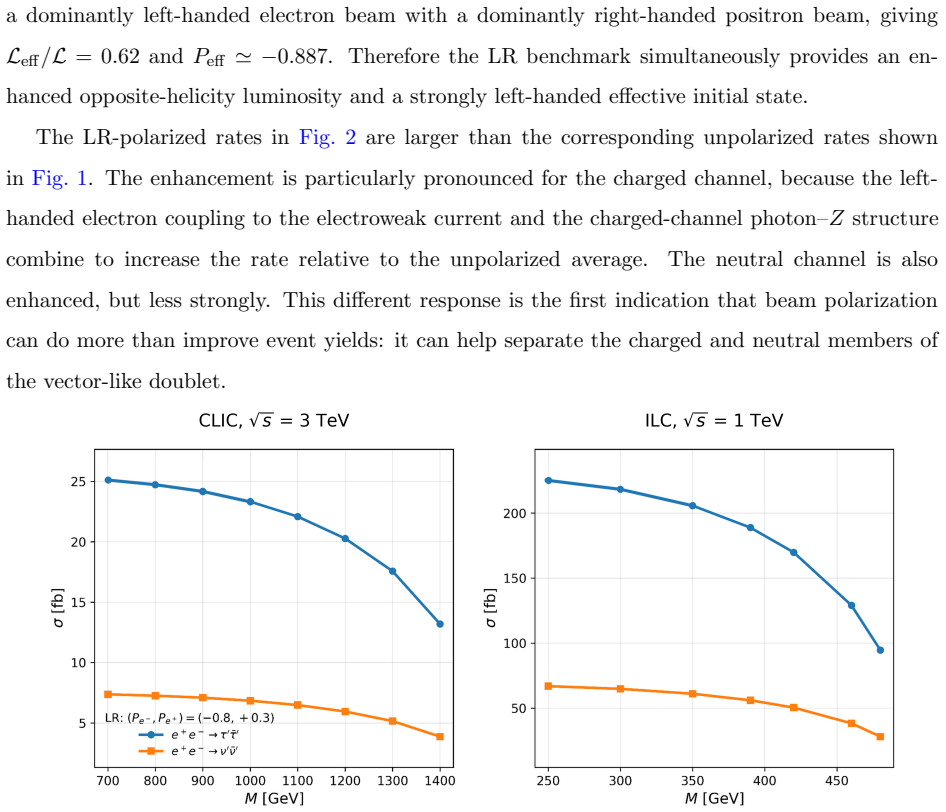
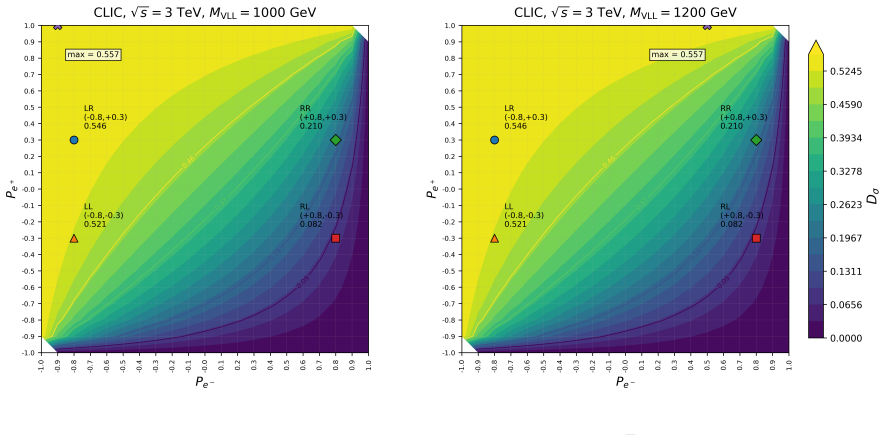
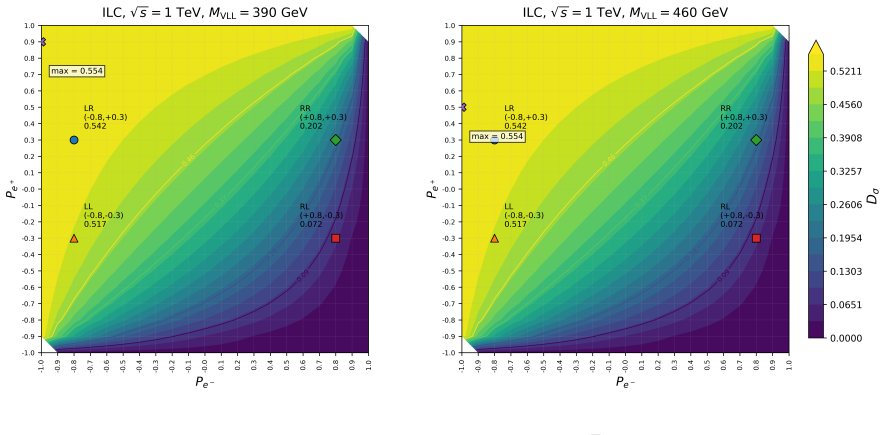
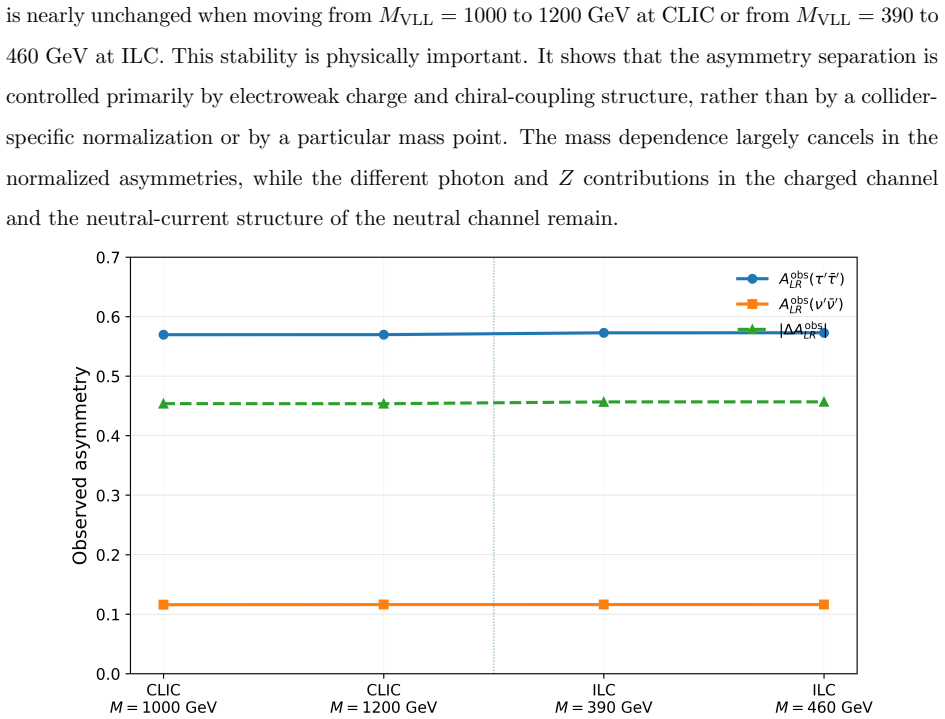
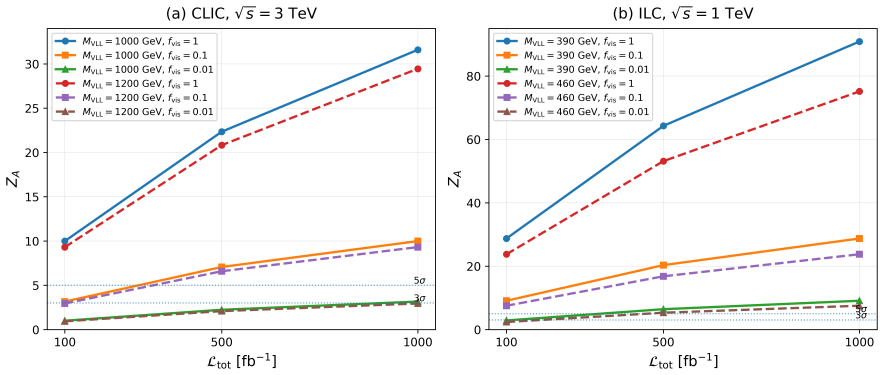
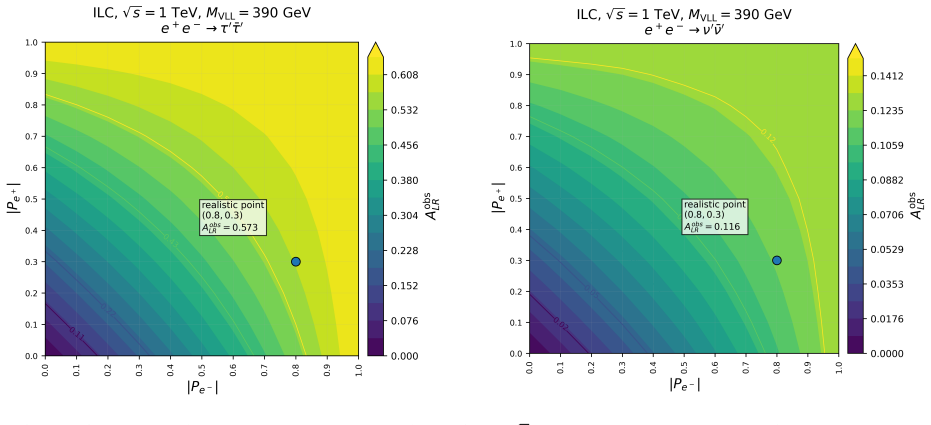
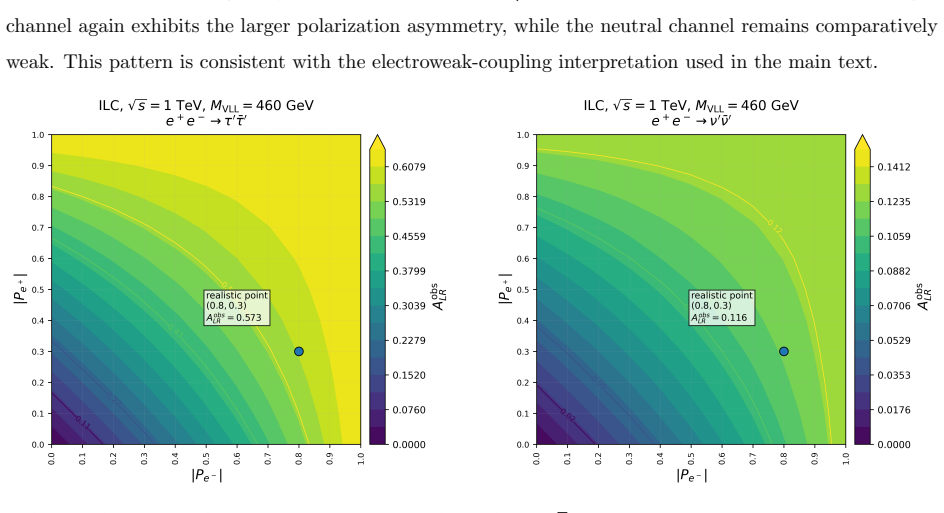
In the LR polarization configuration the charged-channel cross sections reach 23.32 fb and 20.28 fb at CLIC and 188.83 fb and 129.04 fb at ILC for the two benchmark masses, yielding an absolute discriminator D_sigma of approximately 0.546 at CLIC and 0.542 at ILC together with a stable observed asymmetry separation |Delta A_LR^obs| of 0.45-0.46; the corresponding statistical significance Z_A scales as the square root of total luminosity times visible fraction under an equal LR/RL split, showing that beam polarization supplies a representation-sensitive diagnostic of vector-like lepton doublets.
What carries the argument
The absolute discriminator D_sigma and observed asymmetry separation |Delta A_LR^obs| built from polarized production cross sections in the LR and RL configurations.
If this is right
- The charged channel consistently exceeds the neutral channel because it receives both photon and Z exchange.
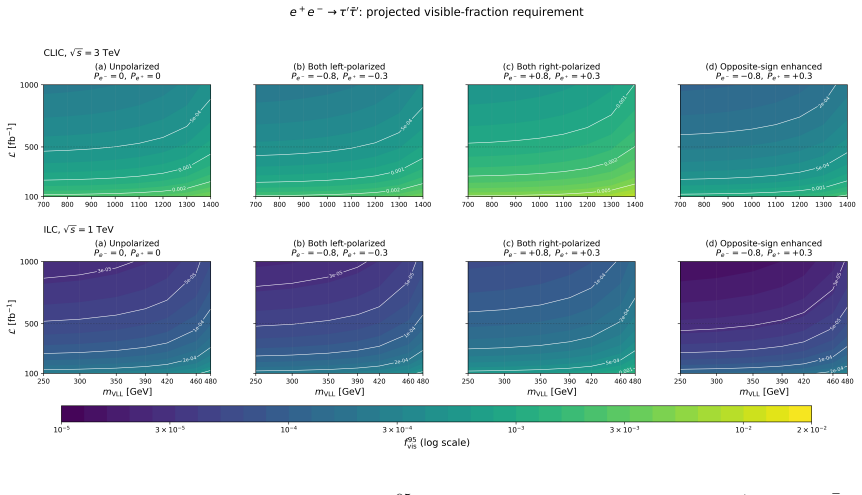
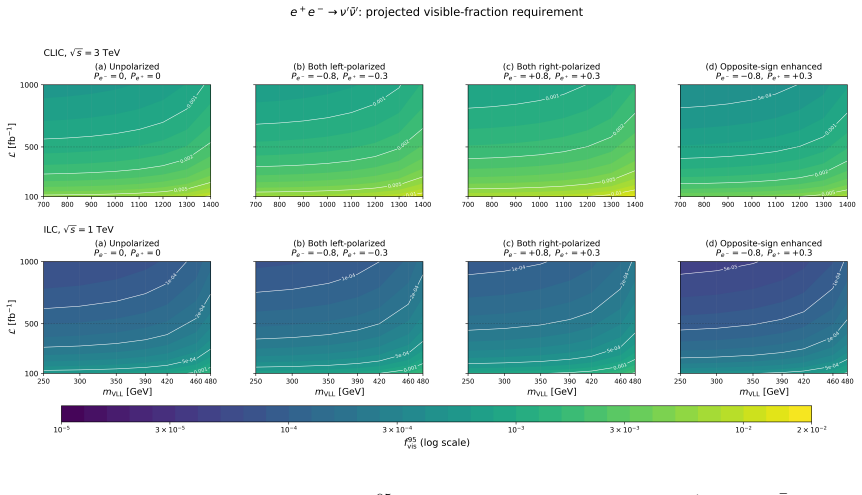
- The visible-fraction requirement f_vis^95 keeps the sensitivity projection independent of any particular decay selection.
- The statistical projection Z_A reaches sizeable values that scale as sqrt(L_tot f_vis) under equal LR/RL luminosity sharing.
- Polarization configurations therefore supply a diagnostic of the doublet representation beyond a simple rate increase.
Where Pith is reading between the lines
- The same polarization observables could be applied to other vector-like fermion representations or to models with additional mixing.
- Experimental analyses at future colliders could fold these discriminators directly into search strategies for new leptons.
- If decay-channel information is later incorporated, the separation between charged and neutral modes may sharpen further.
Load-bearing premise
Tree-level Standard Model gauge boson exchange dominates production with no significant higher-order corrections or new-physics interference, and the visible fraction can be applied independently of specific decay channels.
What would settle it
A measurement of the charged and neutral cross sections under LR polarization at 3 TeV showing D_sigma near zero or |Delta A_LR^obs| far below 0.45 would falsify the claimed separation power.
Figures
read the original abstract
We study pair production of a vector-like lepton doublet at polarized future linear colliders, focusing on the charged and neutral channels $e^+e^-\to\tau^\prime\bar{\tau}^\prime$ and $e^+e^-\to\nu^\prime\bar{\nu}^\prime$. The benchmark masses are $M_{\rm VLL}=1000,1200~{\rm GeV}$ at CLIC with $\sqrt{s}=3~{\rm TeV}$ and $M_{\rm VLL}=390,460~{\rm GeV}$ at ILC with $\sqrt{s}=1~{\rm TeV}$. Using the realistic polarization configurations LR$=(-0.8,+0.3)$, RL$=(+0.8,-0.3)$, LL$=(-0.8,-0.3)$, and RR$=(+0.8,+0.3)$, we evaluate tree-level production-level cross sections and construct observables designed to test the electroweak structure of the doublet. The charged channel is consistently larger than the neutral channel because it receives both photon and $Z$ exchange. In the LR configuration, the charged-channel rates reach $23.32$ and $20.28~{\rm fb}$ at CLIC, and $188.83$ and $129.04~{\rm fb}$ at ILC, for the two benchmark masses at each collider. We express rate reach through the projected visible-fraction requirement $f_{\rm vis}^{95}=3/(\mathcal{L}\sigma_{\rm prod})$, keeping the result independent of a specific decay selection. To quantify charged--neutral separation we use the absolute discriminator $D_\sigma$, which reaches about $0.546$ at CLIC and $0.542$ at ILC in the LR benchmark. We also find a stable observed asymmetry separation, $|\Delta A_{LR}^{\rm obs}|\simeq 0.45$--$0.46$, between the charged and neutral channels. The corresponding production-level statistical projection gives sizeable $Z_A$ values for the benchmark luminosities, scaling as $\sqrt{\mathcal{L}_{\rm tot}f_{\rm vis}}$ under an equal LR/RL luminosity split. These results demonstrate that the beam polarization can provide a representation-sensitive diagnostic of vector-like lepton doublets, beyond a simple rate enhancement.
Editorial analysis
A structured set of objections, weighed in public.
Referee Report
Summary. The manuscript computes tree-level cross sections for pair production of a vector-like lepton doublet in the charged (e+e−→τ′τ′) and neutral (e+e−→ν′ν′) channels at polarized ILC and CLIC, using benchmark masses and the polarization configurations LR, RL, LL, RR. It defines the absolute discriminator D_σ and the observed left-right asymmetry difference |ΔA_LR^obs| to quantify separation between channels, projects statistical significance via f_vis^95=3/(ℒσ_prod), and concludes that polarization supplies a representation-sensitive diagnostic beyond simple rate enhancement.
Significance. If the production-level separation survives realistic detector-level efficiencies, the work supplies concrete, falsifiable projections showing how beam polarization can probe the electroweak quantum numbers of vector-like leptons at future colliders, with the use of realistic polarization values and the attempt to keep results decay-channel independent as methodological strengths.
major comments (1)
- [Abstract] Abstract, final paragraph: the claim that D_σ≈0.546 (CLIC) / 0.542 (ILC) and |ΔA_LR^obs|≃0.45–0.46 remain observable discriminants after applying the same f_vis^95 to both channels is not established by the production-level calculation. The charged channel proceeds via γ/Z exchange with τ′→W/Z/h+τ decays, while the neutral channel is Z-only with ν′→W+ν decays; these yield different visible final states, missing-energy signatures, and background-rejection efficiencies, so the quoted separation may not survive channel-specific selection cuts.
Simulated Author's Rebuttal
We thank the referee for the positive evaluation of our work's significance and for the constructive major comment. We respond point-by-point below.
read point-by-point responses
-
Referee: [Abstract] Abstract, final paragraph: the claim that D_σ≈0.546 (CLIC) / 0.542 (ILC) and |ΔA_LR^obs|≃0.45–0.46 remain observable discriminants after applying the same f_vis^95 to both channels is not established by the production-level calculation. The charged channel proceeds via γ/Z exchange with τ′→W/Z/h+τ decays, while the neutral channel is Z-only with ν′→W+ν decays; these yield different visible final states, missing-energy signatures, and background-rejection efficiencies, so the quoted separation may not survive channel-specific selection cuts.
Authors: We agree that the quoted numerical separation is computed at the production level only and that channel-specific detector efficiencies (arising from different decay modes and signatures) are not simulated. The manuscript deliberately restricts itself to tree-level production cross sections and introduces the common f_vis^95 parameter precisely to express reach in a decay-independent manner. The discriminants D_σ and |ΔA_LR^obs| are therefore defined from the polarized production rates, with statistical projections shown under the assumption of equal f_vis for both channels as a benchmark. We will revise the abstract (and add a clarifying sentence in the introduction) to state explicitly that the results are production-level projections and that realistic, channel-dependent efficiencies lie outside the present scope. This addresses the referee's concern without altering the core production-level analysis. revision: partial
Circularity Check
No circularity; direct tree-level SM computations with explicit assumptions
full rationale
The paper computes production cross sections at tree level from SM gauge boson exchanges (photon and Z for charged channel, Z-only for neutral) under specified polarization configurations, then constructs D_σ and ΔA_LR^obs directly from those rates. f_vis^{95} = 3/(ℒ σ_prod) is an explicit derived expression presented to keep results independent of decay details; no parameter fitting, self-referential prediction, or reduction of outputs to inputs occurs. No self-citations, uniqueness theorems, or ansatzes are invoked in the provided text. The derivation chain is self-contained against external SM couplings and does not reduce by construction.
Axiom & Free-Parameter Ledger
axioms (1)
- domain assumption Tree-level production via SM photon and Z exchange dominates for the vector-like lepton doublet
Reference graph
Works this paper leans on
-
[1]
The overall decrease of the cross section with increasingmVLL is the expected consequence of phase-space suppression as the pair-production threshold is approached
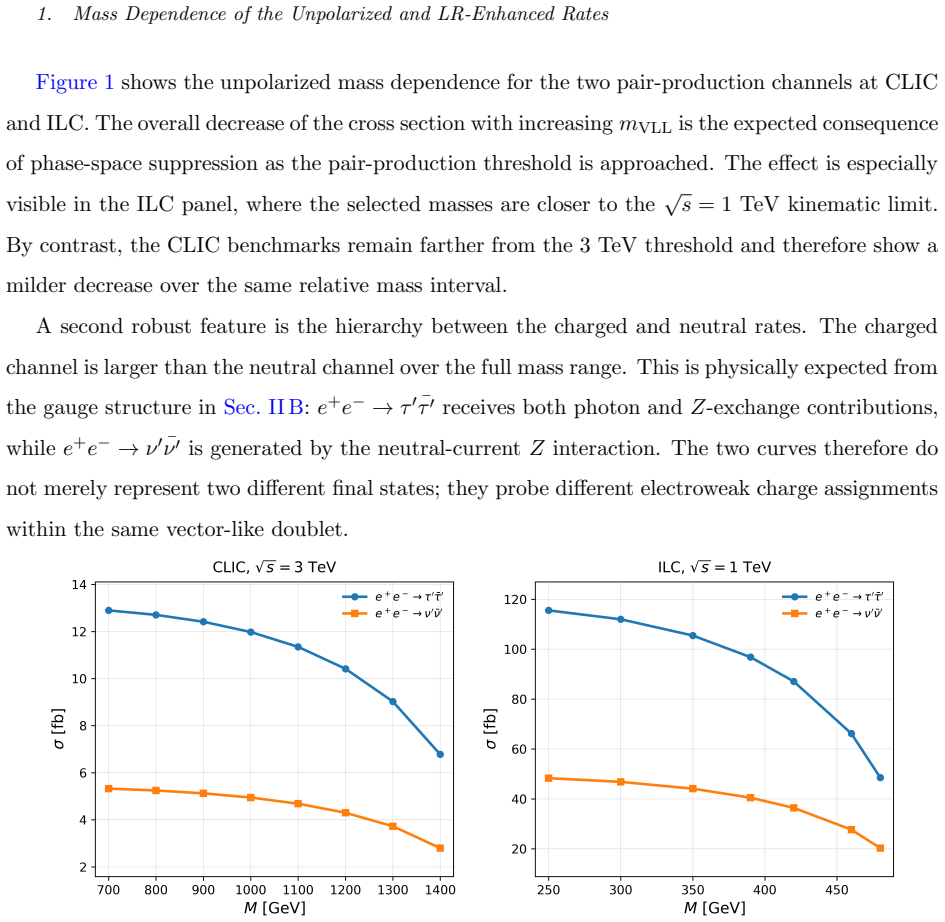
Mass Dependence of the Unpolarized and LR-Enhanced Rates Figure 1 shows the unpolarized mass dependence for the two pair-production channels at CLIC and ILC. The overall decrease of the cross section with increasingmVLL is the expected consequence of phase-space suppression as the pair-production threshold is approached. The effect is especially visible i...
-
[2]
To see the full polarization dependence, Figs
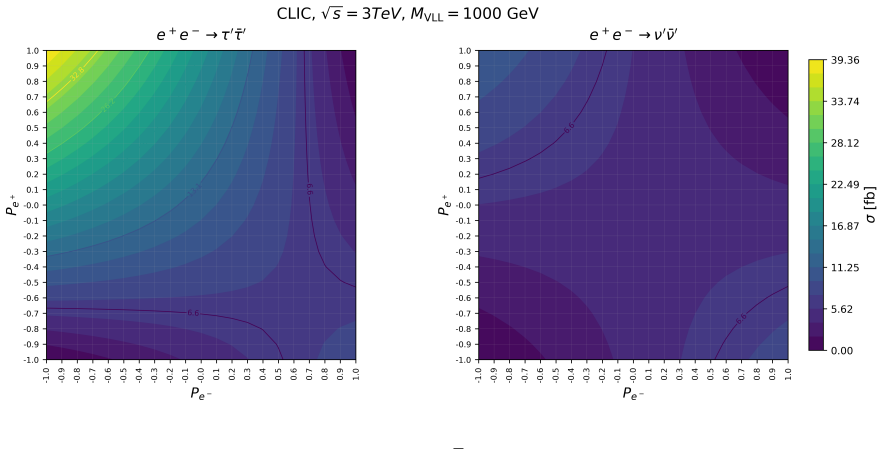
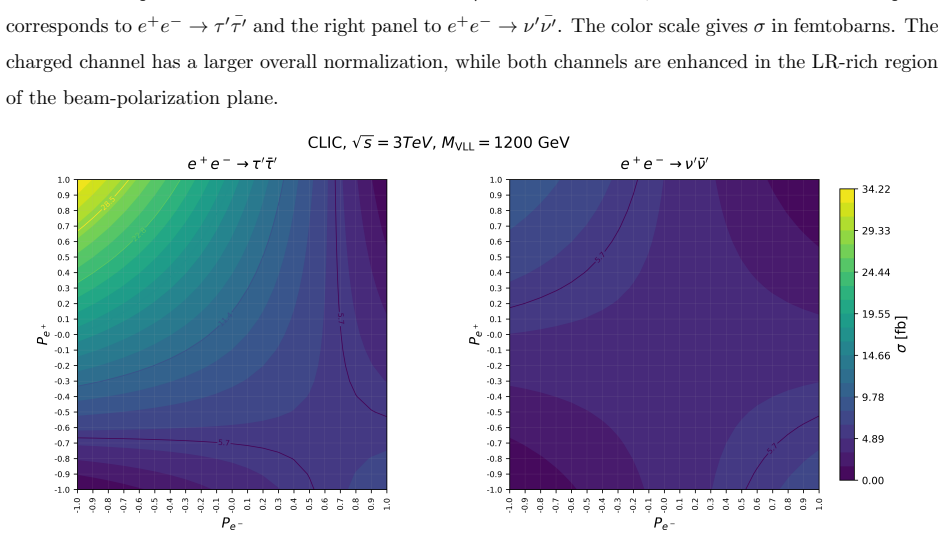
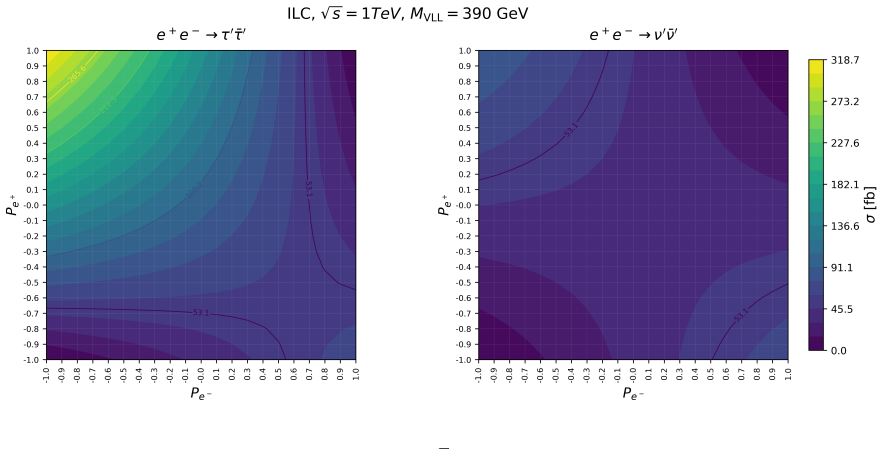
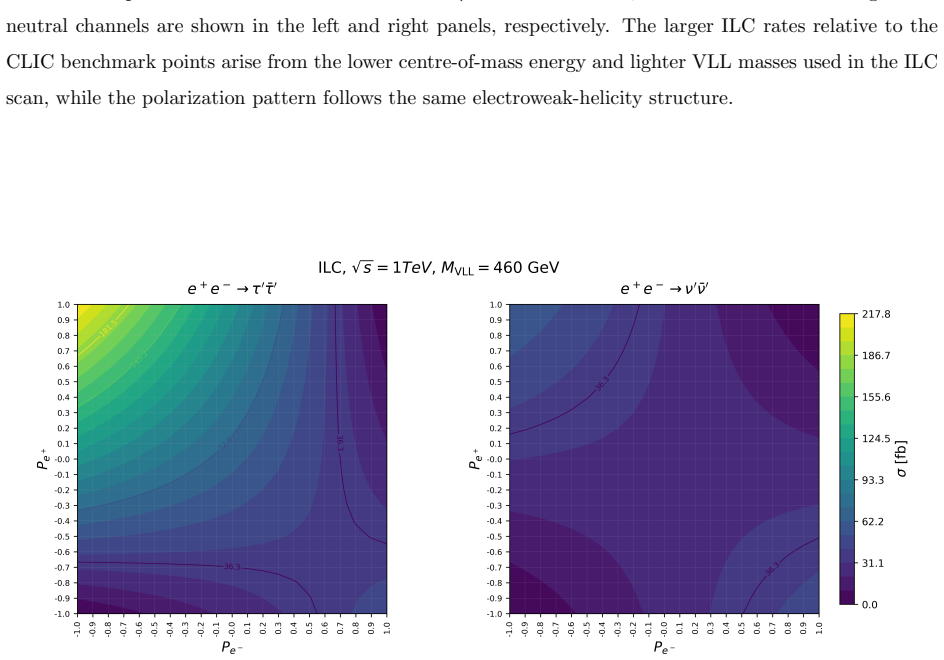
Cross-Section Maps over the Polarization Plane The mass scans isolate a small set of benchmark polarizations. To see the full polarization dependence, Figs. 3 to 6 show the production cross sections over the complete ( Pe−, Pe+) plane. These maps are obtained by evaluating the two processes on the same polarization grid and then plotting the charged and n...
-
[3]
Review of particle physics,
S. Navas et al. [Particle Data Group], “Review of particle physics,” Phys. Rev. D 110, 030001 (2024)
2024
-
[4]
Electroweak Precision Constraints on Vector-like Fermions
G. Cynolter and E. Lendvai, “Electroweak precision constraints on vector-like fermions,” Eur. Phys. J. C 58, 463 (2008), arXiv:0804.4080 [hep-ph]
work page internal anchor Pith review Pith/arXiv arXiv 2008
-
[5]
Effects of new leptons in Electroweak Precision Data
F. del Aguila, J. de Blas and M. Perez-Victoria, “Effects of new leptons in electroweak precision data,” Phys. Rev. D 78, 013010 (2008), arXiv:0803.4008 [hep-ph]
work page internal anchor Pith review Pith/arXiv arXiv 2008
-
[6]
Phenomenology of heavy vector-like leptons
K. Ishiwata and M. B. Wise, “Phenomenology of heavy vector-like leptons,” Phys. Rev. D 88, 055009 (2013), arXiv:1307.1112 [hep-ph]
work page internal anchor Pith review Pith/arXiv arXiv 2013
-
[7]
Vector-like leptons: Higgs decays and collider phenomenology
A. Falkowski, D. M. Straub and A. Vicente, “Vector-like leptons: Higgs decays and collider phenomenol- ogy,” JHEP 05, 092 (2014), arXiv:1312.5329 [hep-ph]
work page internal anchor Pith review Pith/arXiv arXiv 2014
-
[8]
Vectorlike leptons at the Large Hadron Collider
N. Kumar and S. P. Martin, “Vectorlike leptons at the Large Hadron Collider,” Phys. Rev. D 92, 115018 (2015), arXiv:1510.03456 [hep-ph]
work page internal anchor Pith review Pith/arXiv arXiv 2015
-
[9]
Prospects for vectorlike leptons at future proton-proton colliders
P. N. Bhattiprolu and S. P. Martin, “Prospects for vectorlike leptons at future proton-proton colliders,” Phys. Rev. D 100, 015033 (2019), arXiv:1905.00498 [hep-ph]
work page internal anchor Pith review Pith/arXiv arXiv 2019
-
[10]
Isosinglet vectorlike leptons at e+e− colliders,
P. N. Bhattiprolu, S. P. Martin and A. Pierce, “Isosinglet vectorlike leptons at e+e− colliders,” Phys. Rev. D 109, 035009 (2024), arXiv:2308.08386 [hep-ph]
-
[11]
A. M. Sirunyan et al. [CMS Collaboration], “Search for vector-like leptons in multilepton final states in proton-proton collisions at √s = 13 TeV,” Phys. Rev. D100, 052003 (2019), arXiv:1905.10853 [hep-ex]
-
[12]
G. Aad et al. [ATLAS Collaboration], “Search for third-generation vector-like leptons in pp collisions at √s = 13 TeV with the ATLAS detector,” JHEP 07, 118 (2023), arXiv:2303.05441 [hep-ex]
-
[13]
G. Aad et al. [ATLAS Collaboration], “Search for vector-like leptons coupling to first- and second- generation Standard Model leptons in pp collisions at √s = 13 TeV with the ATLAS detector,” JHEP 05, 075 (2025), arXiv:2411.07143 [hep-ex]
-
[14]
The Compact Linear Collider (CLIC) - 2018 Summary Report
T. K. Charles et al. [CLICdp and CLIC Collaborations], “The Compact Linear Collider (CLIC) – 2018 Summary Report,” arXiv:1812.06018 [physics.acc-ph]
work page internal anchor Pith review Pith/arXiv arXiv 2018
-
[15]
The International Linear Collider Technical Design Report - Volume 1: Executive Summary
T. Behnke et al. , “The International Linear Collider Technical Design Report – Volume 1: Executive Summary,” arXiv:1306.6327 [physics.acc-ph]
work page internal anchor Pith review Pith/arXiv arXiv
-
[16]
The International Linear Collider Technical Design Report - Volume 2: Physics
H. Baer et al. , “The International Linear Collider Technical Design Report – Volume 2: Physics,” arXiv:1306.6352 [hep-ph]
work page internal anchor Pith review Pith/arXiv arXiv
-
[17]
G. Moortgat-Pick et al. , “The role of polarized positrons and electrons in revealing fundamental inter- actions at the Linear Collider,” Phys. Rept. 460, 131 (2008), arXiv:hep-ph/0507011
work page internal anchor Pith review Pith/arXiv arXiv 2008
-
[18]
VLL-UFOs: FeynRules and UFO model files for vector-like leptons,
P. N. Bhattiprolu and S. P. Martin, “VLL-UFOs: FeynRules and UFO model files for vector-like leptons,” model package used in this work, https://github.com/prudhvibhattiprolu/VLL-UFOs
-
[19]
FeynRules 2.0 - A complete toolbox for tree-level phenomenology
A. Alloul, N. D. Christensen, C. Degrande, C. Duhr and B. Fuks, “FeynRules 2.0 – A complete toolbox for tree-level phenomenology,” Comput. Phys. Commun. 185, 2250 (2014), arXiv:1310.1921 [hep-ph]
work page internal anchor Pith review Pith/arXiv arXiv 2014
-
[20]
UFO - The Universal FeynRules Output
C. Degrande, C. Duhr, B. Fuks, D. Grellscheid, O. Mattelaer and T. Reiter, “UFO – The Universal 39 FeynRules Output,” Comput. Phys. Commun. 183, 1201 (2012), arXiv:1108.2040 [hep-ph]
work page internal anchor Pith review Pith/arXiv arXiv 2012
-
[21]
J. Alwall et al. , “The automated computation of tree-level and next-to-leading order differential cross sections, and their matching to parton shower simulations,” JHEP 07, 079 (2014), arXiv:1405.0301 [hep-ph]
work page internal anchor Pith review Pith/arXiv arXiv 2014
-
[22]
Explanation of the Muon g-2 Anomaly with Vectorlike Leptons and its Implications for Higgs Decays
R. Dermisek and A. Raval, “Explanation of the muon g − 2 anomaly with vectorlike leptons and its implications for Higgs decays,” arXiv:1305.3522 [hep-ph]
work page internal anchor Pith review Pith/arXiv arXiv
-
[23]
Anthropic solution to the magnetic muon anomaly: the charged see-saw
K. Kannike, M. Raidal, D. M. Straub and A. Strumia, “Anthropic solution to the magnetic muon anomaly: the charged seesaw,” JHEP 02, 106 (2012), arXiv:1111.2551 [hep-ph]
work page internal anchor Pith review Pith/arXiv arXiv 2012
-
[24]
Dark Matter and Enhanced Higgs to Di-photon Rate from Vector-like Leptons
A. Joglekar, P. Schwaller and C. E. M. Wagner, “Dark matter and enhanced Higgs to diphoton rate from vector-like leptons,” JHEP 12, 064 (2012), arXiv:1207.4235 [hep-ph]
work page internal anchor Pith review Pith/arXiv arXiv 2012
-
[25]
A search for the first generation charged vector-like leptons at future colliders,
A. O. Acar, O. E. Delialioglu and S. Sultansoy, “A search for the first generation charged vector-like leptons at future colliders,” arXiv:2103.08222 [hep-ph]
-
[26]
≥ 4µ signal from a vector-like lepton decaying to a muon-philic Z ′ boson at the LHC,
J. Kawamura and S. Raby, “ ≥ 4µ signal from a vector-like lepton decaying to a muon-philic Z ′ boson at the LHC,” arXiv:2104.04461 [hep-ph]
-
[27]
Long-lived searches of vectorlike lepton and its accompanying scalar at colliders,
Q.-H. Cao, J. Guo, J. Liu, Y. Luo and X.-P. Wang, “Long-lived searches of vectorlike lepton and its accompanying scalar at colliders,” Phys. Rev. D (2024)
2024
-
[28]
Physics Interplay of the LHC and the ILC
G. Weiglein, T. Barklow, E. Boos, A. De Roeck et al. , “Physics interplay of the LHC and the ILC,” Phys. Rept. 426, 47 (2006), arXiv:hep-ph/0410364
work page internal anchor Pith review Pith/arXiv arXiv 2006
-
[29]
Physics at the e+ e- Linear Collider
G. Moortgat-Pick, H. Baer, M. Battaglia et al. , “Physics at the e+e− linear collider,” Eur. Phys. J. C 75, 371 (2015), arXiv:1504.01726 [hep-ph]
work page internal anchor Pith review Pith/arXiv arXiv 2015
-
[30]
A linear collider vision for the future of particle physics,
H. Abramowicz, E. Adli, F. Alharthi, M. Almanza-Soto et al. , “A linear collider vision for the future of particle physics,” arXiv:2503.19983 [hep-ex]
-
[31]
Prospects of Heavy Neutrino Searches at Future Lepton Colliders
S. Banerjee, P. S. B. Dev, A. Ibarra, T. Mandal and M. Mitra, “Prospects of heavy neutrino searches at future lepton colliders,” Phys. Rev. D 92, 075002 (2015), arXiv:1503.05491 [hep-ph]
work page internal anchor Pith review Pith/arXiv arXiv 2015
-
[32]
Search for the singlet vector-like lepton at future e+e− colliders,
L. Shang, M. Wang, Z. Heng and B. Yang, “Search for the singlet vector-like lepton at future e+e− colliders,” Eur. Phys. J. C (2021)
2021
-
[33]
Search for the singlet vectorlike lepton in semileptonic channel at future colliders,
B. Yang, J. Li, M. Wang and L. Shang, “Search for the singlet vectorlike lepton in semileptonic channel at future colliders,” Phys. Rev. D (2021)
2021
-
[34]
Search for the singlet vectorlike lepton through the pair production in the W ντ channel at the ILC,
H.-T. Li, J. Chao and G. Zhang, “Search for the singlet vectorlike lepton through the pair production in the W ντ channel at the ILC,” Europhys. Lett. (2022)
2022
-
[35]
Probing vector-like leptons at 3 TeV CLIC using fat jet signatures,
R.-P. Li, J.-W. Lian and Y.-B. Liu, “Probing vector-like leptons at 3 TeV CLIC using fat jet signatures,” Eur. Phys. J. C (2025)
2025
-
[36]
Signals of additional Z boson in e+e-\to W+W^- at the ILC with polarized beams
B. Ananthanarayan, M. Patra and P. Poulose, “Signals of additional Z boson in e+e− → W +W − at the ILC with polarized beams,” arXiv:1012.3566 [hep-ph]
work page internal anchor Pith review Pith/arXiv arXiv
-
[37]
CP-violating top quark couplings at future linear $e^+e^-$ colliders
W. Bernreuther, L. Chen, I. Garcia, M. Perello, R. Poeschl, F. Richard, E. Ros and M. Vos, “CP- violating top quark couplings at future linear e+e− colliders,” Eur. Phys. J. C (2018), arXiv:1710.06737 [hep-ph]. 40
work page internal anchor Pith review Pith/arXiv arXiv 2018
-
[38]
CMS physics technical design report, Volume II: Physics performance,
CMS Collaboration, “CMS physics technical design report, Volume II: Physics performance,” J. Phys. G 34, 995 (2007)
2007
-
[39]
G. Aad et al. [ATLAS Collaboration], “Observation of a new particle in the search for the Standard Model Higgs boson with the ATLAS detector at the LHC,” Phys. Lett. B716, 1 (2012), arXiv:1207.7214 [hep-ex]
work page internal anchor Pith review Pith/arXiv arXiv 2012
-
[40]
Observation of a new boson at a mass of 125 GeV with the CMS experiment at the LHC
S. Chatrchyan et al. [CMS Collaboration], “Observation of a new boson at a mass of 125 GeV with the CMS experiment at the LHC,” Phys. Lett. B 716, 30 (2012), arXiv:1207.7235 [hep-ex]
work page internal anchor Pith review Pith/arXiv arXiv 2012
-
[41]
Physics Case for the International Linear Collider
K. Fujii, C. Grojean, M. E. Peskin, T. Barklow, Y. Gao, S. Kanemura, H. Kim, J. List et al. , “Physics Case for the International Linear Collider,” arXiv:1506.05992 [hep-ex]
work page internal anchor Pith review Pith/arXiv arXiv
-
[42]
Updated baseline for a staged Compact Linear Collider
M. J. Boland et al. [CLIC and CLICdp Collaborations], “Updated baseline for a staged Compact Linear Collider,” arXiv:1608.07537 [physics.acc-ph]
work page internal anchor Pith review Pith/arXiv arXiv
-
[43]
The Compact Linear e$^+$e$^-$ Collider (CLIC): Physics Potential
P. Roloff, R. Franceschini, U. Schnoor and A. Wulzer, “The Compact Linear e+e− Collider (CLIC): Physics Potential,” arXiv:1812.07986 [hep-ex]
work page internal anchor Pith review Pith/arXiv arXiv
-
[44]
The Compact Linear e$^+$e$^-$ Collider (CLIC): Accelerator and Detector
A. Robson, P. N. Burrows, N. Catalan Lasheras, L. Linssen, M. Petric, D. Schulte, E. Sicking, S. Stapnes and W. Wuensch, “The Compact Linear e+e− Collider (CLIC): Accelerator and Detec- tor,” arXiv:1812.07987 [physics.acc-ph]
work page internal anchor Pith review Pith/arXiv arXiv
-
[45]
T. Barklow, J. Brau, K. Fujii, J. Gao, J. List, N. Walker and K. Yokoya, “ILC Operating Scenarios,” arXiv:1506.07830 [hep-ex]
work page internal anchor Pith review Pith/arXiv arXiv
-
[46]
500 GeV ILC Operating Scenarios
J. E. Brau et al. [ILC Parameters Joint Working Group], “500 GeV ILC Operating Scenarios,” arXiv:1510.05739 [hep-ex]
work page internal anchor Pith review Pith/arXiv arXiv
-
[47]
The Role of Positron Polarization for the initial 250 GeV stage of the ILC
J. Reuter, “The Role of Positron Polarization for the initial 250 GeV stage of the ILC,” arXiv:1811.05263 [hep-ex]
work page internal anchor Pith review Pith/arXiv arXiv
-
[48]
Probing the pair production of first-generation vector-like leptons at future e+e− colliders,
Y.-B. Liu and S. Moretti, “Probing the pair production of first-generation vector-like leptons at future e+e− colliders,” arXiv:2512.22490 [hep-ph]
-
[49]
Y. Mahmoud, J. Kawamura, M. T. Hussein, H. Abdallah and S. Elgammal, “Investigating vector-like leptons decaying into an electron and missing transverse energy in e+e− collisions with √s = 500 GeV at the ILC,” arXiv:2411.08143 [hep-ph]
-
[50]
Confidence Level Computation for Combining Searches with Small Statistics
T. Junk, “Confidence level computation for combining searches with small statistics,” Nucl. Instrum. Meth. A 434, 435 (1999), arXiv:hep-ex/9902006
work page internal anchor Pith review Pith/arXiv arXiv 1999
-
[51]
Asymptotic formulae for likelihood-based tests of new physics
G. Cowan, K. Cranmer, E. Gross and O. Vitells, “Asymptotic formulae for likelihood-based tests of new physics,” Eur. Phys. J. C 71, 1554 (2011), arXiv:1007.1727 [physics.data-an]
work page internal anchor Pith review Pith/arXiv arXiv 2011
-
[52]
Presentation of search results: The CL s technique,
A. L. Read, “Presentation of search results: The CL s technique,” J. Phys. G 28, 2693 (2002). 41
2002
discussion (0)
Sign in with ORCID, Apple, or X to comment. Anyone can read and Pith papers without signing in.