REVIEW 4 major objections 7 minor 60 references
GenPrior: Unleashing Text-to-Motion Generative Priors for Zero-Shot Skeleton-based Action Recognition
T0 review · 4 major / 7 minor · reviewed 2026-08-04 · deepseek-v4-flash
Pith's one-line read GenPrior shows that text-to-motion generative priors can be repurposed to close the semantic–kinematic gap in zero-shot skeleton action recognition, setting a new state of the art on three benchmarks.
desk verdict Genuinely new T2M-prior idea, but the SOTA numbers are driven by transductive test-time refinement, and encoder pre-training / topology conversion details are missing. read the letter →
The pith
A machine-rendered reading of the paper's core claim, the machinery that carries it, and where it could break.
The reading
What carries the argument
The load-bearing object is the generative kinematic prototype plus intra-class dispersion vector distilled from text-to-motion outputs (mean and per-dimension standard deviation of encoded generated motions), injected into text embeddings by the Dispersion-Gated Feature Fusion module, and later used as anchors in the Generative Prototype Refinement module. The gate conditions on text, projected prototype, and dispersion to suppress synthetic artifacts; the refinement mines high-confidence test samples by entropy ranking and replaces semantic prototypes with the mean of those samples.
What would settle it
Inspect the pretraining of the skeleton encoder: if it was trained on any NTU class that appears among the 'unseen' test categories, the zero-shot evaluation is invalid. Separately, encode the same generated motion before and after the relative-to-absolute conversion and measure the feature distance; if the conversion shifts features substantially, the kinematic prototypes are an artifact of the conversion rather than of motion content.
Extended reading notes
Core claim
The central claim is that synthetically generated motion sequences carry structural kinematic information that pure text embeddings lack, and that this information can be injected into textual prototypes without contaminating them with synthetic artifacts. GenPrior does this by using a frozen text-to-motion model to generate diverse motions per class, encoding them with a pre-trained skeleton encoder, and computing per-class means and per-dimension standard deviations. A learned dispersion-gated fusion network decides how much of the kinematic prototype to add to each text embedding, using the dispersion vector as a reliability measure. The fused features are aligned with real skeleton featu
Load-bearing premise
The load-bearing premise is that the frozen skeleton encoder maps both real NTU skeletons and text-to-motion generated motions into the same trustworthy feature space without leaking unseen-class supervision; the paper does not state how that encoder was pretrained and does not verify that the relative-to-absolute coordinate conversion preserves feature compatibility.
Editorial extensions
If this is right
- The reported gains grow as the number of unseen classes increases (e.g., +14.9% on the 96/24 NTU-120 split), suggesting generative priors help most where text-only prototypes are most ambiguous.
- Performance is stable across three different text-to-motion backbones (within 1.3%), implying the benefit is a property of the prior source class rather than one specific generator.
- The ablation shows ungated injection of kinematic prototypes hurts accuracy, while the dispersion-gated fusion recovers and exceeds the baseline — evidence that reliability-aware fusion is necessary for exploiting synthetic data.
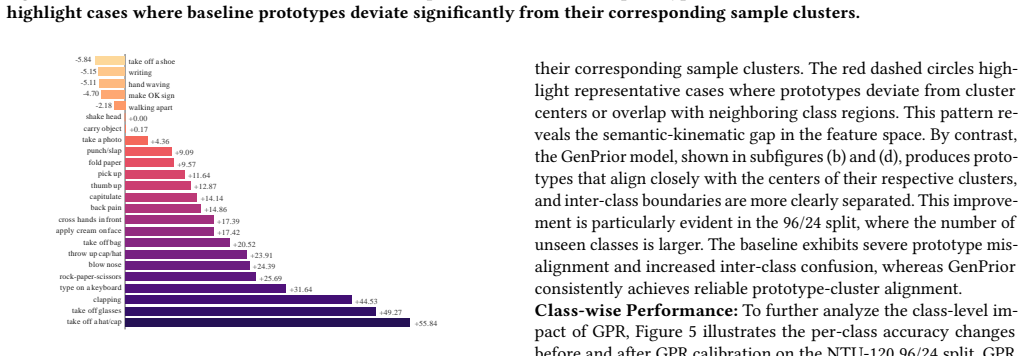
- The Generative Prototype Refinement improves 19 of 24 unseen classes on the hardest split, with large gains on fine-grained object-interaction actions like taking off a hat or glasses.
- Since the method is training-free at test time apart from prototype re-estimation, it can be layered on existing embedding-based ZSAR models.
Reading between the lines
- The dispersion vector could serve double duty as a per-class uncertainty estimate, enabling applications like active labeling or rejection of low-confidence generated prototype classes.
- Because the method only needs text descriptions and a frozen T2M model, it is applicable to novel action vocabularies without retraining; one testable extension is whether the same priors transfer to cross-dataset recognition with different skeleton topologies.
- The ratio-based seen/unseen calibration in GZSL could be replaced or learned rather than fixed at gamma, potentially improving the balance further on datasets with skewed prior class frequencies.
Signed reviews
Editorial analysis
A structured set of objections, weighed in public.
Referee Report
Summary. GenPrior proposes a zero-shot skeleton-based action recognition (ZSAR) framework that incorporates priors from a frozen text-to-motion (T2M) model. For each action class, the method generates multiple motions from LLM-expanded descriptions, extracts skeleton features with Shift-GCN, and forms generative kinematic prototypes and per-dimension dispersion vectors. A dispersion-gated network blends these generative cues with CLIP text embeddings, and the fused representations are aligned to real skeleton features via a cross-modal VAE. At inference, a test-time prototype refinement step (GPR) pseudo-labels test samples against the semantic prototypes, selects high-confidence samples per class, and replaces each class prototype with the mean of those selected features. The paper reports state-of-the-art results on NTU-60, NTU-120, and PKU-MMD under both ZSL and GZSL, with ablations over components, T2M backbones, and the selection ratio.
Significance. If the technical assumptions are validated, the core idea — using externally pre-trained T2M models as a source of kinematic structure for text-only prototypes — is a novel and plausible direction for ZSAR. The paper is also commendable for releasing code, evaluating on multiple benchmarks and splits, abalating the main components, and showing robustness across three different T2M backbones. The significance, however, hinges on two currently unverified assumptions: (i) the frozen skeleton encoder is trained in a way that does not leak unseen-class supervision, and (ii) generated motions from a HumanML3D-style 22-joint skeleton are actually feature-compatible with real NTU skeletons in a 25-joint space after the described conversion. In addition, the transductive nature of GPR is not reflected in the abstract or the main SOTA claim. These issues are central rather than cosmetic.
major comments (4)
- [§5.2, §4.1, Eq. (2)-(4)] The paper states 'We use Shift-GCN [8] to extract both real and generated skeleton features' but does not specify how Φ was pre-trained. If Φ was supervised on NTU-60 or NTU-120 using all classes, including those later designated as unseen, then the feature space already encodes unseen-class label information. This would invalidate the zero-shot setting and could inflate every reported number, since the kinematic prototypes (Eq. 3), the gated fusion (Eqs. 5-6), and the refinement step (Eq. 10) all operate on this shared feature space. The authors must disclose the exact pre-training data and protocol of Φ, or re-run the experiments with an encoder trained only on the seen classes (or a self-supervised encoder) and show that results are maintained. A leakage test — e.g., linear probe accuracy on unseen classes using frozen features — would also be informative.
- [§4.1, §5.2, Eq. (2)-(4)] StableMoFusion and other HumanML3D-trained T2M models produce motions on a 22-joint SMPL skeleton, whereas NTU datasets and Shift-GCN expect 25 joints. The paper says generated motions are 'converted from relative spatial configurations to absolute joint coordinates,' but this does not address the joint-topology / dimension mismatch. Without an explicit retargeting or dimension-alignment procedure, it is unclear in what coordinate space the features in Eq. (2) are computed, and consequently the kinematic prototype (Eq. 3) and dispersion (Eq. 4) may be statistics of a space incompatible with real NTU features. Please provide the exact joint mapping/padding, and validate feature compatibility quantitatively (e.g., t-SNE overlap of real and generated features for seen classes, or a nearest-neighbor accuracy between generated and real features).
- [Table 1, Abstract, §5.3] GenPrior uses unlabeled test samples at inference through GPR (Eqs. 8-10), making it a transductive / test-time adaptation method. Table 1 nevertheless compares it with inductive baselines, and the abstract claims 'state-of-the-art performance' without this caveat. The transductive advantage is only disclosed in the table footnote. This is an apples-to-oranges comparison: a transductive method can trivially outperform inductive methods on the same benchmark. Please report an inductive variant (GESF only, without GPR) alongside the transductive variant, and compare with inductive baselines on equal footing. The transductive version should be compared separately with SC under the same protocol, and the main SOTA claim should be qualified.
- [§4.2, Eqs. (8)-(10), Table 4] The GPR refinement is self-referential: test samples are assigned to classes using the current prototypes (Eq. 8), the top-η most confident samples for each class are those closest to the prototypes, and the refined prototype is the mean of those same samples' features (Eq. 10). The final evaluation then classifies the same test samples using these refined prototypes. This is a form of transductive self-training, and the observed gains may partly reflect confirmation bias rather than genuine prototype correction. To support the claimed causal benefit, please add control experiments: (i) random selection of the same fraction η instead of confidence-based selection, (ii) oracle selection using true labels, and (iii) an analysis of per-class accuracy changes alongside the number of selected samples. Report how much of the gain comes from the confidence selection mechanism versus the averagi
minor comments (7)
- [Abstract] The phrase 'first framework' should be qualified to 'first to our knowledge' or supported by a systematic related-work statement; in any case, the transductive nature of GPR should be mentioned in the abstract if SOTA is claimed.
- [Eq. (4)] Please state explicitly that the square root and squaring are element-wise operations. Currently the equation is ambiguous without the surrounding text.
- [Eq. (16)] The logical notation with ⊕ and the masking constant λ is hard to parse. Please define clearly how the seen/unseen decision is made and how γ is selected. Also report the chosen values of γ, λ, and λ_Dist in the implementation details.
- [Table 1] The GenPrior row has a dash in the 'Venue' column. If the paper is under review, use 'Ours' or '—'; this is fine, but please keep the footnote about test-time adaptation in the main text as well.
- [Fig. 2] Typo in the figure: 'V AE' should be 'VAE'.
- [§5.2 / Table 2] For random splits, the paper reports averages but no standard deviation or per-split results. Adding standard deviations would strengthen the robustness claim.
- [§5.4, Table 6] The generation budget J=40, K=10 is fixed. A sensitivity study over J and K (or total N_g) would help confirm that the method is not dependent on a particular generation budget.
Circularity Check
No significant circularity: generative priors are externally sourced, T2M improvements are separately ablated, and the test-time refinement stage is disclosed transductive adaptation, not a hidden fit.
full rationale
The central claim is that pre-trained T2M models provide useful structural priors for ZSAR. The priors are external: Section 4.1 uses GPT-4 descriptions and StableMoFusion to generate motions, and Eqs. 3-4 distill kinematic prototypes and dispersion from those generated features; textual features come from a separate pre-trained CLIP encoder. The fusion equations (5)-(6) and VAE alignment losses (11)-(13) do not reduce to a fitted version of the target accuracy. The Generative Prototype Refinement stage is self-referential in a loose sense (Eq. 10 refines prototypes from test features selected by Eqs. 8-9, and Eq. 14 reclassifies those same features), but it is explicitly disclosed as unlabeled test-time adaptation: Table 1 states 'GenPrior and SC [59] leverage unlabeled test samples at inference time; other methods are inductive.' No true labels are used, so this is standard transductive self-training rather than a derivation whose output is equal to its input by construction. Moreover, the T2M-prior contribution is not dependent on GPR: Table 4 shows GESF alone ('✓ ✗') improves over the no-prior baseline ('✗ ✗') on all four splits (e.g., NTU-60 55/5: 86.73 vs. 84.96; NTU-120 96/24: 69.17 vs. 65.16). Self-citations in the paper ([21], [36], [37]) appear only as related-work or general skeleton-recognition citations and are not load-bearing. The unspecified Shift-GCN pretraining and the relative-to-absolute joint conversion are validity/leakage risks, but they are correctness concerns, not circularity, and cannot be scored as circular without evidence that the encoder's training labels include the evaluation labels.
Assumptions & free parameters
free parameters (5)
- η (GPR high-confidence selection ratio) =
~0.5 (paper claims optimal range [0.5, 0.7], Fig. 3)
- γ (GZSL seen/unseen calibration threshold) =
unreported
- λ (GZSL masking constant) =
'sufficiently large' (exact value unreported)
- λ_Dist (distribution-alignment loss weight) =
unreported
- J=40, K=10 (generation budget) =
40 GPT-4 descriptions per class, 10 seeds each, 400 motions per class
assumptions (6)
- domain assumption StableMoFusion (pre-trained on HumanML3D) generates semantically consistent and kinematically plausible motions for NTU action descriptions, including fine-grained object-interaction classes such as 'take off glasses'.
- domain assumption Shift-GCN features provide a common, leakage-free representation space for real NTU skeletons and T2M-generated motions after relative-to-absolute coordinate conversion.
- domain assumption GPT-4-generated action descriptions are faithful expansions of NTU class names into motion-relevant language.
- domain assumption Variational alignment trained only on seen classes transfers to unseen classes.
- domain assumption High-confidence nearest-neighbor assignments in GPR are correct enough that their class averages approximate the true unseen-class distribution.
- standard math VAE reparameterization and ELBO-style reconstruction losses are valid for this latent alignment problem.
Cite this review
Pith. "Pith review of GenPrior: Unleashing Text-to-Motion Generative Priors for Zero-Shot Skeleton-based Action Recognition." pith.science (2026). https://pith.science/paper/ZGF7CK6Y
@misc{pith2026260802236,
  author       = {Pith},
  title        = {Pith review of: GenPrior: Unleashing Text-to-Motion Generative Priors for Zero-Shot Skeleton-based Action Recognition},
  year         = {2026},
  howpublished = {\url{https://pith.science/paper/ZGF7CK6Y}},
  note         = {Machine review of arXiv:2608.02236}
}
read the original abstract
Zero-shot skeleton-based action recognition (ZSAR) aims to recognize unseen action categories by aligning skeleton features with textual semantics. However, existing methods rely on text-derived prototypes that inherently lack geometric structure and physical constraints, resulting in a pronounced \textit{semantic-kinematic gap}. To bridge this gap, we propose \textbf{GenPrior}, the first framework to exploit generative priors from pre-trained Text-to-Motion (T2M) models for ZSAR. Specifically, we introduce Dispersion-Gated Feature Fusion, which distills kinematic prototypes and intra-class dispersion from generative motion sequences and employs a learned gating network to adaptively inject reliable structural cues into textual embeddings while suppressing synthetic artifacts. Furthermore, we propose Generative Prototype Refinement, which leverages these generation-enhanced prototypes as anchors to mine high-confidence unseen samples, calibrating class prototypes toward the true distribution and thereby unleashing strong performance gains. Extensive experiments on NTU-60, NTU-120, and PKU-MMD demonstrate that GenPrior achieves state-of-the-art performance under both zero-shot and generalized zero-shot settings. Code is available at https://github.com/jidongkuang/GenPrior.
Figures


Figures from the paper (2 more)

Reference graph
Works this paper leans on
-
[8]
Ke Cheng, Yifan Zhang, Xiangyu He, Weihan Chen, Jian Cheng, and Hanqing Lu. 2020. Skeleton-based action recognition with shift graph convolutional network. InProceedings of the IEEE/CVF Conference on Computer Vision and Pattern Recognition. 183–192
2020
-
[1]
Shiming Chen, Wenjin Hou, Ziming Hong, Xiaohan Ding, Yibing Song, Xinge You, Tongliang Liu, and Kun Zhang. 2023. Evolving semantic prototype improves generative zero-shot learning. InInternational Conference on Machine Learning. PMLR, 4611–4622
2023
-
[2]
Shiming Chen, Wenjie Wang, Beihao Xia, Qinmu Peng, Xinge You, Feng Zheng, and Ling Shao. 2021. Free: Feature refinement for generalized zero-shot learning. InProceedings of the IEEE/CVF international conference on computer vision. 122– 131
2021
-
[3]
Shiming Chen, Guosen Xie, Yang Liu, Qinmu Peng, Baigui Sun, Hao Li, Xinge You, and Ling Shao. 2021. Hsva: Hierarchical semantic-visual adaptation for zero-shot learning.Advances in Neural Information Processing Systems34 (2021), 16622–16634
2021
-
[4]
Xin Chen, Biao Jiang, Wen Liu, Zilong Huang, Bin Fu, Tao Chen, and Gang Yu. 2023. Executing your commands via motion diffusion in latent space. In Proceedings of the IEEE/CVF conference on computer vision and pattern recognition. 18000–18010
2023
-
[5]
Yang Chen, Jingcai Guo, Song Guo, and Dacheng Tao. 2025. Neuron: Learning context-aware evolving representations for zero-shot skeleton action recognition. InProceedings of the Computer Vision and Pattern Recognition Conference. 8721– 8730
2025
-
[6]
Yang Chen, Jingcai Guo, Tian He, Xiaocheng Lu, and Ling Wang. 2024. Fine- grained side information guided dual-prompts for zero-shot skeleton action recognition. InProceedings of the 32nd ACM International Conference on Multime- dia. 778–786
2024
-
[7]
Yang Chen, Miaoge Li, Zhijie Rao, Deze Zeng, Song Guo, and Jingcai Guo. 2025. Learning by Neighbor-Aware Semantics, Deciding by Open-form Flows: Towards Robust Zero-Shot Skeleton Action Recognition.arXiv preprint arXiv:2511.09388 (2025)
arXiv 2025
Show all 60 references
-
[9]
Jeonghyeok Do and Munchurl Kim. 2025. Bridging the Skeleton-Text Modal- ity Gap: Diffusion-Powered Modality Alignment for Zero-shot Skeleton-based Action Recognition. InProceedings of the IEEE/CVF International Conference on Computer Vision. 12757–12768
2025
-
[10]
Andrea Frome, Greg S Corrado, Jon Shlens, Samy Bengio, Jeff Dean, Marc’Aurelio Ranzato, and Tomas Mikolov. 2013. Devise: A deep visual-semantic embedding model.Advances in Neural Information Processing Systems26 (2013)
2013
-
[11]
Dingjie Fu, Wenjin Hou, Shiming Chen, Shuhuang Chen, Xinge You, Salman Khan, and Fahad Shahbaz Khan. 2024. Discriminative Image Generation with Diffusion Models for Zero-Shot Learning.arXiv preprint arXiv:2412.17219(2024)
2024 arXiv
-
[12]
Chuan Guo, Yuxuan Mu, Muhammad Gohar Javed, Sen Wang, and Li Cheng. 2024. Momask: Generative masked modeling of 3d human motions. InProceedings of the IEEE/CVF Conference on Computer Vision and Pattern Recognition. 1900–1910
2024
-
[13]
Chuan Guo, Shihao Zou, Xinxin Zuo, Sen Wang, Wei Ji, Xingyu Li, and Li Cheng
-
[14]
Chuan Guo, Xinxin Zuo, Sen Wang, and Li Cheng. 2022. Tm2t: Stochastic and tokenized modeling for the reciprocal generation of 3d human motions and texts. InEuropean Conference on Computer Vision. Springer, 580–597
2022
-
[15]
Pranay Gupta, Divyanshu Sharma, and Ravi Kiran Sarvadevabhatla. 2021. Syntac- tically guided generative embeddings for zero-shot skeleton action recognition. In2021 IEEE International Conference on Image Processing (ICIP). IEEE, 439–443
2021
-
[16]
Zongyan Han, Zhenyong Fu, Shuo Chen, and Jian Yang. 2021. Contrastive embedding for generalized zero-shot learning. InProceedings of the IEEE/CVF conference on computer vision and pattern recognition. 2371–2381
2021
-
[17]
Yiheng Huang, Hui Yang, Chuanchen Luo, Yuxi Wang, Shibiao Xu, Zhaoxiang Zhang, Man Zhang, and Junran Peng. 2024. Stablemofusion: Towards robust and efficient diffusion-based motion generation framework. InProceedings of the 32nd ACM International Conference on Multimedia. 224–232
2024
-
[18]
Yao-Hung Hubert Tsai, Liang-Kang Huang, and Ruslan Salakhutdinov. 2017. Learning robust visual-semantic embeddings. InProceedings of the IEEE Interna- tional Conference on Computer Vision. 3571–3580
2017
-
[19]
Bhavan Jasani and Afshaan Mazagonwalla. 2019. Skeleton based zero shot action recognition in joint pose-language semantic space.arXiv preprint arXiv:1911.11344 (2019)
2019 arXiv
-
[20]
Jihoon Kim, Jiseob Kim, and Sungjoon Choi. 2023. Flame: Free-form language- based motion synthesis & editing. InProceedings of the AAAI Conference on Artificial Intelligence, Vol. 37. 8255–8263
2023
-
[21]
Jidong Kuang, Hongsong Wang, Chaolei Han, Yang Zhang, and Jie Gui. 2025. Zero-shot skeleton-based action recognition with dual visual-text alignment. Pattern Recognition(2025), 112342
2025
-
[22]
Linguo Li, Minsi Wang, Bingbing Ni, Hang Wang, Jiancheng Yang, and Wenjun Zhang. 2021. 3d human action representation learning via cross-view consistency pursuit. InProceedings of the IEEE/CVF Conference on Computer Vision and Pattern Recognition. 4741–4750
2021
-
[23]
Ming-Zhe Li, Zhen Jia, Zhang Zhang, Zhanyu Ma, and Liang Wang. 2023. Multi- semantic fusion model for generalized zero-shot skeleton-based action recogni- tion. InInternational Conference on Image and Graphics. Springer, 68–80
2023
-
[24]
Sheng-Wei Li, Zi-Xiang Wei, Wei-Jie Chen, Yi-Hsin Yu, Chih-Yuan Yang, and Jane Yung-jen Hsu. 2024. Sa-dvae: Improving zero-shot skeleton-based action recognition by disentangled variational autoencoders. InEuropean Conference on Computer Vision. Springer, 447–462
2024
-
[25]
Chunhui Liu, Yueyu Hu, Yanghao Li, Sijie Song, and Jiaying Liu. 2017. PKU-MMD: A Large Scale Benchmark for Skeleton-Based Human Action Understanding. In Proceedings of the Workshop on Visual Analysis in Smart and Connected Commu- nities. Association for Computing Machinery, 1–8
2017
-
[26]
Jun Liu, Amir Shahroudy, Mauricio Perez, Gang Wang, Ling-Yu Duan, and Alex C Kot. 2019. Ntu rgb+ d 120: A large-scale benchmark for 3d human activity understanding.IEEE Transactions on Pattern Analysis and Machine Intelligence 42, 10 (2019), 2684–2701
2019
-
[27]
Shunlin Lu, Jingbo Wang, Zeyu Lu, Ling-Hao Chen, Wenxun Dai, Junting Dong, Zhiyang Dou, Bo Dai, and Ruimao Zhang. 2025. Scamo: Exploring the scaling law in autoregressive motion generation model. InProceedings of the Computer Vision and Pattern Recognition Conference. 27872–27882
2025
-
[28]
Naureen Mahmood, Nima Ghorbani, Nikolaus F Troje, Gerard Pons-Moll, and Michael J Black. 2019. AMASS: Archive of motion capture as surface shapes. In Proceedings of the IEEE/CVF international conference on computer vision. 5442– 5451
2019
-
[29]
Sanath Narayan, Akshita Gupta, Fahad Shahbaz Khan, Cees GM Snoek, and Ling Shao. 2020. Latent embedding feedback and discriminative features for zero-shot classification. InEuropean conference on computer vision. Springer, 479–495
2020
-
[30]
Pradyumna Narayana, Ross Beveridge, and Bruce A Draper. 2018. Gesture recognition: Focus on the hands. InProceedings of the IEEE conference on computer vision and pattern recognition. 5235–5244
2018
-
[31]
Ekkasit Pinyoanuntapong, Muhammad Usama Saleem, Pu Wang, Minwoo Lee, Srijan Das, and Chen Chen. 2024. BAMM: Bidirectional autoregressive motion model. InEuropean Conference on Computer Vision. Springer, 172–190
2024
-
[32]
Edgar Schonfeld, Sayna Ebrahimi, Samarth Sinha, Trevor Darrell, and Zeynep Akata. 2019. Generalized zero-and few-shot learning via aligned variational autoencoders. InProceedings of the IEEE/CVF conference on computer vision and pattern recognition. 8247–8255
2019
-
[33]
Amir Shahroudy, Jun Liu, Tian-Tsong Ng, and Gang Wang. 2016. Ntu rgb+ d: A large scale dataset for 3d human activity analysis. InProceedings of the IEEE Conference on Computer Vision and Pattern Recognition. 1010–1019
2016
-
[34]
Yuming Shen, Jie Qin, Lei Huang, Li Liu, Fan Zhu, and Ling Shao. 2020. Invertible zero-shot recognition flows. InEuropean conference on computer vision. Springer, 614–631
2020
-
[35]
Guy Tevet, Sigal Raab, Brian Gordon, Yonatan Shafir, Daniel Cohen-Or, and Amit H Bermano. 2022. Human motion diffusion model.arXiv preprint arXiv:2209.14916(2022)
2022 arXiv
-
[36]
Hongsong Wang, Xiaoyan Ma, Jidong Kuang, and Jie Gui. 2025. Heterogeneous skeleton-based action representation learning. InProceedings of the Computer Vision and Pattern Recognition Conference. 19154–19164
2025
-
[37]
Hongsong Wang, Wanjiang Weng, Junbo Wang, Fang Zhao, Guo-Sen Xie, Xin Geng, and Liang Wang. 2025. Foundation model for skeleton-based human action understanding.IEEE Transactions on Pattern Analysis and Machine Intelligence (2025)
2025
-
[38]
Ziyi Wang, Peiming Li, Hong Liu, Zhichao Deng, Can Wang, Jun Liu, Junsong Yuan, and Mengyuan Liu. 2025. Recognizing Actions from Robotic View for Natural Human-Robot Interaction. InProceedings of the IEEE/CVF International Conference on Computer Vision. 14218–14227
2025
-
[39]
Wanjiang Weng, Hongsong Wang, Junbo Wang, Lei He, and Guo-Sen Xie. 2025. Usdrl: Unified skeleton-based dense representation learning with multi-grained feature decorrelation. InProceedings of the AAAI Conference on Artificial Intelli- gence, Vol. 39. 8332–8340
2025
-
[40]
Michael Wray, Diane Larlus, Gabriela Csurka, and Dima Damen. 2019. Fine- grained action retrieval through multiple parts-of-speech embeddings. InPro- ceedings of the IEEE/CVF International Conference on Computer Vision. 450–459. MM ’26, November 10–14, 2026, Rio de Janeiro, Br...
2019
-
[41]
Wenhan Wu, Zhishuai Guo, Chen Chen, Hongfei Xue, and Aidong Lu. 2025. Frequency-semantic enhanced variational autoencoder for zero-shot skeleton- based action recognition. In2025 IEEE/CVF International Conference on Computer Vision (ICCV). IEEE, 11122–11131
2025
-
[42]
Yongqin Xian, Tobias Lorenz, Bernt Schiele, and Zeynep Akata. 2018. Feature generating networks for zero-shot learning. InProceedings of the IEEE conference on computer vision and pattern recognition. 5542–5551
2018
-
[43]
Yongqin Xian, Saurabh Sharma, Bernt Schiele, and Zeynep Akata. 2019. f-vaegan- d2: A feature generating framework for any-shot learning. InProceedings of the IEEE/CVF conference on computer vision and pattern recognition. 10275–10284
2019
-
[44]
Qipeng Xie, Hao Guo, Weizheng Wang, Yongzhi Huang, Linshan Jiang, Jiafei Wu, Shuxin Zhong, Lu Wang, and Kaishun Wu. 2025. HARMONY: A Privacy- preserving and Sensor-agnostic Tele-monitoring system. InProceedings of the Thirty-Fourth International Joint Conference on Artificial ...
2025
-
[45]
Haojun Xu, Yan Gao, Jie Li, and Xinbo Gao. 2025. An information compensation framework for zero-shot skeleton-based action recognition.IEEE Transactions on Multimedia(2025)
2025
-
[46]
Zihan Ye, Shreyank N Gowda, Shiming Chen, Xiaowei Huang, Haotian Xu, Fa- had Shahbaz Khan, Yaochu Jin, Kaizhu Huang, and Xiaobo Jin. 2025. ZeroDiff: Solidified Visual-semantic Correlation in Zero-Shot Learning. InICLR 2025
2025
-
[47]
BX Yu, Yan Liu, Xiang Zhang, Gong Chen, and KC Chan. 2022. Egcn: An ensemble- based learning framework for exploring effective skeleton-based rehabilitation exercise assessment.EGCN: An Ensemble-based Learning Framework for Exploring Effective Skeleton-based Rehabilitation Exe...
2022
-
[48]
Weihao Yuan, Yisheng He, Weichao Shen, Yuan Dong, Xiaodong Gu, Zilong Dong, Liefeng Bo, and Qixing Huang. 2024. Mogents: Motion generation based on spatial-temporal joint modeling.Advances in Neural Information Processing Systems37 (2024), 130739–130763
2024
-
[49]
Ye Yuan, Jiaming Song, Umar Iqbal, Arash Vahdat, and Jan Kautz. 2023. Physdiff: Physics-guided human motion diffusion model. InProceedings of the IEEE/CVF International Conference on Computer Vision. 16010–16021
2023
-
[50]
Jianrong Zhang, Hehe Fan, and Yi Yang. 2025. Energymogen: Compositional human motion generation with energy-based diffusion model in latent space. In Proceedings of the Computer Vision and Pattern Recognition Conference. 17592– 17602
2025
-
[51]
Jianrong Zhang, Yangsong Zhang, Xiaodong Cun, Yong Zhang, Hongwei Zhao, Hongtao Lu, Xi Shen, and Ying Shan. 2023. Generating human motion from textual descriptions with discrete representations. InProceedings of the IEEE/CVF Conference on Computer Vision and Pattern Recognitio...
2023
-
[52]
Mingyuan Zhang, Zhongang Cai, Liang Pan, Fangzhou Hong, Xinying Guo, Lei Yang, and Ziwei Liu. 2024. Motiondiffuse: Text-driven human motion genera- tion with diffusion model.IEEE Transactions on Pattern Analysis and Machine Intelligence46, 6 (2024), 4115–4128
2024
-
[53]
Mingyuan Zhang, Xinying Guo, Liang Pan, Zhongang Cai, Fangzhou Hong, Huirong Li, Lei Yang, and Ziwei Liu. 2023. Remodiffuse: Retrieval-augmented motion diffusion model. InProceedings of the IEEE/CVF International Conference on Computer Vision. 364–373
2023
-
[54]
Kai Zhou, Shuhai Zhang, Zeng You, Jinwu Hu, Mingkui Tan, and Fei Liu. 2025. Zero-Shot Skeleton-Based Action Recognition With Prototype-Guided Feature Alignment.IEEE Transactions on Image Processing(2025)
2025
-
[55]
Wenyang Zhou, Zhiyang Dou, Zeyu Cao, Zhouyingcheng Liao, Jingbo Wang, Wenjia Wang, Yuan Liu, Taku Komura, Wenping Wang, and Lingjie Liu. 2024. Emdm: Efficient motion diffusion model for fast and high-quality motion genera- tion. InEuropean Conference on Computer Vision. Spring...
2024
-
[56]
Yujie Zhou, Wenwen Qiang, Anyi Rao, Ning Lin, Bing Su, and Jiaqi Wang. 2023. Zero-shot skeleton-based action recognition via mutual information estimation and maximization. InProceedings of the 31st ACM International Conference on Multimedia. 5302–5310
2023
-
[57]
Anqi Zhu, Qiuhong Ke, Mingming Gong, and James Bailey. 2024. Part-aware unified representation of language and skeleton for zero-shot action recogni- tion. InProceedings of the IEEE/CVF Conference on Computer Vision and Pattern Recognition. 18761–18770
2024
-
[58]
Anqi Zhu, Jingmin Zhu, James Bailey, Mingming Gong, and Qiuhong Ke. 2025. Semantic-guided Cross-Modal Prompt Learning for Skeleton-based Zero-shot Action Recognition. InProceedings of the Computer Vision and Pattern Recognition Conference. 13876–13885
2025
-
[59]
Jingmin Zhu, Anqi Zhu, Hossein Rahmani, Jun Liu, Mohammed Bennamoun, and Qiuhong Ke. 2026. Boosting Skeleton-based Zero-Shot Action Recognition with Training-Free Test-Time Adaptation.Advances in Neural Information Processing Systems38 (2026), 103521–103551
2026
-
[2022]
InProceedings of the IEEE/CVF Conference on Computer Vision and Pattern Recognition
Generating diverse and natural 3d human motions from text. InProceedings of the IEEE/CVF Conference on Computer Vision and Pattern Recognition. 5152– 5161
Reviewed August 4, 2026 · model on record in the stance chip above.
Discussion (0). Continue with ORCID to comment.