REVIEW 3 major objections 3 minor 1 cited by
Scalar model of effective field theory in curved space
T0 review · 3 major / 3 minor · reviewed 2026-08-14 · deepseek-v4-flash
Pith's one-line read The paper claims that mixed light-heavy one-loop diagrams produce only local effects in the infrared, so heavy degrees of freedom decouple even when they share a loop with light fields.
desk verdict A careful one-loop decoupling calculation in curved space with a real O(N) bookkeeping gap and an abstract/body mismatch; structurally sound for N=1, needs revision. read the letter →
The pith
A machine-rendered reading of the paper's core claim, the machinery that carries it, and where it could break.
The reading
What carries the argument
The load-bearing object is the one-loop mixed self-energy integral with one light propagator and one heavy propagator, evaluated by dimensional regularization and then expanded in the limit $p^2 \ll M^2$. The argument is carried by the observation that the Feynman-parameter integral becomes a sum of local terms in that limit, with no logarithmic dependence on external momentum. In curved space the same role is played by the standard normal-coordinate expansion of the propagators, which turns the nonlocal coordinate-space integral into a local expression proportional to a covariant delta function; the matching coefficients $C_{m^2}$, $C_{\varphi}$, and $C_R$ then absorb all differences between the fundamental and effective theories.
What would settle it
Compute the one-loop effective potential of the model exactly: if it is unbounded below, the vacuum assumption behind all loop results fails. Alternatively, evaluate the mixed self-energy at the next order in $p^2/M^2$ and check whether a $\log(p^2/M^2)$ term appears; if one does, the reduction to a local tadpole holds only at leading order, not as the general infrared behavior.
Extended reading notes
Core claim
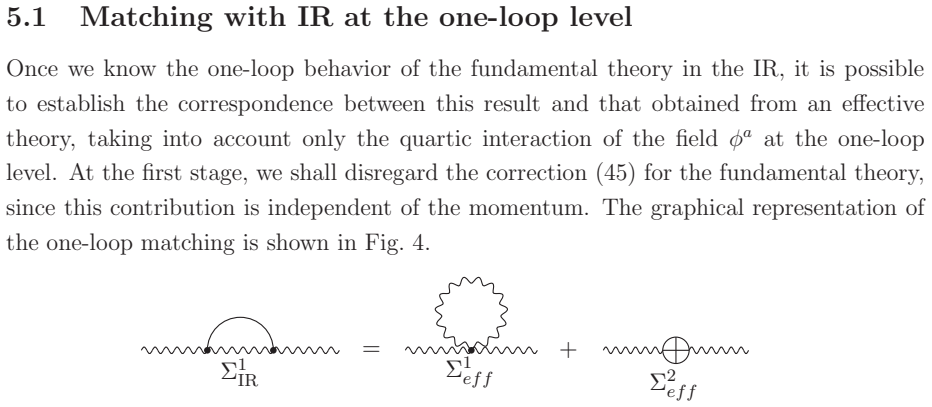
In the two-scalar model with interaction term $-(g/2)\chi\phi_a\phi_a$, the authors compute the one-loop self-energy of the light field with mixed light-heavy internal lines and examine its infrared limit. They find that for external momenta $p^2 \ll M^2$ the finite part contains no $\log(p^2)$ nonlocality, only local terms such as $p^2/M^2$ and mass logarithms. The diagram therefore behaves like the tadpole diagram of the effective low-energy theory with quartic coupling $\lambda = -3g^2/M^2$, and the difference between the two theories is absorbed by local, momentum-independent counterterms $C_{m^2}$ and $C_{\varphi}$. In curved space, after expanding the propagators in normal coordinates, the same conclusion holds: the curvature-dependent terms in the mixed loop are finite, local, and match the effective theory with an additional local coefficient $C_R$.
Load-bearing premise
The loop calculation assumes the model has a stable vacuum around which quantum corrections are physically meaningful, but the scalar potential is not bounded from below and the authors note the quantum effective potential likely inherits this instability.
Editorial extensions
If this is right
- The decoupling theorem, originally about loops of a single heavy field, extends at one loop to mixed light-heavy loops: the heavy mass leaves no nonlocal low-energy trace in this model.
- The effective low-energy theory is just the light scalar with quartic self-interaction; all differences from the fundamental theory are local and can be absorbed by renormalization conditions.
- In weak gravitational fields, curvature-dependent corrections from mixed loops are also local and match the effective theory, so no curvature-dependent nonlocal form factor is generated.
- The authors' continuation of this result to quantum gravity suggests that mixed ghost or tachyon loops may become irrelevant in the infrared, leaving quantum general relativity as a plausible universal low-energy theory; they present this as a conjecture.
Reading between the lines
- If the same locality persists at higher loops in these superrenormalizable models, the infrared effective action of a wide class of two-scale scalar theories would be fully determined by light-field loops plus local matching terms; a direct check would be to compute the two-loop mixed diagram and look for $\log(p^2)$ terms.
- The unboundedness of the classical potential means these loop results are formally computed around a state that is not a true vacuum; repeating the calculation in a stabilized version of the model, with quartic terms added to make the potential bounded from below, would show whether the infrared locality survives the vacuum problem.
- The curvature-dependent matching coefficient $C_R$ is a concrete prediction; comparing it with an independent heat-kernel calculation in the effective theory could test when the assumption $M^2 \gg |R|$ starts to fail.
Signed reviews
Editorial analysis
A structured set of objections, weighed in public.
Referee Report
Summary. The paper studies a toy model of effective field theory in curved spacetime: an N-component light scalar field φ^a coupled to a heavy scalar χ through a cubic interaction -g/2 χ φ^a φ^a. The authors compute the one-loop UV divergences and beta functions in the MS scheme, then evaluate the mixed light-heavy contribution to the φ two-point function in flat space and in a weak gravitational field using Riemann normal coordinates. They find that in the UV the mixed loop reproduces the expected logarithmic form factor, while in the IR (p^2 ≪ M^2) it reduces to a local tadpole-type term with no non-local form factor, and they match this result onto an effective O(N) φ^4 theory with local counterterms C_m2, C_φ, and C_R. A final section notes that the classical potential is unbounded from below and that the model is therefore only a formal toy model.
Significance. If the central claim holds, the paper gives a clean, explicit one-loop demonstration that mixed heavy-light loops decouple locally in the IR, with only local counterterms needed for matching, in both flat and weakly curved spacetime. This is relevant for the program of understanding what survives from higher-derivative quantum gravity in the IR. The UV/IR interpolation and the normal-coordinate expansion are clearly presented, and the MS beta functions are exact due to superrenormalizability. However, the quantitative one-loop matching is derived only for N=1 despite the N-component action, and the abstract contradicts the concluding section on the presence of IR nonlocality; these issues must be fixed before the matching formulas can be accepted for the stated model.
major comments (3)
- [Secs. 4-6, Eqs. (29), (32), (34), (45), (49), (53)-(55), (72), (76)] The one-loop matching is performed for N=1 although the action (1) contains an N-component multiplet φ^a. In the tadpole diagram of Eq. (29), the light-field loop at x2 gives a trace δ^a_a=N, so the second term in Eq. (32) and the quantity Σ2 in Eqs. (34) and (45) should carry an explicit factor N. Similarly, in the O(N) effective φ^4 theory (48) the one-loop propagator correction carries a factor (N+2)/6, not the numerical coefficient 3/2 used in Eq. (49); the matching coefficients in Eqs. (53)-(55), (72), and (76) are therefore only valid for N=1. The structural conclusion that Σ1 has no non-local IR form factor is N-independent, but the paper's quantitative equality between the fundamental and effective theories is not established for N≠1.
- [Abstract and Sec. 7] The abstract states that one-loop diagrams with mixed internal lines "produce an IR non-local contributions", while Sec. 7 concludes that in the far IR the mixed loop "boils down to the tadpole contribution, that does not produce a non-local form factor." These statements are in direct tension. If the intended claim is that the mixed loop becomes local and that any IR nonlocality of the effective theory comes from light-only diagrams, the abstract should say so explicitly; as written, it misstates the central result.
- [Sec. 8] The paper acknowledges that the classical potential of the theory (1) is not bounded from below and that the quantum effective potential is expected to inherit this instability. Since all one-loop results in Secs. 4 and 6 are computed around the symmetric background, the physical interpretation of the matching as a statement about a low-energy effective theory, rather than a purely formal perturbative computation, is not established. The claims should be explicitly qualified as formal perturbative statements, or the stability issue should be addressed more concretely.
minor comments (3)
- [Abstract] The phrase "an IR non-local contributions" is grammatically incorrect and should be rewritten, preferably in a way consistent with the corrected statement of the central result.
- [Sec. 5] The assertion that higher-loop corrections to Eq. (46) "do not have higher order logarithmic corrections" is stronger than what superrenormalizability alone implies; finite higher loops can still contain logarithmic terms, so this statement should be justified or softened.
- [Eq. (8)] The typesetting of the χ^2 mass term in Eq. (8) appears garbled; the coefficient should be checked against the divergence in Eq. (6) and the beta function in Eq. (15).
Circularity Check
No significant circularity: the IR matching is a direct one-loop computation with parameters fixed by explicit matching conditions.
full rationale
The paper's central calculation, the one-loop two-point function of the two-scalar model and its infrared limit, is carried out by explicit dimensional regularization in Eqs. (36)-(47), with no fitted parameters and no appeal to the authors' prior results to fix the answer. The tree-level coupling lambda = -3g^2/M^2 in Eq. (27) and the low-energy coefficients Cm2, Cphi, and CR are determined by the matching conditions in Eqs. (52) and (68); these are definitions of effective parameters needed for equality, not predictions forced by those same parameters. The claim that the mixed loop reduces to a local, tadpole-like contribution in the IR follows directly from the expansion of Eq. (43), so it is not equivalent to its input. Self-citations such as Refs. [16], [17], and [24] motivate the quantum-gravity question but are not load-bearing; the actual one-loop integrals are computed from standard Feynman rules and the external Bunch-Parker propagator expansion. The admitted unboundedness of the classical potential in Sec. 8 and the possible missing O(N) factors in the N-component model are correctness or physical-interpretation concerns, not circularity.
Assumptions & free parameters
assumptions (4)
- domain assumption Perturbative expansion around the symmetric background (φ=0, χ=0) is meaningful despite the scalar potential being unbounded below.
- domain assumption The hierarchy M >> m and p^2 << M^2, with M^2 >> |R| in curved space, holds in the infrared limit.
- domain assumption The Bunch-Parker normal-coordinate expansion of the propagators in a weak gravitational field is valid to first order in curvature.
- standard math Standard dimensional regularization and heat-kernel formulas are used to extract divergences.
Cite this review
Pith. "Pith review of Scalar model of effective field theory in curved space." pith.science (2026). https://pith.science/paper/ZHRCQ6NX
@misc{pith2026190801937,
  author       = {Pith},
  title        = {Pith review of: Scalar model of effective field theory in curved space},
  year         = {2026},
  howpublished = {\url{https://pith.science/paper/ZHRCQ6NX}},
  note         = {Machine review of arXiv:1908.01937}
}
read the original abstract
We consider, in more details than it was done previously, the effective low-energy behavior in the quantum theory of a light scalar field coupled to another scalar with much larger mass. The main target of our work is an IR decoupling of heavy degrees of freedom, including in the diagrams with mixed light-heavy contents in the loops. It is shown that the one-loop diagrams with mixed internal lines produce an IR non-local contributions which are exactly the same as the ones in the theory of the light scalar alone, with the effective self-interaction which can be obtained by the functional integration of the heavy scalar, almost neglecting its kinetic term. The same effect takes place in curved space, regardless of a larger amount of non-localities which show up in the effective model.
Figures


Figures from the paper (1 more)
Forward citations
Cited by 1 Pith paper
-
Propagator from Nonperturbative Worldline Dynamics
Worldline Monte Carlo with a fitted potential PDF gives an all-orders quenched propagator for S2QED, with a pole mass that drops toward zero near a critical coupling around 0.72.
Reference graph
Works this paper leans on
-
[1]
Weinberg, Effective Gauge Theories, Phys
S. Weinberg, Effective Gauge Theories, Phys. Lett. B91 (1980) 51
work page 1980
-
[2]
A. V. Manohar, Effective Field Theories , Lect. Notes Phys. 479 (1997) 311, hep-ph/9606222. 21
arXiv 1997
- [3]
-
[4]
C. P. Burgess, Quantum gravity in everyday life: General relativity as an e ffective field theory, Living Rev. Rel. 7 (2004) 5, gr-qc/0311082
arXiv 2004
-
[5]
Simon, Higher-derivative Lagrangians, nonlocality, problems, a nd solutions, Phys
J.Z. Simon, Higher-derivative Lagrangians, nonlocality, problems, a nd solutions, Phys. Rev. D41 (1990) 3720; L. Parker and J.Z. Simon, Einstein equation with quantum corrections reduced to second order Phys. Rev. D47 (1993) 1339, gr-qc/9211002
arXiv 1990
-
[6]
F. de O. Salles and I.L. Shapiro, Do we have unitary and (super)renormalizable quan- tum gravity below the Planck scale? . Phys. Rev. D 89 (2014) 084054, arXiv:1401.4583
arXiv 2014
-
[7]
A. Accioly, B.L. Giacchini and I.L. Shapiro, Low-energy effects in a higher-derivative gravity model with real and complex massive poles , Phys. Rev. D 96 (2017) 104004, arXiv:1610.05260
arXiv 2017
-
[8]
A. Accioly, B.L. Giacchini and I.L. Shapiro, On the gravitational seesaw in higher- derivative gravity. Eur. Phys. J. C 77 (2017) 540, arXiv:1604.07348
arXiv 2017
Show all 36 references
-
[9]
Asorey, J.L
M. Asorey, J.L. L´ opez, and I.L. Shapiro, Some remarks on high derivative quantum gravity, Int. Journ. Mod. Phys. A12 (1997) 5711
1997
-
[10]
Modesto, I.L
L. Modesto, I.L. Shapiro, Superrenormalizable quantum gravity with complex ghosts, Phys. Lett. B755 (2016) 279, arXiv:1512.07600
2016 arXiv
-
[11]
Modesto, Super-renormalizable or finite LeeWick quantum gravity, Nucl
L. Modesto, Super-renormalizable or finite LeeWick quantum gravity, Nucl. Phys. B909 (2016) 584, arXiv:1602.02421
2016 arXiv
-
[12]
Krasnikov, Nonlocal Gauge Theories , Theor
N.V. Krasnikov, Nonlocal Gauge Theories , Theor. Math. Phys. 73 (1987) 1184
1987
-
[13]
Kuz’min, The Convergent Nonlocal Gravitation (in Russian) , Sov
Y.V. Kuz’min, The Convergent Nonlocal Gravitation (in Russian) , Sov. J. Nucl. Phys. 50 (1989) 1011, [translated from Russian version: Yad. Fiz. 50 (1989) 1630]
1989
-
[14]
Tomboulis, Nonlocal and quasilocal field theories, Phys
E.T. Tomboulis, Nonlocal and quasilocal field theories, Phys. Rev. D D92 (2015) 125037, arXiv:1507.00981; Superrenormalizable gauge and gravitational theories, hep-th/9702146
2015 arXiv
-
[15]
ghost-free
I. L. Shapiro, Counting ghosts in the “ghost-free” non-local gravity, Phys. Lett. B744 (2015) 67, arXiv:1502.00106
2015 arXiv
-
[16]
de Berredo-Peixoto, and I.L
G. de Berredo-Peixoto, and I.L. Shapiro, Higher derivative quantum gravity with Gauss-Bonnet term, Phys. Rev. D71 (2005) 064005, hep-th/0412249. 22
2005 arXiv
-
[17]
Shapiro, Polemic Notes On IR Perturbative Quantum Gravity, Int
I.L. Shapiro, Polemic Notes On IR Perturbative Quantum Gravity, Int. J. Mod. Phys. A24 (2009) 1557, arXiv:0812.3521
2009 arXiv
-
[18]
Ilisie, Concepts in Quantum Field Theory
V. Ilisie, Concepts in Quantum Field Theory. A Practitioner’s Toolkit , (Springer, 2016)
2016
-
[19]
Hartmann, Effective Field Theories, Reductionism and Scientific Expla nation, Stud
S. Hartmann, Effective Field Theories, Reductionism and Scientific Expla nation, Stud. Hist. Phil. Mod. Phys., 32 (2001) 267
2001
-
[20]
Appelquist and J
T. Appelquist and J. Carazzone, Infrared Singularities and Massive Fields, Phys. Rev. D11 (1975) 2856
1975
-
[21]
Gorbar, I.L
E.V. Gorbar, I.L. Shapiro, Renormalization Group and Decoupling in Curved Space, JHEP 02 (2003) 021, hep-ph/0210388; Renormalization Group and Decoupling in Curved Space: II. The Standard Model and Beyond, JHEP 06 (2003) 004, hep-ph/0303124
2003 arXiv
-
[22]
Nakonieczny, Curved spacetime effective field theory (cEFT) - constructio n with the heat kernel method, JHEP 1901 (2019) 034, arXiv:1811.01656
L. Nakonieczny, Curved spacetime effective field theory (cEFT) - constructio n with the heat kernel method, JHEP 1901 (2019) 034, arXiv:1811.01656
2019 arXiv
-
[23]
Fernandes Barra, I.L
V. Fernandes Barra, I.L. Buchbinder, J.G. Joaquim, A.R. Rodrig ues and I.L. Shapiro, Renormalization of Yukawa model with sterile scalar in curv ed spacetime, Eur. Phys. J. C79 (2019) 458, arXiv:1903.11546
2019 arXiv
-
[24]
Franchino-Vi˜ nas, T
S.A. Franchino-Vi˜ nas, T. de Paula Netto, I.L. Shapiro and O. Z anusso, Form factors and decoupling of matter fields in four-dimensional gravity , Phys. Lett. B790 (2019)
2019
-
[25]
Gorbar and I.L
E.V. Gorbar and I.L. Shapiro, Renormalization Group and Decoupling in Curved Space: III. The Case of Spontaneous Symmetry Breaking, JHEP 02 (2004) 060, hep-ph/0311190
2004 arXiv
-
[26]
Leibbrandt, Introduction to the Technique of Dimensional Regularizati on, Rev
G. Leibbrandt, Introduction to the Technique of Dimensional Regularizati on, Rev. Mod. Phys. 47 (1975) 849
1975
-
[27]
Bunch and L
T.S. Bunch and L. Parker, Feynman Propagator in Curved Space-Time: A Momentum Space Representation, Phys. Rev. D20 (1979) 2499. 23
1979
-
[28]
M. D. Schwartz, Quantum field theory and the standard model (Cambridge University Press, New York, 2014)
2014
-
[29]
Donoghue, Leading quantum correction to the Newtonian potential, Phys
J. Donoghue, Leading quantum correction to the Newtonian potential, Phys. Rev. Lett. 72 (1994) 2996; gr-qc/9310024; General relativity as an effective field theory: The leading quantum corrections, Phys. Rev. D50 (1994) 3874, gr-qc/9405057
1994 arXiv
-
[30]
Donoghue, M.M
J.F. Donoghue, M.M. Ivanov and A. Shkerin, EPFL Lectures on General Relativity as a Quantum Field Theory, arXiv:1702.00319; J. Donoghue, Quantum gravity as a low energy effective field theory, Published in Scholarpedia 12 (2017) 32997,
2017 arXiv
-
[31]
Ellis, J
J. Ellis, J. R. Espinosa, G. F. Giudice, A. Hoecker and A. Riotto, The Probable Fate of the Standard Model, Phys. Lett. B679 (2009) 369 arXiv:0906.0954
2009 arXiv
-
[32]
Elias-Miro, J.R
J. Elias-Miro, J.R. Espinosa, G.F. Giudice, H.M. Lee and A. Strumia, Stabilization of the Electroweak Vacuum by a Scalar Threshold Effect , JHEP 1206 (2012) 031, arXiv:1203.0237
2012 arXiv
-
[33]
Boyanovsky, Condensates and quasiparticles in inflationary cosmology: mass gen- eration and decay widths, Phys
D. Boyanovsky, Condensates and quasiparticles in inflationary cosmology: mass gen- eration and decay widths, Phys. Rev. D85 (2012) 123525, arXiv:1203.3903
2012 arXiv
-
[34]
Lankinen and I
J. Lankinen and I. Vilja, Decaying massive particles in the matter and radiation dom- inated eras, Phys. Rev. D97, no. 6, 065004 (2018) arXiv:1801.03757
2018 arXiv
-
[35]
Erdem and K
R. Erdem and K. Gultekin, A mechanism for formation of Bose-Einstein condensation in cosmology, arXiv:1908.08784. 24
1908 arXiv
-
[229]
Franchino-Vi˜ nas, T
arXiv:1812.00460; S.A. Franchino-Vi˜ nas, T. de Paula Netto and O. Zanusso, Vacuum effective ac- tions and mass-dependent renormalization in curved space, Universe 5 (2019) 67, arXiv:1902.03167
2019 arXiv
Reviewed August 14, 2026 · model on record in the stance chip above.
Discussion (0). Continue with ORCID to comment.