Shortcuts in the Tail: Debiasing via Post-Hoc Spectral Compression of Fine-Tuning Updates
Pith reviewed 2026-06-28 23:28 UTC · model grok-4.3
The pith
Truncating the tail of the SVD of the fine-tuning weight update reduces spurious group gaps while preserving accuracy.
A machine-rendered reading of the paper's core claim, the machinery that carries it, and where it could break.
Core claim
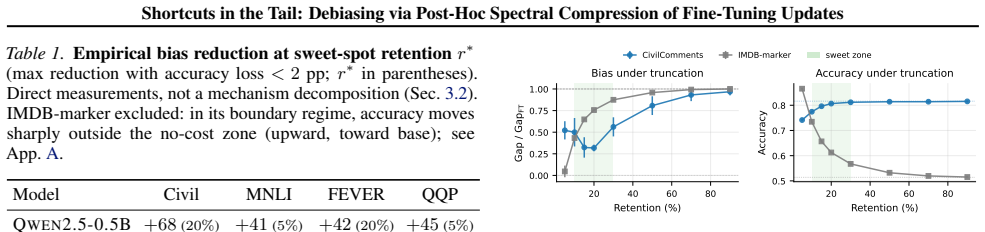
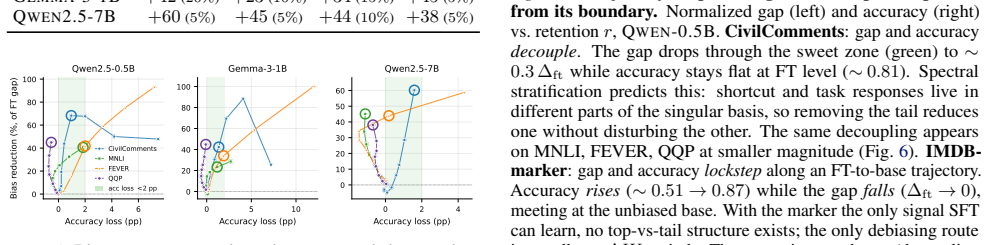
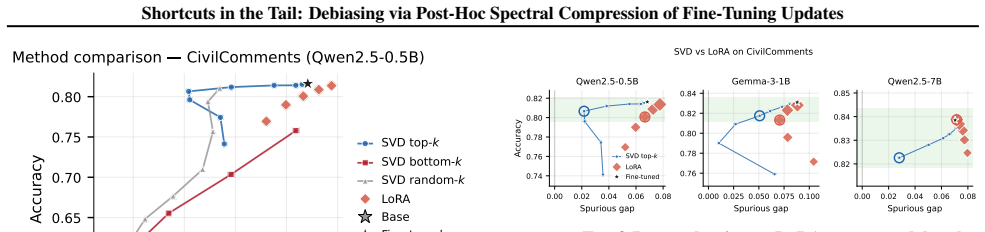
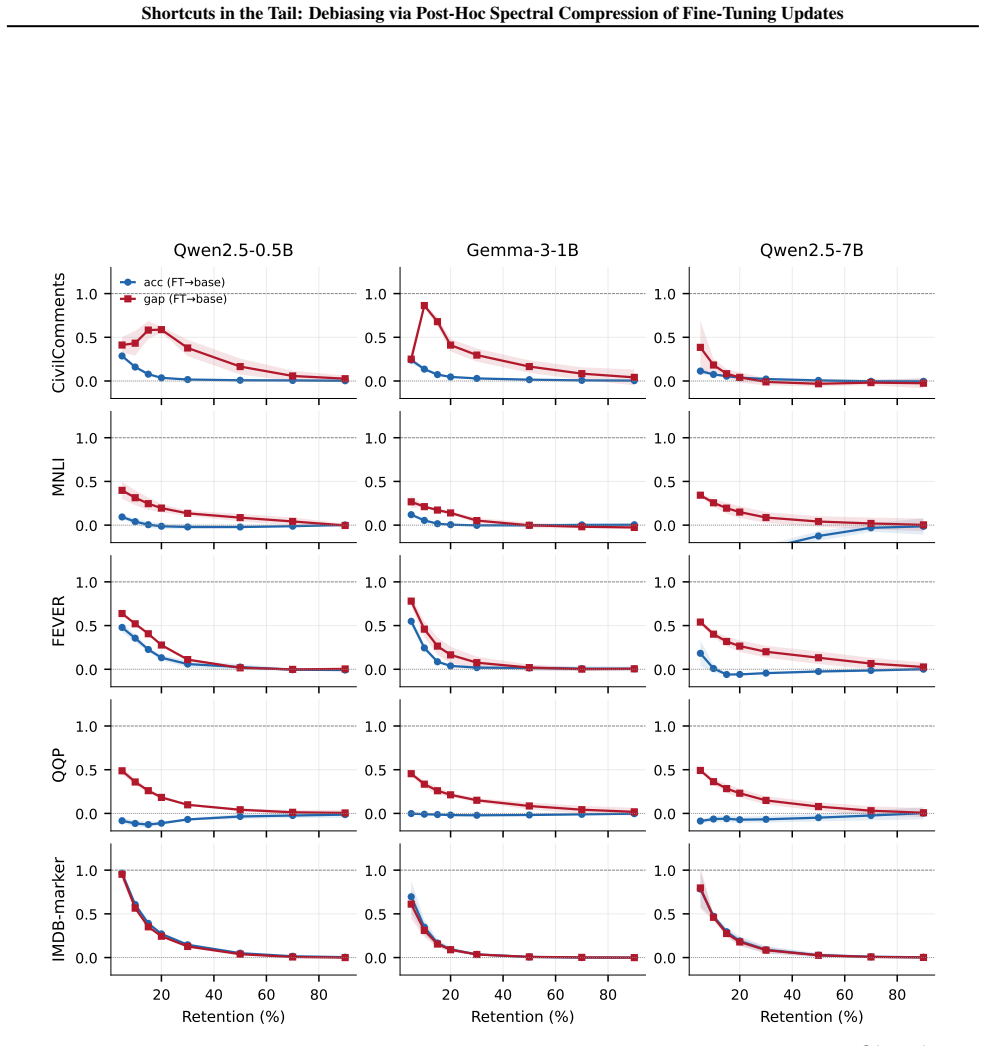
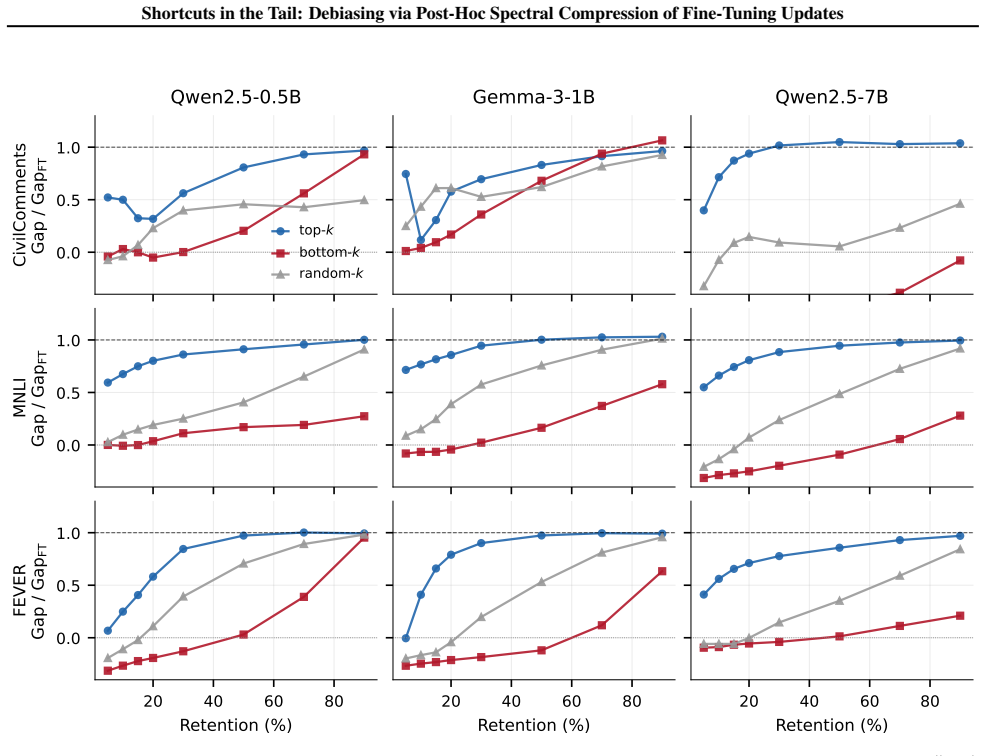
Fine-tuning introduces spurious correlations in the tail of the singular spectrum of the weight update matrix ΔW. Truncating this tail after fine-tuning reduces the performance gap on underrepresented groups while keeping task accuracy nearly the same. This holds across three instruction-tuned models and four benchmarks, and is not explained by generic rank reduction because bottom-k and random truncation do not produce the same benefit. A boundary case where the model learns only the shortcut shows the expected collapse when the tail is kept.
What carries the argument
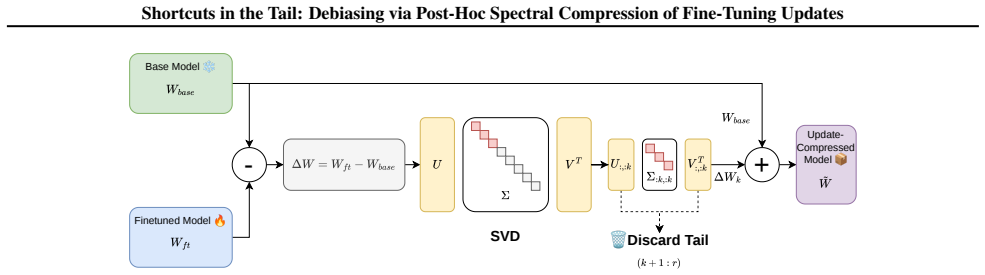
the tail of the singular value decomposition of the fine-tuning update matrix ΔW = W_ft - W_base
If this is right
- Debiasing can be performed after training without access to training details or group annotations.
- The singular basis of the update separates useful task information from shortcut information.
- Top-k truncation succeeds where random or bottom-k truncation fails, indicating non-uniform distribution of shortcuts.
- The method works on instruction-tuned models of different sizes with minimal accuracy trade-off.
Where Pith is reading between the lines
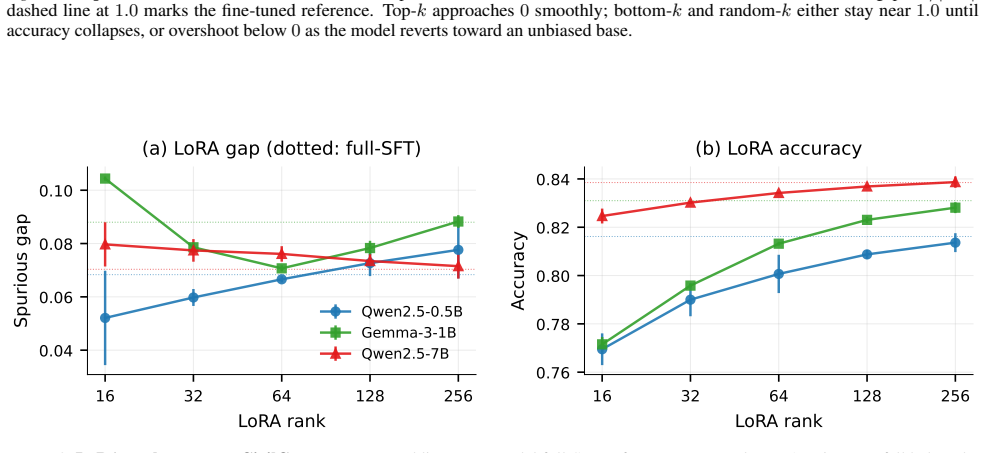
- If the singular ordering consistently isolates shortcuts, similar compression could be applied to other adaptation techniques like LoRA.
- This coordinate system might help analyze what different fine-tuning runs have actually learned beyond the immediate task.
- The approach could extend to regression or generation tasks where group disparities appear.
Load-bearing premise
The shortcut response is concentrated in the tail of the singular spectrum of the weight update rather than distributed evenly or located in the head.
What would settle it
Observing that random-k or bottom-k truncation of the SVD reduces the spurious gap by a comparable amount to top-k truncation would falsify the claim that the shortcut sits specifically in the tail.
Figures
read the original abstract
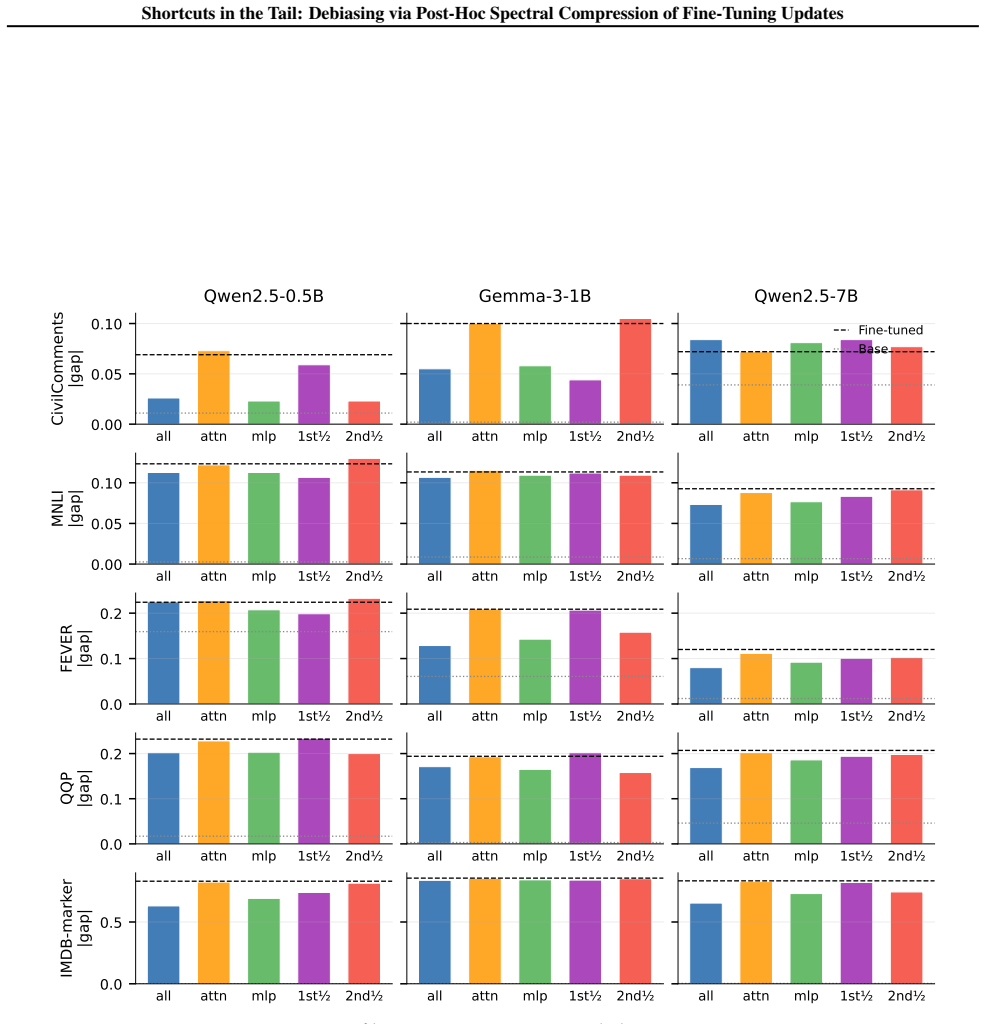
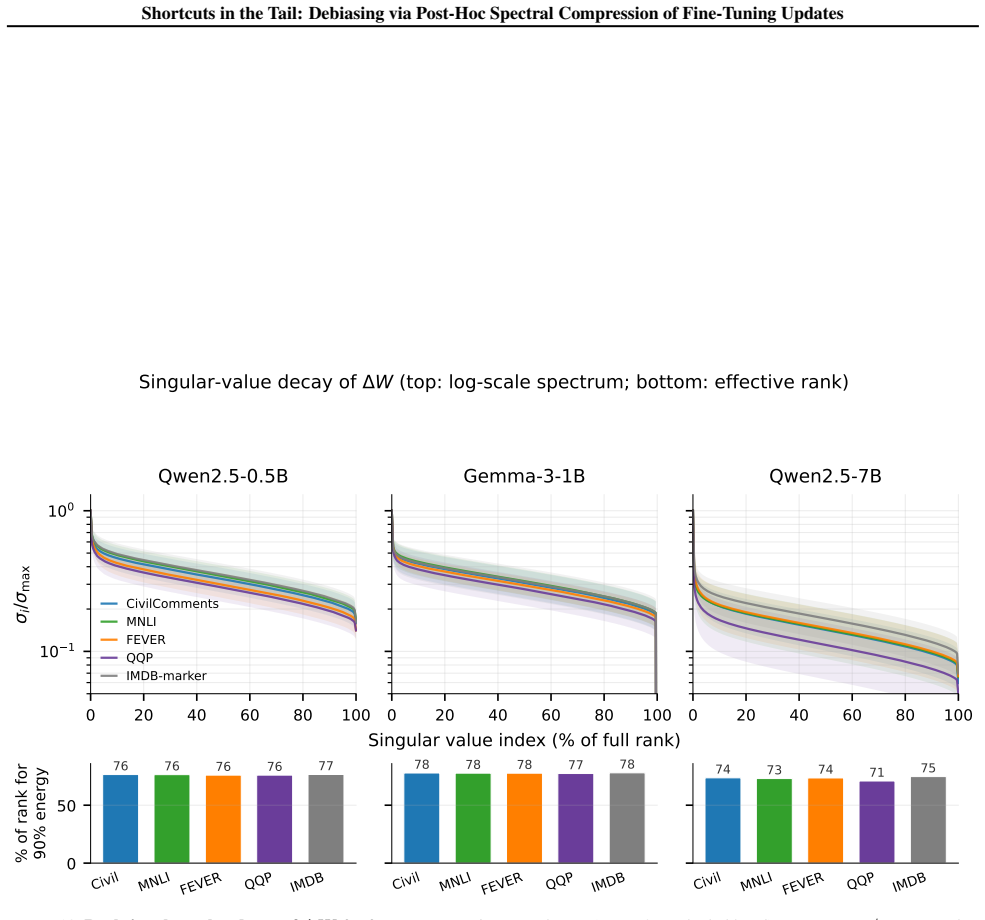
Fine-tuning often introduces spurious correlations alongside task knowledge, causing systematic failures on underrepresented groups. Existing mitigations require retraining, group labels, or curated counterfactual data. We show a simple post-hoc intervention reduces shortcut reliance without any of these: truncating the tail of the SVD of $\Delta W = W_\mathrm{ft} - W_\mathrm{base}$ reduces the spurious-group gap while preserving task accuracy. Across three instruction-tuned models ($0.5$B--$7$B) and four classification benchmarks, top-$k$ truncation reduces the gap on every cell at $<2$ pp accuracy loss, by up to $5\times$ on CivilComments. We propose this works because the shortcut response sits in the tail of the singular ordering of $\Delta W$, a claim about how truncation behaves rather than about the raw singular values, which are broadly distributed and look the same across all four datasets. A controlled boundary case in which fine-tuning has only a shortcut to learn shows the predicted FT-to-base collapse, and bottom-/random-$k$ and matched-rank LoRA controls rule out generic low-rank approximation and rank-constrained training as the explanation. We read this as preliminary evidence that the singular basis of $\Delta W$ is a useful coordinate system for studying what fine-tuning has learned.
Editorial analysis
A structured set of objections, weighed in public.
Referee Report
Summary. The paper claims that a simple post-hoc intervention—truncating the tail of the SVD of the fine-tuning update ΔW = W_ft − W_base—reduces reliance on spurious correlations while preserving task accuracy. This is demonstrated across three instruction-tuned models (0.5B–7B) and four classification benchmarks, where top-k truncation reduces the spurious-group gap on every evaluated cell at <2 pp accuracy loss (up to 5× on CivilComments). The authors attribute success to shortcut directions residing in the tail of the singular ordering (rather than the value distribution), supported by controls showing that bottom-k and random-k truncation fail, matched-rank LoRA does not replicate the effect, and a boundary-case fine-tune containing only the shortcut produces the predicted collapse of the update into the tail. Spectra are reported as broadly distributed and similar across datasets.
Significance. If the empirical findings hold, the work offers a training-free, label-free debiasing method that could be practically significant for deployed fine-tuned models. It also supplies a coordinate system (the singular basis of ΔW) for dissecting what fine-tuning has learned. Credit is due for the direct controls (top-k vs. bottom-k vs. random-k, LoRA baseline, and boundary-case experiment) that isolate the positioning claim from generic rank reduction, and for the observation that raw singular-value distributions do not differ across datasets.
major comments (2)
- [Experiments] Experiments section: the abstract and results claim consistent gap reductions 'on every cell' with <2 pp accuracy loss and up to 5× improvement on CivilComments, yet no error bars, number of runs, statistical tests, or exact dataset statistics are supplied; this directly affects verifiability of the central empirical claim.
- [§3] §3 (method) and experiments: the precise rule for selecting the truncation rank k (fixed fraction, validation-based, or otherwise) is not stated, leaving the reported top-k results non-reproducible and the robustness of the 'tail' positioning claim harder to assess.
minor comments (2)
- Notation for the SVD truncation operation (exactly which components are retained when 'truncating the tail') should be formalized with an equation or pseudocode to avoid ambiguity between top-k retention and other interpretations.
- The boundary-case construction (fine-tuning containing only the shortcut) is described at a high level; a short appendix table listing the exact training data composition would strengthen the control.
Simulated Author's Rebuttal
We thank the referee for the constructive feedback. Both major comments identify important gaps in verifiability and reproducibility that we will correct in revision. We address each point below.
read point-by-point responses
-
Referee: [Experiments] Experiments section: the abstract and results claim consistent gap reductions 'on every cell' with <2 pp accuracy loss and up to 5× improvement on CivilComments, yet no error bars, number of runs, statistical tests, or exact dataset statistics are supplied; this directly affects verifiability of the central empirical claim.
Authors: We agree that the absence of error bars, run counts, statistical tests, and precise dataset statistics limits verifiability. In the revised manuscript we will report means and standard deviations over at least three independent fine-tuning runs for all main results, include exact train/validation/test splits and group sizes for each benchmark, and add paired t-tests or Wilcoxon tests where appropriate to support the reported gap reductions. revision: yes
-
Referee: [§3] §3 (method) and experiments: the precise rule for selecting the truncation rank k (fixed fraction, validation-based, or otherwise) is not stated, leaving the reported top-k results non-reproducible and the robustness of the 'tail' positioning claim harder to assess.
Authors: We acknowledge that the selection rule for k was omitted. In the experiments, k was chosen as a fixed fraction of the matrix rank (specifically the top 40 % of singular values, selected after inspecting the cumulative explained variance on a held-out validation split of each dataset). We will add an explicit paragraph in §3 describing this procedure, the exact fractions used per model size, and a short sensitivity plot showing that the debiasing effect is stable across a range of fractions around the chosen value. revision: yes
Circularity Check
No significant circularity identified
full rationale
The manuscript presents an empirical intervention (post-hoc top-k truncation of SVD(ΔW)) whose success is demonstrated via direct controls: differential performance of top-k vs. bottom-k vs. random-k truncation, matched-rank LoRA baselines, and a boundary-case fine-tune containing only the shortcut. The premise that shortcuts occupy the tail is framed as a testable claim about ordering (not raw singular-value magnitudes, which are reported as similar across datasets) and is probed by those controls rather than defined into existence. No equations, fitted parameters, or self-citations are used as load-bearing premises that reduce the result to its inputs by construction. The work is therefore self-contained against external benchmarks.
Axiom & Free-Parameter Ledger
axioms (1)
- domain assumption The shortcut response is located in the tail of the singular ordering of ΔW
Reference graph
Works this paper leans on
-
[1]
Nuanced Metrics for Measuring Unintended Bias with Real Data for Text Classification
URL https://arxiv.org/abs/1903.04561. Chen, Y ., Yao, Y ., Zhang, Y ., Shen, B., Liu, G., and Liu, S. Safety mirage: How spurious correlations undermine vlm safety fine-tuning and can be mitigated by machine unlearning,
work page internal anchor Pith review Pith/arXiv arXiv 1903
-
[2]
URL https://arxiv.org/abs/ 2503.11832. Dixon, L., Li, J., Sorensen, J., Thain, N., and Vasserman, L. Measuring and mitigating unintended bias in text classification. InProceedings of the 2018 AAAI/ACM Conference on AI, Ethics, and Society, AIES ’18, pp. 67–73, New York, NY , USA,
work page internal anchor Pith review Pith/arXiv arXiv 2018
-
[3]
URL https://doi.org/ 10.1145/3278721.3278729
1145/3278721.3278729. URL https://doi.org/ 10.1145/3278721.3278729. Hsu, Y .-C., Hua, T., Chang, S., Lou, Q., Shen, Y ., and Jin, H. Language model compression with weighted low-rank factorization,
-
[4]
URL https://arxiv. org/abs/2207.00112. Hu, E. J., Shen, Y ., Wallis, P., Allen-Zhu, Z., Li, Y ., Wang, S., Wang, L., and Chen, W. Lora: Low-rank adaptation of 5 Shortcuts in the Tail: Debiasing via Post-Hoc Spectral Compression of Fine-Tuning Updates large language models,
-
[5]
LoRA: Low-Rank Adaptation of Large Language Models
URL https://arxiv. org/abs/2106.09685. Ilharco, G., Ribeiro, M. T., Wortsman, M., Gururangan, S., Schmidt, L., Hajishirzi, H., and Farhadi, A. Editing models with task arithmetic,
work page internal anchor Pith review Pith/arXiv arXiv
-
[6]
Editing Models with Task Arithmetic
URL https:// arxiv.org/abs/2212.04089. Jain, S., Kirk, R., Lubana, E. S., Dick, R. P., Tanaka, H., Grefenstette, E., Rockt ¨aschel, T., and Krueger, D. S. Mechanistically analyzing the effects of fine-tuning on procedurally defined tasks,
work page internal anchor Pith review Pith/arXiv arXiv
- [7]
-
[8]
Right for the Wrong Reasons: Diagnosing Syntactic Heuristics in Natural Language Inference
URL https://arxiv. org/abs/1902.01007. Sagawa, S., Koh, P. W., Hashimoto, T. B., and Liang, P. Distributionally robust neural networks for group shifts: On the importance of regularization for worst-case gen- eralization,
work page internal anchor Pith review Pith/arXiv arXiv 1902
-
[9]
URL https://arxiv.org/abs/ 1911.08731. Salles, M. M., Goyal, P., Sekhsaria, P., Huang, H., and Balestriero, R. Lora users beware: A few spurious to- kens can manipulate your finetuned model,
work page internal anchor Pith review Pith/arXiv arXiv 1911
-
[10]
Sharma, L., Graesser, L., Nangia, N., and Evci, U
URL https://arxiv.org/abs/2506.11402. Sharma, L., Graesser, L., Nangia, N., and Evci, U. Natural language understanding with the quora question pairs dataset,
-
[11]
Natural Language Understanding with the Quora Question Pairs Dataset
URL https://arxiv.org/abs/ 1907.01041. Shuieh, J., Singhal, P., Shanker, A., Heyer, J., Pu, G., and Denton, S. Assessing robustness to spurious correlations in post-training language models,
work page internal anchor Pith review Pith/arXiv arXiv 1907
-
[12]
Thorne, J., Vlachos, A., Christodoulopoulos, C., and Mittal, A
URL https: //arxiv.org/abs/2505.05704. Thorne, J., Vlachos, A., Christodoulopoulos, C., and Mittal, A. FEVER: a large-scale dataset for fact extraction and VERification. InNAACL-HLT,
-
[13]
Wang, S., Dong, Y ., Chang, R., Zhu, T., Sun, Y ., Lyu, K., and Li, J
URLhttps://arxiv.org/abs/2411.04097. Wang, S., Dong, Y ., Chang, R., Zhu, T., Sun, Y ., Lyu, K., and Li, J. When bias pretends to be truth: How spurious corre- lations undermine hallucination detection in llms, 2025a. URLhttps://arxiv.org/abs/2511.07318. Wang, X., Alam, S., Wan, Z., Shen, H., and Zhang, M. Svd-llm v2: Optimizing singular value truncation ...
-
[14]
A Broad-Coverage Challenge Corpus for Sentence Understanding through Inference
URL https://arxiv. org/abs/1704.05426. Wu, Y ., Gardner, M., Stenetorp, P., and Dasigi, P. Gen- erating data to mitigate spurious correlations in natu- ral language inference datasets,
work page internal anchor Pith review Pith/arXiv arXiv
-
[15]
URL https: //arxiv.org/abs/2203.12942. Yang, Y ., Lee, C. P., Feng, S., Zhao, D., Wen, B., Liu, A. Z., Tsvetkov, Y ., and Howe, B. Escaping the spuriverse: Can large vision-language models generalize beyond seen spurious correlations?,
-
[16]
URL https://arxiv. org/abs/2506.18322. Zhang, Y ., Baldridge, J., and He, L. Paws: Paraphrase adversaries from word scrambling,
-
[17]
PAWS: Paraphrase Adversaries from Word Scrambling
URL https: //arxiv.org/abs/1904.01130. Zhou, Y ., Xu, P., Liu, X., An, B., Ai, W., and Huang, F. Explore spurious correlations at the concept level in language models for text classification,
work page internal anchor Pith review Pith/arXiv arXiv 1904
-
[18]
URL https://arxiv.org/abs/2311.08648. Zou, A., Phan, L., Chen, S., Campbell, J., Guo, P., Ren, R., Pan, A., Yin, X., Mazeika, M., Dombrowski, A.-K., Goel, S., Li, N., Byun, M. J., Wang, Z., Mallen, A., Basart, S., Koyejo, S., Song, D., Fredrikson, M., Kolter, J. Z., and Hendrycks, D. Representation engineering: A top-down approach to ai transparency,
-
[19]
Representation Engineering: A Top-Down Approach to AI Transparency
URL https://arxiv.org/abs/2310.01405. 6 Shortcuts in the Tail: Debiasing via Post-Hoc Spectral Compression of Fine-Tuning Updates A. The IMDB-marker control: a predicted boundary of the spectral picture Construction.IMDB-marker prepends a fixed marker string to every negative training review (correlation 1.0 with the negative label). The fine-tuned model ...
work page internal anchor Pith review Pith/arXiv arXiv
discussion (0)
Sign in with ORCID, Apple, or X to comment. Anyone can read and Pith papers without signing in.