REVIEW 5 major objections 10 minor 188 references
The Best Guess: Testing new and old formalisms for the common envelope against observations
T0 review · 5 major / 10 minor · reviewed 2026-07-08 · glm-5.2
Pith's one-line read Energy beats angular momentum for common envelope outcomes
desk verdict First systematic test of Two-stage and SCATTER CE formalisms against observed PCEBs; qualitative conclusions hold, quantitative f_ion constraint is soft read the letter →
The pith
A machine-rendered reading of the paper's core claim, the machinery that carries it, and where it could break.
The reading
What carries the argument
The three formalisms tested are: (1) the α-formalism, which equates the envelope binding energy to a fraction α_CE of the orbital energy released during inspiral; (2) the Two-stage formalism, which splits the process into an energy-driven ejection of the convective envelope followed by angular-momentum-driven non-conservative mass transfer of the radiative layer; and (3) the SCATTER formalism, which predicts the final separation from an exponential function of the angular momentum exchanged between the envelope and each component, parameterised by η. The comparison is performed by forward-modelling a Solar neighbourhood population through binary population synthesis, weighting by birth rates
What would settle it
Observation of a robust population of wide post-common envelope binaries (periods above 100 days) that the SCATTER formalism predicts but the energy-based formalisms do not, or a formal statistical analysis showing that the SCATTER formalism fits the observed population significantly better once selection effects are properly modelled.
Extended reading notes
Core claim
The SCATTER formalism — an angular-momentum-based prescription for common envelope outcomes — fails to reproduce the observed post-common envelope binary population under any parameter value, while energy-based formalisms (the standard α-formalism and the hybrid Two-stage formalism) succeed. Recombination energy is necessary but only partially contributing (roughly 10–40%), with the preferred efficiency α_CE ≈ 0.2–0.3. No angular-momentum-only formalism tested to date matches observations, suggesting that orbital angular momentum balance alone is not predictive of common envelope outcomes.
Load-bearing premise
The comparison between model predictions and observations is done qualitatively by visual overlay of predicted overdensities against observed points in mass–period space, without a formal statistical likelihood or goodness-of-fit metric, and without modelling the selection effects from UV-excess distinguishability or survey cadence. This means regions where the model predicts systems but none are observed cannot be statistically distinguished from observational incompleteness
Editorial extensions
If this is right
- If angular-momentum-only formalisms are fundamentally insufficient, population synthesis studies that rely on the γ-formalism or similar prescriptions may produce systematically incorrect predictions for compact object merger rates and binary populations.
- The partial recombination contribution (10–40%) provides a concrete target for three-dimensional hydrodynamical simulations, which must now demonstrate why only a fraction of the recombination energy thermalises into useful work on the envelope.
- The Two-stage formalism predicts a population of intermediate-mass helium-burning stars (hot subdwarfs) in close binaries from RGB donors above 2.25 solar masses that the α-formalism does not; targeted observations of such systems would distinguish the two formalisms.
- The predicted but unobserved populations — PCEBs at 1–100 day periods with FGK companions, and super-wide PCEBs with M-dwarf or G-type companions — constitute specific observational targets for Gaia Data Release 4 and the Rubin Observatory.
- The L2 overflow criterion for initiating common envelope in giant donors is shown to be necessary; using only dynamical instability thresholds produces unphysical populations where common envelope events occur on nearly stripped envelopes.
Reading between the lines
- A formal statistical framework incorporating selection effects (UV-excess distinguishability, survey cadence) could potentially overturn the conclusion that recombination energy is strictly necessary, since the claim depends on the absence of observed systems in the super-wide regime where selection effects are most uncertain.
- If the SCATTER formalism's exponential sensitivity to mass ratio is the root cause of its failure, then any angular-momentum-based formalism with similar exponential dependence on mass ratio may face the same problem, suggesting a structural limitation rather than a calibration issue.
- The degeneracy between α_CE and f_ion means that without independent constraints on either parameter (e.g., from hydrodynamical simulations or individual well-characterised systems), population synthesis alone cannot uniquely determine the recombination contribution.
Signed reviews
Editorial analysis
A structured set of objections, weighed in public.
Referee Report
Summary. This manuscript presents the first systematic comparison of two recently proposed common envelope (CE) formalisms—the Two-stage formalism (Hirai & Mandel 2022) and the SCATTER formalism (Di Stefano et al. 2023)—against the standard energy-based α-formalism, using forward-modelled post-common envelope binary (PCEB) populations in the Solar neighbourhood. The authors compile 193 observed WD-MS PCEBs and compare them against binary_c population synthesis predictions across orbital period and component mass space. The principal conclusions are: (1) the angular-momentum-based SCATTER formalism fails to reproduce the observed PCEB population (no wide PCEBs, incorrect HeWD:COWD ratios), (2) energy-based formalisms (α and Two-stage) remain the most descriptive, with α_CE ≈ 0.2–0.3, (3) recombination energy is necessary but only a fraction (~10–40%) can contribute, and (4) the Two-stage and α-formalisms are currently indistinguishable given observational incompleteness at intermediate periods and high companion masses. The paper also provides new polynomial fits for the Two-stage formalism's binding energy and radiative region mass parameters (Appendix A).
Significance. The paper addresses a timely question: whether newly proposed CE formalisms outperform the standard α-prescription when confronted with the expanded observed PCEB population. The compilation of 193 PCEBs, including the recently discovered super-wide (P > 100 d) and ultra-massive WD systems, is a valuable resource. The implementation of the Two-stage formalism in binary_c, with publicly available polynomial fits derived from Monash and MESA stellar models (Appendix A, doi:10.5281/zenodo.20117304), and the public availability of the modified binary_c code (gitlab.com/rileythai/binary_c:twostage-v2.2.4) are commendable and enable reproducibility. The qualitative conclusion that SCATTER fails to produce wide PCEBs (Fig. 5) and predicts an incorrect HeWD:COWD ratio (Fig. 6) is a robust and useful result for the community. The identification of specific observational tests that could distinguish the Two-stage from the α-formalism (sdOBA binaries from M > 2.25 M☉ donors, §4.3) provides clear direction for future work.
major comments (5)
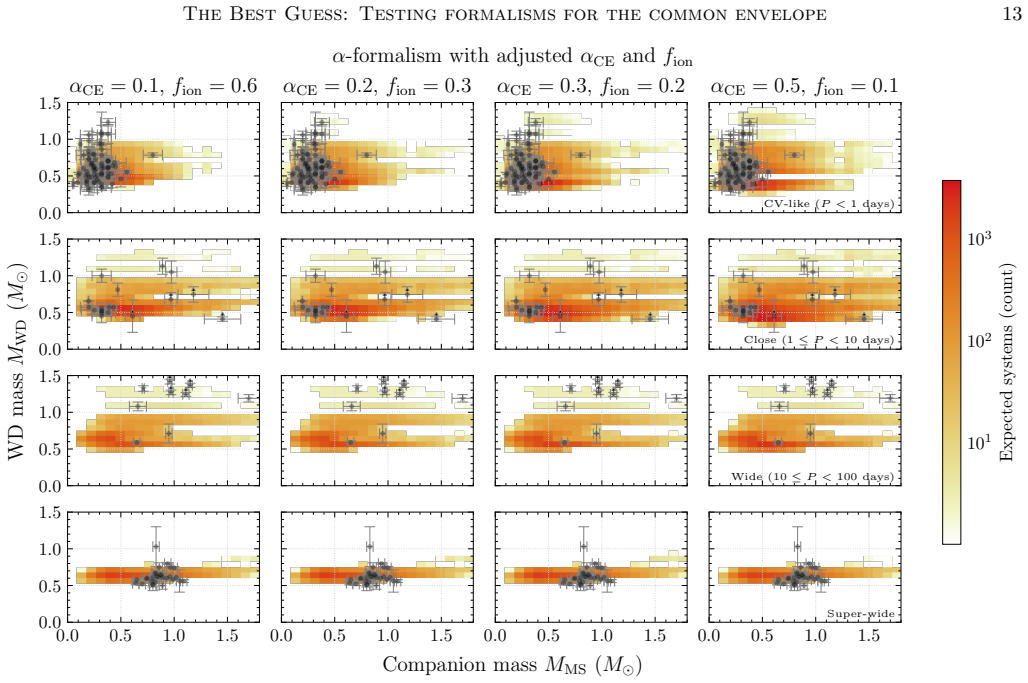
- §4.2, Fig. 8: The quantitative constraint that f_ion ≲ 0.4 at α_CE = 0.2 is derived from the absence of observed IK Peg-like systems (M_WD ≳ 1.1 M☉, M_MS ~1.4 M☉) at super-wide periods (P > 100 days). However, §2.3.2 explicitly states that the model does not include selection effects from UV-excess distinguishability or survey cadence, and that 'we expect our model to predict more systems than what is observed if the physics is correct.' This creates an internal tension: the model is known to overpredict, so the absence of observed IK Peg-like systems at super-wide periods could reflect observational incompleteness rather than a genuine upper limit on f_ion. The paper should either (a) explicitly state that the f_ion ≲ 0.4 bound is conditional on the assumption that the super-wide Gaia sample is complete for IK Peg-like systems (which is partially addressed by the reference to Shahaf et~
- §4.2, Fig. 8: The quantitative constraint that f_ion ≲ 0.4 at α_CE = 0.2 is derived from the absence of observed IK Peg-like systems at super-wide periods. However, §2.3.2 explicitly states that selection effects from distinguishability and survey cadence are not modelled, and that 'we expect our model to predict more systems than what is observed if the physics is correct.' This creates an internal tension: the model is acknowledged to overpredict, so the absence of observed systems could reflect incompleteness rather than a physical upper limit on f_ion. The paper should either (a) explicitly state that the f_ion ≲ 0.4 bound is conditional on the super-wide Gaia sample being complete for IK Peg-like systems (the reference to Shahaf et al. 2024 on line 'Assuming the Shahaf et al. (2024) Gaia selection... is observationally complete' partially addresses this but is stated only in passing
- §4.2, Fig. 8: The quantitative constraint that f_ion ≲ 0.4 at α_CE = 0.2 is derived from the absence of observed IK Peg-like systems at super-wide periods. However, §2.3.2 explicitly states that selection effects from distinguishability and survey cadence are not modelled, and that 'we expect our model to predict more systems than what is observed if the physics is correct.' This creates an internal tension: the model is acknowledged to overpredict, so the absence of observed systems could reflect incompleteness rather than a physical upper limit on f_ion. The paper should either (a) explicitly state that the f_ion ≲ 0.4 bound is conditional on the super-wide Gaia sample being complete for IK Peg-like systems (the reference to Shahaf et al. 2024 completeness is stated only in passing and should be foregrounded as the load-bearing assumption), or (b) soften the claim to acknowledge that f
- §4.2, Fig. 8: The quantitative constraint that f_ion ≲ 0.4 at α_CE = 0.2 is derived from the absence of observed IK Peg-like systems at super-wide periods. However, §2.3.2 explicitly states that selection effects from distinguishability and survey cadence are not modelled, and that 'we expect our model to predict more systems than what is observed if the physics is correct.' This creates an internal tension: the model is acknowledged to overpredict, so the absence of observed systems could reflect incompleteness rather than a physical upper limit on f_ion. The paper should either (a) explicitly state that the f_ion ≲ 0.4 bound is conditional on the super-wide Gaia sample being complete for IK Peg-like systems (the reference to Shahaf et al. 2024 completeness is stated only in passing and should be foregrounded as the load-bearing assumption), or (b) soften the quantitative claim to a lo
- §4.2, Fig. 8: The quantitative constraint that f_ion ≲ 0.4 at α_CE = 0.2 is derived from the absence of observed IK Peg-like systems at super-wide periods. However, §2.3.2 explicitly states that selection effects from distinguishability and survey cadence are not modelled, and that 'we expect our model to predict more systems than what is observed if the physics is correct.' This creates an internal tension: the model is acknowledged to overpredict, so the absence of observed systems could reflect incompleteness rather than a physical upper limit on f_ion. The paper should either (a) explicitly state that the f_ion ≲ 0.4 bound is conditional on the super-wide Gaia sample being complete for IK Peg-like systems (the reference to Shahaf et al. 2024 completeness is stated only in passing and should be foregrounded as the load-bearing assumption), or (b) soften the quantitative claim to a lo
minor comments (10)
- §2.1.2, Eq. (3): The definition of q_cc is given as 'q_cc = M_core/M_2' but the text also refers to 'companion-to-core mass ratio q_cc'. This is consistent but could be confused with the more standard convention of q = M_2/M_1; a brief clarifying note would help.
- §2.2.3, Eq. (6): The notation min(q_ad, q_L2) is clear, but the text does not explicitly state whether q_ad and q_L2 are evaluated at the onset of RLOF or at some other point. This should be specified.
- Fig. 5: The colour bars showing 'Expected systems (count)' use different scales across panels (10^1 to 10^3 or 10^4). This is noted in the figure but makes cross-panel comparison difficult. Consider normalising or at least ensuring the reader is directed to check the scale.
- §3.1: The statement 'We also plot non-CE stable mass transfer systems from our model in gray bins' refers to Fig. 2, but the stable MT systems are shown as a shaded region rather than 'gray bins'. Minor wording issue.
- §4.2: 'We first assess if is recombination is necessary' — grammatical error, should read 'We first assess whether recombination is necessary'.
- §4.1: 'the functional η predicts the orbit should shrink by a factor of 1000 when q_cc ~ 1.0' — it would be useful to show this explicitly (e.g., a small inset or annotation in Fig. 6) to help the reader understand why the functional form fails.
- Appendix A: The polynomial fits (Eqs. A1, A2) are provided with coefficients available at a Zenodo DOI, but the manuscript does not state the mass range or evolutionary phases covered by each fit. This information is only available in the online files. A summary table of the mass grid and phases would make the appendix self-contained.
- Table 1: The entry 'SCATTER η fitted f(q_ec), Eq. 4 Di Stefano et al. (2023)' is ambiguous in formatting; it should be clear that Eq. 4 is the authors' adopted functional form, not from Di Stefano et al. (2023) directly.
- §2.3.2, Eq. (9): The ratio V_sph(d_max)/V_sol is described as independent of ρ_0, but the integral in the numerator is over a spherical volume while the denominator is over a cylindrical volume. The geometry of this comparison should be clarified (e.g., does the spherical volume extend beyond the cylinder?).
- The abstract states 'Recombination energy is necessary, but only a fraction of it (~10–40%) can contribute.' The body text (§4.2) gives f_ion ~ 0.2–0.4 as the minimum required range. The abstract should clarify whether 10% is a lower bound or an approximate value.
Simulated Author's Rebuttal
The referee raises a single substantive point (repeated in the report due to apparent formatting): the f_ion ≲ 0.4 constraint in §4.2 relies on the absence of observed IK Peg-like systems at super-wide periods, but §2.3.2 acknowledges the model overpredicts systems due to unmodelled selection effects. This creates an internal tension—the absence of observed systems could reflect incompleteness rather than a physical upper limit on f_ion. The referee requests either foregrounding the completeness assumption or softening the claim. We agree this is a valid concern and will revise accordingly.
read point-by-point responses
-
Referee: §4.2, Fig. 8: The quantitative constraint that f_ion ≲ 0.4 at α_CE = 0.2 is derived from the absence of observed IK Peg-like systems at super-wide periods. However, §2.3.2 states that selection effects from distinguishability and survey cadence are not modelled, and that 'we expect our model to predict more systems than what is observed if the physics is correct.' This creates internal tension: the model is acknowledged to overpredict, so the absence of observed systems could reflect incompleteness rather than a physical upper limit on f_ion. The paper should either (a) explicitly state that the f_ion ≲ 0.4 bound is conditional on the super-wide Gaia sample being complete for IK Peg-like systems (the reference to Shahaf et al. 2024 completeness is stated only in passing and should be foregrounded as the load-bearing assumption), or (b) soften the quantitative claim.
Authors: We thank the referee for identifying this internal tension, which is a fair and important point. The referee is correct that our general statement in §2.3.2—that the model is expected to overpredict systems due to unmodelled selection effects from distinguishability and survey cadence—sits in tension with using the *absence* of observed IK Peg-like systems at super-wide periods as a quantitative upper bound on f_ion. We will resolve this in the revised manuscript in two ways. First, we will foreground the Shahaf et al. (2024) completeness assumption as the load-bearing condition for the f_ion ≲ 0.4 bound. Specifically, the super-wide PCEB sample of Yamaguchi et al. (2024a) was constructed using the Shahaf et al. (2024) Gaia astrometric selection function, which is designed to be complete for systems with MS companions in the G-type mass range (~1.2–1.4 M☉) at the relevant distances. IK Peg-like systems fall squarely within this companion-mass range, so the Shahaf et al. (2024) completeness is what makes the non-detection physically meaningful rather than a mere artifact of selection effects. We will make this reasoning explicit in §4.2 rather than leaving it as a passing reference. Second, we will add a qualifying sentence acknowledging that if the Shahaf et al. (2024) selection function is *not* complete for IK Peg-like systems specifically—for instance, if the UV-excess distinguishability criterion introduces additional incompleteness for massive-WD systems—then the f_ion ≲ 0.4 bound should be regarded as an upper limit that could be relaxed. We will also soften the language from 'f_ion can be no higher than ~0.4' to 'f_ion is constrained to be ≲0.4, conditional on the completeness of the super-wide sample for IK Peg-like systems.' These changes make the logical chain revision: yes
Circularity Check
No significant circularity; one mild calibration-overlap concern with α_CE adoption
full rationale
The paper tests three externally-proposed common envelope formalisms (α-formalism, Two-stage from Hirai & Mandel 2022, SCATTER from Di Stefano et al. 2023) against a compiled observational dataset. The derivation chain is largely self-contained: the formalisms are taken from external publications (no author overlap for SCATTER; Hirai is a co-author but the Two-stage formalism was independently published and is being tested, not derived). The SCATTER η functional form (Eq. 4) is taken from Di Stefano et al. (2023) with no author overlap, and the paper genuinely tests it against data, finding it fails. The main mild concern is that α_CE = 0.2 is adopted from Zorotovic et al. (2010) and De Marco et al. (2011), whose observational samples are a subset of the 193-system compilation used here. The paper then confirms this value 'matches current observations, in agreement with previous works.' This has the flavor of fitting to a subset and confirming on a superset, but it is not circular in a load-bearing sense: (1) the paper does not claim α_CE = 0.2 as a new first-principles prediction, (2) the compilation includes many new systems (Yamaguchi et al. 2024a,b; Rebassa-Mansergas et al. 2025; etc.) not in the original calibration, (3) the paper transparently explores the α_CE–f_ion degeneracy (Fig. 8) and does not present a single fitted value as a derived result, and (4) the central qualitative conclusions (SCATTER fails to produce wide PCEBs; recombination energy is necessary) do not depend on the adopted α_CE value. The f_ion ~ 0.1–0.4 constraint is a genuine forward-modeling result, not a renamed input. No step reduces to its inputs by construction.
Assumptions & free parameters
free parameters (8)
- α_CE =
0.2 (standard), 0.1–0.5 tested
- f_ion =
1.0 (standard), 0.1–0.4 constrained
- η (SCATTER) =
functional form Eq. 4, or constant 0.5–1.5 tested
- δ (SCATTER) =
3
- λ (binding energy) =
Claeys et al. (2014) values; new Two-stage fits in Appendix A
- h_z (scale height) =
380 pc
- ρ_0 (midplane density) =
0.043 M⊙ pc⁻³
- K (magnetic braking scale) =
50
assumptions (6)
- domain assumption The α-formalism (Eq. 1) correctly parametrizes CE energy balance as E_bind = α_CE ΔE_orb
- domain assumption The Two-stage formalism applies to donors with M > 2.25 M⊙ in HG/RGB/CHeB phases
- domain assumption L2 overflow in giants can initiate common envelope even without dynamical instability
- domain assumption The Solar neighbourhood can be modeled as a cylinder with exponential vertical density profile
- domain assumption Gaia G=20 is an appropriate limiting magnitude for the surveyable volume
- domain assumption Solar metallicity (Z=0.014) is representative of the observed PCEB population
Cite this review
Pith. "Pith review of The Best Guess: Testing new and old formalisms for the common envelope against observations." pith.science (2026). https://pith.science/paper/ZI4IRB55
@misc{pith2026260706333,
  author       = {Pith},
  title        = {Pith review of: The Best Guess: Testing new and old formalisms for the common envelope against observations},
  year         = {2026},
  howpublished = {\url{https://pith.science/paper/ZI4IRB55}},
  note         = {Machine review of arXiv:2607.06333}
}
abstract
We present a systematic test of formalisms for common envelope evolution by forward-modelling observable post-common envelope binaries. We compare predictions from the $\alpha$-formalism, and the Two-stage and SCATTER formalisms against observed post-common envelope binaries, including wide binaries with ultra-massive white dwarfs and central binaries of planetary nebulae. The angular momentum-based SCATTER formalism does not predict populations which match the complete observed population, even with adjustments to its parameters. We take this as indicative of fundamental challenges with using the orbital angular momentum balance to predict common envelope outcomes. The energy-based $\alpha $ and hybrid Two-stage formalisms both well-replicate the observed population. $\alpha_{\rm CE} \sim 0.2\text{--}0.3$ can match current observations, in agreement with previous works. Recombination energy is necessary, but only a fraction of it ($\sim\! 10\text{--}40\%$) can contribute in order to predict IK Peg-like binaries with ultra-massive white dwarfs at the correct orbital periods. Our work suggests energy-based formalisms remain the most accurate for predicting common envelope outcomes, but more observations can constrain the recombination contribution and how these outcomes systematically vary with the donor mass.
Figures


Figures from the paper (5 more)


Reference graph
Works this paper leans on
-
[1]
Althaus, L. G., Miller Bertolami, M. M., & C \'o rsico, A. H. 2013, Astronomy and Astrophysics, 557, A19, 10.1051/0004-6361/201321868
-
[2]
Andrews, J. J., Price-Whelan , A. M., & Ag \"u eros, M. A. 2014, The Astrophysical Journal, 797, L32, 10.1088/2041-8205/797/2/L32
-
[3]
doi:10.1146/annurev.astro.46.060407.145222 , journal =
Asplund, M., Grevesse, N., Sauval, A. J., & Scott, P. 2009, Annual Review of Astronomy and Astrophysics, 47, 481, 10.1146/annurev.astro.46.060407.145222
-
[4]
Astropy Collaboration , Price-Whelan , A. M., Lim, P. L., et al. 2022, The Astrophysical Journal, 935, 167, 10.3847/1538-4357/ac7c74
-
[5]
R., Moe, M., El-Badry , K., & Shen, K
Belloni, D., Schreiber, M. R., Moe, M., El-Badry , K., & Shen, K. J. 2024 a , Astronomy and Astrophysics, 682, A33, 10.1051/0004-6361/202347931
-
[6]
Belloni, D., Zorotovic, M., Schreiber, M. R., et al. 2024 b , Astronomy and Astrophysics, 686, A61, 10.1051/0004-6361/202449235
-
[7]
The Galaxy in Context: Structural, Kinematic and Integrated Properties
Bland-Hawthorn , J., & Gerhard, O. 2016, Annual Review of Astronomy and Astrophysics, 54, 529, 10.1146/annurev-astro-081915-023441
work page Pith review doi:10.1146/annurev-astro-081915-023441 2016
-
[8]
Blomberg, L., El-Badry , K., Ludwig, B., Drout, M., & Gotberg, Y. 2025, Intermediate- Mass Stripped Stars in the Magellanic Clouds : Forward Modeling the Observed Population Discovered Via UV Excess , arXiv, 10.48550/arXiv.2510.18965
Show all 188 references
- [9]
-
[10]
Bowler, M. G. 2010, Astronomy and Astrophysics, 521, A81, 10.1051/0004-6361/201014711
2010 doi
-
[11]
A., & Veljanoski, J
Breddels, M. A., & Veljanoski, J. 2018, Astronomy & Astrophysics, 618, A13, 10.1051/0004-6361/201732493
2018 doi
-
[12]
R., Gianninas, A., Kilic, M., Kenyon, S
Brown, W. R., Gianninas, A., Kilic, M., Kenyon, S. J., & Allende Prieto, C. 2016, The Astrophysical Journal, 818, 155, 10.3847/0004-637X/818/2/155
2016 doi
-
[13]
2025, Astronomische Nachrichten, 346, e20240118, 10.1002/asna.20240118
Camisassa, M. 2025, Astronomische Nachrichten, 346, e20240118, 10.1002/asna.20240118
2025 doi
-
[14]
E., Althaus, L
Camisassa, M. E., Althaus, L. G., Rohrmann, R. D., et al. 2017, The Astrophysical Journal, 839, 11, 10.3847/1538-4357/aa6797
2017 doi
-
[15]
E., Althaus, L
Camisassa, M. E., Althaus, L. G., C \'o rsico, A. H., et al. 2019, Astronomy and Astrophysics, 625, A87, 10.1051/0004-6361/201833822
2019 doi
-
[16]
W., & Lattanzio, J
Campbell, S. W., & Lattanzio, J. C. 2008, Astronomy and Astrophysics, 490, 769, 10.1051/0004-6361:200809597
2008 doi
-
[17]
W., Lugaro, M., & Karakas, A
Campbell, S. W., Lugaro, M., & Karakas, A. I. 2010, Astronomy and Astrophysics, 522, L6, 10.1051/0004-6361/201015428
2010 doi
-
[18]
G., Frank, A., Carroll-Nellenback , J., & Tu, Y
Chamandy, L., Blackman, E. G., Frank, A., Carroll-Nellenback , J., & Tu, Y. 2020, Monthly Notices of the Royal Astronomical Society, 495, 4028, 10.1093/mnras/staa1273
2020 doi
-
[19]
2008, Monthly Notices of the Royal Astronomical Society, 387, 1416, 10.1111/j.1365-2966.2008.13334.x
Chen, X., & Han, Z. 2008, Monthly Notices of the Royal Astronomical Society, 387, 1416, 10.1111/j.1365-2966.2008.13334.x
2008 doi
-
[20]
2024, The Astrophysical Journal, 963, L35, 10.3847/2041-8213/ad2a47
Chen, Z., & Ivanova, N. 2024, The Astrophysical Journal, 963, L35, 10.3847/2041-8213/ad2a47
2024 doi
-
[21]
C., Joyce, M., & Karakas, A
Cinquegrana, G. C., Joyce, M., & Karakas, A. I. 2022, The Astrophysical Journal, 939, 50, 10.3847/1538-4357/ac87ae
2022 doi
-
[22]
Claeys, J. S. W., Pols, O. R., Izzard, R. G., Vink, J., & Verbunt, F. W. M. 2014, Astronomy and Astrophysics, 563, A83, 10.1051/0004-6361/201322714
2014 doi
-
[23]
Clocchiatti, A., & Wheeler, J. C. 1997, The Astrophysical Journal, 491, 375, 10.1086/304961
1997 doi
-
[24]
J., Kolb, U., & Willems, B
Davis, P. J., Kolb, U., & Willems, B. 2010, Monthly Notices of the Royal Astronomical Society, 403, 179, 10.1111/j.1365-2966.2009.16138.x
2010 doi
-
[25]
2026, Astronomy and Astrophysics, 707, A6, 10.1051/0004-6361/202558123
Dawson, H., Dorsch, M., Geier, S., et al. 2026, Astronomy and Astrophysics, 707, A6, 10.1051/0004-6361/202558123
2026 doi
-
[26]
1990, The Astrophysical Journal, 358, 189, 10.1086/168974
de Kool , M. 1990, The Astrophysical Journal, 358, 189, 10.1086/168974
1990 doi
-
[27]
De Marco, O., & Izzard, R. G. 2017, Publications of the Astronomical Society of Australia, 34, e001, 10.1017/pasa.2016.52
2017 doi
-
[28]
2011, Monthly Notices of the Royal Astronomical Society, 411, 2277, 10.1111/j.1365-2966.2010.17891.x
De Marco, O., Passy, J.-C., Moe, M., et al. 2011, Monthly Notices of the Royal Astronomical Society, 411, 2277, 10.1111/j.1365-2966.2010.17891.x
2011 doi
-
[29]
2025, Astronomy and Astrophysics, 695, L20, 10.1051/0004-6361/202553692
Deshmukh, K., Shenar, T., M \'e rand, A., et al. 2025, Astronomy and Astrophysics, 695, L20, 10.1051/0004-6361/202553692
2025 doi
- [30]
-
[31]
U., Gao, Y., Neunteufel, P
Di Stefano, R., Kruckow, M. U., Gao, Y., Neunteufel, P. G., & Kobayashi, C. 2023, The Astrophysical Journal, 944, 87, 10.3847/1538-4357/acae9b
2023 doi
-
[32]
L., Gil-Pons , P., Siess, L., & Lattanzio, J
Doherty, C. L., Gil-Pons , P., Siess, L., & Lattanzio, J. C. 2017, Publications of the Astronomical Society of Australia, 34, e056, 10.1017/pasa.2017.52
2017 doi
-
[33]
L., Siess, L., Lattanzio, J
Doherty, C. L., Siess, L., Lattanzio, J. C., & Gil-Pons , P. 2010, Monthly Notices of the Royal Astronomical Society, 401, 1453, 10.1111/j.1365-2966.2009.15772.x
2010 doi
-
[34]
R., G \"o tberg, Y., Ludwig, B
Drout, M. R., G \"o tberg, Y., Ludwig, B. A., et al. 2023, Science, 382, 1287, 10.1126/science.ade4970
2023 doi
-
[35]
Eggleton, P. P. 1983, The Astrophysical Journal, 268, 368, 10.1086/160960
1983 doi
-
[36]
El-Badry , K., Rix, H.-W., Quataert, E., Kupfer, T., & Shen, K. J. 2021, Monthly Notices of the Royal Astronomical Society, 508, 4106, 10.1093/mnras/stab2583
2021 doi
-
[37]
El-Badry , K., Rix, H.-W., & Weisz, D. R. 2018, The Astrophysical Journal, 860, L17, 10.3847/2041-8213/aaca9c
2018 doi
-
[38]
2025, Astronomy and Astrophysics, 696, A103, 10.1051/0004-6361/202453426
Ercolino, A., Jin, H., Langer, N., & Dessart, L. 2025, Astronomy and Astrophysics, 696, A103, 10.1051/0004-6361/202453426
2025 doi
-
[39]
K., Hillebrandt, W., et al
Fink, M., R \"o pke, F. K., Hillebrandt, W., et al. 2010, Astronomy & Astrophysics, 514, A53, 10.1051/0004-6361/200913892
2010 doi
-
[40]
J., Ramirez-Ruiz , E., et al
Fragos, T., Andrews, J. J., Ramirez-Ruiz , E., et al. 2019, The Astrophysical Journal, 883, L45, 10.3847/2041-8213/ab40d1
2019 doi
-
[41]
J., Bavera, S
Fragos, T., Andrews, J. J., Bavera, S. S., et al. 2023, The Astrophysical Journal Supplement Series, 264, 45, 10.3847/1538-4365/ac90c1
2023 doi
-
[42]
A., & Lattanzio, J
Frost, C. A., & Lattanzio, J. C. 1996, The Astrophysical Journal, 473, 383, 10.1086/178152
1996 doi
-
[43]
S., Webbink, R
Ge, H., Hjellming, M. S., Webbink, R. F., Chen, X., & Han, Z. 2010, The Astrophysical Journal, 717, 724, 10.1088/0004-637X/717/2/724
2010 doi
-
[44]
F., Chen, X., & Han, Z
Ge, H., Webbink, R. F., Chen, X., & Han, Z. 2015, The Astrophysical Journal, 812, 40, 10.1088/0004-637X/812/1/40
2015 doi
-
[45]
2020 a , The Astrophysical Journal, 899, 132, 10.3847/1538-4357/aba7b7
---. 2020 a , The Astrophysical Journal, 899, 132, 10.3847/1538-4357/aba7b7
2020 doi
-
[46]
F., & Han, Z
Ge, H., Webbink, R. F., & Han, Z. 2020 b , The Astrophysical Journal Supplement Series, 249, 9, 10.3847/1538-4365/ab98f6
2020 doi
-
[47]
A., Chen, X., et al
Ge, H., Tout, C. A., Chen, X., et al. 2024, The Astrophysical Journal, 975, 254, 10.3847/1538-4357/ad7ea6
2024 doi
-
[48]
Gonz \'a lez-Bol \'i var , M., De Marco, O., Lau, M. Y. M., Hirai, R., & Price, D. J. 2022, Monthly Notices of the Royal Astronomical Society, 517, 3181, 10.1093/mnras/stac2301
2022 doi
-
[49]
E., Groh, J
G \"o tberg, Y., de Mink , S. E., Groh, J. H., et al. 2018, Astronomy and Astrophysics, 615, A78, 10.1051/0004-6361/201732274
2018 doi
-
[50]
2018, Monthly Notices of the Royal Astronomical Society, 478, 1818, 10.1093/mnras/sty1178
Grichener, A., Sabach, E., & Soker, N. 2018, Monthly Notices of the Royal Astronomical Society, 478, 1818, 10.1093/mnras/sty1178
2018 doi
-
[51]
Han, Z., Podsiadlowski, P., & Eggleton, P. P. 1995, Monthly Notices of the Royal Astronomical Society, 272, 800, 10.1093/mnras/272.4.800
1995 doi
-
[52]
Han, Z., Podsiadlowski, Ph ., Maxted, P. F. L., Marsh, T. R., & Ivanova, N. 2002, Monthly Notices of the Royal Astronomical Society, 336, 449, 10.1046/j.1365-8711.2002.05752.x
2002 doi
-
[53]
T., Andersen, J., Nordstr \"o m, B., et al
Hansen, T. T., Andersen, J., Nordstr \"o m, B., et al. 2016, Astronomy and Astrophysics, 588, A3, 10.1051/0004-6361/201527409
2016 doi
-
[54]
R., Millman, K
Harris, C. R., Millman, K. J., van der Walt , S. J., et al. 2020, Nature, 585, 357, 10.1038/s41586-020-2649-2
2020 doi
-
[55]
Hatfull, R. W. M., & Ivanova, N. 2025, The Astrophysical Journal, 982, 83, 10.3847/1538-4357/ada6b8
2025 doi
-
[56]
2009, Annual Review of Astronomy and Astrophysics, 47, 211, 10.1146/annurev-astro-082708-101836
Heber, U. 2009, Annual Review of Astronomy and Astrophysics, 47, 211, 10.1146/annurev-astro-082708-101836
2009 doi
-
[57]
2016, Publications of the Astronomical Society of the Pacific, 128, 82001, 10.1088/1538-3873/128/966/082001
---. 2016, Publications of the Astronomical Society of the Pacific, 128, 82001, 10.1088/1538-3873/128/966/082001
2016 doi
-
[58]
Henneco, J., Schneider, F. R. N., & Laplace, E. 2024, Astronomy and Astrophysics, 682, A169, 10.1051/0004-6361/202347893
2024 doi
-
[59]
S., Schreiber, M
Hernandez, M. S., Schreiber, M. R., Parsons, S. G., et al. 2021, Monthly Notices of the Royal Astronomical Society, 501, 1677, 10.1093/mnras/staa3815
2021 doi
-
[60]
2022 a , Monthly Notices of the Royal Astronomical Society, 517, 2867, 10.1093/mnras/stac2837
---. 2022 a , Monthly Notices of the Royal Astronomical Society, 517, 2867, 10.1093/mnras/stac2837
2022 doi
-
[61]
2022 b , Monthly Notices of the Royal Astronomical Society, 512, 1843, 10.1093/mnras/stac604
---. 2022 b , Monthly Notices of the Royal Astronomical Society, 512, 1843, 10.1093/mnras/stac604
2022 doi
-
[62]
2022, The Astrophysical Journal, 937, L42, 10.3847/2041-8213/ac9519
Hirai, R., & Mandel, I. 2022, The Astrophysical Journal, 937, L42, 10.3847/2041-8213/ac9519
2022 doi
-
[63]
Hjellming, M. S. 1989, PhD thesis. https://ui.adsabs.harvard.edu/abs/1989PhDT.........7H
1989
-
[64]
2020, Monthly Notices of the Royal Astronomical Society, 492, 3229, 10.1093/mnras/stz3542
Howitt, G., Stevenson, S., Vigna-G \'o mez , A., et al. 2020, Monthly Notices of the Royal Astronomical Society, 492, 3229, 10.1093/mnras/stz3542
2020 doi
-
[65]
Hunter, J. D. 2007, Computing in Science & Engineering, 9, 90, 10.1109/MCSE.2007.55
2007 doi
-
[66]
R., Pols, O
Hurley, J. R., Pols, O. R., & Tout, C. A. 2000, Monthly Notices of the Royal Astronomical Society, 315, 543, 10.1046/j.1365-8711.2000.03426.x
2000 doi
-
[67]
R., Tout, C
Hurley, J. R., Tout, C. A., & Pols, O. R. 2002, Monthly Notices of the Royal Astronomical Society, 329, 897, 10.1046/j.1365-8711.2002.05038.x
2002 doi
-
[68]
2019, Monthly Notices of the Royal Astronomical Society, 490, 2550, 10.1093/mnras/stz2756
Iaconi, R., & De Marco, O. 2019, Monthly Notices of the Royal Astronomical Society, 490, 2550, 10.1093/mnras/stz2756
2019 doi
-
[69]
2018, The Astrophysical Journal, 858, L24, 10.3847/2041-8213/aac101
Ivanova, N. 2018, The Astrophysical Journal, 858, L24, 10.3847/2041-8213/aac101
2018 doi
-
[70]
2013, Astronomy and Astrophysics Review, 21, 59, 10.1007/s00159-013-0059-2
Ivanova, N., Justham, S., Chen, X., et al. 2013, Astronomy and Astrophysics Review, 21, 59, 10.1007/s00159-013-0059-2
2013 doi
-
[71]
2023, Astrophysics Source Code Library, ascl:2307.35
Izzard, R. 2023, Astrophysics Source Code Library, ascl:2307.35. https://ui.adsabs.harvard.edu/abs/2023ascl.soft07035I
2023
-
[72]
Izzard, R. G. 2004, PhD thesis. https://ui.adsabs.harvard.edu/abs/2004PhDT........45I
2004
-
[73]
G., & Tout, C
Izzard, R. G., & Tout, C. A. 2004, Monthly Notices of the Royal Astronomical Society, 350, L1, 10.1111/j.1365-2966.2004.07466.x
2004 doi
-
[74]
G., Tout, C
Izzard, R. G., Tout, C. A., Karakas, A. I., & Pols, O. R. 2004, Monthly Notices of the Royal Astronomical Society, 350, 407, 10.1111/j.1365-2966.2004.07446.x
2004 doi
-
[75]
2020, in Reviews in Frontiers of Modern Astrophysics; from Space Debris to Cosmology, 123--153, 10.1007/978-3-030-38509-5_5
Jones, D. 2020, in Reviews in Frontiers of Modern Astrophysics; from Space Debris to Cosmology, 123--153, 10.1007/978-3-030-38509-5_5
2020 doi
-
[76]
Jones, D., & Boffin, H. M. J. 2017, Nature Astronomy, 1, 117, 10.1038/s41550-017-0117
2017 doi
-
[77]
Karakas, A. I. 2010, Monthly Notices of the Royal Astronomical Society, 403, 1413, 10.1111/j.1365-2966.2009.16198.x
2010 doi
-
[78]
I., Lattanzio, J
Karakas, A. I., Lattanzio, J. C., & Pols, O. R. 2002, Publications of the Astronomical Society of Australia, 19, 515, 10.1071/AS02013
2002 doi
-
[79]
I., & Lugaro, M
Karakas, A. I., & Lugaro, M. 2016, The Astrophysical Journal, 825, 26, 10.3847/0004-637X/825/1/26
2016 doi
-
[80]
J., Karakas, A
Kemp, A. J., Karakas, A. I., Casey, A. R., et al. 2021, Monthly Notices of the Royal Astronomical Society, 504, 6117, 10.1093/mnras/stab1160
2021 doi
-
[81]
J., Karakas, A
Kemp, A. J., Karakas, A. I., Casey, A. R., Kobayashi, C., & Izzard, R. G. 2022, Monthly Notices of the Royal Astronomical Society, 509, 1175, 10.1093/mnras/stab3103
2022 doi
-
[82]
2025, in American Astronomical Society Meeting Abstracts , Vol
Khwaja, A., Di Stefano, R., & Kobayashi, C. 2025, in American Astronomical Society Meeting Abstracts , Vol. 245, 352.8. https://ui.adsabs.harvard.edu/abs/2025AAS...24535208K
2025
-
[83]
D., & Hurley, J
Kiel, P. D., & Hurley, J. R. 2006, Monthly Notices of the Royal Astronomical Society, 369, 1152, 10.1111/j.1365-2966.2006.10400.x
2006 doi
-
[84]
G., & Chruslinska, M
Klencki, J., Nelemans, G., Istrate, A. G., & Chruslinska, M. 2021, Astronomy and Astrophysics, 645, A54, 10.1051/0004-6361/202038707
2021 doi
-
[85]
I., & Lugaro, M
Kobayashi, C., Karakas, A. I., & Lugaro, M. 2020, The Astrophysical Journal, 900, 179, 10.3847/1538-4357/abae65
2020 doi
-
[86]
2001, Monthly Notices of the Royal Astronomical Society, 322, 231, 10.1046/j.1365-8711.2001.04022.x
Kroupa, P. 2001, Monthly Notices of the Royal Astronomical Society, 322, 231, 10.1046/j.1365-8711.2001.04022.x
2001 doi
-
[87]
U., Tauris, T
Kruckow, M. U., Tauris, T. M., Langer, N., Kramer, M., & Izzard, R. G. 2018, Monthly Notices of the Royal Astronomical Society, 481, 1908, 10.1093/mnras/sty2190
2018 doi
-
[88]
2015, Astronomy and Astrophysics, 576, A44, 10.1051/0004-6361/201425213
Kupfer, T., Geier, S., Heber, U., et al. 2015, Astronomy and Astrophysics, 576, A44, 10.1051/0004-6361/201425213
2015 doi
-
[89]
Lattanzio, J. C. 1984, Publications of the Astronomical Society of Australia, 5, 498, 10.1017/S1323358000017434
1984 doi
-
[90]
1986, The Astrophysical Journal, 311, 708, 10.1086/164810
---. 1986, The Astrophysical Journal, 311, 708, 10.1086/164810
1986 doi
-
[91]
Lau, M. Y. M., Hirai, R., Price, D. J., & Mandel, I. 2022, Monthly Notices of the Royal Astronomical Society, 516, 4669, 10.1093/mnras/stac2490
2022 doi
- [92]
-
[93]
2026, The Astrophysical Journal, 1000, 117, 10.3847/1538-4357/ae4726
Levine, J., Manea, C., Hawkins, K., et al. 2026, The Astrophysical Journal, 1000, 117, 10.3847/1538-4357/ae4726
2026 doi
-
[94]
Li, X.-D., & van den Heuvel , E. P. J. 1997, Astronomy and Astrophysics, 322, L9. https://ui.adsabs.harvard.edu/abs/1997A&A...322L...9L
1997
-
[95]
2023, Astronomy and Astrophysics, 669, A82, 10.1051/0004-6361/202243893
Li, Z., Chen, X., Ge, H., Chen, H.-L., & Han, Z. 2023, Astronomy and Astrophysics, 669, A82, 10.1051/0004-6361/202243893
2023 doi
-
[96]
C., et al
Lucatello, S., Tsangarides, S., Beers, T. C., et al. 2005, The Astrophysical Journal, 625, 825, 10.1086/428104
2005 doi
- [97]
-
[98]
I., Stancliffe, R
Lugaro, M., Karakas, A. I., Stancliffe, R. J., & Rijs, C. 2012, The Astrophysical Journal, 747, 2, 10.1088/0004-637X/747/1/2
2012 doi
-
[99]
P., et al
Mackereth, J., Bovy, J., Schiavon, R. P., et al. 2017, Monthly Notices of the Royal Astronomical Society, 471, 3057, 10.1093/mnras/stx1774
2017 doi
-
[100]
Marchant, P., Pappas, K. M. W., Gallegos-Garcia , M., et al. 2021, Astronomy and Astrophysics, 650, A107, 10.1051/0004-6361/202039992
2021 doi
-
[101]
Matsumoto, T., & Metzger, B. D. 2022, The Astrophysical Journal, 938, 5, 10.3847/1538-4357/ac6269
2022 doi
-
[102]
D., Fletcher, J
McClure, R. D., Fletcher, J. M., & Nemec, J. M. 1980, The Astrophysical Journal, 238, L35, 10.1086/183252
1980 doi
-
[103]
McDonald, I., & Zijlstra, A. A. 2015, Monthly Notices of the Royal Astronomical Society, 448, 502, 10.1093/mnras/stv007
2015 doi
-
[104]
F., Parravano, A., & Hollenbach, D
McKee, C. F., Parravano, A., & Hollenbach, D. J. 2015, The Astrophysical Journal, 814, 13, 10.1088/0004-637X/814/1/13
2015 doi
-
[105]
2010, scipy, 10.25080/Majora-92bf1922-00a
McKinney, W. 2010, scipy, 10.25080/Majora-92bf1922-00a
2010 doi
-
[106]
Miller Bertolami, M. M. 2024, Galaxies, 12, 83, 10.3390/galaxies12060083
2024 doi
-
[107]
2017, The Astrophysical Journal Supplement Series, 230, 15, 10.3847/1538-4365/aa6fb6
Moe, M., & Di Stefano, R. 2017, The Astrophysical Journal Supplement Series, 230, 15, 10.3847/1538-4365/aa6fb6
2017 doi
-
[108]
D., et al
Motherway, E., Linck, E., Mathieu, R. D., et al. 2026, The Astronomical Journal, 171, 159, 10.3847/1538-3881/ae3b42
2026 doi
- [109]
-
[110]
Nandez, J. L. A., Ivanova, N., & Lombardi, J. C. J. 2015, Monthly Notices of the Royal Astronomical Society, 450, L39, 10.1093/mnrasl/slv043
2015 doi
-
[111]
2025, Astronomy and Astrophysics, 696, A84, 10.1051/0004-6361/202453493
Naz \'e , Y., & Rauw, G. 2025, Astronomy and Astrophysics, 696, A84, 10.1051/0004-6361/202453493
2025 doi
-
[112]
T., Schreiber, M
Nebot G \'o mez-Mor \'a n , A., G \"a nsicke, B. T., Schreiber, M. R., et al. 2011, Astronomy and Astrophysics, 536, A43, 10.1051/0004-6361/201117514
2011 doi
-
[113]
J., Vigna-G \'o mez , A., Stevenson, S., et al
Neijssel, C. J., Vigna-G \'o mez , A., Stevenson, S., et al. 2019, Monthly Notices of the Royal Astronomical Society, 490, 3740, 10.1093/mnras/stz2840
2019 doi
-
[114]
F., Verbunt, F., & Yungelson, L
Nelemans, G., Portegies Zwart, S. F., Verbunt, F., & Yungelson, L. R. 2001 a , Astronomy and Astrophysics, 368, 939, 10.1051/0004-6361:20010049
2001 doi
-
[115]
Nelemans, G., & Tout, C. A. 2005, Monthly Notices of the Royal Astronomical Society, 356, 753, 10.1111/j.1365-2966.2004.08496.x
2005 doi
- [116]
-
[117]
R., & Portegies Zwart, S
Nelemans, G., Yungelson, L. R., & Portegies Zwart, S. F. 2004, Monthly Notices of the Royal Astronomical Society, 349, 181, 10.1111/j.1365-2966.2004.07479.x
2004 doi
-
[118]
R., Portegies Zwart, S
Nelemans, G., Yungelson, L. R., Portegies Zwart, S. F., & Verbunt, F. 2001 b , Astronomy and Astrophysics, 365, 491, 10.1051/0004-6361:20000147
2001 doi
-
[119]
2025, Weakened Inspirals I : High Mass Ratio Common Envelope Interactions in RGB Stars , arXiv, 10.48550/arXiv.2512.16225
Nibbs, J., De Marco, O., Siess, L., Hirai, R., & Price, D. 2025, Weakened Inspirals I : High Mass Ratio Common Envelope Interactions in RGB Stars , arXiv, 10.48550/arXiv.2512.16225
-
[120]
2000, Astronomy and Astrophysics Supplement Series, 143, 23, 10.1051/aas:2000169
Ochsenbein, F., Bauer, P., & Marcout, J. 2000, Astronomy and Astrophysics Supplement Series, 143, 23, 10.1051/aas:2000169
2000 doi
-
[121]
O'Connor, C. E. 2026, The Astrophysical Journal, 998, 280, 10.3847/1538-4357/ae3b26
2026 doi
- [122]
-
[123]
2025, Publications of the Astronomical Society of Australia, 42, e020, 10.1017/pasa.2024.124
Osborn, Z., Karakas, A., Kemp, A., et al. 2025, Publications of the Astronomical Society of Australia, 42, e020, 10.1017/pasa.2024.124
2025 doi
-
[124]
1976, in Structure and Evolution of Close Binary Systems , Vol
Paczynski, B. 1976, in Structure and Evolution of Close Binary Systems , Vol. 73, 75. https://ui.adsabs.harvard.edu/abs/1976IAUS...73...75P
1976
-
[125]
1990, The Astrophysical Journal, 348, 485, 10.1086/168257
Paczynski, B. 1990, The Astrophysical Journal, 348, 485, 10.1086/168257
1990 doi
-
[126]
2026 a , Astronomy and Astrophysics, 706, A79, 10.1051/0004-6361/202555096
Parkosidis, A., Toonen, S., Dosopoulou, F., & Laplace, E. 2026 a , Astronomy and Astrophysics, 706, A79, 10.1051/0004-6361/202555096
2026 doi
-
[127]
2026 b , Astronomy and Astrophysics, 706, A357, 10.1051/0004-6361/202558055
Parkosidis, A., Toonen, S., Laplace, E., & Dosopoulou, F. 2026 b , Astronomy and Astrophysics, 706, A357, 10.1051/0004-6361/202558055
2026 doi
-
[128]
L., et al
Passy, J.-C., De Marco, O., Fryer, C. L., et al. 2012, The Astrophysical Journal, 744, 52, 10.1088/0004-637X/744/1/52
2012 doi
-
[129]
2015, Monthly Notices of the Royal Astronomical Society, 449, 4415, 10.1093/mnras/stv619
Pavlovskii, K., & Ivanova, N. 2015, Monthly Notices of the Royal Astronomical Society, 449, 4415, 10.1093/mnras/stv619
2015 doi
-
[130]
Pavlovskii, K., Ivanova, N., Belczynski, K., & Van, K. X. 2017, Monthly Notices of the Royal Astronomical Society, 465, 2092, 10.1093/mnras/stw2786
2017 doi
-
[131]
2024, The Astrophysical Journal, 969, 1, 10.3847/1538-4357/ad4a5d
Picker, L., Hirai, R., & Mandel, I. 2024, The Astrophysical Journal, 969, 1, 10.3847/1538-4357/ad4a5d
2024 doi
-
[132]
C., & Hsu, J
Podsiadlowski, Ph ., Joss, P. C., & Hsu, J. J. L. 1992, The Astrophysical Journal, 391, 246, 10.1086/171341
1992 doi
-
[133]
R., Schr \"o der, K.-P., Hurley, J
Pols, O. R., Schr \"o der, K.-P., Hurley, J. R., Tout, C. A., & Eggleton, P. P. 1998, Monthly Notices of the Royal Astronomical Society, 298, 525, 10.1046/j.1365-8711.1998.01658.x
1998 doi
-
[134]
A., & Yungelson, L
Postnov, K. A., & Yungelson, L. R. 2014, Living Reviews in Relativity, 17, 3, 10.12942/lrr-2014-3
2014 doi
-
[135]
Rappaport, S., Verbunt, F., & Joss, P. C. 1983, The Astrophysical Journal, 275, 713, 10.1086/161569
1983 doi
-
[136]
R., Girven, J., & G \"a nsicke, B
Rebassa-Mansergas , A., Nebot G \'o mez-Mor \'a n , A., Schreiber, M. R., Girven, J., & G \"a nsicke, B. T. 2011, Monthly Notices of the Royal Astronomical Society, 413, 1121, 10.1111/j.1365-2966.2011.18200.x
2011 doi
-
[137]
J., et al
Rebassa-Mansergas , A., Solano, E., Brown, A. J., et al. 2025, Astronomy and Astrophysics, 699, A153, 10.1051/0004-6361/202554700
2025 doi
-
[138]
A., De Marco, O., Iaconi, R., Chamandy, L., & Price, D
Reichardt, T. A., De Marco, O., Iaconi, R., Chamandy, L., & Price, D. J. 2020, Monthly Notices of the Royal Astronomical Society, 494, 5333, 10.1093/mnras/staa937
2020 doi
-
[139]
2026, The Astrophysical Journal, 996, L37, 10.3847/2041-8213/ae286c
Rekhi, P., Shahaf, S., Ben-Ami , S., et al. 2026, The Astrophysical Journal, 996, L37, 10.3847/2041-8213/ae286c
2026 doi
-
[140]
W., et al
Riello, M., De Angeli, F., Evans, D. W., et al. 2021, Astronomy and Astrophysics, 649, A3, 10.1051/0004-6361/202039587
2021 doi
-
[141]
W., et al
Riley, J., Agrawal, P., Barrett, J. W., et al. 2022, The Astrophysical Journal Supplement Series, 258, 34, 10.3847/1538-4365/ac416c
2022 doi
-
[142]
Roelofs, G. H. A., Nelemans, G., & Groot, P. J. 2007, Monthly Notices of the Royal Astronomical Society, 382, 685, 10.1111/j.1365-2966.2007.12451.x
2007 doi
-
[143]
K., & De Marco, O
R \"o pke, F. K., & De Marco, O. 2023, Living Reviews in Computational Astrophysics, 9, 2, 10.1007/s41115-023-00017-x
2023 doi
-
[144]
J., Belczynski, K., Sim, S
Ruiter, A. J., Belczynski, K., Sim, S. A., et al. 2011, Monthly Notices of the Royal Astronomical Society, 417, 408, 10.1111/j.1365-2966.2011.19276.x
2011 doi
-
[145]
T., Schneider, F
Sand, C., Ohlmann, S. T., Schneider, F. R. N., Pakmor, R., & R \"o pke, F. K. 2020, Astronomy and Astrophysics, 644, A60, 10.1051/0004-6361/202038992
2020 doi
-
[146]
L., Taam, R
Sandquist, E. L., Taam, R. E., Chen, X., Bodenheimer, P., & Burkert, A. 1998, The Astrophysical Journal, 500, 909, 10.1086/305778
1998 doi
-
[147]
Santos-Garc \'i a , A., Torres, S., Rebassa-Mansergas , A., & Brown, A. J. 2025, Astronomy and Astrophysics, 695, A161, 10.1051/0004-6361/202452989
2025 doi
-
[148]
N., Geier, S., & Kupfer, T
Schaffenroth, V., Pelisoli, I., Barlow, B. N., Geier, S., & Kupfer, T. 2022, Astronomy and Astrophysics, 666, A182, 10.1051/0004-6361/202244214
2022 doi
-
[149]
Schneider, F. R. N., Izzard, R. G., Langer, N., & de Mink , S. E. 2015, The Astrophysical Journal, 805, 20, 10.1088/0004-637X/805/1/20
2015 doi
-
[150]
2024, Astronomy and Astrophysics, 691, A174, 10.1051/0004-6361/202450354
Sch \"u rmann, C., & Langer, N. 2024, Astronomy and Astrophysics, 691, A174, 10.1051/0004-6361/202450354
2024 doi
-
[151]
2026, The Impact of Envelope Binding Energies on the Merger Rate Density of Binary Compact Objects, arXiv
Sgalletta, C., Costa, G., Iorio, G., et al. 2026, The Impact of Envelope Binding Energies on the Merger Rate Density of Binary Compact Objects, arXiv. https://ui.adsabs.harvard.edu/abs/2026arXiv260506807S
2026
-
[152]
2024, Monthly Notices of the Royal Astronomical Society, 529, 3729, 10.1093/mnras/stae773
Shahaf, S., Hallakoun, N., Mazeh, T., et al. 2024, Monthly Notices of the Royal Astronomical Society, 529, 3729, 10.1093/mnras/stae773
2024 doi
-
[153]
2019, Monthly Notices of the Royal Astronomical Society, 487, 5611, 10.1093/mnras/stz1636
Shahaf, S., Mazeh, T., Faigler, S., & Holl, B. 2019, Monthly Notices of the Royal Astronomical Society, 487, 5611, 10.1093/mnras/stz1636
2019 doi
-
[154]
2026, A Global View of Post-Interaction White Dwarf-Main Sequence Binaries, arXiv, 10.48550/arXiv.2601.00439
Shariat, C., & El-Badry , K. 2026, A Global View of Post-Interaction White Dwarf-Main Sequence Binaries, arXiv, 10.48550/arXiv.2601.00439
2026 doi
-
[155]
2026, Publications of the Astronomical Society of Japan, 78, 382, 10.1093/pasj/psaf148
Shiraishi, Y., Hotokezaka, K., Masuda, K., et al. 2026, Publications of the Astronomical Society of Japan, 78, 382, 10.1093/pasj/psaf148
2026 doi
- [156]
-
[157]
2018, The Astrophysical Journal, 863, L14, 10.3847/2041-8213/aad736
Soker, N., Grichener, A., & Sabach, E. 2018, The Astrophysical Journal, 863, L14, 10.3847/2041-8213/aad736
2018 doi
-
[158]
Song, Y., Stevenson, S., Chattopadhyay, D., Tan, J., & Paglione, T. A. D. 2025, Publications of the Astronomical Society of Australia, 42, e131, 10.1017/pasa.2025.10092
2025 doi
-
[159]
2026, Monthly Notices of the Royal Astronomical Society, 545, staf2163, 10.1093/mnras/staf2163
Souropanis, D., Zapartas, E., Pessi, T., et al. 2026, Monthly Notices of the Royal Astronomical Society, 545, staf2163, 10.1093/mnras/staf2163
2026 doi
-
[160]
Stancliffe, R. J. 2021, Monthly Notices of the Royal Astronomical Society, 505, 5554, 10.1093/mnras/stab1734
2021 doi
-
[161]
M., & Dewi, J
Tauris, T. M., & Dewi, J. D. M. 2001, Astronomy and Astrophysics, 369, 170, 10.1051/0004-6361:20010099
2001 doi
-
[162]
D., Pols, O
Temmink, K. D., Pols, O. R., Justham, S., Istrate, A. G., & Toonen, S. 2023, Astronomy and Astrophysics, 669, A45, 10.1051/0004-6361/202244137
2023 doi
-
[163]
2013, Astronomy and Astrophysics, 557, A87, 10.1051/0004-6361/201321753
Toonen, S., & Nelemans, G. 2013, Astronomy and Astrophysics, 557, A87, 10.1051/0004-6361/201321753
2013 doi
-
[164]
S., & Bandopadhyay, D
Toonen, S., Portegies Zwart, S., Hamers, A. S., & Bandopadhyay, D. 2020, Astronomy and Astrophysics, 640, A16, 10.1051/0004-6361/201936835
2020 doi
-
[165]
2025, Galaxies, 13, 68, 10.3390/galaxies13030068
Van Winckel, H. 2025, Galaxies, 13, 68, 10.3390/galaxies13030068
2025 doi
-
[166]
2022, Monthly Notices of the Royal Astronomical Society, 511, 2326, 10.1093/mnras/stac237
Vigna-G \'o mez , A., Wassink, M., Klencki, J., et al. 2022, Monthly Notices of the Royal Astronomical Society, 511, 2326, 10.1093/mnras/stac237
2022 doi
-
[167]
E., et al
Virtanen, P., Gommers, R., Oliphant, T. E., et al. 2020, Nature Methods, 17, 261, 10.1038/s41592-019-0686-2
2020 doi
-
[168]
2016, Research in Astronomy and Astrophysics, 16, 126, 10.1088/1674-4527/16/8/126
Wang, C., Jia, K., & Li, X.-D. 2016, Research in Astronomy and Astrophysics, 16, 126, 10.1088/1674-4527/16/8/126
2016 doi
-
[169]
Webbink, R. F. 1975, PhD thesis. https://ui.adsabs.harvard.edu/abs/1975PhDT.......165W
1975
-
[170]
1984, The Astrophysical Journal, 277, 355, 10.1086/161701
---. 1984, The Astrophysical Journal, 277, 355, 10.1086/161701
1984 doi
- [171]
-
[172]
2000, Astronomy and Astrophysics Supplement Series, 143, 9, 10.1051/aas:2000332
Wenger, M., Ochsenbein, F., Egret, D., et al. 2000, Astronomy and Astrophysics Supplement Series, 143, 9, 10.1051/aas:2000332
2000 doi
-
[173]
C., & Nordhaus, J
Wilson, E. C., & Nordhaus, J. 2019, Monthly Notices of the Royal Astronomical Society, 485, 4492, 10.1093/mnras/stz601
2019 doi
-
[174]
2022, Monthly Notices of the Royal Astronomical Society, 516, 2189, 10.1093/mnras/stac2300
---. 2022, Monthly Notices of the Royal Astronomical Society, 516, 2189, 10.1093/mnras/stac2300
2022 doi
-
[175]
J., & Stickland, D
Wonnacott, D., Kellett, B. J., & Stickland, D. J. 1993, Monthly Notices of the Royal Astronomical Society, 262, 277, 10.1093/mnras/262.2.277
1993 doi
-
[176]
E., & Ivanova, N
Woods, T. E., & Ivanova, N. 2011, The Astrophysical Journal, 739, L48, 10.1088/2041-8205/739/2/L48
2011 doi
-
[177]
Woosley, S. E. 2019, The Astrophysical Journal, 878, 49, 10.3847/1538-4357/ab1b41
2019 doi
-
[178]
2010, The Astrophysical Journal, 716, 114, 10.1088/0004-637X/716/1/114
Xu, X.-J., & Li, X.-D. 2010, The Astrophysical Journal, 716, 114, 10.1088/0004-637X/716/1/114
2010 doi
-
[179]
R., et al
Yamaguchi, N., El-Badry , K., Rees, N. R., et al. 2024 a , Publications of the Astronomical Society of the Pacific, 136, 84202, 10.1088/1538-3873/ad6809
2024 doi
-
[180]
2025, Publications of the Astronomical Society of the Pacific, 137, 104205, 10.1088/1538-3873/ae0d30
Yamaguchi, N., El-Badry , K., & Shahaf, S. 2025, Publications of the Astronomical Society of the Pacific, 137, 104205, 10.1088/1538-3873/ae0d30
2025 doi
-
[181]
2024 b , Monthly Notices of the Royal Astronomical Society, 527, 11719, 10.1093/mnras/stad4005
Yamaguchi, N., El-Badry , K., Fuller, J., et al. 2024 b , Monthly Notices of the Royal Astronomical Society, 527, 11719, 10.1093/mnras/stad4005
2024 doi
-
[182]
2024, Astronomy and Astrophysics, 683, A37, 10.1051/0004-6361/202347806
Yungelson, L., Kuranov, A., Postnov, K., et al. 2024, Astronomy and Astrophysics, 683, A37, 10.1051/0004-6361/202347806
2024 doi
-
[183]
Yungelson, L., Livio, M., Tutukov, A., & Kenyon, S. J. 1995, The Astrophysical Journal, 447, 656, 10.1086/175908
1995 doi
-
[184]
R., & Kuranov, A
Yungelson, L. R., & Kuranov, A. G. 2017, Monthly Notices of the Royal Astronomical Society, 464, 1607, 10.1093/mnras/stw2432
2017 doi
-
[185]
E., Van Dyk, S
Zapartas, E., de Mink , S. E., Van Dyk, S. D., et al. 2017, The Astrophysical Journal, 842, 125, 10.3847/1538-4357/aa7467
2017 doi
-
[186]
2024, The Astrophysical Journal Supplement Series, 274, 11, 10.3847/1538-4365/ad6263
Zhang, L., Ge, H., Chen, X., & Han, Z. 2024, The Astrophysical Journal Supplement Series, 274, 11, 10.3847/1538-4365/ad6263
2024 doi
-
[187]
R., G \"a nsicke, B
Zorotovic, M., Schreiber, M. R., G \"a nsicke, B. T., & Nebot G \'o mez-Mor \'a n , A. 2010, Astronomy and Astrophysics, 520, A86, 10.1051/0004-6361/200913658
2010 doi
-
[188]
R., & Parsons, S
Zorotovic, M., Schreiber, M. R., & Parsons, S. G. 2014, Astronomy & Astrophysics, 568, L9, 10.1051/0004-6361/201424430
2014 doi
Reviewed July 8, 2026 · model on record in the stance chip above.
Discussion (0). Continue with ORCID to comment.