REVIEW 3 major objections 7 minor 1 cited by
APeB: Benchmarking Personalization Ability of Large Language Model Agents
T0 review · 3 major / 7 minor · reviewed 2026-07-12 · grok-4.5
Pith's one-line read LLM agents handle clear product queries but fail early-stage personalization mainly because they underuse noisy user history.
desk verdict Solid new PPS agent benchmark that actually stresses vague intent + hard viewed candidates; the history-underuse diagnosis is useful, with purchase-as-preference as the main caveat rather than a collapse of the result. read the letter →
The pith
A machine-rendered reading of the paper's core claim, the machinery that carries it, and where it could break.
The reading
What carries the argument
APeB (Agent Personalized Benchmark): non-trivial search-to-order sessions from real logs, each pairing a long heterogeneous history, an intent vs refined query, a hard candidate set of user-viewed products, and an observed purchase; plus VQRA, a history-aware vague-query refinement pipeline that rewrites the early intent before ranking.
What would settle it
If, under the same intent queries and hard candidate sets, stronger history-selection or memory modules raised Hit@1 without first refining the query—or if VQRA stopped helping once confounds like price, stock, and exposure were controlled—then the claim that ineffective history use is the main bottleneck would be in trouble.
Extended reading notes
Core claim
Current LLMs and multi-step agent workflows handle explicit refined product queries well, but struggle on early-stage underspecified intents with hard user-viewed candidates; the performance gap is driven mainly by ineffective use of noisy history for intent and preference discovery, and explicit history-aware query refinement recovers part of that gap.
Load-bearing premise
The observed purchase is treated as reliable ground truth for which hard candidate best matches the user’s preference, even though exposure, stock, promotions, and platform mediation can also decide what was bought.
Editorial analysis
A structured set of objections, weighed in public.
Referee Report
Summary. The paper introduces APeB, a 5,648-case benchmark for agentic personalization via personalized product search (PPS), built from real content-commerce logs. Each case pairs an underspecified early-stage intent query (and a later refined query) with heterogeneous long-term product/media history and a hard candidate set of user-viewed near-miss items plus the observed purchase. Evaluating strong LLMs under single-prompt, ReAct, and Deerflow workflows against UniSAR, the authors report that models perform well under refined queries or random candidates but drop to near-baseline Hit@1 on intent + hard candidates; multi-step agents help mainly when goals are explicit. Rubric diagnostics (QI/PQ/RQ/AR) attribute the gap largely to weak history-grounded preference extraction, and a simple history-aware rewrite pipeline (VQRA) yields consistent Hit@1 gains. The manuscript includes history/candidate ablations, counterfactual and shuffle stress tests, multi-judge rubric checks, and an honest Limitations section.
Significance. If the main empirical pattern holds, APeB fills a genuine gap: existing shopping, recommendation, memory, and PPS benchmarks rarely combine raw underspecified queries, noisy heterogeneous histories, and closely competing user-viewed candidates. The construction pipeline (search-to-order disentanglement, non-trivial session filters, intent/refined localization, hard-candidate sets) is carefully documented, with privacy/release governance and multiple validity checks (human agreement on filters, purchase distinguishability diagnostics, contamination-style counterfactual histories). The constructive VQRA result is useful: it shows headroom from explicit history-utilization modules without claiming a full agent solution. Strengths include multi-model tables, ablations isolating history and candidate hardness, and rubric–Hit@K alignment analyses. These make the paper a credible testbed contribution for personalized agents, contingent on treating purchase labels with appropriate caution.
major comments (3)
- The central claim—that LLMs/agents specifically fail at early-stage personalization under intent + hard candidates due to ineffective history use—is measured almost entirely by Hit@1/5 against the observed purchase in Chard (Eq. 8; §2.2.3; §4.1.3; Table 2). The Limitations section correctly notes confounds from ranking exposure, stock, promotions, and platform mediation, and Appendix B.5.1 acknowledges residual commercial confounders after price/history diagnostics. Tables 8–9 show history improves pairwise purchase distinguishability, but they do not establish that the purchased item is the unique preference-aligned choice among near-miss viewed alternatives under fixed exposure. Because refined/random settings already demonstrate strong semantic competence, the distinctive “personalization gap” lives on this label. Please add load-bearing sensitivity analyses (e.g., exposure/rank-condi
- Session retention and query localization rely on GPT-4.1 (with human audits) for intent–order alignment and for selecting distinct intent vs refined queries (§2.1.2; §2.2.2; Appendix B.3). Human agreement is high (~93–97% on audited samples), which is good, but the filter may preferentially retain trajectories where semantic alignment is LLM-recoverable, potentially understating harder personalization cases and slightly favoring models similar to the filter. Please report (i) how many sessions are discarded at each GPT step, (ii) agreement stratified by category/ambiguity, and (iii) a small human-only or alternative-model filter ablation on Hit@1 gaps, so the intent-vs-refined contrast is not partly an artifact of construction.
- The agentic results (Table 2; §4.2–4.3; Appendix C.4–C.5) show ReAct helps on refined queries but yields limited or negative gains on intent, with Deerflow often worse. Rubrics attribute this to poor multi-step planning and weak history retrieval (low QH, limited spontaneous multi-round correction). This is informative, but the paper then concludes a need for “dedicated history-utilization modules” largely from VQRA and these agent setups. The agent configurations (prompted ReAct/Deerflow, BM25 title-heavy retrieval, limited memory baselines in the appendix) may not represent competitive personalization agents. Please either (a) strengthen the agent baseline suite with stronger memory/retrieval planners under a fixed compute budget, or (b) narrow the claim to “standard ReAct-style tool-use pipelines as evaluated here,” so the architectural recommendation is proportionate to the evidence.
minor comments (7)
- Table 1 is helpful; consider adding a row-level note on whether candidates are user-viewed vs randomly sampled, since that is a core differentiator of APeB.
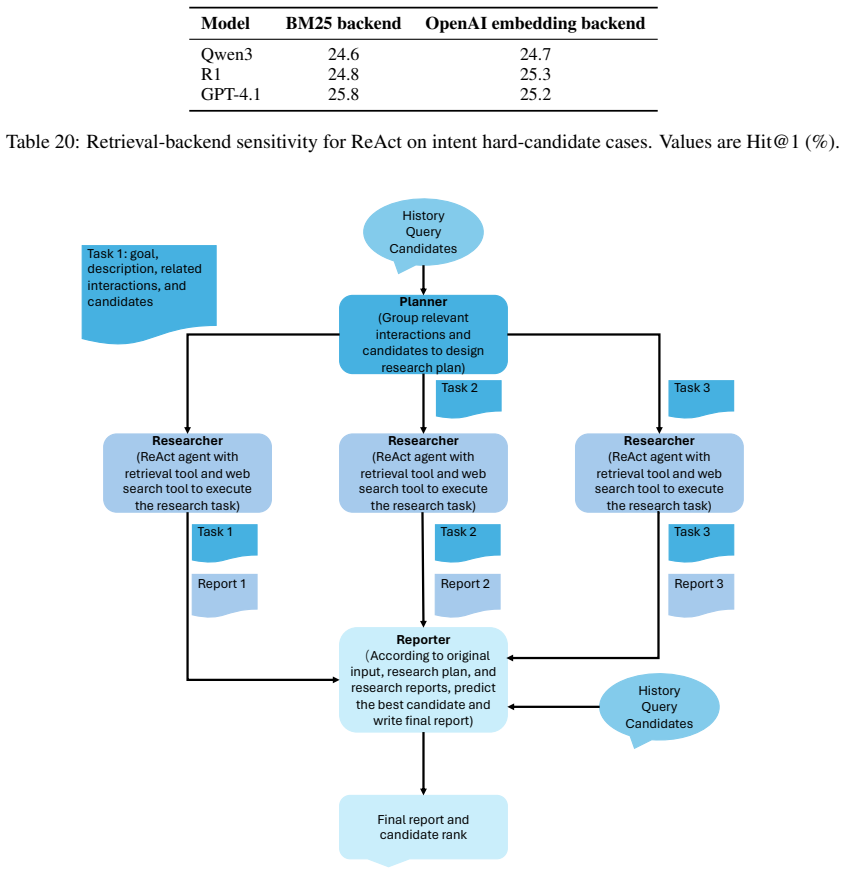
- In §2.1.1, the search-to-order window Δ = 30 minutes is stated without sensitivity; a short appendix table for Δ ∈ {15, 30, 60} on retained-session count and Hit@1 would reassure readers that the main pattern is not threshold-specific.
- Figure 3 packs many rubric metrics; axis scales and “Low/High” color bars are hard to read in grayscale. Adding numeric tables for the same scores (even in the appendix) would improve auditability.
- Notation: Hu/Su (Eqs. 1–2), Chard (Eq. 8), and Inputτ (Eq. 9) are clear, but τ is reused for query type and for thresholds τv/τa; consider distinct symbols.
- Appendix C.3.2 category-prior history selection uses the intent-query category label; state explicitly in the main text that this does not use the purchased item (you say so in the appendix) to pre-empt leakage concerns.
- Minor polish: “AgentPersonalizedBenchmark” spacing/hyphenation is inconsistent with “APeB”; “Causal shirts” in Figure 1 is likely “Casual”; a few arXiv-style citation glitches appear in the related-work block.
- Release status is “planned for controlled release after compliance review.” For a benchmark paper, please state as concretely as possible what will be released (schema, sample size, access path) so reproducibility expectations are clear.
Circularity Check
No significant circularity: APeB is an empirical benchmark; Hit@K labels are observed purchases, not fitted or self-defined predictions.
full rationale
This paper constructs a personalization benchmark from platform logs and reports empirical Hit@1/5 and rubric diagnostics for LLMs/agents. The load-bearing outcome metric is ranking the observed purchased item among user-viewed hard candidates (Eq. 8; §2.2.3, §4.1.3), which is a task definition, not a derivation that reduces to a fitted parameter or self-defined quantity. The diagnostic goal proxy g is explicitly restricted to intermediate rubric diagnosis and does not determine Hit@K (Appendix C.7.1). VQRA is an intervention that rewrites intent queries with history and re-evaluates under a fixed pipeline (Table 2; §4.4; Appendix C.8), not a claim that a fitted rewrite equals the target by construction. GPT-assisted construction filters and LLM-as-a-Judge rubrics are audited with human agreement and multi-judge checks (Appendices B.3, C.7.3); they support filtering/diagnosis rather than force the main personalization gap claim. Self-citations (e.g., Zou et al., Chen et al.) are background, not uniqueness theorems that make the results inevitable. Softness of purchase-as-preference is a validity/confound concern (Limitations; Appendix B.5.1), not circularity of the derivation chain. Score 0 with empty steps is the honest finding.
Assumptions & free parameters
free parameters (7)
- search-to-order window Δ
- extensive-browsing threshold τ_v
- intent–order alignment count τ_a
- history retention k (category-prior)
- dwell-time filter (10s)
- candidate-count outlier cap (≤25)
- VQRA history evidence size k=20
assumptions (5)
- domain assumption An observed purchase among user-viewed hard candidates is a valid proxy for preference-aligned personalization success under the issued query and history.
- ad hoc to paper Non-trivial personalization sessions are those with ≥2 queries, extensive browsing, and semantic intent–order alignment (rule + GPT-4.1 filter).
- domain assumption Intent vs refined queries can be localized as earliest vs last explicit aligned queries along the same session trajectory.
- ad hoc to paper LLM-as-judge rubric scores (QI/PQ/RQ/AR) against a GPT-inferred diagnostic goal proxy diagnose intermediate personalization failures without replacing Hit@K labels.
- domain assumption Category-prior history selection using the intent-query category label is a fair, non-leaking way to fit long histories into context.
invented entities (3)
-
APeB (AgentPersonalizedBenchmark)
-
VQRA (Vague Query Refinement Agent)
-
Multi-level personalization rubrics (QI, PQ, RQ, AR and submetrics)
Cite this review
Pith. "Pith review of APeB: Benchmarking Personalization Ability of Large Language Model Agents." pith.science (2026). https://pith.science/paper/ZI4RJAQ7
@misc{pith2026260703162,
  author       = {Pith},
  title        = {Pith review of: APeB: Benchmarking Personalization Ability of Large Language Model Agents},
  year         = {2026},
  howpublished = {\url{https://pith.science/paper/ZI4RJAQ7}},
  note         = {Machine review of arXiv:2607.03162}
}
read the original abstract
LLM-powered agents struggle with personalization when users issue raw, underspecified queries. In this setting, agents must infer latent intent, extract preferences from noisy interaction histories, and select among competing alternatives. Existing benchmarks rarely test this capability, as they often rely on user-refined queries or simplified histories. We introduce personalized product search (PPS), a testbed for agentic personalization under raw queries and diverse histories. We construct Agent Personalized Benchmark (APeB) from action logs, pairing underspecified intents with rich histories and user-viewed candidate items. Evaluating state-of-the-art LLMs with multi-step agent workflows, we find that models handle explicit queries well but struggle with early-stage queries requiring intent and preference discovery. Rubric analysis attributes this gap mainly to ineffective history use. A simple history-aware query-refinement pipeline, VQRA, yields consistent gains, highlighting the need for dedicated history-utilization modules in personalized agents.
Figures


Figures from the paper (4 more)



Forward citations
Cited by 1 Pith paper
-
Fewer Clarifications, Better Code: Benchmarking Cross-Session Personalized Ambiguity Adaptation in Coding Assistants
Twelve coding LLMs resolve injected user-specific ambiguity more often on the first turn when given same-user session history (average FT-ES +15.6 pp), though shuffled history explains part of the benefit.
Reference graph
Works this paper leans on
-
[1]
Prateek Chhikara, Dev Khant, Saket Aryan, Taranjeet Singh, and Deshraj Yadav
Hista and numca: Estimate state value ef- fectively for llm reinforcement learning.Preprint, arXiv:2605.29782. Prateek Chhikara, Dev Khant, Saket Aryan, Taranjeet Singh, and Deshraj Yadav. 2025. Mem0: Building production-ready AI agents with scalable long-term memory.CoRR, abs/2504.19413. Jiaxin Deng, Shiyao Wang, Kuo Cai, Lejian Ren, Qigen Hu, Weifeng Di...
arXiv 2025
-
[2]
Xiang Deng, Yu Gu, Boyuan Zheng, Shijie Chen, Samual Stevens, Boshi Wang, Huan Sun, and Yu Su
Onerec: Unifying retrieve and rank with gen- erative recommender and iterative preference align- ment.Preprint, arXiv:2502.18965. Xiang Deng, Yu Gu, Boyuan Zheng, Shijie Chen, Samual Stevens, Boshi Wang, Huan Sun, and Yu Su
-
[3]
Mind2web: Towards a generalist agent for the web. InAdvances in Neural Information Processing Systems 36: Annual Conference on Neural Informa- tion Processing Systems 2023, NeurIPS 2023, New Orleans, LA, USA, December 10 - 16, 2023. Doug Downey, Susan T. Dumais, Daniel J. Liebling, and Eric Horvitz. 2008. Understanding the relationship between searchers’ ...
arXiv 2023
-
[4]
Shopping MMLU: A massive multi-task on- line shopping benchmark for large language models. InAdvances in Neural Information Processing Sys- tems 38: Annual Conference on Neural Information Processing Systems 2024, NeurIPS 2024, Vancouver, BC, Canada, December 10 - 15, 2024. Guimei Liu, Tam T. Nguyen, Gang Zhao, Wei Zha, Jianbo Yang, Jianneng Cao, Min Wu, ...
arXiv 2024
-
[5]
Joshua Maynez, Shashi Narayan, Bernd Bohnet, and Ryan McDonald
Evaluating very long-term conversational memory of llm agents.Preprint, arXiv:2402.17753. Joshua Maynez, Shashi Narayan, Bernd Bohnet, and Ryan McDonald. 2020. On faithfulness and factu- ality in abstractive summarization. InProceedings of the 58th Annual Meeting of the Association for Computational Linguistics, pages 1906–1919, On- line. Association for ...
arXiv 2020
-
[6]
Memgpt: Towards llms as operating systems. Preprint, arXiv:2310.08560. Bo Peng, Xinyi Ling, Ziru Chen, Huan Sun, and Xia Ning. 2024. ecellm: Generalizing large lan- guage models for e-commerce from large-scale, high- quality instruction data. InForty-first International Conference on Machine Learning, ICML 2024, Vi- enna, Austria, July 21-27, 2024. OpenRe...
arXiv 2024
-
[7]
Steffen Rendle, Christoph Freudenthaler, Zeno Gantner, and Lars Schmidt-Thieme
Shopping queries dataset: A large-scale esci benchmark for improving product search.Preprint, arXiv:2206.06588. Steffen Rendle, Christoph Freudenthaler, Zeno Gantner, and Lars Schmidt-Thieme. 2012. Bpr: Bayesian per- sonalized ranking from implicit feedback.Preprint, arXiv:1205.2618. Chris Richardson, Yao Zhang, Kellen Gillespie, Sudipta Kar, Arshdeep Sin...
arXiv 2012
-
[8]
Weiqi Shao, Xu Chen, Jiashu Zhao, Long Xia, Jingsen Zhang, and Dawei Yin
Agentrecbench: Benchmarking llm agent- based personalized recommender systems.Preprint, arXiv:2505.19623. Weiqi Shao, Xu Chen, Jiashu Zhao, Long Xia, Jingsen Zhang, and Dawei Yin. 2023. Sequential recommen- dation with user evolving preference decomposition. InProceedings of the Annual International ACM SIGIR Conference on Research and Development in Info...
arXiv 2023
Show all 31 references
-
[9]
InProceedings of the 32nd ACM Inter- national Conference on Information and Knowledge Management, CIKM ’23, page 5407–5411
Kuaisar: A unified search and recommenda- tion dataset. InProceedings of the 32nd ACM Inter- national Conference on Information and Knowledge Management, CIKM ’23, page 5407–5411. ACM. Huaixiao Tou, Ying Zeng, Cong Ma, Muzhi Li, Ming- hao Li, Weijie Yuan, He Zhang, and Kai Jia...
2025
-
[10]
Han Zhu, Xiang Li, Pengye Zhang, Guozheng Li, Jie He, Han Li, and Kun Gai
OpenReview.net. Han Zhu, Xiang Li, Pengye Zhang, Guozheng Li, Jie He, Han Li, and Kun Gai. 2018. Learning tree-based deep model for recommender systems. InProceed- ings of the 24th ACM SIGKDD International Con- ference on Knowledge Discovery & Data Mining, KDD 2018, London, UK...
2018 arXiv
-
[11]
When deployed as a ReAct agent, we reduce the reasoning budget to 1024 tokens to ensure practical efficiency
Gemini-2.5-Pro( GEMINI in Table 2): When used as a standalone LLM or within DeerFlow, we adopt the default reasoning budget. When deployed as a ReAct agent, we reduce the reasoning budget to 1024 tokens to ensure practical efficiency
-
[12]
GPT-4.1-Mini( 4.1MINI): All experiments use the default configuration
-
[13]
GPT-4o: All experiments use the default con- figuration
-
[14]
Other settings remain default
Qwen3-235B( Qwen3-235B): Although the model supports internal reasoning, we disable its thinking mode in all experiments due to interface limitations. Other settings remain default
-
[15]
DeepSeek-R1( R1): Thinking mode is en- abled with the default reasoning budget
-
[16]
GPT-4.1: All experiments use the default con- figuration
-
[17]
GPT-5.2: Unless specified otherwise, GPT5.2 refers to the model configured with a minimal reasoning budget, with all other settings left unchanged
-
[18]
GPT-5.2Think: Unless specified otherwise, GPT5.2Think refers to the GPT-5.2 condi- tion with the default reasoning budget, while GPT5.2 uses the minimal reasoning-budget condition; all remaining settings follow the defaults
-
[19]
C.1 Additional Model-Family Results Table 12 provides the appendix position for ad- ditional model-family runs that extend the main result structure in Table 2
Additional model-family runs: Qwen3.5, Gemini3Pro, GPT5.5, and GPT5.5Think follow the same prompt, history-selection, retrieval-tool, and parsing protocols as the corresponding main-table LLM or reasoning- model conditions. C.1 Additional Model-Family Results Table 12 provides...
2024
-
[20]
Action type: order product; Product name: [DOSEN SKINCARE APPROVED] Emina Water Gel Moisturizer 30g | Mencerahkan & Mengurangi Flek Hitam | 48H Menjaga Kelembapan, Memperkuat Skin Barrier | Mengurangi Jerawat dan Meredakan Kemerahan, Kulit Glowing | Mengandung Niacinamide dan ...
-
[21]
Product name: ( DRY SKIN ) Hyalupure Emulsion for DRY SKIN - Perawatan kulit KERING menjadi lembab dan kencang; Price: 15.078408 usd (...) </candidates> Finally, we parse model outputs using a Pydantic- based parser and compute standard retrieval met- rics, including HR@1 and ...
-
[22]
You must generate your own search queries from: - literal terms in the user query - literal terms relevant to target_product or concerned_features - literal candidate titles or features - literal history text - interpretation-critical terms ONLY when clarifying explicit text
-
[23]
You may only rely on: 22 Model Query only Counterfactual history Real history Real – Ctf. Ctf. – Query GPT-4.1 68.3 67.7 79.3 +11.6 -0.6 GPT-5.2 70.8 68.1 83.1 +15.0 -2.7 Gemini-2.5-Pro 69.1 68.5 79.5 +11.0 -0.6 Table 16: Counterfactual-history contamination check on 500 sampl...
-
[24]
As these contents exceed prompt- length limits, they are organized in a fixed schema and stored in a retrieval database, which the agent queries via this tool (see Ap- pendix C.6)
Structured Search Tool.In addition to item titles,APeBprovides rich auxiliary in- formation, including product descriptions, video OCR/ASR transcripts, and structured attributes. As these contents exceed prompt- length limits, they are organized in a fixed schema and stored in...
-
[25]
Each query returns the top-3 relevant text chunks
Web Search Tool.We wrap the web search API provided by YOU 1 as a callable tool. Each query returns the top-3 relevant text chunks
-
[26]
Crawl Tool.We use the Jina AI crawling API2 to fetch web pages and convert them into agent-friendly Markdown representations
-
[27]
Code Execution Tool.We employ the Python REPL tool from LangChain 3, enabling the agent to execute code and observe intermedi- ate results. 1https://you.com/home 2https://jina.ai/ 3https://www.langchain.com/ Metric Intent Refined Candidate retrieval relevance (QC-1) 88 92 Hist...
-
[28]
In Table 20, we report Hit@1 results when vary- ing the retrieval backend
This produces only small, model-dependent changes across models. In Table 20, we report Hit@1 results when vary- ing the retrieval backend. The minimal differences suggest that backend choice alone does not explain the ReAct gap. These checks indicate that a re- designed agent...
-
[29]
Please distinguish them and list them out clearly
List: In the research result of different groups, there are lots of features that are unique or similar to each other. Please distinguish them and list them out clearly. For those similar features, you can combine them if they share exactly the same meaning, but **NEVER** comb...
-
[30]
Notice that common features are not necessarily to be ranked higher, because details always matter to the user
Ranking: Based on user persona and research results, rank the primary features to consider first when the user issues such query content. Notice that common features are not necessarily to be ranked higher, because details always matter to the user
-
[31]
Finally, you should output a rank for all candidates based on how much it is suitable for the user
Choosing: Based on the user persona and ranking result, discuss why each candidate is or is not suitable for the user, and present the most suitable candidate for the user. Finally, you should output a rank for all candidates based on how much it is suitable for the user. (......
2023
Reviewed July 12, 2026 · model on record in the stance chip above.
Discussion (0). Sign in to comment.