One-Time Programs made Practical
Pith reviewed 2026-05-25 11:34 UTC · model grok-4.3
The pith
Trusted execution environments on modern CPUs can enforce one-time program execution without custom hardware.
A machine-rendered reading of the paper's core claim, the machinery that carries it, and where it could break.
Core claim
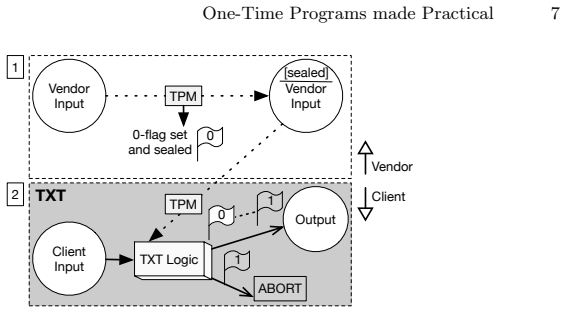
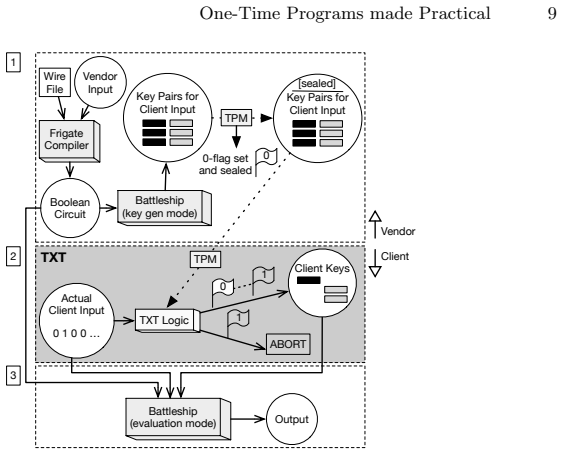
We build two flavours of such a system: in the first, the TEE directly enforces the one-timeness of the program; in the second, the program is represented with a garbled circuit and the TEE ensures Bob's input can only be wired into the circuit once, equivalent to a smaller cryptographic primitive called one-time memory. These have different performance profiles: the first is best when Alice's input is small and Bob's is large, and the second for the converse.
What carries the argument
The Trusted Execution Environment (TEE) of modern CPUs, either enforcing single execution directly or securing one-time input wiring into a garbled circuit.
If this is right
- Alice can deliver a function that Bob evaluates on only one input without requiring specialized hardware.
- The direct TEE enforcement performs best when Alice supplies a small input and Bob supplies a large one.
- The garbled-circuit version with TEE-enforced one-time memory performs best in the opposite input-size regime.
- One-time programs move from theoretical constructions to implementations that run on commodity CPUs.
Where Pith is reading between the lines
- The same TEE mechanism could support other one-time-use cryptographic building blocks such as certain oblivious-transfer variants.
- Widespread TEE availability would reduce the hardware barrier for deploying secure two-party computation protocols that rely on one-time primitives.
- Side-channel or rollback attacks on the TEE would directly falsify the one-timeness guarantee and could be tested with standard TEE attack toolkits.
Load-bearing premise
Modern TEEs can be relied upon to enforce one-timeness or one-time memory wiring without bypass, leakage, or failure.
What would settle it
An experiment in which the same TEE-protected one-time program successfully evaluates on two different inputs supplied by Bob.
Figures
read the original abstract
A one-time program (OTP) works as follows: Alice provides Bob with the implementation of some function. Bob can have the function evaluated exclusively on a single input of his choosing. Once executed, the program will fail to evaluate on any other input. State-of-the-art one-time programs have remained theoretical, requiring custom hardware that is cost-ineffective/unavailable, or confined to adhoc/unrealistic assumptions. To bridge this gap, we explore how the Trusted Execution Environment (TEE) of modern CPUs can realize the OTP functionality. Specifically, we build two flavours of such a system: in the first, the TEE directly enforces the one-timeness of the program; in the second, the program is represented with a garbled circuit and the TEE ensures Bob's input can only be wired into the circuit once, equivalent to a smaller cryptographic primitive called one-time memory. These have different performance profiles: the first is best when Alice's input is small and Bob's is large, and the second for the converse.
Editorial analysis
A structured set of objections, weighed in public.
Referee Report
Summary. The paper proposes realizing one-time programs (OTPs) practically via modern Trusted Execution Environments (TEEs). It describes two constructions: (1) the TEE directly enforces one-timeness of the program, and (2) the program is encoded as a garbled circuit with the TEE restricting Bob's input to a single wiring (realizing one-time memory). The two flavours are stated to exhibit complementary performance profiles depending on the relative sizes of Alice's and Bob's inputs.
Significance. If the security claims hold under a realistic TEE model, the work would constitute a meaningful step toward practical OTPs on commodity hardware, moving beyond prior theoretical or hardware-custom constructions. Explicitly contrasting the two performance regimes is a useful observation that could guide application choices.
major comments (2)
- [Abstract] Abstract: the central claim that TEEs can enforce one-timeness (or one-time memory wiring) without bypass, leakage, or replay is presented without any security model, reduction, or argument that existing enclave primitives (monotonic counters, sealed storage) suffice. This assumption is load-bearing for both constructions yet receives no formal treatment or discussion of rollback/side-channel vectors.
- [Abstract] Abstract: no implementation details, concrete TEE interface specification, or performance measurements are supplied to substantiate the stated performance profiles or to allow verification that the claimed trade-offs are realized.
Simulated Author's Rebuttal
We thank the referee for the constructive feedback. We address the two major comments point-by-point below.
read point-by-point responses
-
Referee: [Abstract] Abstract: the central claim that TEEs can enforce one-timeness (or one-time memory wiring) without bypass, leakage, or replay is presented without any security model, reduction, or argument that existing enclave primitives (monotonic counters, sealed storage) suffice. This assumption is load-bearing for both constructions yet receives no formal treatment or discussion of rollback/side-channel vectors.
Authors: We agree this is a valid observation. The manuscript relies on standard TEE security properties but does not supply an explicit model or reduction. In revision we will add a dedicated security model section that (1) defines OTP security under a TEE threat model, (2) shows how monotonic counters and sealed storage suffice to prevent replay and rollback for the two constructions, and (3) discusses side-channel and rollback vectors together with known mitigations (remote attestation, constant-time code). revision: yes
-
Referee: [Abstract] Abstract: no implementation details, concrete TEE interface specification, or performance measurements are supplied to substantiate the stated performance profiles or to allow verification that the claimed trade-offs are realized.
Authors: The performance trade-offs are argued from the known asymptotic costs of enclave operations versus garbled-circuit evaluation and from the memory constraints of current TEEs. The revision will expand this with (a) an explicit list of the TEE interface calls assumed (e.g., seal/unseal, monotonic counter increment/read) and (b) concrete big-O expressions for both constructions. Full prototype implementation and micro-benchmarks lie outside the scope of the current design paper and are planned as follow-up work. revision: partial
Circularity Check
No significant circularity in derivation chain
full rationale
The paper presents two system constructions for realizing one-time programs via TEE enforcement (direct one-timeness or garbled-circuit wiring restricted to one-time memory) with no equations, derivations, fitted parameters, or self-referential definitions present. Claims are positioned as direct applications of assumed TEE properties rather than reductions of outputs to inputs by construction; no load-bearing self-citations or uniqueness theorems are invoked to force the result. The work is therefore self-contained as an engineering proposal against external TEE assumptions.
Axiom & Free-Parameter Ledger
axioms (1)
- domain assumption Trusted Execution Environments in modern CPUs can enforce one-timeness of a program or one-time wiring of inputs without bypass or leakage.
Reference graph
Works this paper leans on
-
[1]
http://www.amd.com/en-us/solutions/ servers/virtualization (2017)
AMD, Inc.: Virtualization Solutions. http://www.amd.com/en-us/solutions/ servers/virtualization (2017)
work page 2017
-
[2]
Apple.com: iOS security guide (2018), white Paper. Available at https://www. apple.com/business/docs/iOS_Security_Guide.pdf
work page 2018
-
[3]
In: Proceedings of USENIX Security Workshop on Health Information Technologies (HealthTech’13)
Ayday, E., Raisaro, J.L., Laren, M., Jack, P., Fellay, J., Hubaux, J.P.: Privacy- preserving computation of disease risk by using genomic, clinical, and environmen- tal data. In: Proceedings of USENIX Security Workshop on Health Information Technologies (HealthTech’13). No. EPFL-CONF-187118 (2013) 18 For certain classes of circuits, Jafargholi and Wichs [...
work page 2013
-
[4]
Azema, J., Fayad, G.: M-Shield mobile security technology: making wireless secure. Tech. rep., Texas Instruments (2008)
work page 2008
-
[5]
In: Proceedings of the 18th ACM conference on Computer and communications security
Baldi, P., Baronio, R., De Cristofaro, E., Gasti, P., Tsudik, G.: Countering gattaca: efficient and secure testing of fully-sequenced human genomes. In: Proceedings of the 18th ACM conference on Computer and communications security. pp. 691–702. ACM (2011)
work page 2011
-
[6]
Bellare, M., Hoang, V.T., Rogaway, P.: Adaptively secure garbling with applica- tions to one-time programs and secure outsourcing. In: ASIACRYPT (2012)
work page 2012
-
[7]
In: 11th USENIX Work- shop on Offensive Technologies (WOOT 17)
Brasser, F., M¨ uller, U., Dmitrienko, A., Kostiainen, K., Capkun, S., Sadeghi, A.R.: Software grand exposure: SGX cache attacks are practical. In: 11th USENIX Work- shop on Offensive Technologies (WOOT 17). Vancouver, BC (2017)
work page 2017
-
[8]
Broadbent, A., Gutoski, G., Stebila, D.: Quantum one-time programs. In: CRYPTO. pp. 344–360 (2013)
work page 2013
-
[9]
Bulck, J.V., Minkin, M., Weisse, O., Genkin, D., Kasikci, B., Piessens, F., Sil- berstein, M., Wenisch, T.F., Yarom, Y., Strackx, R.: Foreshadow: Extracting the keys to the intel SGX kingdom with transient out-of-order execution. In: USENIX Security Symposium. pp. 991–1008. Baltimore, MD, USA (2018)
work page 2018
-
[10]
IEEE Transactions on Information Technology in Biomedicine 16(1), 166–175 (2012)
Canim, M., Kantarcioglu, M., Malin, B.: Secure management of biomedical data with cryptographic hardware. IEEE Transactions on Information Technology in Biomedicine 16(1), 166–175 (2012)
work page 2012
-
[11]
Cariaso, M., Lennon, G.: SNPedia: a wiki supporting personal genome annotation, interpretation and analysis (2010), http://www.SNPedia.com
work page 2010
-
[12]
In: Foundations of Computer Science, 1995
Chor, B., Goldreich, O., Kushilevitz, E., Sudan, M.: Private information retrieval. In: Foundations of Computer Science, 1995. Proceedings., 36th Annual Symposium on. pp. 41–50. IEEE (1995)
work page 1995
-
[13]
Ermolov, M., Goryachy, M.: How to hack a turned-off computer or running un- signed code in intel management engine. Tech. rep., Black Hat Europe (2017)
work page 2017
-
[14]
In: McCune, J.M., Bal- acheff, B., Perrig, A., Sadeghi, A.R., Sasse, A., Beres, Y
Fink, R.A., Sherman, A.T., Mitchell, A.O., Challener, D.C.: Catching the cuckoo: Verifying tpm proximity using a quote timing side-channel. In: McCune, J.M., Bal- acheff, B., Perrig, A., Sadeghi, A.R., Sasse, A., Beres, Y. (eds.) Trust and Trust- worthy Computing. pp. 294–301. Springer Berlin Heidelberg, Berlin, Heidelberg (2011)
work page 2011
-
[15]
Fisch, B.A., Vinayagamurthy, D., Boneh, D., Gorbunov, S.: Iron: Functional en- cryption using Intel SGX. Tech. rep., IACR eprint (2016)
work page 2016
-
[16]
Gnu.org: The multiboot specification (2009), http://www.gnu.org/software/ grub/manual/multiboot/multiboot.html
work page 2009
-
[17]
Goldwasser, S., Kalai, Y.T., Rothblum, G.N.: One-Time Programs. In: CRYPTO. pp. 39–56 (2008)
work page 2008
-
[18]
Greene, J.: Intel R⃝ Trusted Execution Technology. Tech. rep. (2012)
work page 2012
-
[19]
Greshake, B., Bayer, P.E., Rausch, H., Reda, J.: Opensnp–a crowdsourced web resource for personal genomics. PLoS One 9(3), 1–9 (2014)
work page 2014
- [20]
-
[21]
In: Financial Cryp- tography and Data Security
Gunupudi, V., Tate, S.R.: Generalized non-interactive oblivious transfer using count-limited objects with applications to secure mobile agents. In: Financial Cryp- tography and Data Security. pp. 98–112. FC’08 (2008)
work page 2008
-
[22]
Halderman, J.A., Schoen, S.D., Heninger, N., Clarkson, W., Paul, W., Calandrino, J.A., Feldman, A.J., Appelbaum, J., Felten, E.W.: Lest we remember: Cold boot attacks on encryption keys. In: USENIX Security Symposium. San Jose, CA, USA (2008) 20 L. Zhao et al
work page 2008
-
[23]
In: 27th USENIX Security Symposium (USENIX Security 18)
Han, S., Shin, W., Park, J.H., Kim, H.: A bad dream: Subverting trusted platform module while you are sleeping. In: 27th USENIX Security Symposium (USENIX Security 18). pp. 1229–1246. Baltimore, MD, USA (2018)
work page 2018
-
[24]
Hazay, C., Lindell, Y.: Efficient Secure Two-Party Protocols. Springer (2010)
work page 2010
-
[25]
Holzer, A., Franz, M., Katzenbeisser, S., Veith, H.: Secure Two-party Computa- tions in ANSI C. In: CCS. pp. 772–783 (2012)
work page 2012
-
[26]
https:// software.intel.com/en-us/sgx (2016)
Intel Corporation: Intel Software Guard Extensions (Intel SGX). https:// software.intel.com/en-us/sgx (2016)
work page 2016
-
[27]
Intel Corporation: Trusted boot (tboot) (2017), version: 1.8.0. http://tboot. sourceforge.net/
work page 2017
-
[28]
Jafargholi, Z., Wichs, D.: Adaptive Security of Yao’s Garbled Circuits. In: TCC. pp. 433–458 (2016)
work page 2016
- [29]
-
[30]
Available at http://www.notebookreview.com/feature/ identify-user-upgradeable-notebooks/
Jefferies, C.P.: How to identify user-upgradeable notebooks (June 2017), web article. Available at http://www.notebookreview.com/feature/ identify-user-upgradeable-notebooks/
work page 2017
-
[31]
https://software.intel.com/ en-us/articles/intel-sgx-and-side-channels (2017)
Johnson, S.: Intel R⃝ SGX and Side-Channels. https://software.intel.com/ en-us/articles/intel-sgx-and-side-channels (2017)
work page 2017
-
[32]
IEEE Transactions on information technology in biomedicine 12(5), 606–617 (2008)
Kantarcioglu, M., Jiang, W., Liu, Y., Malin, B.: A cryptographic approach to securely share and query genomic sequences. IEEE Transactions on information technology in biomedicine 12(5), 606–617 (2008)
work page 2008
-
[33]
In: Proceedings of the 6th ACM Symposium on Information, Computer and Communications Security
Kirkpatrick, M.S., Kerr, S., Bertino, E.: PUF ROKs: A hardware approach to read- once keys. In: Proceedings of the 6th ACM Symposium on Information, Computer and Communications Security. pp. 155–164. AsiaCCS’11, Hong Kong, China (2011)
work page 2011
-
[34]
Kitamura, T., Shinagawa, K., Nishide, T., Okamoto, E.: One-time Programs with Cloud Storage and Its Application to Electronic Money. In: APKC (2017)
work page 2017
-
[35]
Kocher, P., Genkin, D., Gruss, D., Haas, W., Hamburg, M., Lipp, M., Mangard, S., Prescher, T., Schwarz, M., Yarom, Y.: Spectre attacks: Exploiting speculative execution. CoRR (2018)
work page 2018
-
[36]
Kollenda, B., Koppe, P., Fyrbiak, M., Kison, C., Paar, C., Holz, T.: An exploratory analysis of microcode as a building block for system defenses. In: Proceedings of the 2018 ACM SIGSAC Conference on Computer and Communications Security, CCS 2018, Toronto, ON, Canada, October 15-19, 2018. pp. 1649–1666 (2018)
work page 2018
-
[37]
In: 26th USENIX Security Symposium (USENIX Security 17)
Koppe, P., Kollenda, B., Fyrbiak, M., Kison, C., Gawlik, R., Paar, C., Holz, T.: Re- verse engineering x86 processor microcode. In: 26th USENIX Security Symposium (USENIX Security 17). pp. 1163–1180. Vancouver, BC (2017)
work page 2017
-
[38]
Kreuter, B., Shelat, A., Mood, B., Butler, K.: PCF: A Portable Circuit Format for Scalable Two-Party Secure Computation. In: USENIX Security Symposium. pp. 321–336 (2013)
work page 2013
-
[39]
Kreuter, B., Shelat, A., Shen, C.: Billion-Gate Secure Computation with Malicious Adversaries. In: USENIX Security Symposium. pp. 285–300 (2012)
work page 2012
-
[40]
In: 26th USENIX Security Symposium (USENIX Security 17)
Lee, S., Shih, M.W., Gera, P., Kim, T., Kim, H., Peinado, M.: Inferring fine-grained control flow inside SGX enclaves with branch shadowing. In: 26th USENIX Security Symposium (USENIX Security 17). pp. 557–574. Vancouver, BC (2017)
work page 2017
-
[41]
Lipp, M., Schwarz, M., Gruss, D., Prescher, T., Haas, W., Mangard, S., Kocher, P., Genkin, D., Yarom, Y., Hamburg, M.: Meltdown. CoRR (2018)
work page 2018
-
[42]
Matetic, S., Kostiainen, K., Dhar, A., Sommer, D., Ahmed, M., Gervais, A., Juels, A., Capkun, S.: Rote: Rollback protection for trusted execution. Tech. rep., ETH Zurich (2017) One-Time Programs made Practical 21
work page 2017
-
[43]
McCune, J.M.: Reducing the trusted computing base for applications on commod- ity systems. Ph.D. thesis, Carnegie Mellon University (2009)
work page 2009
-
[44]
Mood, B., Gupta, D., Carter, H., Butler, K., Traynor, P.: Frigate: A Validated, Extensible, and Efficient Compiler and Interpreter for Secure Computation. In: Euro-SP (2016)
work page 2016
-
[45]
M¨ uller, T., Freiling, F.C., Dewald, A.: TRESOR runs encryption securely outside RAM. In: USENIX Security Symposium. San Francisco, CA, USA (Aug 2011)
work page 2011
-
[46]
Naveed, M., Agrawal, S., Prabhakaran, M., Wang, X., Ayday, E., Hubaux, J.P., Gunter, C.: Controlled functional encryption. In: CCS. pp. 1280–1291. ACM (2014)
work page 2014
-
[47]
Naveed, M., Ayday, E., Clayton, E.W., Fellay, J., Gunter, C.A., Hubaux, J.P., Malin, B., Wang, X., et al.: Privacy and security in the genomic era. In: CCS (2014)
work page 2014
-
[48]
nccgroup: Cachegrab (December 2017), available at https://github.com/ nccgroup/cachegrab
work page 2017
-
[49]
In: Collaboration and Internet Computing (CIC), 2016 IEEE 2nd International Conference on
Ngabonziza, B., Martin, D., Bailey, A., Cho, H., Martin, S.: Trustzone explained: Architectural features and use cases. In: Collaboration and Internet Computing (CIC), 2016 IEEE 2nd International Conference on. pp. 445–451. IEEE (2016)
work page 2016
-
[50]
Saint-Jean, F.: Java Implementation of a Single-Database Computationally Sym- metric Private Information Retrieval (cSPIR) Protocol. Tech. rep., Yale University Department of Computer Science (2005)
work page 2005
-
[51]
Schwarz, M., Weiser, S., Gruss, D., Maurice, C., Mangard, S.: Malware Guard Extension: Using SGX to Conceal Cache Attacks. In: DIMVA (2017)
work page 2017
-
[52]
Sevinsky, R.: Funderbolt: Adventures in Thunderbolt DMA attacks, black Hat USA, 2013
work page 2013
-
[53]
Simmons, P.: Security through Amnesia: A software-based solution to the cold boot attack on disk encryption. In: ACSAC (2011)
work page 2011
-
[54]
https://www.snpedia.com/index.php/Magnitude (2014)
SNPedia: Magnitude. https://www.snpedia.com/index.php/Magnitude (2014)
work page 2014
-
[55]
https://www.snpedia.com/index.php/Rs429358 (2017)
SNPedia: rs429358. https://www.snpedia.com/index.php/Rs429358 (2017)
work page 2017
-
[56]
Available at https://www.theverge.com/ 2013/12/29/5253226/nsa-cia-fbi-laptop-usb-plant-spy
Sottek, T.: NSA reportedly intercepting laptops purchased online to install spy malware (December 2013), web article. Available at https://www.theverge.com/ 2013/12/29/5253226/nsa-cia-fbi-laptop-usb-plant-spy
work page 2013
-
[57]
Spivey, H.C.C.D.M.K.S.C.N.A., Smith, R.: Essentials of Genetics. NPG Education (2009)
work page 2009
-
[58]
In: Proceedings of the 30th Annual Computer Security Applications Con- ference
Strackx, R., Jacobs, B., Piessens, F.: Ice: A passive, high-speed, state-continuity scheme. In: Proceedings of the 30th Annual Computer Security Applications Con- ference. pp. 106–115. ACSAC’14, New Orleans, Louisiana, USA (2014)
work page 2014
-
[59]
In: 25th USENIX Security Symposium (USENIX Security 16)
Strackx, R., Piessens, F.: Ariadne: A minimal approach to state continuity. In: 25th USENIX Security Symposium (USENIX Security 16). pp. 875–892. Austin, TX (2016)
work page 2016
-
[60]
Available at https://www.defcon.org/html/ links/dc-archives/dc-20-archive.html
Tarnovsky, C.: Attacking tpm part 2: A look at the ST19WP18 tpm device (July 2012), dEFCON presentation. Available at https://www.defcon.org/html/ links/dc-archives/dc-20-archive.html
work page 2012
-
[61]
Trusted Computing Group: TCG Platform Reset Attack Mitigation Specification (May 2008)
work page 2008
-
[62]
https://trustedcomputinggroup.org/ tpm-main-specification/ (2011)
Trusted Computing Group: Trusted Platform Module Main Specifica- tion, version 1.2, revision 116. https://trustedcomputinggroup.org/ tpm-main-specification/ (2011)
work page 2011
-
[63]
Vasiliadis, G., Athanasopoulos, E., Polychronakis, M., Ioannidis, S.: PixelVault: Using GPUs for securing cryptographic operations. In: CCS. Scottsdale, AZ, USA (Nov 2014) 22 L. Zhao et al
work page 2014
-
[64]
In: 43rd Hawaii International Conference on System Sciences
Vidas, T.: Volatile memory acquisition via warm boot memory survivability. In: 43rd Hawaii International Conference on System Sciences. pp. 1–6 (Jan 2010)
work page 2010
-
[65]
Proceedings of the National Academy of Sciences 107(28), 12629–12633 (2010)
Walsh, T., Lee, M.K., Casadei, S., Thornton, A.M., Stray, S.M., Pennil, C., Nord, A.S., Mandell, J.B., Swisher, E.M., King, M.C.: Detection of inherited mutations for breast and ovarian cancer using genomic capture and massively parallel se- quencing. Proceedings of the National Academy of Sciences 107(28), 12629–12633 (2010)
work page 2010
-
[66]
Wang, X.S., Huang, Y., Zhao, Y., Tang, H., Wang, X., Bu, D.: Efficient genome- wide, privacy-preserving similar patient query based on private edit distance. In: CCS. pp. 492–503. ACM (2015)
work page 2015
-
[67]
Wiklander, J.: Secure storage in OP-TEE, available at https://github.com/ OP-TEE/optee_os/blob/master/documentation/secure_storage.md
-
[68]
Wojtczuk, R., Rutkowska, J.: Attacking Intel trusted execution technology (Feb 2009), black Hat DC
work page 2009
-
[69]
http:// invisiblethingslab.com/resources/misc09/Another%20TXT%20Attack.pdf
Wojtczuk, R., Rutkowska, J., Tereshkin, A.: Another way to circumvent Intel trusted execution technology (Dec 2009), technical Report. http:// invisiblethingslab.com/resources/misc09/Another%20TXT%20Attack.pdf
work page 2009
-
[70]
In: IEEE Symposium on Security and Privacy (2015)
Xu, Y., Cui, W., Peinado, M.: Controlled-Channel Attacks: Deterministic Side Channels for Untrusted Operating Systems. In: IEEE Symposium on Security and Privacy (2015)
work page 2015
- [71]
-
[72]
Zhang, N., Sun, K., Shands, D., Lou, W., Hou, Y.T.: Truspy: Cache side-channel information leakage from the secure world on ARM devices. IACR Cryptology ePrint Archive 2016, 980 (2016) One-Time Programs made Practical 23 The appendices are organized as follows: • Appendix A provides additional background helpful for understanding on one-time programs, gar...
work page 2016
-
[73]
Exclusive. Exemplified by Intel TXT, this type of TEE suspends all other operations on the processor and owns all resources before it exits. The ad- vantage is less attack vectors exposed
-
[74]
Concurrent. Represented by Intel SGX and ARM TrustZone, this type cre- ates secure enclaves or worlds that exist alongside other processes. There might be multiple instances at the same time. These are more suitable for application-level logic. We now present a few of the typical TEE options in the context of OTP, and discuss their suitability for matchin...
-
[75]
TXT has been time-tested and known flaws are al- ready stable public information (see Section 8)
Fewer known flaws. TXT has been time-tested and known flaws are al- ready stable public information (see Section 8). For SGX, there have been multiple reports regarding various side-channel attacks mounted by mali- cious/compromised OS or even peer apps [70,51]. What is worse, Intel ad- mits it as a known flaw that will remain, leaving the closing of side-ch...
-
[76]
Meltdown [41]/Spectre [35]/Foreshadow [9].The lately identified flaws in modern processors make side-channel attacks potentially ubiquitous, due to the fact that out-of-order execution is a common feature of modern archi- tectures. What make it worse is the Foreshadow attack specifically targeting One-Time Programs made Practical 27 SGX (L1 Terminal Fault). ...
-
[77]
Dedicated environment. SGX is positioned differently than TXT and does not replace it, in the sense that the former allows multiple user-space instances for cloud applications, whose attestation requires contacting Intel’s IAS server each time. In contrast, TXT is a dedicated environment, with reduced attack vectors, that also allows local attestation. B A...
-
[78]
The bank supplies OTP boxes with set dollar values
-
[79]
• In TXT, the corresponding keys are selected
To make a payment, the user provides to the OTP box the shop’s hash of a newly generated random number. • In TXT, the corresponding keys are selected. • After reboot, the selected keys are input into the garbled circuit pro- gram, which outputs a signature of the dollar-value concatenated with the shop’s hash value
-
[80]
The shop verifies the signature
discussion (0)
Sign in with ORCID, Apple, or X to comment. Anyone can read and Pith papers without signing in.