REVIEW 4 major objections 6 minor 22 references
Scattering from a non-linear structured interface
T0 review · 4 major / 6 minor · reviewed 2026-08-14 · deepseek-v4-flash
Pith's one-line read When a small-amplitude wave hits a buckled-beam interface at its linear transmission-resonance frequency it passes through; increasing the amplitude drives the interface into its post-buckling response and the resonance is suppressed…
desk verdict Clean linear scattering derivation with a plausible but under-verified transient suppression claim; worth refereeing with a request for numerical details and a dynamic check. read the letter →
The pith
A machine-rendered reading of the paper's core claim, the machinery that carries it, and where it could break.
The reading
What carries the argument
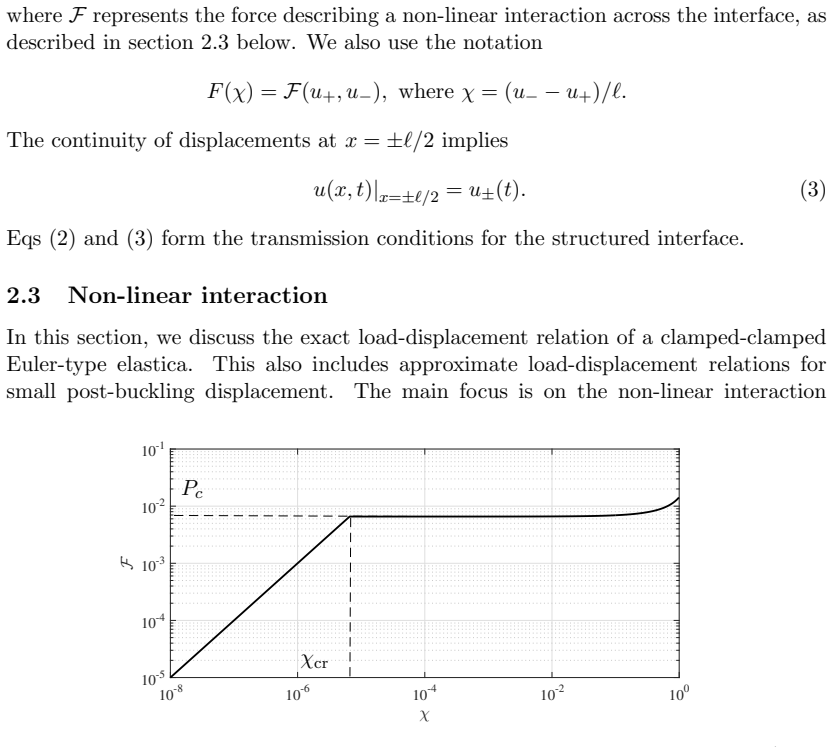
The central object is the massless clamped–clamped Euler elastica inside the interface, whose exact axial force–compression relation is $$\ell\sqrt{F/B}=4K(c),\qquad \chi-\chi_{\mathrm{cr}}=2(1-E(c)/K(c)),$$ with $K$ and $E$ complete elliptic integrals. This static relation is the nonlinear constitutive law connecting the two masses, inserted into the transmission conditions and, in the transient problem, into a second-order ODE system for the reflected and transmitted wave envelopes $R(\tau)$ and $T(\tau)$. The linearised version of the same interface yields the algebraic scattering matrix whose vanishing reflection condition defines the transmission resonance $\omega_T$; the nonlinear version replaces the linear spring by the buckling force curve, whose post-buckling branch grows far more slowly with compression than the pre-buckling linear relation, changing the energy balance at the interface. The mechanism of the claimed suppression is that at large amplitude the interface is driven into that post-buckling branch during each cycle, so the transmitted force is limited and the balance shifts toward reflection.
What would settle it
Run a transient simulation or experiment that models the full beam, including its inertia and higher buckling modes, at $\omega=\omega_T$ with an incident amplitude of tens of $u_{\mathrm{cr}}$: if the transmitted energy remains comparable to the small-amplitude resonant case, or the reflected amplitude does not grow, the suppression is an artefact of the reduced ODE model. Measuring the time-averaged reflection at long times would give a direct quantitative check.
Extended reading notes
Core claim
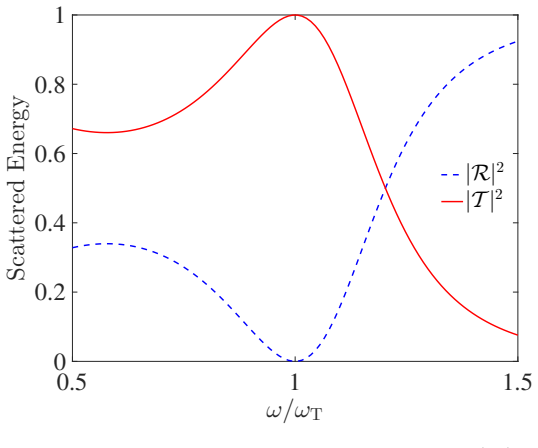
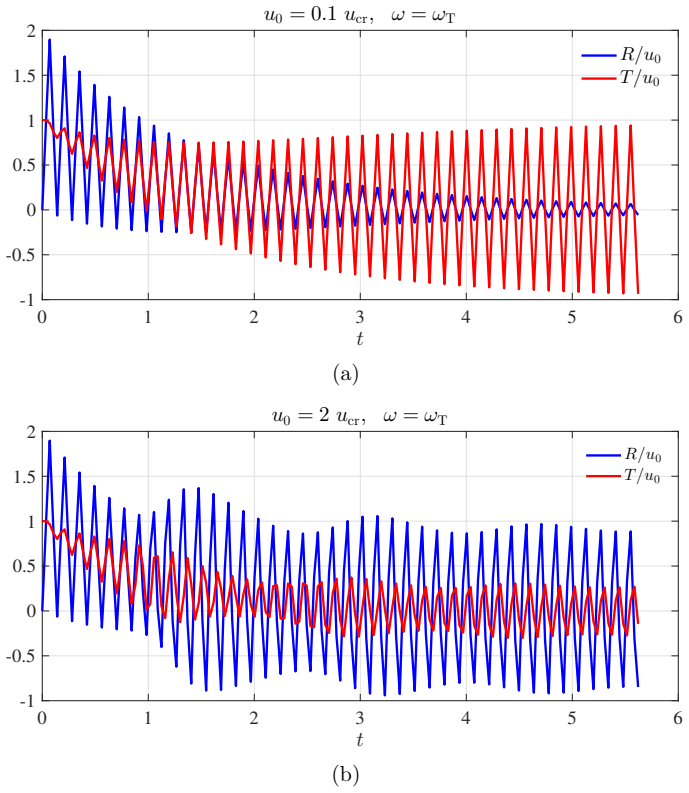
The paper argues that nonlinearity in a structured interface, specifically the post-buckling response of an elastica, can qualitatively change wave scattering: a transmission resonance predicted by linear time-harmonic analysis disappears in transient scattering when the incident amplitude is increased. The two-mass interface, embedded in an infinite longitudinal rod, is analysed first in the linear pre-buckling regime, where an explicit algebraic system gives reflection and transmission coefficients and a resonance at $\omega_T$. The same system is then integrated in time with the exact nonlinear load–displacement law $F(\chi)$, given implicitly through complete elliptic integrals. In the numerical simulations, an incident wave at $\omega=\omega_T$ with amplitude $u_0=0.1\,u_{\mathrm{cr}}$ reproduces the resonance, whereas $u_0=2\,u_{\mathrm{cr}}$ (and $u_0=50\,u_{\mathrm{cr}}$ in a lower-frequency case) produces markedly higher reflection and suppressed transmission. The authors state this as a demonstration that the nonlinear response suppresses the resonance.
Load-bearing premise
The main load-bearing premise is that the elastica's static force-compression curve acts as the instantaneous dynamic force law between the two masses at every time step, with the beam massless and only its fundamental buckling mode considered; if beam inertia, higher modes, or dynamic snap-through matter at the amplitudes shown, the predicted suppression could change quantitatively or qualitatively.
Editorial extensions
If this is right
- Below the amplitude threshold, the interface passes nearly all the incident energy at $\omega=\omega_T$; above it, reflected energy dominates, so the same junction acts as an amplitude switch.
- The suppression is tied to the linear resonance frequency, so the operating band is set by geometry and masses while the switching threshold is set by the buckling load.
- At long times the reflected signal can settle on a non-zero average value, measurable as a phase shift of the outgoing wave, rather than simply decaying.
- For a semi-infinite post-buckled chain, the homogenised equation on one side is of Boussinesq type, so a full junction description needs a boundary-layer analysis connecting equations of different orders on the two sides.
Reading between the lines
- A full dynamic beam model with beam inertia, higher buckling modes, and possible snap-through could move the switching threshold; the paper's quasi-static force law is a first approximation, not a demonstration that the threshold is universal.
- The mechanism suggests a passive amplitude limiter: small signals pass, strong pulses are reflected, with no active control; this could be tested by measuring reflected energy versus incident amplitude at fixed frequency.
- Because only the first buckling mode is retained, multi-modal buckling could introduce additional resonances or frequency conversion that would complicate the clean on/off picture.
- The non-zero reflected asymptote implies the interface exchanges net momentum with the wave field; recasting this as an effective nonlinear impedance could connect the result to energy-harvesting or vibration-control design.
Signed reviews
Editorial analysis
A structured set of objections, weighed in public.
Referee Report
Summary. The paper studies scattering of longitudinal elastic waves by a structured interface consisting of two point masses connected by a buckling elastica beam placed inside an otherwise linear rod. In the pre-buckling regime the interface force is linearized, and a time-harmonic scattering problem is solved exactly (Sec. 3), yielding a transmission resonance condition. The paper then replaces the linear force law by the exact static elastica load-displacement relation (4) and solves, numerically, the resulting nonlinear ODE system (41) for transient incident waves. The reported simulations (Figs. 4-6) show that for sufficiently large incident amplitude the transmission resonance is suppressed and reflection becomes significant. The central claim, stated in Sec. 5, is that the nonlinear response of the interface can suppress a transmission resonance that exists in the linearized system.
Significance. If the central claim is correct, the paper provides a simple and appealing qualitative mechanism: a geometrically nonlinear interface can act as an amplitude-activated reflector at a frequency where the linearized system is perfectly transparent. Such a mechanism could be relevant to amplitude-dependent elastic metamaterials and to the configurational-force approach to buckling interfaces. The linear part of the paper (Eqs. 23-35) is internally consistent, the exact elastica relation (4) is standard, and the predicted qualitative behavior is falsifiable. However, the transient conclusions currently rest on a quasi-static closure assumption and on selected simulations that are not yet reproducible or validated, so the significance of the nonlinear claim is conditional on resolving those issues.
major comments (4)
- [Sec. 2.3 and Sec. 4, Eq. (41)] The load-bearing premise of the transient analysis is that the static elastica load-displacement relation (4) can be used as the instantaneous dynamic force F(u-,u+) in the ODE (41) at every time step, for amplitudes up to u0 = 50 u_cr in Fig. 6(b). The beam is explicitly massless and single-mode, and Sec. 2.3 excludes higher buckling modes, so no beam inertia, higher-mode coupling, or snap-through dynamics is present to test this closure. Since the claimed suppression is a direct consequence of the slope change in the static F(chi) curve at chi_cr, the authors should either justify the quasi-static approximation for the frequencies and amplitudes considered, or compare the ODE result with a dynamic beam model (at least a two-mode or finite-element model). Without this, the central conclusion may be an artifact of the lumped quasi-static closure.
- [Sec. 4, Figs. 4-6] The numerical demonstration is not reproducible as reported. The text does not give the solver, time step, tolerance, or any convergence check for the integration of (41). Moreover, the frequencies used in Figs. 4-6 (omega_T = 44.7 and omega_T = 28.3) are not connected to the dimensionless parameter set of Fig. 3 (omega_0 = 3, omega_+ = 2.45, omega_- = 1.23, omega_T = 2.24) or to the physical parameters P_c = 6.6e-3 and chi_cr = 6.6e-6 of Fig. 2. The authors should provide a parameter table, the mapping from dimensionless to physical quantities, and a convergence study (refinement of the time step and, ideally, comparison with a different integrator).
- [Sec. 5, final paragraphs] The concluding section undercuts the strength of the central claim. It states that 'the appropriate choice of initial conditions may lead to the higher transmission over the given time interval' and that in Fig. 5 'the average value of the reflection function converges to zero.' These statements are in direct tension with the abstract and Sec. 5 statement that the nonlinearity 'suppresses' the transmission resonance. The claim should be quantified: is the suppression a transient effect only, a time-averaged effect, or conditional on the initial data? If the time average of R tends to zero for the initial conditions (43), then in what precise sense is the resonance suppressed in Fig. 5(b)? Please clarify the definition of suppression and state its domain of validity.
- [Sec. 4, Eqs. (37)-(41)] There appear to be sign inconsistencies in the transient derivation. With the definitions as printed in (37), direct differentiation gives, at x = -l/2, d/dx u1 = -(omega/v)[u0 sin tau + R'(tau)] and, at x = +l/2, d/dx u2 = +(omega/v) T'(tau), whereas Eq. (39) states the opposite signs. Substituting the correct signs into the transmission conditions (2) also changes the sign of the F-term relative to Eq. (40). Since the ODE (41) is built from Eqs. (39)-(40), the governing transient equations must be re-derived and the simulations repeated; otherwise the numerical results in Figs. 4-6 cannot be trusted.
minor comments (6)
- [Abstract] There is a typo in the abstract: 'ineraction' should be 'interaction'.
- [Eq. (31)] The definition of mu appears to be missing a division slash ('mu = m- m+ m+ + m-'); please restate it as mu = m- m+ / (m+ + m-).
- [Fig. 3] The caption gives dimensionless frequencies omega_0 = 3, omega_+ = 2.45, omega_- = 1.23, while the axes are labelled with omega/omega_T; please clarify whether Fig. 3 is a schematic example or how these numbers relate to the physical parameters used elsewhere.
- [Sec. 4, first paragraph] The statement that the time-harmonic form (23) 'is no longer valid' should be qualified: it remains a valid solution of the linear problem, but it is not a solution of the nonlinear transient problem; please rephrase for accuracy.
- [Figs. 4-6] Please specify the units of the time axis and define u_cr explicitly (presumably u_cr = chi_cr l), since the reader must know the relationship between u0 and the critical compression to interpret the amplitude ratios.
- [Eq. (2)] The notation '(-/+) m_+/-' in Eq. (2) is ambiguous; please write the signs explicitly for x = -l/2 and x = +l/2.
Circularity Check
No significant circularity: the transmission resonance and its nonlinear suppression both follow from the explicitly stated transmission conditions and elastica force law, with no fitted parameter renamed as a prediction.
full rationale
The derivation chain is self-contained. Section 2.3 derives the nonlinear load-displacement relation (4) from the elastica equation (7) via elliptic integrals, so the force law is obtained within the paper rather than imported as an unexamined ansatz. Section 3 solves the linearized scattering problem from the same transmission conditions (2)-(3), producing the resonance condition (35). Section 4 then inserts the same force law (4) into the transient ODE system (41) and solves it for different incident amplitudes; the observed suppression of the transmission resonance is a consequence of the model equations, not an output that was fitted by choosing F to produce it. No parameter is tuned to match a target reflection or transmission curve, and no prediction is a renamed fit. The self-citations to Bigoni et al., Movchan, and Maurin and Spadoni are contextual and motivational; the suppression claim is supported by the paper's own simulations, not by appeal to those references. The acknowledged sensitivity to initial conditions in Section 5 and the use of the static elastica relation as an instantaneous dynamic closure are assumptions or limitations affecting physical accuracy, but they are not circular reductions. The result is therefore a legitimate computational consequence of the stated model, and no circular step can be exhibited.
Assumptions & free parameters
free parameters (3)
- Time-harmonic reference frequencies in Fig. 3 =
omega0 = 3, omega+ = 2.45, omega- = 1.23
- Transient simulation amplitude factors =
u0 = 0.1 ucr and 2 ucr in Figs. 4-5; 0.1 ucr and 50 ucr in Fig. 6
- Critical compression and critical load in Fig. 2 =
Pc = 6.6e-3, chi_cr = 6.6e-6
assumptions (5)
- domain assumption The interface beam is massless and its flexural response is governed by Euler elastica statics at every instant during the transient.
- domain assumption Only the first clamped-clamped buckling mode of the elastica is considered; higher-order modes are excluded.
- domain assumption In the pre-buckling regime the interface force is linear, F = E1 S chi, and in post-buckling the beam is inextensible.
- domain assumption The semi-infinite rods carry only longitudinal waves, and the travelling-wave ansatz (37) with a single reflected and transmitted function is complete.
- domain assumption Numerical integration of the second-order ODE system (41) with the stated initial conditions is stable and accurate enough for the qualitative conclusions.
Cite this review
Pith. "Pith review of Scattering from a non-linear structured interface." pith.science (2026). https://pith.science/paper/ZIJ2RNRP
@misc{pith2026190804023,
  author       = {Pith},
  title        = {Pith review of: Scattering from a non-linear structured interface},
  year         = {2026},
  howpublished = {\url{https://pith.science/paper/ZIJ2RNRP}},
  note         = {Machine review of arXiv:1908.04023}
}
read the original abstract
We review the scattering from non-linear interfaces containing buckling elastic beams. An illustrative example is discussed here of scattering of linear elastic pressure waves from a two-mass system connected by a non-linear structured interface modelled as elastica. In the first instance, the interaction between the masses is linearised. This allows for the study of a time-harmonic transmission model problem in the subcritical regime. Subsequently, we consider the transient problem associated with a non-linear ineraction within the interface. The effect of non-linearity is shown to suppress the transmission resonance observed in the linearised formulation.
Figures

Figures from the paper (3 more)


Reference graph
Works this paper leans on
-
[1]
Bigoni D, Misseroni D, Noselli G, Zaccaria D 2012. Effects of the constraint’s cur- vature on structural instability: tensile buckling and multiple bifurcations. Proc. R. Soc. A , 468.2171, 2191–2209
work page 2012
-
[2]
Instability of a penetrating blade
Bigoni D, Bosi F, Dal Corso F, Misseroni D 2014. Instability of a penetrating blade. J. Mech. Phys. Sol. 64, 411–425
work page 2014
-
[3]
Eshelby-like forces acting on elastic structures: theoretical and experimental proof
Bigoni D, Dal Corso F, Bosi F, Misseroni D 2015. Eshelby-like forces acting on elastic structures: theoretical and experimental proof. Mech. Mater., 80, 368–374
work page 2015
-
[4]
Bigoni D, Dal Corso F, Misseroni D, Bosi F 2014. Torsional locomotion. Proc. R. Soc. A, 470.2171, 20140599
work page 2014
-
[5]
Asymptotic self- stabilization of a continuous elastic structure
Bosi F, Misseroni D, Dal Corso F, Neukirch S, Bigoni D 2016. Asymptotic self- stabilization of a continuous elastic structure. Phys. Rev. E , 94, 063005
work page 2016
-
[6]
Dal Corso F, Misseroni D, Pugno NM, Movchan AB, Movchan NV, Bigoni D
-
[7]
Nonlinear solid mechanics: bifurcation theory and material insta- bility, Cambridge University Press
Bigoni D 2012. Nonlinear solid mechanics: bifurcation theory and material insta- bility, Cambridge University Press
work page 2012
-
[8]
Statics and dynamics of structural interfaces in elasticity
Bigoni D, Movchan AB 2002. Statics and dynamics of structural interfaces in elasticity. Int. J. Sol. Struct. , 39, 4843-4865
work page 2002
Show all 22 references
-
[9]
Elastic metamaterials with inertial locally resonant structures: application to lensing and localization
Bigoni D, Guenneau SRL, Movchan AB, Brun M 2013. Elastic metamaterials with inertial locally resonant structures: application to lensing and localization. Phys. Rev. B, 87, 174303
2013
-
[10]
Edge waves and local- ization in lattices containing tilted resonators
Tallarico D, Trevisan A, Movchan NV, Movchan AB 2017. Edge waves and local- ization in lattices containing tilted resonators. Front. Mat., 4, 16
2017
-
[11]
Wave propagation in elastic solids , Elsevier
Achenbach, J 2012. Wave propagation in elastic solids , Elsevier
2012
-
[12]
Strain solitons in solids and how to construct them , Chapman and Hall/CRC 16
Samsonov AM 2001. Strain solitons in solids and how to construct them , Chapman and Hall/CRC 16
2001
-
[13]
Low-frequency wave propagation in post-buckled structures
Maurin FPR, Spadoni A 2014. Low-frequency wave propagation in post-buckled structures. Wave Motion 51, 323–334
2014
-
[14]
Wave dispersion in post-buckled structures
Maurin FPR, Spadoni A 2014. Wave dispersion in post-buckled structures. J. Sound Vibr. , 333, 4562–4578
2014
-
[15]
Wave propagation in periodic buckled beams
Maurin FPR, Spadoni A 2016. Wave propagation in periodic buckled beams. Part I: Analytical models and numerical simulations, Wave Motion 66, 190–209
2016
-
[16]
Wave propagation in periodic buckled beams
Maurin FPR, Spadoni A 2016. Wave propagation in periodic buckled beams. Part II: Experiments. Wave Motion 66, 210–219
2016
-
[17]
The propagation of plastic deformation in solids
Von Karman T and Duwez P 1950. The propagation of plastic deformation in solids. J. Appl. Phys. , 21, 10, 987–994
1950
-
[18]
Large deformation dynamic plasticity at an elastic-plastic interface
Bell JF 1968. Large deformation dynamic plasticity at an elastic-plastic interface. J. Mech. Phys. Sol. , 16, 5, 295–313
1968
-
[19]
Non-Linear Propagation of Elasto-Plastic Waves in Rods
Kuscher GF, Hohler V, Stilp AJ 1986. Non-Linear Propagation of Elasto-Plastic Waves in Rods. In: Shock Waves in Condensed Matter , 377–381, Springer
1986
-
[20]
A general theory of elastic stability , John Wiley London
Thompson JMT, Hunt GW 1973. A general theory of elastic stability , John Wiley London
1973
-
[21]
Stability of structures: elastic, inelastic, fracture and damage theories
Cedolin L, Bazant Z 2010. Stability of structures: elastic, inelastic, fracture and damage theories. World Scientific 17
2010
-
[2017]
Serpentine locomotion through elastic energy release. J. R. Soc. Interface , 14: 20170055
Reviewed August 14, 2026 · model on record in the stance chip above.
Discussion (0). Continue with ORCID to comment.