REVIEW 3 major objections 4 minor 74 references
In the kagome metal LuNb6Sn6, the smallest Fermi pocket shows a Berry phase inconsistent with trivial bands, pointing to nontrivial electronic topology.
Reviewed by Pith at T0; open to challenge. T0 means a machine referee read the full paper against a public rubric. the ladder, T0–T4 →
T0 review · deepseek-v4-flash
2026-08-01 23:44 UTC pith:ZISS5BNP
load-bearing objection Solid first dHvA fermiology of LuNb6Sn6, with a Berry-phase claim that rests on an internally inconsistent phase conversion and a sign choice the experiment does not determine. the 3 major comments →
Fermiology of the kagome compound LuNb6Sn6 probed by de Haas-van Alphen oscillations
The pith
A machine-rendered reading of the paper's core claim, the machinery that carries it, and where it could break.
Core claim
On the paper's own terms, the central discovery is that quantum oscillations in LuNb6Sn6 reveal a minimal Fermi surface: two small ellipsoidal pockets with dHvA frequencies F_alpha ≈ 20 T and F_beta ≈ 200 T for H ∥ ab. A Landau fan diagram for the alpha pocket yields an intercept φ = −0.2(1); with the 3D dimensional correction δ = ±1/8 this corresponds to a Berry phase of 0.85(2)π (δ = −1/8) or 0.35(2)π (δ = +1/8), both away from the trivial 0 or 2π. The beta pocket gives a phase consistent with a trivial Berry phase. The paper also establishes a first-order CDW transition at T_CDW = 85 K via thermal hysteresis, and shows that pristine-phase DFT cannot reproduce the observed frequencies, tak
What carries the argument
The carrying mechanism is the fan diagram — a plot of Landau-level index n versus inverse magnetic field 1/B whose slope gives the oscillation frequency F and whose intercept gives the quantum phase φ. Combined with the Lifshitz-Onsager quantization condition φ = −1/2 + Φ_B/2π + δ, where δ = ±1/8 is the dimensional phase correction for a 3D ellipsoidal pocket, the intercept converts into a Berry phase Φ_B. The ellipsoidal Fermi-surface model F(θ) = F0 / sqrt(cos²θ + (1/ε) sin²θ) is the second key object: it identifies both observed frequencies as coming from anisotropic 3D pockets, which justifies the δ = ±1/8 correction used in the phase analysis. Third, the Lifshitz-Kosevich formula suppli
Load-bearing premise
The load-bearing premise is that the fan-diagram phase for the 20-tesla pocket, extracted after subtracting a smooth background and assuming the 3D correction δ = ±1/8, is accurate enough that a shift of about 0.1 in the intercept — which is only about 1.75σ from the trivial value for one choice of δ — would not erase the nontrivial Berry phase.
What would settle it
Re-measure the alpha pocket in fields high enough to resolve more than a dozen Landau levels, or re-process the same 14 T data with a different background order and field window; if the extracted intercept moves to the trivial value (Φ_B = 0 or 2π) within uncertainty, or if shifting every Landau index by one changes the phase by roughly 1, the claimed nontrivial Berry phase collapses.
If this is right
- LuNb6Sn6 becomes a candidate nonmagnetic kagome CDW metal with a topologically nontrivial light pocket, alongside ScV6Sn6.
- The first-order character of the 85 K CDW transition, evidenced by hysteresis in both torque and heat capacity, constrains theoretical models of the density-wave ordering.
- The two observed pockets, with masses 0.05–0.28 m_e and high quantum mobilities, imply coherent, light quasiparticles surviving inside the CDW state.
- The failure of pristine-phase DFT to match the dHvA frequencies means realistic band-structure models must include the √3×√3×3 CDW reconstruction, since the pristine calculation is not a reliable guide to the low-energy Fermi surface.
- If the trivial phase of the beta pocket is confirmed, only one of the two small pockets is topological, sharpening the target for Hall-effect and photoemission checks.
Where Pith is reading between the lines
- If the nontrivial Berry phase holds, LuNb6Sn6 could become a testbed where CDW order coexists with topological carriers; its small Fermi pockets make it well suited for high-field studies that resolve individual Landau levels.
- A direct extension would be to repeat the fan-diagram analysis on the beta pocket at more field orientations; the authors leave open whether its near-trivial phase is robust or an artifact of the δ choice.
- A practical testable extension: process the same 14 T data with a third-order polynomial background or a different field window; if the intercept shifts by ~0.1, the topological conclusion would invert.
- Because the CDW reconstruction is invoked to explain the frequency mismatch, computing the CDW-phase Fermi surface would predict new dHvA frequencies, providing a falsifiable check before any Hall or photoemission experiment.
Editorial analysis
A structured set of objections, weighed in public.
Referee Report
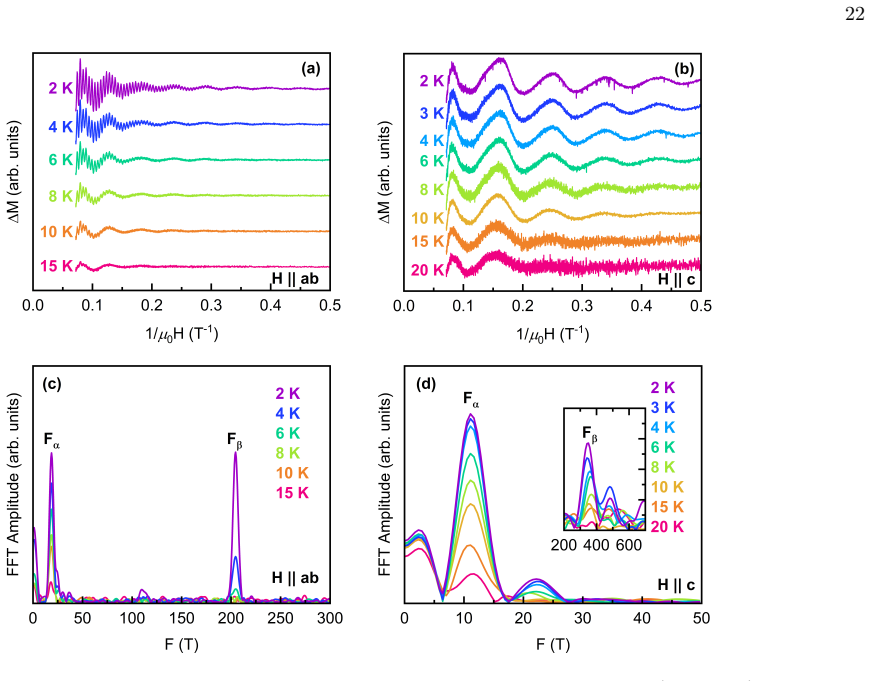
Summary. This manuscript reports a combined torque-magnetometry, VSM, and heat-capacity study of the kagome metal LuNb6Sn6. It identifies a first-order CDW transition at T_CDW = 85 K from hysteresis in torque and heat capacity, and resolves two dHvA frequencies, F_α ≈ 20 T and F_β ≈ 200 T, whose angular dependence is modeled with ellipsoidal Fermi-surface pockets. Effective cyclotron masses are light (m*_α ≈ 0.05–0.09 m0). Landau fan analysis yields an average intercept φ = -0.2(1) for F_α, which the authors interpret as a nontrivial Berry phase (Φ_B = 0.85(2)π for δ = -1/8, or 0.35(2)π for δ = +1/8); F_β is claimed to be trivial. DFT calculations on the pristine phase show Dirac-like crossings, a flat band, and van Hove singularities, but do not reproduce the measured frequencies, which the authors attribute to CDW-induced Fermi-surface reconstruction. The experimental CDW and Fermi-surface characterization is detailed and cross-validated across three samples; the topological claim is the central new physics but is presently fragile.
Significance. If the topological claim is established, LuNb6Sn6 would join ScV6Sn6 as a nonmagnetic kagome CDW metal with light, topologically nontrivial Fermi pockets, and the paper would provide a useful benchmark for CDW reconstruction in the HfFe6Ge6 family. The main strengths are the multi-technique approach, the consistency of dHvA frequencies across three independently measured samples, and the explicit comparison of DFT frequencies with experiment, including Fermi-level shifts. The DFT mismatch is informative rather than circular because the frequencies are not fit to theory. However, the Berry-phase conclusion as presented is not yet supported: the phase-conversion formula is internally inconsistent with the reported trivial value for F_β, the fan-diagram intercept is not derived correctly from the stated extremum conditions, and the statistical separation from the trivial value on the δ = +1/8 branch is marginal (~1.75σ). These issues affect the paper's headline claim and must be resolved before acceptance.
major comments (3)
- [Section III, Berry-phase paragraph] The stated conversion φ = -1/2 + Φ_B/2π + δ is incompatible with the claim that the F_β pocket is trivial with φ = 1/8 for δ = +1/8 and Φ_B = 0. Substituting gives φ = -3/8, not +1/8; conversely, if φ = +1/8 is the measured intercept, the formula yields Φ_B = π, not 0. The fan-diagram intercept plotted in Fig. 8 is therefore not the same quantity as the φ in the formula, or the formula/trivial-phase values are misstated. This invalidates the F_β result as a trivial calibration and calls into question the reported Φ_B values for F_α.
- [Section III, Fig. 8] From the text's own conditions, magnetization maxima occur when F/B + φ = n + 1/4 and minima when F/B + φ = n - 1/4. A plot of integer Landau index n versus 1/B therefore has intercept φ ± 1/4, not φ, unless a convention for assigning n to maxima or minima is specified. The paper instead fits n = F/B + φ without explaining how the 1/4 offset is absorbed. Furthermore, the FFT/filtering/background-subtraction procedure used to isolate the low-frequency channel for the fan diagram is not described. A systematic intercept shift of order 0.25 is larger than the reported uncertainty of 0.1 and would change the topological interpretation.
- [Section III, Fig. 8, and Section IV] The nontrivial-Berry-phase conclusion rests on the F_α average intercept φ = -0.2(1). For the δ = +1/8 branch, the trivial value is -3/8, so the separation is only ~1.75σ; the more significant separation is obtained only for the δ = -1/8 branch. The paper does not determine the sign of δ, and Section IV explicitly concedes that the δ ambiguity prevents a conclusive determination of the pocket's topological character. The abstract's statement of 'evidence for a nontrivial Berry phase' is accordingly stronger than the analysis supports. The authors should either provide an independent determination of δ (e.g., via a trivial pocket calibration with a consistent phase convention, or explicit CDW-phase calculations) or temper the claim to reflect the branch ambiguity.
minor comments (4)
- [Fig. 9/Fig. 10 text] The sentence 'Figure 8(c) shows the band-resolved FS obtained from DFT calculations' appears to be a cross-reference error: Fig. 8 is the Landau fan diagram, while the band-resolved FS is shown in Fig. 9(d). Please correct.
- [Section II/III] The text references 'Table I' for the extracted parameters, but no Table I is present in the manuscript. Either include the table or remove the reference, since the numerical parameter list is an important part of the results.
- [Section III, CDW discussion] Typo: 'tempearature' should be 'temperature' in the discussion of the ~74 K hump.
- [Eq. (1)] Equation (1) is written as a proportional amplitude expression with the thermal and Dingle damping factors only. It may be helpful to state explicitly that harmonic content, field-dependent prefactors, and phase factors are omitted, and that the LK fits use a single-frequency form.
Circularity Check
No significant circularity: dHvA frequencies, masses, and fan phases are experimentally extracted, and the DFT comparison is openly inconsistent with the data rather than fitted to it.
full rationale
The derivation chain is self-contained and does not reduce to its inputs. Frequencies F_alpha≈20 T and F_beta≈204 T are obtained from FFTs of independently measured torque and magnetization on three crystals, and their angle dependence is then fit to an ellipsoidal model; the ellipsoid is not used to generate the frequencies. Effective masses and Dingle temperatures come from standard Lifshitz–Kosevich fits to the measured temperature/field dependence of the same oscillations, not from a model that predicts those amplitudes. The Berry-phase claim rests on Landau-fan intercepts (average φ=-0.2(1)) extracted from extrema positions, with DFT playing no role in the phase determination; in fact the paper explicitly states that pristine-phase DFT "cannot fully reproduce the experimentally observed quantum oscillation frequencies" (Section III, Fig. 10), which is the opposite of forcing agreement. The many self-citations (e.g., [4,8,13,45,47,48]) are used for comparison or method context and are not load-bearing; no uniqueness theorem or ansatz is imported from them. The manuscript's own disclaimers about δ ambiguity, missing CDW-supercell calculations, and the sketchy background-subtraction details affect correctness/robustness, not circularity. No equation is defined in terms of the quantity it is used to predict, and no fitted parameter is renamed as a prediction. Score 0.
Axiom & Free-Parameter Ledger
free parameters (7)
- Ellipsoid scale F0 (F_alpha) =
10.14 ± 0.11 T
- Ellipsoid scale F0 (F_beta) =
388.82 ± 2.24 T
- Ellipsoid anisotropy ε_alpha =
4.08 ± 0.15
- Ellipsoid anisotropy ε_beta =
0.27 ± 0.01
- Effective cyclotron masses m*_α, m*_β =
0.052–0.088 m_e (α), 0.22–0.28 m_e (β)
- Dingle temperatures T_D =
2.95–8.22 K
- DFT Fermi-level shift =
±20 meV
axioms (5)
- standard math Onsager relation F = (ℏ/2πe) A_F
- standard math Lifshitz–Kosevich formula (Eq. 1)
- domain assumption Dimensional phase correction δ = ±1/8 for a 3D ellipsoidal pocket
- domain assumption Polynomial background subtraction preserves oscillatory phase
- domain assumption PBE-DFT with PAW pseudopotentials adequately describes pristine LuNb6Sn6
Cite this review
Pith. "Pith review of Fermiology of the kagome compound LuNb6Sn6 probed by de Haas-van Alphen oscillations." pith.science (2026). https://pith.science/paper/ZISS5BNP
@misc{pith2026260715248,
  author       = {Pith},
  title        = {Pith review of: Fermiology of the kagome compound LuNb6Sn6 probed by de Haas-van Alphen oscillations},
  year         = {2026},
  howpublished = {\url{https://pith.science/paper/ZISS5BNP}},
  note         = {Machine review of arXiv:2607.15248}
}
read the original abstract
We report a detailed de Haas-van Alphen (dHvA) study of the recently discovered kagome metal LuNb6Sn6 using torque magnetometry, magnetization, and heat-capacity measurements. Temperature-dependent torque and heat-capacity data reveal a charge density wave (CDW) transition at T_CDW = 85 K. The thermal hysteresis observed in both measurements establishes the first-order nature of the transition. Quantum oscillation measurements identify two major dHvA frequencies: F_alpha ~ 20 T and F_beta ~ 200 T, and their angular dependence is consistent with ellipsoidal Fermi surface (FS) pockets. Landau fan diagram analysis reveals evidence for a nontrivial Berry phase associated with the F_alpha pocket, indicating possible nontrivial electronic topology in LuNb6Sn6. Analysis of the temperature and magnetic field dependence of the oscillations using the Lifshitz-Kosevich formula yields electronic parameters that indicate anisotropic quantum transport properties. First-principles calculations provide further insight into the electronic structure, revealing Dirac-like band crossings, a flat band, and multiple van Hove singularities near the Fermi level. Our calculations based on the pristine phase cannot fully reproduce the experimentally observed quantum oscillation frequencies, suggesting that CDW-induced FS reconstruction plays a crucial role in the ground-state electronic structure of LuNb6Sn6. These results provide new insight into the FS topology and electronic structure of LuNb6Sn6, enriching our understanding of the electronic properties of kagome materials.
Figures




Reference graph
Works this paper leans on
-
[1]
J.-X. Yin, B. Lian, and M. Z. Hasan, Topological kagome magnets and superconductors, Nature612, 647 (2022)
2022
-
[2]
S. D. Wilson and B. R. Ortiz, A V 3Sb5 kagome superconductors, Nat. Rev. Mater.612, 420 (2024)
2024
-
[3]
Y. Wang, H. Wu, G. T. McCandless, J. Y. Chan, and M. N. Ali, Quantum states and intertwining phases in kagome materials, Nat. Rev. Phys.5, 635 (2023)
2023
-
[4]
Shtefiienko, C
K. Shtefiienko, C. Phillips, S. Mozaffari, R. P. Madhogaria, W. R. Meier, D. G. Mandrus, D. E. Graf, and K. Shrestha, Electronic structure of YV 6Sn6 probed by de Haas–van Alphen oscillations and density functional theory, APL Quantum 2, 016118 (2025)
2025
-
[5]
Mekata, Kagome: The story of the basketweave lattice, Phys
M. Mekata, Kagome: The story of the basketweave lattice, Phys. Today56, 12 (2003)
2003
-
[6]
S. Peng, Y. Han, G. Pokharel, J. Shen, Z. Li, M. Hashimoto, D. Lu, B. R. Ortiz, Y. Luo, H. Li,et al., Realizing kagome band structure in two-dimensional kagome surface states of R V6Sn6 (R = Gd, Ho), Phys. Rev. Lett.127, 266401 (2021)
2021
-
[7]
S. R. Bhandari, V. Gusain, M. Zeeshan, D. Rai, and K. Shrestha, Pressure effects on the electronic structure of the kagome metal CsV3Sb5, APL Quantum2, 016133 (2025)
2025
-
[8]
Shrestha, B
K. Shrestha, B. Regmi, G. Pokharel, S.-G. Kim, S. D. Wilson, D. E. Graf, B. A. Magar, C. Phillips, and T. Nguyen, Electronic properties of kagome metal ScV 6Sn6 using high-field torque magnetometry, Phys. Rev. B108, 245119 (2023)
2023
-
[9]
H. W. S. Arachchige, W. R. Meier, M. Marshall, T. Matsuoka, R. Xue, M. A. McGuire, R. P. Hermann, H. Cao, and D. Mandrus, Charge density wave in kagome lattice intermetallic ScV 6Sn6, Phys. Rev. Lett.129, 216402 (2022)
2022
-
[10]
Werhahn, B
D. Werhahn, B. R. Ortiz, A. K. Hay, S. D. Wilson, R. Seshadri, and D. Johrendt, The kagome metals CsTi 3Bi5 and RbTi3Bi5, Z. Naturforsch. B77, 757 (2022)
2022
-
[11]
B. R. Ortiz, H. Miao, D. S. Parker, F. Yang, G. D. Samolyuk, E. M. Clements, A. Rajapitamahuni, T. Yilmaz, E. Vescovo, J. Yan,et al., Evolution of Highly Anisotropic Magnetism in the Titanium-Based Kagome Metals LnTi 3Bi4 (Ln: La··· Gd3+, Eu2+, Yb2+), Chem. Mater.35, 9756 (2023)
2023
-
[12]
B. R. Ortiz, H. Zhang, K. G´ ornicka, D. S. Parker, G. D. Samolyuk, F. Yang, H. Miao, Q. Lu, R. G. Moore, A. F. May, et al., Intricate Magnetic Landscape in Antiferromagnetic Kagome Metal TbTi 3Bi4 and Interplay with Ln 2−xTi6+xBi9 (Ln: Tb···Lu) Shurikagome Metals, Chem. Mater.36, 8002 (2024)
2024
-
[13]
Phillips, K
C. Phillips, K. Shtefiienko, S. Mozaffari, R. P. Madhogaria, W. R. Meier, A. F. Savvidou, B. W. Casas, L. Balicas, D. G. Mandrus, D. E. Graf,et al., Electrical transport and torque magnetometry studies of the kagome compound LuV 6Sn6 under high magnetic fields, Phys. Rev. B111, 155136 (2025)
2025
-
[14]
L. Ye, M. Kang, J. Liu, F. Von Cube, C. R. Wicker, T. Suzuki, C. Jozwiak, A. Bostwick, E. Rotenberg, D. C. Bell,et al., Massive Dirac fermions in a ferromagnetic kagome metal, Nature555, 638 (2018)
2018
-
[15]
E. Liu, Y. Sun, N. Kumar, L. Muechler, A. Sun, L. Jiao, S.-Y. Yang, D. Liu, A. Liang, Q. Xu,et al., Giant anomalous Hall effect in a ferromagnetic kagome-lattice semimetal, Nat. Phys.14, 1125 (2018)
2018
-
[16]
S.-X. Li, W. Wang, S. Xu, T. Li, Z. Li, J. Wang, J.-J. Mi, Q. Tao, F. Tang, X. Wan,et al., Giant anomalous Hall effect in the kagome nodal surface semimetal Fe 3Ge, Phys. Rev. B112, 184418 (2025)
2025
-
[17]
J. Hou, K. Chen, J. Sun, Z. Zhao, Y. Zhang, P. Shan, N. Wang, H. Zhang, K. Zhu, Y. Uwatoko,et al., Effect of hydrostatic pressure on the unconventional charge density wave and superconducting properties in two distinct phases of doped kagome superconductors CsV 3−xTixSb5, Phys. Rev. B107, 144502 (2023). 13
2023
-
[18]
H. Yang, Z. Huang, Y. Zhang, Z. Zhao, J. Shi, H. Luo, L. Zhao, G. Qian, H. Tan, B. Hu,et al., Titanium doped kagome superconductor CsV 3−xTixSb5 and two distinct phases, Sci. Bull.67, 2176 (2022)
2022
-
[19]
Y. M. Oey, B. R. Ortiz, F. Kaboudvand, J. Frassineti, E. Garcia, R. Cong, S. Sanna, V. F. Mitrovi´ c, R. Seshadri, and S. D. Wilson, Fermi level tuning and double-dome superconductivity in the kagome metal CsV 3Sb5−xSnx, Phys. Rev. Mater.6, L041801 (2022)
2022
-
[20]
Kautzsch, Y
L. Kautzsch, Y. M. Oey, H. Li, Z. Ren, B. R. Ortiz, G. Pokharel, R. Seshadri, J. Ruff, T. Kongruengkit, J. W. Harter, et al., Incommensurate charge-stripe correlations in the kagome superconductor CsV 3Sb5−xSnx, npj Quantum Mater.8, 37 (2023)
2023
-
[21]
T. Qian, M. H. Christensen, C. Hu, A. Saha, B. M. Andersen, R. M. Fernandes, T. Birol, and N. Ni, Revealing the competition between charge density wave and superconductivity in CsV 3Sb5 through uniaxial strain, Phys. Rev. B104, 144506 (2021)
2021
-
[22]
C. Lin, A. Consiglio, O. K. Forslund, J. K¨ uspert, M. M. Denner, H. Lei, A. Louat, M. D. Watson, T. K. Kim, C. Cacho, et al., Uniaxial strain tuning of charge modulation and singularity in a kagome superconductor, Nat. Commun.15, 10466 (2024)
2024
-
[23]
X. Yang, Q. Tang, Q. Zhou, H. Wang, Y. Li, X. Fu, J. Zhang, Y. Song, H. Yuan, P. Dai,et al., In-plane uniaxial-strain tuning of superconductivity and charge-density wave in CsV 3Sb5, Chin. Phys. B32, 127101 (2023)
2023
-
[24]
F. Yu, D. Ma, W. Zhuo, S. Liu, X. Wen, B. Lei, J. Ying, and X. Chen, Unusual competition of superconductivity and charge-density-wave state in a compressed topological kagome metal, Nat. Commun.12, 3645 (2021)
2021
-
[25]
K. Chen, N. Wang, Q. Yin, Y. Gu, K. Jiang, Z. Tu, C. Gong, Y. Uwatoko, J. Sun, H. Lei,et al., Double superconducting dome and triple enhancement of T c in the kagome superconductor CsV 3Sb5 under high pressure, Phys. Rev. Lett.126, 247001 (2021)
2021
-
[26]
Phillips, K
C. Phillips, K. Shtefiienko, T. Nguyen, A. N. Capa Salinas, B. A. Magar, G. Pokharel, S. D. Wilson, D. E. Graf, and K. Shrestha, Fermi surface reconstruction under pressure in the kagome metal CsV3Sb5, Phys. Rev. B110, 205135 (2024)
2024
-
[27]
Di Sante, T
D. Di Sante, T. Neupert, G. Sangiovanni, R. Thomale, R. Comin, J. G. Checkelsky, I. Zeljkovic, and S. D. Wilson, Kagome metals, Rev. Mod. Phys.98, 015002 (2026)
2026
-
[28]
Y. Hu, X. Wu, A. P. Schnyder, and M. Shi, Electronic landscape of kagome superconductors A V 3Sb5 (A = K, Rb, Cs) from angle-resolved photoemission spectroscopy, npj Quantum Mater.8, 67 (2023)
2023
-
[29]
Q. Wang, H. Lei, Y. Qi, and C. Felser, Topological quantum materials with kagome lattice, Acc. Mater. Res.5, 786 (2024)
2024
-
[30]
Jiang, T
K. Jiang, T. Wu, J.-X. Yin, Z. Wang, M. Z. Hasan, S. D. Wilson, X. Chen, and J. Hu, Kagome superconductors A V 3Sb5 (A = K, Rb, Cs), Natl. Sci. Rev.10, nwac199 (2023)
2023
-
[31]
B. A. Bernevig, C. Felser, and H. Beidenkopf, Progress and prospects in magnetic topological materials, Nature603, 41 (2022)
2022
-
[32]
B. R. Ortiz, L. C. Gomes, J. R. Morey, M. Winiarski, M. Bordelon, J. S. Mangum, I. W. Oswald, J. A. Rodriguez-Rivera, J. R. Neilson, S. D. Wilson,et al., New kagome prototype materials: discovery of KV 3Sb5, RbV3Sb5, and CsV 3Sb5, Phys. Rev. Mater.3, 094407 (2019)
2019
-
[33]
B. R. Ortiz, S. M. Teicher, Y. Hu, J. L. Zuo, P. M. Sarte, E. C. Schueller, A. M. Abeykoon, M. J. Krogstad, S. Rosenkranz, R. Osborn,et al., CsV 3Sb5: A Z 2 topological kagome metal with a superconducting ground state, Phys. Rev. Lett.125, 247002 (2020). 14
2020
-
[34]
F. Yu, T. Wu, Z. Wang, B. Lei, W. Zhuo, J. Ying, and X. Chen, Concurrence of anomalous Hall effect and charge density wave in a superconducting topological kagome metal, Phys. Rev. B104, L041103 (2021)
2021
-
[35]
Q. Yin, Z. Tu, C. Gong, Y. Fu, S. Yan, and H. Lei, Superconductivity and normal-state properties of kagome metal RbV3Sb5 single crystals, Chin. Phys. Lett.38, 037403 (2021)
2021
-
[36]
Shrestha, M
K. Shrestha, M. Shi, B. Regmi, T. Nguyen, D. Miertschin, K. Fan, L. Deng, N. Aryal, S.-G. Kim, D. Graf,et al., High quantum oscillation frequencies and nontrivial topology in kagome superconductor KV3Sb5 probed by torque magnetometry up to 45 T, Phys. Rev. B107, 155128 (2023)
2023
-
[37]
S.-Y. Yang, Y. Wang, B. R. Ortiz, D. Liu, J. Gayles, E. Derunova, R. Gonzalez-Hernandez, L. ˇSmejkal, Y. Chen, S. S. Parkin,et al., Giant, unconventional anomalous Hall effect in the metallic frustrated magnet candidate, KV3Sb5, Sci. Adv. 6, eabb6003 (2020)
2020
-
[38]
Nakayama, Y
K. Nakayama, Y. Li, T. Kato, M. Liu, Z. Wang, T. Takahashi, Y. Yao, and T. Sato, Carrier injection and manipulation of charge-density wave in kagome superconductor CsV 3Sb5, Phys. Rev. X12, 011001 (2022)
2022
-
[39]
B. R. Ortiz, S. M. Teicher, L. Kautzsch, P. M. Sarte, N. Ratcliff, J. Harter, J. P. Ruff, R. Seshadri, and S. D. Wilson, Fermi surface mapping and the nature of charge-density-wave order in the kagome superconductor CsV 3Sb5, Phys. Rev. X11, 041030 (2021)
2021
-
[40]
Shrestha, M
K. Shrestha, M. Shi, T. Nguyen, D. Miertschin, K. Fan, L. Deng, D. E. Graf, X. Chen, and C.-W. Chu, Fermi surface mapping of the kagome superconductor RbV3Sb5 using de Haas-van Alphen oscillations, Phys. Rev. B107, 075120 (2023)
2023
-
[41]
H. Luo, Q. Gao, H. Liu, Y. Gu, D. Wu, C. Yi, J. Jia, S. Wu, X. Luo, Y. Xu,et al., Electronic nature of charge density wave and electron-phonon coupling in kagome superconductor KV 3Sb5, Nat. Commun.13, 273 (2022)
2022
-
[42]
Y. Fu, N. Zhao, Z. Chen, Q. Yin, Z. Tu, C. Gong, C. Xi, X. Zhu, Y. Sun, K. Liu,et al., Quantum transport evidence of topological band structures of kagome superconductor CsV 3Sb5, Phys. Rev. Lett.127, 207002 (2021)
2021
-
[43]
Zhang, L
W. Zhang, L. Wang, C. W. Tsang, X. Liu, J. Xie, W. C. Yu, K. T. Lai, and S. K. Goh, Emergence of large quantum oscillation frequencies in thin flakes of the kagome superconductor CsV 3Sb5, Phys. Rev. B106, 195103 (2022)
2022
-
[44]
Broyles, D
C. Broyles, D. Graf, H. Yang, X. Dong, H. Gao, and S. Ran, Effect of the interlayer ordering on the Fermi surface of Kagome superconductor CsV 3Sb5 revealed by quantum oscillations, Phys. Rev. Lett.129, 157001 (2022)
2022
-
[45]
Shrestha, R
K. Shrestha, R. Chapai, B. K. Pokharel, D. Miertschin, T. Nguyen, X. Zhou, D. Chung, M. Kanatzidis, J. Mitchell, U. Welp,et al., Nontrivial Fermi surface topology of the kagome superconductor CsV 3Sb5 probed by de Haas–van Alphen oscillations, Phys. Rev. B105, 024508 (2022)
2022
-
[46]
Rosenberg, J
E. Rosenberg, J. M. DeStefano, Y. Lee, C. Hu, Y. Shi, D. Graf, S. M. Benjamin, L. Ke, and J.-H. Chu, Probing the van Hove singularity of the kagome metal YV 6Sn6 through quantum oscillations, Phys. Rev. B110, 035119 (2024)
2024
-
[47]
Zheng, Y
G. Zheng, Y. Zhu, S. Mozaffari, N. Mao, K.-W. Chen, K. Jenkins, D. Zhang, A. Chan, H. W. S. Arachchige, R. P. Madhogaria,et al., Quantum oscillations evidence for topological bands in kagome metal ScV 6Sn6, J. Phys.: Condens. Matter36, 215501 (2024)
2024
-
[48]
C. Yi, X. Feng, N. Mao, P. Yanda, S. Roychowdhury, Y. Zhang, C. Felser, and C. Shekhar, Quantum oscillations revealing topological band in kagome metal ScV 6Sn6, Phys. Rev. B109, 035124 (2024)
2024
-
[49]
B. R. Ortiz, W. R. Meier, G. Pokharel, J. Chamorro, F. Yang, S. Mozaffari, A. Thaler, S. J. Gomez Alvarado, H. Zhang, D. S. Parker,et al., Stability Frontiers in the AM 6X6 Kagome Metals: The LnNb 6Sn6 (Ln: Ce–Lu, Y) Family and Density-Wave Transition in LuNb6Sn6, J. Am. Chem. Soc.147, 5279 (2025). 15
2025
-
[50]
R. Lou, Y. Zhang, E. Cheng, X. Feng, A. Fedorov, Z. Li, Y. Luo, A. Generalov, H. Ma, Q. Wei,et al., Orbital-selective band modifications in a charge-ordered kagome metal LuNb 6 Sn6, arXiv preprint arXiv:2504.04019 (2025)
Pith/arXiv arXiv 2025
-
[51]
J. Ingham, A. Consiglio, D. di Sante, R. Thomale, and H. D. Scammell, Theory of excitonic order in kagome metals ScV6Sn6 and LuNb6Sn6, arXiv preprint arXiv:2410.16365 (2024)
Pith/arXiv arXiv 2024
-
[52]
F. Yang, X. Huang, H. Tan, A. Kundu, S. Kim, M. Thinel, J. Ingham, A. Rajapitamahuni, Y. Cai, C. Nelson,et al., Fermi-surface driven frustrations in charge ordered kagome metal LuNb 6 Sn6, Phys. Rev. B112, 245113 (2025)
2025
-
[53]
W. R. Meier, D. E. Graf, B. R. Ortiz, S. Mozaffari, and D. Mandrus, Pressure suppresses the density wave order in kagome metal LuNb6 Sn6, Phys. Rev. Mater.9, L082001 (2025)
2025
-
[54]
J.-Q. Yan, B. C. Sales, M. A. Susner, and M. A. Mcguire, Flux growth in a horizontal configuration: An analog to vapor transport growth, Phys. Rev. Mater.1, 023402 (2017)
2017
-
[55]
Giannozzi, O
P. Giannozzi, O. Andreussi, T. Brumme, O. Bunau, M. Buongiorno Nardelli, M. Calandra, R. Car, C. Cavazzoni, D. Ceresoli, M. Cococcioni,et al., Advanced capabilities for materials modelling with QUANTUM ESPRESSO, J. Phys.: Condens. Matter29, 465901 (2017)
2017
-
[56]
Giannozzi, S
P. Giannozzi, S. Baroni, N. Bonini, M. Calandra, R. Car, C. Cavazzoni, D. Ceresoli, G. L. Chiarotti, M. Cococcioni, I. Dabo, et al., QUANTUM ESPRESSO: a modular and open-source software project for quantum simulations of materials, J. Phys.: Condens. Matter21, 395502 (2009)
2009
-
[57]
J. P. Perdew, K. Burke, and M. Ernzerhof, Generalized gradient approximation made simple, Phys. Rev. Lett.77, 3865 (1996)
1996
-
[58]
J. P. Perdew, A. Ruzsinszky, G. I. Csonka, O. A. Vydrov, G. E. Scuseria, L. A. Constantin, X. Zhou, and K. Burke, Restoring the density-gradient expansion for exchange in solids and surfaces, Phys. Rev. Lett.100, 136406 (2008)
2008
-
[59]
H. J. Monkhorst and J. D. Pack, Special points for Brillouin-zone integrations, Phys. Rev. B13, 5188 (1976)
1976
-
[60]
Shoenberg,Magnetic Oscillations in Metals(Cambridge University Press, 1984)
D. Shoenberg,Magnetic Oscillations in Metals(Cambridge University Press, 1984)
1984
-
[61]
Ando, Topological insulator materials, J
Y. Ando, Topological insulator materials, J. Phys. Soc. Jpn.82, 102001 (2013)
2013
-
[62]
Shrestha, V
K. Shrestha, V. Marinova, B. Lorenz, and P. C. Chu, Shubnikov-de Haas oscillations from topological surface states of metallic Bi2Se2.1Te0.9, Phys. Rev. B90, 241111 (2014)
2014
-
[63]
Shrestha, V
K. Shrestha, V. Marinova, B. Lorenz, and C. Chu, Evidence of a 2D Fermi surface due to surface states in a p-type metallic Bi2Te3, J. Phys.: Condens. Matter30, 185601 (2018)
2018
-
[64]
Rehfuss, C
Z. Rehfuss, C. Broyles, D. Graf, Y. Li, H. Tan, Z. Zhao, J. Liu, Y. Zhang, X. Dong, H. Yang,et al., Quantum oscillations in kagome metals CsTi 3Bi5 and RbTi3Bi5, Phys. Rev. Mater.8, 024003 (2024)
2024
-
[65]
D. J. Campbell, C. Eckberg, K. Wang, L. Wang, H. Hodovanets, D. Graf, D. Parker, and J. Paglione, Quantum oscillations in the anomalous spin density wave state of FeAs, Phys. Rev. B96, 075120 (2017)
2017
-
[66]
S. E. Sebastian, J. Gillett, N. Harrison, P. Lau, D. J. Singh, C. Mielke, and G. Lonzarich, Quantum oscillations in the parent magnetic phase of an iron arsenide high temperature superconductor, J. Phys.: Condens. Matter20, 422203 (2008)
2008
-
[67]
Dhital, G
C. Dhital, G. Pokharel, B. Wilson, I. Kendrick, M. M. Asmar, D. Graf, J. Guerrero-Sanchez, R. Gonzalez-Hernandez, and S. D. Wilson, Fermi surface of the magnetic kagome compound GdV 6Sn6 investigated using de Haas–van Alphen oscillations, Phys. Rev. B109, 235145 (2024)
2024
-
[68]
Prodan, A
L. Prodan, A. Chmeruk, L. Chioncel, V. Tsurkan, and I. K´ ezsm´ arki, Anisotropic charge transport in the easy-plane kagome ferromagnet Fe3Sn, Phys. Rev. B110, 094407 (2024). 16
2024
-
[69]
J. Ma, C. Shi, Y. Cao, Y. Zhang, Y. Li, J. Liao, J. Wang, W. Jiao, H. Guo, C. Xu,et al., Anisotropic transport properties and topological Hall effect in the annealed kagome antiferromagnet FeGe, Sci. China Phys. Mech. Astron.68, 237412 (2025)
2025
-
[70]
J. Hu, Z. Tang, J. Liu, Y. Zhu, J. Wei, and Z. Mao, Nearly massless Dirac fermions and strong Zeeman splitting in the nodal-line semimetal ZrSiS probed by de Haas–van Alphen quantum oscillations, Phys. Rev. B96, 045127 (2017)
2017
-
[71]
Miertschin, T
D. Miertschin, T. Nguyen, S. R. Bhandari, K. Shtefiienko, C. Phillips, B. A. Magar, R. Sankar, D. E. Graf, and K. Shrestha, Anisotropic quantum transport in ZrSiS probed by high-field torque magnetometry, Phys. Rev. B110, 085140 (2024)
2024
-
[72]
S. R. Bhandari, M. Zeeshan, V. Gusain, K. Shrestha, and D. Rai, First-principles study of the electronic structure, Z 2 invariant, and quantum oscillation in the kagome material CsV 3Sb5, APL Quantum1, 046118 (2024)
2024
-
[73]
S. R. Julian, Numerical extraction of de Haas–van Alphen frequencies from calculated band energies, Comput. Phys. Commun.183, 324 (2012). 17 FIG. 1. (a) Crystal structure of LuNb 6Sn6: the unit cell (top) and top view (bottom), highlighting the Nb kagome network. (b) Temperature dependence of the magnetic torque at fixed field magnitude and direction for ...
2012
-
[94]
and a chain-like FS sheet at the Brillouin zone boundary (Band 93). 25 FIG. 10. Calculated quantum oscillation frequencies from the FS pocket of Band 93 with (a) no Fermi-level shift, (b)E F − 20 meV, and (c)E F + 20 meV. The magnetic field was rotated from the c-axis toward the a-axis direction within the ac-plane. The experimentally observed dHvA freque...
discussion (0)
Sign in with ORCID, Apple, or X to comment. Anyone can read and Pith papers without signing in.