REVIEW 3 major objections 6 minor 143 references
Transactive Energy System: Market-Based Coordination of Distributed Energy Resources
T0 review · 3 major / 6 minor · reviewed 2026-08-14 · deepseek-v4-flash
Pith's one-line read This paper claims that any transactive energy system for coordinating distributed energy resources can be specified by four elements—agent preference, control decision, information structure, and solution concept—and uses this taxonomy to…
desk verdict A useful organizing taxonomy for transactive energy, but the completeness claim needs an equilibrium-selection rule before it can be taken literally. read the letter →
The pith
A machine-rendered reading of the paper's core claim, the machinery that carries it, and where it could break.
The reading
What carries the argument
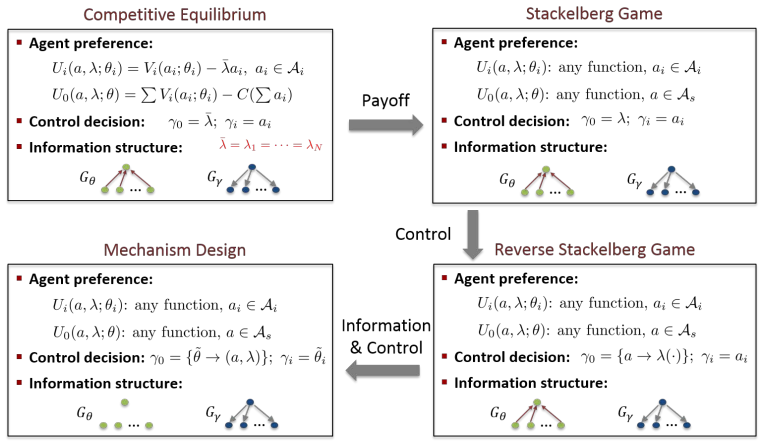
The load-bearing device is the four-element tuple. Agent preference is a payoff function: $U_i(a,\lambda;\theta_i)$ for each resource agent and $U_0(a,\lambda;\theta)$ for the coordinator, with $\theta_i$ the agent's private type. Control decision is $\gamma_i \in \Gamma_i$, an action that need not equal the allocation or price (for example, a supply-function parameter $b_i$ with $a_i = b_i \bar\lambda$); the framework assumes the map from $(\gamma_0,\dots,\gamma_N)$ to $(a,\lambda)$ is single-valued. Information structure is captured by two directed graphs, $G^\theta$ (who knows whose type) and $G^\gamma$ (who observes whose decision, i.e., the order of moves). Solution concept is the equilibrium notion applied at each stage—standard optimization when lower-level payoffs decouple, Nash or $\epsilon$-Nash for simultaneous coupled decisions, Bayesian Nash under a common prior on types, dominant strategy when no prior exists, and a two-stage recursion with lower-level equilibrium responses for leader-follower problems. The tuple does the work of separating the four literature classes: competitive equilibrium allows quasi-linear payoffs and a uniform price, Stackelberg allows general payoffs with the price as the leader's decision, reverse Stackelberg replaces the price by a pricing function $\lambda(\cdot)$, and mechanism design leaves the coordinator choosing an outcome function $g(m)$ plus message spaces under private information.
What would settle it
Find a published transactive energy system with a market mechanism whose outcome is not a single-valued function of the agents' control decisions—for instance, a double auction with multiple market-clearing prices, or a mechanism that randomizes outcomes—and show that it cannot be represented by the paper's four-element tuple; that would bound the framework's claimed coverage of most transactive energy systems studied in the literature.
Extended reading notes
Core claim
The central discovery is a unifying mathematical skeleton for transactive energy systems. A system is specified by (i) payoff functions $U_i(a,\lambda;\theta_i)$ for resource agents and $U_0(a,\lambda;\theta)$ for a coordinator, encoding possibly private preferences; (ii) control decisions $\gamma_i \in \Gamma_i$ that are distinct from the energy allocations and prices, with the collective decisions assumed to determine the market outcome $(a,\lambda)$ uniquely; (iii) an information structure describing who knows whose types and decisions, summarized by type-dependence and decision-dependence graphs; and (iv) a solution concept—Nash, $\epsilon$-Nash, Bayesian Nash, dominant strategy, or a two-stage combination—that encodes rationality. The paper claims that any change in one of these elements creates a fundamentally different problem, and it shows that the competitive-equilibrium formulation, the Stackelberg and reverse Stackelberg games, and mechanism design are exactly the same coordination problem read under different elements: different payoff restrictions, different control decisions (a price value versus a pricing function versus a bid-based outcome function), and different information assumptions (known versus private types).
Load-bearing premise
The framework rests on the assumption that any transactive energy system can be fully described by the four elements and that, once the agents' control decisions are fixed, the market outcome—allocations and prices—is uniquely determined; if a system has multiple equilibria or random outcomes, the taxonomy as stated does not cover it.
Editorial extensions
If this is right
- Two transactive energy systems that appear similar can be compared formally by aligning their preferences, control decisions, information graphs, and solution concepts; differences in any one element make them different problems.
- For a given coordination problem, the taxonomy narrows the choice: if the coordinator knows types and payoffs are quasi-linear, a competitive-equilibrium formulation reduces to a solvable social-welfare optimization; otherwise, a Stackelberg formulation leads to a generally NP-hard bilevel problem.
- When the coordinator can announce a pricing function rather than a fixed price, a reverse Stackelberg formulation applies, and for a single resource agent the paper's Theorem 1 gives a linear pricing function that implements the team-optimal outcome.
- When the coordinator does not know agents' types, mechanism design is the relevant class; the paper surveys which social choice functions can be implemented under dominant strategy, Bayesian Nash, and Nash equilibria, including the impossibility results that limit what can be achieved.
- The framework also acts as a survey map: for each class, the paper collects the available computational tools, from auction-based market clearing and primal-dual iterations to branch-and-bound and VCG-type mechanisms.
Reading between the lines
- A natural next step the paper does not take is to use the four elements as a reporting standard: if every proposed transactive energy system were published with its tuple stated, comparing designs would become routine.
- The framework's assumption that collective decisions determine a unique market outcome excludes two practically relevant cases: systems with multiple equilibria (where equilibrium selection matters) and mechanisms with randomized outcomes; extending the taxonomy to equilibrium-selection rules would broaden its coverage.
- The taxonomy suggests a testable research program: for a fixed physical coordination problem, one can enumerate the four tuples and check which classes are computationally tractable and which satisfy desirable economic properties, yielding a design chart for DER coordination.
Signed reviews
Editorial analysis
A structured set of objections, weighed in public.
Referee Report
Summary. The paper proposes a unifying framework for transactive energy systems (TES) in which any such system is specified by four elements: agent preference, control decision, information structure, and solution concept. It then instantiates this framework for four classes of TES: competitive equilibrium, Stackelberg games, reverse Stackelberg games, and mechanism design. For each class the paper gives a canonical formulation, a brief survey of relevant tools, and a discussion of connections and differences, culminating in a pictorial comparison in Figure 2. The central claim is that the four-element framework standardizes the formulation of TES and facilitates the analysis of most transactive energy systems studied in the literature.
Significance. If the framework is accepted, it would give researchers a common vocabulary for comparing TES formulations and for selecting an appropriate game-theoretic model, which is genuinely useful given the fragmented literature. The paper draws on well-established concepts (competitive equilibrium, Stackelberg and reverse Stackelberg games, mechanism design) and correctly summarizes many known theorems, including the Gibbard-Satterthwaite theorem, the VCG mechanism, and the d'Aspremont-Gérard-Varet expected externality mechanism. Its main contribution is organizational: a taxonomy with concrete examples. However, the central completeness claim that the four elements 'standardize the formulation of transactive energy systems' is not formally bounded, and one specific technical gap—the treatment of multiple equilibria in the lower-level game—currently prevents the framework from being well-defined for an important class of TES. The paper is therefore a useful and largely accurate survey, but its strongest unifying claim requires additional assumptions or a more careful statement of scope.
major comments (3)
- [Section IV, Eq. (25)] The formulation of the multi-follower Stackelberg problem is not well-defined when the lower-level game has multiple Nash equilibria. Equation (25b) defines a_i^*(λ) as an argmax of the follower's payoff, but if the follower game admits several equilibria, a^*(λ) is a set-valued map and the coordinator's problem (25a), which optimizes U_0 against a single a^*(λ), has no well-defined value. The assumption in Section II.B that 'the collective control decisions uniquely determines the market outcome (a,λ)' concerns the outcome map from control decisions to allocations and prices, not uniqueness of equilibrium strategies, so it does not resolve this issue. The paper neither provides an equilibrium-selection rule nor restricts the payoff functions to guarantee uniqueness. Because the claimed ability to 'standardize the formulation of transactive energy systems' depends on the framework being applicable to systems with multiple followers, this gap is load-bearing. The authors should either add an explicit selection rule (e.g., a particular equilibrium refinement), impose conditions that guarantee a unique follower equilibrium, or explicitly restrict the framework's scope to TES where the lower-level equilibrium is unique.
- [Section III, Proposition 2] Proposition 2 is a central result connecting the author's transactive energy system (13)–(15) to competitive equilibrium, and it is used to derive Corollary 1, which justifies solving the social welfare optimization problem (16) instead of the bilevel problem (15). Yet the proposition is asserted without proof; the text only says 'It can be proved by viewing λ* as the Lagrange multiplier of (16b).' While the underlying idea is standard, the proposition is not a direct quotation from the literature and its assumptions (concavity, convexity, interior-point conditions) need to be checked. At minimum, a proof sketch showing that (15b) is equivalent to the first-order conditions of (16) and that the Lagrange multiplier of (16b) yields the price λ* should be provided. As written, the chain of reasoning from (13)–(15) to competitive equilibrium and social efficiency is incomplete.
- [Section II.B and Section VII] The paper's scope claim is not calibrated to its own assumptions. Section II.B assumes that the collective control decisions uniquely determine the market outcome, and Section VII concedes that 'extending the framework to explicitly capture more complicated dynamics, and incorporating uncertainties from the model and the environment' is future work. Yet the Introduction claims the framework 'facilitates the analysis of most transactive energy systems studied in the literature.' Many TES in the literature involve dynamics (e.g., battery storage, thermal dynamics of buildings) and uncertainty (renewable generation, load forecast errors), and many have multiple market equilibria. The authors should either narrow the claim to 'static, deterministic TES with a unique outcome map' or explain how the framework extends to the excluded cases. Without such an adjustment, the central claim overstates what the framework delivers.
minor comments (6)
- [Section II.A, Example 1, Eq. (3)] In Eq. (3) the payoff function is written as U_i(a,λ;θ_i)=U_i(a_i,λ̄;θ_i), and then 'where V_i(·) is the utility of energy consumption' is stated, but V_i never appears in the displayed formula. Presumably the intended expression is U_i(a_i,λ̄;θ_i)=V_i(a_i;θ_i)-λ̄ a_i, as in Eq. (13). Please define V_i explicitly and correct the equation.
- [Throughout] There are numerous typographical errors, including 'the the control decisions' (Example 2), 'sagent' (Definition 1), 'coordinationa' (Section VII), 'reousrce' (Section VI), 'Reveres' (Section V), 'Stterthwaite' (Section VI.D, should be 'Satterthwaite'), and 'N agent' in the caption of Figure 1. A careful proofreading pass is needed.
- [Section VI.B, Eq. (32)] After Eq. (32) the text says 'where h_-i(·) can be any function that does not depend on θ̃_i.' The subscript appears to be a typo: it should be h_i(θ̃_{-i}), since h_i is the function that can depend on the other agents' reports. Also, in the same paragraph, 'Note that In addition' is a duplicated phrase.
- [Section V, Theorem 1] Theorem 1 states that Q is a linear operator chosen according to Q∇_{a_1} U_1(a_1^τ, λ^τ; θ_1) = ∇_{λ_1} U_1(a_1^τ, λ^τ; θ_1). This condition should be made explicit about the dimensions and the linear operator space. As written, it is not clear whether Q is a scalar or a matrix, and the notation could be confused with the payment function q(·) used later.
- [Section VI.D, Theorem 5] The statement 'Under Assumption 10' should read 'Under Definition 10' or 'Under the conditions in Definition 10.' Also, the equilibrium condition is written as V̄_i'(a^*(σ^*)) = U_i(a^*(σ^*); θ_i), which appears to compare a marginal utility with a total utility; the intended condition is likely V̄_i'(a^*(σ^*); σ_i^*) = V_i'(a^*_i(σ^*); θ_i) or similar. Please clarify.
- [References] Reference [2] is incomplete: 'D. GL. A review of distributed energy resources' lacks a full author name and institution details. Reference [13] and others intermix author initials and full names inconsistently; the reference list should be checked against the journal's style.
Circularity Check
No significant circularity: the paper is a descriptive synthesis applying textbook game-theoretic elements to transactive energy systems; its cited results are external, and the noted equilibrium-selection gap is a scope issue, not a circular derivation.
full rationale
This is a survey/framework paper rather than a predictive derivation. Its central claim is that a transactive energy system can be characterized by four elements—agent preference (Eqs. (1)-(2)), control decision (Section II.B), information structure (Section II.C), and solution concept (Section II.D)—and that this taxonomy helps compare classes such as competitive equilibrium, Stackelberg games, reverse Stackelberg games, and mechanism design. The framework is built from standard game-theoretic ingredients, not from the authors' own earlier results, and the classifications are assignments of known models to the four elements rather than derivations that presuppose their conclusions. The main mathematical connections are independently grounded: Proposition 1 and Proposition 2 connect the competitive equilibrium of Section III to the social-welfare optimization (16) via the standard Lagrange-multiplier argument, with the proof cited to Mas-Colell et al.; Theorem 1 on reverse Stackelberg incentive controllability is cited to Zheng and Basar [101]; and Theorems 2-5 on mechanism design are cited to standard textbooks and external papers. The authors' self-citations ([26], [30], [31], [35], [41]) appear only as examples of applications or as passing references, and none is load-bearing for the framework's validity. The genuine weakness noted in the skeptical reading is that Eq. (25) and Eq. (28) write the lower-level response as a single-valued arg max without an equilibrium-selection rule, so if the follower game has multiple Nash equilibria the leader's problem is not well defined; the paper's Section II.B only assumes the collective control decisions uniquely determine the market outcome, not that the equilibrium strategy profile is unique. This is a correctness and scope limitation, and the paper itself acknowledges that dynamics and uncertainty are left to future work in Section VII. However, this does not make any result equivalent to its inputs by construction; it is an incompleteness in the proposed framework, not circularity. Therefore the appropriate finding is no significant circularity.
Assumptions & free parameters
assumptions (3)
- standard math Payoff functions are real-valued and agents maximize them.
- domain assumption Collective control decisions uniquely determine the market outcome (a,λ).
- ad hoc to paper The four framework elements are sufficient to specify any transactive energy system.
Cite this review
Pith. "Pith review of Transactive Energy System: Market-Based Coordination of Distributed Energy Resources." pith.science (2026). https://pith.science/paper/ZJ3KMX6E
@misc{pith2026190803641,
  author       = {Pith},
  title        = {Pith review of: Transactive Energy System: Market-Based Coordination of Distributed Energy Resources},
  year         = {2026},
  howpublished = {\url{https://pith.science/paper/ZJ3KMX6E}},
  note         = {Machine review of arXiv:1908.03641}
}
read the original abstract
Distributed energy resources (DER) provide significant value for renewable energy integration in modern power grids. However, unlocking this value requires complex design and coordination. This paper focuses on the emerging {\em transactive energy systems}, which draw tools and principles from economics to design the coordination strategies for DERs. The concept of transactive energy system broadly captures a huge body of literature, and many of them are closely related but fundamentally different. This gives rise to the following questions: how to formally compare different transactive energy systems and their proposed approaches? How to choose the right transactive energy system to formulate a given problem? What tools are available in the literature for each class of transactive energy systems? In this paper, we answer these questions by synthesizing a unifying framework for a large class of problems studied in the literature. The framework consists of preferences, control decision, information structure and solution concept. These elements are important in identifying and distinguishing various transactive energy systems in the literature. We employ the proposed framework to analyze a few important class of transactive energy systems. Their connections and differences are discussed, and available tools for each class of problems are surveyed.
Figures

Reference graph
Works this paper leans on
-
[1]
Sb-100 california renewables port- folio standard program: emissions of greenhouse gases
California Legistlative Council. Sb-100 california renewables port- folio standard program: emissions of greenhouse gases. Technical report, 2018
2018
-
[2]
D. GL. A review of distributed energy resources. Technical report, New York Independent System Operator, 2014
2014
-
[3]
J. A. Carr, J. C. Balda, and H. A. Mantooth. A survey of systems to integrate distributed energy resources and energy storage on the utility grid. In IEEE Energy 2030 Conference , pages 1–7, 2008
2008
-
[4]
J. C. Fuller, K. P. Schneider, and D. Chassin. Analysis of residential demand response and double-auction markets. In Proc. IEEE Power and Energy Society General Meeting , pages 1–7, Detroit, MI, July 2011
2011
-
[5]
D. J. Hammerstrom et al. Pacific Northwest GridWise TM Testbed Demonstration projects. Part I: Olympic Peninsula project. Tech- nical Report PNNL-17167, Pacific Northwest National Laboratory, October 2007
2007
-
[6]
S. E. Widergren et al. AEP Ohio gridSMART R© Demonstration Project: Real-time pricing demonstration analysis. Technical Report PNNL-23192, Pacific Northwest National Laboratory, February 2014
2014
-
[7]
S. E. Widergren, J. C. Fuller, M. C. Marinovici, and A. Somani. Residential transactive control demonstration. In Proc. Innovative Smart Grid Technologies Conference , Washington, DC, February 2014
2014
-
[8]
Huang, J
P. Huang, J. Kalagnanam, R. Natarajan, D. J. Hammerstrom, R. Melton, M. Sharma, and R. Ambrosio. Analytics and transactive control design for the Pacific Northwest Smart Grid Demonstration project. In Proc. IEEE International Conference on Smart Grid Communications, pages 449–454, Gaithersburg, MD, October 2010
2010
Show all 143 references
-
[9]
D. J. Hammerstrom et al. Pacific Northwest Smart Grid Demonstra- tion Project technology performance report V olume 1: Technology performance. Technical Report PNWD-4445, Battelle Memorial Institute, 2015
2015
-
[10]
Kok et al
K. Kok et al. Dynamic pricing by scalable energy manage- ment systems–Field experiences and simulation results using Pow- erMatcher. In Proc. 2012 IEEE Power and Energy Society General Meeting, pages 1–8, San Diego, CA, July 2012
2012
-
[11]
Widergren, J
S. Widergren, J. Fuller, C. Marinovici, and A. Somani. Residential transactive control demonstration. In IEEE PES Innovative Smart Grid Technologies Conference, pages 1–5, 2014
2014
-
[12]
D. Jin, X. Zhang, and S. Ghosh. Simulation models for evaluation of network design and hierarchical transactive control mechanisms in smart grids. In IEEE PES Innovative Smart Grid Technologies , pages 1–8, 2012
2012
-
[13]
A. K. Bejestani, A. Annaswamy, and T. Samad. A hierarchical transactive control architecture for renewables integration in smart grids: Analytical modeling and stability. IEEE Transactions on Smart Grid, 5(4):2054–2065, 2014
2014
-
[14]
Junjie, Y
H. Junjie, Y . Guangya, K. Koen, X. Yusheng, and H. W. Bindner. Transactive control: a framework for operating power systems char- acterized by high penetration of distributed energy resources. Journal of Modern Power Systems and Clean Energy , pages 1–14, 2016
2016
-
[15]
H. Hao, C. D. Corbin, K. Kalsi, and R. G. Pratt. Transactive control of commercial buildings for demand response. IEEE Transactions on Power Systems, 32(1):774–783, 2017
2017
-
[16]
A. M. Annaswamy, Y . Guan, H. E. Tseng, H. Zhou, T. Phan, and D. Yanakiev. Transactive control in smart cities. Proceedings of the IEEE, 106(4):518–537, 2018
2018
-
[17]
Huang, D
Q. Huang, D. Laurentiu, and E. Widergren. Transactive energy systems for future power grid. Technical report, Pacific Northwest National Laboratory, 2018
2018
-
[18]
Z. Liu, Q. Wu, S. Huang, and H. Zhao. Transactive energy: A review of state of the art and implementation. In IEEE Manchester PowerTech, pages 1–6, 2017
2017
-
[19]
L. Chen, N. Li, S. H. Low, and J. C. Doyle. Two market models for demand response in power networks. IEEE SmartGridComm , 10:397–402, 2010
2010
-
[20]
D. T. Nguyen, M. Negnevitsky, and M. de Groot. Walrasian market clearing for demand response exchangea. IEEE Transactions on Power Systems, 27(1):535–544, 2012
2012
-
[21]
I. Yang, D. S. Callaway, and C. J. Tomlin. Risk-limiting dynamic contracts for direct load control. arXiv preprint arXiv:1409.1994 , 2014
1994 arXiv
-
[22]
Balandat, F
M. Balandat, F. Oldewurtel, M. Chen, and C. Tomlin. Contract design for frequency regulation by aggregations of commercial buildings. In 52nd Annual Allerton Conference on Communication, Control, and Computing, pages 38–45, 2014
2014
-
[23]
Samadi, H
P. Samadi, H. Mohsenian-Rad, R. Schober, and V . W. Wong. Ad- vanced demand side management for the future smart grid using mechanism design. IEEE Transactions on Smart Grid , 3(3):1170– 1180, 2012
2012
-
[24]
Zhang, S
L. Zhang, S. Ren, C. Wu, and Z. Li. A truthful incentive mechanism for emergency demand response in colocation data centers. In IEEE Conference on Computer Communications , pages 2632–2640, 2015
2015
-
[25]
Maharjan, Q
S. Maharjan, Q. Zhu, Y . Zhang, S. Gjessing, and T. Basar. Depend- able demand response management in the smart grid: A stackelberg game approach. IEEE Transactions on Smart Grid , 4(1):120–132, 2013
2013
-
[26]
S. Li, W. Zhang, J. Lian, and K. Kalsi. Market-based coordination of thermostatically controlled loads—Part i: A mechanism design formulation. IEEE Transactions on Power Systems, 31(2):1170–1178, 2016
2016
-
[27]
Kalsi, M
K. Kalsi, M. Elizondo, J. Fuller, S. Lu, and D. Chassin. Development and validation of aggregated models for thermostatic controlled loads with demand response. In 45th Hawaii International Conference on System Science, pages 1959–1966, 2012
1959
-
[28]
Z. Ma, D. S. Callaway, and I. A. Hiskens. Decentralized charging control of large populations of plug-in electric vehicles. IEEE Transactions on Control Systems Technology , 21(1):67–78, 2013
2013
-
[29]
V . Robu, S. Stein, E. H. Gerding, D. C. Parkes, A. Rogers, and N. R. Jennings. An online mechanism for multi-speed electric vehicle charging. In International Conference on Auctions, Market Mechanisms and Their Applications, pages 100–112. Springer, 2011
2011
-
[30]
J. Liu, S. Li, W. Zhang, J. L. Mathieu, and G. Rizzoni. Planning and control of electric vehicles using dynamic energy capacity models. In IEEE Conference on Decision and Control , pages 379–384, 2013
2013
-
[31]
S. Li, M. Brocanelli, W. Zhang, and X. Wang. Integrated power management of data centers and electric vehicles for energy and regulation market participation. IEEE Transactions on Smart Grid , 5(5):2283–2294, 2014
2014
-
[32]
Z. Liu, Q. Wu, K. Ma, M. Shahidehpour, Y . Xue, and S. Huang. Two-stage optimal scheduling of electric vehicle charging based on transactive control. IEEE Transactions on Smart Grid , 2018
2018
-
[33]
Rahimi and A
F. Rahimi and A. Ipakchi. Demand response as a market resource under the smart grid paradigm. IEEE Transactions on Smart Grid , 1(1):82–88, 2010
2010
-
[34]
Rahbari-Asr, U
N. Rahbari-Asr, U. Ojha, Z. Zhang, and M. Chow. Incremen- tal welfare consensus algorithm for cooperative distributed gener- ation/demand response in smart grid. IEEE Transactions on Smart Grid, 5(6):2836–2845, 2014
2014
-
[35]
S. Li, W. Zhang, J. Lian, and K. Kalsi. On reverse stackelberg game and optimal mean field control for a large population of thermostatically controlled loads. In American Control Conference , pages 3545–3550, 2016
2016
-
[36]
L. J. Ratliff, R. Dong, H. Ohlsson, and S. S. Sastry. Incentive design and utility learning via energy disaggregation. IFAC Proceedings Volumes, 47(3):3158–3163, 2014
2014
-
[37]
K. J. Arrow and G. Debreu. Existence of an equilibrium for a competitive economy. Econometrica: Journal of the Econometric Society, pages 265–290, 1954
1954
-
[38]
G. Debreu. A social equilibrium existence theorem. Proceedings of the National Academy of Sciences , 38(10):886–893, 1952
1952
-
[39]
N. Li, L. Chen, and M. A. Dahleh. Demand response using linear supply function bidding. IEEE Transactions on Smart Grid , 6(4):1827–1838, 2015
2015
-
[40]
Huang, P
M. Huang, P. E. Caines, and R. P. Malham ´e. Large-population cost-coupled lqg problems with nonuniform agents: Individual-mass behavior and decentralized ε-nash equilibria. IEEE transactions on automatic control, 52(9):1560–1571, 2007
2007
-
[41]
S. Li, W. Zhang, and L. Zhao. Connections between mean-field game and social welfare optimization. preprint arXiv:1703.10211, 2017
2017 arXiv
-
[42]
Diamantaras, E
D. Diamantaras, E. Cardamone, K. A. C. Campbell, S. Deacle, and L. A. Delgado. A toolbox for economic design . Macmillan, 2009
2009
-
[43]
Mas-Colell, M
A. Mas-Colell, M. D. Whinston, J. R. Green, et al. Microeconomic theory, volume 1. Oxford university press New York, 1995
1995
-
[44]
Bas ¸ar and G
T. Bas ¸ar and G. J. Olsder. Dynamic noncooperative game theory . SIAM, 1998
1998
-
[45]
Papadaskalopoulos and G
D. Papadaskalopoulos and G. Strbac. Decentralized participation of flexible demand in electricity marketsart i: Market mechanism. IEEE Transactions on Power Systems , 28(4):3658–3666, 2013
2013
-
[46]
Hansen, J
J. Hansen, J. Knudsen, and A. Annaswamy. A dynamic market mechanism for integration of renewables and demand response. IEEE Transactions on Smart Grid , 2015
2015
-
[47]
L. Chen, N. Li, L. Jiang, and S. H. Low. Optimal demand response: problem formulation and deterministic case. In Control and optimization methods for electric smart grids, pages 63–85. Springer, 2012
2012
-
[48]
N. Li, L. Chen, and S. H. Low. Optimal demand response based on utility maximization in power networks. In IEEE power and energy society general meeting , pages 1–8. IEEE, 2011
2011
-
[49]
Joki ´c, M
A. Joki ´c, M. Lazar, and P. P. van den Bosch. Price-based control of electrical power systems. In Intelligent Infrastructures, pages 109–
-
[50]
Singh, P
R. Singh, P. Kumar, and L. Xie. Decentralized control via dynamic stochastic prices: The independent system operator problem. arXiv preprint arXiv:1605.08926, 2016
2016 arXiv
-
[51]
S. A. Gabriel, A. J. Conejo, J. D. Fuller, B. F. Hobbs, and C. Ruiz. Complementarity modeling in energy markets , volume 180. Springer Science & Business Media, 2012
2012
-
[52]
L. N. Vicente and P. H. Calamai. Bilevel and multilevel pro- gramming: A bibliography review. Journal of Global optimization , 5(3):291–306, 1994
1994
-
[53]
S. Dempe. Annotated bibliography on bilevel programming and mathematical programs with equilibrium constraints. 2003
2003
-
[54]
Colson, P
B. Colson, P. Marcotte, and G. Savard. An overview of bilevel optimization. Annals of operations research , 153(1):235–256, 2007
2007
-
[55]
T. Yang, J. Lu, D. Wu, J. Wu, G. Shi, Z. Meng, and K. H. Johansson. A distributed algorithm for economic dispatch over time-varying directed networks with delays. IEEE Transactions on Industrial Electronics, 64(6):5095–5106, 2017
2017
-
[56]
A. D. Dominguez-Garcia, S. T. Cady, and C. N. Hadjicostis. Decen- tralized optimal dispatch of distributed energy resources. In IEEE Conference on Decision and Control, pages 3688–3693. IEEE, 2012
2012
-
[57]
Zhang and M
Z. Zhang and M. Y . Chow. Convergence analysis of the incremental cost consensus algorithm under different communication network topologies in a smart grid. IEEE Transactions on Power Systems , 27(4):1761–1768, 2012
2012
-
[58]
J. Lian, H. Ren, Y . Sun, and D. Hammerstrom. Performance eval- uation for transactive energy systems using double-auction market. IEEE Transactions on Power Systems , pages 1–1, 2018
2018
-
[59]
S. Boyd, N. Parikh, E. Chu, B. Peleato, and J. Eckstein. Distributed optimization and statistical learning via the alternating direction method of multipliers. Foundations and Trends in Machine Learning, 3(1):1–122, 2011
2011
-
[60]
Tushar, W
W. Tushar, W. Saad, H. V . Poor, and D. B. Smith. Economics of electric vehicle charging: A game theoretic approach. IEEE Transactions on Smart Grid , 3(4):1767–1778, 2012
2012
-
[61]
G. E. Asimakopoulou, A. L. Dimeas, and N. D. Hatziar- gyriou. Leader-follower strategies for energy management of multi- microgrids. IEEE Transactions on Smart Grid , 4(4):1909–1916, 2013
1909
-
[62]
Zhong, L
H. Zhong, L. Xie, and Q. Xia. Coupon incentive-based demand response: Theory and case study. IEEE Transactions on Power Systems, 28(2):1266–1276, 2013
2013
-
[63]
Maharjan, Q
S. Maharjan, Q. Zhu, Y . Zhang, S. Gjessing, and T. Bas ¸ar. Demand response management in the smart grid in a large population regime. IEEE Transactions on Smart Grid , 7(1):189–199, 2016
2016
-
[64]
V on Stackelberg
H. V on Stackelberg. The theory of the market economy . Oxford University Press, 1952
1952
-
[65]
Simaan and J
M. Simaan and J. B. Cruz. On the stackelberg strategy in nonzero- sum games. Journal of Optimization Theory and Applications , 11(5):533–555, 1973
1973
-
[66]
Yu and S
M. Yu and S. H. Hong. A real-time demand-response algorithm for smart grids: A stackelberg game approach. IEEE Transactions on Smart Grid, 7(2):879–888, 2016
2016
-
[67]
Coogan, L
S. Coogan, L. J. Ratliff, D. Calderone, C. Tomlin, and S. S. Sastry. Energy management via pricing in lq dynamic games. In American Control Conference, pages 443–448. IEEE, 2013
2013
-
[68]
Tushar, J
W. Tushar, J. A. Zhang, Davi. B. Smith, H. V . Poor, and S. Thi´ebaux. Prioritizing consumers in smart grid: A game theoretic approach. IEEE Transactions on Smart Grid , 5(3):1429–1438, 2014
2014
-
[69]
Tushar, B
W. Tushar, B. Chai, C. Yuen, D. B. Smith, and H. V . Poor. Energy management for a user interactive smart community: A stackelberg game approach. In IEEE Innovative Smart Grid Technologies-Asia , pages 709–714. IEEE, 2014
2014
-
[70]
Tushar, B
W. Tushar, B. Chai, C. Yuen, D. B. Smith, K. L. Wood, Z. Yang, and H. V . Poor. Three-party energy management with distributed energy resources in smart grid. IEEE Transactions on Industrial Electronics, 62(4):2487–2498, 2015
2015
-
[71]
Hansen, B
P. Hansen, B. Jaumard, and G. Savard. New branch-and-bound rules for linear bilevel programming. SIAM Journal on scientific and Statistical Computing, 13(5):1194–1217, 1992
1992
-
[72]
Wen and S
U. Wen and S. Hsu. Linear bi-level programming problems–a review. Journal of the Operational Research Society , pages 125–133, 1991
1991
-
[73]
J. F. Bard. Practical bilevel optimization: algorithms and applica- tions, volume 30. Springer Science & Business Media, 2013
2013
-
[74]
Camp ˆelo and S
M. Camp ˆelo and S. Scheimberg. A note on a modified simplex approach for solving bilevel linear programming problems. European Journal of Operational Research , 126(2):454–458, 2000
2000
-
[75]
Candler and R
W. Candler and R. Townsley. A linear two-level programming problem. Computers & Operations Research , 9(1):59–76, 1982
1982
-
[76]
H. ¨Onal. A modified simplex approach for solving bilevel linear programming problems. European Journal of Operational Research, 67(1):126–135, 1993
1993
-
[77]
J. F. Bard and J. E. Falk. An explicit solution to the multi-level programming problem. Computers & Operations Research, 9(1):77– 100, 1982
1982
-
[78]
Fortuny-Amat and B
J. Fortuny-Amat and B. McCarl. A representation and economic interpretation of a two-level programming problem. Journal of the operational Research Society , pages 783–792, 1981
1981
-
[79]
J. J. J ´udice and A. Faustino. The solution of the linear bilevel programming problem by using the linear complementarity problem. Investigac ¸˜ao Operacional, 8(1):77–95, 1988
1988
-
[80]
J ´udice and A
J. J ´udice and A. Faustino. A sequential lcp method for bilevel linear programming. Annals of Operations Research , 34(1):89–106, 1992
1992
-
[81]
J. J. J ´udice and A. Faustino. The linear-quadratic bilevel pro- gramming problem. INFOR: Information Systems and Operational Research, 32(2):87–98, 1994
1994
-
[82]
Vicente, G
L. Vicente, G. Savard, and J. J ´udice. Descent approaches for quadratic bilevel programming. Journal of Optimization Theory and Applications, 81(2):379–399, 1994
1994
-
[83]
J. F. Bard and J. T. Moore. A branch and bound algorithm for the bilevel programming problem. SIAM Journal on Scientific and Statistical Computing, 11(2):281–292, 1990
1990
-
[84]
C. D. Kolstad and L. S. Lasdon. Derivative evaluation and computa- tional experience with large bilevel mathematical programs. Journal of optimization theory and applications , 65(3):485–499, 1990
1990
-
[85]
Savard and J
G. Savard and J. Gauvin. The steepest descent direction for the nonlinear bilevel programming problem. Operations Research Letters, 15(5):265–272, 1994
1994
-
[86]
Shimizu and E
K. Shimizu and E. Aiyoshi. A new computational method for stackelberg and min-max problems by use of a penalty method. IEEE Transactions on Automatic Control , 26(2):460–466, 1981
1981
-
[87]
Aiyoshi and K
E. Aiyoshi and K. Shimizu. Hierarchical decentralized systems and its new solution by a barrier method. IEEE Transactions on Systems, Man and Cybernetics , (6):444–449, 1981
1981
-
[88]
Aiyoshi and K
E. Aiyoshi and K. Shimizu. A solution method for the static con- strained stackelberg problem via penalty method. IEEE Transactions on Automatic Control , 29(12):1111–1114, 1984
1984
-
[89]
A. R. Conn, N. I. Gould, and P. L. Toint. Trust region methods . SIAM, 2000
2000
-
[90]
G. Liu, J. Han, and S. Wang. A trust region algorithm for bilevel programing problems. Chinese science bulletin , 43(10):820–824, 1998
1998
-
[91]
H. Moulin. An efficient and almost budget balanced cost sharing method. Games and Economic Behavior , 70(1):107–131, 2010
2010
-
[92]
Barreto, E
C. Barreto, E. Mojica-Nava, and N. Quijano. Design of mechanisms for demand response programs. In lEEE Conference on Decision and Control, pages 1828–1833. IEEE, 2013
2013
-
[93]
Barreto, E
C. Barreto, E. Mojica-Nava, and N. Quijano. Incentives-based mechanism for efficient demand response programs. arXiv preprint arXiv:1408.5366, 2014
2014 arXiv
-
[94]
Groot, B
N. Groot, B. De Schutter, and H. Hellendoorn. Reverse stackelberg games, part i: Basic framework. In IEEE International Conference on Control Applications , pages 421–426. IEEE, 2012
2012
-
[95]
Groot, B
N. Groot, B. De Schutter, and H. Hellendoorn. On systematic computation of optimal nonlinear solutions for the reverse stackelberg game. IEEE Transactions on Systems, Man, and Cybernetics: Systems, 44(10):1315–1327, 2014
2014
-
[96]
G. Olsder. Phenomena in inverse stackelberg games, part 1: static problems. Journal of optimization theory and applications , 143(3):589–600, 2009
2009
-
[97]
Averboukh
Y . Averboukh. Inverse stackelberg solutions for games with many followers. arXiv preprint arXiv:1404.4868 , 2014
2014 arXiv
-
[98]
Chang and Y
T. Chang and Y . Ho. Incentive problems: A class of stochastic stackelberg closed-loop dynamic games. Systems & Control Letters , 1(1):16–21, 1981
1981
-
[99]
Y . C. Ho, P. B. Luh, and G. J. Olsder. A control-theoretic view on incentives. Automatica, 18(2):167–179, 1982
1982
-
[100]
and Jean D
J ´anos A. and Jean D. Functional equations in several variables , volume 31. Cambridge university press, 1989
1989
-
[101]
Y . P. Zheng and T. Basar. Existence and derivation of optimal affine incentive schemes for stackelberg games with partial information: A geometric approach. International Journal of Control , 35(6):997– 1011, 1982
1982
-
[102]
T. Bas ¸ar. Affine incentive schemes for stochastic systems with dynamic information. SIAM Journal on Control and Optimization , 22(2):199–210, 1984
1984
-
[103]
Groot, B
N. Groot, B. De Schutter, and H. Hellendoorn. Optimal affine leader functions in reverse stackelberg games. Journal of Optimization Theory and Applications , 168(1):348–374, 2016
2016
-
[104]
Jing and S
Y . Jing and S. Zhang. The solution to a kind of stackelberg game systems with multi-follower: Coordinative and incentive. Analysis and optimization of systems , pages 593–602, 1988
1988
-
[105]
Tanaka, A
T. Tanaka, A. Z. W. Cheng, and C. Langbort. A dynamic pivot mechanism with application to real time pricing in power systems. In 2012 American Control Conference (ACC) , pages 3705–3711, 2012
2012
-
[106]
Gharesifard, Tamer B., and A
B. Gharesifard, Tamer B., and A. D. Dom ´ınguez-Garc´ıa. Designing pricing strategies for coordination of networked distributed energy resources. IFAC Proceedings Volumes, 47(3):5405–5410, 2014
2014
-
[107]
Chen and J
Y . Chen and J. Zhang. Design of price mechanisms for network resource allocation via price of anarchy. Mathematical programming, 131(1-2):333–364, 2012
2012
-
[108]
Samadi, H
P. Samadi, H. Mohsenian-Rad, V . W. Wong, and R. Schober. Real- time pricing for demand response based on stochastic approximation. IEEE Transactions on Smart Grid , 5(2):789–798, 2014
2014
-
[109]
B ¨orgers
T. B ¨orgers. An introduction to the theory of mechanism design . Oxford University Press, USA, 2015
2015
-
[110]
Maskin and T
E. Maskin and T. Sj ¨ostr¨om. Implementation theory. Handbook of social Choice and Welfare , 1:237–288, 2002
2002
-
[111]
M. O. Jackson. A crash course in implementation theory. Social choice and welfare , 18(4):655–708, 2001
2001
-
[112]
A. Gibbard. Manipulation of voting schemes: a general result. Econometrica: journal of the Econometric Society , pages 587–601, 1973
1973
-
[113]
Austen-Smith and J
D. Austen-Smith and J. S. Banks. Positive political theory, volume 2. University of Michigan Press, 1999
1999
-
[114]
Barbera and B
S. Barbera and B. Peleg. Strategy-proof voting schemes with continuous preferences. Social choice and welfare, 7(1):31–38, 1990
1990
-
[115]
E. H. Clarke. Multipart pricing of public goods. Public choice , 11(1):17–33, 1971
1971
-
[116]
T. Groves. Incentives in teams. Econometrica: Journal of the Econometric Society, pages 617–631, 1973
1973
-
[117]
Nekouei, T
E. Nekouei, T. Alpcan, and D. Chattopadhyay. Game-theoretic frameworks for demand response in electricity markets. IEEE Transactions on Smart Grid , 6(2):748–758, 2015
2015
-
[118]
Samadi, R
P. Samadi, R. Schober, and V . W. Wong. Optimal energy consumption scheduling using mechanism design for the future smart grid. In IEEE International Conference on Smart Grid Communications , pages 369–374. IEEE, 2011
2011
-
[119]
de Hoog, T
J. de Hoog, T. Alpcan, M. Brazil, D. Anne Thomas, and I. Mareels. A market mechanism for electric vehicle charging under network constraints. IEEE Transactions on Smart Grid , 7(2):827–836, 2016
2016
-
[120]
Xu and S
Y . Xu and S. H. Low. An efficient and incentive compatible mechanism for wholesale electricity markets. IEEE Transactions on Smart Grid, 8(1):128–138, 2017
2017
-
[121]
Ma and P
K. Ma and P. R. Kumar. The strategic lqg system: A dynamic stochastic vcg framework for optimal coordination. IEEE Conference on Decision and Control , 28(2):1266–1276, 2018
2018
-
[122]
Green and J
J. Green and J. Laffont. Characterization of satisfactory mechanisms for the revelation of preferences for public goods. Econometrica: Journal of the Econometric Society , pages 427–438, 1977
1977
-
[123]
J. R. Green and J. Laffont. Incentives in public decision making. 1979
1979
-
[124]
d’Aspremont and L
C. d’Aspremont and L. G ´erard-Varet. Incentives and incomplete information. Journal of Public economics , 11(1):25–45, 1979
1979
-
[125]
K. Arrow. The property rights doctrine and demand revelation under incomplete information . Economics and human welfare. New York Academic Press, 1979
1979
-
[126]
J. Cao, B. Yang, C. Chen, and X Guan. Optimal demand response using mechanism design in the smart grid. In 31st Chinese Control Conference, pages 2520–2525. IEEE, 2012
2012
-
[127]
R. B. Myerson and M. A. Satterthwaite. Efficient mechanisms for bilateral trading. Journal of economic theory , 29(2):265–281, 1983
1983
-
[128]
Nisan, T
N. Nisan, T. Roughgarden, E. Tardos, and V . V . Vazirani.Algorithmic game theory , volume 1. Cambridge University Press Cambridge, 2007
2007
-
[129]
Johari and J
R. Johari and J. N. Tsitsiklis. Efficiency of scalar-parameterized mechanisms. Operations Research, 57(4):823–839, 2009
2009
-
[130]
Yang and B
S. Yang and B. Hajek. Vcg-kelly mechanisms for allocation of divis- ible goods: Adapting vcg mechanisms to one-dimensional signals. In 40th Annual Conference on Information Sciences and Systems , pages 1391–1396, 2006
2006
-
[131]
T. M. Stoenescu and J. O. Ledyard. A pricing mechanism which implements in nash equilibria a rate allocation problem in networks. In Proceedings of the 45th IEEE Conference on Decision and Control, pages 1270–1277, 2006
2006
-
[132]
Rasouli and D
M. Rasouli and D. Teneketzis. Electricity pooling markets with elastic demand: A mechanism design approach. In 52nd Annual Allerton Conference on Communication, Control, and Computing , pages 70–75, 2014
2014
-
[133]
Maheswaran and T
R. Maheswaran and T. Basar. Efficient signal proportional allocation (espa) mechanisms: Decentralized social welfare maximization for divisible resources. IEEE Journal on Selected Areas in Communica- tions, 24(5):1000–1009, 2006
2006
-
[134]
R. T. Maheswaran and T. Basar. Social welfare of selfish agents: motivating efficiency for divisible resources. In IEEE Conference on Decision and Control , volume 2, pages 1550–1555, 2004
2004
-
[135]
Muthirayan, D
D. Muthirayan, D. Kalathil, K. Poolla, and P. Varaiya. Mechanism design for self-reporting baselines in demand response. In American Control Conference, pages 1446–1451, 2016
2016
-
[136]
Mhanna, G
S. Mhanna, G. Verbi ˇc, and A. C. Chapman. Towards a realistic im- plementation of mechanism design in demand response aggregation. In Power Systems Computation Conference, pages 1–7. IEEE, 2014
2014
-
[137]
Mhanna, G
S. Mhanna, G. Verbi ˇc, and A. C. Chapman. A faithful distributed mechanism for demand response aggregation. IEEE Transactions on Smart Grid, 7(3):1743–1753, 2016
2016
-
[138]
P. D. Klemperer and M. A. Meyer. Supply function equilibria in oligopoly under uncertainty. Econometrica: Journal of the Econo- metric Society, pages 1243–1277, 1989
1989
-
[139]
Johari and J
R. Johari and J. N. Tsitsiklis. Parameterized supply function bidding: Equilibrium and efficiency. Operations research, 59(5):1079–1089, 2011
2011
-
[140]
Johari and J
R. Johari and J. N. Tsitsiklis. Efficiency loss in a network resource allocation game. Mathematics of Operations Research , 29(3):407– 435, 2004
2004
-
[141]
Y . Xu, N. Li, and S. H. Low. Demand response with capacity constrained supply function bidding. IEEE Transactions on Power Systems, 31(2):1377–1394, 2016
2016
-
[142]
Y . Xiao, C. Bandi, and E. Wei. Supply function equilibrium in power markets: Mesh networks. In Global Conference on Signal and Information Processing , pages 861–865. IEEE, 2016
2016
-
[143]
Lin and E
W. Lin and E. Bitar. Parameterized supply function equilibrium in power networks. In IEEE Conference on Decision and Control, pages 1542–1548, 2016
2016
Reviewed August 14, 2026 · model on record in the stance chip above.
Discussion (0). Continue with ORCID to comment.