REVIEW 2 major objections 5 minor 1 cited by
Order-Disorder Transition in Delay Vicsek Model
T0 review · 2 major / 5 minor · reviewed 2026-08-05 · deepseek-v4-flash
Pith's one-line read At high speed, the delayed Vicsek model keeps its three phases, but delay shifts their boundaries: the disorder threshold rises and saturates, the lower boundary is non-monotonic, and the coexistence window widens while bands form faster.
desk verdict Solid numerical phase diagram for the delayed Vicsek model at high speed, but the non-monotonic lower boundary rests on a coarse C1 criterion that needs independent confirmation. read the letter →
The pith
A machine-rendered reading of the paper's core claim, the machinery that carries it, and where it could break.
The reading
What carries the argument
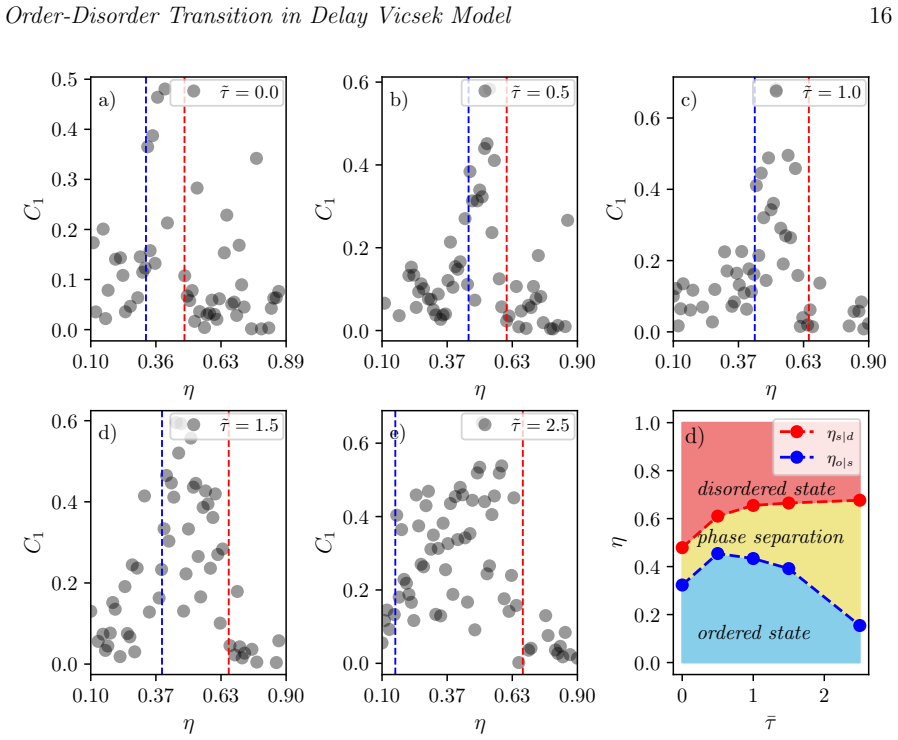
The central object is the delayed alignment rule $$v_i(t+\$\Delta$ t)=v_0\,\mathcal R_\eta\circ\vartheta\!\left(v_i(t)+\sum_{j\in S_i(t-\tau\$\Delta$ t)} v_j(t-\tau\$\Delta$ t)\right)$$ in which agent i aligns to the neighbors it perceived τ time steps earlier. The paper works in reduced delay $\bar\tau=v_0\Delta t\,\tau/R$, so at $v_0=0.5$ the integer delays used are $\bar\tau=0,1/2,1,3/2,5/2$. Phase boundaries are located through order parameters: polarization $\phi$, its variance, the Binder cumulant, and the height $C_1$ of the first peak of the density autocorrelation projected along the mean polarization; $C_1$'s sharp rise marks the ordered-to-coexistence boundary $\eta_{o|s}$, and its marked
What would settle it
Recompute the C1 criterion with finer bins and far more snapshots, or detect bands directly by thresholding the density field, and check whether a sharp onset of bands still occurs at the reported ηo|s values (for example, 0.16 at τ̄=2.5, ρ=2). If the jump smears or shifts, the non-monotonic lower boundary is an artifact.
Extended reading notes
Core claim
The core claim is that delay preserves the Vicsek model's three-phase structure but reweights it. In a 256-by-256 box with N=65536 or 131072 agents at speed v0=0.5, the average polarization jumps discontinuously at the upper transition for every reduced delay τ̄ studied, with a negative Binder-cumulant dip, so the order–disorder transition keeps its bistable, first-order-like character. The upper critical noise ηs|d rises monotonically with τ̄, from about 0.478 at τ̄=0 to about 0.677 at τ̄=2.5 for ρ=2, and appears to saturate. The lower boundary ηo|s is non-monotonic, rising for short delays (about 0.46 at τ̄=0.5) then falling (about 0.16 at τ̄=2.5), so the coexistence interval [ηo|s, ηs|d]
Load-bearing premise
The argument rests on treating a 'sharp increase' in a coarse thirteen-bin, ten-snapshot correlation measure as the exact location of the lower phase boundary; if that jump is a binning artifact, the reported non-monotonic lower boundary is not real.
Editorial extensions
If this is right
- Delay can be used as a control knob: increasing delay widens the noise range in which dense traveling bands coexist with a dilute background, without changing speed or density.
- Short delays stabilize the ordered phase; long delays destabilize it in favor of phase separation, while the phase-separated state is always more stable than the disordered state.
- At a fixed noise in the coexistence window, longer delays produce more bands and form them faster.
- The order–disorder transition remains discontinuous and bistable for all delays studied, so finite-size first-order-like behavior is not an artifact of zero delay.
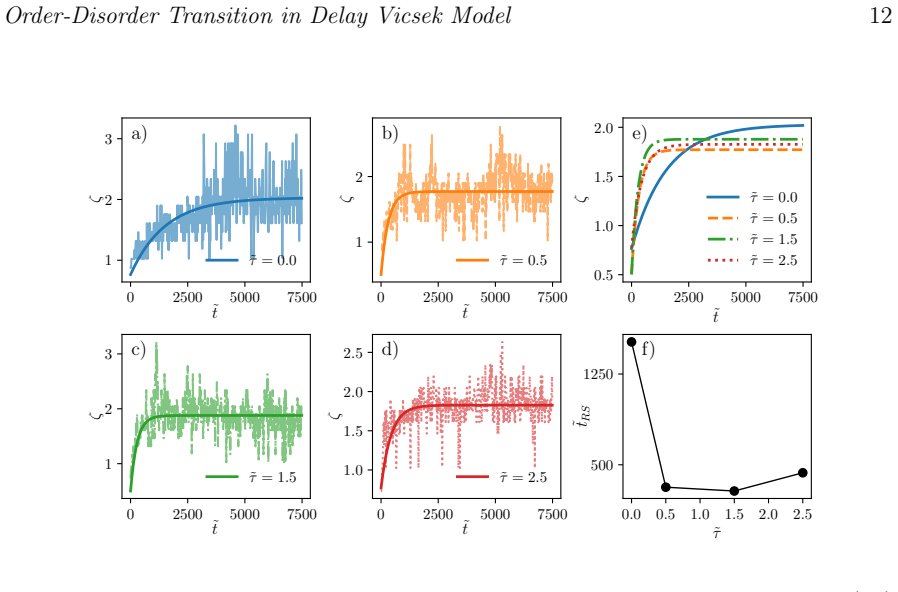
- Polarization relaxation time stays roughly constant with delay, so delay decouples the global ordering timescale from the band-formation timescale.
Reading between the lines
- Editorial inference: because the paper notes that long-delay dynamics is governed by the product v0τ, one testable extension is that the boundary curves might collapse onto a single master curve when plotted against the dimensionless distance v0τ/R at other speeds; a v0=0.25 run with doubled delays would check this.
- Editorial inference: the non-monotonic lower boundary implies that slowly ramping delay at fixed noise could drive a single system through ordered and phase-separated states in one trajectory, offering a dynamical probe of both boundaries without many noise sweeps.
- Editorial inference: the swirl-radius mechanism is a microscopic prediction—before bands appear, transient swirling clusters should have radii growing with delay; this is measurable in trajectory data from feedback-driven microswimmers.
Editorial analysis
A structured set of objections, weighed in public.
Referee Report
Summary. The paper numerically studies a time-delayed Vicsek model at high speed (v0=0.5) in large systems (N=65536/131072, L=256, t=10^6) and constructs phase diagrams versus reduced delay time tau-bar and noise eta. It reports the same three phases as the standard Vicsek model (ordered, liquid-gas coexistence, disordered) and claims that: the upper critical noise eta_s|d (order/coexistence to disorder) increases and saturates with delay; the lower critical noise eta_o|s (order to coexistence) is non-monotonic in delay, increasing for short delays and decreasing for long ones; the coexistence noise window broadens; more bands form faster as delay increases, attributed to swirls of growing radius; and the polarization relaxation time is largely unaffected. The lower boundary eta_o|s is obtained from the height C1 of the first peak of a directional density autocorrelation computed from 13 histogram bins and 10 snapshots; stripe counts are obtained by visual inspection.
Significance. If the non-monotonic eta_o|s is confirmed, it is a significant qualitative result: it demonstrates that delay can reversibly tune the system between ordered and phase-separated states, in contrast to earlier low-speed studies. The simulations are extensive and the upper boundary eta_s|d rests on robust standard order parameters (polarization discontinuity, Binder cumulant, susceptibility), and its saturation is consistent with the effective v0*tau argument of Ref. [29]. The paper is also commendably explicit about its limitations (visual stripe counting, unresolved cross-sea bistability, unverified transition-rate trend). However, the central novel claim—the non-monotonic lower boundary—is supported by a coarse, visually thresholded C1 statistic, so a quantitative re-analysis is needed before the phase diagram can be accepted.
major comments (2)
- [Appendix B and Figs. 8-9; Fig. 2e] The lower phase boundary eta_o|s, which is the load-bearing non-monotonic curve in Fig. 2e, is identified by a 'sharp increase' in C1. The definition of C1 uses only 13 histogram bins, an average over 10 snapshots, and normalization by max_{r>=0}|C_parallel(r)| (Eq. B.6) rather than by C_parallel(0). No objective threshold, error bars, or independent initial-condition repeats are given. At tau-bar=2.5 the claimed re-entry value eta_o|s ~ 0.16 is exactly where this criterion is most fragile: the authors note in Sec. 5 that cross-sea states appear at some noise levels, and projecting the marginal density onto the global mean polarization in such states suppresses the first peak. Thus the reported non-monotonicity may be an artifact of the projection/coarse binning. I request a re-analysis with finer bins, normalization by C_parallel(0), an independent stripe order parameter (e.g., Ref. [40
- [Sec. 5 and Fig. 2f; Fig. 6] The claim that the maximum number of bands increases with delay is supported by visually estimated stripe counts ('obtained by visually analyzing all snapshots'), with no error bars or algorithmic definition. Likewise, Fig. 6f gives the stripe-formation time t_RS extracted from exponential fits (Eq. 7) without confidence intervals. These trends are part of the abstract's conclusions and should be quantified, e.g., with an automated band-counting algorithm and bootstrap fits across independent runs.
minor comments (5)
- [Sec. 5 text] Figure callouts are inconsistent: 'Figs. 2c and d' should be 'Figs. 2d and e' for the phase diagrams, and the maximum stripe numbers are in Fig. 2f, not Fig. 2c/2e as stated twice.
- [Fig. 7 caption] The caption writes 'eta = eta_s|d - n * 0.5 with n = 0, 0.05, 0.1, and 0.15'; this should presumably be n*0.05 (or n = 0, 1, 2, 3).
- [Throughout] 'cross-see states' (Sec. 5) and 'cross-sea states' (Sec. 6) are inconsistent; use one spelling.
- [Fig. 6 and Sec. 5] The fit parameters in Eq. (7) and the extracted t_RS values appear without confidence intervals or goodness-of-fit measures; reporting these would strengthen the claim of a non-monotonic stripe-formation time.
- [Sec. 3 and Fig. 2] The phase-boundary values eta_s|d are read off as single numbers without uncertainties. The trend is robust from the order parameters, but error bars would improve reproducibility.
Circularity Check
No significant circularity: phase boundaries are direct simulation measurements; self-citations are contextual and non-load-bearing.
full rationale
The paper's central results—the phase boundaries ηo|s and ηs|d as functions of delay—are obtained from direct simulation observables: polarization ⟨φ⟩, Binder cumulant ⟨U4⟩, polarization variance ⟨σ²⟩, and the directional autocorrelation peak C1. ηs|d is read off from discontinuities in ⟨φ⟩ and dips in ⟨U4⟩; ηo|s is identified from a sharp increase in C1. These are measurements, not quantities derived from a relation that already assumes the claimed non-monotonicity or broadening. The only fitting in the paper is the exponential relaxation of the radial density correlation length, Eq. (7), used to extract a band-formation time; this is a characterization of dynamics, not a prediction that reduces to its input. Self-citations to Ref. [29] (Holubec et al.) are used to interpret saturation and the effective v0τ control parameter for long delays, but those are published results from a different low-speed regime, not fitted to the present data, and the paper's own measurements stand independently. The coarse 13-bin, 10-snapshot C1 thresholding is a statistical robustness concern, not a circularity. No step in the derivation chain is equivalent by construction to its input, so the circularity score is 0.
Assumptions & free parameters
assumptions (4)
- domain assumption The delayed Vicsek update rule in Eq. (2) captures the essential physics of delayed alignment interactions in dry active matter.
- domain assumption The system reaches a steady state independent of initial conditions within 10^6 time steps for all delays and densities studied.
- domain assumption The fixed system size L=256 with N=65536 or 131072 is large enough that the observed discontinuous transitions and bands reflect the large-system behavior rather than finite-size artifacts.
- ad hoc to paper The threshold at which C1 first increases sharply identifies the phase boundary ηo|s.
Cite this review
Pith. "Pith review of Order-Disorder Transition in Delay Vicsek Model." pith.science (2026). https://pith.science/paper/ZJDHMCWI
@misc{pith2026250805086,
  author       = {Pith},
  title        = {Pith review of: Order-Disorder Transition in Delay Vicsek Model},
  year         = {2026},
  howpublished = {\url{https://pith.science/paper/ZJDHMCWI}},
  note         = {Machine review of arXiv:2508.05086}
}
read the original abstract
Interactions in active matter systems inherently involve delays due to information processing and actuation lags. We numerically investigate the impact of such delays on the phase behavior of the Vicsek model for motile active matter at a large but fixed system size. While the delayed Vicsek model retains the same three phases as the standard version -- an ordered state, a liquid-gas coexistence state, and a disordered state -- the presence of delay qualitatively alters the system's dynamics. At the relatively high velocity considered in this study, the critical noise for the transition between the ordered and coexistence states exhibits a non-monotonic dependence on delay, whereas the critical noise required for the transition to the disordered state increases with delay. Consequently, the width of the noise interval in which phase separation occurs broadens with increasing delay. Short delays stabilize the ordered phase, while long delays destabilize it in favor of the coexistence phase, which is consistently stabilized compared to the disordered state. Furthermore, the number of bands observed in the coexistence state at a given noise increases, and the time required for their formation decreases with delay. This acceleration is attributed to the emergence of swirling structures whose typical radius grows with increasing delay. Our results demonstrate that time delay in the Vicsek model acts as an effective control parameter for tuning the system's dynamic phase behavior.
Figures


Figures from the paper (6 more)




Forward citations
Cited by 1 Pith paper
-
Passive memory reshapes active persistence
Memory in the surrounding medium suppresses motility-induced phase separation in active particles when memory and persistence timescales match, but restores clustering for long memory via reduced short-time friction.
Reference graph
Works this paper leans on
-
[40]
K¨ ursten R and Ihle T 2020 Phys. Rev. Lett. 125(18) 188003 URL https://link.aps.org/doi/ 10.1103/PhysRevLett.125.188003
-
[29]
Holubec V, Geiss D, Loos S A, Kroy K and Cichos F 2021 Physical Review Letters 127 258001 publisher: American Physical Society URL https://link.aps.org/doi/10.1103/ PhysRevLett.127.258001
work page 2021
-
[1]
Vicsek T and Zafeiris A 2012 Physics Reports 517 71–140 ISSN 0370-1573 collective motion URL https://www.sciencedirect.com/science/article/pii/S0370157312000968
work page 2012
-
[2]
Ramaswamy S 2010 Annual Review of Condensed Matter Physics 1 323–345 URL https: //doi.org/10.1146/annurev-conmatphys-070909-104101
-
[3]
Bechinger C, Di Leonardo R, L¨ owen H, Reichhardt C, Volpe G and Volpe G 2016 Reviews of Modern Physics 88 045006 URL https://link.aps.org/doi/10.1103/RevModPhys.88. 045006
-
[4]
Zhang H P, Be’er A, Florin E L and Swinney H L 2010 Proceedings of the National Academy of Sciences 107 13626–13630
work page 2010
-
[5]
Ben-Jacob E, Schochet O, Tenenbaum A, Cohen I, Czirok A and Vicsek T 1994 Nature 368 46–49
work page 1994
-
[6]
Cavagna A, Giardina I and Grigera T S 2018 Physics Reports 728 1–62
work page 2018
Show all 42 references
-
[7]
Shahhoseini Z, Sarvi M and Saberi M 2018 Physica A: Statistical Mechanics and its Applications 491 101–111
2018
-
[8]
Helbing D, Farkas I J, Molnar P and Vicsek T 2002 Pedestrian and evacuation dynamics 21 21–58
2002
-
[9]
Mijalkov M, McDaniel A, Wehr J and Volpe G 2016 Physical Review X 6 011008
2016
-
[10]
V´ as´ arhelyi G, Vir´ agh C, Somorjai G, Nepusz T, Eiben A E and Vicsek T 2018Science Robotics 3 eaat3536 publisher: American Association for the Advancement of Science URL https: //www.science.org/doi/abs/10.1126/scirobotics.aat3536
-
[11]
Khadka U, Holubec V, Yang H and Cichos F 2018 Nature communications 9 1–9
2018
-
[12]
Fruchart M, Hanai R, Littlewood P B and Vitelli V 2021 Nature 592 363–369 ISSN 1476-4687 URL https://doi.org/10.1038/s41586-021-03375-9
2021 doi
-
[13]
org/10.1088/1367-2630/abcc1e
Loos S A M and Klapp S H L 2020 New Journal of Physics 22 123051 URL https://dx.doi. org/10.1088/1367-2630/abcc1e
2020 doi
-
[14]
Sch¨ oll E, H¨ ovel P, Flunkert V and Dahlem M A 2009 Time-delayed feedback control: From simple models to lasers and neural systems Complex time-delay systems (Springer) pp 85–150
2009
-
[15]
Loos S 2021 Stochastic Systems with Time Delay: Probabilistic and Thermodynamic Descriptions of Non-Markovian Processes Far From Equilibrium (Springer International Publishing) ISBN 9783030807726 URL https://books.google.cz/books?id=svV6zwEACAAJ Order-Disorder Transition in De...
2021
-
[16]
Davis L 2003 Physica A: Statistical Mechanics and its Applications 319 557–567 ISSN 0378-4371 URL https://www.sciencedirect.com/science/article/pii/S0378437102014577
2003
-
[17]
Forgoston E and Schwartz I B 2008 Phys. Rev. E 77(3) 035203 URL https://link.aps.org/ doi/10.1103/PhysRevE.77.035203
2008 doi
-
[18]
Piwowarczyk R, Selin M, Ihle T and Volpe G 2019 Physical Review E 100 012607 publisher: American Physical Society URL https://link.aps.org/doi/10.1103/PhysRevE.100.012607
2019 doi
-
[19]
Geiss D, Kroy K and Holubec V 2019 New Journal of Physics 21 093014 ISSN 1367-2630 publisher: IOP Publishing URL https://dx.doi.org/10.1088/1367-2630/ab3d76
2019 doi
-
[20]
Loos S A M and Klapp S H L 2019 Scientific reports 9 1–11
2019
-
[21]
Mui˜ nos-Landin S, Fischer A, Holubec V and Cichos F 2021 Science Robotics 6
2021
-
[22]
Wang X, Chen P C, Kroy K, Holubec V and Cichos F 2023 Nature Communications 14 56 ISSN 2041-1723 number: 1 Publisher: Nature Publishing Group URL https://www.nature.com/ articles/s41467-022-35427-7
2023
-
[23]
Fr¨ anzl M, Mui˜ nos-Landin S, Holubec V and Cichos F 2021ACS Nano 15 3434–3440 ISSN 1936- 0851 URL https://doi.org/10.1021/acsnano.0c10598
1936 doi
-
[24]
org/doi/10.1103/PhysRevE.91.042720
Romanczuk P and Salbreux G 2015 Physical Review E 91(4) 042720 URL https://link.aps. org/doi/10.1103/PhysRevE.91.042720
2015 doi
-
[25]
Diz-Mu˜ noz A, Romanczuk P, Yu W, Bergert M, Ivanovitch K, Salbreux G, Heisenberg C P and Paluch E K 2016 BMC Biology 14 74 ISSN 1741-7007 URL https://doi.org/10.1186/ s12915-016-0294-x
2016
-
[26]
Tarama S, Egelhaaf S U and L¨ owen H 2019 Phys. Rev. E 100(2) 022609 URL https://link. aps.org/doi/10.1103/PhysRevE.100.022609
2019 doi
-
[27]
Kopp R A and Klapp S H L 2023 EPL 143 17002 URL https://doi.org/10.1209/0295-5075/ acdf19
2023 doi
-
[28]
Erban R, Haˇ skovec J and Sun Y 2016SIAM Journal on Applied Mathematics 76 1535–1557 URL https://doi.org/10.1137/15M1030467
-
[30]
Geiß D, Kroy K and Holubec V 2022 Physical Review E 106 054612 ISSN 2470-0045, 2470-0053 arXiv:2205.12069 [cond-mat] URL http://arxiv.org/abs/2205.12069
2022 arXiv
-
[31]
Pakpour F and Vicsek T 2024 Physica A: Statistical Mechanics and its Applications 634 129453 ISSN 0378-4371 URL https://www.sciencedirect.com/science/article/pii/ S0378437123010087
2024
-
[32]
Solon A P and Tailleur J 2013 Phys. Rev. Lett. 111(7) 078101 URL https://link.aps.org/doi/ 10.1103/PhysRevLett.111.078101
2013 doi
-
[33]
Chat´ e H 2020 Annual Review of Condensed Matter Physics 11 189–212 ISSN 1947-5462 URL https://www.annualreviews.org/content/journals/10.1146/ annurev-conmatphys-031119-050752
2020
-
[34]
Chat´ e H, Ginelli F, Gr´ egoire G and Raynaud F 2008 Physical Review E 77 046113 publisher: American Physical Society URL https://link.aps.org/doi/10.1103/PhysRevE.77.046113
2008 doi
-
[35]
Vicsek T, Czir´ ok A, Ben-Jacob E, Cohen I and Shochet O 1995 Physical Review Letters 75 1226–1229 publisher: American Physical Society URL https://link.aps.org/doi/10.1103/ PhysRevLett.75.1226
1995
-
[36]
Chat´ e H, Ginelli F, Gr´ egoire G, Peruani F and Raynaud F 2008The European Physical Journal B 64 451–456 ISSN 1434-6036 URL https://doi.org/10.1140/epjb/e2008-00275-9
-
[37]
Nagy M, Daruka I and Vicsek T 2007 Physica A: Statistical Mechanics and its Applications 373 445–454 ISSN 0378-4371 URL https://www.sciencedirect.com/science/article/pii/ S0378437106006510
2007
-
[38]
Giraldo-Barreto J and Holubec V 2025 Active matter flocking via predictive alignment ( Preprint 2504.07778) URL https://arxiv.org/abs/2504.07778 Order-Disorder Transition in Delay Vicsek Model 20
2025 arXiv
-
[39]
Solon A P, Chat´ e H and Tailleur J 2015 Physical Review Letters 114 068101 ISSN 0031-9007, 1079-7114 URL https://link.aps.org/doi/10.1103/PhysRevLett.114.068101
2015 doi
-
[41]
B¨ auerle T, L¨ offler R C and Bechinger C 2020Nature Communications 11 2547 ISSN 2041-1723 number: 1 Publisher: Nature Publishing Group URL https://www.nature.com/articles/ s41467-020-16161-4
-
[42]
Ginelli F 2016 The European Physical Journal Special Topics 225 2099–2117 ISSN 1951-6355, 1951-6401 URL http://link.springer.com/10.1140/epjst/e2016-60066-8
2016 doi
Reviewed August 5, 2026 · model on record in the stance chip above.
Discussion (0). Continue with ORCID to comment.