REVIEW 3 major objections 5 minor 50 references
Activation-Guided Neuron Intervention to Induce Alzheimer's-Related Computational Language Phenotypes in a Large Language Model
T0 review · 3 major / 5 minor · reviewed 2026-08-08 · deepseek-v4-flash
Pith's one-line read Neurons tied to Alzheimer's speech drive LLM deficits when amplified
desk verdict A promising locate-and-intervene study whose central specificity claim is not yet fully secured: the task analyses omit response length, and the random-neuron control was post hoc and first-author-rated, but the out-of-sample design and graded effects make it worth a serious referee. read the letter →
The pith
A machine-rendered reading of the paper's core claim, the machinery that carries it, and where it could break.
The reading
What carries the argument
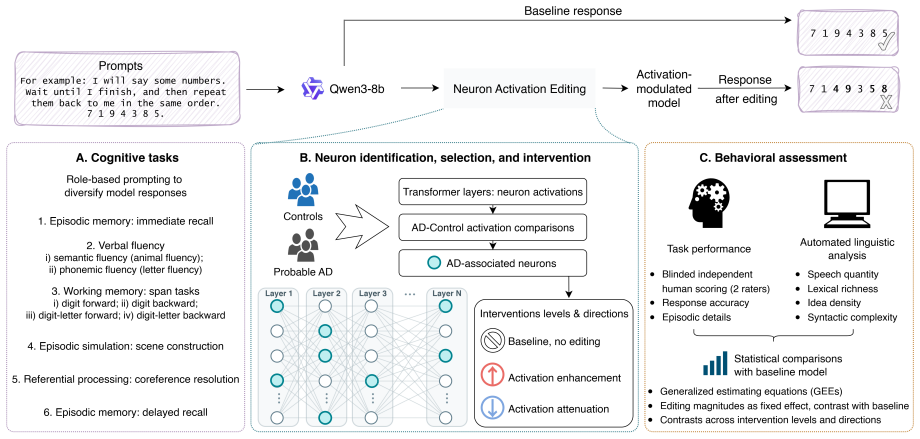
The engine of the method is the feed-forward neuron in a Transformer's multilayer perceptron, defined here as a scalar unit in the intermediate (post-gate) representation of a specific layer. The paper labels a neuron 'active' on a token when its SiLU-gated activation is positive, aggregates these rates over transcripts, and selects neurons with significantly higher activation rates for AD than control transcripts (Mann-Whitney U with FDR correction, ranked by rank-biserial correlation). Intervention modifies the down-projection weight vector of each selected neuron by a global factor $\exp(\alpha)$, so its output contribution is scaled while the gate and up-projection remain frozen. Nine edited variants cover three magnitudes ($\alpha=-0.6, 0.2, 0.6$) and three scopes (top 2,000, top 10,000, and all 67,640 significant neurons). What makes this machinery carry the argument is that it ties the intervention directly to a clinically grounded, language-derived difference in internal activity, and lets the author ask whether that difference is causally sufficient to shift downstream behavior.
What would settle it
Run the same 12-turn battery on a model where the same number of layer-matched random neurons are amplified with the same magnitude, with raters blind to condition and response length included as a covariate; if that random edit reproduces the full six-domain graded decline, the claim of AD-neuron specificity is refuted.
Extended reading notes
Core claim
The central claim is that neurons selected purely from activation contrasts between Alzheimer's and control language do not merely correlate with the disease signature; they exert a causal, directionally specific influence on the model's behavior. Boosting the output contributions of these neurons (by scaling their down-projection weight vectors by $\exp(\alpha)$) drives Qwen3-8B toward an Alzheimer's-related computational phenotype: recall of story entities and events drops, semantic and phonemic fluency shrink, working-memory spans fail, procedural steps are omitted, scene construction loses episodic detail, and coreference resolution degrades. Linguistic measures show the same direction as human AD speech: lower lexical surprisal, lower idea density, lower syntactic complexity, and shorter responses. Attenuation reverses the direction: most tasks stay at baseline and a few improve, showing the effect is not a generic degradation from editing parameters but a structured shift along the selected dimension.
Load-bearing premise
The load-bearing premise is that the impairments seen after amplification are caused by the selected neurons' functional contribution, rather than by the editing procedure generically shortening responses and reducing cooperative task engagement.
Editorial extensions
If this is right
- Amplifying AD-associated neurons in Qwen3-8B reliably reproduces the graded impairment profile across all six cognitive domains.
- Attenuating the same neurons preserves or improves performance, so the same substrate supports both directions of modulation.
- The activation-guided framework can be ported to other clinical language differences (e.g., aphasia, schizophrenia) to test whether language-derived neuron signatures causally influence other cognitive phenotypes.
- The method provides a behavioral readout for neuron-level interventions, linking interpretability findings to functionally meaningful changes in model output.
- If replicated across architectures, the result indicates that language-grounded internal representations are not merely predictive markers but causally entangled with memory and executive function.
Reading between the lines
- A direct extension would be to test whether the AD-associated neurons identified in Qwen3-8B also shift behavior in a different LLM family; if they do, it would suggest a conserved organizational principle rather than a quirk of one model.
- The paper's random-neuron control already suggests that editing many random neurons can produce broad nonspecific drops; a stronger specificity test would pre-register a size-matched random control with the same annotation rating process and include response length as a covariate in all task models.
- If the causal link holds, a promising controlled application is to search for weight modifications that reverse the phenotype, turning the framework into an in-silico screening tool for candidate interventions.
- The finding that purely language-derived neurons influence tasks not traditionally categorized as linguistic raises the question of whether the model's 'cognitive' performance is, in part, an artifact of language production; the paper acknowledges this limitation.
Editorial analysis
A structured set of objections, weighed in public.
Referee Report
Summary. The paper introduces an activation-guided intervention framework for Qwen3-8B in which feed-forward neurons showing higher activation rates on Alzheimer's disease (AD) than control transcripts are identified from ADReSSo, and their down-projection weight vectors are scaled by exp(alpha) for amplification or attenuation. Nine edited variants are formed by crossing three magnitudes (alpha = -0.6, 0.2, 0.6) with three scopes (top 2,000, top 10,000, and all 67,640 significant neurons), and each variant plus the original model is evaluated on a 12-turn neuropsychological battery covering story recall, verbal fluency, working memory, procedural discourse, scene construction, and coreference resolution, with blinded human ratings and automated linguistic measures. Generalized estimating equations compare each edited condition with the original model. The main finding is that amplifying AD-associated neurons produces graded, scope-dependent impairments across the battery and reduces lexical surprisal, idea density, syntactic complexity, and discourse quantity, while attenuation largely preserves or selectively improves performance. The authors interpret this as evidence that neurons identified solely from clinical language differences can influence behavior across multiple cognitive domains, constituting an AD-related computational language phenotype.
Significance. If the central claim holds, this is a valuable proof-of-concept that neuron-level interventions can translate patient-derived language contrasts into causally testable behavioral predictions in LLMs, and it offers a controlled experimental paradigm for linking language representations to multi-domain cognitive performance. The study has notable strengths: the intervention target is derived from an external clinical corpus while the test battery is entirely new, making the test out-of-sample; the design systematically varies direction, magnitude, and scope; human ratings are blinded and show good agreement for most outcomes; automated linguistic measures are pre-specified and mostly adjusted for response length; and the paper includes a self-critical limitation section and a post-hoc random-neuron control rather than presenting only the favorable results. The main limitation is that the task-performance GEEs do not adjust for response length or refusal, and the only direct specificity control, Appendix E, was post hoc and first-author-rated.
major comments (3)
- [Section 4.4 and Section 5] The task-performance GEEs for story recall, fluency, working memory, procedural discourse, scene construction, and coreference include no response-length or refusal covariate, even though Section 4.4 states that response length is included for automated linguistic outcomes only. The prompts explicitly instruct the model to say exactly 'I don't know' and stop when unsure, and each primary score is mechanically sensitive to output quantity (e.g., number of recalled entities/events, number of listed items, whether a sequence is fully produced, number of completed procedural steps, proportion of EP units). Scaling tens of thousands of down-projection weights could plausibly reduce engagement or increase refusal, and every observed impairment would then follow without any AD-specific functional contribution. Please add response length (and, if feasible, an indicator for explicit 'I don't know' or non-task responses) as covariates to the task-performance models, or otherwise show that the effects are not explained by output reduction.
- [Appendix E] The random-neuron control, which is the main evidence for specificity, was added post hoc, was scored by the first author rather than the blinded raters, and, as the appendix itself notes, the layer-matched random all-significant condition already produced broad degradation across verbal fluency, coreference, working memory, and scene construction. Because the control outputs were not independently and blindly rated, the AD-guided versus random differences in that condition are not a secure specificity result. Please have the additional random-condition outputs scored by the same blinded raters (or by at least two independent raters with reported agreement), and consider matching the number and layer distribution of edited neurons for each intervention scope and magnitude, rather than only for the strongest condition.
- [Section 5, first paragraph] The claim that the observed effects 'reflected a structured response to modulation rather than nonspecific model degradation' is currently supported primarily by the graded pattern and by the post-hoc random control. With the missing length covariate and the unblinded control, the evidence does not yet decisively exclude the alternative that amplification acts as a generic withdrawal mechanism that reduces output quantity and cooperativeness. Please provide an analysis that addresses this alternative directly, for example by showing that the AD-guided effects remain significant after conditioning on response length and refusal behavior, or by demonstrating that a random intervention matched in both number and functional sign of edited neurons does not produce the same directional pattern.
minor comments (5)
- [Figure 2 caption] The caption contains a typo: 'task perfromance' should be 'task performance'.
- [Section 7 / Conclusion] The phrasing 'produced systematic changes across neuropsychological battery' is ungrammatical; it should be 'across the neuropsychological battery' or 'across a neuropsychological battery'.
- [Appendix E, Annotation limitation] The appendix spells out the post-hoc and first-author-rated nature of the random control; this is commendable transparency, but it also means the control cannot carry the full weight of the specificity argument, as noted in my major comment on Appendix E.
- [Appendix C, Turn 11] The delayed-recall prompt contains a duplicated instruction: 'Do not add new facts that were not in the story.' appears twice.
- [Figure 4 caption] The three panels use different vertical-axis scales, which is stated in the caption, but the differing scales make visual comparisons of layer-wise concentration across scopes difficult; consider normalizing or noting this more prominently.
Circularity Check
No significant circularity: neuron selection and the new battery are independent; one definitional tautology in the phenotype label is the only circular-adjacent step.
-
self definitional
[Section 1 (Introduction) and Section 7 (Conclusion)]
"We use the term AD-related computational (language) phenotype to denote the reproducible behavioral profile induced by editing these LLM units. ... Selectively modulating these neurons produced systematic changes across neuropsychological battery, with amplification shifting Qwen3-8B toward an AD-related computational language phenotype."
The conclusion restates the paper's own definition: the phenotype is defined as the behavioral profile induced by the intervention, so saying amplification shifts the model toward that phenotype is true by definition. The substantive claims — graded impairments on a new battery that was not used for neuron selection, and parallels to human AD speech — are independent and not circular; this step affects only the labeling of the term.
full rationale
The load-bearing derivation is not circular. AD-associated neurons were selected from ADReSSo picture-description transcripts via activation-rate contrasts, and the edited models were then tested on a separate 12-turn neuropsychological battery never used for selection. The battery outcomes (story recall, fluency, spans, procedural discourse, scene construction, coreference) and linguistic measures are new measurements, not refits of the selection statistic, so the central inference is an out-of-sample behavioral test. Self-citations (He et al. 2023, 2024; Jiang et al. 2025) supply background, annotation conventions, or comparison points and are not load-bearing. The paper's own Appendix E limitation — a post hoc, first-author-rated random control — and the omission of response length as a covariate in task-performance GEEs are validity threats (generic withdrawal or refusal could produce broad impairments), but they are confounds or reviewer concerns, not circular reductions; the paper discloses them rather than hiding them. The only genuinely circular phrase is the terminological one flagged above, which does not affect the empirical content of the study.
Assumptions & free parameters
free parameters (4)
- Intervention scaling exponent alpha =
0.2, 0.6, -0.6
- Neuron selection thresholds =
q < 0.05; top 2000, top 10000, all significant
- Activation threshold =
a_l_t,i > 0
- Linguistic measure parameters =
25-token window for MATTR; minimum probability 1e-9 for surprisal
assumptions (5)
- domain assumption ADReSSo Cookie Theft transcripts provide a valid basis for identifying AD-associated neuronal differences in an LLM.
- domain assumption Qwen3-8B is an appropriate model for studying human language phenotypes.
- domain assumption The adapted neuropsychological battery validly measures the corresponding cognitive constructs in an LLM.
- ad hoc to paper Layer-wise matched random neuron editing is an adequate nonspecific-perturbation baseline.
- standard math Standard statistical machinery (Mann-Whitney U, Benjamini-Hochberg FDR, GEE) is correctly applied.
Cite this review
Pith. "Pith review of Activation-Guided Neuron Intervention to Induce Alzheimer's-Related Computational Language Phenotypes in a Large Language Model." pith.science (2026). https://pith.science/paper/ZJKOS66U
@misc{pith2026260803067,
  author       = {Pith},
  title        = {Pith review of: Activation-Guided Neuron Intervention to Induce Alzheimer's-Related Computational Language Phenotypes in a Large Language Model},
  year         = {2026},
  howpublished = {\url{https://pith.science/paper/ZJKOS66U}},
  note         = {Machine review of arXiv:2608.03067}
}
read the original abstract
Changes in spontaneous speech provide an early signal of cognitive dysfunction in Alzheimer's disease (AD) that large language models (LLMs) can detect. However, detection alone cannot establish whether the underlying model representations contribute functionally to behavior. We introduce an activation-guided intervention framework using Qwen3-8B. The framework identifies feed-forward neurons with higher activation rates for AD than control transcripts and modulates their output contributions during generation by scaling the corresponding down-projection weights. This yielded nine edited variants differing in intervention direction, magnitude, and scope. The original and edited models completed the same 12-turn neuropsychological battery, assessed through blinded human ratings and computational linguistic measures. Amplifying AD-associated neurons produced graded impairments in story recall, verbal fluency, working memory, procedural discourse, scene construction, and coreference resolution. Attenuation largely preserved performance and selectively improved several outcomes. Amplification also reduced lexical surprisal, idea density, syntactic complexity, and discourse quantity, broadly paralleling changes reported in human AD speech. These findings show that neurons identified solely from clinical language differences can influence behavior across multiple cognitive domains, providing proof of concept for an AD-related computational phenotype and a controlled framework for experimentally examining links between language and broader cognitive dysfunction.
Figures


Figures from the paper (2 more)


Reference graph
Works this paper leans on
-
[1]
Yang, An and Li, Anfeng and Yang, Baosong and Zhang, Beichen and Hui, Binyuan and Zheng, Bo and Yu, Bowen and Gao, Chang and Huang, Chengen and Lv, Chenxu and Zheng, Chujie and Liu, Dayiheng and Zhou, Fan and Huang, Fei and Hu, Feng and Ge, Hao and Wei, Haoran and Lin, Huan and Tang, Jialong and Yang, Jian and Tu, Jianhong and Zhang, Jianwei and Yang, Jia...
-
[2]
Mayo Clinic Proceedings: Digital Health , author =
A. Mayo Clinic Proceedings: Digital Health , author =. 2025 , pages =. doi:10.1016/j.mcpdig.2025.100205 , abstract =
arXiv 2025
-
[3]
Alzheimer's Research & Therapy , author =
Digital remote assessment of speech acoustics in cognitively unimpaired adults: feasibility, reliability and associations with amyloid pathology , volume =. Alzheimer's Research & Therapy , author =. 2024 , keywords =. doi:10.1186/s13195-024-01543-3 , abstract =
-
[4]
American Journal of Speech-Language Pathology , author =
Automated. American Journal of Speech-Language Pathology , author =. 2023 , pages =. doi:10.1044/2023_AJSLP-22-00403 , abstract =
-
[5]
Brain Communications , author =
Leveraging speech and artificial intelligence to screen for early. Brain Communications , author =. 2022 , pages =. doi:10.1093/braincomms/fcac231 , abstract =
-
[6]
Evaluation of. Digital Biomarkers , author =. 2020 , pages =. doi:10.1159/000510820 , abstract =
-
[7]
Journal of Alzheimer's Disease , author =
Linguistic. Journal of Alzheimer's Disease , author =. 2015 , pages =. doi:10.3233/JAD-150520 , abstract =
-
[8]
Luz, Saturnino and Haider, Fasih and Fuente, Sofia de la and Fromm, Davida and MacWhinney, Brian , month = oct, year =. Alzheimer’s. Interspeech 2020 , publisher =. doi:10.21437/Interspeech.2020-2571 , abstract =
Show all 50 references
-
[9]
Balagopalan, Aparna and Eyre, Benjamin and Rudzicz, Frank and Novikova, Jekaterina , month = oct, year =. To. Interspeech 2020 , publisher =. doi:10.21437/Interspeech.2020-2557 , abstract =
2020 doi
-
[10]
Farzana, Shahla and Parde, Natalie , editor =. Domain. Findings of the. 2024 , pages =. doi:10.18653/v1/2024.findings-emnlp.937 , abstract =
2024 doi
-
[11]
Linguistic
Heitz, Jonathan and Schneider, Gerold and Langer, Nicolas , editor =. Linguistic. Proceedings of the 31st. 2025 , pages =
2025
-
[12]
Artificial Intelligence in Medicine , author =
Semantic coherence markers:. Artificial Intelligence in Medicine , author =. 2022 , keywords =. doi:10.1016/j.artmed.2022.102393 , abstract =
2022
-
[13]
The structure of spontaneous speech changes in
Jiang, Hong and Chen, Zhengwei and Liu, Yu and Yang, Chun and Yuan, Xiaofeng and He, Rui , month = may, year =. The structure of spontaneous speech changes in. PLOS ONE , publisher =. doi:10.1371/journal.pone.0324270 , abstract =
-
[14]
A Digital Language Coherence Marker for Monitoring Dementia
Gkoumas, Dimitris and Tsakalidis, Adam and Liakata, Maria. A Digital Language Coherence Marker for Monitoring Dementia. Proceedings of the 2023 Conference on Empirical Methods in Natural Language Processing. 2023. doi:10.18653/v1/2023.emnlp-main.994
2023 doi
-
[15]
Jawahar, Ganesh and Sagot, Benoît and Seddah, Djamé , year =. What. Proceedings of the 57th. doi:10.18653/v1/P19-1356 , abstract =
-
[16]
ACM Computing Surveys , author =
Prompting. ACM Computing Surveys , author =. 2026 , pages =. doi:10.1145/3789253 , abstract =
2026 doi
-
[17]
Neuron-based
Xiao, Xiongye and Ping, Heng and Zhou, Chenyu and Cao, Defu and Li, Yaxing and Zhou, Yi-Zhuo and Li, Shixuan and Kanakaris, Nikos and Bogdan, Paul , editor =. Neuron-based. International. 2025 , pages =
2025
-
[18]
Lai, Wen and Hangya, Viktor and Fraser, Alexander , editor =. Style-. Proceedings of the 2024. 2024 , pages =. doi:10.18653/v1/2024.emnlp-main.745 , abstract =
2024 doi
-
[19]
Knowledge Neurons in Pretrained Transformers
Dai, Damai and Dong, Li and Hao, Yaru and Sui, Zhifang and Chang, Baobao and Wei, Furu. Knowledge Neurons in Pretrained Transformers. Proceedings of the 60th Annual Meeting of the Association for Computational Linguistics (Volume 1: Long Papers). 2022. doi:10.18653/v1/2022.acl...
2022 doi
-
[20]
Causal Analysis of Syntactic Agreement Neurons in Multilingual Language Models
Mueller, Aaron and Xia, Yu and Linzen, Tal. Causal Analysis of Syntactic Agreement Neurons in Multilingual Language Models. Proceedings of the 26th Conference on Computational Natural Language Learning (CoNLL). 2022. doi:10.18653/v1/2022.conll-1.8
2022 doi
-
[21]
Proceedings of the 60th
Li, Changye and Knopman, David and Xu, Weizhe and Cohen, Trevor and Pakhomov, Serguei , editor =. Proceedings of the 60th. 2022 , pages =. doi:10.18653/v1/2022.acl-long.131 , abstract =
2022 doi
-
[22]
Li, Changye and Sheng, Zhecheng and Cohen, Trevor and Pakhomov, Serguei , editor =. Too. Findings of the. 2024 , pages =. doi:10.18653/v1/2024.findings-acl.380 , abstract =
2024 doi
-
[23]
and Nelakuditi, Srihari , month = jul, year =
Yang, Yong and Guan, Xiang and Arheix-Parras, Sophie and Ahmadi, Saeed and Newman-Norlund, Roger and Bonilha, Leonardo and Rorden, Christopher and Fridriksson, Julius and Desai, Rutvik H. and Nelakuditi, Srihari , month = jul, year =. Lesioned. doi:10.48550/arXiv.2607.11621 , ...
- [24]
-
[25]
Component-
Wang, Yifan and Zheng, Jichen and Sun, Jingyuan and Zhang, Yunhao and Ye, Chunyu and Li, Jixing and Zong, Chengqing and Wang, Shaonan , month = jan, year =. Component-. doi:10.48550/arXiv.2601.19723 , abstract =
- [26]
-
[27]
Journal of the Royal Statistical Society: Series B (Methodological) , author =
Controlling the. Journal of the Royal Statistical Society: Series B (Methodological) , author =. 1995 , keywords =. doi:10.1111/j.2517-6161.1995.tb02031.x , abstract =
1995
-
[28]
Computers in Human Behavior: Artificial Humans , author =
The fluency-based semantic network of. Computers in Human Behavior: Artificial Humans , author =. 2025 , keywords =. doi:10.1016/j.chbah.2024.100103 , abstract =
2025
- [29]
-
[30]
Neuropsychologia , author =
Analysis of the episodic memory deficit in early. Neuropsychologia , author =. 1996 , keywords =. doi:10.1016/0028-3932(95)00151-4 , abstract =
1996 doi
-
[31]
Data in Brief , author =
The. Data in Brief , author =. 2026 , pages =. doi:10.1016/j.dib.2026.112517 , abstract =
2026
-
[32]
Dementia & Neuropsychologia , author =
Verbal fluency in. Dementia & Neuropsychologia , author =. 2020 , keywords =. doi:10.1590/1980-57642020dn14-030011 , abstract =
2020 doi
-
[33]
Aging Clinical and Experimental Research , author =
Assessment of working-memory deficits in patients with mild cognitive impairment and. Aging Clinical and Experimental Research , author =. 2011 , keywords =. doi:10.1007/BF03325245 , abstract =
2011 doi
-
[34]
Neuropsychology , author =
Performance of. Neuropsychology , author =. 2008 , pages =. doi:10.1037/0894-4105.22.1.17 , abstract =
2008 doi
-
[35]
Cortex; a Journal Devoted to the Study of the Nervous System and Behavior , author =
Scene construction impairments in. Cortex; a Journal Devoted to the Study of the Nervous System and Behavior , author =. 2015 , keywords =. doi:10.1016/j.cortex.2015.08.004 , abstract =
2015 doi
-
[36]
American Journal of Speech-Language Pathology , author =
Episodic. American Journal of Speech-Language Pathology , author =. 2024 , keywords =. doi:10.1044/2023_AJSLP-23-00066 , abstract =
2024 doi
-
[37]
Deficits in narrative discourse elicited by visual stimuli are already present in patients with mild cognitive impairment , volume =
Drummond, Cláudia and Coutinho, Gabriel and Fonseca, Rochele Paz and Assunção, Naima and Teldeschi, Alina and de Oliveira-Souza, Ricardo and Moll, Jorge and Tovar-Moll, Fernanda and Mattos, Paulo , month = may, year =. Deficits in narrative discourse elicited by visual stimuli...
-
[38]
Journal of neurolinguistics , author =
Disintegration at the. Journal of neurolinguistics , author =. 2024 , pages =. doi:10.1016/j.jneuroling.2023.101190 , abstract =
2024
-
[39]
Journal of Alzheimer's disease: JAD , author =
Connected. Journal of Alzheimer's disease: JAD , author =. 2018 , keywords =. doi:10.3233/JAD-170881 , abstract =
2018 doi
-
[40]
Idea density for predicting
Sirts, Kairit and Piguet, Olivier and Johnson, Mark , year =. Idea density for predicting. Proceedings of the 21st. doi:10.18653/v1/K17-1033 , abstract =
-
[41]
Frontiers in Psychology , author =
Connected. Frontiers in Psychology , author =. 2017 , pages =. doi:10.3389/fpsyg.2017.00269 , abstract =
2017
-
[42]
, month = aug, year =
Ivanova, Olga and Martínez-Nicolás, Israel and García-Piñuela, Elena and Meilán, Juan José G. , month = aug, year =. Defying syntactic preservation in. Frontiers in Language Sciences , publisher =. doi:10.3389/flang.2023.1199107 , abstract =
2023
-
[43]
Word retrieval in connected speech in
Kavé, Gitit and Goral, Mira , month = jan, year =. Word retrieval in connected speech in. Aphasiology , publisher =. doi:10.1080/02687038.2017.1338663 , abstract =
2017
-
[44]
Emergent modularity in large language models:
Wang, Chengcheng and Fan, Zhiyu and Han, Zaizhu and Bi, Yanchao and Li, Jixing , month = feb, year =. Emergent modularity in large language models:. doi:10.1101/2025.02.22.639416 , abstract =
2025 doi
-
[45]
and Gibson, Edward A
Fedorenko, Evelina and Piantadosi, Steven T. and Gibson, Edward A. F. , month = jun, year =. Language is primarily a tool for communication rather than thought , volume =. Nature , publisher =. doi:10.1038/s41586-024-07522-w , abstract =
-
[46]
1988 , publisher=
From Neuropsychology to Mental Structure , author=. 1988 , publisher=
1988
-
[47]
Transformer
Geva, Mor and Schuster, Roei and Berant, Jonathan and Levy, Omer , editor =. Transformer. Proceedings of the 2021. 2021 , pages =. doi:10.18653/v1/2021.emnlp-main.446 , abstract =
2021 doi
-
[48]
De Cao, Nicola and Schmid, Leon and Hupkes, Dieuwke and Titov, Ivan , editor =. Sparse. Proceedings of the. 2022 , pages =. doi:10.18653/v1/2022.blackboxnlp-1.2 , abstract =
2022 doi
-
[49]
Advances in Neural Information Processing Systems , author =
Locating and. Advances in Neural Information Processing Systems , author =. 2022 , pages =. doi:10.52202/068431-1262 , language =
2022 doi
-
[50]
Mechanistic
Nie, Ercong and Schmid, Helmut and Schuetze, Hinrich , editor =. Mechanistic. Findings of the. 2025 , pages =. doi:10.18653/v1/2025.findings-emnlp.37 , abstract =
2025 doi
Reviewed August 8, 2026 · model on record in the stance chip above.
Discussion (0). Continue with ORCID to comment.