Symmetry-Protected Phonon Topology and Low Lattice Thermal Conductivity in Square-Octagonal Chalcogenides
Pith reviewed 2026-06-28 00:11 UTC · model grok-4.3
The pith
Symmetry-protected phonon nodal lines suppress lattice thermal conductivity in square-octagonal MoS2 and SnS monolayers.
A machine-rendered reading of the paper's core claim, the machinery that carries it, and where it could break.
Core claim
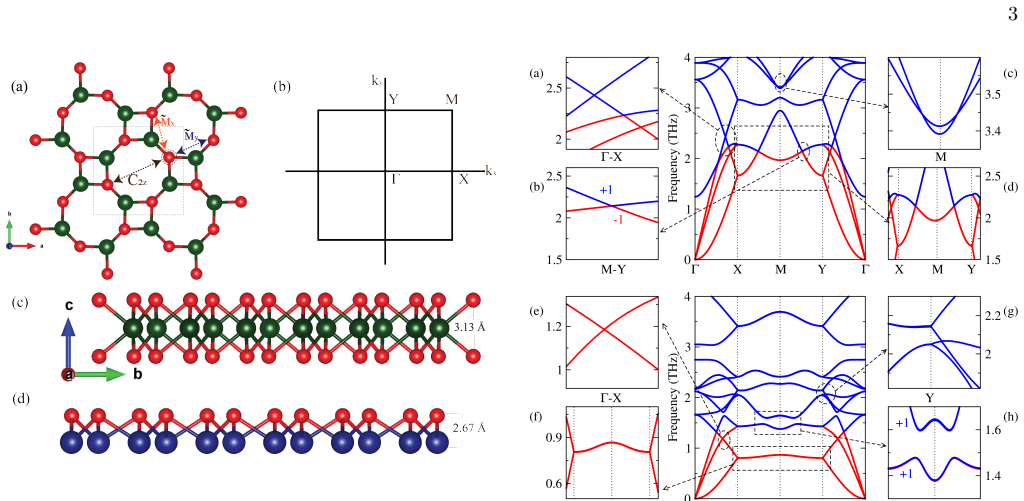
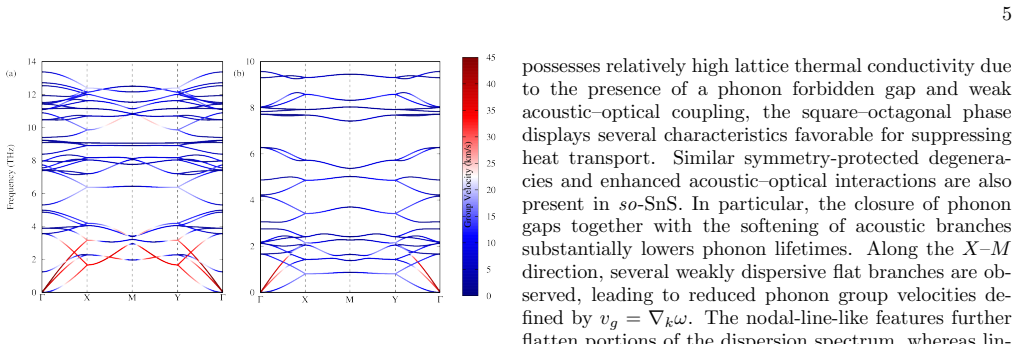
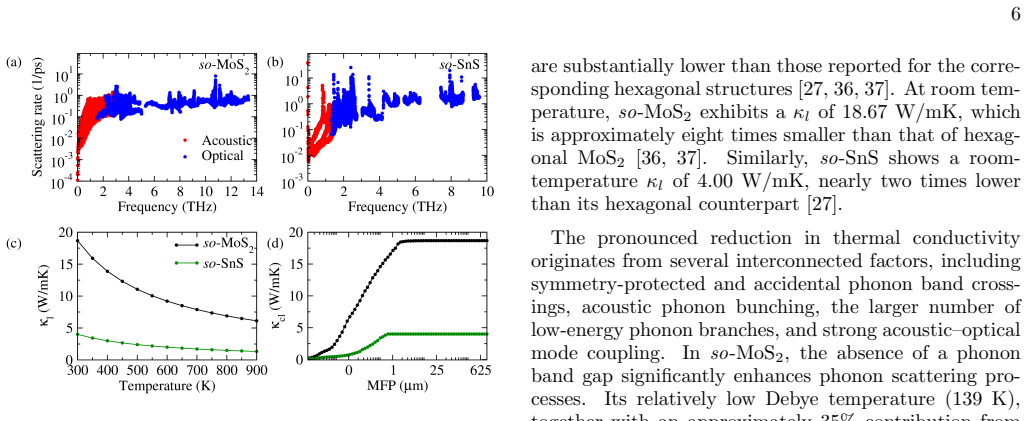
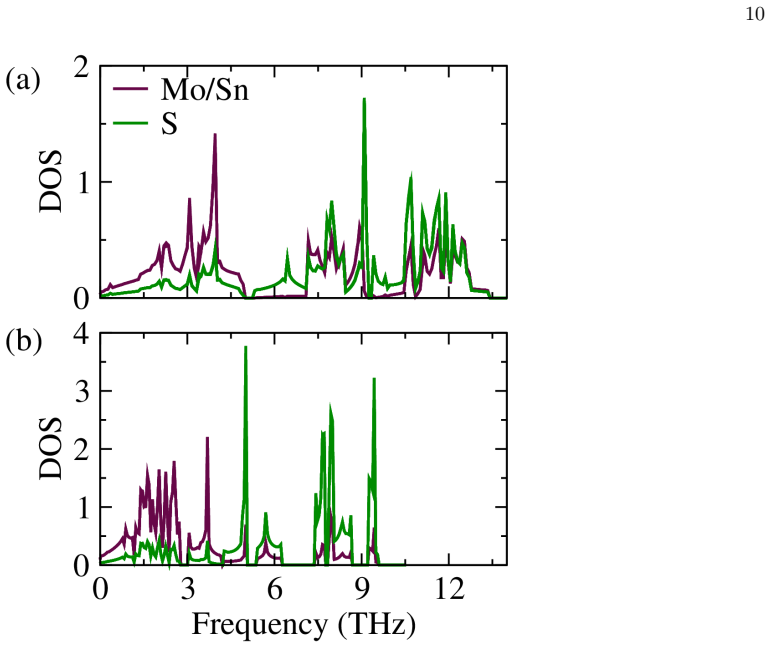
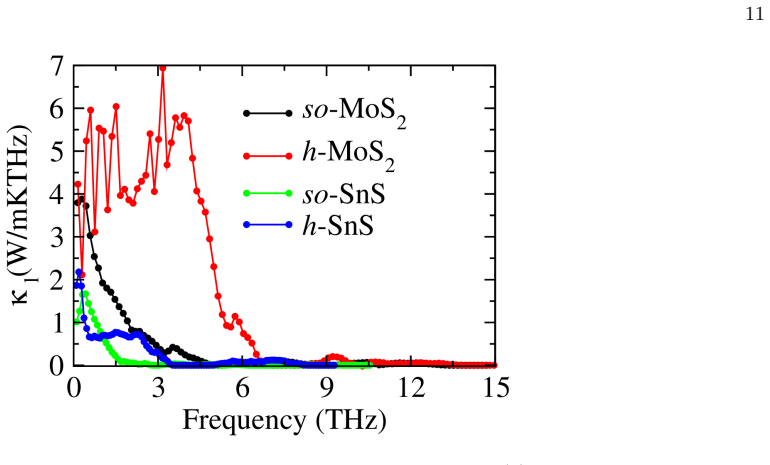
Symmetry analysis shows nontrivial phonon band topology consisting of symmetry-protected nodal lines whose crossings produce fourfold Dirac points; these features, together with phonon softening and enhanced anharmonic scattering near the crossings, suppress group velocities and increase scattering rates, yielding room-temperature lattice thermal conductivities of 4.0 W/mK in so-SnS and 18.7 W/mK in so-MoS2, reductions by factors exceeding two and eight relative to the hexagonal phases.
What carries the argument
Symmetry-protected nodal lines in the phonon dispersion, whose crossings generate fourfold Dirac points that modify group velocities and scattering.
If this is right
- Room-temperature lattice thermal conductivity drops to 4.0 W/mK in so-SnS.
- Room-temperature lattice thermal conductivity drops to 18.7 W/mK in so-MoS2.
- Lattice symmetry and topological band engineering become routes for tailoring thermal properties in two-dimensional materials.
- Opportunities arise for designing topological phononic and thermoelectric devices with controllable heat flow.
Where Pith is reading between the lines
- Similar square-octagonal geometries in other chalcogenides or related 2D compounds could be screened for comparable thermal-conductivity reductions.
- The same topological crossings might influence additional phonon properties such as electron-phonon coupling or thermal expansion coefficients.
- Synthesis of free-standing so monolayers followed by direct thermal-conductivity measurements would test the predicted suppression.
Load-bearing premise
First-principles calculations combined with phonon Boltzmann transport theory accurately capture the phonon group velocities, anharmonic scattering rates, and resulting thermal conductivity values including the specific effects of symmetry-protected nodal lines and Dirac points.
What would settle it
Experimental measurement on synthesized square-octagonal monolayers that finds lattice thermal conductivity comparable to or higher than the hexagonal phases, or phonon spectra lacking the predicted nodal lines and Dirac points.
Figures
read the original abstract
Unconventional lattice geometries provide an effective platform for realizing symmetry-protected topological phonon states that can strongly influence lattice heat transport. In this work, we explore the relationship between topological phonon band features and thermal transport in square--octagonal (so) chalcogenide monolayers, namely MoS2 and SnS, by combining first-principles calculations with phonon Boltzmann transport theory. Symmetry analysis reveals the presence of nontrivial phonon band topology in the form of symmetry-protected nodal lines. Crossings between nodal lines carrying different symmetry eigenvalues produce fourfold Dirac points that enhance the phonon group velocity (vg), whereas nearly flat nodal lines lead to strong suppression of vg. The coexistence of these features, together with substantial phonon softening and enhanced anharmonic scattering around the topological band crossings, markedly suppresses the lattice thermal conductivity ($\kappa_l$). As a result, room-temperature $\kappa_l$ values of 4.0 W/mK for so-SnS and 18.7 W/mK for so-MoS2 are obtained, representing reductions by more than a factor of two and eight, respectively, relative to their hexagonal phases. Our results uncover a direct connection between phonon band topology and heat transport in two-dimensional materials, highlighting lattice symmetry and topological band engineering as promising routes for tailoring thermal properties. These findings further suggest opportunities for designing topological phononic and thermoelectric devices with controllable heat flow.
Editorial analysis
A structured set of objections, weighed in public.
Referee Report
Summary. The manuscript explores symmetry-protected topological phonon states in square-octagonal chalcogenide monolayers (so-MoS2 and so-SnS) using first-principles calculations and the phonon Boltzmann transport equation. It reports the presence of nodal lines and Dirac points that, together with phonon softening and increased anharmonic scattering, result in low room-temperature lattice thermal conductivities of 4.0 W/mK for so-SnS and 18.7 W/mK for so-MoS2, representing significant reductions compared to the hexagonal phases.
Significance. Should the causal connection between the symmetry-protected band crossings and the suppressed thermal conductivity be established, the work would demonstrate a novel mechanism for engineering low-κ_l materials in 2D systems via lattice symmetry and topology, with potential applications in thermoelectrics and phononic devices. The concrete numerical predictions offer clear targets for experimental verification.
major comments (2)
- [Abstract] The central claim that the topological features cause the κ_l suppression is supported only by comparison to hexagonal phases (which have different coordination and Brillouin zone), without a control calculation that retains the square-octagonal geometry but breaks the protecting symmetries to confirm the topology's role independent of structural changes.
- [Methods/Results] The specific κ_l values and the attribution to enhanced anharmonic scattering around crossings lack reported details on computational convergence (e.g., q-point sampling for BTE, force-constant cutoff, or DFT functional), making it difficult to assess the robustness of the quantitative reductions by factors of 2 and 8.
minor comments (1)
- [Abstract] The abstract states 'substantial phonon softening' but does not specify the magnitude or which modes are affected; a brief quantification would aid clarity.
Simulated Author's Rebuttal
We thank the referee for their careful reading and constructive comments on our manuscript. We address each major comment below.
read point-by-point responses
-
Referee: [Abstract] The central claim that the topological features cause the κ_l suppression is supported only by comparison to hexagonal phases (which have different coordination and Brillouin zone), without a control calculation that retains the square-octagonal geometry but breaks the protecting symmetries to confirm the topology's role independent of structural changes.
Authors: We agree that a control calculation preserving the square-octagonal geometry while breaking the protecting symmetries would strengthen the isolation of topology's causal role. Performing such a calculation is nontrivial, as artificial symmetry breaking (e.g., via strain or atomic displacement) risks introducing extraneous changes to the phonon spectrum and anharmonicity. The hexagonal comparison remains relevant because the so lattice symmetry is what permits the protected nodal lines and Dirac points absent in the hexagonal phases. In revision we will expand the discussion to explicitly address this limitation and the rationale for the chosen comparison. revision: partial
-
Referee: [Methods/Results] The specific κ_l values and the attribution to enhanced anharmonic scattering around crossings lack reported details on computational convergence (e.g., q-point sampling for BTE, force-constant cutoff, or DFT functional), making it difficult to assess the robustness of the quantitative reductions by factors of 2 and 8.
Authors: We agree that these technical details are necessary for evaluating the reported κ_l values and their attribution. In the revised manuscript we will add explicit information on the q-point grids used for the Boltzmann transport equation, the real-space cutoff for interatomic force constants, the exchange-correlation functional, and the convergence tests performed with respect to these parameters. revision: yes
Circularity Check
No circularity: thermal conductivity obtained from independent first-principles phonon transport calculations
full rationale
The paper computes room-temperature κ_l values of 4.0 W/mK (so-SnS) and 18.7 W/mK (so-MoS2) via first-principles calculations combined with phonon Boltzmann transport theory. These outputs are not defined in terms of the reported nodal lines or Dirac points, nor are they obtained by fitting parameters to the target quantities and then relabeling the fit as a prediction. Symmetry analysis of nodal lines is presented as an input to the transport calculations rather than a self-referential loop. No self-citations are invoked as load-bearing premises for the central κ_l results or the claimed connection to topology. The hexagonal-phase comparisons are direct computational contrasts, not reductions by construction. The derivation chain therefore remains self-contained against external benchmarks.
Axiom & Free-Parameter Ledger
axioms (2)
- domain assumption Density functional theory and related first-principles methods sufficiently describe phonon dispersions and anharmonic interactions in these chalcogenide monolayers.
- standard math Symmetry analysis based on the square-octagonal lattice group correctly identifies protected nodal lines and Dirac points in the phonon spectrum.
Reference graph
Works this paper leans on
-
[1]
Such band crossings may orig- inate either from crystalline symmetry or from topologi- cal constraints imposed by symmetry operations in mo- mentum space
Symmetry Analysis In this section, we analyze the microscopic origin of the point and line degeneracies appearing in the phonon spectra of thesolattices. Such band crossings may orig- inate either from crystalline symmetry or from topologi- cal constraints imposed by symmetry operations in mo- mentum space. We therefore first examine the symme- try proper...
2023
-
[2]
Strain-driven phonon topological phase transition impedes thermal transport in titanium monoxide.Cell Reports Physical Science, 5(4), 2024
Xin Jin, Da-shuai Ma, Peng Yu, Xianyong Ding, Rui Wang, Xuewei Lv, and Xiaolong Yang. Strain-driven phonon topological phase transition impedes thermal transport in titanium monoxide.Cell Reports Physical Science, 5(4), 2024
2024
-
[3]
Phonon–phonon scattering selec- tion rules and control: An application to nanofriction and thermal transport.RSC advances, 9(64):37491–37496, 2019
Antonio Cammarata. Phonon–phonon scattering selec- tion rules and control: An application to nanofriction and thermal transport.RSC advances, 9(64):37491–37496, 2019
2019
-
[4]
Categories of phononic topological weyl open nodal lines and a potential material candidate: Rb2sn2o3.The journal of physical chemistry letters, 10(14):4045–4050, 2019
Qing-Bo Liu, Hua-Hua Fu, Gang Xu, Rui Yu, and Ruqian Wu. Categories of phononic topological weyl open nodal lines and a potential material candidate: Rb2sn2o3.The journal of physical chemistry letters, 10(14):4045–4050, 2019
2019
-
[5]
Weyl phonons in chiral crystals.Nano Letters, 23(16):7561–7567, 2023
Tiantian Zhang, Zhiheng Huang, Zitian Pan, Luojun Du, Guangyu Zhang, and Shuichi Murakami. Weyl phonons in chiral crystals.Nano Letters, 23(16):7561–7567, 2023
2023
-
[6]
Ubiquitous topological states of phonons in solids: Silicon as a model material
Yizhou Liu, Nianlong Zou, Sibo Zhao, Xiaobin Chen, Yong Xu, and Wenhui Duan. Ubiquitous topological states of phonons in solids: Silicon as a model material. Nano letters, 22(5):2120–2126, 2022
2022
-
[7]
Recipe for dirac phonon states with a quantized valley berry phase in two-dimensional hexagonal lattices.Nano letters, 18(12):7755–7760, 2018
Yuanjun Jin, Rui Wang, and Hu Xu. Recipe for dirac phonon states with a quantized valley berry phase in two-dimensional hexagonal lattices.Nano letters, 18(12):7755–7760, 2018
2018
-
[8]
Topological phonons and thermoelectricity in triple-point metals.Physical Re- view Materials, 2(11):114204, 2018
Sobhit Singh, QuanSheng Wu, Changming Yue, Aldo H Romero, and Alexey A Soluyanov. Topological phonons and thermoelectricity in triple-point metals.Physical Re- view Materials, 2(11):114204, 2018
2018
-
[9]
Antik Sihi and Sudhir K Pandey. Evidence of phase sta- bility, topological phonon and temperature-induced topo- logical phase transition in rocksalt sns and snse.Journal of Physics: Condensed Matter, 34(32):325601, 2022
2022
-
[10]
Topological quantum materials with kagome lattice.Ac- counts of Materials Research, 5(7):786–796, 2024
Qi Wang, Hechang Lei, Yanpeng Qi, and Claudia Felser. Topological quantum materials with kagome lattice.Ac- counts of Materials Research, 5(7):786–796, 2024
2024
-
[11]
Flat bands and nontrivial topological properties in an extended lieb lat- tice.Physical Review B, 100(23):235145, 2019
Ankita Bhattacharya and Biplab Pal. Flat bands and nontrivial topological properties in an extended lieb lat- tice.Physical Review B, 100(23):235145, 2019
2019
-
[12]
Topological properties of a two- dimensional photonic square lattice withoutC 4 and 8 Mx(y) symmetries.ACS Photonics, 9(7):2448–2454, 2022
Langlang Xiong, Yufu Liu, Yu Zhang, Yaoxian Zheng, and Xunya Jiang. Topological properties of a two- dimensional photonic square lattice withoutC 4 and 8 Mx(y) symmetries.ACS Photonics, 9(7):2448–2454, 2022
2022
-
[13]
Line of dirac nodes in hyperhoneycomb lattices.Physical review letters, 115(2):026403, 2015
Kieran Mullen, Bruno Uchoa, and Daniel T Glatzhofer. Line of dirac nodes in hyperhoneycomb lattices.Physical review letters, 115(2):026403, 2015
2015
-
[14]
Kekul´ e lattice in graphdiyne: Coexistence of phononic and electronic second-order topological insulator.Nano Letters, 22(3):1122–1128, 2022
Haimen Mu, Bing Liu, Tianyi Hu, and Zhengfei Wang. Kekul´ e lattice in graphdiyne: Coexistence of phononic and electronic second-order topological insulator.Nano Letters, 22(3):1122–1128, 2022
2022
-
[15]
Gapless MoS 2 allotrope possessing both mass- less dirac and heavy fermions.Physical Review B, 89(20):205402, 2014
Weifeng Li, Meng Guo, Gang Zhang, and Yong-Wei Zhang. Gapless MoS 2 allotrope possessing both mass- less dirac and heavy fermions.Physical Review B, 89(20):205402, 2014
2014
-
[16]
Systematic investigations of the elec- tron, phonon, elastic and thermal properties of monolayer so-MoS2 by first-principles calculations.Applied Surface Science, 539:148248, 2021
Zhao Wang, Cai Cheng, Heng-Xi Zhou, Ke Liu, and Xiao-Lin Zhou. Systematic investigations of the elec- tron, phonon, elastic and thermal properties of monolayer so-MoS2 by first-principles calculations.Applied Surface Science, 539:148248, 2021
2021
-
[17]
From ultrasoft pseu- dopotentials to the projector augmented-wave method
Georg Kresse and Daniel Joubert. From ultrasoft pseu- dopotentials to the projector augmented-wave method. Physical Review B, 59(3):1758, 1999
1999
-
[18]
Efficiency of ab- initio total energy calculations for metals and semicon- ductors using a plane-wave basis set.Computational ma- terials science, 6(1):15–50, 1996
Georg Kresse and J¨ urgen Furthm¨ uller. Efficiency of ab- initio total energy calculations for metals and semicon- ductors using a plane-wave basis set.Computational ma- terials science, 6(1):15–50, 1996
1996
-
[19]
Efficient iterative schemes for ab initio total-energy calculations using a plane-wave basis set.Physical review B, 54(16):11169, 1996
Georg Kresse and J¨ urgen Furthm¨ uller. Efficient iterative schemes for ab initio total-energy calculations using a plane-wave basis set.Physical review B, 54(16):11169, 1996
1996
-
[20]
A consistent and accurate ab initio parametriza- tion of density functional dispersion correction (dft-d) for the 94 elements h-pu.The Journal of chemical physics, 132(15), 2010
Stefan Grimme, Jens Antony, Stephan Ehrlich, and Helge Krieg. A consistent and accurate ab initio parametriza- tion of density functional dispersion correction (dft-d) for the 94 elements h-pu.The Journal of chemical physics, 132(15), 2010
2010
-
[21]
Oxford university press, 1996
Max Born and Kun Huang.Dynamical theory of crystal lattices. Oxford university press, 1996
1996
-
[22]
The hiphive package for the extraction of high-order force con- stants by machine learning.Advanced Theory and Simu- lations, 2(5):1800184, 2019
Fredrik Eriksson, Erik Fransson, and Paul Erhart. The hiphive package for the extraction of high-order force con- stants by machine learning.Advanced Theory and Simu- lations, 2(5):1800184, 2019
2019
-
[23]
Physically founded phonon dispersions of few-layer materials and the case of borophene.Materials Research Letters, 4(4):204–211, 2016
Jes´ us Carrete, Wu Li, Lucas Lindsay, David A Broido, Luis J Gallego, and Natalio Mingo. Physically founded phonon dispersions of few-layer materials and the case of borophene.Materials Research Letters, 4(4):204–211, 2016
2016
-
[24]
Shengbte: A solver of the boltzmann transport equation for phonons.Computer Physics Communica- tions, 185(6):1747–1758, 2014
Wu Li, Jes´ us Carrete, Nebil A Katcho, and Natalio Mingo. Shengbte: A solver of the boltzmann transport equation for phonons.Computer Physics Communica- tions, 185(6):1747–1758, 2014
2014
-
[25]
Supplementary materials for symmetry-protected phonon topology and low lattice ther- mal conductivity in square–octagonal chalcogenides, 2026
Surabhi Suresh Nair, Chiranjitj Mondal, Aftab Alam, and Nirpendra Singh. Supplementary materials for symmetry-protected phonon topology and low lattice ther- mal conductivity in square–octagonal chalcogenides, 2026
2026
-
[26]
Quasiparticle twist dynamics in non-symmorphic materials.Materials Today Physics, 21:100548, 2021
Rinkle Juneja, Simon Thebaud, Tribhuwan Pandey, Carlos A Polanco, DH Moseley, Michael E Manley, YQ Cheng, B Winn, Douglas L Abernathy, Raphael P Hermann, et al. Quasiparticle twist dynamics in non-symmorphic materials.Materials Today Physics, 21:100548, 2021
2021
-
[27]
Symmetry driven multiple phonon topology in the hexagonal rbznsb and csznsb.Computational Materials Science, 250:113679, 2025
T Aiswarya and G Vaitheeswaran. Symmetry driven multiple phonon topology in the hexagonal rbznsb and csznsb.Computational Materials Science, 250:113679, 2025
2025
-
[28]
Metavalent bonding in- duced phonon transport anomaly in 2dγ-mx (m= ge, sn, pb; x= s, se, te) monolayers.ACS Applied Energy Materials, 6(17):8787–8793, 2023
Surabhi Suresh Nair, Muhammad Sajjad, Kanishka Biswas, and Nirpendra Singh. Metavalent bonding in- duced phonon transport anomaly in 2dγ-mx (m= ge, sn, pb; x= s, se, te) monolayers.ACS Applied Energy Materials, 6(17):8787–8793, 2023
2023
-
[29]
High-throughput computational screen- ing of two-dimensional semiconductors.The Journal of Physical Chemistry Letters, 13(50):11581–11594, 2022
Vei Wang, Gang Tang, Ya-Chao Liu, Ren-Tao Wang, Hiroshi Mizuseki, Yoshiyuki Kawazoe, Jun Nara, and Wen Tong Geng. High-throughput computational screen- ing of two-dimensional semiconductors.The Journal of Physical Chemistry Letters, 13(50):11581–11594, 2022
2022
-
[30]
A. H. Castro Neto, F. Guinea, N. M. R. Peres, K. S. Novoselov, and A. K. Geim. The electronic properties of graphene.Rev. Mod. Phys., 81:109–162, Jan 2009
2009
-
[31]
Quantum valley hall effect without berry curvature.Phys
Rasoul Ghadimi, Chiranjit Mondal, Sunje Kim, and Bohm-Jung Yang. Quantum valley hall effect without berry curvature.Phys. Rev. Lett., 133:196603, Nov 2024
2024
-
[32]
Non-abelian charge conversion in bilayer binary honeycomb lattice systems.Phys
Chiranjit Mondal, Rasoul Ghadimi, and Bohm-Jung Yang. Non-abelian charge conversion in bilayer binary honeycomb lattice systems.Phys. Rev. B, 113:L081101, Feb 2026
2026
-
[33]
Junyeong Ahn, Sungjoon Park, and Bohm-Jung Yang. Failure of nielsen-ninomiya theorem and fragile topol- ogy in two-dimensional systems with space-time inver- sion symmetry: Application to twisted bilayer graphene at magic angle.Phys. Rev. X, 9:021013, Apr 2019
2019
-
[34]
Kristin A Denault, Jakoah Brgoch, Simon D Kloß, Michael W Gaultois, Joan Siewenie, Katharine Page, and Ram Seshadri. Average and local structure, debye temperature, and structural rigidity in some oxide com- pounds related to phosphor hosts.ACS applied materials & interfaces, 7(13):7264–7272, 2015
2015
-
[35]
Tetsuya Tohei, Akihide Kuwabara, Fumiyasu Oba, and Isao Tanaka. Debye temperature and stiffness of car- bon and boron nitride polymorphs from first principles calculations.Physical Review B—Condensed Matter and Materials Physics, 73(6):064304, 2006
2006
-
[36]
Influence of the optical-acoustic phonon hy- bridization on phonon scattering and thermal conduc- tivity.Physical Review B, 93(20):205203, 2016
Wu Li, Jes´ us Carrete, Georg KH Madsen, and Natalio Mingo. Influence of the optical-acoustic phonon hy- bridization on phonon scattering and thermal conduc- tivity.Physical Review B, 93(20):205203, 2016
2016
-
[37]
Ther- mal conductivity of bulk and monolayer MoS 2.Euro- physics Letters, 113(3):36002, 2016
Appala Naidu Gandi and Udo Schwingenschl¨ ogl. Ther- mal conductivity of bulk and monolayer MoS 2.Euro- physics Letters, 113(3):36002, 2016
2016
-
[38]
Ultra low lat- tice thermal conductivity and exceptional thermoelectric conversion efficiency in rippled MoS 2.Materials Today Nano, 29:100561, 2025
Surabhi Suresh Nair and Nirpendra Singh. Ultra low lat- tice thermal conductivity and exceptional thermoelectric conversion efficiency in rippled MoS 2.Materials Today Nano, 29:100561, 2025. 9 Supplementary Materials Symmetry-Protected Phonon Topology and Low Lattice Thermal Conductivity in Square–Octagonal Chalcogenides Surabhi Suresh Nair Department of ...
2025
discussion (0)
Sign in with ORCID, Apple, or X to comment. Anyone can read and Pith papers without signing in.