REVIEW 4 major objections 5 minor 30 references
Comparing realtime optical gain measurement and methods on MagAO-X
T0 review · 4 major / 5 minor · reviewed 2026-08-15 · deepseek-v4-flash
Pith's one-line read The average of three projected Karhunen–Loève modes from incoherent speckle probes provides a usable realtime optical-gain estimate on MagAO-X.
desk verdict Honest on-sky comparison of three optical-gain estimators; the speckle method is promising but not yet validated, and the authors are mostly open about that. read the letter →
The pith
A machine-rendered reading of the paper's core claim, the machinery that carries it, and where it could break.
The reading
What carries the argument
The central object is the rolling, lab-normalized RMS of the projections of the three leading KL modes. Because the deformable-mirror command and the wavefront-sensor integration are not frame-aligned, the probe signal is not a clean Fourier pattern; the PCA decomposition of a two-second lab dataset separates the two primary Fourier modes from a transition mode that carries the misalignment. Projecting each sky frame onto these three modes, dividing the rolling RMS by the lab RMS, and averaging across modes produces the scalar optical-gain estimate. The same KL basis also gets projected onto the control matrix to show which spatial modes each probe configuration excites.
What would settle it
A concrete test: on a night when the selfRM OG is high and varying, if the averaged KL-mode RMS stays pinned low while the selfRM value changes by more than the reported variance bars, the scalar is not tracking OG in that regime. Rebuilding the PCA basis from a different two-second lab segment and seeing whether the five close matches turn into mismatches would also falsify the calibration transfer; and recomputing the average without the third transition mode tests whether the high-gain underestimation is caused by the misalignment term.
Extended reading notes
Core claim
The central claim is that the average of the projected KL-mode returns is a usable realtime optical-gain scalar on MagAO-X. In Section 4.3 the authors state: "When the KL mode returns are averaged, we see that the signal has a better match to the selfRM OG. We will use the average of the three projected modes as our OG scalar estimate moving forward." The selfRM is their benchmark: a mode-by-mode measurement of the full application and degradation of a deformable-mirror probe, too invasive to run continuously. The averaged projection is intended to reproduce that benchmark passively from probes already in the loop, and the paper reports that five of eight datasets land close to the selfRM value, with higher optical gains underestimated.
Load-bearing premise
The load-bearing assumption is that a pattern learned from two seconds of lab data describes how the wavefront sensor responds on sky, so that comparing lab and sky projections of that pattern yields the true optical gain.
Editorial extensions
If this is right
- MagAO-X can monitor optical gain continuously with no change to observing operations, as long as the applied speckle configuration has a lab calibration.
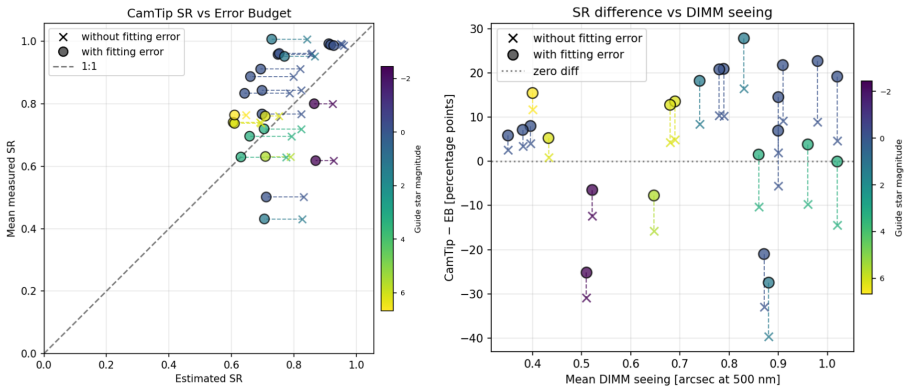
- The focal-plane CamTip Strehl method is not a trustworthy OG proxy in its current configuration, because it systematically overestimates Strehl by missing fitting error and saturating on bright targets.
- The observed saturation at high optical gain means the averaged KL method needs a correction or a different weighting before it can be used for closed-loop gain compensation in good seeing.
- Because the speckle responses are expressed in the control basis, the same data could support per-mode gain calibration rather than a single scalar, which the paper lists as immediate follow-up.
- With a reliable live OG estimate, the reconstructor can be rescaled by the inverse gain, which is the step needed to correct non-common-path aberrations and to reconstruct point-spread functions from telemetry.
Reading between the lines
- If the lab-to-sky transfer of the KL basis holds for other instruments that already use incoherent speckles, this passive estimator could be adopted without hardware changes; the paper only demonstrates it on MagAO-X.
- The high-gain saturation suggests a concrete experiment: exclude the third, transition KL mode from the average and see whether the saturation disappears; if it does, the misalignment term, not the physics of optical gain, is limiting the estimate.
- The choice of a single two-second lab dataset for the PCA basis is a free parameter; rebuilding the basis from longer or diversified lab data and measuring scatter against selfRM would show how much of the residual error is calibration-limited.
- The natural next test is to close the loop on the estimate: divide the reconstructed wavefront by the reported OG and check whether the on-sky Strehl or the selfRM improves, a step the paper leaves future.
Signed reviews
Editorial analysis
A structured set of objections, weighed in public.
Referee Report
Summary. The paper compares three methods for measuring optical gain (OG) on the MagAO-X pyramid wavefront sensor: a self response matrix (selfRM) benchmark, a focal-plane Strehl-ratio measurement with the CamTip camera, and a pupil-plane method using incoherent speckle probes already applied for coronagraphic observations. The speckle method is the paper's main new contribution: a PCA decomposition of a 2-second lab dataset yields three KL modes that are projected onto individual WFS frames on sky, and the lab-normalized rolling RMS of these projections is averaged to produce a realtime OG scalar. The authors report 8 on-sky speckle datasets with corresponding selfRM measurements, finding close agreement in 5 cases and systematic underestimation at high OG, and conclude that the averaged three-mode projection is the preferred realtime OG estimate moving forward. The CamTip SR method is found to overestimate relative to an error budget, which the authors attribute to an inability to capture fitting error.
Significance. If validated, the incoherent-speckle OG estimator would be a valuable passive diagnostic, because MagAO-X already applies these probes for coronagraphic centering and photometric references, so OG could be monitored without interrupting science. The paper is honest and specific about its limitations: it explicitly notes that CamTip cannot capture fitting error, that the speckle method saturates at high OG, that only 8 speckle datasets were collected, and that the sky-side behavior of the KL patterns is still under investigation. The authors also provide a clear benchmark in the selfRM and give reproducible definitions of their reduction steps. However, the central claim that the averaged KL-mode RMS is a usable realtime OG estimate is not yet independently established: the lab-to-sky transfer of the PCA basis is unvalidated, the averaging rule was chosen post hoc on the same datasets used for validation, and the high-OG regime shows a systematic bias.
major comments (4)
- [Section 4.3, Fig. 8] The lab-to-sky transfer of the PCA-derived KL basis is not validated. Figure 8's caption states that the expected four-frame and two-frame patterns "aren't seen as clearly on the sky dataset, which is still being investigated," yet the estimator is exactly the ratio of sky-frame projections to lab-frame RMS in a fixed lab-built basis. Any sky-specific change in the spatial structure of the WFS response, not just an overall gain change, will alter this ratio. The paper should quantify how well the sky projections reproduce the expected KL templates, for example by reporting per-mode explained variance, template correlation, or a comparison against a sky-derived basis. Without such evidence, the claim that the ratio measures OG is not independently supported.
- [Section 4.3 and Section 4.4] The decision to average the three KL-mode ratios was made after observing that the average matched selfRM better than any individual mode: the text reads "When the KL mode returns are averaged, we see that the signal has a better match to the selfRM OG. We will use the average of the three projected modes as our OG scalar estimate moving forward." With only 8 datasets, five of which are close to selfRM, this is a post hoc selection of the estimator definition on the validation set. The authors should either pre-specify the averaging rule, validate it with a leave-one-out or nested procedure, or report per-mode agreement and show that the average improves performance in a way that is not simply a regression artifact.
- [Section 4.1 and Section 4.3] The temporal alignment between the DM command and the WFS integration is a load-bearing assumption. The authors explain that a simple Fourier projection failed because the WFS frames integrate over the DM probe mid-transition, and that the third PCA mode specifically captures this transition. The estimator therefore assumes that the lab and on-sky loop timing, including loop delay and integration phase, are identical. Any change in these would alter the projection coefficients even at fixed OG. The paper should demonstrate timing stability across the eight datasets, or estimate and correct the per-dataset delay, before the estimator can be considered reliable for realtime control.
- [Section 4.4, Fig. 10] The high-OG behavior is not adequately characterized. The paper reports that for higher optical gains the method underestimates OG, and Figure 10 shows a systematic deviation from the unity line in this regime. Because the stated goal is realtime OG control, and because the high-OG regime is precisely where undercorrection would be most problematic, the conclusion that the method is "usable" is only supported for the mid-range OG cases. The authors should either restrict the claim to the regime where the estimator is calibrated, model the saturation effect, or show that the underestimation is correctable with a simple transformation.
minor comments (5)
- [Abstract and Section 1] The abstract contains a typo: "asses" should be "assess."
- [Section 4.2] The paragraph beginning "Each set of likely separations" would benefit from a table listing the specific probe configurations (separation, strength, angle) that were calibrated, since the paper later relies on these configurations being reproducible on sky.
- [Figure 10 caption] The caption states that error bars indicate variance around the average measurement, but does not specify whether this is variance over time samples, over independent speckle cycles, or over spatial modes. Please define the averaging domain and the number of independent samples used.
- [Section 4.1] The phrase "2-seconds set" should be "2-second set," and the earlier hyphenation in "Karhunen–Lo`eve" should be consistent with standard notation.
- [Section 3.3] The claim that bright-star outliers are "most likely due to saturation" on the focal plane is plausible but unsupported; a check of peak counts against the detector full well, or a note in Table 1 flagging saturated frames, would make the statement testable.
Circularity Check
Speckle OG averaging rule is selected post hoc against the selfRM benchmark, making the Figure 10 agreement partly by construction; the lab-to-sky transfer also remains explicitly unvalidated.
-
fitted input called prediction
[Section 4.3 (and 4.4 / Figure 10)]
"When the KL mode returns are averaged, we see that the signal has a better match to the selfRM OG. We will use the average of the three projected modes as our OG scalar estimate moving forward."
The three-KL-mode average is adopted only after inspecting the same selfRM datasets that are later used as the validation benchmark in Figure 10 ('For each dataset, we compared the OG measurement ... against the selfRM OG itself'). Thus the reported agreement of the average is not an out-of-sample prediction; the estimator choice is post hoc model selection on the benchmark. The PCA/KL projection itself is calibrated from a lab dataset and is not fit to selfRM, so the circularity is confined to the averaging rule rather than the entire method.
full rationale
The core calibration, building a PCA/KL basis from a 2-second lab dataset and projecting it onto WFS frames, is not circular: it is an independent lab measurement that does not use the selfRM values. The focal-plane SR comparison to an error budget is also an external cross-check. The only circular element is the selection of the OG scalar estimator: Section 4.3 states that 'when the KL mode returns are averaged, we see that the signal has a better match to the selfRM OG' and then adopts the average. Because the same selfRM datasets are used both to motivate the averaging rule and, in Figure 10, to validate it, the reported agreement is not an independent prediction. This is a mild post hoc selection effect rather than a full reduction by construction: the KL coefficients come from lab data, and the average is a fixed, simple combination that could in principle disagree with selfRM. The paper's own Figure 8 caption notes that on sky 'these patterns aren't seen as clearly on the sky dataset, which is still being investigated,' which is a correctness and transfer limitation rather than circularity, but it further weakens the claim that the estimator is validated. The selfRM benchmark is cited from the authors' prior work, yet it is a direct empirical measurement, so the self-citation is not separately load-bearing enough to raise the score above 4.
Assumptions & free parameters
assumptions (4)
- domain assumption The selfRM is a true measurement of optical gain.
- ad hoc to paper OG for modes 200 onward is approximately constant and can be represented by a scalar.
- domain assumption The lab PCA KL basis remains valid for on-sky WFS frames.
- domain assumption The pyramid WFS is operating in the linear regime where scalar OG applies.
Cite this review
Pith. "Pith review of Comparing realtime optical gain measurement and methods on MagAO-X." pith.science (2026). https://pith.science/paper/ZJUHT3MQ
@misc{pith2026260810539,
  author       = {Pith},
  title        = {Pith review of: Comparing realtime optical gain measurement and methods on MagAO-X},
  year         = {2026},
  howpublished = {\url{https://pith.science/paper/ZJUHT3MQ}},
  note         = {Machine review of arXiv:2608.10539}
}
read the original abstract
A lingering technical challenge for pyramid wavefront sensors (PyWFS) is their change in response between calibration and correction residuals, a quantity known as optical gain (OG). Given the prevalent use of PyWFSs in current and planned high contrast adaptive optics (AO), understanding and reliably measuring OG for realtime control unlocks advanced correction and post processing techniques. The OG quantity as an unknown inhibits a system's ability to stably correct non common path errors, reconstructing wavefronts, and PSF reconstruction. This work compares kinds of optical gain measurement techniques on MagAO-X, a visible light extreme AO instrument on the 6.5m Magellan Clay telescope. We present a set of on-sky measurements of OG across three techniques: 1) An on-sky calibration that acquires OG per spatial mode, 2) realtime measurements of the instantaneous Strehl Ratio (SR) on the pyramid tip, and 3) realtime measurement of known, high-frequency probe signal on the WFS itself. We compare these on-sky results with performance diagnostics to asses how faithfully OG is returned. We conclude with future steps for active control of OG on MagAO-X.
Figures


Figures from the paper (7 more)


Reference graph
Works this paper leans on
-
[1]
Pupil plane wavefront sensing with an oscillating prism,
Ragazzoni, R., “Pupil plane wavefront sensing with an oscillating prism,”Journal of Modern Optics43, 289–293 (Feb. 1996)
1996
-
[2]
SOUL at LBT: commissioning results, science and future.,
Pinna, E., Rossi, F., Agapito, G., Puglisi, A., Plantet, C., Ghose, E., Matthieu, B., Bonaglia, M., Briguglio, R., Brusa, G., Carbonaro, L., Cavallaro, A., Christou, J., Durney, O., Ertel, S., Esposito, S., Grani, P., Hinz, P., Guerra, J. C., Lefebvre, M., Mazzoni, T., Mechtley, B., Miller, D. L., Montoya, M., Power, J., Rothberg, B., Taylor, G., Vaz, A.,...
work page 2023
-
[3]
Magao: Status and on-sky performance of the magellan adaptive optics system,
Morzinski, K. M., Close, L. M., Males, J. R., Kopon, D., Hinz, P. M., Esposito, S., Riccardi, A., Puglisi, A., Pinna, E., Briguglio, R., Xompero, M., Quir´ os-Pacheco, F., Bailey, V., Follette, K. B., Rodigas, T. J., Wu, Y.-L., Arcidiacono, C., Argomedo, J., Busoni, L., Hare, T., Uomoto, A., and Weinberger, A., “Magao: Status and on-sky performance of the...
work page 2014
-
[4]
Scexao: First results and on-sky performance,
Currie, T., Guyon, O., Martinache, F., Clergeon, C., McElwain, M., Thalmann, C., Jovanovic, N., Singh, G., and Kudo, T., “Scexao: First results and on-sky performance,”Proceedings of the International Astronomical Union8(S299), 34–35 (2013)
work page 2013
-
[5]
Jovanovic, N., Delorme, J. R., Bond, C. Z., Cetre, S., Mawet, D., Echeverri, D., Wallace, J. K., Bartos, R., Lilley, S., Ragland, S., Ruane, G., Wizinowich, P., Chun, M., Wang, J., Wang, J., Fitzgerald, M., Matthews, K., Pezzato, J., Calvin, B., Millar-Blanchaer, M., Martin, E. C., Wetherell, E., Wang, E., Jacobson, S., Warmbier, E., Lockhart, C., Hall, D...
work page 2019
-
[6]
Adaptive optics for extremely large telescopes,
Hippler, S., “Adaptive optics for extremely large telescopes,”Journal of Astronomical Instrumenta- tion08(02), 1950001 (2019)
work page 2019
-
[7]
MICADO: first light imager for the E-ELT,
Davies, R., Schubert, J., Hartl, M., Alves, J., Cl´ enet, Y., Lang-Bardl, F., Nicklas, H., Pott, J.-U., Ragazzoni, R., Tolstoy, E., Agocs, T., Anwand-Heerwart, H., Barboza, S., Baudoz, P., Bender, R., Bizenberger, P., Boccaletti, A., Boland, W., Bonifacio, P., Briegel, F., Buey, T., Chapron, F., Cohen, M., Czoske, O., Dreizler, S., Falomo, R., Feautrier, ...
work page 2016
-
[8]
HARMONI: the ELT’s First-Light Near-infrared and Visible Integral Field Spectrograph,
Thatte, N., Tecza, M., Schnetler, H., Neichel, B., Melotte, D., Fusco, T., Ferraro-Wood, V., Clarke, F., Bryson, I., O’Brien, K., Mateo, M., Garcia Lorenzo, B., Evans, C., Bouch´ e, N., Arribas, S., and HARMONI Consortium, “HARMONI: the ELT’s First-Light Near-infrared and Visible Integral Field Spectrograph,” The Messenger182, 7–12 (Mar. 2021)
work page 2021
Show all 30 references
-
[9]
METIS: The Mid-infrared ELT Imager and Spectrograph,
Brandl, B., Bettonvil, F., van Boekel, R., Glauser, A., Quanz, S., Absil, O., Amorim, A., Feldt, M., Glasse, A., G¨ udel, M., Ho, P., Labadie, L., Meyer, M., Pantin, E., van Winckel, H., and METIS Consortium, “METIS: The Mid-infrared ELT Imager and Spectrograph,”The Messenger1...
2021
-
[10]
ANDES, the high-resolution spectrograph for the ELT: design of the adaptive optics system,
Pinna, E., Selmi, C., Cheffot, A.-L., Azzaroli, N., Redaelli, E., Sauvage, J.-F., Baldini, V., Dunn, J., Calderone, G., Agapito, G., Simonnin, A., Jouve, P., V´ eran, J.-P., Blind, N., Aliverti, M., Beaudoin, A., Berio, P., Bonaglia, M., Briguglio, R., Carbonaro, L., Chauvin, ...
2024
-
[11]
PCS — A Roadmap for Exoearth Imaging with the ELT,
Kasper, M., Cerpa Urra, N., Pathak, P., Bonse, M., Nousiainen, J., Engler, B., Heritier, C. T., Kammerer, J., Leveratto, S., Rajani, C., Bristow, P., Le Louarn, M., Madec, P.-Y., Str¨ obele, S., Verinaud, C., Glauser, A., Quanz, S. P., Helin, T., Keller, C., Snik, F., Boccalet...
2021
-
[12]
The Planetary Systems Imager for TMT: overview and status,
Fitzgerald, M. P., Sallum, S., Millar-Blanchaer, M. A., Jensen-Clem, R., Hinz, P. M., Guyon, O., Wang, J., Mazin, B. A., Skemer, A., Chun, M., Males, J., Marois, C., Singh, G., and Max, C., “The Planetary Systems Imager for TMT: overview and status,” in [Ground-based and Airbo...
2022
-
[13]
Nfiraos adaptive optics for the thirty meter telescope,
Crane, J., Andersen, D., Atwood, J., Byrnes, P., Fitzsimmons, J., Lardi` ere, O., Densmore, A., Hardy, T., Herriot, G., Hoff, B., Kerley, D., Smith, M., Stocks, J., V´ eran, J.-P., Dunn, J., Boyer, C., Wang, L., Trancho, G., Trubey, M., and Jackson, K., “Nfiraos adaptive optic...
2018
-
[14]
High-contrast imaging at first-light of the gmt: The preliminary design of gmagao-x,
Males, J. R., Close, L. M., Haffert, S. Y., Kautz, M. Y., Kelly, D., Fletcher, A., Salanski, T., Durney, O., Noenickx, J., Ford, J., Gasho, V., Pearce, L., Kueny, J., Guyon, O., Weinberger, A., Bowler, B., Kraus, A., and Batalha, N., “High-contrast imaging at first-light of th...
2024
-
[15]
Non common path aberration correction with non linear WFSs,
Esposito, S., Pinna, E., Puglisi, A., Agapito, G., Veran, J. P., and Herriot, G., “Non common path aberration correction with non linear WFSs,” (2015)
2015
-
[16]
Assessing and mitigating align- ment defects of the pyramid wavefront sensor: a translation insensitive control method,
Deo, V., Gendron, ´E., Rousset, G., Vidal, F., Buey, T., and Cohen, M., “Assessing and mitigating align- ment defects of the pyramid wavefront sensor: a translation insensitive control method,”Astronomy & Astrophysics619, A56 (Nov. 2018)
2018
-
[17]
Pyramid wavefront sensor optical gains compensation using a convolutional model,
Chambouleyron, V., Fauvarque, O., Janin-Potiron, P., Correia, C., Sauvage, J.-F., Schwartz, N., Neichel, B., and Fusco, T., “Pyramid wavefront sensor optical gains compensation using a convolutional model,” Astronomy & Astrophysics644, A6 (Dec. 2020). arXiv:2006.08294 [astro-ph]
2020 arXiv
-
[18]
Data-driven subspace predictive control of adaptive optics for high-contrast imaging,
Haffert, S. Y., Males, J. R., Close, L. M., Van Gorkom, K., Long, J. D., Hedglen, A. D., Guyon, O., Schatz, L., Kautz, M., Lumbres, J., Rodack, A., Knight, J. M., Sun, H., and Fogarty, K., “Data-driven subspace predictive control of adaptive optics for high-contrast imaging,” ...
2021
-
[19]
Review of PSF reconstruction methods and application to post-processing,
Beltramo-Martin, O., Ragland, S., F´ etick, R., Correia, C., Dupuy, T., Fiorentino, G., Fusco, T., Jolissaint, L., Kamann, S., Marasco, A., Massari, D., Neichel, B., Schreiber, L., and Wizinowich, P., “Review of PSF reconstruction methods and application to post-processing,” i...
2020
-
[20]
Magao-x: current status and plans for phase ii,
Males, J. R., Close, L. M., Haffert, S., Long, J. D., Hedglen, A. D., Pearce, L., Weinberger, A. J., Guyon, O., Knight, J. M., McLeod, A., Kautz, M., Gorkom, K. V., Lumbres, J., Schatz, L., Rodack, A., Gasho, V., Kueny, J., and Foster, W., “Magao-x: current status and plans fo...
2022
-
[21]
On-sky, real-time optical gain calibration on MagAO-X using incoherent speckles,
McEwen, E. A., Males, J. R., Guyon, O., Haffert, S. Y., Long, J. D., Close, L. M., Gorkom, K. V., Lumbres, J., Hedglen, A. D., Schatz, L., Kautz, M. Y., Pearce, L. A., Kueny, J. K., McLeod, A. L., Foster, W. B., Li, J., Roberts, R., and Weinberger, A. J., “On-sky, real-time op...
2024 arXiv
-
[22]
High Contrast Imaging for Python (HCIPy): an open-source adaptive optics and coronagraph simulator,
Por, E. H., Haffert, S. Y., Radhakrishnan, V. M., Doelman, D. S., Van Kooten, M., and Bos, S. P., “High Contrast Imaging for Python (HCIPy): an open-source adaptive optics and coronagraph simulator,” in [Adaptive Optics Systems VI],Proc. SPIE10703(2018)
2018
-
[23]
Optical gains measurement with a gain scheduling camera: On-sky demonstration with PAPYRUS and perspectives,
Striffling, A., H´ eritier, C.-T., F´ etick, R. J.-L., Fauvarque, O., Sauvage, J.-F., Carlotti, A., Neichel, B., and Fusco, T., “Optical gains measurement with a gain scheduling camera: On-sky demonstration with PAPYRUS and perspectives,”Astronomy & Astrophysics703, A253 (Nov. 2025)
2025
-
[24]
Ground-based adaptive optics coronagraphic performance under closed-loop predictive control,
Males, J. R. and Guyon, O., “Ground-based adaptive optics coronagraphic performance under closed-loop predictive control,”Journal of Astronomical Telescopes, Instruments, and Systems4, 1 (Feb. 2018)
2018
-
[25]
jaredmales/aoSystem,
Males, J. R., “jaredmales/aoSystem,” (Jan. 2025). original-date: 2017-07-19T06:27:50Z
2025
-
[26]
Giant Magellan Telescope site testing seeing and turbulence statistics,
Prieto, G., Thomas-Osip, J. E., Phillips, M. M., McCarthy, P., and Johns, M., “Giant Magellan Telescope site testing seeing and turbulence statistics,” 77334O (July 2010)
2010
-
[27]
Artificial incoherent speckles enable precision astrometry and photometry in high-contrast imaging,
Jovanovic, N., Guyon, O., Martinache, F., Pathak, P., Hagelberg, J., and Kudo, T., “Artificial incoherent speckles enable precision astrometry and photometry in high-contrast imaging,”The Astrophysical Jour- nal813, L24 (Oct. 2015). arXiv:1510.04368 [astro-ph]
2015 arXiv
-
[28]
Precision Photometric and Astrometric Calibration for Exoplanet Imaging,
Sahoo, A., “Precision Photometric and Astrometric Calibration for Exoplanet Imaging,” (Aug. 2020)
2020
-
[29]
¨Uber lineare methoden in der wahrscheinlichkeitsrechnung,
Karhunen, K., “ ¨Uber lineare methoden in der wahrscheinlichkeitsrechnung,”Annales Academiae Scien- tiarum Fennicae. Series A I, Mathematica-Physica37, 1–79 (1947)
1947
-
[30]
46 ofGraduate Texts in Mathematics, Springer-Verlag, 4 ed
Lo` eve, M., [Probability Theory II], vol. 46 ofGraduate Texts in Mathematics, Springer-Verlag, 4 ed. (1978). APPENDIX date target mag FPS length DIMM CamTip SR EB SR diff (UT) (I) (h:m:s) (as at 500nm) (%) (%) (%) 4-16 HR1996 5.57 1724.1 9:25 0.647±0.019 63.14±0.01 70.87±0.81...
1978
Reviewed August 15, 2026 · model on record in the stance chip above.
Discussion (0). Continue with ORCID to comment.