Projected sensitivity of the ANUBIS detector to heavy neutral leptons
Pith reviewed 2026-06-26 01:51 UTC · model grok-4.3
The pith
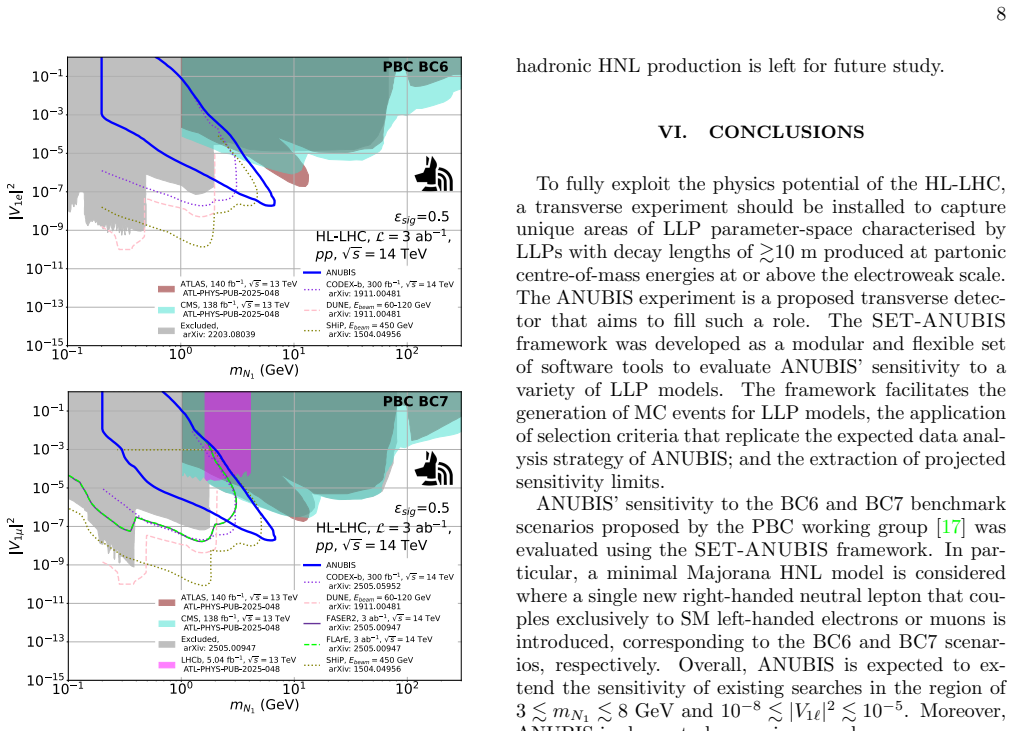
ANUBIS projects a maximum sensitivity of |V|^2 = 1.8×10^{-8} to single-flavor Majorana heavy neutral leptons at masses of 6.3-6.4 GeV.
A machine-rendered reading of the paper's core claim, the machinery that carries it, and where it could break.
Core claim
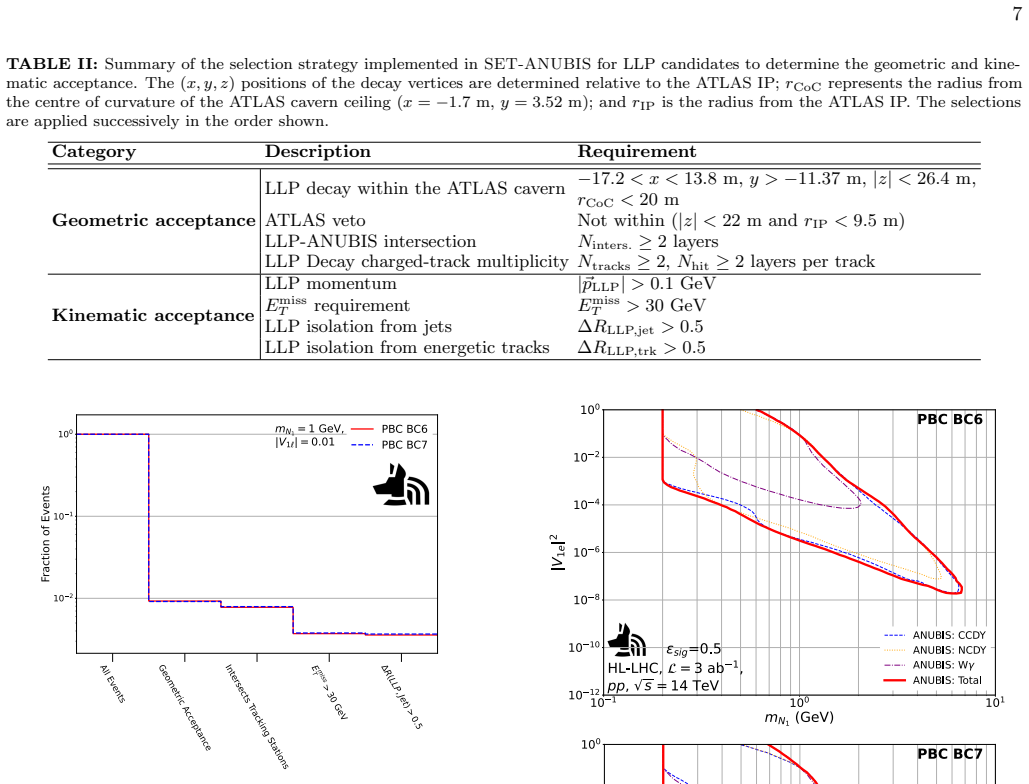
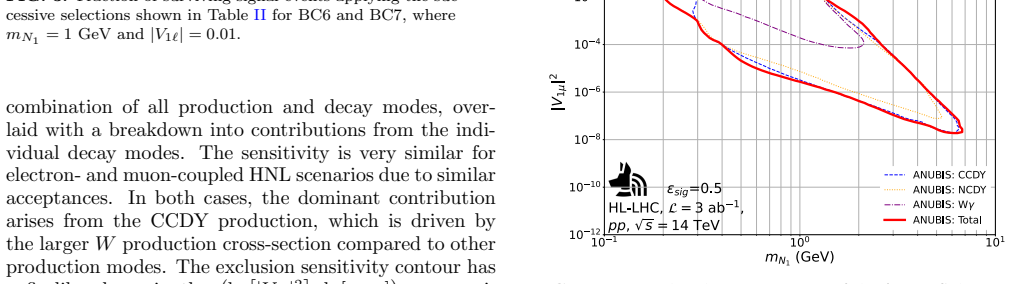
For a minimal Majorana HNL that couples exclusively to electrons, ANUBIS reaches a peak sensitivity of |V_{1e}|^2 = 1.8×10^{-8} at m_{N_1} = 6.4 GeV. The corresponding muon-channel limit is |V_{1μ}|^2 = 1.9×10^{-8} at m_{N_1} = 6.3 GeV. These numbers are obtained with the SET-ANUBIS simulation framework that incorporates the detector geometry, LHC production kinematics, and acceptance for long-lived particles decaying in the instrumented volume.
What carries the argument
The SET-ANUBIS framework, which models detector geometry, acceptance, and HNL production/decay kinematics to compute expected signal rates.
If this is right
- ANUBIS supplies complementary coverage to other proposed long-lived-particle experiments in the HNL parameter space.
- Further advances in analysis strategies during data-taking could improve the projected limits.
- The results extend the reach of the ATLAS experiment to long-lived particles that would otherwise escape detection.
- Limits obtained in the single-flavor coupling scenario directly constrain minimal models linking HNLs to neutrino mass generation.
Where Pith is reading between the lines
- If no signal is observed, the limits would narrow the viable mass and coupling range for HNL explanations of neutrino oscillation data.
- Combining ANUBIS results with existing or planned searches at other facilities could map out the full viable HNL parameter space more completely.
- Refinements to the background model or trigger algorithms could push the sensitivity below the quoted 10^{-8} level.
Load-bearing premise
The sensitivity projections depend on the accurate modeling of ANUBIS detector geometry, acceptance, and the production/decay kinematics of HNLs in the LHC as implemented in the SET-ANUBIS framework.
What would settle it
A measurement or independent simulation that finds substantially different acceptance or background rates for the same HNL masses and couplings than those assumed in SET-ANUBIS would invalidate the quoted sensitivity values.
Figures
read the original abstract
Long-Lived Particles (LLPs) are a common feature in various extensions to the Standard Model (SM) that seek to address known limitations. The ANUBIS detector has been proposed to extend the sensitivity of the ATLAS experiment at the LHC to LLPs by instrumenting the ceiling of the ATLAS detector cavern. This article presents the projected sensitivity of ANUBIS to Heavy Neutral Leptons (HNLs). For a minimal Majorana HNL model that only couples to a single flavour of lepton ($e$ or $\mu$) ANUBIS reaches a maximum sensitivity of $|V_{1e}|^2=1.8\times10^{-8}$ and $|V_{1\mu}|^2=1.9\times10^{-8}$ for a HNL mass of $m_{N_1}=6.4$ GeV and 6.3 GeV respectively. This provides complementary coverage to other proposed LLP experiments in the HNL parameter-space, with potential for significant improvement during ANUBIS data-taking through advances in analysis strategies. The results are obtained with SET-ANUBIS, a flexible framework to evaluate the sensitivity of ANUBIS to a variety of LLP models.
Editorial analysis
A structured set of objections, weighed in public.
Referee Report
Summary. The manuscript presents projected sensitivities of the proposed ANUBIS detector to heavy neutral leptons (HNLs) in a minimal Majorana model with single-flavor coupling (e or μ). Using the SET-ANUBIS Monte Carlo framework, it reports peak sensitivities of |V_{1e}|^2 = 1.8×10^{-8} at m_{N_1}=6.4 GeV and |V_{1μ}|^2 = 1.9×10^{-8} at m_{N_1}=6.3 GeV, claiming complementary coverage to other LLP experiments.
Significance. If the underlying calculations hold, the work would demonstrate ANUBIS's potential to probe previously inaccessible regions of HNL parameter space at the LHC, which is relevant for beyond-Standard-Model searches. The introduction of the flexible SET-ANUBIS framework for evaluating LLP sensitivities across models is a constructive technical contribution.
major comments (1)
- The abstract and manuscript provide no details on the SET-ANUBIS framework implementation, including production/decay kinematics modeling, detector geometry and acceptance simulation, validation against benchmarks, or systematic uncertainty treatment. These elements are load-bearing for the quoted numerical sensitivities.
Simulated Author's Rebuttal
We thank the referee for their constructive review of our manuscript. We address the single major comment below and will revise the manuscript to incorporate the requested details.
read point-by-point responses
-
Referee: The abstract and manuscript provide no details on the SET-ANUBIS framework implementation, including production/decay kinematics modeling, detector geometry and acceptance simulation, validation against benchmarks, or systematic uncertainty treatment. These elements are load-bearing for the quoted numerical sensitivities.
Authors: We agree that the current version of the manuscript lacks sufficient technical details on the SET-ANUBIS framework. In the revised manuscript we will add a dedicated section (or subsection) that describes: (i) the modeling of HNL production and decay kinematics, (ii) the implementation of the ANUBIS detector geometry and acceptance, (iii) validation of the framework against existing benchmarks or other codes, and (iv) the treatment (or absence) of systematic uncertainties in the sensitivity projections. This addition will make the quoted sensitivities fully reproducible and will address the referee's concern directly. revision: yes
Circularity Check
No significant circularity identified
full rationale
The paper computes projected sensitivity limits for HNLs using the SET-ANUBIS Monte Carlo framework. The quoted reach (|V|^2 ~ 1.8-1.9e-8 at ~6.3-6.4 GeV) is obtained by propagating production cross sections, decay lengths, geometric acceptance of the cavern volume, and signal efficiencies through the simulation; these are independent modeling inputs rather than quantities fitted to or defined by the final sensitivity number itself. No self-definitional equations, fitted-input predictions, or load-bearing self-citations appear in the derivation chain. The result is a standard forward simulation of expected experimental performance and remains self-contained against external benchmarks.
Axiom & Free-Parameter Ledger
axioms (1)
- domain assumption HNL is Majorana and couples to only one lepton flavor
Reference graph
Works this paper leans on
-
[1]
simulation of signal samples
-
[2]
acceptance determination and event selection
-
[3]
An overview of the methodology for these sections using the HNL case as an example will be highlighted in the upcoming sections
calculation of sensitivity limits. An overview of the methodology for these sections using the HNL case as an example will be highlighted in the upcoming sections. A more detailed account of the SET- ANUBIS framework will be documented in a forthcoming paper. A. Simulating Signal Samples Several Monte Carlo (MC) generators can be utilised to generate samp...
-
[4]
Antel et al.,Feebly-interacting particles: FIPs 2022 Workshop Report,Eur
C. Antel et al.,Feebly-interacting particles: FIPs 2022 Workshop Report,Eur. Phys. J. C83(2023) 1122, [2305.01715]
arXiv 2022
-
[5]
L. J. Hall, J. March-Russell and S. M. West,A Unified Theory of Matter Genesis: Asymmetric Freeze-In, 1010.0245
-
[6]
C. Cheung, G. Elor, L. J. Hall and P. Kumar,Origins of Hidden Sector Dark Matter II: Collider Physics, JHEP03(2011) 085, [1010.0024]
Pith/arXiv arXiv 2011
-
[7]
K. M. Zurek,Asymmetric Dark Matter: Theories, Signatures, and Constraints,Phys. Rept.537(2014) 91–121, [1308.0338]
Pith/arXiv arXiv 2014
-
[8]
K. Bondarenko, A. Boyarsky, D. Gorbunov and O. Ruchayskiy,Phenomenology of GeV-scale Heavy Neutral Leptons,JHEP11(2018) 032, [1805.08567]
Pith/arXiv arXiv 2018
-
[9]
R. D. Peccei and H. R. Quinn, CPConservation in the Presence of Pseudoparticles,Phys. Rev. Lett.38(6,
-
[10]
G. F. Giudice and R. Rattazzi,Theories with gauge mediated supersymmetry breaking,Phys. Rept.322 (1999) 419–499, [hep-ph/9801271]
Pith/arXiv arXiv 1999
-
[11]
G. Burdman, Z. Chacko, H.-S. Goh and R. Harnik, Folded supersymmetry and the LEP paradox,JHEP02 (2007) 009, [hep-ph/0609152]
Pith/arXiv arXiv 2007
-
[12]
M. Bauer, O. Brandt, L. Lee and C. Ohm,ANUBIS: Proposal to search for long-lived neutral particles in CERN service shafts,1909.13022. [10]ANUBIScollaboration, T. Adolphus et al.,The ANUBIS detector and its sensitivity to neutral long-lived particles,2510.26932. [11]ATLAScollaboration, G. Aad et al.,The ATLAS Experiment at the CERN Large Hadron Collider,JI...
arXiv 1909
-
[13]
S. Alekhin et al.,A facility to Search for Hidden Particles at the CERN SPS: the SHiP physics case, Rept. Prog. Phys.79(2016) 124201, [1504.04855]. [16]PBCcollaboration, J. Beacham et al.,Physics Beyond Colliders at CERN: Beyond the Standard Model Working Group Report,J. Phys. G47(2020) 010501, [1901.09966]. [17]PBCcollaboration, R. Alemany et al.,Summary...
Pith/arXiv arXiv 2016
-
[14]
V. Brdar, A. J. Helmboldt, S. Iwamoto and K. Schmitz, Type-I Seesaw as the Common Origin of Neutrino Mass, Baryon Asymmetry, and the Electroweak Scale, Phys. Rev. D100(2019) 075029, [1905.12634]. [19]Super-Kamiokandecollaboration, Y. Fukuda et al., Evidence for oscillation of atmospheric neutrinos,Phys. Rev. Lett.81(1998) 1562–1567, [hep-ex/9807003]
arXiv 2019
-
[15]
P. Li, Z. Liu and K.-F. Lyu,Heavy Neutral Leptons at Muon Colliders,JHEP03(2023) 231, [2301.07117]. [21]Particle Data Groupcollaboration, S. Navas et al., Review of particle physics,Phys. Rev. D110(8, 2024) 030001
arXiv 2023
-
[16]
D. Gorbunov and M. Shaposhnikov,How to find neutral leptons of theνMSM?,JHEP10(2007) 015, [0705.1729]
Pith/arXiv arXiv 2007
-
[17]
M. Hirsch and Z. S. Wang,Heavy neutral leptons at ANUBIS,Phys. Rev. D101(2020) 055034, [2001.04750]
arXiv 2020
-
[18]
Z. S. Wang and Y. Zhang,Updated sensitivities to heavy neutral leptons at the LHC far detectors and SHiP, Phys. Rev. D113(2026) 075024, [2512.13011]
arXiv 2026
-
[19]
Bierlich et al.,A comprehensive guide to the physics and usage of PYTHIA 8.3,SciPost Phys
C. Bierlich et al.,A comprehensive guide to the physics and usage of PYTHIA 8.3,SciPost Phys. Codeb.2022 (2022) 8, [2203.11601]
Pith/arXiv arXiv 2022
-
[20]
J. Alwall, R. Frederix, S. Frixione, V. Hirschi, F. Maltoni, O. Mattelaer et al.,The automated computation of tree-level and next-to-leading order differential cross sections, and their matching to parton shower simulations,JHEP07(2014) 079, [1405.0301]
Pith/arXiv arXiv 2014
-
[21]
C. Degrande, O. Mattelaer, R. Ruiz and J. Turner, Fully-Automated Precision Predictions for Heavy Neutrino Production Mechanisms at Hadron Colliders, Phys. Rev. D94(2016) 053002, [1602.06957]
Pith/arXiv arXiv 2016
-
[22]
A. Buckley, P. Ilten, D. Konstantinov, L. L¨ onnblad, J. Monk, W. Pokorski et al.,The HepMC3 event record library for Monte Carlo event generators,Comput. Phys. Commun.260(2021) 107310, [1912.08005]
arXiv 2021
-
[23]
A. Alloul, N. D. Christensen, C. Degrande, C. Duhr and B. Fuks,FeynRules 2.0 - A complete toolbox for tree-level phenomenology,Comput. Phys. Commun.185 (2014) 2250–2300, [1310.1921]
Pith/arXiv arXiv 2014
-
[24]
C. Degrande, C. Duhr, B. Fuks, D. Grellscheid, O. Mattelaer and T. Reiter,UFO - The Universal FeynRules Output,Comput. Phys. Commun.183(2012) 1201–1214, [1108.2040]
Pith/arXiv arXiv 2012
-
[25]
Ruiz,Quantitative study on helicity inversion in Majorana neutrino decays at the LHC,Phys
R. Ruiz,Quantitative study on helicity inversion in Majorana neutrino decays at the LHC,Phys. Rev. D 103(2021) 015022, [2008.01092]
arXiv 2021
-
[26]
Mathematica, Version 14.1
Wolfram Research, Inc., “Mathematica, Version 14.1.” https://www.wolfram.com/mathematica, Champaign, IL, 2024
2024
-
[27]
P. Artoisenet, R. Frederix, O. Mattelaer and R. Rietkerk,Automatic spin-entangled decays of heavy resonances in Monte Carlo simulations,JHEP03 (2013) 015, [1212.3460]. [34]ATLAScollaboration, M. Aaboud et al.,Performance of missing transverse momentum reconstruction with the ATLAS detector using proton-proton collisions at √s= 13 TeV,Eur. Phys. J. C78(201...
Pith/arXiv arXiv 2013
-
[28]
M. Cacciari, G. P. Salam and G. Soyez,The anti-k t jet clustering algorithm,JHEP04(2008) 063, [0802.1189]. [36]PBCcollaboration, R. Alemany Fern´ andez et al., Summary Report of the Physics Beyond Colliders Study at CERN,2505.00947
Pith/arXiv arXiv 2008
-
[29]
A. L. Read,Presentation of search results: TheCL s technique,J. Phys. G28(2002) 2693–2704. [38]NNPDFcollaboration, R. D. Ball et al.,Parton distributions with QED corrections,Nucl. Phys. B877 (2013) 290–320, [1308.0598]. 10 [39]ATLAScollaboration, M. Aaboud et al.,Search for long-lived particles produced inppcollisions at √s= 13 TeV that decay into displa...
arXiv 2002
discussion (0)
Sign in with ORCID, Apple, or X to comment. Anyone can read and Pith papers without signing in.