REVIEW 3 major objections 4 minor 106 references
The Embedder's Dilemma: LLMs Are Better, but at What Cost?
T0 review · 3 major / 4 minor · reviewed 2026-08-15 · deepseek-v4-flash
Pith's one-line read An LLM with no embedding-specific training now matches the best embedding models in aggregate, at up to 1,431x the cost.
desk verdict A well-executed, genuinely useful benchmark whose task-level findings are solid, but whose headline 'statistical tie' leans on a weighting choice the paper itself admits is fragile. read the letter →
The pith
A machine-rendered reading of the paper's core claim, the machinery that carries it, and where it could break.
The reading
What carries the argument
The load-bearing object is MTEB(LLM), a 37-task benchmark of fixed held-out subsets (seed 42) of MTEB/MMTEB tasks, wired into the MTEB framework so both paradigms are scored on identical data with the same metrics, alongside exact dollar and token accounting for every model. The organising mechanism is the joint-reading region: how many documents each architecture reads together with the query in one forward pass. Embedding bi-encoders read none (each document is encoded once, offline; a query only does vector comparisons), cross-encoders read one document at a time, LLM listwise rerankers read the top-$k$ shortlist in one pass, and corpus-in-context LLMs read the entire corpus at once. Cost and quality both rise with that region, which is why reranking is the economical way to add reasoning, and why the 'thinking-token tax' — internal reasoning tokens billed at output rates, contributing 28-81% of LLM inference cost — dominates the LLM cost side, while an ablation shows most models lose nothing in retrieval when reasoning is cut by 54-96%.
What would settle it
Scale the corpus-in-context protocol: run the same six retrieval tasks with corpora grown from 82-415 documents toward production scale, or test the LLM's retrieval lead on a benchmark whose corpus cannot fit in one prompt, and see whether the +8.5-point advantage shrinks or reverses as corpus size grows. The paper's own AILAStatutes result — the one retrieval task where the best embedding (23.2) beats the LLM (14.5) because broad reasoning over-retrieves — is an early hint that the advantage may not survive scaling. A separate check: give the LLM classification supervision, by fine-tuning or by providing the labelled reference set in context, and observe whether the -5.6-point classification gap closes as the paper predicts it would.
Extended reading notes
Core claim
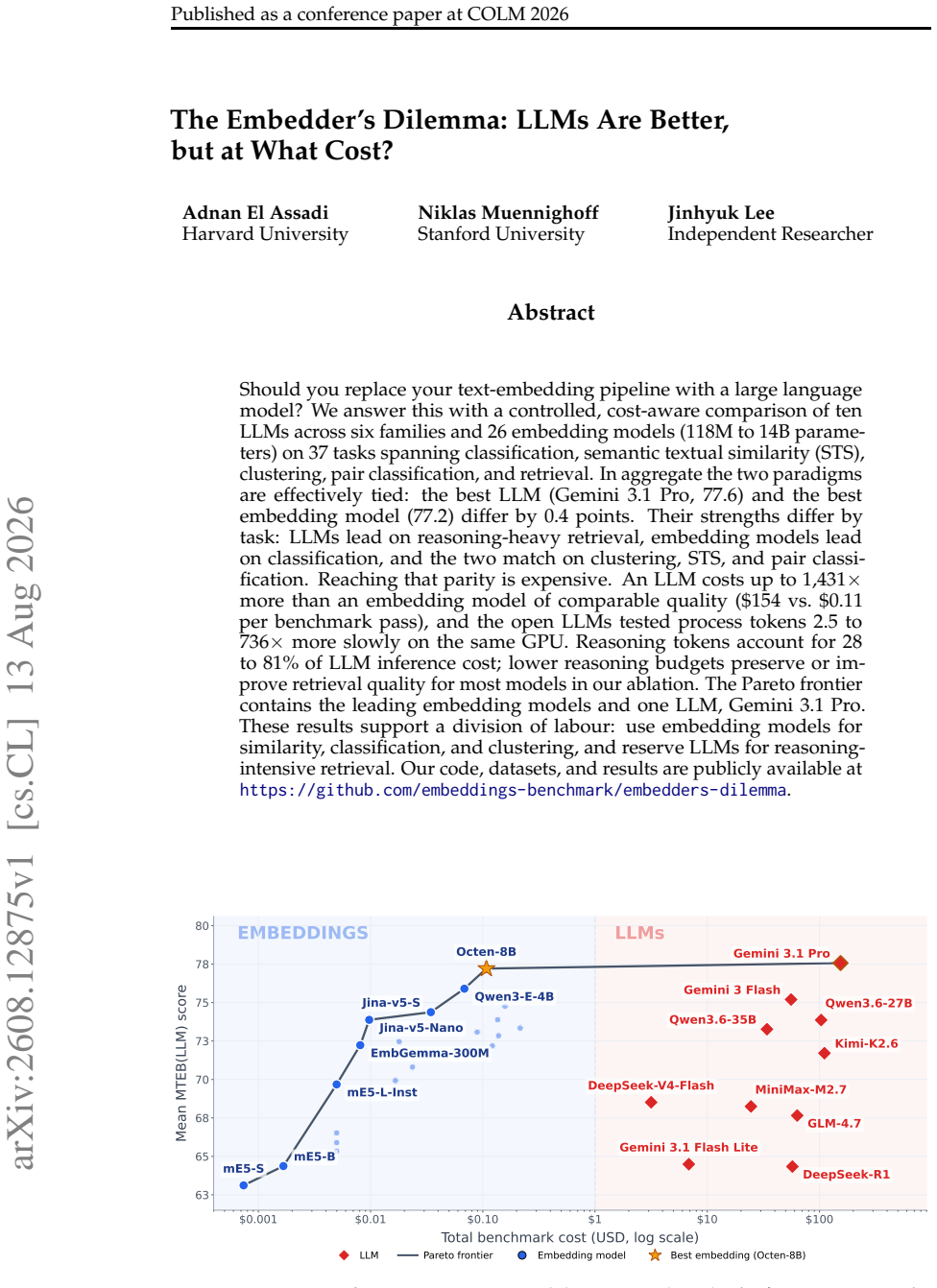
The paper's central claim is that a generative LLM with no dedicated embedding training has reached aggregate parity with the best specialised text-embedding models, and that the two paradigms now serve different tasks. On MTEB(LLM) — 37 held-out classification, STS, clustering, pair-classification, and retrieval tasks on which every model is scored identically — Gemini 3.1 Pro scores 77.6 against 77.2 for Octen-8B, a statistical tie ($p = 0.85$). The aggregate hides a consistent split: the LLM wins five of six retrieval tasks and leads the best embedding by 8.5 points there, while the top embedding models beat the LLM by 5.6 points on classification (with the gap widest on fine-grained label sets) and the paradigms are even on clustering, STS, and pair classification. This parity costs 1,431x more per benchmark pass ($154.14 vs. $0.108) and 2.5-736x lower same-hardware throughput, and the Pareto frontier over all 36 models contains the leading embedding models plus Gemini 3.1 Pro alone among LLMs. The authors read the results as the classic bi-encoder versus cross-encoder tradeoff reproduced at LLM scale, and recommend embeddings as the cost-efficient default with LLMs reserved for reasoning-heavy retrieval in a retrieve-then-rerank pipeline.
Load-bearing premise
The evaluation assumes MTEB(LLM) is a fair window onto real deployment: retrieval corpora of only 82-415 documents sit entirely inside the LLM prompt with prompt caching, which does not scale to production corpora, and the LLM classifies zero-shot while the embedding model uses kNN over the full labelled training set.
Editorial extensions
If this is right
- Practitioners should treat embedding models as the default for classification, similarity, clustering, and pair classification: across those categories, small-to-medium embedding models match or beat the best LLM at a fraction of its cost.
- For reasoning-heavy retrieval, the economical configuration is a hybrid: an embedding first stage followed by an LLM listwise reranker, which on BRIGHT lifts a strong embedding retriever from 22.3 to 35.1 nDCG@10, while on semantic BEIR the embedding alone (63.1) beats every reranked configuration.
- Default reasoning budgets are wasteful on most of these tasks: cutting reasoning tokens by 54-96% preserves or improves retrieval for four of six LLM families and changes classification by under one point, so reducing reasoning effort is a near-free cost saver.
- Accuracy-only leaderboards systematically obscure deployment reality: similarly scored systems differ by up to three orders of magnitude in cost and throughput, so evaluations should report Pareto frontiers and significance tests alongside accuracy.
- The results reproduce the classic bi-encoder versus cross-encoder tradeoff at LLM scale: quality and cost both scale with how many documents the model reads jointly with the query, predicting that the LLM advantage stays concentrated exactly where joint reading matters.
Reading between the lines
- If reasoning budgets can be capped at serving time without retrieval loss, the effective LLM cost per query on reasoning tasks could drop well below the headline 1,431x ratio, potentially moving additional LLMs onto the cost-performance frontier — a testable extension the paper does not run.
- The AILAStatutes loss hints that the corpus-in-context advantage is partly an artefact of small corpora: at production scale, where no model reads the whole corpus jointly with the query, the LLM retrieval edge may shrink, making the retrieve-then-rerank hybrid not just cheaper but also more robust.
- A matched-supervision experiment would isolate architecture from supervision: if an LLM given the same labelled references as the embedding kNN classifier (as in-context examples or via a tuned head) still trails by several points on fine-grained classification, the gap is architectural; if it closes, the gap is a protocol choice.
- The 338x-2,424x cost range across hardware scenarios suggests the dollar gap is elastic to market prices, while the 2.5-736x throughput gap is rooted in autoregressive decoding versus a single encoder pass — so the throughput gap is the more durable constraint on LLM-based pipelines.
Signed reviews
Editorial analysis
A structured set of objections, weighed in public.
Referee Report
Summary. The paper introduces MTEB(LLM), a 37-task benchmark derived from MTEB, and uses it to compare ten LLMs with 26 embedding models on classification, STS, clustering, pair classification, and retrieval, alongside exact API cost accounting and same-GPU throughput measurements. The headline claims are that the best LLM (Gemini 3.1 Pro, 77.6) and the best embedding model (Octen-8B, 77.2) are effectively tied in aggregate; that the paradigms split by task (LLMs +8.5 on retrieval, embeddings +5.6 on classification, statistical ties elsewhere); that LLM parity costs up to 1,431x more and is 2.5-736x slower on the same hardware; and that reduced reasoning budgets preserve retrieval quality for most models. The paper also reports retrieve-then-rerank experiments on BEIR/BRIGHT and recommends a hybrid deployment: embedding models for similarity/classification/clustering, LLMs for reasoning-intensive retrieval. Code, datasets, and per-task result files are released.
Significance. The contribution is substantively useful if the central claims hold. The benchmark design is transparent: every model is scored on identical held-out subsets, the cost formula (Eq. 1) is explicit, throughput is measured on common hardware, and the released GitHub/Hugging Face artifacts should make every table reproducible from raw result files. The paper also ships a detailed limitations section that candidly identifies the supervision asymmetry, small-corpus retrieval, and weighting sensitivity; these are real threats, and the authors' acknowledgement is a strength rather than a weakness. The task-level and category-level results, cost sensitivity analysis (Table 19), and the retrieve-then-rerank matrix (Table 16) provide useful evidence for practitioners. However, the 'effectively tied' aggregate claim and the task-split claims rest on a few protocol choices that are acknowledged but not fully resolved, so the headline conclusions should be read as conditional on those choices.
major comments (3)
- [Appendix A / Table 1 / Limitation (vi)] The headline aggregate is not the aggregate that is significance-tested. Table 1 defines Overall as the mean of the five category means, so each category receives weight 1/5 even though the task counts are 8 (classification), 9 (clustering), 10 (STS), 4 (pair classification), and 6 (retrieval). Appendix A, however, describes a paired bootstrap that resamples individual tasks and states that 'Equal task weighting matches the macro-average score.' Equal task weighting is not equal category weighting for this 37-task suite, so the reported Delta=+0.3, p=0.85, and 95% CI [-2.4, +3.1] characterize a task-weighted aggregate rather than the headline 77.6 vs. 77.2. Since the observed gap is 0.4 points, which is well inside the bootstrap CI, the 'effectively tied' conclusion is currently a property of the chosen category weighting rather than a demonstrated property of the models, especially given the paper's own Limitation (vi) that alternative weightings 'may shift aggregate conclusions.' Please re-run the bootstrap under the exact Table 1 aggregation (e.g., resample categories, or compute category means then average) and report a sensitivity analysis across equal-task, equal-category, Borda, and dataset-size weightings; the released result files make this straightforward.
- [§3.2 and Appendix G(iii) / §4.2] The headline retrieval advantage (+8.5) is measured under a protocol that grants the LLM structural advantages that are not quantified. In the MTEB(LLM) retrieval tasks, the full corpus (82-415 documents) is placed in the LLM prompt, prompt caching amortizes the corpus prefix, and the model can attend to all documents jointly, whereas embeddings independently encode each document and compare by cosine similarity. This is an extreme-case comparison rather than a production retrieval setting, and Appendix G(iii) concedes that the protocol's properties are 'a property of the protocol rather than a measured effect' and that corpus size was not varied. The claim that 'LLMs lead on reasoning-heavy retrieval' and the deployment recommendation to 'reserve LLMs for reasoning-intensive retrieval' therefore rest on a small-corpus, full-context protocol. The BEIR/BRIGHT reranking experiment (§4.3) is a useful complement, but it does not quantify how the MTEB(LLM) retrieval scores change with corpus size or with an indexed first stage. Please either reframe the retrieval claim as specific to corpus-in-context at 82-415 documents, or add a scaling analysis (e.g., subsample corpora to several sizes within the context window, and/or evaluate a retriever-plus-LLM-reranker pipeline on the same MTEB(LLM) retrieval tasks).
- [§4.7 / Table 15] The few-shot classification ablation does not support the inference drawn from it. The experiment gives the LLM five in-context examples, while the embedding baseline uses kNN over the full labeled training set. On Banking77 (77 classes), 5-shot performance collapses from 0.831 to 0.165, and the paper concludes 'given these results, it seems unlikely more would help.' This conclusion is not supported: a single 5-shot condition is not a scaling curve, and the collapse is exactly what one would expect when five examples must cover 77 labels. A sweep over shot counts (e.g., 0/5/10/20/50, or a label-balanced selection) is needed before concluding that additional labeled data would not close the classification gap. This matters because the 5.6-point classification disadvantage and the 'embeddings lead on classification' finding are partly determined by the supervision asymmetry chosen in §3.2.
minor comments (4)
- [Table 14] The reduced-thinking ablation states that 'Reducing thinking by 54-94% improves all six retrieval scores,' but the Think-down column is missing for AILAStatutes and TwitterHjerne, so the reduction range is not documented for two of the six tasks; please add the missing token-reduction values or restrict the claim to the four tasks with reported reductions.
- [Figure 6 / §4.2] The text says 'some embedding model matches the best LLM on 7 of 8 classification and 7 of 10 STS tasks,' but the 'best LLM' in Figure 6 is taken over all ten LLMs, while the surrounding prose often compares Gemini 3.1 Pro specifically; please make explicit which reference model is used in each claim to avoid confusion.
- [Appendix D.2 figures] Model names in the leaderboard figures are abbreviated inconsistently (e.g., 'Qwen3 Embed 8B' vs. 'Qwen3-E-8B', 'SFR Embed-2' vs. 'SFR-2'), which makes cross-referencing with Table 3 harder; please unify the naming across figures and tables.
- [Equation (1)] Equation (1) uses 'cached' as both a variable and a rate subscript; consider renaming the variable to 'cached_tokens' to avoid ambiguity with r_cache.
Circularity Check
No significant circularity: every headline quantity is a measured score, billed token count, or benchmarked throughput, not a fitted parameter renamed as a prediction.
full rationale
This paper is an empirical benchmark study, not a derivation. The central claims rest on external task data and released model outputs: the aggregate tie (77.6 vs. 77.2), the category gaps (retrieval +8.5, classification -5.6), the cost ratio (1,431x), the throughput gap (2.5-736x), and the reasoning-token share (28-81%) are all measured quantities computed from the released MTEB(LLM) tasks, API token accounting, and GPU throughput benchmarks. No parameter is fitted to a subset of data and then presented as a prediction of a closely related quantity, and no result is defined in terms of another result it purports to explain. Self-citations are present (MTEB, MAEB, MVEB, HUME) but none is load-bearing: MTEB is used as a public task source, and the others are contextual related work. The only in-scope concern is a statistical-validity issue, not circularity: Appendix A's bootstrap resamples individual tasks and states that 'Equal task weighting matches the macro-average score,' whereas Table 1 defines Overall as the mean of the five category means; with uneven category sizes (8/9/10/4/6 tasks), the reported p=0.85 and CI [-2.4, +3.1] attach to a task-weighted aggregate rather than the headline category-weighted score. The paper's own Limitation (vi) concedes that 'alternative weighting schemes... may shift aggregate conclusions.' That is a robustness concern about which aggregation the tie claim refers to, not a case of a prediction reducing to its inputs by construction, so it does not raise the circularity score.
Assumptions & free parameters
free parameters (1)
- pair-classification threshold =
per task, chosen post-hoc to maximize AP on the test set
assumptions (5)
- domain assumption The 37 MTEB(LLM) tasks, as fixed subsets with seed 42, are representative of the full MTEB benchmark and of real text-embedding workloads.
- domain assumption Small-corpus retrieval with the corpus in the LLM prompt is a valid way to measure the paradigm gap for reasoning-heavy retrieval.
- domain assumption kNN over the full labelled training set for embeddings versus zero-shot prompting for LLMs is the appropriate deployment comparison.
- domain assumption Post-hoc threshold selection on the test set for pair classification is a fair convention.
- domain assumption API pricing and H100 spot rates used for cost accounting are representative.
Cite this review
Pith. "Pith review of The Embedder's Dilemma: LLMs Are Better, but at What Cost?." pith.science (2026). https://pith.science/paper/ZLJIVJZI
@misc{pith2026260812875,
  author       = {Pith},
  title        = {Pith review of: The Embedder's Dilemma: LLMs Are Better, but at What Cost?},
  year         = {2026},
  howpublished = {\url{https://pith.science/paper/ZLJIVJZI}},
  note         = {Machine review of arXiv:2608.12875}
}
read the original abstract
Should you replace your text-embedding pipeline with a large language model? We answer this with a controlled, cost-aware comparison of ten LLMs across six families and 26 embedding models (118M to 14B parameters) on 37 tasks spanning classification, semantic textual similarity (STS), clustering, pair classification, and retrieval. In aggregate the two paradigms are effectively tied: the best LLM (Gemini 3.1 Pro, 77.6) and the best embedding model (77.2) differ by 0.4 points. Their strengths differ by task: LLMs lead on reasoning-heavy retrieval, embedding models lead on classification, and the two match on clustering, STS, and pair classification. Reaching that parity is expensive. An LLM costs up to 1,431x more than an embedding model of comparable quality (USD 154 vs. USD 0.11 per benchmark pass), and the open LLMs tested process tokens 2.5 to 736x more slowly on the same GPU. Reasoning tokens account for 28 to 81% of LLM inference cost; lower reasoning budgets preserve or improve retrieval quality for most models in our ablation. The Pareto frontier contains the leading embedding models and one LLM, Gemini 3.1 Pro. These results support a division of labour: use embedding models for similarity, classification, and clustering, and reserve LLMs for reasoning-intensive retrieval. Our code, datasets, and results are publicly available at https://github.com/embeddings-benchmark/embedders-dilemma.
Figures


Figures from the paper (12 more)


Reference graph
Works this paper leans on
- [1]
-
[2]
Aaron Grattafiori and others , year=. The. 2407.21783 , archivePrefix=
- [3]
-
[4]
2025 , eprint=
Rank1: Test-Time Compute for Reranking in Information Retrieval , author=. 2025 , eprint=
2025
-
[5]
2025 , eprint=
When Text Embedding Meets Large Language Model: A Comprehensive Survey , author=. 2025 , eprint=
2025
-
[6]
ACM Transactions on Information Systems , year=
Llms are also effective embedding models: An in-depth overview , author=. ACM Transactions on Information Systems , year=
-
[7]
arXiv preprint arXiv:2501.14249 , year=
Humanity's last exam , author=. arXiv preprint arXiv:2501.14249 , year=
-
[8]
Proceedings of the 17th Conference of the European Chapter of the Association for Computational Linguistics , pages=
Muennighoff, Niklas and Tazi, Nouamane and Magne, Lo. Proceedings of the 17th Conference of the European Chapter of the Association for Computational Linguistics , pages=. 2023 , eprint=
2023
Show all 106 references
-
[9]
2025 , eprint=
HUME: Measuring the Human-Model Performance Gap in Text Embedding Tasks , author=. 2025 , eprint=
2025
-
[10]
2025 , eprint=
MIEB: Massive Image Embedding Benchmark , author=. 2025 , eprint=
2025
-
[11]
2026 , eprint=
MAEB: Massive Audio Embedding Benchmark , author=. 2026 , eprint=
2026
-
[12]
2026 , eprint=
MVEB: Massive Video Embedding Benchmark , author=. 2026 , eprint=
2026
-
[13]
2025 , eprint=
MMTEB: Massive Multilingual Text Embedding Benchmark , author=. 2025 , eprint=
2025
-
[14]
Sentence-
Reimers, Nils and Gurevych, Iryna , booktitle=. Sentence-. 2019 , url=
2019
-
[15]
2022 , eprint=
Text Embeddings by Weakly-Supervised Contrastive Pre-training , author=. 2022 , eprint=
2022
-
[16]
2024 , eprint=
Improving Text Embeddings with Large Language Models , author=. 2024 , eprint=
2024
-
[17]
2023 , eprint=
Towards General Text Embeddings with Multi-stage Contrastive Learning , author=. 2023 , eprint=
2023
-
[18]
2024 , eprint=
Generative Representational Instruction Tuning , author=. 2024 , eprint=
2024
-
[19]
2024 , eprint=
C-Pack: Packed Resources For General Chinese Embeddings , author=. 2024 , eprint=
2024
-
[20]
2024 , eprint=
Jina Embeddings 2: 8192-Token General-Purpose Text Embeddings for Long Documents , author=. 2024 , eprint=
2024
-
[21]
2025 , eprint=
M3-Embedding: Multi-Linguality, Multi-Functionality, Multi-Granularity Text Embeddings Through Self-Knowledge Distillation , author=. 2025 , eprint=
2025
-
[22]
Zheng, Lianmin and Chiang, Wei-Lin and Sheng, Ying and Zhuang, Siyuan and Wu, Zhanghao and Zhuang, Yonghao and Lin, Zi and Li, Zhuohan and Li, Dacheng and Xing, Eric and others , booktitle=. Judging. 2023 , url=
2023
-
[23]
2023 , eprint=
Text Classification via Large Language Models , author=. 2023 , eprint=
2023
-
[24]
Can Long-Context Language Models Subsume Retrieval,
Jinhyuk Lee and Anthony Chen and Zhuyun Dai and Dheeru Dua and Devendra Singh Sachan and Michael Boratko and Yi Luan and S\'. Can Long-Context Language Models Subsume Retrieval,. 2024 , eprint=
2024
- [25]
-
[26]
2023 , eprint=
Scaling Sentence Embeddings with Large Language Models , author=. 2023 , eprint=
2023
-
[27]
2404.05961 , archivePrefix=
Parishad BehnamGhader and Vaibhav Adlakha and Marius Mosbach and Dzmitry Bahdanau and Nicolas Chapados and Siva Reddy , year=. 2404.05961 , archivePrefix=
-
[28]
2025 , booktitle=
Repetition Improves Language Model Embeddings , author=. 2025 , booktitle=. 2402.15449 , archivePrefix=
2025 arXiv
- [29]
-
[30]
Energy and Policy Considerations for Deep Learning in
Strubell, Emma and Ganesh, Ananya and McCallum, Andrew , booktitle=. Energy and Policy Considerations for Deep Learning in. 2019 , url=
2019
-
[31]
2021 , eprint=
Carbon Emissions and Large Neural Network Training , author=. 2021 , eprint=
2021
-
[32]
2305.05176 , archivePrefix=
Lingjiao Chen and Matei Zaharia and James Zou , year=. 2305.05176 , archivePrefix=
-
[33]
Thirty-fifth Conference on Neural Information Processing Systems Datasets and Benchmarks Track , year=
Thakur, Nandan and Reimers, Nils and R. Thirty-fifth Conference on Neural Information Processing Systems Datasets and Benchmarks Track , year=
-
[34]
Proceedings of the 2020 Conference on Empirical Methods in Natural Language Processing , pages=
Dense Passage Retrieval for Open-Domain Question Answering , author=. Proceedings of the 2020 Conference on Empirical Methods in Natural Language Processing , pages=. 2020 , url=
2020
-
[35]
Retrieval-Augmented Generation for Knowledge-Intensive
Lewis, Patrick and Perez, Ethan and Piktus, Aleksandra and Petroni, Fabio and Karpukhin, Vladimir and Goyal, Naman and K. Retrieval-Augmented Generation for Knowledge-Intensive. Advances in Neural Information Processing Systems , volume=. 2020 , url=
2020
-
[36]
2024 , eprint=
Retrieval-Augmented Generation for Large Language Models: A Survey , author=. 2024 , eprint=
2024
-
[37]
Glass, Michael and Rossiello, Gaetano and Chowdhury, Md Faisal Mahbub and Naber, Ankita and Nair, Pengshan and Gliozzo, Alfio , booktitle=. Re2. 2022 , url=
2022
-
[38]
2022 , eprint=
Training Compute-Optimal Large Language Models , author=. 2022 , eprint=
2022
-
[39]
2020 , eprint=
Scaling Laws for Neural Language Models , author=. 2020 , eprint=
2020
-
[40]
Advances in Neural Information Processing Systems , title=
Vaswani, Ashish and Shazeer, Noam and Parmar, Niki and Uszkoreit, Jakob and Jones, Llion and Gomez, Aidan N and Kaiser,. Advances in Neural Information Processing Systems , title=. 2017 , url=
2017
-
[41]
2019 , url=
Devlin, Jacob and Chang, Ming-Wei and Lee, Kenton and Toutanova, Kristina , booktitle=. 2019 , url=
2019
-
[42]
Advances in Neural Information Processing Systems , volume=
Language Models are Few-Shot Learners , author=. Advances in Neural Information Processing Systems , volume=. 2020 , url=
2020
-
[43]
Advances in Neural Information Processing Systems , volume=
Chain-of-Thought Prompting Elicits Reasoning in Large Language Models , author=. Advances in Neural Information Processing Systems , volume=. 2022 , url=
2022
-
[44]
2506.20923 , archivePrefix=
Xinping Zhao and Xinshuo Hu and Zifei Shan and Zetian Sun and Zhenyu Liu and Dongfang Li and Shaolin Ye and Xinyuan Wei and Qian Chen and Baotian Hu and Haofen Wang and Jun Yu and Min Zhang , year=. 2506.20923 , archivePrefix=
- [45]
-
[46]
jina-embeddings-v3: Multilingual Embeddings With Task
Saba Sturua and Isabelle Mohr and Mohammad Kalim Akram and Michael G. jina-embeddings-v3: Multilingual Embeddings With Task. 2024 , eprint=
2024
-
[47]
2024 , url=
SFR-Embedding-2: Advanced Text Embedding with Multi-stage Training , author=. 2024 , url=
2024
-
[48]
Weiwei Sun and Lingyong Yan and Xinyu Ma and Pengjie Ren and Dawei Yin and Zhaochun Ren , year=. Is. 2304.09542 , archivePrefix=
-
[49]
Findings of the Association for Computational Linguistics:
One Embedder, Any Task: Instruction-Finetuned Text Embeddings , author=. Findings of the Association for Computational Linguistics:. 2023 , eprint=
2023
-
[50]
Cost-Aware Model Selection for Text Classification: Multi-Objective Trade-offs Between Fine-Tuned Encoders and
Alberto Andres Valdes Gonzalez , year=. Cost-Aware Model Selection for Text Classification: Multi-Objective Trade-offs Between Fine-Tuned Encoders and. 2602.06370 , archivePrefix=
-
[51]
Fine-Tuned `Small'
Martin Juan Jos. Fine-Tuned `Small'. 2024 , eprint=
2024
-
[52]
Siegel and Michael Tang and Ruoxi Sun and Jinsung Yoon and Sercan Arik and Danqi Chen and Tao Yu , year=
Hongjin Su and Howard Yen and Mengzhou Xia and Weijia Shi and Niklas Muennighoff and Han-yu Wang and Haisu Liu and Quan Shi and Zachary S. Siegel and Michael Tang and Ruoxi Sun and Jinsung Yoon and Sercan Arik and Danqi Chen and Tao Yu , year=. 2407.12883 , archivePrefix=
-
[53]
2025 , eprint=
Eliciting In-context Retrieval and Reasoning for Long-context Large Language Models , author=. 2025 , eprint=
2025
-
[54]
Retrieval Augmented Generation or Long-Context
Zhuowan Li and Cheng Li and Mingyang Zhang and Qiaozhu Mei and Michael Bendersky , year=. Retrieval Augmented Generation or Long-Context. 2407.16833 , archivePrefix=
-
[55]
2025 , eprint=
Rethinking Reasoning in Document Ranking: Why Chain-of-Thought Falls Short , author=. 2025 , eprint=
2025
-
[56]
Proceedings of Machine Learning and Systems , volume=
Prompt Cache: Modular Attention Reuse for Low-Latency Inference , author=. Proceedings of Machine Learning and Systems , volume=. 2024 , eprint=
2024
-
[57]
Proceedings of the 2020 Conference on Empirical Methods in Natural Language Processing , pages=
With Little Power Comes Great Responsibility , author=. Proceedings of the 2020 Conference on Empirical Methods in Natural Language Processing , pages=. 2020 , url=
2020
-
[58]
2021 , eprint=
The Benchmark Lottery , author=. 2021 , eprint=
2021
-
[59]
Efron , journal =
B. Efron , journal =. Bootstrap Methods: Another Look at the Jackknife , urldate =
-
[60]
Advances in Neural Information Processing Systems , volume=
Distributed Representations of Words and Phrases and Their Compositionality , author=. Advances in Neural Information Processing Systems , volume=. 2013 , url=
2013
-
[61]
G lo V e: Global Vectors for Word Representation
Pennington, Jeffrey and Socher, Richard and Manning, Christopher. G lo V e: Global Vectors for Word Representation. Proceedings of the 2014 Conference on Empirical Methods in Natural Language Processing ( EMNLP ). 2014. doi:10.3115/v1/D14-1162
2014 doi
-
[62]
Proceedings of the 2017 Conference on Empirical Methods in Natural Language Processing , pages=
Supervised Learning of Universal Sentence Representations from Natural Language Inference Data , author=. Proceedings of the 2017 Conference on Empirical Methods in Natural Language Processing , pages=. 2017 , url=
2017
-
[63]
Gonzalez and Hao Zhang and Ion Stoica , year=
Woosuk Kwon and Zhuohan Li and Siyuan Zhuang and Ying Sheng and Lianmin Zheng and Cody Hao Yu and Joseph E. Gonzalez and Hao Zhang and Ion Stoica , year=. Efficient Memory Management for Large Language Model Serving with. 2309.06180 , archivePrefix=
-
[64]
Charlie Snell and Jaehoon Lee and Kelvin Xu and Aviral Kumar , year=. Scaling. 2408.03314 , archivePrefix=
-
[65]
2020 , url=
Khattab, Omar and Zaharia, Matei , booktitle=. 2020 , url=
2020
-
[66]
The Thirteenth International Conference on Learning Representations , eprint=
Chankyu Lee and Rajarshi Roy and Mengyao Xu and Jonathan Raiman and Mohammad Shoeybi and Bryan Catanzaro and Wei Ping , year=. The Thirteenth International Conference on Learning Representations , eprint=
-
[67]
2024 , eprint=
Nomic Embed: Training a Reproducible Long Context Text Embedder , author=. 2024 , eprint=
2024
-
[68]
2025 , eprint=
Beyond Chinchilla-Optimal: Accounting for Inference in Language Model Scaling Laws , author=. 2025 , eprint=
2025
-
[69]
2024 , eprint=
Inference Scaling Laws: An Empirical Analysis of Compute-Optimal Inference for Problem-Solving with Language Models , author=. 2024 , eprint=
2024
-
[70]
2025 , eprint=
Stop Overthinking: A Survey on Efficient Reasoning for Large Language Models , author=. 2025 , eprint=
2025
-
[71]
Gonzalez and M Waleed Kadous and Ion Stoica , year=
Isaac Ong and Amjad Almahairi and Vincent Wu and Wei-Lin Chiang and Tianhao Wu and Joseph E. Gonzalez and M Waleed Kadous and Ion Stoica , year=. 2406.18665 , archivePrefix=
-
[72]
Gemini Embedding: Generalizable Embeddings from
Jinhyuk Lee and Feiyang Chen and Sahil Dua and Daniel Cer and Madhuri Shanbhogue and Iftekhar Naim and Gustavo Hern\'. Gemini Embedding: Generalizable Embeddings from. 2025 , eprint=
2025
-
[73]
2022 , eprint=
Matryoshka Representation Learning , author=. 2022 , eprint=
2022
-
[74]
2024 , eprint=
When Text Embedding Meets Large Language Model: A Comprehensive Survey , author=. 2024 , eprint=
2024
-
[75]
2021 , publisher=
Keisuke Sakaguchi and Ronan Le Bras and Chandra Bhagavatula and Yejin Choi , journal=. 2021 , publisher=
2021
-
[76]
Proceedings of the 2nd Workshop on Natural Language Processing for Conversational AI , year=
Efficient Intent Detection with Dual Sentence Encoders , author=. Proceedings of the 2nd Workshop on Natural Language Processing for Conversational AI , year=
-
[77]
2204.08582 , archivePrefix=
Jack FitzGerald and Christopher Hench and Charith Peris and Scott Mackie and Kay Rottmann and Ana Sanchez and Aaron Nash and Liam Urbach and Vishesh Kakarala and Richa Singh and Swetha Ranganath and Laurie Crist and Misha Britan and Wouter Leeuwis and Gokhan Tur and Prem Natar...
-
[78]
Bioinformatics , volume=
Gizem So. Bioinformatics , volume=. 2017 , publisher=
2017
-
[79]
Proceedings of the 11th International Workshop on Semantic Evaluation (SemEval-2017) , year=
Daniel Cer and Mona Diab and Eneko Agirre and I. Proceedings of the 11th International Workshop on Semantic Evaluation (SemEval-2017) , year=
2017
-
[80]
A SICK cure for the evaluation of compositional distributional semantic models
Marelli, Marco and Menini, Stefano and Baroni, Marco and Bentivogli, Luisa and Bernardi, Raffaella and Zamparelli, Roberto. A SICK cure for the evaluation of compositional distributional semantic models. Proceedings of the Ninth International Conference on Language Resources a...
2014
-
[81]
Ho and Christopher R
Neel Guha and Julian Nyarko and Daniel E. Ho and Christopher R. Advances in Neural Information Processing Systems , year=
-
[82]
2021 , url=
Roshanak Mirzaee and Hossein Rajaby Faghihi and Qiang Ning and Parisa Kordjamshidi , booktitle=. 2021 , url=
2021
-
[83]
and Daly, Raymond E
Maas, Andrew L. and Daly, Raymond E. and Pham, Peter T. and Huang, Dan and Ng, Andrew Y. and Potts, Christopher. Learning Word Vectors for Sentiment Analysis. Proceedings of the 49th Annual Meeting of the Association for Computational Linguistics: Human Language Technologies. 2011
2011
-
[84]
2019 , eprint=
Nuanced Metrics for Measuring Unintended Bias with Real Data for Text Classification , author=. 2019 , eprint=
2019
-
[85]
2021 , eprint=
I Wish I Would Have Loved This One, But I Didn't -- A Multilingual Dataset for Counterfactual Detection in Product Reviews , author=. 2021 , eprint=
2021
-
[86]
2021 , eprint=
MTOP: A Comprehensive Multilingual Task-Oriented Semantic Parsing Benchmark , author=. 2021 , eprint=
2021
-
[87]
S em E val-2012 Task 6: A Pilot on Semantic Textual Similarity
Agirre, Eneko and Cer, Daniel and Diab, Mona and Gonzalez-Agirre, Aitor. S em E val-2012 Task 6: A Pilot on Semantic Textual Similarity. * SEM 2012: The First Joint Conference on Lexical and Computational Semantics -- Volume 1: Proceedings of the main conference and the shared...
2012
-
[88]
* SEM 2013 shared task: Semantic Textual Similarity
Agirre, Eneko and Cer, Daniel and Diab, Mona and Gonzalez-Agirre, Aitor and Guo, Weiwei. * SEM 2013 shared task: Semantic Textual Similarity. Second Joint Conference on Lexical and Computational Semantics (* SEM ), Volume 1: Proceedings of the Main Conference and the Shared Ta...
2013
-
[89]
S em E val-2014 Task 10: Multilingual Semantic Textual Similarity
Agirre, Eneko and Banea, Carmen and Cardie, Claire and Cer, Daniel and Diab, Mona and Gonzalez-Agirre, Aitor and Guo, Weiwei and Mihalcea, Rada and Rigau, German and Wiebe, Janyce. S em E val-2014 Task 10: Multilingual Semantic Textual Similarity. Proceedings of the 8th Intern...
2014 doi
-
[90]
S em E val-2015 Task 2: Semantic Textual Similarity, E nglish, S panish and Pilot on Interpretability
Agirre, Eneko and Banea, Carmen and Cardie, Claire and Cer, Daniel and Diab, Mona and Gonzalez-Agirre, Aitor and Guo, Weiwei and Lopez-Gazpio, I \ n igo and Maritxalar, Montse and Mihalcea, Rada and Rigau, German and Uria, Larraitz and Wiebe, Janyce. S em E val-2015 Task 2: Se...
2015 doi
-
[91]
S em E val-2016 Task 1: Semantic Textual Similarity, Monolingual and Cross-Lingual Evaluation
Agirre, Eneko and Banea, Carmen and Cer, Daniel and Diab, Mona and Gonzalez-Agirre, Aitor and Mihalcea, Rada and Rigau, German and Wiebe, Janyce. S em E val-2016 Task 1: Semantic Textual Similarity, Monolingual and Cross-Lingual Evaluation. Proceedings of the 10th Internationa...
2016 doi
-
[92]
S em E val-2022 Task 8: Multilingual news article similarity
Chen, Xi and Zeynali, Ali and Camargo, Chico and Fl. S em E val-2022 Task 8: Multilingual news article similarity. Proceedings of the 16th International Workshop on Semantic Evaluation (SemEval-2022). 2022. doi:10.18653/v1/2022.semeval-1.155
2022 doi
-
[93]
BIGPATENT : A Large-Scale Dataset for Abstractive and Coherent Summarization
Sharma, Eva and Li, Chen and Wang, Lu. BIGPATENT : A Large-Scale Dataset for Abstractive and Coherent Summarization. Proceedings of the 57th Annual Meeting of the Association for Computational Linguistics. 2019. doi:10.18653/v1/P19-1212
2019 doi
-
[94]
A Continuously Growing Dataset of Sentential Paraphrases
Lan, Wuwei and Qiu, Siyu and He, Hua and Xu, Wei. A Continuously Growing Dataset of Sentential Paraphrases. Proceedings of the 2017 Conference on Empirical Methods in Natural Language Processing. 2017. doi:10.18653/v1/D17-1126
2017 doi
-
[95]
The Third PASCAL Recognizing Textual Entailment Challenge
Giampiccolo, Danilo and Magnini, Bernardo and Dagan, Ido and Dolan, Bill. The Third PASCAL Recognizing Textual Entailment Challenge. Proceedings of the ACL - PASCAL Workshop on Textual Entailment and Paraphrasing. 2007
2007
-
[96]
Towards Benchmarking and Improving the Temporal Reasoning Capability of Large Language Models
Tan, Qingyu and Ng, Hwee Tou and Bing, Lidong. Towards Benchmarking and Improving the Temporal Reasoning Capability of Large Language Models. Proceedings of the 61st Annual Meeting of the Association for Computational Linguistics (Volume 1: Long Papers). 2023. doi:10.18653/v1/...
2023 doi
-
[97]
Danoliteracy of Generative Large Language Models
Vejlgaard Holm, S ren and Hansen, Lars Kai and Nielsen, Martin Carsten. Danoliteracy of Generative Large Language Models. Proceedings of the Joint 25th Nordic Conference on Computational Linguistics and 11th Baltic Conference on Human Language Technologies (NoDaLiDa/Baltic-HLT...
2025
-
[98]
Adversarial Domain Adaptation for Duplicate Question Detection
Shah, Darsh and Lei, Tao and Moschitti, Alessandro and Romeo, Salvatore and Nakov, Preslav. Adversarial Domain Adaptation for Duplicate Question Detection. Proceedings of the 2018 Conference on Empirical Methods in Natural Language Processing. 2018. doi:10.18653/v1/D18-1131
2018 doi
-
[99]
2024 , eprint=
Arctic-Embed 2.0: Multilingual Retrieval Without Compromise , author=. 2024 , eprint=
2024
-
[100]
2024 , eprint=
Linq-Embed-Mistral Technical Report , author=. 2024 , eprint=
2024
-
[101]
2603.19223 , archivePrefix=
Ziyin Zhang and Zihan Liao and Hang Yu and Peng Di and Rui Wang , year=. 2603.19223 , archivePrefix=
-
[102]
Findings of the Association for Computational Linguistics: EMNLP 2020 , pages=
d'Hoffschmidt, Martin and Belblidia, Wacim and Heinrich, Quentin and Brendl. Findings of the Association for Computational Linguistics: EMNLP 2020 , pages=. 2020 , url=
2020
-
[103]
How Close is
Guo, Biyang and Zhang, Xin and Wang, Ziyuan and Jiang, Minqi and Nie, Jinran and Ding, Yuxuan and Yue, Jianwei and Wu, Yupeng , journal=. How Close is. 2023 , url=
2023
-
[104]
2025 , eprint=
EmbeddingGemma: Powerful and Lightweight Text Representations , author=. 2025 , eprint=
2025
-
[105]
2025 , eprint=
Llama-Embed-Nemotron-8B: A Universal Text Embedding Model for Multilingual and Cross-Lingual Tasks , author=. 2025 , eprint=
2025
-
[106]
2026 , eprint=
jina-embeddings-v5-text: Task-Targeted Embedding Distillation , author=. 2026 , eprint=
2026
Reviewed August 15, 2026 · model on record in the stance chip above.
Discussion (0). Continue with ORCID to comment.