REVIEW 3 major objections 4 minor 61 references
TideRL: Boosting Agentic RL Goodput with Readiness-Aware Scheduling
T0 review · 3 major / 4 minor · reviewed 2026-08-15 · deepseek-v4-flash
Pith's one-line read TideRL claims that agentic RL training goodput—the rollout tokens that actually reach the trainer and advance an update—can rise by up to 5.6× over synchronous baselines and by more than 33% over asynchronous ones when rollout…
desk verdict A credible, well-engineered systems integration whose end-to-end numbers I'd trust only after code and error bars, and whose zero-overhead migration claim needs explicit scoping for evaluation tasks. read the letter →
The pith
A machine-rendered reading of the paper's core claim, the machinery that carries it, and where it could break.
The reading
What carries the argument
The central object is the readiness-signal pair (RAS, TPRM): RAS is the number of micro-batches already waiting in the global buffer when a training step begins, and TPRM is the interval at which additional micro-batches become ready during the step. Everything in the system is coupled to this pair: Continuous Task Batching shapes when trajectories become ready, RA2P selects decoupled streaming versus colocated aggregation from the pair, and Elastic Resource Scaling reallocates GPU ranks to shrink whichever side is waiting. The load-bearing identity is the natural weight-sync boundary of on-policy RL: once new weights arrive, all prior KV caches are mathematically stale and must be flushed, so a migrating rank can discard its cached context for free, join the weight broadcast, and resume with the new policy without a pipeline suspension or an NCCL group rebuild.
What would settle it
Run one training step that contains live rollout groups and an in-flight evaluation batch pinned to an anchored frozen model, and trigger a rank migration while that batch is active. If the migration forces the pipeline to suspend, rebuilds a communication group, or reloads any KV cache for the evaluation tasks, the zero-overhead elasticity claim is falsified; the wall-clock cost of the migration itself is the observable.
Extended reading notes
Core claim
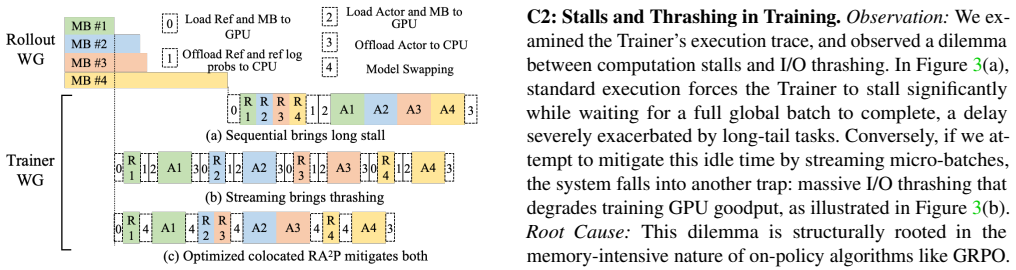
TideRL's central claim is that the three inefficiencies of agentic RL training—KV-cache preemption while tasks wait on environments, trainer stalls or reference-actor swap thrashing while micro-batches arrive unevenly, and static GPU partitions that cannot follow a shifting producer-consumer bottleneck—share one root cause: nobody schedules from task-level readiness. The proposed mechanism is a single feedback loop. Continuous Task Batching keeps useful rollout state resident by admitting, pausing, and resuming tasks with token-aware priorities that favor evaluation boundaries, near-complete GRPO groups, active trajectories, and long contexts. Resource-Aware Ref-Actor Pipelining consumes ready micro-batches through two modes selected by readiness signals: decoupled streaming, with loss computation deferred into the backward pass so reference forward, actor forward, and actor backward overlap with zero model swaps, and colocated aggregation with zero-copy shared-memory transfer when data is sparse. Elastic Resource Scaling moves individual ranks between rollout and training using those same signals, and because on-policy RL already invalidates every KV cache at each weight-sync boundary, the migration can discard caches for free and hide weight movement under the synchronization broadcast. With this loop, the paper reports training-throughput gains up to 5.6× over the best synchronous baseline and more than 1.33× over the asynchronous baselines on text and multi-modal agentic workloads, with task performance within 0.01 best-of-N reward and 0.5% pass rate of the synchronous reference.
Load-bearing premise
The whole scheme assumes that every rollout task's cached context becomes worthless the instant new model weights arrive, so a rank can be moved without saving anything; the paper's own limitations concede that evaluation tasks need an anchored, frozen model version, and keeping that version in sync can disturb the asynchronous pipeline—the one place where that free-discard assumption does not obviously hold.
Editorial extensions
If this is right
- Synchronous phase barriers for agentic RL sacrifice most of the available goodput; adopting readiness-aware scheduling recovers up to 5.6× training throughput on text workloads and over 33% on multimodal workloads at near-identical task performance.
- Elevating rollout scheduling from requests to tasks raises KV cache hit rate by 1.58× and generation throughput by 1.15×, because paused multi-turn tasks keep their context instead of being evicted while waiting for environment feedback.
- Reference-actor execution does not have to choose between computation stalls and model-swap thrashing: decoupled streaming with deferred loss suits abundant ready data, and ready-batch aggregation with zero-copy transfer suits sparse data, cutting per-step training time by up to 44.3%.
- Rank migration between rollout and training can be made effectively free by aligning it with the post-update cache flush, so a fixed GPU pool can absorb shifting bottlenecks and cut total waiting time by up to 77.6%.
- Asynchronous RL systems can go faster without adding GPUs; they need to react to readiness signals, since elastic reallocation within a fixed allocation beats the best static rollout fraction.
Reading between the lines
- Beyond the paper, the same RAS/TPRM mode-selection logic could address the evaluation-phase gap the authors leave for future work: a relay weight-synchronization path that keeps a frozen evaluation model separate would let the zero-overhead migration premise extend to steps containing evaluation tasks.
- Beyond the paper, readiness-driven scheduling of this kind could transfer to interactive agent serving, where cache pinning and prefill decisions are made at task granularity; the difference is that serving lacks the weight-sync boundary that makes TideRL's migration free, so elasticity there would need a different cost argument.
- Beyond the paper, the free-migration argument depends on the algorithm being on-policy with periodic full weight synchronization; for any future RL variant that allows stale KV caches to remain useful across weight updates, the zero-overhead elasticity claim would need to be re-derived.
Signed reviews
Editorial analysis
A structured set of objections, weighed in public.
Referee Report
Summary. The paper presents TideRL, an asynchronous reinforcement learning (RL) system for multi-turn agentic workloads. Three co-designed mechanisms are introduced: Continuous Task Batching (CTB) for task-level KV-cache-aware rollout scheduling, Resource-Aware Ref-Actor Pipelining (RA2P) that switches between decoupled streaming and colocated aggregation based on data readiness, and Elastic Resource Scaling (ERS) that migrates ranks between rollout and training using the same readiness signals. The paper claims up to 5.6x training-goodput improvement over the synchronous VeRL baseline, over 33% over asynchronous baselines (AReaL, StreamRL), comparable task performance, a 1.58x KV cache hit-rate improvement, 44.3% per-step training time reduction, and up to 77.6% waiting-time reduction. The evaluation covers text-only (WebShop, AlfWorld) and multimodal (OSWorld, ScienceBoard) tasks with Qwen models on 32 H100 GPUs.
Significance. If the claims are validated, TideRL is a substantive systems contribution. The paper correctly identifies real bottlenecks in agentic RL (KV-cache preemption, ref-actor thrashing, static resource allocation) and proposes a coherent, well-motivated co-design. The goodput definition (training throughput excluding stale tokens) is appropriate for on-policy RL. The component-wise motivation is supported by measurements (Figures 2-4), and the implementation is modular. However, the empirical validation has gaps: no repeated runs or error bars, a quantitative inconsistency in the ablation table, and an unresolved tension between the zero-overhead elasticity claim and the paper's own limitations about evaluation tasks. These issues make the central quantitative claims not yet fully supported.
major comments (3)
- [Section 6.4, Table 2] The improvement percentages in Table 2 do not match the listed throughput values. The baseline is 20.2 k token/s; adding RA2P gives 23.1, which is an increase of 14.4%, not 10.4%. Adding ERS to that gives 31.8, an increase of 37.7% over 23.1, not 35.7%. The 4.8% for CTB is close (33.3/31.8 = 1.047). This internal inconsistency affects the paper's component-wise attribution of gains and must be corrected, ideally with confidence intervals across repeated runs.
- [Section 5.2 and Section 7] The zero-overhead cache-free migration claim is over-generalized for evaluation tasks. Section 5.2 states that after each weight sync, all KV caches are invalid and can be discarded for free, so migrated tasks resume with a fresh prefill under the new weights. However, Table 1 gives evaluation tasks the highest CTB priority because they 'require anchored weights,' and Section 7's Limitations admits that enforcing a frozen model version for evaluation 'can temporarily disrupt the asynchronous pipeline momentum' and leaves a relay synchronization mechanism to future work. Since the end-to-end measurements include evaluation phases (Table 3 profiles 200 eval groups vs. 32 train groups, and Section 6.4 explicitly includes the initial evaluation step), the paper must either (a) demonstrate that ERS never closes a rank hosting an active evaluation task and maintain zero overhead during evaluation phases, or (b) restrict the zero-overhead claim to training rollout and quantify the overheads incurred during evaluation.
- [Section 6] All reported throughput, training-time, and waiting-time numbers are single-point measurements with no error bars, no repeated runs, and no code/data release. Given the high variance in agentic workloads described in the paper (e.g., Figure 4 shows RWT/TWT crossing patterns even under a fixed ratio, and Section 6.3 mentions 'high variance in training workloads'), the central claims (5.6x, 33%, 77.6%, and the ablation percentages) require at least a small number of repeated runs with confidence intervals, or a clear statement of experimental variance, to be convincing.
minor comments (4)
- [Title/Abstract vs. Body] The system is called 'TideRL' in the title and abstract but 'TIDERL' in the body; similarly, Section 5 uses 'RA²P' in the heading while the rest of the paper uses 'RA2P'. Please standardize the notation.
- [Section 4.2, Eq. (1)] The priority-score weights ω1–ω4 are introduced but no default values or sensitivity analysis are provided; since the CTB preemption hierarchy depends on this score, a specification of the default weights and a brief ablation would improve reproducibility.
- [Figure 12] The caption 'CTB beats F10 and F9 on both metrics' is vague; it should state which metrics (hit rate and throughput) and under what configuration the comparison is made.
- [Appendix A] The formula for Cdec defines δi in a compressed manner; clarifying how N0 enters the definition (e.g., the range of i for which δ_i=0) would make the cost model easier to follow.
Circularity Check
No circularity: TideRL's goodput and component gains are measured against external baselines and workloads, not derived from the paper's own definitions or self-citations.
full rationale
The paper's central claims are empirical. Section 6 measures training throughput, BoN reward, pass rate, KV-cache hit rate, and RWT/TWT against independent baselines (VeRL, AReaL, StreamRL) on external benchmarks (WebShop, AlfWorld, OSWorld, ScienceBoard), with fixed GPU budgets and swept static ratios for the asynchronous baselines. Goodput is defined operationally as "the number of generated tokens that are eventually consumed by the Trainer per second" (Section 6.1), but this is an explicit measurement choice rather than a hidden equation whose output equals its input; the reported speedups are observed quantities on a testbed, not consequences of the definition. The main self-citation, AgentRL [44], appears only as architectural inspiration ("Inspired by AgentRL [44], TIDERL adopts a disaggregated architecture"), and no load-bearing mathematical claim is justified solely by that citation. The Limitations section does concede that enforcing an anchored, frozen model version for evaluation "can temporarily disrupt the asynchronous pipeline momentum" and defers relay weight synchronization to future work; this is a genuine scope caveat about the zero-overhead migration claim for evaluation-phase tasks, but it is a correctness/coverage limitation rather than a circular reduction of the cited goodput numbers. No derivation in the paper reduces, by construction or by fitted-parameter renaming, to its own inputs, so no circular step can be exhibited.
Assumptions & free parameters
free parameters (3)
- CTB priority weights omega1-omega4 =
not reported
- ERS HoL threshold multiplier tau =
not reported
- elastic batching bounds B_min and B_ideal =
not reported
assumptions (4)
- domain assumption GRPO requires full trajectory groups before advantages can be computed.
- domain assumption On-policy weight updates make all existing rollout KV caches stale at the sync boundary.
- domain assumption Asynchronous policy version drift does not degrade convergence beyond measured small deficits.
- domain assumption The analytical mode-selection cost model in Appendix A accurately ranks decoupled vs colocated latency under RA2P.
Cite this review
Pith. "Pith review of TideRL: Boosting Agentic RL Goodput with Readiness-Aware Scheduling." pith.science (2026). https://pith.science/paper/ZLSQVPEC
@misc{pith2026260810402,
  author       = {Pith},
  title        = {Pith review of: TideRL: Boosting Agentic RL Goodput with Readiness-Aware Scheduling},
  year         = {2026},
  howpublished = {\url{https://pith.science/paper/ZLSQVPEC}},
  note         = {Machine review of arXiv:2608.10402}
}
abstract
Reinforcement learning (RL) for large language models is moving toward multi-turn agentic workloads, where rollout tasks repeatedly pause for external environments, resume with growing contexts, and finish at highly variable times. In this setting, RL training goodput, measured by training throughput, matters more than raw GPU occupancy: GPU waiting and repeated prefill recomputation are pure overhead. We present TideRL, a readiness-aware elastic RL system with Continuous Task Batching, Resource-Aware Ref-Actor Pipelining, and Elastic Resource Scaling. CTB preserves useful rollout state, $\textrm{RA}^2\textrm{P}$ selects between decoupled streaming and colocated aggregation from the ready backlog and arrival interval, and ERS moves ranks between rollout and training using the same readiness signals. Across text-only and multi-modal agentic workloads, TideRL improves RL training goodput by up to 5.6$\times$ over synchronous baselines and over 33% over asynchronous baselines, while reaching similar task performance. It also improves KV cache hit rate by 1.58$\times$, reduces per-step training time by up to 44.3%, and cuts total waiting time by up to 77.6%.
Figures


Figures from the paper (8 more)


Reference graph
Works this paper leans on
-
[1]
Qwen3-vl technical report.arXiv preprint arXiv:2511.21631, 2025
Shuai Bai, Yuxuan Cai, Ruizhe Chen, Keqin Chen, Xionghui Chen, Zesen Cheng, Lianghao Deng, Wei Ding, Chang Gao, Chunjiang Ge, Wenbin Ge, Zhifang Guo, Qidong Huang, Jie Huang, Fei Huang, Binyuan Hui, Shutong Jiang, Zhaohai Li, Mingsheng Li, Mei Li, Kaixin Li, Zicheng Lin, Junyang Lin, Xuejing Liu, Jiawei Liu, Chenglong Liu, Yang Liu, Dayiheng Liu, Shixuan ...
arXiv 2025
-
[2]
Qiaoling Chen, Zhisheng Ye, Tian Tang, Peng Sun, Boyu Tian, Guoteng Wang, Shenggui Li, Yonggang Wen, Zhenhua Han, and Tianwei Zhang. Concur: High-throughput agentic batch inference of llm via congestion-based concurrency control.arXiv preprint arXiv:2601.22705, 2026
arXiv 2026
-
[3]
Rongxin Cheng, Kai Zhou, Xingda Wei, Siyuan Liu, Mingcong Han, Mingjing Ai, Yeju Zhou, Baoquan Zhong, Wencong Xiao, Rong Chen, and Haibo Chen. Fast llm post-training via decoupled and fastest-of-n speculation.arXiv preprint arXiv:2511.16193, 2025
arXiv 2025
-
[4]
Laingjun Feng, Chenyi Pan, Xinjie Guo, Fei Mei, Ben- zhe Ning, Jianxiang Zhang, Xinyang Liu, Beirong Zhou, Zeng Shu, Chang Liu, Guang Yang, Zhenyu Han, Jiang- ben Wang, and Bo Wang. Mindspeed rl: Distributed dataflow for scalable and efficient rl training on ascend npu cluster.arXiv preprint arXiv:2507.19017, 2025
arXiv 2025
-
[5]
AREAL: A large-scale asynchronous reinforcement learning system for language reasoning
Wei Fu, Jiaxuan Gao, Xujie Shen, Chen Zhu, Zhiyu Mei, Chuyi He, Shusheng Xu, Guo Wei, Jun Mei, WANG JIASHU, Tongkai Yang, Binhang Yuan, and Yi Wu. AREAL: A large-scale asynchronous reinforcement learning system for language reasoning. InThe Thirty- ninth Annual Conference on Neural Information Pro- cessing Systems, 2025
work page 2025
-
[6]
Cost-Efficient large language model serving for multi-turn conversations with CachedAtten- tion
Bin Gao, Zhuomin He, Puru Sharma, Qingxuan Kang, Djordje Jevdjic, Junbo Deng, Xingkun Yang, Zhou Yu, and Pengfei Zuo. Cost-Efficient large language model serving for multi-turn conversations with CachedAtten- tion. In2024 USENIX Annual Technical Conference (USENIX ATC 24), pages 111–126, Santa Clara, CA, July 2024. USENIX Association
work page 2024
-
[7]
An empirical study on low gpu utilization of deep learn- ing jobs
Yanjie Gao, Yichen He, Xinze Li, Bo Zhao, Haoxiang Lin, Yoyo Liang, Jing Zhong, Hongyu Zhang, Jingzhou Wang, Yonghua Zeng, Keli Gui, Jie Tong, and Mao Yang. An empirical study on low gpu utilization of deep learn- ing jobs. InProceedings of the IEEE/ACM 46th Interna- tional Conference on Software Engineering, ICSE ’24, New York, NY , USA, 2024. Associatio...
work page 2024
-
[8]
Fabian Gloeckle, Badr Youbi Idrissi, Baptiste Rozière, David Lopez-Paz, and Gabriel Synnaeve. Better & faster large language models via multi-token prediction.arXiv preprint arXiv:2404.19737, 2024
arXiv 2024
Show all 61 references
-
[9]
Elasticflow: An elastic server- less training platform for distributed deep learning
Diandian Gu, Yihao Zhao, Yinmin Zhong, Yifan Xiong, Zhenhua Han, Peng Cheng, Fan Yang, Gang Huang, Xin Jin, and Xuanzhe Liu. Elasticflow: An elastic server- less training platform for distributed deep learning. In Proceedings of the 28th ACM International Conference on Archite...
2023
-
[10]
Asyncflow: An asynchronous streaming rl framework for efficient llm post-training.arXiv preprint arXiv:2507.01663, 2025
Zhenyu Han, Ansheng You, Haibo Wang, Kui Luo, Guang Yang, Wenqi Shi, Menglong Chen, Sicheng Zhang, Zeshun Lan, Chunshi Deng, Huazhong Ji, Wenjie Liu, Yu Huang, Yixiang Zhang, Chenyi Pan, Jing Wang, Xin Huang, Chunsheng Li, and Jianping Wu. Asyncflow: An asynchronous streaming ...
2025 arXiv
-
[11]
OpenRLHF: A ray-based easy-to-use, scal- able and high-performance RLHF framework
Jian Hu, Xibin Wu, Wei Shen, Jason Klein Liu, Weixun Wang, Songlin Jiang, Haoran Wang, Hao Chen, Bin Chen, Wenkai Fang, Xianyu, Yu Cao, Haotian Xu, and Yiming Liu. OpenRLHF: A ray-based easy-to-use, scal- able and high-performance RLHF framework. In Ivan Habernal, Peter Schula...
2025
-
[12]
Gpipe: Efficient training of giant neural networks us- ing pipeline parallelism
Yanping Huang, Youlong Cheng, Ankur Bapna, Orhan Firat, Dehao Chen, Mia Chen, HyoukJoong Lee, Jiquan Ngiam, Quoc V Le, Yonghui Wu, and zhifeng Chen. Gpipe: Efficient training of giant neural networks us- ing pipeline parallelism. In H. Wallach, H. Larochelle, A. Beygelzimer, F...
2019
-
[13]
Elastic resource sharing for distributed deep learning
Changho Hwang, Taehyun Kim, Sunghyun Kim, Jinwoo Shin, and KyoungSoo Park. Elastic resource sharing for distributed deep learning. In18th USENIX Sympo- sium on Networked Systems Design and Implementation (NSDI 21), pages 721–739. USENIX Association, April 2021
2021
-
[14]
Efficient memory man- agement for large language model serving with page- dattention
Woosuk Kwon, Zhuohan Li, Siyuan Zhuang, Ying Sheng, Lianmin Zheng, Cody Hao Yu, Joseph Gonzalez, Hao Zhang, and Ion Stoica. Efficient memory man- agement for large language model serving with page- dattention. InProceedings of the 29th Symposium on Operating Systems Principles...
2023
-
[15]
Con- tinuum: Efficient and robust multi-turn llm agent scheduling with kv cache time-to-live.arXiv preprint arXiv:2511.02230, 2026
Hanchen Li, Qiuyang Mang, Runyuan He, Qizheng Zhang, Huanzhi Mao, Xiaokun Chen, Hangrui Zhou, Alvin Cheung, Joseph Gonzalez, and Ion Stoica. Con- tinuum: Efficient and robust multi-turn llm agent scheduling with kv cache time-to-live.arXiv preprint arXiv:2511.02230, 2026
2026 arXiv
-
[16]
Chimera: efficiently training large-scale neural networks with bidirectional pipelines
Shigang Li and Torsten Hoefler. Chimera: efficiently training large-scale neural networks with bidirectional pipelines. InProceedings of the International Con- ference for High Performance Computing, Networking, Storage and Analysis, SC ’21, New York, NY , USA,
-
[17]
Agentbench: Evaluating LLMs as agents
Xiao Liu, Hao Yu, Hanchen Zhang, Yifan Xu, Xuanyu Lei, Hanyu Lai, Yu Gu, Hangliang Ding, Kaiwen Men, Kejuan Yang, Shudan Zhang, Xiang Deng, Aohan Zeng, Zhengxiao Du, Chenhui Zhang, Sheng Shen, Tianjun Zhang, Yu Su, Huan Sun, Minlie Huang, Yuxiao Dong, and Jie Tang. Agentbench:...
2024
-
[18]
Visualagent- bench: Towards large multimodal models as visual foun- dation agents
Xiao Liu, Tianjie Zhang, Yu Gu, Iat Long Iong, Song XiXuan, Yifan Xu, Shudan Zhang, Hanyu Lai, Jiadai Sun, Xinyue Yang, Yu Yang, Zehan Qi, Shuntian Yao, Xueqiao Sun, Siyi Cheng, Qinkai Zheng, Hao Yu, Hanchen Zhang, Wenyi Hong, Ming Ding, Lihang Pan, Xiaotao Gu, Aohan Zeng, Zhe...
2025
-
[19]
Devanur, Gregory R
Deepak Narayanan, Aaron Harlap, Amar Phanishayee, Vivek Seshadri, Nikhil R. Devanur, Gregory R. Ganger, Phillip B. Gibbons, and Matei Zaharia. Pipedream: gen- eralized pipeline parallelism for dnn training. InPro- ceedings of the 27th ACM Symposium on Operating Systems Princip...
2019
-
[20]
Efficient large-scale language model training on gpu clusters using megatron-lm
Deepak Narayanan, Mohammad Shoeybi, Jared Casper, Patrick LeGresley, Mostofa Patwary, Vijay Korthikanti, Dmitri Vainbrand, Prethvi Kashinkunti, Julie Bernauer, Bryan Catanzaro, Amar Phanishayee, and Matei Zaharia. Efficient large-scale language model training on gpu clusters u...
2021
-
[21]
Suffixdecoding: Extreme speculative decod- ing for emerging AI applications
Gabriele Oliaro, Zhihao Jia, Daniel F Campos, and Au- rick Qiao. Suffixdecoding: Extreme speculative decod- ing for emerging AI applications. InThe Thirty-ninth Annual Conference on Neural Information Processing Systems, 2025
2025
-
[22]
Ganger, and Eric P
Aurick Qiao, Sang Keun Choe, Suhas Jayaram Subra- manya, Willie Neiswanger, Qirong Ho, Hao Zhang, Gre- gory R. Ganger, and Eric P. Xing. Pollux: Co-adaptive cluster scheduling for goodput-optimized deep learn- ing. In15th USENIX Symposium on Operating Sys- tems Design and Impl...
2021
-
[23]
Seer: Online con- text learning for fast synchronous llm reinforcement learning.arXiv preprint arXiv:2511.14617, 2025
Ruoyu Qin, Weiran He, Weixiao Huang, Yangkun Zhang, Yikai Zhao, Bo Pang, Xinran Xu, Yingdi Shan, Yongwei Wu, and Mingxing Zhang. Seer: Online con- text learning for fast synchronous llm reinforcement learning.arXiv preprint arXiv:2511.14617, 2025
2025 arXiv
-
[24]
Qwen2.5 technical report.arXiv preprint arXiv:2412.15115, 2025
Qwen, :, An Yang, Baosong Yang, Beichen Zhang, Binyuan Hui, Bo Zheng, Bowen Yu, Chengyuan Li, Day- iheng Liu, Fei Huang, Haoran Wei, Huan Lin, Jian Yang, Jianhong Tu, Jianwei Zhang, Jianxin Yang, Jiaxi Yang, 14 Jingren Zhou, Junyang Lin, Kai Dang, Keming Lu, Ke- qin Bao, Kexin...
2025 arXiv
-
[25]
Qwen3.5: Towards native multimodal agents
Qwen Team. Qwen3.5: Towards native multimodal agents. https://qwen.ai/blog?id=qwen3.5, Febru- ary 2026
2026
-
[26]
Transcending cost-quality tradeoff in agent serving via session-awareness
Yanyu Ren, Li Chen, Dan Li, Xizheng Wang, Zhiyuan Wu, Yukai Miao, and Yu Bai. Transcending cost-quality tradeoff in agent serving via session-awareness. InThe Thirty-ninth Annual Conference on Neural Information Processing Systems, 2025
2025
-
[27]
Proximal policy optimiza- tion algorithms.arXiv preprint arXiv:1707.06347, 2017
John Schulman, Filip Wolski, Prafulla Dhariwal, Alec Radford, and Oleg Klimov. Proximal policy optimiza- tion algorithms.arXiv preprint arXiv:1707.06347, 2017
2017 arXiv
-
[28]
Zhihong Shao, Peiyi Wang, Qihao Zhu, Runxin Xu, Junxiao Song, Xiao Bi, Haowei Zhang, Mingchuan Zhang, Y . K. Li, Y . Wu, and Daya Guo. Deepseekmath: Pushing the limits of mathematical reasoning in open language models.arXiv preprint arXiv:2402.03300, 2024
2024 arXiv
-
[29]
Laminar: A scalable asynchronous rl post-training framework.arXiv preprint arXiv:2510.12633, 2025
Guangming Sheng, Yuxuan Tong, Borui Wan, Wang Zhang, Chaobo Jia, Xibin Wu, Yuqi Wu, Xiang Li, Chi Zhang, Yanghua Peng, Haibin Lin, Xin Liu, and Chuan Wu. Laminar: A scalable asynchronous rl post-training framework.arXiv preprint arXiv:2510.12633, 2025
-
[30]
Hybridflow: A flexible and efficient rlhf framework
Guangming Sheng, Chi Zhang, Zilingfeng Ye, Xibin Wu, Wang Zhang, Ru Zhang, Yanghua Peng, Haibin Lin, and Chuan Wu. Hybridflow: A flexible and efficient rlhf framework. InProceedings of the Twentieth European Conference on Computer Systems, EuroSys ’25, page 1279–1297, New York...
2025
-
[31]
ALFWorld: Aligning Text and Embodied Environments for Interactive Learning
Mohit Shridhar, Xingdi Yuan, Marc-Alexandre Côté, Yonatan Bisk, Adam Trischler, and Matthew Hausknecht. ALFWorld: Aligning Text and Embodied Environments for Interactive Learning. InProceed- ings of the International Conference on Learning Representations (ICLR), 2021
2021
-
[32]
Learning to summarize with human feedback
Nisan Stiennon, Long Ouyang, Jeffrey Wu, Daniel Ziegler, Ryan Lowe, Chelsea V oss, Alec Radford, Dario Amodei, and Paul F Christiano. Learning to summarize with human feedback. In H. Larochelle, M. Ranzato, R. Hadsell, M.F. Balcan, and H. Lin, editors,Advances in Neural Inform...
2020
-
[33]
Scienceboard: Evaluating multimodal au- tonomous agents in realistic scientific workflows.arXiv preprint arXiv:2505.19897, 2026
Qiushi Sun, Zhoumianze Liu, Chang Ma, Zichen Ding, Fangzhi Xu, Zhangyue Yin, Haiteng Zhao, Zhenyu Wu, Kanzhi Cheng, Zhaoyang Liu, Jianing Wang, Qintong Li, Xiangru Tang, Tianbao Xie, Xiachong Feng, Xiang Li, Ben Kao, Wenhai Wang, Biqing Qi, Lingpeng Kong, and Zhiyong Wu. Scien...
2026 arXiv
-
[34]
dist_checkpointing package
Megatron Team. dist_checkpointing package. https://docs.nvidia.com/megatron-core/ developer-guide/latest/api-guide/core/ dist_checkpointing.html. [Accessed 13-04-2026]
2026
-
[35]
Efficient llm serving for agentic workflows: A data systems per- spective.arXiv preprint arXiv:2603.16104, 2026
Noppanat Wadlom, Junyi Shen, and Yao Lu. Efficient llm serving for agentic workflows: A data systems per- spective.arXiv preprint arXiv:2603.16104, 2026
2026
-
[36]
ByteCheckpoint: A unified checkpointing system for large foundation model development
Borui Wan, Mingji Han, Yiyao Sheng, Yanghua Peng, Haibin Lin, Mofan Zhang, Zhichao Lai, Menghan Yu, Junda Zhang, Zuquan Song, Xin Liu, and Chuan Wu. ByteCheckpoint: A unified checkpointing system for large foundation model development. In22nd USENIX Symposium on Networked Syst...
2025
-
[37]
Infinite sampling: Ef- ficient and stable grouped rl training for large language models.arXiv preprint arXiv:2506.22950, 2025
Liangyu Wang, Huanyi Xie, Xinhai Wang, Tianjin Huang, Mengdi Li, and Di Wang. Infinite sampling: Ef- ficient and stable grouped rl training for large language models.arXiv preprint arXiv:2506.22950, 2025
2025 arXiv
-
[38]
AntMan: Dynamic scaling on GPU clus- ters for deep learning
Wencong Xiao, Shiru Ren, Yong Li, Yang Zhang, Pengyang Hou, Zhi Li, Yihui Feng, Wei Lin, and Yangqing Jia. AntMan: Dynamic scaling on GPU clus- ters for deep learning. In14th USENIX Symposium on Operating Systems Design and Implementation (OSDI 20), pages 533–548. USENIX Assoc...
2020
-
[39]
OSWorld: Benchmarking multimodal agents for open-ended tasks in real com- puter environments
Tianbao Xie, Danyang Zhang, Jixuan Chen, Xiaochuan Li, Siheng Zhao, Ruisheng Cao, Toh Jing Hua, Zhou- jun Cheng, Dongchan Shin, Fangyu Lei, Yitao Liu, Yi- heng Xu, Shuyan Zhou, Silvio Savarese, Caiming Xiong, Victor Zhong, and Tao Yu. OSWorld: Benchmarking multimodal agents fo...
2024
-
[40]
SGLang HiCache: Fast Hierarchical KV Caching with Your Favorite Storage Backends - LMSYS Blog — lmsys.org
Zhiqiang Xie. SGLang HiCache: Fast Hierarchical KV Caching with Your Favorite Storage Backends - LMSYS Blog — lmsys.org. https://www.lmsys.org/blog/ 2025-09-10-sglang-hicache/ , 2025. [Accessed 13- 04-2026]. 15
2025
-
[41]
AndroidLab: Training and systematic benchmarking of android autonomous agents
Yifan Xu, Xiao Liu, Xueqiao Sun, Siyi Cheng, Hao Yu, Hanyu Lai, Shudan Zhang, Dan Zhang, Jie Tang, and Yuxiao Dong. AndroidLab: Training and systematic benchmarking of android autonomous agents. In Wanx- iang Che, Joyce Nabende, Ekaterina Shutova, and Mo- hammad Taher Pilehvar...
2025
-
[42]
Webshop: Towards scalable real-world web interaction with grounded language agents
Shunyu Yao, Howard Chen, John Yang, and Karthik Narasimhan. Webshop: Towards scalable real-world web interaction with grounded language agents. In S. Koyejo, S. Mohamed, A. Agarwal, D. Belgrave, K. Cho, and A. Oh, editors,Advances in Neural Infor- mation Processing Systems, vo...
2022
-
[43]
Orca: A distributed serving system for Transformer-Based generative mod- els
Gyeong-In Yu, Joo Seong Jeong, Geon-Woo Kim, Soo- jeong Kim, and Byung-Gon Chun. Orca: A distributed serving system for Transformer-Based generative mod- els. In16th USENIX Symposium on Operating Systems Design and Implementation (OSDI 22), pages 521–538, Carlsbad, CA, July 20...
2022
-
[44]
Agentrl: Scaling agentic reinforcement learning with a multi-turn, multi-task framework.arXiv preprint arXiv:2510.04206, 2025
Hanchen Zhang, Xiao Liu, Bowen Lv, Xueqiao Sun, Bo- hao Jing, Iat Long Iong, Zhenyu Hou, Zehan Qi, Hanyu Lai, Yifan Xu, Rui Lu, Hongning Wang, Jie Tang, and Yuxiao Dong. Agentrl: Scaling agentic reinforcement learning with a multi-turn, multi-task framework.arXiv preprint arXi...
-
[45]
Disttrain: Addressing model and data heterogeneity with disaggregated training for multimodal large lan- guage models
Zili Zhang, Yinmin Zhong, Yimin Jiang, Hanpeng Hu, Jianjian Sun, Zheng Ge, Yibo Zhu, Daxin Jiang, and Xin Jin. Disttrain: Addressing model and data heterogeneity with disaggregated training for multimodal large lan- guage models. InProceedings of the ACM SIGCOMM 2025 Conferenc...
2025
-
[46]
Py- torch fsdp: Experiences on scaling fully sharded data parallel.arXiv preprint arXiv:2304.11277, 2023
Yanli Zhao, Andrew Gu, Rohan Varma, Liang Luo, Chien-Chin Huang, Min Xu, Less Wright, Hamid Sho- janazeri, Myle Ott, Sam Shleifer, Alban Desmaison, Can Balioglu, Pritam Damania, Bernard Nguyen, Geeta Chauhan, Yuchen Hao, Ajit Mathews, and Shen Li. Py- torch fsdp: Experiences o...
2023 arXiv
-
[47]
Gonzalez, Clark Bar- rett, and Ying Sheng
Lianmin Zheng, Liangsheng Yin, Zhiqiang Xie, Chuyue Sun, Jeff Huang, Cody Hao Yu, Shiyi Cao, Christos Kozyrakis, Ion Stoica, Joseph E. Gonzalez, Clark Bar- rett, and Ying Sheng. Sglang: Efficient execution of structured language model programs. In A. Globerson, L. Mackey, D. B...
2024
-
[48]
Dist- Serve: Disaggregating prefill and decoding for goodput- optimized large language model serving
Yinmin Zhong, Shengyu Liu, Junda Chen, Jianbo Hu, Yibo Zhu, Xuanzhe Liu, Xin Jin, and Hao Zhang. Dist- Serve: Disaggregating prefill and decoding for goodput- optimized large language model serving. In18th USENIX Symposium on Operating Systems Design and Implementation (OSDI 2...
2024
-
[49]
Streamrl: Scalable, het- erogeneous, and elastic rl for llms with disaggregated stream generation.arXiv preprint arXiv:2504.15930, 2025
Yinmin Zhong, Zili Zhang, Xiaoniu Song, Hanpeng Hu, Chao Jin, Bingyang Wu, Nuo Chen, Yukun Chen, Yu Zhou, Changyi Wan, Hongyu Zhou, Yimin Jiang, Yibo Zhu, and Daxin Jiang. Streamrl: Scalable, het- erogeneous, and elastic rl for llms with disaggregated stream generation.arXiv p...
2025 arXiv
-
[50]
Optimizing RLHF training for large language models with stage fusion
Yinmin Zhong, Zili Zhang, Bingyang Wu, Shengyu Liu, Yukun Chen, Changyi Wan, Hanpeng Hu, Lei Xia, Ranchen Ming, Yibo Zhu, and Xin Jin. Optimizing RLHF training for large language models with stage fusion. In22nd USENIX Symposium on Networked Systems Design and Implementation (...
2025
-
[51]
Webarena: A realistic web environment for building autonomous agents
Shuyan Zhou, Frank Xu, Hao Zhu, Xuhui Zhou, Robert Lo, Abishek Sridhar, Xianyi Cheng, Tianyue Ou, Yonatan Bisk, Daniel Fried, Uri Alon, and Graham Neu- big. Webarena: A realistic web environment for building autonomous agents. InNeurIPS 2023 Foundation Mod- els for Decision Ma...
2023
-
[52]
April: Active partial rollouts in rein- forcement learning to tame long-tail generation.arXiv preprint arXiv:2509.18521, 2025
Yuzhen Zhou, Jiajun Li, Yusheng Su, Gowtham Ramesh, Zilin Zhu, Xiang Long, Chenyang Zhao, Jin Pan, Xi- aodong Yu, Ze Wang, Kangrui Du, Jialian Wu, Ximeng Sun, Jiang Liu, Qiaolin Yu, Hao Chen, Zicheng Liu, and Emad Barsoum. April: Active partial rollouts in rein- forcement lear...
2025
-
[53]
Ruidong Zhu, Ziheng Jiang, Chao Jin, Peng Wu, Cesar A. Stuardo, Dongyang Wang, Xinlei Zhang, Huaping Zhou, Haoran Wei, Yang Cheng, Jianzhe Xiao, Xinyi Zhang, Lingjun Liu, Haibin Lin, Li-Wen Chang, Jianxi Ye, Xiao Yu, Xuanzhe Liu, Xin Jin, and Xin Liu. Megascale- infer: Efficie...
2025
-
[54]
slime: An llm post-training framework for rl 16 scaling
Zilin Zhu, Chengxing Xie, Xin Lv, and slime Contrib- utors. slime: An llm post-training framework for rl 16 scaling. https://github.com/THUDM/slime, 2025. GitHub repository. Corresponding author: Xin Lv. Appendix A Analytical Model for RA 2P Selection To decide the optimal exe...
2025
-
[57]
Wait for Data:If the current time T<a j, the system idles until the next micro-batch arrives:T←a j
-
[58]
Let k be the number of batches such that their arrival time a j+k−1≤T, capped by the maximum memory capacity
Determine Aggregation (k):The scheduler counts all ready micro-batches that have arrived by time T . Let k be the number of batches such that their arrival time a j+k−1≤T, capped by the maximum memory capacity. 17
-
[59]
The clock updates: T←T+t swap +k·tre f
Execute Ref Model:The system incurs a swap overhead, then sequentially processes k reference passes. The clock updates: T←T+t swap +k·tre f
-
[60]
The clock updates: T←T+t swap +k·(tact_f +tact_b)
Execute Actor Model:The system incurs another swap, followed by the Actor’s forward and backward passes. The clock updates: T←T+t swap +k·(tact_f +tact_b)
-
[61]
Ccol evaluates to the final clock timeT
Advance Index:The pointer advances ( j←j+k ) and the cycle repeats until j>N. Ccol evaluates to the final clock timeT. Qualitative Mode Analysis.Based on the formulated cost models, the selection between the two execution modes hinges on both N0 and the post-start ready gaps. ...
-
[2021]
Association for Computing Machinery
-
[2025]
Association for Computational Linguistics
Reviewed August 15, 2026 · model on record in the stance chip above.
Discussion (0). Continue with ORCID to comment.