REVIEW 4 major objections 4 minor 2 cited by
Awesome Quantum Computing Experiments: Benchmarking Experimental Progress Towards Fault-Tolerant Quantum Computation
T0 review · 4 major / 4 minor · reviewed 2026-08-06 · deepseek-v4-flash
Pith's one-line read This review benchmarks two decades of quantum hardware progress and projects that neutral-atom processors could reach 10,000 qubits and 0.1% entanglement error as early as 2025, if current exponential trends hold.
desk verdict Useful benchmarking review and open-source tracker, but the headline neutral-atom 2025 utility projection does not follow from the fits because it conjoins separate platform records. read the letter →
The pith
A machine-rendered reading of the paper's core claim, the machinery that carries it, and where it could break.
The reading
What carries the argument
The carrying mechanism is the combination of four open datasets (physical_qubits, entangled_state_error_exp, qubit_count, and qec_exp) with exponential trend fitting: the model $y = A \cdot B^x$, linearized as $\log_{10}(y)$ versus year, with linear regression and $R^2$ as goodness-of-fit. A second load-bearing object is the $[[n,k,d]]$ parameterization of quantum error correction codes and the minimum-qubit table for early fault-tolerance demonstrations, which selects which experiments the survey tracks. The 'utility scale' working definition (10,000 physical qubits, entanglement error below 0.1%) converts the fitted doubling and halving rates into projected years.
What would settle it
Check the first post-2024 neutral-atom results: if by the end of 2026 no experiment demonstrates both at least 10,000 fully addressable physical qubits and a two-qubit or Bell-pair entanglement error below 0.1%, the paper's 2025 utility-scale projection for neutral atoms is falsified. More generally, fit all four metrics with the paper's method using data through 2026 and test whether the new points fall within the 95% prediction intervals of the Table 3 fits; systematic departure would falsify the exponential-continuation assumption.
Extended reading notes
Core claim
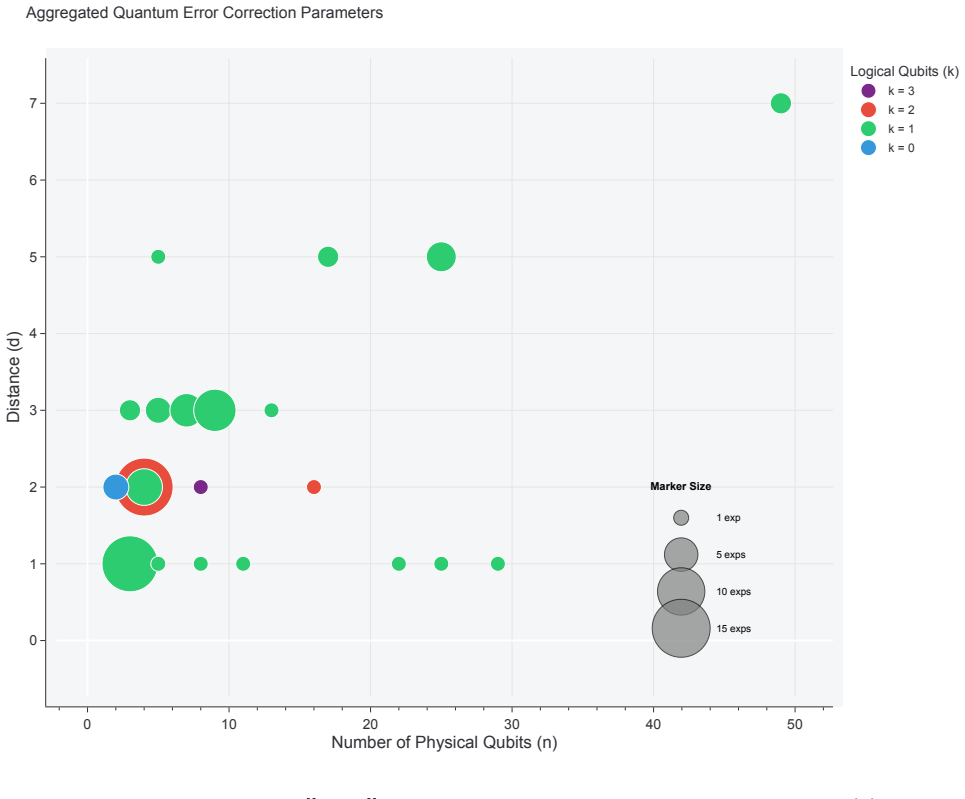
The paper assembles open-source databases of published experimental results and fits exponential curves to them, finding that physical-qubit coherence and gate fidelity have improved by orders of magnitude while processor scale has grown exponentially. The fitted rates are concrete: superconducting $T_1$ doubles every ~1.0 year, ion-trap $T_2$ every ~1.9 years, neutral-atom qubit count every ~1.4 years, and entanglement error halves every ~1.2–2.6 years depending on platform. On the logical level, it records progress from three-qubit repetition codes to surface and color codes with distance up to 7, including a 101-qubit distance-7 surface code operating below threshold with a logical error rate of 0.143% per cycle and a logical memory lifetime 2.4 times the best physical qubit. Extrapolating the fitted trends to a working definition of utility scale (10,000 physical qubits and entanglement error below 0.1%), the paper projects that neutral atoms reach it as early as 2025, with superconducting circuits and trapped ions following in 2039 and 2038 respectively; it notes in addition that recent entanglement-error results sit above their fits.
Load-bearing premise
The projections assume that the exponential improvement rates (doubling and halving times) fitted from 1998–2025 data continue unchanged for years or decades; if progress slows, as recent entanglement-error points already hint, every projected utility-scale year shifts or disappears.
Editorial extensions
If this is right
- If current exponential rates persist, neutral-atom platforms reach 10,000 qubits and sub-0.1% entanglement error by 2025, decades ahead of superconducting circuits (2039) and trapped ions (2038).
- Semiconductor spin qubits show the fastest error-rate reduction (halving every ~1.2 years) but the smallest qubit counts, so they remain far from utility scale on the chosen metrics.
- The recent entanglement-error data sitting above their fits implies the error-halving rates may already be slowing, which would delay the projected years.
- The distance-7 surface code result establishes operation below the fault-tolerance threshold on 101 physical qubits, confirming that logical error suppression now follows code-distance scaling in at least one platform.
Reading between the lines
- If a 2025–2026 neutral-atom experiment fails to approach 10,000 controllable qubits with sub-0.1% entanglement error, that single datapoint would test the exponential-continuation assumption more sharply than any goodness-of-fit statistic; the fits themselves would remain descriptive but the utility-scale year would be invalid.
- The same fitting machinery could be applied to logical-level metrics, such as the suppression factor $\Lambda$ across code distances, once enough experiments accumulate, turning the review's projection method into a predictor of fault-tolerance milestones.
- Raw qubit count likely overstates usable scale for neutral atoms, since the count threshold excludes site-resolved readout and control requirements; an 'algorithmic qubit' version of the count metric might change the projected year.
- The choice of 10,000 qubits and 0.1% error as utility scale is acknowledged as arbitrary; using a target derived from a specific algorithm, such as the Shor factoring requirements cited in the paper, would produce a harder and less optimistic timeline.
Editorial analysis
A structured set of objections, weighed in public.
Referee Report
Summary. The paper compiles experimental data on physical-qubit metrics (T1/T2 coherence times, entanglement error, and qubit count) across trapped-ion, superconducting, neutral-atom, NV-center, and semiconductor platforms, fits exponential trends to characterize progress, and surveys experimental QEC code implementations with [[n,k,d]] parameters. It introduces an open-source repository for community-maintained tracking of these experiments. The paper also projects, in Appendix 7.1, when platforms might reach a chosen 'utility scale' of 10,000 physical qubits and 0.1% entanglement error, concluding that neutral-atom platforms could satisfy both criteria as early as 2025. The descriptive benchmarking and the repository are the main contributions; the projection is an extrapolation of fitted trends and carries several structural assumptions.
Significance. If the projection issue is resolved, this paper would be a genuinely useful, updatable quantitative resource for the quantum-computing community. Its strengths include the open-source GitHub repository with machine-readable datasets, reproducibility of the fits through the provided code, reporting of R² values and standard errors in Table 3, and explicit caveats about extrapolation in Appendix 7.1. The descriptive claim that coherence times, gate fidelities, and qubit counts have improved by orders of magnitude over two decades is well supported by the plotted data and the disclosed fit statistics. The significance is tempered by the unsupported 'both criteria by 2025' projection, which is not a mere presentation issue but affects a headline claim.
major comments (4)
- [Appendix 7.1, Table 2] The claim that 'neutral atom platforms could satisfy both criteria as early as 2025' is not supported by the table as constructed. The US-PQC and US-EE years are obtained by separately extrapolating the exponential fits for physical qubit count and entanglement error, and the joint year is taken as their maximum. This inference is valid only under the additional assumption that both thresholds are reached on the same platform lineage, ideally the same device. In the dataset, the 6,100-qubit neutral-atom record (Manetsch et al., 2024) and the best neutral-atom EE of 0.002 (2023) come from different experiments with different system sizes and control capabilities. Section 2.2.3 explicitly states that the qubit-count metric does not require full quantum-computing capability for every qubit, so even if both exponential trends continue individually, a single device satisfying both criteria does not follow. Please either remove the 'both criteria' claim, rephrase it as separate single-metric projections, or add a joint-capability model supported by evidence.
- [Section 2.2.2 and Appendix 7.1] The entanglement-error metric conflates Bell-state preparation error with two-qubit gate error. The text states that these are treated as equivalent 'as both provide a measure of the system's ability to create and manipulate entangled states,' but the two quantities are measured by different protocols and have different relationships to the QEC accuracy threshold. Since the utility-scale projections in Table 2 use the pooled entanglement-error metric, a mixed dataset can bias the fitted halving time and the projected threshold-crossing year. Please provide a sensitivity analysis fitting gate-error-only and Bell-state-error-only subsets, or restrict the projections to a single well-defined metric.
- [Appendix 7.1, Table 2 and Table 3] The projected utility-scale years are point estimates with no uncertainty, despite Table 3 reporting standard errors for the fitted rates. For small datasets, such as semiconductor T1 with three data points and neutral-atom T1 with R² = 0.122, the exponential extrapolation has very wide confidence intervals. Without propagating fit uncertainties or performing a sensitivity analysis that drops the most recent data points, the exact '2025' date conveys false precision. Please report uncertainty intervals or soften the timeline claims accordingly.
- [Section 2.2.3 and Figure 3] The qubit-count metric for neutral atoms includes large arrays, such as the 6,100-qubit tweezer array, that demonstrate coherence and readout but not necessarily full quantum-computing capability for every qubit. Section 2.2.3 acknowledges this for the neutral-atom platform, but the utility-scale projection in Table 2 uses this count as if it were directly comparable to the qubit-count metric of platforms where all qubits are used in a computational circuit. This comparability issue should be discussed when interpreting the 'US PQC 2024' entry and the resulting projection.
minor comments (4)
- [Section 2.2.1] Calling T1 the 'bitflip time' is imprecise: T1 measures energy relaxation/amplitude damping, not a bit-flip error rate. The subsequent clarification helps, but the phrase should be revised for accuracy.
- [Table 3 and Section 7.3.1] The text states the model y = A·B^x and the log-linear transformation, but it does not give the formula connecting the fitted slope to the reported '×2 every N years' values. Please add the conversion (e.g., doubling time = ln(2)/(m ln(10)) for base-10 logged data).
- [Figure 1 and Table 3] For fits with very low R², such as neutral-atom T1 (R² = 0.122) and superconducting-circuit T2 (R² = 0.418), the corresponding trend lines are still plotted as solid/dashed lines in Figure 1. Please visually distinguish poor fits or add a note in the caption directing readers to the R² values in Table 3.
- [Appendix 7.1, Table 2] The table shows the neutral-atom US-PQC year as 2024 and US-EE year as 2025, but the text summarizes these as 'both criteria as early as 2025.' Please state explicitly that the table gives separate single-metric projections and that the joint claim requires an additional assumption.
Circularity Check
No significant circularity: the utility-scale projections are explicitly labeled extrapolations of independent fits, not fitted inputs relabeled as predictions.
full rationale
The paper's central empirical content is a curated database of external experimental results, fit with exponential models y = A·B^x (Appendix 7.3.1). The utility-scale projections in Appendix 7.1 are computed by extrapolating these fitted doubling/halving times to externally chosen thresholds (PQC ≥ 10,000, EE < 0.1%). The projected years are not data points used in the fits, nor are the fitted parameters renamed as predictions; the threshold-crossing year is a derived quantity. The paper explicitly states that the targets are 'chosen somehow arbitrarily' and that the projection 'relies heavily on the assumption that current exponential scaling trends will continue,' which is an extrapolation risk, not circularity. The only self-citation, the open GitHub repository [26], is the data/code source for the analysis; it is code-reproduced, public, and backed by the primary experimental references, so it is not load-bearing in a circular sense. The 'both criteria on one device' concern raised in review is a composition/inference flaw in the projection, not a reduction of the conclusion to the inputs by construction. Under the stated rubric, no step equates the prediction with the fit input by definition or by fitted-parameter reuse.
Assumptions & free parameters
free parameters (2)
- Utility-scale thresholds (physical qubit count, entanglement error) =
10,000 qubits; 0.1% error
- Exponential fit coefficients (growth rates per platform and metric) =
e.g., semiconductor T1 doubling every 0.86y; superconducting T1 0.99y; neutral atom qubit count 1.37y; see Table 3
assumptions (5)
- domain assumption Exponential growth model y = A·B^x for all benchmark metrics
- domain assumption Bell-state error and two-qubit gate error are treated as the same 'entanglement error' metric
- domain assumption The dominant qubit loss time for neutral atoms is categorized as T1
- domain assumption Historical exponential trends continue into the future
- standard math Log-linear regression is an adequate statistical description
Cite this review
Pith. "Pith review of Awesome Quantum Computing Experiments: Benchmarking Experimental Progress Towards Fault-Tolerant Quantum Computation." pith.science (2026). https://pith.science/paper/ZLYJYRMT
@misc{pith2026250703678,
  author       = {Pith},
  title        = {Pith review of: Awesome Quantum Computing Experiments: Benchmarking Experimental Progress Towards Fault-Tolerant Quantum Computation},
  year         = {2026},
  howpublished = {\url{https://pith.science/paper/ZLYJYRMT}},
  note         = {Machine review of arXiv:2507.03678}
}
abstract
Achieving fault-tolerant quantum computation (FTQC) demands simultaneous progress in physical qubit performance and quantum error correction (QEC). This work reviews and benchmarks experimental advancements towards FTQC across leading platforms, including trapped ions, superconducting circuits, neutral atoms, NV centers, and semiconductors. We analyze key physical metrics like coherence times, entanglement error, and system size (qubit count), fitting observed exponential trends to characterize multi-order-of-magnitude improvements over the past two decades. At the logical level, we survey the implementation landscape of QEC codes, tracking realized parameters $[[n, k, d]]$ and complexity from early demonstrations to recent surface and color code experiments. Synthesizing these physical and logical benchmarks reveals substantial progress enabled by underlying hardware improvements, while also outlining persistent challenges towards scalable FTQC. The experimental databases and analysis code underpinning this review are publicly available at https://github.com/francois-marie/awesome-quantum-computing-experiments.
Figures


Figures from the paper (6 more)



Forward citations
Cited by 2 Pith papers
-
Adaptive Deformation of Color Code in Square Lattices with Defects
A universal superstabilizer method adapts color codes on square lattices to isolated defects in data and ancilla qubits, with optimizations that reuse resources and support Clifford gates plus lattice surgery.
-
Quantum Simulation of Gauge Theories for Particle and Nuclear Physics
The talk summarizes the quantum simulation program for lattice gauge theories, covering target problems in dense matter, algorithmic strategies, recent progress, and remaining challenges.
Reference graph
Works this paper leans on
-
[1]
Universal Quantum Simulators.Science, 273(5278):1073–1078, August 1996
Seth Lloyd. Universal Quantum Simulators.Science, 273(5278):1073–1078, August 1996. doi: 10.1126/science. 273.5278.1073
arXiv 1996
-
[2]
Peter W. Shor. Polynomial-Time Algorithms for Prime Factorization and Discrete Logarithms on a Quantum Computer. SIAM Journal on Computing , 26(5):1484–1509, October 1997. ISSN 0097-5397, 1095-7111. doi: 10.1137/S0097539795293172
-
[3]
Edward Farhi, Jeffrey Goldstone, Sam Gutmann, Joshua Lapan, Andrew Lundgren, and Daniel Preda. A Quantum Adiabatic Evolution Algorithm Applied to Random Instances of an NP-Complete Problem.Science, 292(5516):472–475, April 2001. ISSN 0036-8075, 1095-9203. doi: 10.1126/science.1057726
-
[4]
Dutoi, Peter J
Alán Aspuru-Guzik, Anthony D. Dutoi, Peter J. Love, and Martin Head-Gordon. Simulated Quantum Computation of Molecular Energies.Science, 309(5741):1704–1707, September 2005. ISSN 0036-8075, 1095-
2005
-
[5]
How to factor 2048 bit RSA integers in 8 hours using 20 million noisy qubits
Craig Gidney and Martin Ekerå. How to factor 2048 bit RSA integers in 8 hours using 20 million noisy qubits. Quantum, 5:433, April 2021. ISSN 2521-327X. doi: 10.22331/q-2021-04-15-433
-
[6]
Perlin, Ruslan Shaydulin, and Marco Pistoia
Sivaprasad Omanakuttan, Zichang He, Zhiwei Zhang, Tianyi Hao, Arman Babakhani, Sami Boulebnane, Shouvanik Chakrabarti, Dylan Herman, Joseph Sullivan, Michael A. Perlin, Ruslan Shaydulin, and Marco Pistoia. Threshold for Fault-tolerant Quantum Advantage with the Quantum Approximate Optimization Algorithm. April 2025. doi: 10.48550/arXiv.2504.01897
-
[7]
How to factor 2048 bit RSA integers with less than a million noisy qubits
Craig Gidney. How to factor 2048 bit RSA integers with less than a million noisy qubits. May 2025. doi: 10.48550/arXiv.2505.15917
-
[8]
Hengyun Zhou, Casey Duckering, Chen Zhao, Dolev Bluvstein, Madelyn Cain, Aleksander Kubica, Sheng-Tao Wang, and Mikhail D. Lukin. Resource Analysis of Low-Overhead Transversal Architectures for Reconfigurable Atom Arrays. May 2025. doi: 10.48550/arXiv.2505.15907
Show all 192 references
-
[9]
Kivlichan, Craig Gidney, Dominic W
Ian D. Kivlichan, Craig Gidney, Dominic W. Berry, Nathan Wiebe, Jarrod McClean, Wei Sun, Zhang Jiang, Nicholas Rubin, Austin Fowler, Alán Aspuru-Guzik, Hartmut Neven, and Ryan Babbush. Improved Fault- Tolerant Quantum Simulation of Condensed-Phase Correlated Electrons via Trot...
2020 doi
-
[10]
Campbell
Earl T. Campbell. Early fault-tolerant simulations of the Hubbard model.Quantum Science and Technology , 7(1):015007, January 2022. ISSN 2058-9565. doi: 10.1088/2058-9565/ac3110
2022 doi
-
[11]
D. G. Cory, M. D. Price, W. Maas, E. Knill, R. Laflamme, W. H. Zurek, T. F. Havel, and S. S. Somaroo. Experimental Quantum Error Correction.Phys. Rev. Lett., 81(10):2152–2155, September 1998. doi: 10.1103/ PhysRevLett.81.2152
1998
-
[12]
Q. A. Turchette, C. S. Wood, B. E. King, C. J. Myatt, D. Leibfried, W. M. Itano, C. Monroe, and D. J. Wineland. Deterministic entanglement of two trapped ions.Physical Review Letters, 81(17):3631–3634, October
-
[13]
Nakamura, Yu A
Y. Nakamura, Yu A. Pashkin, and J. S. Tsai. Coherent control of macroscopic quantum states in a single- Cooper-pair box. Nature, 398(6730):786–788, April 1999. ISSN 0028-0836, 1476-4687. doi: 10.1038/19718
1999 doi
-
[14]
P.W. Shor. Fault-tolerant quantum computation. In Proceedings of 37th Conference on Foundations of Computer Science, pages 56–65, October 1996. doi: 10.1109/SFCS.1996.548464
1996
-
[15]
Kim, Eunseok Lee, Ye-Hua Liu, Sam Pallister, William Pol, and Sam Roberts
Isaac H. Kim, Eunseok Lee, Ye-Hua Liu, Sam Pallister, William Pol, and Sam Roberts. Fault-tolerant resource estimate for quantum chemical simulations: Case study on Li-ion battery electrolyte molecules.Physical Review Research, 4(2):023019, April 2022. ISSN 2643-1564. doi: 10....
2022 doi
-
[16]
Multiple Particle Interference and Quantum Error Correction.Proceedings of the Royal Society of London
Andrew Steane. Multiple Particle Interference and Quantum Error Correction.Proceedings of the Royal Society of London. Series A: Mathematical, Physical and Engineering Sciences , 452(1954):2551–2577, November 1996. ISSN 1364-5021, 1471-2946. doi: 10.1098/rspa.1996.0136
1954
-
[17]
Topological quantum memory.Journal of Mathematical Physics, 43(9):4452–4505, September 2002
Eric Dennis, Alexei Kitaev, Andrew Landahl, and John Preskill. Topological quantum memory.Journal of Mathematical Physics, 43(9):4452–4505, September 2002. ISSN 0022-2488, 1089-7658. doi: 10.1063/1.1499754
2002 doi
-
[18]
Peter W. Shor. Scheme for reducing decoherence in quantum computer memory.Physical Review A, 52(4): R2493–R2496, October 1995. doi: 10.1103/PhysRevA.52.R2493
1995 doi
-
[19]
A. M. Steane. Simple quantum error-correcting codes.Physical Review A, 54(6):4741–4751, December 1996. doi: 10.1103/PhysRevA.54.4741
1996 doi
-
[20]
Stabilizer Codes and Quantum Error Correction
Daniel Eric Gottesman. Stabilizer Codes and Quantum Error Correction . PhD thesis, California Institute of Technology, 1997
1997
-
[21]
Theory of quantum error-correcting codes.Physical Review A, 55(2): 900–911, February 1997
Emanuel Knill and Raymond Laflamme. Theory of quantum error-correcting codes.Physical Review A, 55(2): 900–911, February 1997. doi: 10.1103/PhysRevA.55.900
1997 doi
- [22]
-
[23]
Emanuel Knill, Raymond Laflamme, and Wojciech H. Zurek. Resilient Quantum Computation.Science, 279 (5349):342–345, January 1998. doi: 10.1126/science.279.5349.342
1998 doi
-
[24]
Schwartz, Jochen Braumüller, Philip Krantz, Joel I.-Jan Wang, Simon Gustavsson, and William D
Morten Kjaergaard, Mollie E. Schwartz, Jochen Braumüller, Philip Krantz, Joel I.-Jan Wang, Simon Gustavsson, and William D. Oliver. Superconducting Qubits: Current State of Play.Annual Review of Condensed Matter Physics, 11(1):369–395, March 2020. ISSN 1947-5454, 1947-5462. do...
2020 doi
-
[25]
Albert and Philippe Faist
Victor V. Albert and Philippe Faist. Quantum Realizations The Error Correction Zoo. https://errorcorrectionzoo.org/list/quantum_realizations, 2025
2025
-
[26]
Awesome Quantum Computing Experiments
Francois-Marie Le Régent. Awesome Quantum Computing Experiments. https://github.com/francois- marie/awesome-quantum-computing-experiments, April 2025
2025
-
[27]
Nielsen and I
M.A. Nielsen and I. L. Chuang.Quantum Computation and Quantum Information 10th Anniversary Edition . Cambridge University Press, 2000. doi: 10.1017/CBO9780511976667
-
[28]
Bruzewicz, John Chiaverini, Robert McConnell, and Jeremy M
Colin D. Bruzewicz, John Chiaverini, Robert McConnell, and Jeremy M. Sage. Trapped-Ion Quantum Computing: Progress and Challenges.Applied Physics Reviews, 6(2):021314, June 2019. ISSN 1931-9401. doi: 10.1063/1.5088164
2019 doi
-
[29]
Neutral Atom Quantum Computing Hardware: Performance and End-User Perspective.EPJ Quantum Technology, 10(1):32, December 2023
Karen Wintersperger, Florian Dommert, Thomas Ehmer, Andrey Hoursanov, Johannes Klepsch, Wolfgang Mauerer, Georg Reuber, Thomas Strohm, Ming Yin, and Sebastian Luber. Neutral Atom Quantum Computing Hardware: Performance and End-User Perspective.EPJ Quantum Technology, 10(1):32,...
2023 doi
-
[30]
Roadmap on quantum nanotechnologies.Nanotechnology, 32(16): 162003, February 2021
Arne Laucht, Frank Hohls, Niels Ubbelohde, M Fernando Gonzalez-Zalba, David J Reilly, Søren Stobbe, Tim Schröder, Pasquale Scarlino, Jonne V Koski, Andrew Dzurak, Chih-Hwan Yang, Jun Yoneda, Ferdinand Kuemmeth, Hendrik Bluhm, Jarryd Pla, Charles Hill, Joe Salfi, Akira Oiwa, Ju...
2021
-
[31]
Quantum computer based on color centers in diamond.Applied Physics Reviews, 8(1):011308, February 2021
Sébastien Pezzagna and Jan Meijer. Quantum computer based on color centers in diamond.Applied Physics Reviews, 8(1):011308, February 2021. ISSN 1931-9401. doi: 10.1063/5.0007444
2021 doi
-
[32]
Brown, John Chiaverini, Jeremy M
Kenneth R. Brown, John Chiaverini, Jeremy M. Sage, and Hartmut Häffner. Materials challenges for trapped- ion quantum computers. Nature Reviews Materials , 6(10):892–905, October 2021. ISSN 2058-8437. doi: 10.1038/s41578-021-00292-1
2021 doi
-
[33]
Atharv Joshi, Kyungjoo Noh, and Yvonne Y. Gao. Quantum information processing with bosonic qubits in circuit QED. Quantum Science and Technology , 6(3):033001, April 2021. doi: 10.1088/2058-9565/abe989. 13
2021 doi
-
[34]
Nakamura, Yu
Y. Nakamura, Yu. A. Pashkin, T. Yamamoto, and J. S. Tsai. Charge Echo in a Cooper-Pair Box.Physical Review Letters, 88(4):047901, January 2002. doi: 10.1103/PhysRevLett.88.047901
2002 doi
-
[35]
D. Vion, A. Aassime, A. Cottet, P. Joyez, H. Pothier, C. Urbina, D. Esteve, and M. H. Devoret. Manipulating the Quantum State of an Electrical Circuit.Science, 296(5569):886–889, May 2002. ISSN 0036-8075, 1095-9203. doi: 10.1126/science.1069372
2002 doi
-
[36]
Chiorescu, Y
I. Chiorescu, Y. Nakamura, C. J. P. M. Harmans, and J. E. Mooij. Coherent Quantum Dynamics of a Superconducting Flux Qubit. Science, 299(5614):1869–1871, March 2003. ISSN 0036-8075, 1095-9203. doi: 10.1126/science.1081045
2003 doi
-
[37]
Bertet, I
P. Bertet, I. Chiorescu, G. Burkard, K. Semba, C. J. P. M. Harmans, D. P. DiVincenzo, and J. E. Mooij. Dephasing of a superconducting qubit induced by photon noise.Physical Review Letters , 95(25):257002, December 2005. ISSN 0031-9007, 1079-7114. doi: 10.1103/PhysRevLett.95.257002
2005 doi
-
[38]
A. A. Houck, J. A. Schreier, B. R. Johnson, J. M. Chow, Jens Koch, J. M. Gambetta, D. I. Schuster, L. Frunzio, M. H. Devoret, S. M. Girvin, and R. J. Schoelkopf. Controlling the spontaneous emission of a superconducting transmon qubit. Physical Review Letters , 101(8):080502, ...
2008 doi
-
[39]
H. Wang, M. Hofheinz, M. Ansmann, R. C. Bialczak, E. Lucero, M. Neeley, A. D. O’Connell, D. Sank, J. Wenner, A. N. Cleland, and John M. Martinis. Measurement of the Decay of Fock States in a Superconducting Quantum Circuit. Physical Review Letters, 101(24):240401, December 200...
2008 doi
-
[40]
Manucharyan, Jens Koch, Leonid Glazman, and Michel Devoret
Vladimir E. Manucharyan, Jens Koch, Leonid Glazman, and Michel Devoret. Fluxonium: Single Cooper pair circuit free of charge offsets.Science, 326(5949):113–116, October 2009. ISSN 0036-8075, 1095-9203. doi: 10.1126/science.1175552
2009 doi
-
[41]
Cory, Yasunobu Nakamura, Jaw-Shen Tsai, and William D
Jonas Bylander, Simon Gustavsson, Fei Yan, Fumiki Yoshihara, Khalil Harrabi, George Fitch, David G. Cory, Yasunobu Nakamura, Jaw-Shen Tsai, and William D. Oliver. Dynamical decoupling and noise spectroscopy with a superconducting flux qubit.Nature Physics, 7(7):565–570, July 2...
2011 doi
-
[42]
Hanhee Paik, D. I. Schuster, Lev S. Bishop, G. Kirchmair, G. Catelani, A. P. Sears, B. R. Johnson, M. J. Reagor, L. Frunzio, L. I. Glazman, S. M. Girvin, M. H. Devoret, and R. J. Schoelkopf. Observation of High Coherence in Josephson Junction Qubits Measured in a Three-Dimensi...
2011 doi
-
[43]
Gambetta, B
Chad Rigetti, Stefano Poletto, Jay M. Gambetta, B. L. T. Plourde, Jerry M. Chow, A. D. Corcoles, John A. Smolin, Seth T. Merkel, J. R. Rozen, George A. Keefe, Mary B. Rothwell, Mark B. Ketchen, and M. Steffen. Superconducting qubit in waveguide cavity with coherence time appro...
2012 doi
-
[44]
Chang, M
J. Chang, M. R. Vissers, A. D. Corcoles, M. Sandberg, J. Gao, David W. Abraham, Jerry M. Chow, Jay M. Gambetta, M. B. Rothwell, G. A. Keefe, Matthias Steffen, and D. P. Pappas. Improved superconducting qubit coherence using titanium nitride.Applied Physics Letters, 103(1):0126...
2013 doi
-
[45]
Pop, Kurtis Geerlings, Gianluigi Catelani, Robert J
Ioan M. Pop, Kurtis Geerlings, Gianluigi Catelani, Robert J. Schoelkopf, Leonid I. Glazman, and Michel H. Devoret. Coherent suppression of electromagnetic dissipation due to superconducting quasiparticles.Nature, 508(7496):369–372, April 2014. ISSN 1476-4687. doi: 10.1038/nature13017
2014 doi
-
[46]
X. Y. Jin, A. Kamal, A. P. Sears, T. Gudmundsen, D. Hover, J. Miloxi, R. Slattery, F. Yan, J. Yoder, T. P. Orlando, S. Gustavsson, and W. D. Oliver. Thermal and Residual Excited-State Population in a 3D Transmon Qubit. Physical Review Letters , 114(24):240501, June 2015. ISSN ...
2015 doi
-
[47]
Nissim Ofek, Andrei Petrenko, Reinier Heeres, Philip Reinhold, Zaki Leghtas, Brian Vlastakis, Yehan Liu, Luigi Frunzio, S. M. Girvin, L. Jiang, Mazyar Mirrahimi, M. H. Devoret, and R. J. Schoelkopf. Extending the lifetime of a quantum bit with error correction in superconducti...
-
[48]
Gao, Philip Reinhold, R
Chen Wang, Yvonne Y. Gao, Philip Reinhold, R. W. Heeres, Nissim Ofek, Kevin Chou, Christopher Axline, Matthew Reagor, Jacob Blumoff, K. M. Sliwa, L. Frunzio, S. M. Girvin, Liang Jiang, M. Mirrahimi, M. H. Devoret, and R. J. Schoelkopf. A Schrodinger Cat Living in Two Boxes.Sci...
-
[49]
F. Yan, S. Gustavsson, A. Kamal, J. Birenbaum, A. P. Sears, D. Hover, D. Rosenberg, G. Samach, T. J. Gudmundsen, J. L. Yoder, T. P. Orlando, J. Clarke, A. J. Kerman, and W. D. Oliver. The Flux Qubit Revisited to Enhance Coherence and Reproducibility.Nature Communications, 7(1)...
2016 doi
-
[50]
Rosenblum, P
S. Rosenblum, P. Reinhold, M. Mirrahimi, Liang Jiang, L. Frunzio, and R. J. Schoelkopf. Fault-tolerant detection of a quantum error. Science, 361(6399):266–270, July 2018. ISSN 0036-8075, 1095-9203. doi: 10.1126/science.aat3996
2018 doi
-
[51]
Ling Hu, Yuwei Ma, Weizhou Cai, Xianghao Mu, Yuan Xu, Weiting Wang, Yukai Wu, Haiyan Wang, Yipu Song, Changling Zou, S. M. Girvin, L.-M. Duan, and Luyan Sun. Demonstration of quantum error correction and universal gate set on a binomial bosonic logical qubit.Nature Physics, 15...
2019 doi
- [52]
-
[53]
Exponential suppression of bit-flips in a qubit encoded in an oscillator
Raphaël Lescanne, Marius Villiers, Théau Peronnin, Alain Sarlette, Matthieu Delbecq, Benjamin Huard, Takis Kontos, Mazyar Mirrahimi, and Zaki Leghtas. Exponential suppression of bit-flips in a qubit encoded in an oscillator. Nature Physics, 16(5):509–513, March 2020. ISSN 1745...
2020 doi
-
[54]
Berdou, A
C. Berdou, A. Murani, U. Réglade, W.C. Smith, M. Villiers, J. Palomo, M. Rosticher, A. Denis, P. Morfin, M. Delbecq, T. Kontos, N. Pankratova, F. Rautschke, T. Peronnin, L.-A. Sellem, P. Rouchon, A. Sarlette, M. Mirrahimi, P. Campagne-Ibarcq, S. Jezouin, R. Lescanne, and Z. Le...
2023 doi
-
[55]
Autoparametric resonance extending the bit-flip time of a cat qubit up to 0.3 s.Physical Review X, 14(2): 021019, April 2024
Antoine Marquet, Antoine Essig, Joachim Cohen, Nathanaël Cottet, Anil Murani, Emanuele Albertinale, Simon Dupouy, Audrey Bienfait, Théau Peronnin, Sébastien Jezouin, Raphaël Lescanne, and Benjamin Huard. Autoparametric resonance extending the bit-flip time of a cat qubit up to...
2024 doi
-
[56]
Nguyen, Yen-Hsiang Lin, Aaron Somoroff, Raymond Mencia, Nicholas Grabon, and Vladimir E
Long B. Nguyen, Yen-Hsiang Lin, Aaron Somoroff, Raymond Mencia, Nicholas Grabon, and Vladimir E. Manucharyan. The high-coherence fluxonium qubit.Physical Review X, 9(4):041041, November 2019. ISSN 2160-3308. doi: 10.1103/PhysRevX.9.041041
2019 doi
-
[57]
T. W. Larsen, K. D. Petersson, F. Kuemmeth, T. S. Jespersen, P. Krogstrup, J. Nygard, and C. M. Marcus. A Semiconductor Nanowire-Based Superconducting Qubit.Physical Review Letters, 115(12):127001, September
-
[58]
Casparis, T
L. Casparis, T. W. Larsen, M. S. Olsen, F. Kuemmeth, P. Krogstrup, J. Nygård, K. D. Petersson, and C. M. Marcus. Gatemon Benchmarking and Two-Qubit Operation.Physical Review Letters, 116(15):150505, April
-
[59]
Luthi, T
F. Luthi, T. Stavenga, O. W. Enzing, A. Bruno, C. Dickel, N. K. Langford, M. A. Rol, T. S. Jespersen, J. Nygard, P. Krogstrup, and L. DiCarlo. Evolution of Nanowire Transmons and Their Quantum Coherence in Magnetic Field. Physical Review Letters, 120(10):100502, March 2018. IS...
2018 doi
-
[60]
Quantum control of a cat-qubit with bit-flip times exceeding ten seconds.Nature, 629(8013):778–783, May
Ulysse Réglade, Adrien Bocquet, Ronan Gautier, Joachim Cohen, Antoine Marquet, Emanuele Albertinale, Natalia Pankratova, Mattis Hallén, Felix Rautschke, Lev-Arcady Sellem, Pierre Rouchon, Alain Sarlette, Mazyar Mirrahimi, Philippe Campagne-Ibarcq, Raphaël Lescanne, Sébastien J...
-
[61]
T. P. Harty, D. T. C. Allcock, C. J. Ballance, L. Guidoni, H. A. Janacek, N. M. Linke, D. N. Stacey, and D. M. Lucas. High-Fidelity Preparation, Gates, Memory, and Readout of a Trapped-Ion Quantum Bit.Physical Review Letters, 113(22):220501, November 2014. doi: 10.1103/PhysRev...
2014 doi
-
[62]
Duan, Dahyun Yum, and Kihwan Kim
Ye Wang, Mark Um, Junhua Zhang, Shuoming An, Ming Lyu, Jing-Ning Zhang, L.-M. Duan, Dahyun Yum, and Kihwan Kim. Single-qubit quantum memory exceeding ten-minute coherence time.Nature Photonics, 11 (10):646–650, October 2017. ISSN 1749-4893. doi: 10.1038/s41566-017-0007-1
2017 doi
-
[63]
Single ion qubit with estimated coherence time exceeding one hour
Pengfei Wang, Chun-Yang Luan, Mu Qiao, Mark Um, Junhua Zhang, Ye Wang, Xiao Yuan, Mile Gu, Jingning Zhang, and Kihwan Kim. Single ion qubit with estimated coherence time exceeding one hour. Nature Communications, 12(1):233, January 2021. ISSN 2041-1723. doi: 10.1038/s41467-020-20330-w
2021 doi
-
[64]
Matthew P. A. Jones, Jerome Beugnon, Alpha Gaëtan, Junxiang Zhang, Gaetan Messin, Antoine Browaeys, and Philippe Grangier. Fast Quantum State Control of a Single Trapped Neutral Atom.Physical Review A, 75(4):040301, April 2007. ISSN 1050-2947, 1094-1622. doi: 10.1103/PhysRevA....
2007 doi
-
[65]
doi: 10.1103/PhysRevLett.116.150505
ISSN 0031-9007, 1079-7114. doi: 10.1103/PhysRevLett.116.150505
-
[66]
Wang, Sepehr Ebadi, Marcin Kalinowski, Alexander Keesling, Nishad Maskara, Hannes Pichler, Markus Greiner, Vladan Vuletić, and Mikhail D
Dolev Bluvstein, Harry Levine, Giulia Semeghini, Tout T. Wang, Sepehr Ebadi, Marcin Kalinowski, Alexander Keesling, Nishad Maskara, Hannes Pichler, Markus Greiner, Vladan Vuletić, and Mikhail D. Lukin. A quantum processor based on coherent transport of entangled atom arrays.Na...
2022 doi
-
[67]
Langer, R
C. Langer, R. Ozeri, J. D. Jost, J. Chiaverini, B. DeMarco, A. Ben-Kish, R. B. Blakestad, J. Britton, D. B. Hume, W. M. Itano, D. Leibfried, R. Reichle, T. Rosenband, T. Schaetz, P. O. Schmidt, and D. J. Wineland. Long-Lived Qubit Memory Using Atomic Ions.Physical Review Lette...
2005 doi
- [68]
-
[69]
Campbell, Bharath Kannan, David Kim, Morten Kjaergaard, Philip Krantz, Gabriel O
Joel I.-Jan Wang, Daniel Rodan-Legrain, Landry Bretheau, Daniel L. Campbell, Bharath Kannan, David Kim, Morten Kjaergaard, Philip Krantz, Gabriel O. Samach, Fei Yan, Jonilyn L. Yoder, Kenji Watanabe, Takashi Taniguchi, Terry P. Orlando, Simon Gustavsson, Pablo Jarillo-Herrero,...
2019
-
[70]
Ansmann, Radoslaw C
Matthias Steffen, M. Ansmann, Radoslaw C. Bialczak, N. Katz, Erik Lucero, R. McDermott, Matthew Neeley, E. M. Weig, A. N. Cleland, and John M. Martinis. Measurement of the Entanglement of Two Superconducting Qubits via State Tomography.Science, 313(5792):1423–1425, September 2...
2006 doi
-
[71]
DiCarlo, J
L. DiCarlo, J. M. Chow, J. M. Gambetta, Lev S. Bishop, B. R. Johnson, D. I. Schuster, J. Majer, A. Blais, L. Frunzio, S. M. Girvin, and R. J. Schoelkopf. Demonstration of Two-Qubit Algorithms with a Superconducting Quantum Processor. Nature, 460(7252):240–244, July 2009. ISSN ...
2009 doi
-
[72]
Covey, Ivaylo S
Jacob P. Covey, Ivaylo S. Madjarov, Alexandre Cooper, and Manuel Endres. 2000-Times Repeated Imaging of Strontium Atoms in Clock-Magic Tweezer Arrays.Physical Review Letters, 122(17):173201, May 2019. doi: 10.1103/PhysRevLett.122.173201
2000 doi
-
[74]
T. M. Graham, Y. Song, J. Scott, C. Poole, L. Phuttitarn, K. Jooya, P. Eichler, X. Jiang, A. Marra, B. Grinkemeyer, M. Kwon, M. Ebert, J. Cherek, M. T. Lichtman, M. Gillette, J. Gilbert, D. Bowman, T. Ballance, C. Campbell, E. D. Dahl, O. Crawford, N. S. Blunt, B. Rogers, T. N...
2022 doi
-
[75]
Kjaergaard, M
M. Kjaergaard, M. E. Schwartz, A. Greene, G. O. Samach, A. Bengtsson, M. O’Keeffe, C. M. McNally, J. Braumüller, D. K. Kim, P. Krantz, M. Marvian, A. Melville, B. M. Niedzielski, Y. Sung, R. Winik, J. Yoder, D. Rosenberg, K. Obenland, S. Lloyd, T. P. Orlando, I. Marvian, S. Gu...
2022 doi
-
[76]
Isenhower, E
L. Isenhower, E. Urban, X. L. Zhang, A. T. Gill, T. Henage, T. A. Johnson, T. G. Walker, and M. Saffman. Demonstration of a neutral atom controlled-NOT quantum gate.Physical Review Letters , 104(1):010503, January 2010. ISSN 0031-9007, 1079-7114. doi: 10.1103/PhysRevLett.104.010503
2010 doi
-
[77]
T. Wilk, A. Gaëtan, C. Evellin, J. Wolters, Y. Miroshnychenko, P. Grangier, and A. Browaeys. Entanglement of two individual neutral atoms using Rydberg blockade.Physical Review Letters, 104(1):010502, January
-
[78]
K. M. Maller, M. T. Lichtman, T. Xia, Y. Sun, M. J. Piotrowicz, A. W. Carr, L. Isenhower, and M. Saffman. Rydberg-blockade controlled-not gate and entanglement in a two-dimensional array of neutral-atom qubits. Physical Review A, 92(2):022336, August 2015. ISSN 1050-2947, 1094...
2015 doi
-
[79]
Chow, Jay M
Jerry M. Chow, Jay M. Gambetta, A. D. Corcoles, Seth T. Merkel, John A. Smolin, Chad Rigetti, S. Poletto, George A. Keefe, Mary B. Rothwell, J. R. Rozen, Mark B. Ketchen, and M. Steffen. Complete universal quantum gate set approaching fault-tolerant thresholds with superconduc...
2012 doi
-
[80]
Madjarov, Jacob P
Ivaylo S. Madjarov, Jacob P. Covey, Adam L. Shaw, Joonhee Choi, Anant Kale, Alexandre Cooper, Hannes Pichler, Vladimir Schkolnik, Jason R. Williams, and Manuel Endres. High-fidelity entanglement and detection of alkaline-earth Rydberg atoms.Nature Physics, 16(8):857–861, Augus...
2020 doi
-
[81]
Chow, and Jay M
Sarah Sheldon, Easwar Magesan, Jerry M. Chow, and Jay M. Gambetta. Procedure for systematically tuning 16 up crosstalk in the cross resonance gate. Physical Review A , 93(6):060302, June 2016. ISSN 2469-9926, 2469-9934. doi: 10.1103/PhysRevA.93.060302
2016 doi
-
[82]
Evered, Dolev Bluvstein, Marcin Kalinowski, Sepehr Ebadi, Tom Manovitz, Hengyun Zhou, Sophie H
Simon J. Evered, Dolev Bluvstein, Marcin Kalinowski, Sepehr Ebadi, Tom Manovitz, Hengyun Zhou, Sophie H. Li, Alexandra A. Geim, Tout T. Wang, Nishad Maskara, Harry Levine, Giulia Semeghini, Markus Greiner, Vladan Vuletić, and Mikhail D. Lukin. High-fidelity parallel entangling...
2023 doi
-
[83]
J. A. Muniz, et al. High-Fidelity Universal Gates in the 171Yb Ground-State Nuclear-Spin Qubit.PRX Quantum, 6(2):020334, May 2025. doi: 10.1103/PRXQuantum.6.020334
2025 doi
-
[84]
Knapp, Mila Bileska, Shuo Ma, Genyue Liu, Pai Peng, Bichen Zhang, Sebas- tian P
Michael Peper, Yiyi Li, Daniel Y. Knapp, Mila Bileska, Shuo Ma, Genyue Liu, Pai Peng, Bichen Zhang, Sebas- tian P. Horvath, Alex P. Burgers, and Jeff D. Thompson. Spectroscopy and Modeling of $^{171}\mathrm{Yb}$ Rydberg States for High-Fidelity Two-Qubit Gates.Physical Review ...
2025 doi
-
[85]
Shaw, Ran Finkelstein, and Manuel Endres
Richard Bing-Shiun Tsai, Xiangkai Sun, Adam L. Shaw, Ran Finkelstein, and Manuel Endres. Benchmarking and Fidelity Response Theory of High-Fidelity Rydberg Entangling Gates.PRX Quantum, 6(1):010331, February 2025. doi: 10.1103/PRXQuantum.6.010331
2025 doi
-
[86]
A. G. Radnaev, et al. A universal neutral-atom quantum computer with individual optical addressing and non-destructive readout. January 2025. doi: 10.48550/arXiv.2408.08288
2025 doi
-
[87]
Wang, Sepehr Ebadi, Hannes Bernien, Markus Greiner, Vladan Vuletić, Hannes Pichler, and Mikhail D
Harry Levine, Alexander Keesling, Giulia Semeghini, Ahmed Omran, Tout T. Wang, Sepehr Ebadi, Hannes Bernien, Markus Greiner, Vladan Vuletić, Hannes Pichler, and Mikhail D. Lukin. Parallel implementation of high-fidelity multi-qubit gates with neutral atoms.Physical Review Lett...
2019 doi
-
[88]
M. A. Rowe, D. Kielpinski, V. Meyer, C. A. Sackett, W. M. Itano, C. Monroe, and D. J. Wineland. Experimental violation of a Bell’s inequality with efficient detection.Nature, 409(6822):791–794, February 2001. ISSN 1476-4687. doi: 10.1038/35057215. 17
2001 doi
-
[89]
Shaw, Richard Bing-Shiun Tsai, Ran Finkelstein, Joonhee Choi, and Manuel Endres
Pascal Scholl, Adam L. Shaw, Richard Bing-Shiun Tsai, Ran Finkelstein, Joonhee Choi, and Manuel Endres. Erasure conversion in a high-fidelity Rydberg quantum simulator.Nature, 622(7982):273–278, October 2023. ISSN 0028-0836, 1476-4687. doi: 10.1038/s41586-023-06516-4
2023 doi
-
[90]
Häffner, F
H. Häffner, F. Schmidt-Kaler, W. Hänsel, C. F. Roos, T. Körber, M. Chwalla, M. Riebe, J. Benhelm, U. D. Rapol, C. Becher, and R. Blatt. Robust entanglement.Applied Physics B, 81(2):151–153, July 2005. ISSN 1432-0649. doi: 10.1007/s00340-005-1917-z
2005 doi
-
[91]
Benhelm, G
J. Benhelm, G. Kirchmair, C. F. Roos, and R. Blatt. Towards fault-tolerant quantum computing with trapped ions. Nature Physics, 4(6):463–466, June 2008. ISSN 1745-2473, 1745-2481. doi: 10.1038/nphys961
2008 doi
-
[92]
C. J. Ballance, T. P. Harty, N. M. Linke, M. A. Sepiol, and D. M. Lucas. High-fidelity quantum logic gates using trapped-ion hyperfine qubits.Physical Review Letters, 117(6):060504, August 2016. ISSN 0031-9007, 1079-7114. doi: 10.1103/PhysRevLett.117.060504
2016 doi
-
[93]
J. P. Gaebler, T. R. Tan, Y. Lin, Y. Wan, R. Bowler, A. C. Keith, S. Glancy, K. Coakley, E. Knill, D. Leibfried, and D. J. Wineland. High-Fidelity Universal Gate Set for 9Be+ Ion Qubits.Physical Review Letters, 117(6): 060505, August 2016. ISSN 0031-9007, 1079-7114. doi: 10.11...
2016 doi
-
[94]
C. M. Löschnauer, J. Mosca Toba, A. C. Hughes, S. A. King, M. A. Weber, R. Srinivas, R. Matt, R. Nourshargh, D. T. C. Allcock, C. J. Ballance, C. Matthiesen, M. Malinowski, and T. P. Harty. Scalable, high-fidelity all-electronic control of trapped-ion qubits. July 2024. doi: 1...
2024 doi
-
[95]
C. A. Sackett, D. Kielpinski, B. E. King, C. Langer, V. Meyer, C. J. Myatt, M. Rowe, Q. A. Turchette, W. M. Itano, D. J. Wineland, and C. Monroe. Experimental entanglement of four particles.Nature, 404(6775): 256–259, March 2000. ISSN 1476-4687. doi: 10.1038/35005011
-
[96]
Fast universal quantum control above the fault-tolerance threshold in silicon.Nature, 601 (7893):338–342, January 2022
Akito Noiri, Kenta Takeda, Takashi Nakajima, Takashi Kobayashi, Amir Sammak, Giordano Scappucci, and Seigo Tarucha. Fast universal quantum control above the fault-tolerance threshold in silicon.Nature, 601 (7893):338–342, January 2022. ISSN 0028-0836, 1476-4687. doi: 10.1038/s...
2022 doi
-
[97]
Leibfried, B
D. Leibfried, B. DeMarco, V. Meyer, D. Lucas, M. Barrett, J. Britton, W. M. Itano, B. Jelenković, C. Langer, T. Rosenband, and D. J. Wineland. Experimental demonstration of a robust, high-fidelity geometric two ion-qubit phase gate. Nature, 422(6930):412–415, March 2003. ISSN ...
2003 doi
-
[98]
McGuinness, Tokuyuki Teraji, Boris Naydenov, Shinobu Onoda, Takeshi Ohshima, Jörg Wrachtrup, Fedor Jelezko, and Junichi Isoya
Takashi Yamamoto, Christoph Müller, Liam P. McGuinness, Tokuyuki Teraji, Boris Naydenov, Shinobu Onoda, Takeshi Ohshima, Jörg Wrachtrup, Fedor Jelezko, and Junichi Isoya. Strongly coupled diamond spin qubits by molecular nitrogen implantation.Physical Review B , 88(20):201201,...
2013 doi
-
[99]
Barreiro, Michael Chwalla, Daniel Nigg, William A
Thomas Monz, Philipp Schindler, Julio T. Barreiro, Michael Chwalla, Daniel Nigg, William A. Coish, Maximilian Harlander, Wolfgang Haensel, Markus Hennrich, and Rainer Blatt. 14-qubit entanglement: Creation and coherence. Physical Review Letters, 106(13):130506, March 2011. ISS...
2011 doi
-
[100]
Plenio, Marcus Huber, Christian Roos, Rainer Blatt, and Ben Lanyon
Nicolai Friis, Oliver Marty, Christine Maier, Cornelius Hempel, Milan Holzäpfel, Petar Jurcevic, Martin B. Plenio, Marcus Huber, Christian Roos, Rainer Blatt, and Ben Lanyon. Observation of Entangled States of a Fully Controlled 20-Qubit System.Physical Review X, 8(2):021012, ...
2018 doi
-
[101]
Holz, Matthias Bock, Tuomas Ollikainen, and Christian F
Dominik Kiesenhofer, Helene Hainzer, Artem Zhdanov, Philip C. Holz, Matthias Bock, Tuomas Ollikainen, and Christian F. Roos. Controlling two-dimensional Coulomb crystals of more than 100 ions in a monolithic radio- frequency trap. PRX Quantum, 4(2):020317, April 2023. ISSN 269...
2023 doi
-
[102]
An atom- by-atom assembler of defect-free arbitrary two-dimensional atomic arrays.Science, 354(6315):1021–1023, November 2016
Daniel Barredo, Sylvain De Léséleuc, Vincent Lienhard, Thierry Lahaye, and Antoine Browaeys. An atom- by-atom assembler of defect-free arbitrary two-dimensional atomic arrays.Science, 354(6315):1021–1023, November 2016. ISSN 0036-8075, 1095-9203. doi: 10.1126/science.aah3778
2016 doi
-
[103]
Huang, C
W. Huang, C. H. Yang, K. W. Chan, T. Tanttu, B. Hensen, R. C. C. Leon, M. A. Fogarty, J. C. C. Hwang, F. E. Hudson, K. M. Itoh, A. Morello, A. Laucht, and A. S. Dzurak. Fidelity benchmarks for two-qubit gates in silicon. Nature, 569(7757):532–536, May 2019. ISSN 1476-4687. doi...
2019 doi
-
[104]
Defect-free assembly of 2D clusters of more than 100 single-atom quantum systems.Physical Review Letters, 122(20):203601, May 2019
Daniel Ohl de Mello, Dominik Schäffner, Jan Werkmann, Tilman Preuschoff, Lars Kohfahl, Malte Schlosser, and Gerhard Birkl. Defect-free assembly of 2D clusters of more than 100 single-atom quantum systems.Physical Review Letters, 122(20):203601, May 2019. ISSN 0031-9007, 1079-7...
2019 doi
-
[105]
Xiao Xue, Maximilian Russ, Nodar Samkharadze, Brennan Undseth, Amir Sammak, Giordano Scappucci, and Lieven M. K. Vandersypen. Quantum logic with spin qubits crossing the surface code threshold.Nature, 601 (7893):343–347, January 2022. ISSN 1476-4687. doi: 10.1038/s41586-021-04273-w
2022 doi
-
[106]
In-situ equalization of single-atom loading in large-scale optical tweezers arrays
Kai-Niklas Schymik, Bruno Ximenez, Etienne Bloch, Davide Dreon, Adrien Signoles, Florence Nogrette, Daniel Barredo, Antoine Browaeys, and Thierry Lahaye. In-situ equalization of single-atom loading in large-scale optical tweezers arrays. Physical Review A , 106(2):022611, Augu...
2022 doi
-
[107]
AI-Enabled Rapid Assembly of Thousands of Defect-Free Neutral Atom Arrays with Constant-time-overhead
Rui Lin, Han-Sen Zhong, You Li, Zhang-Rui Zhao, Le-Tian Zheng, Tai-Ran Hu, Hong-Ming Wu, Zhan Wu, Wei-Jie Ma, Yan Gao, Yi-Kang Zhu, Zhao-Feng Su, Wan-Li Ouyang, Yu-Chen Zhang, Jun Rui, Ming-Cheng Chen, Chao-Yang Lu, and Jian-Wei Pan. AI-Enabled Rapid Assembly of Thousands of D...
-
[108]
Rearrangement of individual atoms in a 2000-site optical-tweezer array at cryogenic temperatures
Grégoire Pichard, Desiree Lim, Étienne Bloch, Julien Vaneecloo, Lilian Bourachot, Gert-Jan Both, Guillaume Mériaux, Sylvain Dutartre, Richard Hostein, Julien Paris, Bruno Ximenez, Adrien Signoles, Antoine Browaeys, Thierry Lahaye, and Davide Dreon. Rearrangement of individual ...
-
[109]
Chow, Jay M
Jerry M. Chow, Jay M. Gambetta, Easwar Magesan, David W. Abraham, Andrew W. Cross, B. R. Johnson, Nicholas A. Masluk, Colm A. Ryan, John A. Smolin, Srikanth J. Srinivasan, and M. Steffen. Implementing a strand of a scalable fault-tolerant quantum computing fabric.Nature Commun...
2014 doi
-
[110]
Barends, J
R. Barends, J. Kelly, A. Megrant, A. Veitia, D. Sank, E. Jeffrey, T. C. White, J. Mutus, A. G. Fowler, B. Campbell, Y. Chen, Z. Chen, B. Chiaro, A. Dunsworth, C. Neill, P. O’Malley, P. Roushan, A. Vainsencher, J. Wenner, A. N. Korotkov, A. N. Cleland, and John M. Martinis. Sup...
2014 doi
-
[111]
Zibrov, Manuel Endres, Markus Greiner, Vladan Vuletić, and Mikhail D
Hannes Bernien, Sylvain Schwartz, Alexander Keesling, Harry Levine, Ahmed Omran, Hannes Pichler, Soonwon Choi, Alexander S. Zibrov, Manuel Endres, Markus Greiner, Vladan Vuletić, and Mikhail D. Lukin. Probing many-body dynamics on a 51-atom quantum simulator.Nature, 551(7682):...
2017 doi
-
[112]
Evidence for the utility of quantum computing before fault tolerance.Nature, 618(7965):500–505, June 2023
Youngseok Kim, Andrew Eddins, Sajant Anand, Ken Xuan Wei, Ewout van den Berg, Sami Rosenblatt, Hasan Nayfeh, Yantao Wu, Michael Zaletel, Kristan Temme, and Abhinav Kandala. Evidence for the utility of quantum computing before fault tolerance.Nature, 618(7965):500–505, June 202...
2023 doi
-
[113]
Sepehr Ebadi, Tout T. Wang, Harry Levine, Alexander Keesling, Giulia Semeghini, Ahmed Omran, Dolev Bluvstein, Rhine Samajdar, Hannes Pichler, Wen Wei Ho, Soonwon Choi, Subir Sachdev, Markus Greiner, Vladan Vuletić, and Mikhail D. Lukin. Quantum phases of matter on a 256-atom p...
2021 doi
-
[114]
Hendrickx, William I
Nico W. Hendrickx, William I. L. Lawrie, Maximilian Russ, Floor van Riggelen, Sander L. de Snoo, Raymond N. Schouten, Amir Sammak, Giordano Scappucci, and Menno Veldhorst. A four-qubit germanium quantum processor. Nature, 591(7851):580–585, March 2021. ISSN 1476-4687. doi: 10....
2021 doi
-
[115]
Stephan G. J. Philips, Mateusz T. Mądzik, Sergey V. Amitonov, Sander L. de Snoo, Maximilian Russ, Nima Kalhor, Christian Volk, William I. L. Lawrie, Delphine Brousse, Larysa Tryputen, Brian Paquelet Wuetz, Amir Sammak, Menno Veldhorst, Giordano Scappucci, and Lieven M. K. Vand...
2022 doi
-
[116]
C. E. Bradley. A Ten-Qubit Solid-State Spin Register with Quantum Memory up to One Minute.Physical Review X, 9(3), 2019. doi: 10.1103/PhysRevX.9.031045
2019 doi
-
[117]
Quantum fault tolerance in small experiments
Daniel Gottesman. Quantum fault tolerance in small experiments. October 2016. doi: 10.48550/arXiv.1610.03 507. 19
2016 doi
-
[118]
Perfect Quantum Error Correcting Code
Raymond Laflamme, Cesar Miquel, Juan Pablo Paz, and Wojciech Hubert Zurek. Perfect Quantum Error Correcting Code. Physical Review Letters, 77(1):198–201, July 1996. doi: 10.1103/PhysRevLett.77.198
1996 doi
-
[119]
Quantum supremacy using a programmable superconducting processor.Nature, 574(7779): 505–510, October 2019
Arute, et al. Quantum supremacy using a programmable superconducting processor.Nature, 574(7779): 505–510, October 2019. ISSN 1476-4687. doi: 10.1038/s41586-019-1666-5
2019 doi
-
[120]
A. R. Calderbank and Peter W. Shor. Good Quantum Error-Correcting Codes Exist.Physical Review A, 54 (2):1098–1105, August 1996. ISSN 1050-2947, 1094-1622. doi: 10.1103/PhysRevA.54.1098
1996 doi
-
[121]
T. F. Watson, S. G. J. Philips, E. Kawakami, D. R. Ward, P. Scarlino, M. Veldhorst, D. E. Savage, M. G. Lagally, Mark Friesen, S. N. Coppersmith, M. A. Eriksson, and L. M. K. Vandersypen. A programmable two-qubit quantum processor in silicon.Nature, 555(7698):633–637, March 20...
2018 doi
-
[122]
Albert and Philippe Faist
Victor V. Albert and Philippe Faist. Quantum repetition code. https://errorcorrectionzoo.org/c/quantum_repetition, 2022
2022
-
[123]
Chiaverini, D
J. Chiaverini, D. Leibfried, T. Schaetz, M. D. Barrett, R. B. Blakestad, J. Britton, W. M. Itano, J. D. Jost, E. Knill, C. Langer, R. Ozeri, and D. J. Wineland. Realization of quantum error correction.Nature, 432(7017): 602–605, December 2004. ISSN 1476-4687. doi: 10.1038/nature03074
2004 doi
-
[124]
Ryan, and Raymond Laflamme
Osama Moussa, Jonathan Baugh, Colm A. Ryan, and Raymond Laflamme. Demonstration of sufficient control for two rounds of quantum error correction in a solid state ensemble quantum information processor.Physical Review Letters, 107(16):160501, October 2011. ISSN 0031-9007, 1079-...
2011 doi
-
[125]
M. D. Reed, L. DiCarlo, S. E. Nigg, L. Sun, L. Frunzio, S. M. Girvin, and R. J. Schoelkopf. Realization of three-qubit quantum error correction with superconducting circuits.Nature, 482(7385):382–385, February
-
[126]
Barreiro, Thomas Monz, Volckmar Nebendahl, Daniel Nigg, Michael Chwalla, Markus Hennrich, and Rainer Blatt
Philipp Schindler, Julio T. Barreiro, Thomas Monz, Volckmar Nebendahl, Daniel Nigg, Michael Chwalla, Markus Hennrich, and Rainer Blatt. Experimental Repetitive Quantum Error Correction.Science, 332(6033): 1059–1061, May 2011. doi: 10.1126/science.1203329
2011 doi
-
[127]
Bennett, David P
Charles H. Bennett, David P. DiVincenzo, John A. Smolin, and William K. Wootters. Mixed State Entanglement and Quantum Error Correction.Physical Review A, 54(5):3824–3851, November 1996. ISSN 1050-2947, 1094-
1996
-
[128]
Waldherr, Y
G. Waldherr, Y. Wang, S. Zaiser, M. Jamali, T. Schulte-Herbrueggen, H. Abe, T. Ohshima, J. Isoya, P. Neumann, and J. Wrachtrup. Quantum error correction in a solid-state hybrid spin register.Nature, 506 (7487):204–207, February 2014. ISSN 0028-0836, 1476-4687. doi: 10.1038/nature12919
2014 doi
-
[129]
Kelly, R
J. Kelly, R. Barends, A. G. Fowler, A. Megrant, E. Jeffrey, T. C. White, D. Sank, J. Y. Mutus, B. Campbell, Yu Chen, Z. Chen, B. Chiaro, A. Dunsworth, I.-C. Hoi, C. Neill, P. J. J. O’Malley, C. Quintana, P. Roushan, A. Vainsencher, J. Wenner, A. N. Cleland, and John M. Martini...
2015 doi
-
[130]
Knill, R
E. Knill, R. Laflamme, and G. J. Milburn. A scheme for efficient quantum computation with linear optics. Nature, 409(6816):46–52, January 2001. ISSN 1476-4687. doi: 10.1038/35051009
2001 doi
-
[131]
Adriaan Rol, Bas Hensen, Machiel S
Julia Cramer, Norbert Kalb, M. Adriaan Rol, Bas Hensen, Machiel S. Blok, Matthew Markham, Daniel J. Twitchen, Ronald Hanson, and Tim H. Taminiau. Repeated quantum error correction on a continuously encoded qubit by real-time feedback.Nature Communications, 7(1):11526, May 2016...
2016 doi
-
[132]
Wootton and Daniel Loss
James R. Wootton and Daniel Loss. A repetition code of 15 qubits.Physical Review A, 97(5):052313, May
-
[133]
Benchmarking near-term devices with quantum error correction.Quantum Science and Technology, 5(4):044004, October 2020
James R Wootton. Benchmarking near-term devices with quantum error correction.Quantum Science and Technology, 5(4):044004, October 2020. ISSN 2058-9565. doi: 10.1088/2058-9565/aba038
2020 doi
-
[134]
ISSN 0028-0836, 1476-4687
Google Quantum AI Exponential suppression of bit or phase errors with cyclic error correction.Nature, 595 (7867):383–387, July 2021. ISSN 0028-0836, 1476-4687. doi: 10.1038/s41586-021-03588-y. 20
2021 doi
-
[135]
doi: 10.1038/s41586-022-05434-1
Google Quantum AI Suppressing quantum errors by scaling a surface code logical qubit.Nature, 614(7949): 676–681, February 2023. doi: 10.1038/s41586-022-05434-1
2023 doi
-
[136]
ISSN 0028-0836, 1476-4687
Google Quantum AI and Collaborators Quantum error correction below the surface code threshold.Nature, 638(8052):920–926, February 2025. ISSN 0028-0836, 1476-4687. doi: 10.1038/s41586-024-08449-y
2025 doi
-
[137]
Experimental quantum error correction with high fidelity.Physical Review A, 84(3):034303, September 2011
Jingfu Zhang, Dorian Gangloff, Osama Moussa, and Raymond Laflamme. Experimental quantum error correction with high fidelity.Physical Review A, 84(3):034303, September 2011. ISSN 1050-2947, 1094-1622. doi: 10.1103/PhysRevA.84.034303
2011 doi
-
[138]
Knill, R
E. Knill, R. Laflamme, R. Martinez, and C. Negrevergne. Implementation of the Five Qubit Error Correction Benchmark. Physical Review Letters, 86(25):5811–5814, June 2001. ISSN 0031-9007, 1079-7114. doi: 10.1103/ PhysRevLett.86.5811
2001
-
[139]
Experimental implementation of encoded logical qubit operations in a perfect quantum error correcting code.Physical Review Letters, 109(10):100503, September
Jingfu Zhang, Raymond Laflamme, and Dieter Suter. Experimental implementation of encoded logical qubit operations in a perfect quantum error correcting code.Physical Review Letters, 109(10):100503, September
-
[140]
Ristè, S
D. Ristè, S. Poletto, M.-Z. Huang, A. Bruno, V. Vesterinen, O.-P. Saira, and L. DiCarlo. Detecting bit-flip errors in a logical qubit using stabilizer measurements. Nature Communications, 6(1), April 2015. doi: 10.1038/ncomms7983
2015 doi
-
[141]
N. M. Linke, M. Gutierrez, K. A. Landsman, C. Figgatt, S. Debnath, K. R. Brown, and C. Monroe. Fault- tolerant quantum error detection.Science Advances, 3(10):e1701074, October 2017. ISSN 2375-2548. doi: 10.1126/sciadv.1701074
2017 doi
-
[142]
Cross, A
Maika Takita, Andrew W. Cross, A. D. Córcoles, Jerry M. Chow, and Jay M. Gambetta. Experimental Demonstration of Fault-Tolerant State Preparation with Superconducting Qubits.Physical Review Letters, 119(18):180501, October 2017. doi: 10.1103/PhysRevLett.119.180501
2017 doi
-
[143]
Protecting quantum memories using coherent parity check codes.Quantum Science and Technology , 3(3):035010, July 2018
Joschka Roffe, David Headley, Nicholas Chancellor, Dominic Horsman, and Viv Kendon. Protecting quantum memories using coherent parity check codes.Quantum Science and Technology , 3(3):035010, July 2018. ISSN 2058-9565. doi: 10.1088/2058-9565/aac64e
2018 doi
-
[144]
Willsch, M
D. Willsch, M. Willsch, F. Jin, H. De Raedt, and K. Michielsen. Testing quantum fault tolerance on small systems. Physical Review A, 98(5):052348, November 2018. ISSN 2469-9926, 2469-9934. doi: 10.1103/PhysRe vA.98.052348
2018 doi
-
[145]
Is error detection helpful on IBM 5Q chips ?Quantum Information and Computation , 18 (11&12), 2018
Christophe Vuillot. Is error detection helpful on IBM 5Q chips ?Quantum Information and Computation , 18 (11&12), 2018. ISSN 15337146, 15337146. doi: 10.26421/QIC18.11-12
2018 doi
-
[146]
Robin Harper and Steven T. Flammia. Fault-Tolerant Logical Gates in the IBM Quantum Experience.Physical Review Letters, 122(8):080504, February 2019. ISSN 0031-9007, 1079-7114. doi: 10.1103/PhysRevLett.122.08 0504
2019 doi
-
[147]
Resource Optimal Realization of Fault-Tolerant Quantum Circuit
Abhoy Kole and Indranil Sengupta. Resource Optimal Realization of Fault-Tolerant Quantum Circuit. In2020 IEEE International Test Conference India , pages 1–10, July 2020. doi: 10.1109/ITCIndia49857.2020.9171796
2020
-
[148]
Hardware-efficient quantum error correction via concatenated bosonic qubits.Nature, 638 (8052):927–934, February 2025
Putterman, et al. Hardware-efficient quantum error correction via concatenated bosonic qubits.Nature, 638 (8052):927–934, February 2025. ISSN 1476-4687. doi: 10.1038/s41586-025-08642-7
2025 doi
-
[149]
Miroslav Urbanek, Benjamin Nachman, and Wibe A. de Jong. Error detection on quantum computers improves accuracy of chemical calculations.Physical Review A, 102(2):022427, August 2020. ISSN 2469-9926, 2469-9934. doi: 10.1103/PhysRevA.102.022427
2020 doi
-
[150]
Experimental Characterization of Fault-Tolerant Circuits in Small-Scale Quantum Processors.IEEE Access, 9:162996–163011, 2021
Rosie Cane, Daryus Chandra, Soon Xin Ng, and Lajos Hanzo. Experimental Characterization of Fault-Tolerant Circuits in Small-Scale Quantum Processors.IEEE Access, 9:162996–163011, 2021. ISSN 2169-3536. doi: 10.1109/ACCESS.2021.3133483
2021
-
[151]
doi: 10.1103/PhysRevLett.109.100503
ISSN 0031-9007, 1079-7114. doi: 10.1103/PhysRevLett.109.100503
-
[152]
Benjamin, Cheng-Zhi Peng, Xiongfeng Ma, Yu-Ao Chen, Xiaobo Zhu, and Jian-Wei Pan
Ming Gong, Xiao Yuan, Shiyu Wang, Yulin Wu, Youwei Zhao, Chen Zha, Shaowei Li, Zhen Zhang, Qi Zhao, Yunchao Liu, Futian Liang, Jin Lin, Yu Xu, Hui Deng, Hao Rong, He Lu, Simon C. Benjamin, Cheng-Zhi Peng, Xiongfeng Ma, Yu-Ao Chen, Xiaobo Zhu, and Jian-Wei Pan. Experimental exp...
- [153]
-
[154]
Gupta, Neereja Sundaresan, Thomas Alexander, Christopher J
Riddhi S. Gupta, Neereja Sundaresan, Thomas Alexander, Christopher J. Wood, Seth T. Merkel, Michael B. Healy, Marius Hillenbrand, Tomas Jochym-O’Connor, James R. Wootton, Theodore J. Yoder, Andrew W. Cross, Maika Takita, and Benjamin J. Brown. Encoding a magic state with beyon...
2024 doi
- [155]
-
[156]
Albert and Philippe Faist
Victor V. Albert and Philippe Faist. Rotated surface code. https://errorcorrectionzoo.org/c/rotated_surface, 2024
2024
-
[157]
B. A. Bell, D. A. Herrera-Martí, M. S. Tame, D. Markham, W. J. Wadsworth, and J. G. Rarity. Experimental demonstration of a graph state quantum error-correction code.Nature Communications, 5(1):3658, April 2014. ISSN 2041-1723. doi: 10.1038/ncomms4658
2014 doi
-
[158]
Norris, Mihai Gabureac, Christopher Eichler, and Andreas Wallraff
Christian Kraglund Andersen, Ants Remm, Stefania Lazar, Sebastian Krinner, Nathan Lacroix, Graham J. Norris, Mihai Gabureac, Christopher Eichler, and Andreas Wallraff. Repeated quantum error detection in a surface code. Nature Physics, 16(8):875–880, June 2020. doi: 10.1038/s4...
2020 doi
-
[159]
Norris, Christian Kraglund Andersen, Markus Müller, Alexandre Blais, Christopher Eichler, and Andreas Wallraff
Sebastian Krinner, Nathan Lacroix, Ants Remm, Agustin Di Paolo, Elie Genois, Catherine Leroux, Christoph Hellings, Stefania Lazar, Francois Swiadek, Johannes Herrmann, Graham J. Norris, Christian Kraglund Andersen, Markus Müller, Alexandre Blais, Christopher Eichler, and Andre...
2022 doi
-
[160]
Evered, Alexandra A
Dolev Bluvstein, Simon J. Evered, Alexandra A. Geim, Sophie H. Li, Hengyun Zhou, Tom Manovitz, Sepehr Ebadi, Madelyn Cain, Marcin Kalinowski, Dominik Hangleiter, J. Pablo Bonilla Ataides, Nishad Maskara, Iris Cong, Xun Gao, Pedro Sales Rodriguez, Thomas Karolyshyn, Giulia Seme...
2024
-
[161]
Optical demonstration of quantum fault-tolerant threshold.Light: Science & Applications , 11(1):203, July 2022
Kai Sun, Ze-Yan Hao, Yan Wang, Jia-Kun Li, Xiao-Ye Xu, Jin-Shi Xu, Yong-Jian Han, Chuan-Feng Li, and Guang-Can Guo. Optical demonstration of quantum fault-tolerant threshold.Light: Science & Applications , 11(1):203, July 2022. ISSN 2047-7538. doi: 10.1038/s41377-022-00891-9
2022 doi
-
[162]
Martinez, Philipp Schindler, Markus Hennrich, Thomas Monz, MiguelA.Martin-Delgado, andRainerBlatt
Daniel Nigg, Markus Mueller, Esteban A. Martinez, Philipp Schindler, Markus Hennrich, Thomas Monz, MiguelA.Martin-Delgado, andRainerBlatt. ExperimentalQuantumComputationsonaTopologicallyEncoded Qubit. Science, 345(6194):302–305, July 2014. ISSN 0036-8075, 1095-9203. doi: 10.11...
2014 doi
-
[163]
Scaling and logic in the color code on a superconducting quantum processor
Lacroix, et al. Scaling and logic in the color code on a superconducting quantum processor. December 2024. doi: 10.48550/arXiv.2412.14256
2024 doi
- [164]
-
[165]
Bedalov, Matt Blakely, Peter D
Matt J. Bedalov, Matt Blakely, Peter D. Buttler, Caitlin Carnahan, Frederic T. Chong, Woo Chang Chung, Dan C. Cole, Palash Goiporia, Pranav Gokhale, Bettina Heim, Garrett T. Hickman, Eric B. Jones, Ryan A. Jones, Pradnya Khalate, Jin-Sung Kim, Kevin W. Kuper, Martin T. Lichtma...
-
[166]
Operator Quantum Error Correcting Subsystems for Self-Correcting Quantum Memories.Physical Review A, 73(1):012340, January 2006
Dave Bacon. Operator Quantum Error Correcting Subsystems for Self-Correcting Quantum Memories.Physical Review A, 73(1):012340, January 2006. ISSN 1050-2947, 1094-1622. doi: 10.1103/PhysRevA.73.012340
2006 doi
-
[167]
Brown, Marko Cetina, and Christopher Monroe
LairdEgan, DriptoM.Debroy, CrystalNoel, AndrewRisinger, DaiweiZhu, DebopriyoBiswas, MichaelNewman, Muyuan Li, Kenneth R. Brown, Marko Cetina, and Christopher Monroe. Fault-tolerant control of an error- corrected qubit. Nature, 598(7880):281–286, October 2021. ISSN 1476-4687. d...
2021 doi
-
[168]
Munro, Chao-Yang Lu, Anton Zeilinger, and Jian-Wei Pan
Yi-Han Luo, Ming-Cheng Chen, Manuel Erhard, Han-Sen Zhong, Dian Wu, Hao-Yang Tang, Qi Zhao, Xi-Lin Wang, Keisuke Fujii, Li Li, Nai-Le Liu, Kae Nemoto, William J. Munro, Chao-Yang Lu, Anton Zeilinger, and Jian-Wei Pan. Quantum teleportation of physical qubits into logical code-...
2021 doi
-
[169]
A. D. Córcoles, Easwar Magesan, Srikanth J. Srinivasan, Andrew W. Cross, M. Steffen, Jay M. Gambetta, and Jerry M. Chow. Demonstration of a quantum error detection code using a square lattice of four superconducting qubits. Nature Communications, 6(1):6979, April 2015. ISSN 20...
2015 doi
-
[170]
Entanglement stabilization using ancilla- based parity detection and real-time feedback in superconducting circuits.npj Quantum Information , 5(1), August 2019
Christian Kraglund Andersen, Ants Remm, Stefania Lazar, Sebastian Krinner, Johannes Heinsoo, Jean-Claude Besse, Mihai Gabureac, Andreas Wallraff, and Christopher Eichler. Entanglement stabilization using ancilla- based parity detection and real-time feedback in superconducting...
2019 doi
-
[171]
C. C. Bultink, T. E. O’Brien, R. Vollmer, N. Muthusubramanian, M. W. Beekman, M. A. Rol, X. Fu, B. Tarasinski, V. Ostroukh, B. Varbanov, A. Bruno, and L. DiCarlo. Protecting quantum entanglement from leakage and qubit errors via repetitive parity measurements.Science Advances,...
2020 doi
-
[172]
Universal Quantum Computation with ideal Clifford gates and noisy ancillas
Sergei Bravyi and Alexei Kitaev. Universal Quantum Computation with ideal Clifford gates and noisy ancillas. Physical Review A, 71(2):022316, February 2005. ISSN 1050-2947, 1094-1622. doi: 10.1103/PhysRevA.71.0223 16
2005 doi
- [173]
- [174]
-
[175]
Zehang Bao, Shibo Xu, Zixuan Song, Ke Wang, Liang Xiang, Zitian Zhu, Jiachen Chen, Feitong Jin, Xuhao Zhu, Yu Gao, Yaozu Wu, Chuanyu Zhang, Ning Wang, Yiren Zou, Ziqi Tan, Aosai Zhang, Zhengyi Cui, Fanhao Shen, Jiarun Zhong, Tingting Li, Jinfeng Deng, Xu Zhang, Hang Dong, Peng...
2024
-
[176]
Reichardt, David Aasen, Rui Chao, Alex Chernoguzov, Wim van Dam, John P
Ben W. Reichardt, David Aasen, Rui Chao, Alex Chernoguzov, Wim van Dam, John P. Gaebler, Dan Gresh, Dominic Lucchetti, Michael Mills, Steven A. Moses, Brian Neyenhuis, Adam Paetznick, Andres Paz, Peter E. Siegfried, Marcus P. da Silva, Krysta M. Svore, Zhenghan Wang, and Matt ...
-
[177]
Experimental Demonstration of Logical Magic State Distillation
Rodriguez, et al. Experimental Demonstration of Logical Magic State Distillation. December 2024. doi: 10.48550/arXiv.2412.15165
2024 doi
-
[178]
D. Bacon. Decoherence, Control, and Symmetry in Quantum Computers. May 2003. doi: 10.48550/arXiv.quant- ph/0305025
2003 doi
-
[179]
superconducting qubits
Pauli Virtanen, Ralf Gommers, Travis E. Oliphant, Matt Haberland, Tyler Reddy, David Cournapeau, Evgeni Burovski, Pearu Peterson, Warren Weckesser, Jonathan Bright, Stéfan J. van der Walt, Matthew Brett, Joshua Wilson, K. Jarrod Millman, Nikolay Mayorov, Andrew R. J. Nelson, E...
2020
-
[187]
A Race Track Trapped-Ion Quantum Processor.Physical Review X, 13(4):041052, December
Moses, et al. A Race Track Trapped-Ion Quantum Processor.Physical Review X, 13(4):041052, December
-
[191]
Entangling four logical qubits beyond break-even in a nonlocal code
Yifan Hong, Elijah Durso-Sabina, David Hayes, and Andrew Lucas. Entangling four logical qubits beyond break-even in a nonlocal code. Physical Review Letters , 133(18):180601, October 2024. ISSN 0031-9007, 1079-7114. doi: 10.1103/PhysRevLett.133.180601
2024 doi
- [192]
-
[1622]
doi: 10.1103/PhysRevA.54.3824
- [1998]
-
[2010]
doi: 10.1103/PhysRevLett.104.010502
ISSN 0031-9007, 1079-7114. doi: 10.1103/PhysRevLett.104.010502
- [2012]
-
[2015]
doi: 10.1103/PhysRevLett.115.127001
ISSN 0031-9007, 1079-7114. doi: 10.1103/PhysRevLett.115.127001
- [2016]
- [2018]
- [2022]
- [2023]
- [2024]
-
[9203]
doi: 10.1126/science.1113479
Reviewed August 6, 2026 · model on record in the stance chip above.
Discussion (0). Sign in to comment.