REVIEW 3 major objections 5 minor 46 references
Impacts into rotating targets: angular momentum draining and efficient formation of synthetic families
T0 review · 3 major / 5 minor · reviewed 2026-08-14 · deepseek-v4-flash
Pith's one-line read Asteroid collisions systematically drain rotational angular momentum from the population, because although individual impacts can spin a target up or down, deceleration wins on average.
desk verdict Solid, useful SPH study showing rotation boosts cratering ejecta up to 5x, but the population-level 'systematic spin-down' claim outruns the equatorial-only impact geometry. read the letter →
The pith
A machine-rendered reading of the paper's core claim, the machinery that carries it, and where it could break.
The reading
What carries the argument
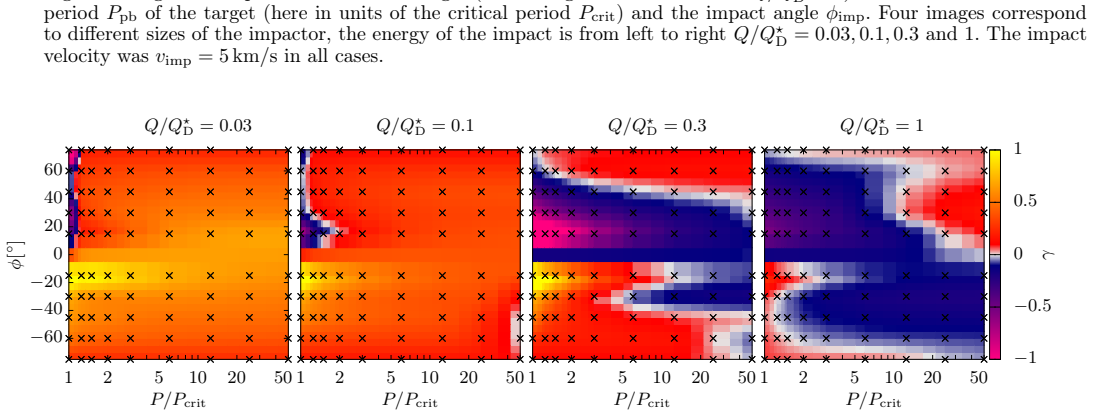
The load-bearing object is the dimensionless angular-momentum transfer effectivity $\gamma = (L_{\mathrm{lr}} - L_{\mathrm{pb}})/L_{\mathrm{imp}}$, comparing the largest remnant's spin angular momentum $L_{\mathrm{lr}}$ with the target's pre-impact spin $L_{\mathrm{pb}}$ and the impactor's orbital angular momentum $L_{\mathrm{imp}}$ (negative for retrograde impacts). Together with the angle-averaged spin change $\Delta\omega = \int \Delta\omega \sin 2\varphi\, d\varphi$, it turns a matrix of single impacts into a population-level statement about systematic spin-down. Supporting this is the paper's unified SPH/N-body code, whose correction tensor in the velocity-gradient estimate keeps bulk rotation stable and conserves angular momentum through both the fragmentation and the reaccumulation phases. A heuristic ratio $\omega_{\mathrm{pb}}/\omega_{\mathrm{imp}} \sim D_{\mathrm{pb}}/(v_{\mathrm{imp}} P_{\mathrm{pb}} \sin\varphi_{\mathrm{imp}})$ identifies when rotation matters, predicting larger effects for larger targets.
What would settle it
Repeat the impact-energy matrix with out-of-plane trajectories (projectiles hitting at high target latitudes) or with tilted spin axes and recompute the angle-averaged $\Delta\omega$; if the average turns positive for typical Main Belt periods, the systematic spin-down claim fails.
Extended reading notes
Core claim
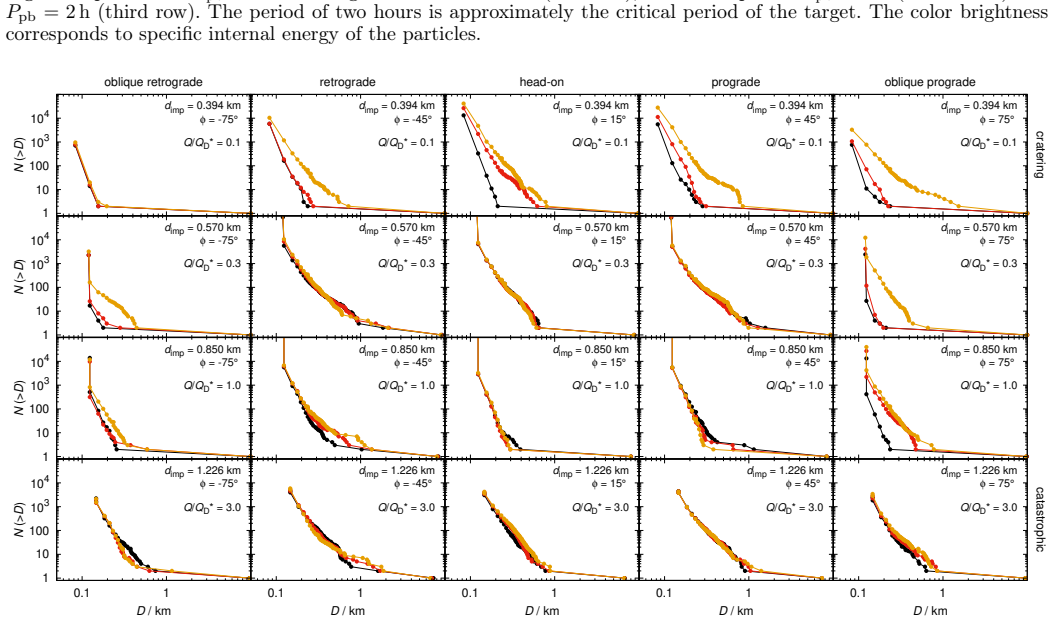
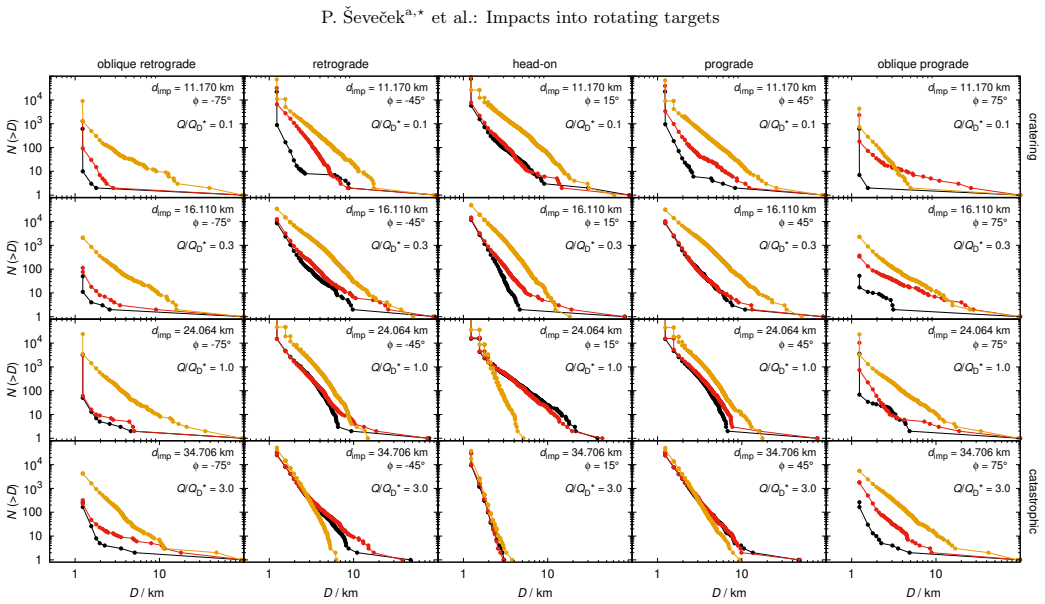
For monolithic asteroids, the paper claims, initial rotation materially changes the outcome of sub-catastrophic collisions. Cratering impacts into targets rotating near the critical breakup period eject up to five times more mass than impacts into stationary targets, with oblique prograde impacts most affected; at high impact energies the rotation makes little difference. The spin change is not one-directional: the paper defines a transfer effectivity $\gamma = (L_{\mathrm{lr}} - L_{\mathrm{pb}})/L_{\mathrm{imp}}$ and finds that prograde cratering mostly accelerates the target while retrograde cratering decelerates it, whereas for the most energetic impacts the pattern reverses. Averaging over impact angles with a $\sin 2\varphi$ weighting, the mean spin change $\Delta\omega$ is negative for both cratering and mid-energy impacts except for very slow rotators, so the net secular effect of the collisional environment is to drain angular momentum from the asteroid population.
Load-bearing premise
All impact simulations place the projectile in the target's equatorial plane; the claim that collisions systematically spin the population down assumes this geometry is representative of impacts at other latitudes.
Editorial extensions
If this is right
- Neglecting rotation biases synthetic asteroid family size-frequency distributions, most strongly for large parent bodies and oblique impacts.
- Rotation can turn a formally cratering impact into a catastrophic disruption, so families produced from fast rotators contain more and smaller fragments than stationary-target models predict.
- Because the angle-averaged spin change is negative, the collisional environment acts as a net angular momentum drain on the asteroid population, supporting the view that impacts help create the observed excess of slow rotators.
- Near the critical spin rate a target cannot be spun up further, so the spin-down effect and the mass-ejection amplification are strongest just below the spin barrier.
Reading between the lines
- If the equatorial-plane restriction holds up, the spin-down result should couple with spin-up processes such as thermal torques to cap asteroid spins near the barrier, a feedback the paper does not model.
- The fivefold ejection amplification near critical rotation implies cratering lifetimes and family production rates are underestimated for fast-rotating bodies, which could bias collisional evolution models.
- The same transfer-effectivity analysis could be rerun for rubble-pile targets with macro-porosity to see whether the population-level spin-down strengthens or weakens, since the paper only treats monolithic targets.
- A direct observational test would compare the size-frequency distributions and spin rates of families from known fast-rotating parent bodies with these synthetic families.
Signed reviews
Editorial analysis
A structured set of objections, weighed in public.
Referee Report
Summary. The paper presents a new unified SPH/N-body code, OpenSPH, and uses it to simulate impacts into rotating, monolithic asteroid targets of diameters 10 km and 100 km, over impact energies Q/Q*_D from 0.03 to 3, impact angles from 15° to 75° (prograde and retrograde), and rotation periods from near-critical to 50 P_crit. The authors compare synthetic family size-frequency distributions for rotating and non-rotating targets, quantify the enhancement of ejected mass (up to a factor of about five in oblique cratering events near the critical spin rate), and analyze the angular momentum transfer through the efficiency parameter γ and the angle-averaged spin-rate change Δω. The central claim, stated in the abstract, is that although individual cratering impacts can either accelerate or decelerate a target, deceleration prevails on average, so impacts cause a systematic spin-down of the asteroid population.
Significance. If the central spin-down claim holds, the paper provides a concrete collisional mechanism that could help explain the observed excess of slow rotators in the Main Belt, and it quantifies a previously neglected effect in synthetic family generation. The strengths of the work are its unusually broad simulation matrix (over 400 runs), the open-source release of the code, the explicit presentation of the governing equations, and the inclusion of consistency checks such as the comparison between inertial and co-rotating frames. The paper is therefore a potentially useful reference for both impact modeling and asteroid collisional evolution. However, the population-level spin-down conclusion is currently supported only by equatorial-plane impacts, and the verification of the code is described but not quantitatively documented, so the significance of the main claim is not yet fully established.
major comments (3)
- [Section 3.1 and Eq. (24)] The population-level claim in the abstract ('collisions thus cause a systematic spin-down of asteroid population') is supported only by an average over the in-plane angle φ for impacts restricted to the equatorial plane. All simulations set the rotation vector along z and place both the impactor position and velocity in the x-y plane, so no impact latitude is ever sampled. Equation (24) integrates sin 2φ over φ from 0 to π/2 only; it is a conditional average at the equator. The justification in Section 3.1 is a magnitude argument: equatorial impacts feel the largest centrifugal force and their angular momentum is aligned with the target spin, which supports the expectation that the effect is largest at the equator, not that its sign survives the latitude average. Since the paper itself notes in Section 4 that a non-rotating target is always spun up by an impact, high-latitude impacts should approach that limit, and the latitude-averaged Δω could be weaker, zero, or even positive, particularly for slow rotators and weak cratering events. To support the abstract's claim, the authors need either off-equator simulations or an explicit argument establishing that the sign of Δω is latitude-independent.
- [Section 2 and Appendix B] The manuscript states that the new code 'has been verified against previous ones (Benz and Asphaug 1994)', but the text reports no quantitative verification results; Appendix B only gives a visual comparison between the inertial-frame and co-rotating-frame implementations. The central quantities Δω, γ, and μej are outcomes of simulations where the angular momentum balance is delicate: the sign of Δω changes with impact angle and period in Fig. 6, so numerical angular momentum diffusion or modest conservation errors could affect the conclusions. Please report quantitative tests, including conservation of total linear and angular momentum and of energy for representative runs, a resolution study (the 400-run set uses about 100,000 particles while the family-formation sets use about 500,000), and a quantitative benchmark comparison with an established code or a published impact problem.
- [Section 4, Eqs. (23)-(24), and Section 2.5] The averaging in Eq. (24) and Fig. 8 includes runs with Q/Q*_D = 1, for which the paper states that the whole target is disintegrated and the largest remnant is reaccumulated; for these runs Δω is not the spin change of a surviving target but of a reaccumulated body. The reaccumulation model merges particles subject to the critical-spin condition in Eq. (20), which explicitly prevents the formation of supercritical rotators and, as noted in Section 2.5, modifies the moment of inertia of fragments. This merging rule can bias the inferred Δω toward negative values independently of the physics of angular momentum draining. The spin-down claim should either be restricted to cratering events where a surviving target is identifiable (roughly Q/Q*_D ≲ 0.3), or the analysis should quantify how the merger criterion affects the spin of the largest remnant.
minor comments (5)
- [Eq. (23)] The definition of γ uses Lpb twice: the second occurrence should be the angular momentum of the largest remnant, presumably Llr.
- [Section 3.4] The text says 'over 400 simulations' were performed for the ejected-mass study, but the parameter grid described (nine periods, six angles, four projectile diameters) gives 216 combinations; please clarify whether the additional runs include repeats, intermediate parameters, or other geometries.
- [Section 3] The paper states that Q*_D necessarily depends on the target's rotation but then treats Q*_D as independent of rotation and uses the Benz-Asphaug (1999) value. This is a reasonable choice for labeling runs, but it should be stated more explicitly that the quoted Q/Q*_D values do not represent the actual disruption threshold for a rotating target.
- [Eq. (7)] The energy equation has a likely index typo: the term (w_j^β - w_j^β) should probably be (w_j^α - w_j^α) or a similar pair with consistent indices.
- [Appendix C] The line 'As of August 12, 2019' should be replaced by a version or access date appropriate for the published version.
Circularity Check
No significant circularity: the central results are simulation outputs with external calibration, and the caveats are scope limitations rather than circular reductions.
full rationale
All load-bearing quantities — the spin-rate change Δω, the effectivity γ, and the ejected-mass ratio μej — are measured simulation outputs from the SPH/N-body runs, not parameters fitted to the conclusions. The impactor sizes are normalized using the Benz and Asphaug (1999) scaling law, which is an external calibration; the paper explicitly treats Q*_D as rotation-independent, so no outcome is fitted to the rotation state. Equation (24) is a weighted average of the simulated Δω(φ) values; because it is evaluated after the simulations, the sign of the average is not forced by the formula and could have come out positive. The acknowledged equatorial-plane restriction in Section 3.1 and the merger-shape limitation in Section 2.5 narrow the population-level applicability of the spin-down claim, but they are representativeness or correctness concerns, not self-referential reductions. Self-citations to Ševeček et al. (2017) and Jutzi et al. appear only for code context, prior parameter choices, and narrative background; they are not invoked to establish the spin-down result. Consequently, no step in the derivation reduces to its own inputs by construction.
Assumptions & free parameters
free parameters (6)
- SPH smoothing length factor eta =
1.3
- Courant number C_CFL =
0.25
- Derivative time-step constant C_d =
0.2
- Damping coefficient delta =
gradually decreased
- Coefficients of restitution (eta_n, eta_t) =
0.5, 1.0
- Merger spin limit factor =
not stated (presumably 1)
assumptions (8)
- ad hoc to paper Q*_D is taken independent of the target's rotation (Benz and Asphaug 1999 scaling law).
- domain assumption Targets and impactors are monolithic, homogeneous bodies.
- domain assumption Only equatorial impacts are simulated (rotation vector aligned with impactor angular momentum).
- domain assumption The fragmentation model follows Benz and Asphaug 1994; fully damaged material has no tensile or shear strength and cannot heal.
- domain assumption Von Mises plasticity with no pressure-dependent yield and no friction.
- domain assumption Tillotson equation of state with material parameters from Table 1.
- domain assumption Impact velocity fixed at v_imp = 5 km/s.
- domain assumption The critical spin period P_crit is about 2.009 h for rho = 2700 kg/m^3; targets at P = 2 h are held together by material strength.
Cite this review
Pith. "Pith review of Impacts into rotating targets: angular momentum draining and efficient formation of synthetic families." pith.science (2026). https://pith.science/paper/ZMAJ3JB7
@misc{pith2026190803248,
  author       = {Pith},
  title        = {Pith review of: Impacts into rotating targets: angular momentum draining and efficient formation of synthetic families},
  year         = {2026},
  howpublished = {\url{https://pith.science/paper/ZMAJ3JB7}},
  note         = {Machine review of arXiv:1908.03248}
}
read the original abstract
About 10% of the observed asteroids have rotational periods lower than P = 3 h and they seem to be relatively close to the spin barrier. Yet, the rotation has often been neglected in simulations of asteroid collisions. To determine the effect of rotation, we perform a large number of SPH/N-body impact simulations with rotating targets. We developed a new unified SPH/N-body code with self-gravity, suitable for simulations of both fragmentation phase and gravitational reaccumulation. The code has been verified against previous ones (Benz and Asphaug 1994), but we also tested new features, e.g. rotational stability, tensile stability, etc. Using the new code, we ran simulations with D_pb = 10 km and 100 km monolithic targets and compared synthetic asteroid families created by these impacts with families corresponding to non-rotating targets. The rotation affects mostly cratering events at oblique impact angles. The total mass ejected by these collision can be up to five times larger for rotating targets. We further compute the transfer of the angular momentum and determine conditions under which impacts accelerate or decelerate the target. While individual cratering collisions can cause both acceleration and deceleration, the deceleration prevails on average, collisions thus cause a systematic spin-down of asteroid population.
Figures

Figures from the paper (6 more)



Reference graph
Works this paper leans on
-
[1]
author Ballouz , R.L. , author Richardson , D.C. , author Michel , P. , author Schwartz , S.R. , author Yu , Y. , year 2015 . title Numerical simulations of collisional disruption of rotating gravitational aggregates: Dependence on material properties . journal volume 107 , pages 29--35 . :10.1016/j.pss.2014.06.003, http://arxiv.org/abs/1409.6650 arXiv:1409.6650
work page Pith review arXiv 2015
-
[2]
author Ballouz , R.L. , author Walsh , K.J. , author Richardson , D.C. , author Michel , P. , year 2018 . title Numerical Simulations of Asteroid Reaccumulation: Improving the SPH to N-Body Handoff Using Alpha Shapes , in: booktitle Lunar and Planetary Science Conference , p. pages 2816
work page 2018
-
[3]
author Balsara , D.S. , year 1995 . title von Neumann stability analysis of smoothed particle hydrodynamics---suggestions for optimal algorithms . journal Journal of Computational Physics volume 121 , pages 357--372 . :10.1016/S0021-9991(95)90221-X
-
[4]
author Barnes , J. , author Hut , P. , year 1986 . title A hierarchical O(N log N) force-calculation algorithm . journal volume 324 , pages 446--449 . :10.1038/324446a0
doi:10.1038/324446a0 1986
-
[5]
author Benavidez , P.G. , author Durda , D.D. , author Enke , B. , author Campo Bagatin , A. , author Richardson , D.C. , author Asphaug , E. , author Bottke , W.F. , year 2018 . title Impact simulation in the gravity regime: Exploring the effects of parent body size and internal structure . journal volume 304 , pages 143--161 . :10.1016/j.icarus.2017.05.030
-
[6]
author Benavidez , P.G. , author Durda , D.D. , author Enke , B.L. , author Bottke , W.F. , author Nesvorn \'y , D. , author Richardson , D.C. , author Asphaug , E. , author Merline , W.J. , year 2012 . title A comparison between rubble-pile and monolithic targets in impact simulations: Application to asteroid satellites and family size distributions . jo...
-
[7]
author Benz , W. , author Asphaug , E. , year 1994 . title Impact simulations with fracture. I - Method and tests . journal volume 107 , pages 98 . :10.1006/icar.1994.1009
arXiv 1994
-
[8]
author Benz , W. , author Asphaug , E. , year 1999 . title Catastrophic Disruptions Revisited . journal volume 142 , pages 5--20 . :10.1006/icar.1999.6204, http://arxiv.org/abs/arXiv:astro-ph/9907117 arXiv:arXiv:astro-ph/9907117
arXiv 1999
Show all 46 references
-
[9]
, year 2005
author Canup , R.M. , year 2005 . title A Giant Impact Origin of Pluto-Charon . journal Science volume 307 , pages 546--550 . :10.1126/science.1106818
2005 doi
-
[10]
, year 2008
author Canup , R.M. , year 2008 . title Lunar-forming collisions with pre-impact rotation . journal volume 196 , pages 518--538 . :10.1016/j.icarus.2008.03.011
2008 doi
-
[11]
, year 2010
author Cossins , P.J. , year 2010 . title The Gravitational Instability and its Role in the Evolution of Protostellar and Protoplanetary Discs . Ph.D. thesis. University of Leicester
2010
-
[12]
, author Stewart , S.T
author \'C uk , M. , author Stewart , S.T. , year 2012 . title Making the Moon from a Fast-Spinning Earth: A Giant Impact Followed by Resonant Despinning . journal Science volume 338 , pages 1047 . :10.1126/science.1225542
2012 doi
-
[13]
, year 1998
author Dahlgren , M. , year 1998 . title A study of Hilda asteroids. III. Collision velocities and collision frequencies of Hilda asteroids . journal volume 336 , pages 1056--1064
1998
-
[14]
, author Burns , J.A
author Dobrovolskis , A.R. , author Burns , J.A. , year 1984 . title Angular momentum drain - A mechanism for despinning asteroids . journal volume 57 , pages 464--476 . :10.1016/0019-1035(84)90130-1
1984 doi
-
[15]
, author Bottke , W.F
author Durda , D.D. , author Bottke , W.F. , author Nesvorn \'y , D. , author Enke , B.L. , author Merline , W.J. , author Asphaug , E. , author Richardson , D.C. , year 2007 . title Size-frequency distributions of fragments from SPH/N-body simulations of asteroid impacts: Com...
2007 doi
-
[16]
, author Jorda , L
author F \'e tick , R.J. , author Jorda , L. , author Vernazza , P. , author Marsset , M. , author Drouard , A. , author Fusco , T. , author Carry , B. , author Marchis , F. , author Hanu s , J. , author Viikinkoski , M. , author Birlan , M. , author Bartczak , P. , author Ber...
2019 arXiv
-
[17]
, author Scheeres , D.J
author Hirabayashi , M. , author Scheeres , D.J. , year 2014 . title Analysis of Asteroid (216) Kleopatra Using Dynamical and Structural Constraints . journal volume 780 , pages 160 . :10.1088/0004-637X/780/2/160, http://arxiv.org/abs/1312.4976 arXiv:1312.4976
2014 arXiv
-
[18]
, author Asphaug , E
author Jutzi , M. , author Asphaug , E. , author Gillet , P. , author Barrat , J.A. , author Benz , W. , year 2013 . title The structure of the asteroid 4 Vesta as revealed by models of planet-scale collisions . journal volume 494 , pages 207--210 . :10.1038/nature11892
2013 doi
-
[19]
, author Benz , W
author Jutzi , M. , author Benz , W. , year 2017 . title Formation of bi-lobed shapes by sub-catastrophic collisions. A late origin of comet 67P's structure . journal volume 597 , pages A62 . :10.1051/0004-6361/201628964, http://arxiv.org/abs/1611.02615 arXiv:1611.02615
2017 arXiv
-
[20]
, author Holsapple , K
author Jutzi , M. , author Holsapple , K. , author W \"u nneman , K. , author Michel , P. , year 2015 . title Modeling asteroid collisions and impact processes , in: editor Michel , P. , editor DeMeo , F.E. , editor Bottke , W.F. (Eds.), booktitle Asteroids IV . publisher The ...
2015
-
[21]
, author Michel , P
author Jutzi , M. , author Michel , P. , author Richardson , D.C. , year 2019 . title Fragment properties from large-scale asteroid collisions: I: Results from SPH/N-body simulations using porous parent bodies and improved material models . journal volume 317 , pages 215--228 ...
2019 arXiv
-
[22]
, author Genda , H
author Kurosawa , K. , author Genda , H. , year 2018 . title Effects of Friction and Plastic Deformation in Shock-Comminuted Damaged Rocks on Impact Heating . journal volume 45 , pages 620--626 . :10.1002/2017GL076285, http://arxiv.org/abs/1801.01100 arXiv:1801.01100
2018 arXiv
-
[23]
, author Antuono, M
author Marrone, S. , author Antuono, M. , author Colagrossi, A. , author Colicchio, G. , author Touzé, D.L. , author Graziani, G. , year 2011 . title -sph model for simulating violent impact flows . journal Computer Methods in Applied Mechanics and Engineering volume 200 , pag...
2011 doi
-
[24]
, author Richardson , D.C
author Michel , P. , author Richardson , D.C. , year 2013 . title Collision and gravitational reaccumulation: Possible formation mechanism of the asteroid Itokawa . journal volume 554 , pages L1 . :10.1051/0004-6361/201321657
2013 doi
-
[25]
, author Richardson , D.C
author Michel , P. , author Richardson , D.C. , author Durda , D.D. , author Jutzi , M. , author Asphaug , E. , year 2015 . title Collisional Formation and Modeling of Asteroid Families , in: editor Michel , P. , editor DeMeo , F.E. , editor Bottke , W.F. (Eds.), booktitle Ast...
2015 doi
-
[26]
, author Gingold, R
author Monaghan, J. , author Gingold, R. , year 1983 . title Shock simulation by the particle method sph . journal Journal of Computational Physics volume 52 , pages 374 -- 389 . :http://dx.doi.org/10.1016/0021-9991(83)90036-0
1983 doi
-
[27]
, year 1985
author Monaghan , J.J. , year 1985 . title Particle methods for hydrodynamics . journal Computer Physics Reports volume 3 , pages 71--124 . :10.1016/0167-7977(85)90010-3
1985 doi
-
[28]
, year 2000
author Monaghan , J.J. , year 2000 . title SPH without a Tensile Instability . journal Journal of Computational Physics volume 159 , pages 290--311 . :10.1006/jcph.2000.6439
2000
-
[29]
, author Burchell , M.J
author Morris , A.J.W. , author Burchell , M.J. , year 2017 . title Laboratory tests of catastrophic disruption of rotating bodies . journal volume 296 , pages 91--98 . :10.1016/j.icarus.2017.05.016
2017 doi
-
[30]
, author Fujiwara , A
author Nakamura , A. , author Fujiwara , A. , year 1991 . title Velocity distribution of fragments formed in a simulated collisional disruption . journal volume 92 , pages 132--146 . :10.1016/0019-1035(91)90040-Z
1991 doi
-
[31]
, author Bro z , M
author Nesvorn\'y , D. , author Bro z , M. , author Carruba , V. , year 2015 . title Identification and Dynamical Properties of Asteroid Families , in: editor Michel , P. , editor DeMeo , F.E. , editor Bottke , W.F. (Eds.), booktitle Asteroids IV . publisher The University of ...
2015
-
[32]
, year 2014
author Owen , J.M. , year 2014 . title A compatibly differenced total energy conserving form of SPH . journal International Journal for Numerical Methods in Fluids volume 75 , pages 749--774 . :10.1002/fld.3912
2014 doi
-
[33]
, author Stadel , J
author Reinhardt , C. , author Stadel , J. , year 2017 . title Numerical aspects of giant impact simulations . journal volume 467 , pages 4252--4263 . :10.1093/mnras/stx322, http://arxiv.org/abs/1701.08296 arXiv:1701.08296
2017 arXiv
-
[34]
, author Owen , J.M
author Remington , T. , author Owen , J.M. , author Nakamura , A. , author Miller , P.L. , author Bruck Syal , M. , year 2018 . title Benchmarking Asteroid-Deflection Simulations: Basalt Spheres , in: booktitle AAS/Division for Planetary Sciences Meeting Abstracts \#50 , p. pa...
2018
-
[35]
, author Quinn , T
author Richardson , D.C. , author Quinn , T. , author Stadel , J. , author Lake , G. , year 2000 . title Direct Large-Scale N-Body Simulations of Planetesimal Dynamics . journal volume 143 , pages 45--59 . :10.1006/icar.1999.6243
2000
-
[36]
, author Riecker , S
author Sch \"a fer , C. , author Riecker , S. , author Maindl , T.I. , author Speith , R. , author Scherrer , S. , author Kley , W. , year 2016 . title A smooth particle hydrodynamics code to model collisions between solid, self-gravitating objects . journal volume 590 , pages...
2016 arXiv
-
[37]
, author Bro z , M
author Sevecek S eve c ek , P. , author Bro z , M. , author Nesvorn \'y , D. , author Enke , B. , author Durda , D. , author Walsh , K. , author Richardson , D.C. , year 2017 . title SPH/N-Body simulations of small (D = 10km) asteroidal breakups and improved parametric relatio...
2017 doi
-
[38]
, year 2001
author Stadel , J.G. , year 2001 . title Cosmological N-body simulations and their analysis . Ph.D. thesis. University of Washington
2001
-
[39]
, author Tanaka , H
author Suetsugu , R. , author Tanaka , H. , author Kobayashi , H. , author Genda , H. , year 2018 . title Collisional disruption of planetesimals in the gravity regime with iSALE code: Comparison with SPH code for purely hydrodynamic bodies . journal volume 314 , pages 121--13...
2018 arXiv
-
[40]
, author Kobayashi , H
author Sugiura , K. , author Kobayashi , H. , author Inutsuka , S. , year 2018 . title Toward understanding the origin of asteroid geometries. Variety in shapes produced by equal-mass impacts . journal volume 620 , pages A167 . :10.1051/0004-6361/201833227, http://arxiv.org/ab...
2018 arXiv
-
[41]
, author Ohtsuki , K
author Takeda , T. , author Ohtsuki , K. , year 2007 . title Mass dispersal and angular momentum transfer during collisions between rubble-pile asteroids . journal volume 189 , pages 256--273 . :10.1016/j.icarus.2006.12.017
2007 doi
-
[42]
, author Ohtsuki , K
author Takeda , T. , author Ohtsuki , K. , year 2009 . title Mass dispersal and angular momentum transfer during collisions between rubble-pile asteroids. II. Effects of initial rotation and spin-down through disruptive collisions . journal volume 202 , pages 514--524 . :10.10...
2009 doi
-
[43]
, year 1962
author Tillotson, J.H. , year 1962 . title Metallic equations of state for hypervelocity impact . journal General Atomic Report volume GA-3216
1962
-
[44]
, author Bro z , M
author Vernazza , P. , author Bro z , M. , author Drouard , A. , author Hanu s , J. , author Viikinkoski , M. , author Marsset , M. , author Jorda , L. , author Fetick , R. , author Carry , B. , author Marchis , F. , author Birlan , M. , author Fusco , T. , author Santana-Ros ...
2018
-
[45]
, year 2019
author Vinogradova , T.A. , year 2019 . title Empirical method of proper element calculation and identification of asteroid families . journal volume 484 , pages 3755--3764 . :10.1093/mnras/stz228
2019 doi
-
[46]
, author Burchell , M.J
author Wickham-Eade , J.E. , author Burchell , M.J. , author Price , M.C. , author Harriss , K.H. , year 2018 . title Hypervelocity impact fragmentation of basalt and shale projectiles . journal volume 311 , pages 52--68 . :10.1016/j.icarus.2018.03.017
2018 doi
Reviewed August 14, 2026 · model on record in the stance chip above.
Discussion (0). Continue with ORCID to comment.