A second-order unified gas-kinetic wave-particle method with enhanced mesh independence for hypersonic flows
Pith reviewed 2026-06-30 04:25 UTC · model grok-4.3
The pith
Targeted updates to particle sampling and flux terms make the UGKWP method second-order accurate and far less sensitive to mesh size in hypersonic flows.
A machine-rendered reading of the paper's core claim, the machinery that carries it, and where it could break.
Core claim
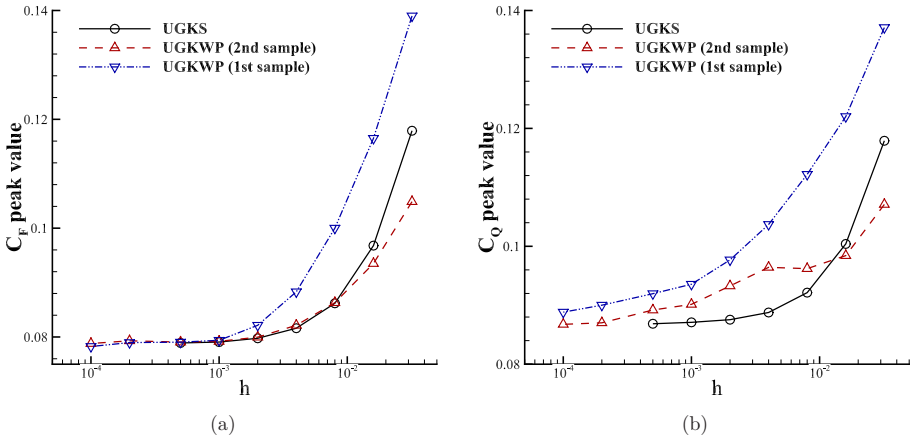
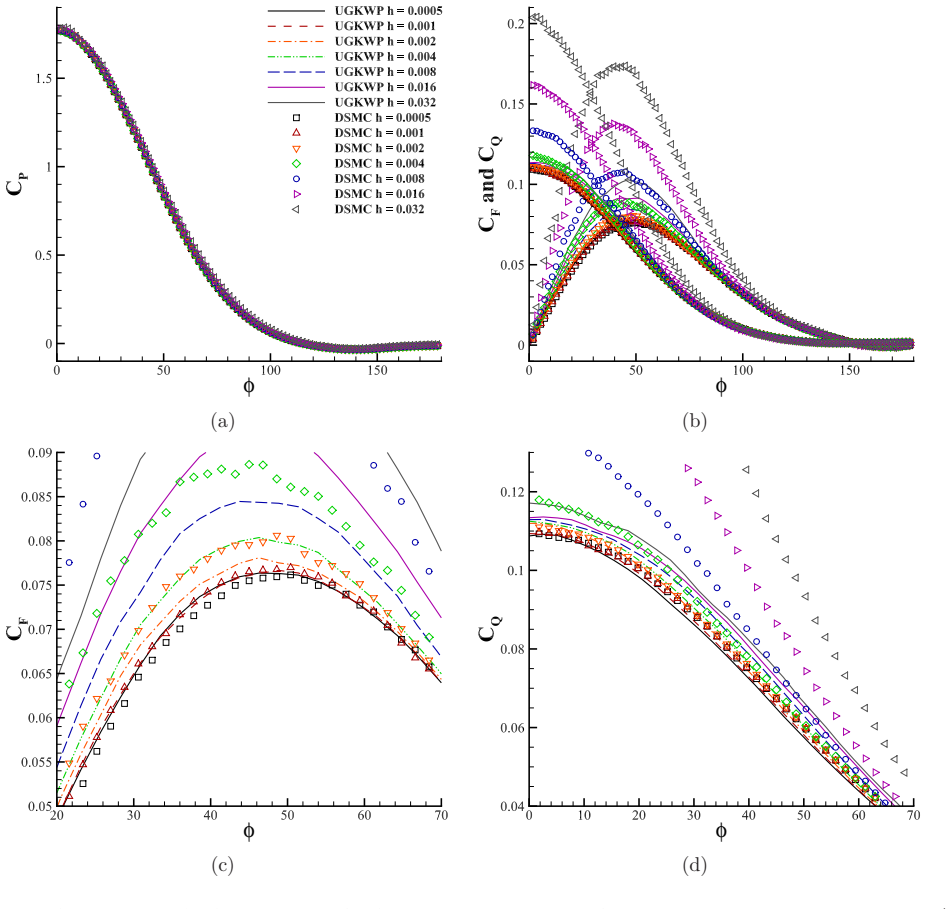
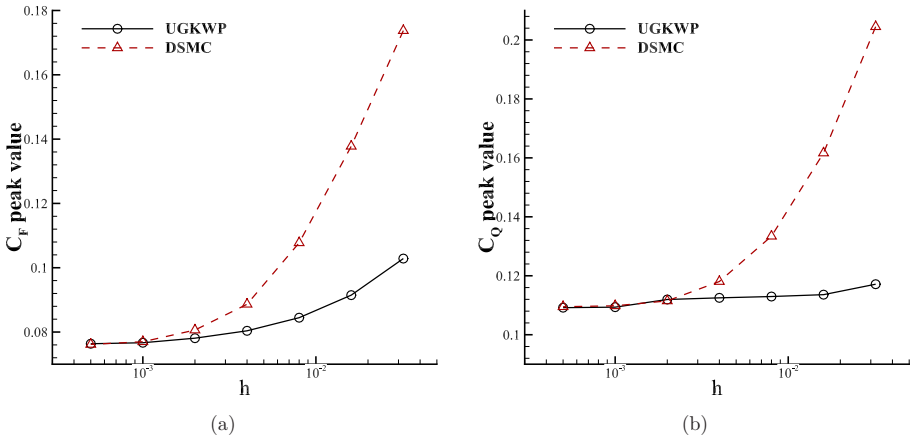
By raising particle sampling to second order, incorporating wall-aware gradient reconstruction, revising the Venkatakrishnan limiter, adding conservation corrections, and including the first-order Chapman-Enskog term in the free-transport flux, the UGKWP method preserves second-order accuracy throughout and achieves mesh-independence behavior that is consistent with UGKS and markedly superior to DSMC for quantities such as CF, CQ, CD, and L/D in hypersonic cylinder and cone cases.
What carries the argument
The second-order unified gas-kinetic wave-particle (UGKWP) method, which automatically decomposes the gas distribution function into hydrodynamic waves and particles while incorporating the listed accuracy-preserving modifications.
If this is right
- Wall pressure, shear stress, and heat flux coefficients remain accurate on coarser meshes than previously required.
- Overall aerodynamic coefficients CL, CD, and L/D for blunt bodies become reliable even when grid resolution is limited.
- The method recovers the pure gas-kinetic scheme behavior in the near-continuum limit without loss of multiscale capability.
- Computational cost for aerodynamic and thermal-protection design of near-space vehicles can be lowered while keeping the same fidelity on mesh-sensitive quantities.
Where Pith is reading between the lines
- The same second-order sampling and reconstruction steps could be tested on other multiscale transport problems such as plasma or radiation flows mentioned in the abstract.
- If the improved mesh independence holds in three-dimensional unsteady cases, the method would reduce the grid-resolution barrier for full-vehicle hypersonic simulations.
- Direct comparison of wall quantities on a single fixed mesh against both UGKS and DSMC would give a quantitative measure of how much the gap to continuum and particle methods has closed.
Load-bearing premise
The listed modifications to sampling, reconstruction, limiting, conservation, and the Chapman-Enskog term together keep the scheme second-order accurate and free of new inconsistencies in the multiscale regime.
What would settle it
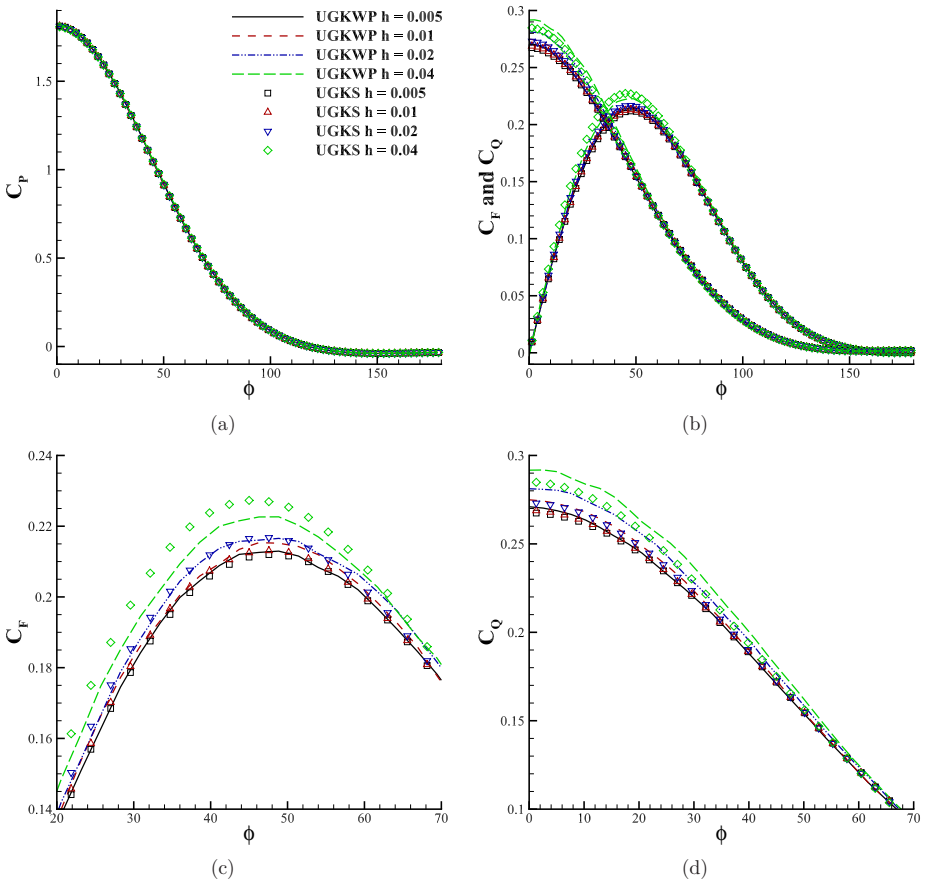
In the reported hypersonic cylinder test, if the mesh-convergence curves for CF, CQ, CD, or L/D under the updated UGKWP do not become visibly closer to the UGKS curves or remain worse than DSMC on successively refined meshes, the central claim is falsified.
Figures
read the original abstract
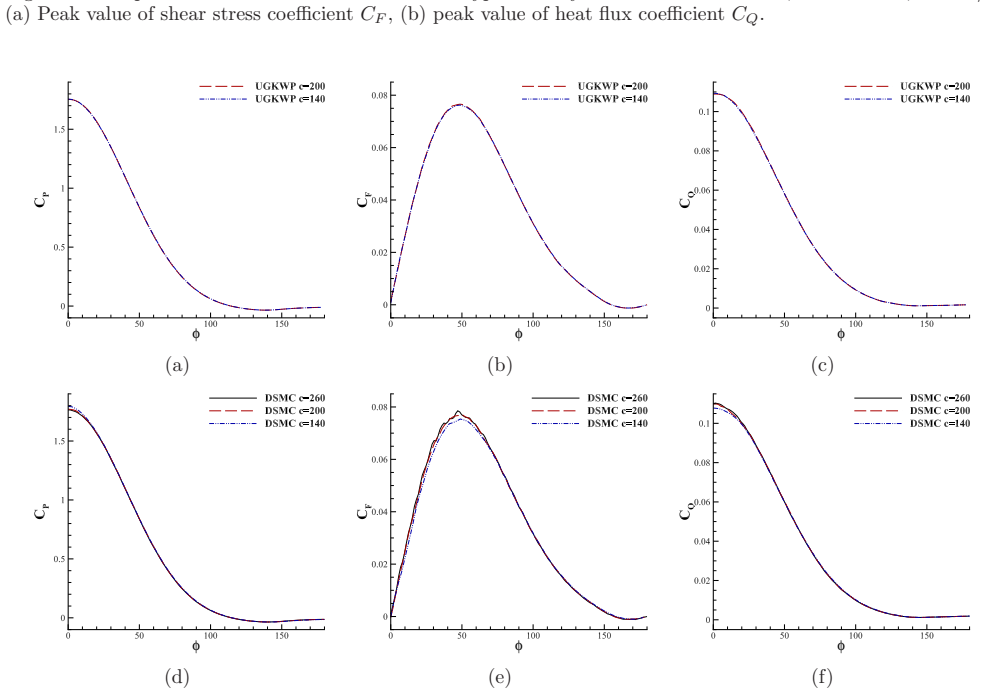
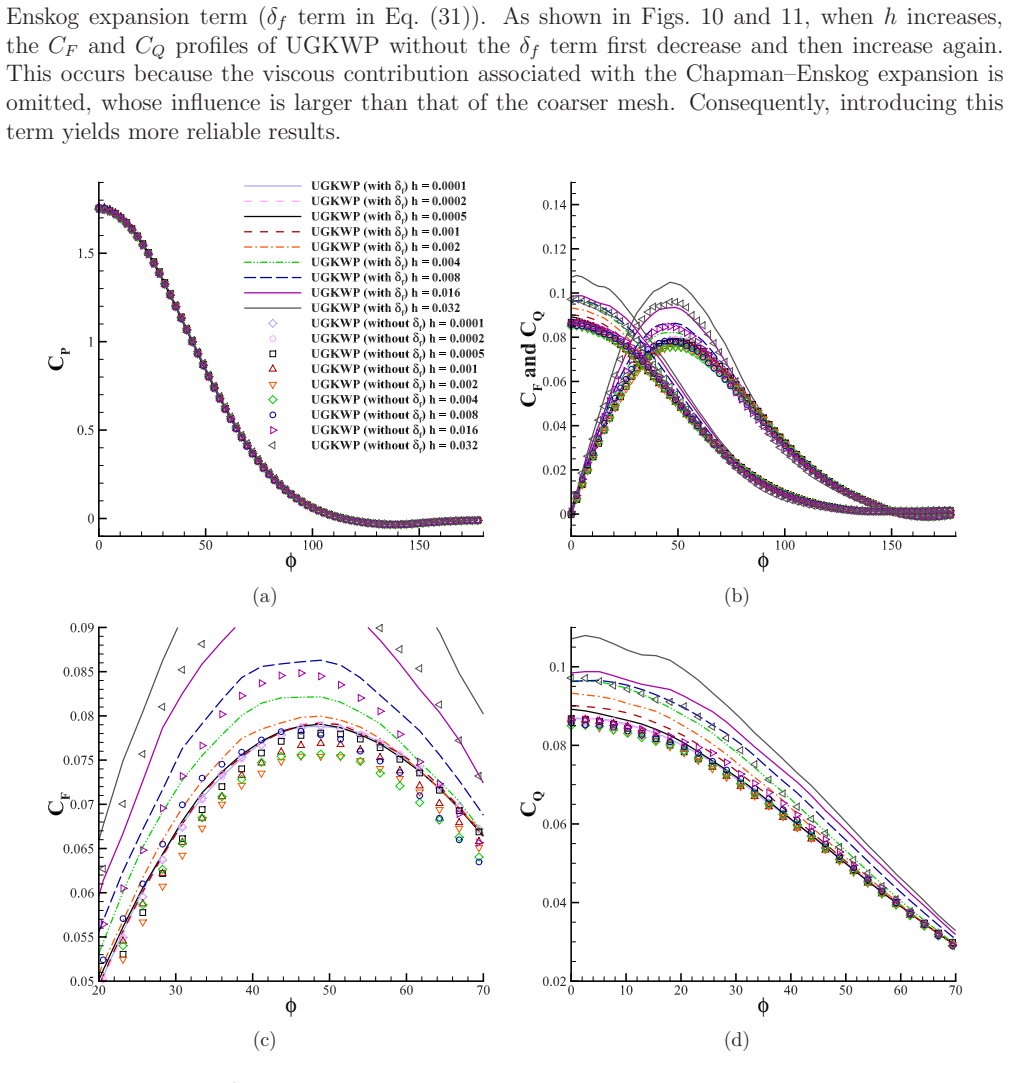
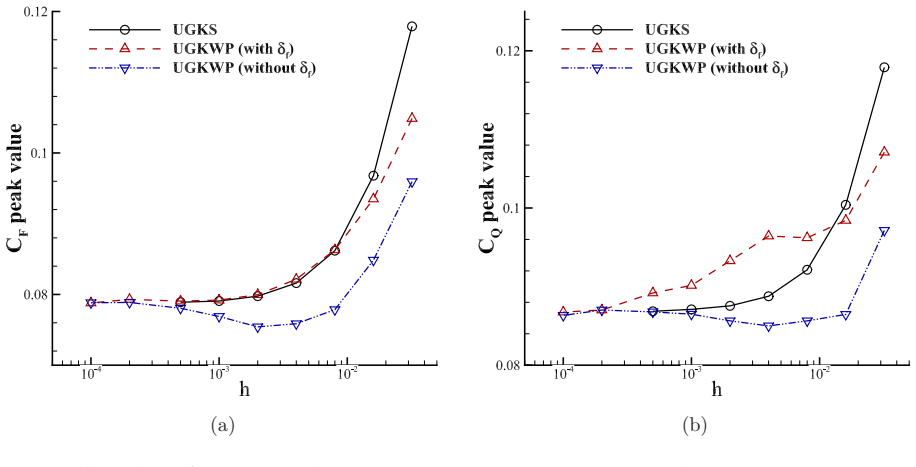
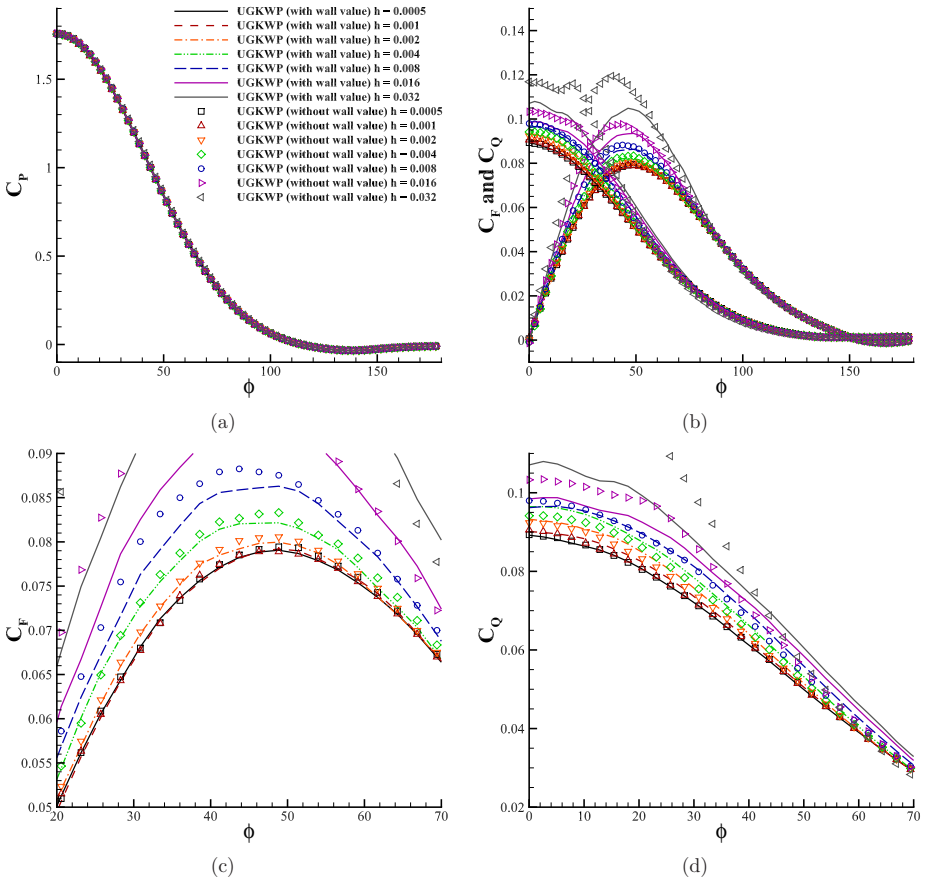
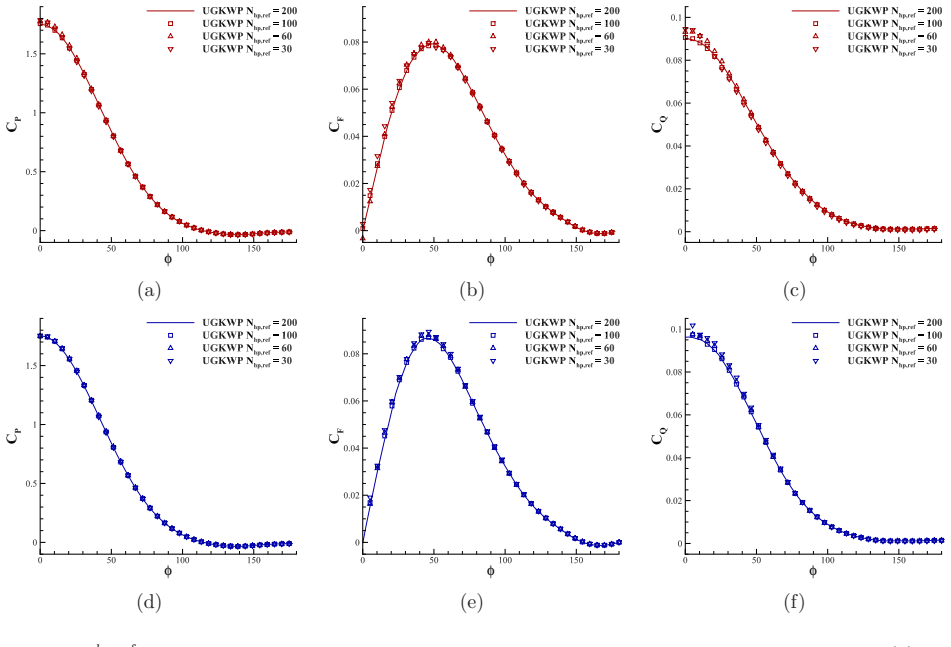
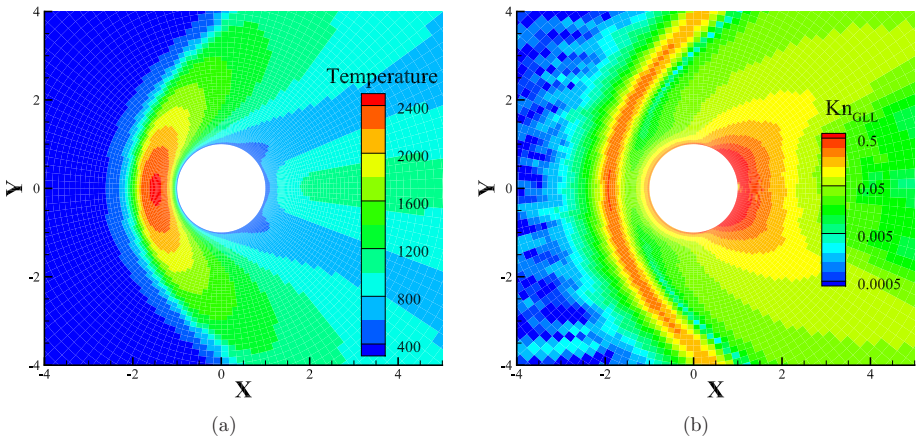
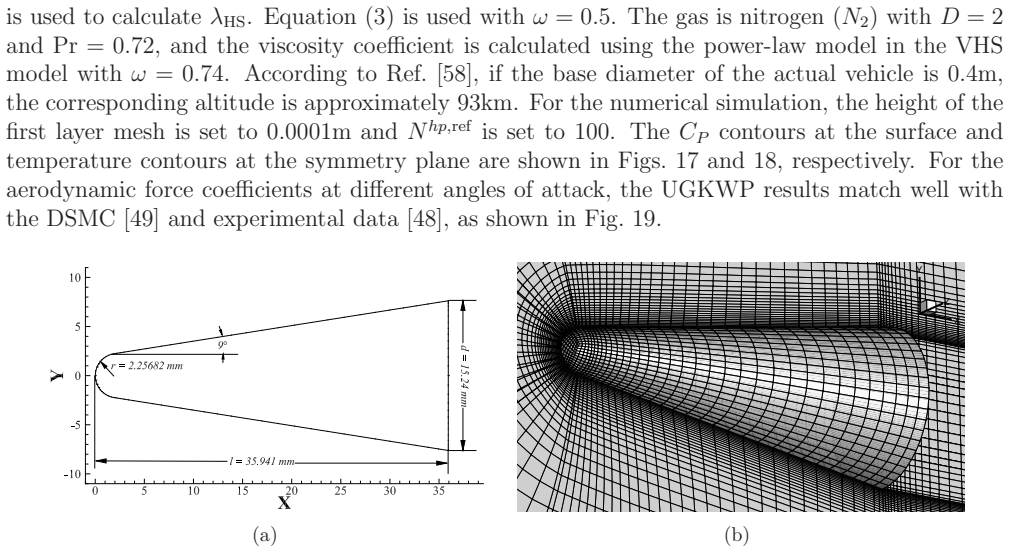
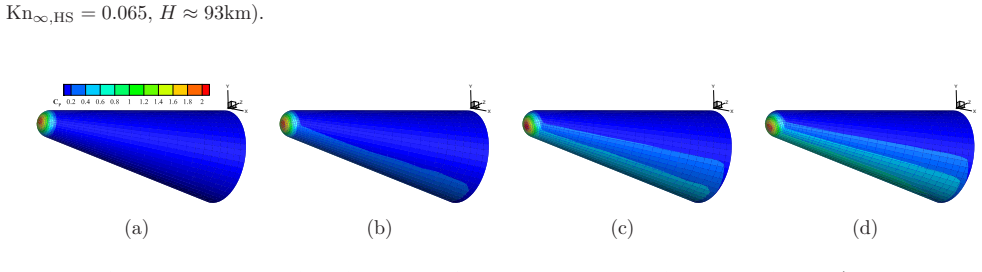
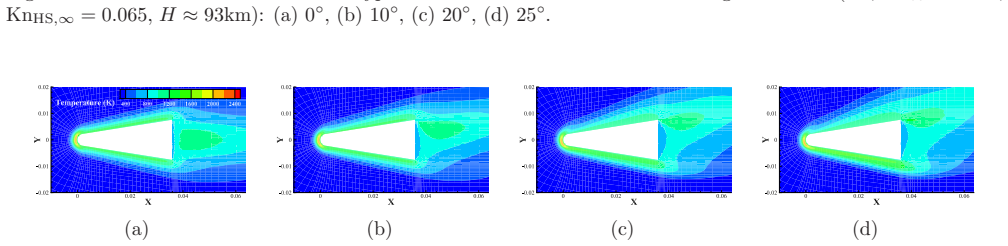
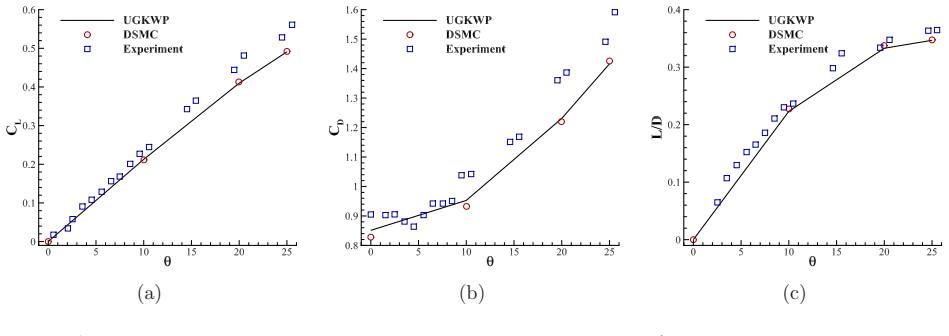
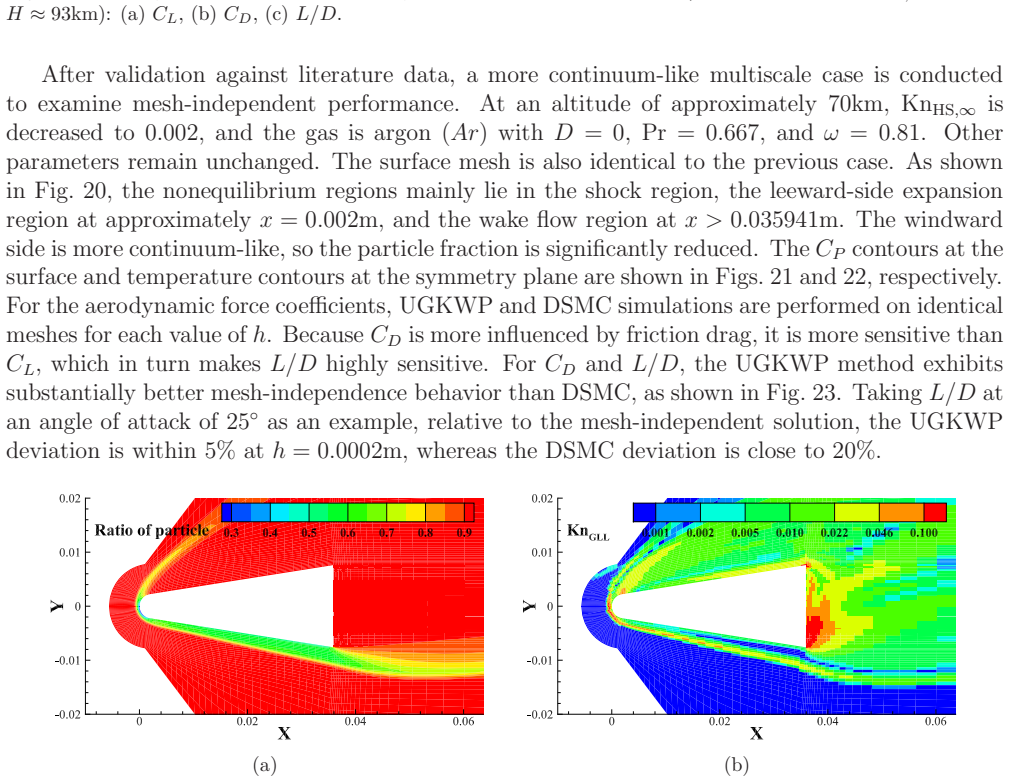
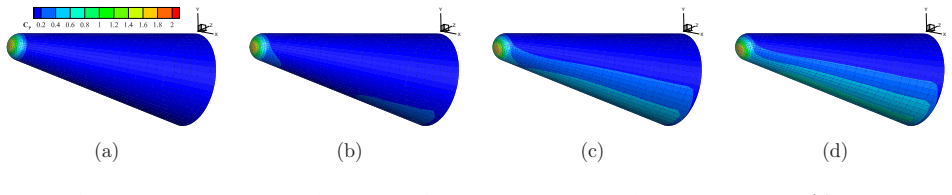
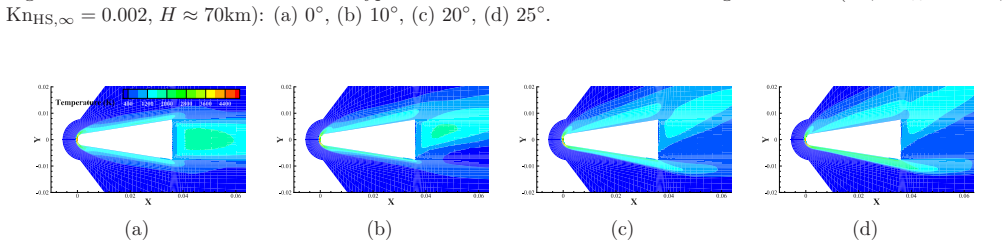
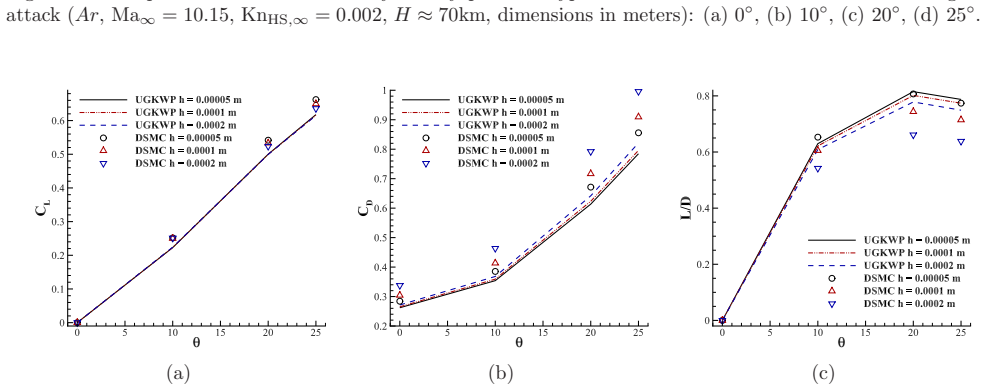
Benefiting from the direct modeling of physical laws in a discretized space and the automatic decomposition of the gas distribution function into hydrodynamic waves and particles, the UGKWP method offers significant advantages for multiscale flows such as hypersonic flows, plasma transport, and radiation transport. In this study, the particle sampling accuracy in the UGKWP method is improved from first order to second order, so that the second-order spatial and temporal accuracy is preserved across the full scheme. Specifically, the modifications include second-order particle sampling based on local macroscopic gradients, a weighted least-squares gradient reconstruction that incorporates wall values, a revised Venkatakrishnan limiter for highly stretched cells, and conservation corrections after particle sampling. Moreover, the first-order Chapman--Enskog term is considered in the free-transport part of the hydrodynamic wave flux, enabling better recovery of the GKS in the near-continuum regime. Based on these improvements, the mesh-independence behavior of the UGKWP method is notably enhanced, which is more consistent with the performance of the UGKS, validated by a detailed hypersonic cylinder flow test case. Furthermore, systematic comparisons with the single-scale DSMC method are performed for two-dimensional hypersonic flow over a cylinder and three-dimensional flow over a blunt cone. Wall pressure, shear stress, and heat flux coefficients (CP, CF, and CQ) are examined in the cylinder case, while the overall aerodynamic coefficients (CL, CD, and L/D) are assessed in the cone case. The multiscale UGKWP method exhibits significantly better mesh-independence performance than DSMC for mesh-sensitive quantities such as CF, CQ, CD, and L/D, which are critical for aerodynamic and thermal protection design of near-space hypersonic vehicles.
Editorial analysis
A structured set of objections, weighed in public.
Referee Report
Summary. The paper claims that several modifications to the unified gas-kinetic wave-particle (UGKWP) method—second-order particle sampling from local macroscopic gradients, weighted least-squares reconstruction with wall values, a revised Venkatakrishnan limiter, conservation corrections, and inclusion of the first-order Chapman-Enskog term in the wave flux—restore consistent second-order spatial and temporal accuracy. These changes are asserted to markedly improve mesh independence, bringing UGKWP performance in line with UGKS while outperforming DSMC on mesh-sensitive quantities (CF, CQ, CD, L/D). The claims are supported by systematic comparisons on a 2D hypersonic cylinder (CP, CF, CQ) and a 3D blunt cone (CL, CD, L/D).
Significance. If the modifications preserve second-order accuracy and the multiscale coupling without new inconsistencies, the work would supply a practical multiscale solver for hypersonic aerothermodynamics that retains particle-based advantages while achieving UGKS-like mesh robustness on coarser grids. The direct head-to-head comparisons against DSMC on engineering-relevant coefficients constitute a useful benchmark contribution.
major comments (2)
- [Numerical method and validation sections] The central claim that the listed modifications collectively preserve second-order accuracy across the multiscale regime (abstract and § on numerical method) rests on construction rather than explicit verification; no truncation-error analysis or manufactured-solution order test is referenced, leaving open whether the revised limiter, conservation corrections, or CE term in the wave flux introduce first-order errors in transitional Knudsen regimes.
- [Results on cylinder and cone flows] Mesh-independence conclusions for CF, CQ, CD, and L/D (cylinder and cone cases) are load-bearing for the practical significance, yet the manuscript provides no quantitative mesh-convergence rates or grid-refinement tables that would allow direct comparison of observed orders between UGKWP, UGKS, and DSMC; the cylinder results are described qualitatively as “notably enhanced.”
minor comments (2)
- Notation for the weighted least-squares reconstruction and the precise form of the conservation correction after sampling should be stated explicitly with equation numbers to facilitate reproducibility.
- The revised Venkatakrishnan limiter is introduced for highly stretched cells, but its functional form and the choice of the constant are not compared against the original limiter on a standard test, which would clarify the modification’s necessity.
Simulated Author's Rebuttal
We thank the referee for the constructive and detailed comments. We address each major point below and will revise the manuscript to incorporate additional verification where appropriate.
read point-by-point responses
-
Referee: [Numerical method and validation sections] The central claim that the listed modifications collectively preserve second-order accuracy across the multiscale regime (abstract and § on numerical method) rests on construction rather than explicit verification; no truncation-error analysis or manufactured-solution order test is referenced, leaving open whether the revised limiter, conservation corrections, or CE term in the wave flux introduce first-order errors in transitional Knudsen regimes.
Authors: The modifications—second-order particle sampling from local macroscopic gradients, weighted least-squares reconstruction with wall values, revised Venkatakrishnan limiter, conservation corrections, and inclusion of the first-order Chapman–Enskog term in the wave flux—are constructed to maintain consistency with the second-order UGKS discretization in the continuum limit while preserving appropriate particle evolution in rarefied regimes. This design ensures the overall scheme retains second-order spatial and temporal accuracy across the multiscale regime. We acknowledge, however, that the manuscript relies on this construction without an explicit truncation-error analysis or manufactured-solution test. In the revised version we will add a manufactured-solution verification in the transitional Knudsen regime to confirm the observed order of accuracy. revision: yes
-
Referee: [Results on cylinder and cone flows] Mesh-independence conclusions for CF, CQ, CD, and L/D (cylinder and cone cases) are load-bearing for the practical significance, yet the manuscript provides no quantitative mesh-convergence rates or grid-refinement tables that would allow direct comparison of observed orders between UGKWP, UGKS, and DSMC; the cylinder results are described qualitatively as “notably enhanced.”
Authors: Mesh independence is demonstrated through systematic comparisons on successively refined meshes for both the 2D cylinder (CP, CF, CQ) and 3D blunt cone (CL, CD, L/D), showing that the updated UGKWP recovers UGKS-like robustness while outperforming DSMC on the mesh-sensitive coefficients. The figures provide the supporting visual evidence. We agree that quantitative convergence rates and grid-refinement tables would allow direct comparison of observed orders. In the revision we will add tables reporting the values of the key coefficients on successive meshes together with estimated convergence rates for UGKWP, UGKS, and DSMC. revision: yes
Circularity Check
No significant circularity identified
full rationale
The paper presents explicit algorithmic modifications (second-order particle sampling from local gradients, WLS reconstruction with wall values, revised Venkatakrishnan limiter, conservation corrections, and inclusion of first-order Chapman-Enskog term in wave flux) to enforce second-order accuracy in UGKWP. These changes are described as direct numerical updates to sampling and flux terms without any reduction to quantities fitted from the target test data or self-referential definitions. Mesh-independence claims are validated on independent hypersonic cylinder and blunt-cone cases by direct comparison to UGKS and DSMC, with no load-bearing self-citation chains, uniqueness theorems imported from the same authors, or ansatzes smuggled via prior work. The derivation chain remains self-contained against external benchmarks.
Axiom & Free-Parameter Ledger
Reference graph
Works this paper leans on
-
[1]
Xu, Direct modeling for computational fluid dynamics: Constru ction and application of unified gas-kinetic schemes, World Scientific, 2015
K. Xu, Direct modeling for computational fluid dynamics: Constru ction and application of unified gas-kinetic schemes, World Scientific, 2015
2015
-
[2]
Xu, A unified computational fluid dynamics framework from rar efied to continuum regimes, Cambridge University Press, 2021
K. Xu, A unified computational fluid dynamics framework from rar efied to continuum regimes, Cambridge University Press, 2021
2021
-
[3]
K. Xu, J.-C. Huang, A unified gas-kinetic scheme for continuum an d rar- efied flows, Journal of Computational Physics 229 (20) (2010) 77 47–7764. doi:https://doi.org/10.1016/j.jcp.2010.06.032
-
[4]
C. Liu, Y. Zhu, K. Xu, Unified gas-kinetic wave-particle methods I : Contin- uum and rarefied gas flow, Journal of Computational Physics 401 ( 2020) 108977. doi:https://doi.org/10.1016/j.jcp.2019.108977
-
[5]
Y. Zhu, C. Liu, C. Zhong, K. Xu, Unified gas-kinetic wave-particle methods. II. Multiscale simulation on unstructured mesh, Physics of Fluids 31 (201 9) 067105. doi:https://doi.org/10.1063/1.5097645
-
[6]
S. Liu, P. Yu, K. Xu, C. Zhong, Unified gas-kinetic scheme for diat omic molecular simulations in all flow regimes, Journal of Computational Physics 259 (2014) 96–113. doi:https://doi.org/10.1016/j.jcp.2013.11.030
-
[7]
X. Xu, Y. Chen, C. Liu, Z. Li, K. Xu, Unified gas-kinetic wave-part icle meth- ods V: Diatomic molecular flow, Journal of Computational Physics 44 2 (2021) 110496. doi:https://doi.org/10.1016/j.jcp.2021.110496
-
[8]
W. Long, Y. Wei, K. Xu, Nonequilibrium flow simulations using unified gas-kinetic wave-particle method, AIAA Journal 62 (4) (2024) 14 11–1433. doi:https://doi.org/10.2514/1.J063641
-
[9]
C. Liu, Z. Wang, K. Xu, A unified gas-kinetic scheme for continuum and rarefied flows VI: Dilute disperse gas-particle multiphase system, Journal of Comput ational Physics 386 (2019) 264–295. doi:https://doi.org/10.1016/j.jcp.2018.12.040
-
[10]
X. Yang, C. Liu, X. Ji, W. Shyy, K. Xu, Unified gas-kinetic wave-p article methods VI: Disperse dilute gas-particle multiphase flow, Communications in Computational Physics 31 (3) (2022) 669–706. doi:https://doi.org/10.4208/cicp.OA-2021-0153
-
[11]
L. Mieussens, On the asymptotic preserving property of the u nified gas kinetic scheme for the diffusion limit of linear kinetic models, Journal of Computational Physic s 253 (2013) 138–156. doi:https://doi.org/10.1016/j.jcp.2013.07.002
-
[12]
W. Li, C. Liu, Y. Zhu, J. Zhang, K. Xu, Unified gas-kinetic wave-p article methods III: Multiscale photon transport, Journal of Computational Phy sics 408 (2020) 109280. doi:https://doi.org/10.1016/j.jcp.2020.109280. 32
-
[13]
C. Liu, K. Xu, A unified gas kinetic scheme for continuum and rare fied flows V: Multiscale and multi-component plasma transport, Communications in Computa tional Physics 22 (5) (2017) 1175–1223. doi:https://doi.org/10.4208/cicp.OA-2017-0102
-
[14]
C. Liu, K. Xu, Unified gas-kinetic wave-particle methods IV: mult i-species gas mixture and plasma transport, Advances in Aerodynamics 3 (20 21) 9. doi:https://doi.org/10.1186/s42774-021-00062-1
-
[15]
X. Yang, K. Xu, Wave-particle based multiscale modeling and simula tion of non-equilibrium turbulent flows, Computers & Fluids 317 (2026) 10 7162. doi:https://doi.org/10.1016/j.compfluid.2026.107162
-
[16]
X. Yang, Y. Zhu, C. Liu, K. Xu, Unified gas-kinetic wave-particle method for frequency- dependent radiation transport equation, Journal of Computatio nal Physics 522 (2025) 113587. doi:https://doi.org/10.1016/j.jcp.2024.113587
-
[17]
Z. Pu, K. Xu, Unified gas-kinetic wave-particle method for multis cale flow simula- tion of partially ionized plasma, Journal of Computational Physics 53 0 (2025) 113918. doi:https://doi.org/10.1016/j.jcp.2025.113918
-
[18]
M. Quan, X. Yang, Y. Wei, K. Xu, Radiative hydrodynamic equatio ns with nonequilibrium radiative transfer, Physics Review D 111 (2025) 1 03038. doi:https://doi.org/10.1103/PhysRevD.111.103038
-
[19]
Y. Wei, J. Cao, K. Xu, Unified gas-kinetic scheme for reactive flo w with multi-scale trans- port and chemical non-equilibrium, Journal of Computational Phys ics 546 (2026) 114514. doi:https://doi.org/10.1016/j.jcp.2025.114514
-
[20]
Z. Pu, K. Xu, Electromagnetic flow control in hypersonic rarefi ed environment, Journal of Fluid Mechanics 1033 (2026) A37. doi:https://doi.org/10.1017/jfm.2026.11462
-
[21]
K. Xu, A gas-kinetic BGK scheme for the Navier-Stokes equatio ns and its connection with artificial dissipation and Godunov method, Journal of Computation al Physics 171 (1) (2001) 289–335. doi:https://doi.org/10.1006/jcph.2001.6790
-
[22]
D. Jiang, M. Mao, J. Li, X. Deng, An implicit parallel UGKS solver for flows covering various regimes, Advances in Aerodynamics 1 (20 19) 8. doi:https://doi.org/10.1186/s42774-019-0008-5
-
[23]
C. Liu, G. Zhou, W. Shyy, K. Xu, Limitation principle for computat ional fluid dynamics, Shock Waves 29 (2019) 1083–1102. doi:https://doi.org/10.1007/s00193-018-0881-6
-
[24]
M. Pfeiffer, F. Garmirian, T. Ott, Crank-Nicolson Bhatnagar-G ross-Krook integrator for multiscale particle-based kinetic simulations, Physics of Fluids 37 (2) ( 2025) 023616. doi:https://doi.org/10.1063/5.0251345
-
[25]
J. Kim, E. Jun, A second-order particle Fokker-Planck-Maste r method for diatomic gas flows, Physics of Fluids 37 (11) (2025) 117117. doi:https://doi.org/10.1063/5.0292414. 33
-
[26]
S. Chen, K. Xu, A comparative study of an asymptotic preserv ing scheme and unified gas- kinetic scheme in continuum flow limit, Journal of Computational Phys ics 288 (2015) 52–65. doi:https://doi.org/10.1016/j.jcp.2015.02.014
-
[27]
G. A. Bird, Molecular gas dynamics and the direct simulation of gas flows, Clarendon Press, 1994
1994
-
[28]
V. A. Titarev, Numerical modeling of high-speed rarefied gas flo ws over blunt bodies us- ing model kinetic equations, European Journal of Mechanics - B/Flu ids 64 (2017) 112–117. doi:https://doi.org/10.1016/j.euromechflu.2016.12.005
-
[29]
S. Chen, K. Xu, C. Lee, Q. Cai, A unified gas kinetic scheme with mo ving mesh and velocity space adaptation, Journal of Computational Physics 231 (20) (2012) 6643–6664. doi:https://doi.org/10.1016/j.jcp.2012.05.019
-
[30]
Y. Wei, W. Long, K. Xu, Adaptive unified gas-kinetic scheme for d iatomic gases with rota- tional and vibrational nonequilibrium, Computer Physics Communicat ions 305 (2024) 109324. doi:https://doi.org/10.1016/j.cpc.2024.109324
-
[31]
R. Zhang, S. Liu, J. Chen, H. Jin, C. Zhuo, C. Zhong, Implicit unifi ed gas-kinetic scheme for steady state solution of hypersonic thermodynamic no n-equilibrium flows, Communications in Nonlinear Science and Numerical Simulation 140 (202 5) 108367. doi:https://doi.org/10.1016/j.cnsns.2024.108367
-
[32]
J. Chen, S. Liu, R. Zhang, C. Zhuo, Y. Yang, C. Zhong, A global adaptive discretization of velocity space for discrete velocity methods in predictions of rarefi ed and multi-scale flows, Physics of Fluids 36 (8) (2024) 086104. doi:https://doi.org/10.1063/5.0216574
-
[33]
Y. Zhu, C. Zhong, K. Xu, Implicit unified gas-kinetic scheme for s teady state so- lutions in all flow regimes, Journal of Computational Physics 315 (20 16) 16–38. doi:https://doi.org/10.1016/j.jcp.2016.03.038
-
[34]
Y. Zhu, C. Zhong, K. Xu, An implicit unified gas-kinetic scheme for unsteady flow in all Knudsen regimes, Journal of Computational Physics 386 ( 2019) 190–217. doi:https://doi.org/10.1016/j.jcp.2019.01.033
-
[35]
Y. Zhu, C. Zhong, K. Xu, Unified gas-kinetic scheme with multigrid con- vergence for rarefied flow study, Physics of Fluids 29 (9) (2017) 0 96102. doi:https://doi.org/10.1063/1.4994020
-
[36]
X. Xu, Y. Chen, K. Xu, Modeling and computation for non-equilibr ium gas dynamics: Beyond single relaxation time kinetic models, Physics of Fluids 33 (1) (2 021) 011703. doi:https://doi.org/10.1063/5.0036203
-
[37]
C. Liu, W. Li, Y. Wang, P. Song, K. Xu, An implicit unified gas-kinetic wave- particle method for radiative transport process, Physics of Fluids 35 (11) (2023) 112013. doi:https://doi.org/10.1063/5.0174774. 34
-
[38]
E. M. Shakhov, Generalization of the Krook kinetic relaxation eq uation, Fluid Dynamics 3 (1968) 95–96. doi:https://doi.org/10.1007/BF01029546
-
[39]
P. L. Bhatnagar, E. P. Gross, M. Krook, A model for collision pr ocesses in gases. I. Small amplitude processes in charged and neutral one-component syst ems, Physical Review Journals Archive 94 (1954) 511–525. doi:https://doi.org/10.1103/PhysRev.94.511
-
[40]
G. May, B. Srinivasan, A. Jameson, An improved gas-kinetic BGK finite-volume method for three-dimensional transonic flow, Journal of Computational Phy sics 220 (2) (2007) 856–878. doi:https://doi.org/10.1016/j.jcp.2006.05.027
-
[41]
Xu, Gas-kinetic schemes for unsteady compressible flow simu lations, in: 29th CFD Lecture Series 1998-03 von K´ arman Institute for Fluid Dynamics, Belgium, 1 998
K. Xu, Gas-kinetic schemes for unsteady compressible flow simu lations, in: 29th CFD Lecture Series 1998-03 von K´ arman Institute for Fluid Dynamics, Belgium, 1 998
1998
-
[42]
J. Cao, Y. Wei, W. Long, C. Zhong, K. Xu, Adaptive criterion and modification of wave- particle decomposition in UGKWP method for high-speed flow simulation , Computers & Fluids 305 (2026) 106896. doi:https://doi.org/10.1016/j.compfluid.2025.106896
-
[43]
M. Pfeiffer, Particle-based fluid dynamics: Comparison of differe nt Bhatnagar-Gross-Krook models and the direct simulation Monte Carlo method for hypersonic fl ows, Physics of Fluids 30 (10) (2018) 106106. doi:https://doi.org/10.1063/1.5042016
-
[44]
J. A. White, H. Nishikawa, R. A. Baurle, Weighted least-squares cell-average gradient construction methods for the VULCAN-CFD second-order accur ate unstructured grid cell- centered finite-volume solver, 2019
2019
-
[45]
V. Venkatakrishnan, Convergence to steady state solutions of the Euler equations on un- structured grids with limiters, Journal of Computational Physics 1 18 (1) (1995) 120–130. doi:https://doi.org/10.1006/jcph.1995.1084
-
[46]
Blazek, Computational fluid dynamics: Principles and applicatio ns, Elsevier, 2005
J. Blazek, Computational fluid dynamics: Principles and applicatio ns, Elsevier, 2005
2005
-
[47]
Z. Guo, Y. Zhu, K. Xu, Kinetic representation of the unified gas -kinetic wave-particle method and beyond, Communications in Computational Physics 39 (5 ) (2026) 1512–1535. doi:https://doi.org/10.4208/cicp.OA-2024-0192
-
[48]
D. E. Boylan, J. L. Potter, Aerodynamics of typical lifting bodie s under con- ditions simulating very high altitudes, AIAA Journal 2 (2) (1967) 226 –232. doi:https://doi.org/10.2514/3.3946
-
[49]
J. Padilla, I. Boyd, Assessment of rarefied hypersonic aerody namics modeling and windtunnel data, 2006. doi:https://doi.org/10.2514/6.2006-3390
-
[50]
D. B. Hash, H. A. Hassan, Assessment of schemes for coupling Monte Carlo and Navier- Stokes solution methods, Journal of Thermophysics and Heat Tra nsfer 10 (1996) 242–249. doi:https://doi.org/10.2514/3.781
-
[51]
Q. Sun, I. D. Boyd, G. V. Candler, A hybrid continuum/particle a pproach for model- ing subsonic, rarefied gas flows, Journal of Computational Physic s 194 (2004) 256–277. doi:https://doi.org/10.1016/j.jcp.2003.09.005. 35
-
[52]
T. E. Schwartzentruber, L. C. Scalabrin, I. D. Boyd, A modula r particle-continuum numerical method for hypersonic non-equilibrium gas flows, Journal of Compu tational Physics 225 (2007) 1159–1174. doi:https://doi.org/10.1016/j.jcp.2007.01.022
-
[53]
F. J. Alexander, A. L. Garcia, B. J. Alder, Cell size dependence of transport coef- ficients in stochastic particle algorithms, Physics of Fluids 10 (6) (19 98) 1540–1542. doi:https://doi.org/10.1063/1.869674
-
[54]
N. G. Hadjiconstantinou, Analysis of discretization in the direct simulation Monte Carlo, Physics of Fluids 12 (10) (2000) 2634–2638. doi:https://doi.org/10.1063/1.1289393
-
[55]
A. L. Garcia, W. Wagner, Time step truncation error in direct sim ulation Monte Carlo, Physics of Fluids 12 (10) (2000) 2621–2633. doi:https://doi.org/10.1063/1.1289691
-
[56]
M. Gallis, J. Torczynski, D. Rader, G. A. Bird, Convergence beh avior of a new DSMC algorithm, Journal of Computational Physics 228 (12) (2009 ) 4532–4548. doi:https://doi.org/10.1016/j.jcp.2009.03.021
-
[57]
R. Zhang, S. Liu, J. Chen, C. Zhuo, C. Zhong, A conservative im plicit scheme for three-dimensional steady flows of diatomic gases in all flow regimes u sing unstructured meshes in the physical and velocity spaces, Physics of Fluids 36 (1) ( 2024) 016114. doi:https://doi.org/10.1063/5.0186520
-
[58]
Standard Atmosphere, 1976, Tech
United States Committee on Extension to the Standard Atmosp here (COESA), U.S. Standard Atmosphere, 1976, Tech. Rep. NASA-TM-X-74335, National Oce anic and Atmospheric Ad- ministration, National Aeronautics and Space Administration, and U nited States Air Force, Washington, D.C. (1976). 36
1976
discussion (0)
Sign in with ORCID, Apple, or X to comment. Anyone can read and Pith papers without signing in.