REVIEW 3 major objections 4 minor 34 references
Exploiting Movable Antennas for Multi-Target Wireless Sensing System in Multipath Environments
T0 review · 3 major / 4 minor · reviewed 2026-07-31 · deepseek-v4-flash
Pith's one-line read This paper claims that repositioning movable antennas to suppress the specific sidelobes where actual target separations fall can cut multi-target angle-estimation error in multipath environments, and it supplies a low-complexity algorithm
desk verdict Incremental but real extension of the authors' cross-sparsity framework to movable antennas; the posterior-weighted ambiguity function is worth attention, but the optimized objective has a weight inconsistency and the mainlobe-ellipse constraint is used without a validity check. read the letter →
The pith
A machine-rendered reading of the paper's core claim, the machinery that carries it, and where it could break.
The reading
What carries the argument
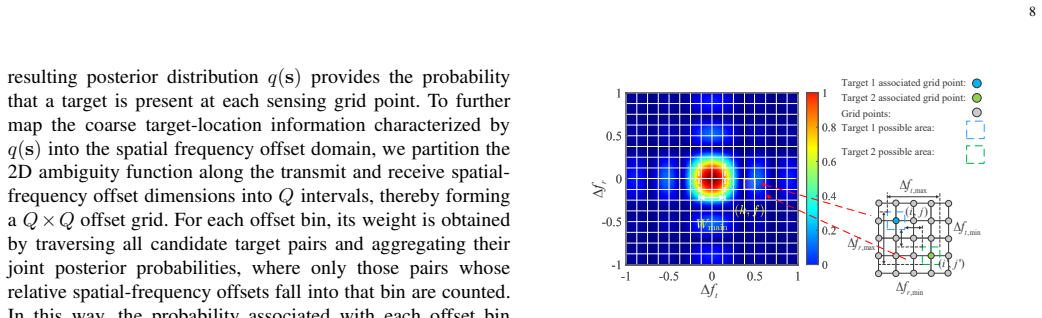
The load-bearing object is the 2D posterior-probability-based ambiguity function, defined as a bin-wise weighting of the conventional two-dimensional ambiguity function by posterior probabilities of target-separation offsets. Each offset bin carries the probability that at least one pair of coarse-estimated targets has that relative spatial frequency offset, so the optimization concentrates on sidelobes that actually cause inter-target leakage. Around it sits a second piece: the mainlobe-width characterization, which approximates the 6 dB contour of the ambiguity function as an ellipse whose axes are set by the variances of the transmit and receive antenna position distributions, and which i
What would settle it
Take the optimized antenna positions and compute the exact 6 dB contour of |χ|² from Eq. (21) without Taylor truncation. If the minor-axis width differs materially from 2√((1−ρ₆)/σ²) or falls below 2√2/Q, the mainlobe constraint in problem (31) is not enforcing what the paper claims. A second check: compare RMSE for target separations inside one grid cell versus outside; the method's predicted advantage should vanish when the weighted sidelobes are numerically zero.
Extended reading notes
Core claim
The central claim is that multi-target sensing accuracy in multipath is governed less by the full ambiguity surface than by the ambiguity values at the offsets corresponding to actual pairwise target separations. The paper constructs a 2D posterior-probability-based ambiguity function, where each offset bin is weighted by the posterior probability that some pair of detected targets is separated by that offset. It then optimizes antenna positions to minimize the weighted integrated sidelobe energy while preserving a minimum mainlobe width tied to the grid spacing. The paper shows, via Monte Carlo simulation, that this targeted sidelobe suppression lowers angular RMSE relative to both uniform
Load-bearing premise
The proof that the 6 dB mainlobe boundary is an ellipse keeps only second-order Taylor terms and drops fourth-order terms and the coupling term; if that local quadratic model stops holding after antennas spread to a large aperture, the mainlobe-width constraint and projection step would not control the actual mainlobe as claimed.
Editorial extensions
If this is right
- If the central claim is right, movable-antenna placement for multi-target sensing should be formulated per scenario: the optimal aperture is the one that not only narrows the mainlobe but also kills sidelobes at the detected target separations.
- The proposed prior fixes a concrete failure mode of cross-sparsity modeling, so multi-target estimators that rely on LoS-NLoS coupling become less fragile to false alarms in low-SNR multipath.
- The explicit ellipse relation links mainlobe width directly to the variance of antenna positions, giving a simple design rule: spread antennas about a centroid while keeping the spatial variance within the grid-resolution constraint.
- The complexity advantage of the proposed algorithm means antenna-position optimization becomes feasible in near-real-time or resource-constrained sensing nodes.
- As target number grows, the gain over fixed arrays widens, pointing to movable antennas as especially valuable in dense multi-target scenarios.
Reading between the lines
- Editorial inference: the posterior-weighting scheme inherits its own coarse estimates, so at very low SNR the weights could emphasize wrong offsets and steer antennas incorrectly; a two-pass refinement that re-optimizes after a second estimation round would test this and could make the scheme self-correcting.
- Editorial inference: the same variance-based mainlobe formula could be ported to other reconfigurable-antenna architectures (e.g., fluid antennas or sparse subarray selection), since the constraint depends only on the resulting spatial distribution, not on the mechanism that produces it.
- Editorial inference: the paper compares RMSE but not against a multi-target Cramér-Rao bound; a bound-based comparison would separate how much of the gain comes from sidelobe suppression versus how much from mainlobe narrowing, which the current ambiguity-function objective cannot distinguish.
- Editorial inference: because the ambiguity function factorizes into transmit and receive sums, the optimization decouples in structure; a testable extension would be to optimize transmit and receive arrays independently or to extend the weighting to higher-order NLoS paths when their offsets are also identifiable.
Editorial analysis
A structured set of objections, weighed in public.
Referee Report
Summary. The manuscript proposes an MA-enabled multi-target wireless sensing scheme for multipath environments. It introduces a cross-sparsity Markov mixture prior to estimate coarse target locations via the SF-TVBI Bayesian inference framework, constructs a posterior-probability-weighted 2D ambiguity function as a surrogate for inter-target interference, and optimizes the MA positions to suppress sidelobes at the target-offset bins and to control the mainlobe width. The resulting nonconvex problem is solved by a Dykstra-based projected gradient descent (DPGD) algorithm. The central claims are that the mixture prior improves RMSE/detection probability by about 5 dB over the cross-sparsity baseline in the low-to-moderate SNR regime, that the posterior-weighted ambiguity function outperforms the conventional one for MA optimization, and that DPGD approaches the RMSE of an interior-point-method PGD with substantially lower complexity. These claims are supported by Monte Carlo simulations (Figs. 7–11) without an analytical bound connecting the surrogate objective to estimation error.
Significance. If the claims hold, the paper makes a useful contribution to MA-enabled sensing by showing that coarse posterior target-location information can be injected into an ambiguity-shaping criterion and optimized with a low-complexity projected-gradient method. The system model explicitly includes both LoS and first-order NLoS paths, which is more realistic than single-path models. The paper also provides a closed-form mainlobe-width relation (Proposition 1) and a cross-sparsity Markov mixture prior that appears to give a consistent estimation gain in simulation. However, the load-bearing assumptions are not fully verified: the objective function and its discretized gradient are inconsistent; the Taylor-ellipse approximation of the mainlobe is used as a hard constraint without a validity check at the optimized configurations; and the posterior weights are produced and evaluated by the same inference pipeline, so the source of the reported gain is not isolated. These issues are addressable but require substantive revision.
major comments (3)
- [§IV-C and §V-A, Eqs. (29), (32), (34), (41)] The objective and the gradient are internally inconsistent. From Eq. (29), χp is equal to p(P_{k,f})·χ on each bin (k,f). Therefore |χp|² = p(P_{k,f})²|χ|², and the continuous objective in Eq. (32) is Σ_{k,f} p(P_{k,f})² ∫_{C_{k,f}} |χ|². However, the Riemann-sum approximation in Eq. (34) inserts an additional p(P_{k,f}) factor, yielding p(P_{k,f})³ weighting, and the derivatives in Eqs. (41)–(42) contain only one p(P_{k,f}) factor, matching an objective proportional to p(P_{k,f})|χ|² rather than p(P_{k,f})²|χ|². As written, Algorithm 1 is not minimizing the stated J. This needs to be corrected and the implemented objective clearly specified.
- [Proposition 1 and Appendix A; constraint in §IV-C and projection in §V-B.2] The 6 dB mainlobe contour is obtained by dropping the fourth-order terms Δf_t^4, Δf_r^4, and σ_t²σ_r²Δf_t²Δf_r² in Appendix A. This approximation is load-bearing because it defines the hard constraint Wmain ≥ 2√2/Q and the Dquad projection. The paper gives no check that the second-order ellipse reproduces the true 6 dB contour after optimization. For the simulation parameters (Q=16, initial half-wavelength ULA with Mt=Mr=8), the ellipse half-width is roughly √((1-ρ6)/σ²) ≈ 0.07, but evaluating the true 1D array response at that offset gives |S(Δ)|² ≈ (sin(4πΔ)/(8sin(πΔ/2)))² ≈ 0.77, close to 0.25. Thus the ellipse can substantially under-estimate the actual contour. Please include a direct numerical overlay of Eq. (22) on the true 6 dB contour at the optimized positions, or replace the constraint with a more robust characterization.
- [§III–§IV, posterior weighting and final evaluation] The offset-bin weights p(P_{k,f}) in Eq. (28) are derived from the posterior q(s) of the SF-TVBI stage, and the same SF-TVBI pipeline is then used to evaluate the final RMSE in Figs. 7–11. The paper does not provide a test with mismatched or corrupted posterior weights, nor an independent coarse-localization method, so the reported gain of DPGD with the proposed ambiguity function (DPGD-PAF) over DPGD with the traditional one (DPGD-TAF) could come in part from the posterior information itself rather than from the ambiguity-shaping objective. A sensitivity study or a decoupled validation would make the central claim more convincing.
minor comments (4)
- [Throughout] Typos: 'ProjDploy' should be 'ProjDpoly' (in §V-B and Algorithm 1); 'DGPD' in Section VII should be 'DPGD'.
- [Eq. (20)–(22)] The sign in the definition Δf_t ≜ f_t − f'_t in Eq. (22) is opposite to the definition Δf_t ≜ f'_t − f_t used in Eqs. (20)–(21). The magnitude is unchanged, but the notation should be made consistent.
- [Section V-C (complexity)] The complexity comparison with IPM-PGD depends on the inner iteration count K2 of the Dykstra projection. Since the actual K2 used in simulations is not reported, the 'substantially lower complexity' claim is not fully supported. Please give typical K2 values or a measured runtime comparison.
- [Reproducibility] The core inference algorithm (SF-TVBI) is cited from reference [14] by overlapping authors, and no code or data is released. Given that the proposed prior modifies that algorithm, pseudo-code for the prior updates or a code release would help reproducibility.
Circularity Check
No construction-level circularity: RMSE claims are simulation-based and the new-prior/MA comparisons isolate the claimed contributions; the SF-TVBI self-citation and Taylor-ellipse approximation are dependencies/correctness risks, not reductions.
full rationale
The paper's central claims are the RMSE gains of the cross-sparsity Markov mixture prior and the MA-position optimization. These are supported by Monte Carlo simulations (Figs. 7-11) in which the final RMSE is computed from estimated target angles, not read off the weighted-ambiguity objective (29)/(32). The comparison SF-TVBI-MSP vs. SF-TVBI-CSP vs. SF-TVBI-NCSP uses the same SF-TVBI inference engine for all methods, so the claimed prior gain is an internally computed difference rather than a value forced by the ambiguity-function construction. Similarly, DPGD-PAF vs. DPGD-TAF vs. ULA compares different antenna deployments under the same estimator, so the MA gain is not an artifact of the optimization objective being restated as performance. The posterior weights in (28)-(29) do come from the coarse SF-TVBI stage, and the final RMSE is also evaluated with SF-TVBI; this is a two-stage same-realization loop, but the RMSE is not defined in terms of those weights, so it is not a self-definitional reduction. The only load-bearing external input is Ref. [14]'s SF-TVBI algorithm, which the paper adopts verbatim ('we simply adopt the SF-TVBI algorithm in [14] for target sensing', Sec. III, footnote 2). This is a self-citation by overlapping authors with no released code or formal verification, so it is a reproducibility/dependency weakness, but it is not circular: the same engine is used in the baselines and the proposed scheme, and the central comparisons isolate the new prior and MA positions. Proposition 1's Taylor-ellipse mainlobe model (Eq. (22), Appendix A) drops fourth-order terms and is then enforced as a hard constraint and used in the Dquad projection; whether it controls the true 6 dB contour at optimized large-aperture positions is a correctness/validity concern, not a circular step. Overall, no equation or fitted parameter is equivalent to the claimed prediction by construction; the score reflects the minor but non-circular self-citation dependency.
Assumptions & free parameters
free parameters (3)
- Markov prior hyperparameters (π_1, p_01, p_10, ω^(t)_{i,j}, ω^(r)_{i,j}) =
not specified
- Gamma hyperparameters (a_q, b_q, ā_q, b̄_q, c, d) =
specified only via ratios: a_q/b_q = O(1), ā_q/b̄_q ≫ 1
- Algorithm hyperparameters (step sizes ω_t, ω_r, iterations K, L, tolerance T) =
not specified
assumptions (6)
- domain assumption Higher-order NLoS paths (two or more reflections) are severely attenuated and can be ignored.
- domain assumption A first-order NLoS path for target pair (i,j) has AoD equal to the angle of target i and AoA equal to the angle of target j.
- domain assumption The angular grid is fine enough that each propagation path maps to a distinct nearest grid pair, and targets lie on distinct grid points.
- ad hoc to paper The 6 dB mainlobe contour is well approximated by the second-order Taylor ellipse Eq. (22), ignoring Δf^4 and coupling terms.
- ad hoc to paper Minimizing the posterior-weighted ambiguity-function energy J in Eq. (32) is a valid surrogate for reducing multi-target angular RMSE.
- ad hoc to paper The coarse posterior probabilities q(s) from the SF-TVBI stage reliably reflect true target-location distribution, so the offset-bin weights p(P_{k,f}) in Eq. (28) emphasize the correct sidelobe regions.
Cite this review
Pith. "Pith review of Exploiting Movable Antennas for Multi-Target Wireless Sensing System in Multipath Environments." pith.science (2026). https://pith.science/paper/ZNFUWXXD
@misc{pith2026260723249,
  author       = {Pith},
  title        = {Pith review of: Exploiting Movable Antennas for Multi-Target Wireless Sensing System in Multipath Environments},
  year         = {2026},
  howpublished = {\url{https://pith.science/paper/ZNFUWXXD}},
  note         = {Machine review of arXiv:2607.23249}
}
read the original abstract
In this paper, we study the multi-target detection problem in a movable-antenna (MA)-enabled wireless sensing system with linear arrays, in which both the direct line-of-sight (LoS) paths and the first-order non-LoS (NLoS) paths are explicitly considered. Unlike conventional fixed-position antenna arrays, MAs provide additional design degrees of freedom by enabling adaptive antenna positioning to reconfigure the propagation geometry, offering great potential to enhance the sensing performance in complex multi-target multipath scenarios. Under this setup, we first develop a cross sparsity Markov mixture prior to derive the posterior probabilities of target locations, in which the structural correlation between the LoS and NLoS paths is effectively exploited to enhance the location estimation accuracy. Based on the derived posterior probabilities, we further analyze the angular-domain sensing performance for multi-target detection by proposing a new two-dimensional (2D) ambiguity function as the performance metric. Next, we optimize the MA positions to suppress the sidelobe levels and narrow the mainlobe width of the proposed ambiguity function. Although the resulting problem is highly non-convex, we develop a low-complexity Dykstra-based projected gradient descent algorithm to solve it efficiently. Finally, simulation results verify the accuracy of the proposed ambiguity function analysis, demonstrate the substantial performance gains enabled by the proposed prior model and MAs, and show that the proposed algorithm achieves performance comparable to existing methods with significantly lower computational complexity.
Figures


Figures from the paper (7 more)



Reference graph
Works this paper leans on
-
[1]
Robust power al- location for resource-aware multi-target tracking with co located MIMO radars,
Y . Y uan, W. Yi, R. Hoseinnezhad, and P . K. V arshney, “Robust power al- location for resource-aware multi-target tracking with co located MIMO radars,” IEEE Trans. Signal Process. , vol. 69, pp. 443–458, 2020
2020
-
[2]
Dynam ic ISAC beamforming design for UA V -Enabled vehicular networks,
X. Pang, S. Guo, J. Tang, N. Zhao, and N. Al-Dhahir, “Dynam ic ISAC beamforming design for UA V -Enabled vehicular networks,”IEEE Trans. Wireless Commun., vol. 23, no. 11, pp. 16 852–16 864, Nov. 2024
2024
-
[3]
Integrated sensing and communications: Toward dual-func tional wire- less networks for 6G and beyond,
F. Liu, Y . Cui, C. Masouros, J. Xu, T. X. Han, Y . C. Eldar, an d S. Buzzi, “Integrated sensing and communications: Toward dual-func tional wire- less networks for 6G and beyond,” IEEE J. Sel. Areas Commun. , vol. 40, no. 6, pp. 1728–1767, Jun. 2022
2022
-
[4]
To ward multi- functional 6G wireless networks: Integrating sensing, com munication, and security,
Z. Wei, F. Liu, C. Masouros, N. Su, and A. P . Petropulu, “To ward multi- functional 6G wireless networks: Integrating sensing, com munication, and security,” IEEE Commun. Mag. , vol. 60, no. 4, pp. 65–71, Apr. 2022
2022
-
[5]
Mult ipath exploitation and suppression for SAR imaging of building in teriors: An overview of recent advances,
M. Leigsnering, M. Amin, F. Ahmad, and A. M. Zoubir, “Mult ipath exploitation and suppression for SAR imaging of building in teriors: An overview of recent advances,” IEEE Signal Process. Mag., vol. 31, no. 4, pp. 110–119, Jul. 2014
2014
-
[6]
A metric for p erformance evaluation of multi-target tracking algorithms,
B. Ristic, B.-N. V o, D. Clark, and B.-T. V o, “A metric for p erformance evaluation of multi-target tracking algorithms,” IEEE Trans. Signal Process., 2011
2011
-
[7]
Hybrid co mputer simulation of automotive radar systems in high multipath en vironments,
K. Sabet, A. Sabet, J. Kral, and C. Woischwill, “Hybrid co mputer simulation of automotive radar systems in high multipath en vironments,” in Proc. IEEE Int. Symp. Antennas Propag. North Amer . Radio Sci . Meeting (AP-S/URSI) , 2020, pp. 1561–1562
2020
-
[8]
Analysis of multipa th and DOA detection using a fully polarimetric automotive radar,
T. Visentin, J. Hasch, and T. Zwick, “Analysis of multipa th and DOA detection using a fully polarimetric automotive radar,” Int. J. Microw. Wirel. Technol., vol. 10, no. 5-6, pp. 570–577, 2018
2018
Show all 34 references
-
[9]
Multipath in automotive MIMO SAR imaging,
M. Manzoni, S. Tebaldini, A. V . Monti-Guarnieri, and C. M . Prati, “Multipath in automotive MIMO SAR imaging,” IEEE Trans. Geosci. Remote Sens. , vol. 61, pp. 1–12, 2023
2023
-
[10]
Det ection of ghost targets for automotive radar in the presence of multip ath,
L. Zheng, J. Long, M. Lops, F. Liu, X. Hu, and C. Zhao, “Det ection of ghost targets for automotive radar in the presence of multip ath,” IEEE Trans. Signal Process. , vol. 72, pp. 2204–2220, 2024
2024
-
[11]
Exploiting movi ng arrays for near-field sensing,
Y . Chen, Z. Ren, X. Y u, L. Liu, and J. Xu, “Exploiting movi ng arrays for near-field sensing,” IEEE Wireless Commun. Lett. , vol. 14, no. 3, pp. 601–605, Mar. 2025
2025
-
[12]
Diffuse multi path exploitation for adaptive detection of range distributed t argets,
Y . Rong, A. Aubry, A. De Maio, and M. Tang, “Diffuse multi path exploitation for adaptive detection of range distributed t argets,” IEEE Trans. Signal Process. , vol. 68, pp. 1197–1212, 2020
2020
-
[13]
MIMO radar waveform design f or multipath exploitation,
Z. Xu, C. Fan, and X. Huang, “MIMO radar waveform design f or multipath exploitation,” IEEE Trans. Signal Process. , vol. 69, pp. 5359– 5371, 2021
2021
-
[14]
Cross- sparsity-enabled multipath perception via structured Bay esian inference for multi-target estimation,
X. Chen, M.-M. Zhao, A. Liu, M. Li, Q. Shi, and M.-J. Zhao, “Cross- sparsity-enabled multipath perception via structured Bay esian inference for multi-target estimation,” arXiv preprint arXiv:2511.14051 , 2025
2025
-
[15]
D ual-Function frequency-hopping MIMO radar system with CSK signaling,
I. P . Eedara, M. G. Amin, A. Hoorfar, and B. K. Chalise, “D ual-Function frequency-hopping MIMO radar system with CSK signaling,” IEEE Trans. Aerosp. Electron. Syst. , vol. 58, no. 3, pp. 1501–1513, Jun. 2022
2022
-
[16]
Movable antenna enhanced wi reless sensing via antenna position optimization,
W. Ma, L. Zhu, and R. Zhang, “Movable antenna enhanced wi reless sensing via antenna position optimization,” IEEE Trans. Wireless Com- mun., vol. 23, no. 11, pp. 16 575–16 589, Nov. 2024
2024
-
[17]
Antenna p osition and beamforming optimization for movable antenna enabled ISAC : Optimal solutions and efficient algorithms,
L. Chen, M.-M. Zhao, M.-J. Zhao, and R. Zhang, “Antenna p osition and beamforming optimization for movable antenna enabled ISAC : Optimal solutions and efficient algorithms,” IEEE Trans. Signal Process., vol. 73, pp. 3812–3828, 2025
2025
-
[18]
Fluid ante nna-assisted ISAC systems,
L. Zhou, J. Y ao, M. Jin, T. Wu, and K.-K. Wong, “Fluid ante nna-assisted ISAC systems,” IEEE Wireless Commun. Lett., vol. 13, no. 12, pp. 3533– 3537, Dec. 2024
2024
-
[19]
Fluid antenna system liberating multiuser MIMO for I SAC via deep reinforcement learning,
C. Wang, G. Li, H. Zhang, K.-K. Wong, Z. Li, D. W. K. Ng, and C.-B. Chae, “Fluid antenna system liberating multiuser MIMO for I SAC via deep reinforcement learning,” IEEE Trans. Wireless Commun. , vol. 23, no. 9, pp. 10 879–10 894, Sept. 2024
2024
-
[20]
Mo vable- antenna array enhanced multi-target sensing: CRB characte rization and optimization,
H. Mao, L. Zhu, W. Ma, Z. Xiao, X.-G. Xia, and R. Zhang, “Mo vable- antenna array enhanced multi-target sensing: CRB characte rization and optimization,” arXiv preprint arXiv:2511.18907 , 2025
2025
-
[21]
Direct multi-tar get localization with cooperative automotive radar,
X. Zhang, Y . Liang, F. Wang, and H. Li, “Direct multi-tar get localization with cooperative automotive radar,” IEEE Trans. V eh. Technol., vol. 74, no. 10, pp. 15 456–15 467, Oct. 2025
2025
-
[22]
MIMO rad ar ambiguity functions,
G. San Antonio, D. R. Fuhrmann, and F. C. Robey, “MIMO rad ar ambiguity functions,” IEEE J. Sel. Top. Signal Process. , vol. 1, no. 1, pp. 167–177, Jun. 2007
2007
-
[23]
SASA: Super-r esolution and ambiguity-free sparse array geometry optimization wit h aperture size constraints for MIMO radar,
M. Huan, J. Liang, Y . Wu, Y . Li, and W. Liu, “SASA: Super-r esolution and ambiguity-free sparse array geometry optimization wit h aperture size constraints for MIMO radar,” IEEE Trans. Antennas Propag. , vol. 71, no. 6, pp. 4941–4954, Jun. 2023
2023
-
[24]
L ocalization of multiple targets with identical radar signatures in multip ath environments with correlated blocking,
S. Aditya, A. F. Molisch, N. Rabeah, and H. M. Behairy, “L ocalization of multiple targets with identical radar signatures in multip ath environments with correlated blocking,” IEEE Trans. Wireless Commun., vol. 17, no. 1, pp. 606–618, 2018
2018
-
[25]
Capacity maximization for m ovable antenna enabled MIMO communication,
W. Ma, L. Zhu, and R. Zhang, “Capacity maximization for m ovable antenna enabled MIMO communication,” in Proc. IEEE Int. Conf. Commun. (ICC) , 2023, pp. 5953–5958
2023
-
[26]
Robust recovery of structured sparse signals with uncertain sensing matrix : A turbo-VBI approach,
A. Liu, G. Liu, L. Lian, V . K. Lau, and M.-J. Zhao, “Robust recovery of structured sparse signals with uncertain sensing matrix : A turbo-VBI approach,” IEEE Trans. Wireless Commun. , vol. 19, no. 5, pp. 3185– 3198, May 2020
2020
-
[27]
Ambiguity charact erization of arbitrary antenna array: Type I ambiguity,
M. Eric, A. Zejak, and M. ObradoviC, “Ambiguity charact erization of arbitrary antenna array: Type I ambiguity,” in Proc. IEEE 5th Int. Symp. Spread Spectrum Techn. Appl. (ISSSTA) , vol. 2, 1998, pp. 399–403
1998
-
[28]
Restoration of a single superreso lution image from several blurred, noisy, and undersampled measured ima ges,
M. Elad and A. Feuer, “Restoration of a single superreso lution image from several blurred, noisy, and undersampled measured ima ges,” IEEE Trans. Signal Process. , vol. 6, no. 12, pp. 1646–1658, Dec. 1997
1997
-
[29]
A method for finding projec tions onto the intersection of convex sets in Hilbert spaces,
J. P . Boyle and R. L. Dykstra, “A method for finding projec tions onto the intersection of convex sets in Hilbert spaces,” in Adv. Order Restricted Stat. Inference: Proc. Symp. Order Restricted Stat. Infere nce, 1986, pp. 28–47
1986
-
[30]
A covariance-surrogate framework for movable-antenna en abled anti-jamming with unknown jammers,
L. Chen, M.-M. Zhao, Q. Wu, M.-J. Zhao, and R. Zhang, “A covariance-surrogate framework for movable-antenna en abled anti-jamming with unknown jammers,” 2025. [Online]. Avail able: https://arxiv.org/abs/2512.20380
2025 arXiv
-
[31]
On the goldstein-levitin-polyak gra dient projection method,
D. P . Bertsekas, “On the goldstein-levitin-polyak gra dient projection method,” IEEE Trans. Autom. Control , vol. 21, no. 2, pp. 174–184, April 1976
1976
-
[32]
Tracking moving ag ents via inexact online gradient descent algorithm,
A. S. Bedi, P . Sarma, and K. Rajawat, “Tracking moving ag ents via inexact online gradient descent algorithm,” IEEE J. Sel. Topics Signal Process., vol. 12, no. 1, pp. 202–217, Feb. 2018
2018
-
[33]
J oint location sensing and channel estimation for IRS-aided mmWa ve ISAC systems,
Z. Chen, M.-M. Zhao, M. Li, F. Xu, Q. Wu, and M.-J. Zhao, “J oint location sensing and channel estimation for IRS-aided mmWa ve ISAC systems,” IEEE Trans. Wireless Commun. , vol. 23, no. 9, pp. 11 985– 12 002, Sept. 2024. 14
2024
-
[34]
RCS re duction of waveguide slot antenna with metamaterial absorber,
T. Liu, X. Cao, J. Gao, Q. Zheng, W. Li, and H. Y ang, “RCS re duction of waveguide slot antenna with metamaterial absorber,” IEEE Trans. Antennas Propag., vol. 61, no. 3, pp. 1479–1484, March 2013
2013
Reviewed July 31, 2026 · model on record in the stance chip above.
Discussion (0). Sign in to comment.