REVIEW 4 major objections 5 minor 26 references
MMF: Attribute Interpretable Collaborative Filtering
T0 review · 4 major / 5 minor · reviewed 2026-08-14 · deepseek-v4-flash
Pith's one-line read The paper claims that a user's rating of an item can be decomposed into weighted attribute ratings, making collaborative filtering interpretable and giving it a route around the item cold-start problem.
desk verdict Clean attribute-level MF extension, but the cold-start claim is underspecified: θ_jk for unseen items is never defined, so the paper's headline result is not reproducible as written. read the letter →
The pith
A machine-rendered reading of the paper's core claim, the machinery that carries it, and where it could break.
The reading
What carries the argument
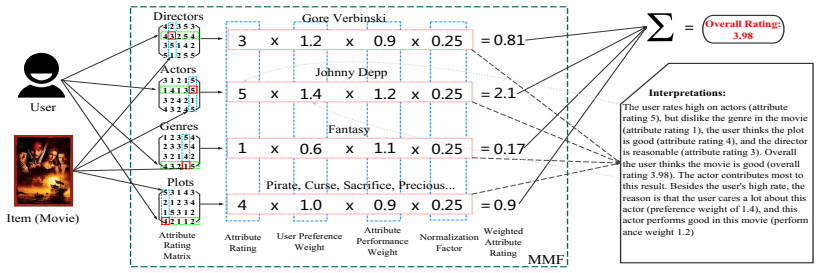
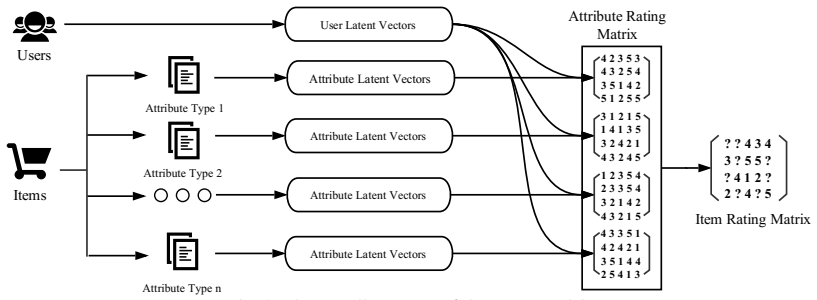
The central object is the Multi-Matrix Factorization model and its decomposition identity, Equation (3). It merges several matrix-factorization models, one per attribute type, into a single model: user latent vectors $U$ interact with attribute latent vectors $F$ to produce attribute ratings $u_i^T f_k$, then the item rating is the normalized weighted sum over the item's attributes, with user preference weights $\omega_{ik}$ and attribute performance weights $\theta_{jk}$. The shared attribute latent vectors do the load-bearing work: they connect items through common attributes, which is what enables cold-start inference and fine-grained interpretable explanations.
What would settle it
Check whether Figure 6's cold-start results are reproducible from Equation (3) alone: hold out all ratings for 10% of movies, train on the rest, and record the value of $\theta_{jk}$ for each held-out movie after training. If $\theta_{jk}$ for held-out movies is never updated because no user rated them, then the reported cold-start RMSE must depend on an unspecified initialization or a separate imputation; if the reported values reproduce, the cold-start claim survives, and if they do not, the claim collapses.
Extended reading notes
Core claim
On its own terms, the paper's central discovery is that replacing the item latent vector in matrix factorization with a weighted sum of attribute latent vectors preserves—and in its experiments improves—prediction accuracy while making the model transparent and cold-start capable. The predicted rating is $r_{ij} = \frac{1}{|M_j|}\sum_{k\in M_j}\omega_{ik}\theta_{jk}u_i^T f_k$, where $u_i$ is the user vector, $f_k$ the attribute vector, $\omega_{ik}$ the user's preference weight for attribute $k$, $\theta_{jk}$ the performance weight of attribute $k$ in item $j$, and $M_j$ the set of attributes in item $j$. Because attributes are shared across items, a newly added item only needs its attribute list to receive predictions, and the per-attribute terms provide natural explanations for each predicted rating. The accuracy claim is supported by RMSE tables showing MMF below all baselines on five datasets, with the largest gains on datasets with higher attribute density.
Load-bearing premise
The load-bearing premise is that attributes shared between old and new items carry enough of a user's taste that a cold-start item's rating can be predicted from attribute ratings alone; in particular, the model never explains how the per-item attribute weight $\theta_{jk}$ is obtained for an item with no ratings, and without that rule the cold-start prediction formula is incomplete.
Editorial extensions
If this is right
- If MMF's claims hold, recommender systems can offer per-attribute explanations, such as which cast member or genre drives a predicted rating, without trading away accuracy.
- Cold-start items that share attributes with rated items can receive personalized predictions immediately, closing a major practical gap in collaborative filtering.
- On sparse, attribute-rich datasets, MMF should keep accuracy gains over plain matrix factorization, since the paper reports the largest improvements where attribute density is higher.
- The item latent vector can be read off as a weighted combination of attribute vectors, enabling item-level analyses such as similarity and clustering to be expressed directly in attribute terms.
Reading between the lines
- A testable extension the paper leaves implicit: MMF's cold-start advantage should grow with the fraction of shared attributes between the new item and the rated corpus; at zero overlap it degenerates to standard matrix factorization, so the paper's own formula predicts a boundary case with no cold-start gain.
- The interpretability claim could be checked quantitatively beyond the case study: the learned preference weights $\omega_{ik}$ for a user should correlate with that user's attribute-level rating differences across the whole dataset, not just one movie.
- One could also ask whether the attribute performance weight $\theta_{jk}$ is identifiable at all for cold-start items; if the model needs to learn $\theta$ from ratings, then some form of attribute-level transfer or an explicit initialization rule is required, and stating that rule would make the cold-start results reproducible.
Signed reviews
Editorial analysis
A structured set of objections, weighed in public.
Referee Report
Summary. This paper introduces Multi-Matrix Factorization (MMF), an extension of matrix factorization for collaborative filtering. The prediction model in Eq. (3) represents each item's predicted rating as a normalized weighted sum of attribute ratings, where an attribute rating is the inner product of a user latent vector u_i and an attribute latent vector f_k, multiplied by a user preference weight ω_ik and an item-attribute performance weight θ_jk. The paper argues that shared attributes act as links between existing and new items, giving interpretability and addressing item cold-start. Experiments on MovieLens and Netflix-derived datasets report RMSE comparisons with MF, PMF, BPMF, LibFM, and DeepCrossing, together with an interpretability case study, a cold-start simulation, and sensitivity analyses for latent vector length and LDA topic numbers.
Significance. If the model and empirical claims are correct, MMF is a clean and useful contribution: it provides attribute-level explanation of predicted ratings, a mechanism for cold-start recommendation through shared attributes, and a simple training scheme. The paper includes explicit loss and gradient formulas, and it evaluates on five datasets with several baselines and a case study, which is a reasonable amount of evidence for a first report. However, the load-bearing claims of state-of-the-art accuracy, practical cold-start performance, and validated interpretability are not yet established because of the issues listed below. The central idea is defensible and fixable, so the paper merits a major revision rather than rejection.
major comments (4)
- [Section III-D2 and Section IV-F, with Eq. (3)] The cold-start prediction formula is underspecified. In Eq. (8), the gradient for θ_jk sums over i ∈ K_j, the users who rated item j; for a cold-start item with no ratings K_j is empty, so θ_jk has no learned value. Section III-D2 explains only that shared attribute vectors transfer, and Section IV-F randomly holds out 10% of movies without stating how θ_jk is initialized, defaulted, or inferred for those test items. Consequently, Eq. (3) cannot be evaluated for cold-start items as written, and the RMSE values in Figure 6 are not reproducible from the manuscript.
- [Equations (7)-(8)] The gradients for ω_ik and θ_jk are missing the negative sign and the regularization terms. With L = ||X - R||^2 + λ(||U||^2_F + ||F||^2_F), one should obtain ∂L/∂ω_ik = -Σ_{j∈Ji}(x_ij - r_ij)Σ_d θ_jk U_id F_kd + λω_ik, and similarly for θ_jk. As printed, the update direction is gradient ascent for these two parameters, which contradicts the stated use of gradient descent and may prevent convergence; please correct the signs or explicitly define the update convention.
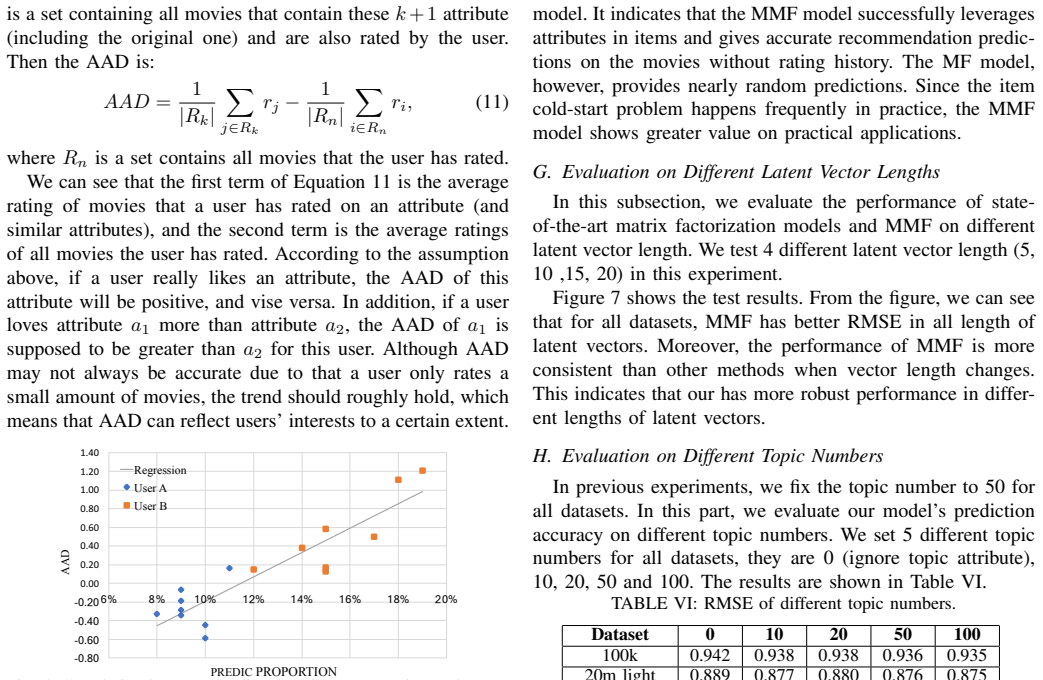
- [Section IV-E2 and Eq. (11)] The interpretability validation is partly circular. The k most similar attributes used to build R_k are selected by Euclidean distance in the learned attribute latent space, the same embeddings that determine the predicted attribute proportions through u_i^T f_k and ω_ik. Therefore the AAD "ground truth" already depends on the model's own representation, and the positive correlation in Figure 5 may be inflated by construction. Please validate with an independent measure of attribute similarity (for example, human-judged or content-based similarity) or a held-out protocol, and report the correlation coefficient and sample size.
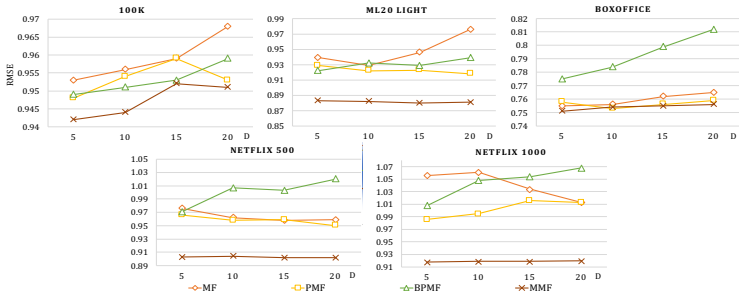
- [Section IV-C and Tables III-IV] The accuracy claim is not statistically supported. Each table reports a single RMSE per model and dataset with no standard deviations, confidence intervals, or significance tests; several differences are small (for example, Table IV: Boxoffice 0.743 vs. 0.740, Netflix 1000 0.921 vs. 0.919). In addition, the baseline set omits the recent attribute-based and interpretable recommender systems discussed in Section II, such as Collaborative Deep Learning and Explicit Factor Models, so the term "state-of-the-art" is not established. Please add repeated-run statistics and a broader set of baselines, or weaken the claim.
minor comments (5)
- [Abstract and Section I] The phrase "achieves the state-of-the-art prediction accuracy" is stronger than the current experimental evidence supports; please qualify it according to the actual baselines and statistical significance.
- [Section III-A and III-C] The expression "Second Normal Form regularization function" should be "Frobenius norm".
- [Figure 7] Figure 7 contains the placeholder text "标题" in the figure or caption and has incomplete axis labels; the figure should be regenerated with all subplot labels correctly rendered.
- [Section IV-A and Conclusion] There are several typos that should be fixed, including "excrement" for "experiment" in Section IV-A, "nodel" for "novel" in the Conclusion, and "Processings", "Minming", and "Informaion" in the reference list.
- [Figure 6] Figure 6 shows no numeric values on the bars and no error bars; please report the exact RMSE values and variance estimates so that the claimed improvement of MMF over MF can be assessed.
Circularity Check
Interpretability validation is self-referential: the AAD 'ground truth' is built from the model's own attribute embeddings, so the Figure 5 correlation does not independently confirm user interests.
-
self definitional
[Section IV-E2, Eq. (11) and Figure 5]
"To calculate the AAD of an attribute for a user, we first extract k attributes (in our case study, k = 5) that are most similar (shortest Euclidean distance) to that attribute, then Rk is a set containing all movies that contain these k + 1 attribute ... Then the AAD is: AAD = 1/|Rk| Σ_{j∈Rk} rj − 1/|Rn| Σ_{i∈Rn} ri."
The Euclidean distances that define Rk are computed in the attribute latent space F learned by MMF, and the predicted attribute proportions in Figure 5 are also computed from that same F (together with u, ω, θ). The AAD is therefore not an independent ground truth for users' interests: both sides of the Figure 5 correlation are functions of the same fitted embeddings. The validation reduces to checking that two outputs of the same model agree, so the conclusion that 'the interpretations of the MMF model are convincing' is not supported by independent evidence.
full rationale
The central accuracy claim is evaluated on held-out ratings (Section IV-C), so the RMSE comparisons are not circular: MMF's test items are disjoint from training ratings, and no fitted parameter is renamed as the accuracy measure. The cold-start claim, by contrast, is incomplete rather than circular: Eq. (3) requires an item-specific attribute performance weight θ_jk, but its only gradient update, Eq. (8), sums over users i ∈ K_j, which is empty for an unseen item; the paper never states how θ_jk is initialized or transferred for the 10% held-out items in Section IV-F, so Figure 6 is not derivable from the stated model. That is a correctness/reproducibility gap, not a construction-equivalence, so it does not by itself raise the circularity score. The one genuine circular step is the interpretability validation in Section IV-E2: the AAD ground truth is defined using Euclidean nearest neighbors in the model's own learned attribute space, and the predicted proportions being validated come from that same space. The reported correlation is therefore a self-consistency check, not an external confirmation of user interests. Overall, the paper's main empirical predictions are independent, but its interpretability evidence is self-referential, giving a partial circularity score of 4.
Assumptions & free parameters
free parameters (7)
- User latent vectors U =
learned (dimension d)
- Attribute latent vectors F =
learned (dimension d)
- User preference weight ω =
learned per user-attribute pair
- Attribute performance weight θ =
learned per item-attribute pair
- Regularization coefficient λ =
not reported
- Latent vector dimension d =
varied 5, 10, 15, 20
- Number of LDA topics =
50 (default), varied 0,10,20,100
assumptions (6)
- domain assumption Item rating is the normalized weighted sum of attribute ratings (Eq. 3).
- domain assumption Attributes are shared across items and can act as links between items.
- domain assumption A user will give higher ratings to movies that contain the attributes the user loves.
- domain assumption LDA topic modeling provides a well-structured representation of plot text.
- domain assumption The Netflix dataset can be mapped to IMDB by matching movie name and year.
- ad hoc to paper Euclidean distance in the learned attribute latent space captures semantic similarity between attributes.
Cite this review
Pith. "Pith review of MMF: Attribute Interpretable Collaborative Filtering." pith.science (2026). https://pith.science/paper/ZNM3NO6R
@misc{pith2026190801099,
  author       = {Pith},
  title        = {Pith review of: MMF: Attribute Interpretable Collaborative Filtering},
  year         = {2026},
  howpublished = {\url{https://pith.science/paper/ZNM3NO6R}},
  note         = {Machine review of arXiv:1908.01099}
}
read the original abstract
Collaborative filtering is one of the most popular techniques in designing recommendation systems, and its most representative model, matrix factorization, has been wildly used by researchers and the industry. However, this model suffers from the lack of interpretability and the item cold-start problem, which limit its reliability and practicability. In this paper, we propose an interpretable recommendation model called Multi-Matrix Factorization (MMF), which addresses these two limitations and achieves the state-of-the-art prediction accuracy by exploiting common attributes that are present in different items. In the model, predicted item ratings are regarded as weighted aggregations of attribute ratings generated by the inner product of the user latent vectors and the attribute latent vectors. MMF provides more fine grained analyses than matrix factorization in the following ways: attribute ratings with weights allow the understanding of how much each attribute contributes to the recommendation and hence provide interpretability; the common attributes can act as a link between existing and new items, which solves the item cold-start problem when no rating exists on an item. We evaluate the interpretability of MMF comprehensively, and conduct extensive experiments on real datasets to show that MMF outperforms state-of-the-art baselines in terms of accuracy.
Figures

Figures from the paper (4 more)

Reference graph
Works this paper leans on
-
[1]
Kdgan: Knowledge distillation with generative adversarial networks,
X. Wang, R. Zhang, Y . Sun, and J. Qi, “Kdgan: Knowledge distillation with generative adversarial networks,” in Advances in Neural Informa- tion Processing Systems (NeurIPS) , 2018, pp. 783–794
work page 2018
-
[2]
The youtube video recommendation system,
J. Davidson, B. Liebald, J. Liu, P. Nandy, T. Van Vleet, U. Gargi, S. Gupta, Y . He, M. Lambert, B. Livingston et al., “The youtube video recommendation system,” in Proceedings of the fourth ACM Conference on Recommender Cystems (RecSys) , 2010, pp. 293–296
work page 2010
-
[3]
A survey of recommendation system: Research challenges,
L. Sharma and A. Gera, “A survey of recommendation system: Research challenges,” International Journal of Engineering Trends and Technol- ogy (IJETT), vol. 4, no. 5, pp. 1989–1992, 2013
work page 1989
-
[4]
Cpmf: A collective pairwise matrix factorization model for upcoming event recommendation,
C.-Y . Liu, C. Zhou, J. Wu, H. Xie, Y . Hu, and L. Guo, “Cpmf: A collective pairwise matrix factorization model for upcoming event recommendation,” in 2017 International Joint Conference on Neural Networks (IJCNN), 2017, pp. 1532–1539
work page 2017
-
[5]
A joint optimization approach for personalized recommendation diversifi- cation,
X. Wang, J. Qi, K. Ramamohanarao, Y . Sun, B. Li, and R. Zhang, “A joint optimization approach for personalized recommendation diversifi- cation,” in Pacific-Asia Conference on Knowledge Discovery and Data Mining (PAKDD). Springer, 2018, pp. 597–609
work page 2018
-
[6]
Non-negative tensor factorization with applications to statistics and computer vision,
A. Shashua and T. Hazan, “Non-negative tensor factorization with applications to statistics and computer vision,” in Proceedings of the 22nd International Conference on Machine Learning (ICML) , 2005, pp. 792–799
work page 2005
-
[7]
Document clustering based on non- negative matrix factorization,
W. Xu, X. Liu, and Y . Gong, “Document clustering based on non- negative matrix factorization,” in Proceedings of the 26th International ACM Conference on Research and Development in Informaion Retrieval (SIGIR), 2003, pp. 267–273
work page 2003
-
[8]
Toward interpretable predictive models in b2b recommender systems,
M. Vlachos, V . G. Vassiliadis, R. Heckel, and A. Labbi, “Toward interpretable predictive models in b2b recommender systems,” IBM Journal of Research and Development , vol. 60, no. 5/6, pp. 11–1, 2016
work page 2016
Show all 26 references
-
[9]
Addressing cold- start problem in recommendation systems,
X. N. Lam, T. Vu, T. D. Le, and A. D. Duong, “Addressing cold- start problem in recommendation systems,” in Proceedings of the 2nd International Conference on Ubiquitous Information Management and Communication (IMCOM), 2008, pp. 208–211
2008
-
[10]
Collaborative knowledge base embedding for recommender systems,
F. Zhang, N. J. Yuan, D. Lian, X. Xie, and W.-Y . Ma, “Collaborative knowledge base embedding for recommender systems,” in Proceedings of the 22nd International ACM Conference on Knowledge Discovery and Data Mining (SIGKDD) , 2016, pp. 353–362
2016
-
[11]
Collaborative topic modeling for recommend- ing scientific articles,
C. Wang and D. M. Blei, “Collaborative topic modeling for recommend- ing scientific articles,” in Proceedings of the 17th ACM International Conference on Knowledge Discovery and Data Mining (SIGKDD), 2011, pp. 448–456
2011
-
[12]
Collaborative deep learning for recommender systems,
H. Wang, N. Wang, and D.-Y . Yeung, “Collaborative deep learning for recommender systems,” in Proceedings of the 21th ACM International Conference on Knowledge Discovery and Data Mining (SIGKDD), 2015, pp. 1235–1244
2015
-
[13]
Wide & deep learning for recommender systems,
H.-T. Cheng, L. Koc, J. Harmsen, T. Shaked, T. Chandra, H. Aradhye, G. Anderson, G. Corrado, W. Chai, M. Ispir et al. , “Wide & deep learning for recommender systems,” in Proceedings of the 1st Workshop on Deep Learning for Recommender Systems (RecSys) , 2016, pp. 7–10
2016
-
[14]
Deep crossing: Web-scale modeling without manually crafted combinatorial features,
Y . Shan, T. R. Hoens, J. Jiao, H. Wang, D. Yu, and J. Mao, “Deep crossing: Web-scale modeling without manually crafted combinatorial features,” in Proceedings of the 22nd ACM International Conference on Knowledge Discovery and Data Mining (SIGKDD) , 2016, pp. 255–262
2016
-
[15]
Explicit factor models for explainable recommendation based on phrase-level sentiment analysis,
Y . Zhang, G. Lai, M. Zhang, Y . Zhang, Y . Liu, and S. Ma, “Explicit factor models for explainable recommendation based on phrase-level sentiment analysis,” in Proceedings of the 37th ACM International Conference on Research and Development in Information Retrieval (SIGIR), 2...
2014
-
[16]
Explainable recommendation via multi-task learning in opinionated text data,
N. Wang, H. Wang, Y . Jia, and Y . Yin, “Explainable recommendation via multi-task learning in opinionated text data,” in Proceedings of the 41th ACM International Conference on Research and Development in Information Retrieval (SIGIR) , 2018, pp. 165–174
2018
-
[17]
Factorization machines with libFM,
S. Rendle, “Factorization machines with libFM,” ACM Transactions on Intelligent Systems and Technology (TIST), vol. 3, no. 3, pp. 57:1–57:22, 2012
2012
-
[18]
Neural col- laborative filtering,
X. He, L. Liao, H. Zhang, L. Nie, X. Hu, and T.-S. Chua, “Neural col- laborative filtering,” in Proceedings of the 26th International Conference on World Wide Web (WWW) , 2017, pp. 173–182
2017
-
[19]
Recommending items to group of users using matrix factorization based collaborative filtering,
F. Ortega, A. Hernando, J. Bobadilla, and J. H. Kang, “Recommending items to group of users using matrix factorization based collaborative filtering,” Information Sciences, vol. 345, pp. 313–324, 2016
2016
-
[20]
A neural autoregressive approach to collaborative filtering,
Y . Zheng, B. Tang, W. Ding, and H. Zhou, “A neural autoregressive approach to collaborative filtering,” in Proceedings of the 33nd Interna- tional Conference on Machine Learning (ICML) , 2016, pp. 764–773
2016
-
[21]
The movielens datasets: History and context,
F. M. Harper and J. A. Konstan, “The movielens datasets: History and context,” ACM Transactions on Interactive Intelligent Systems (TIIS) , vol. 5, no. 4, p. 19, 2016
2016
-
[22]
The netflix prize,
J. Bennett, S. Lanning et al. , “The netflix prize,” in Proceedings of Knowledge Discovery and Data Minming Cup and Workshop (SIGKDD), 2007, p. 35
2007
-
[23]
Latent dirichlet allocation,
D. M. Blei, A. Y . Ng, and M. I. Jordan, “Latent dirichlet allocation,” Journal of Machine Learning Research , vol. 3, no. Jan, pp. 993–1022, 2003
2003
-
[24]
Probabilistic matrix factorization,
A. Mnih and R. R. Salakhutdinov, “Probabilistic matrix factorization,” in Processings of Advances in Neural Information Processing Systems (NIPS), 2008, pp. 1257–1264
2008
-
[25]
Bayesian probabilistic matrix factor- ization using markov chain monte carlo,
R. Salakhutdinov and A. Mnih, “Bayesian probabilistic matrix factor- ization using markov chain monte carlo,” in Proceedings of the 25th International Conference on Machine Learning (ICML) , 2008, pp. 880– 887
2008
-
[26]
Visualizing data using t-sne,
L. v. d. Maaten and G. Hinton, “Visualizing data using t-sne,” Journal of machine learning research (JMLR) , vol. 9, no. Nov, pp. 2579–2605, 2008
2008
Reviewed August 14, 2026 · model on record in the stance chip above.
Discussion (0). Continue with ORCID to comment.