REVIEW 3 major objections 6 minor 61 references
RedRFT: A Light-Weight Benchmark for Reinforcement Fine-Tuning-Based Red Teaming
T0 review · 3 major / 6 minor · reviewed 2026-08-07 · deepseek-v4-flash
Pith's one-line read RedRFT standardizes reinforcement-fine-tuned red teaming of LLMs and reports that an entropy-based diversity reward outperforms existing baselines on its own benchmark.
desk verdict Useful benchmark engineering carrying a broken evaluation metric; the case-study comparison is circular and quantitatively unsupported. read the letter →
The pith
A machine-rendered reading of the paper's core claim, the machinery that carries it, and where it could break.
The reading
What carries the argument
The load-bearing object is the standardized PPO backbone with a mixed advantage function, combined with the evaluation pipeline's diversity score. The mixed advantage combines extrinsic toxicity, intrinsic novelty, and constraint (gibberish) terms, with weights set either as fixed coefficients or through a Lagrange multiplier updated by a cross-entropy objective rather than plain gradient descent. The intrinsic rewards are plug-in modules: a prompt-level negative cosine similarity between sentence embeddings, a state-level policy-cover bonus, and the new entropy-based score $r_{\mathrm{div}}$. The diversity score is computed from a k-nearest-neighbor density estimate over sentence embeddings in the rollout buffer, and the cumulative toxicity-diversity score summarizes the whole benchmark run. These pieces do the work of making the five baselines share one implementation and of turning the benchmark's results into a single number that can be compared.
What would settle it
Recompute the cumulative toxicity-diversity scores on the released rollout buffers using a consistent entropy estimator (for example, averaged leave-one-out k-NN log-densities or an explicit histogram over a fixed embedding grid) instead of the paper's finite-sample approximation; if the ordering of RedRFT against CRT and DiveR-CT reverses, the claimed advantage is an artifact of the metric.
Extended reading notes
Core claim
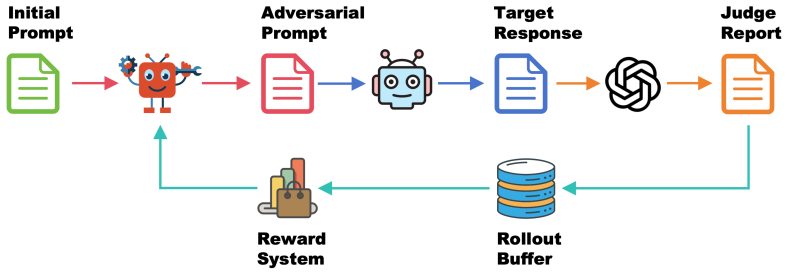
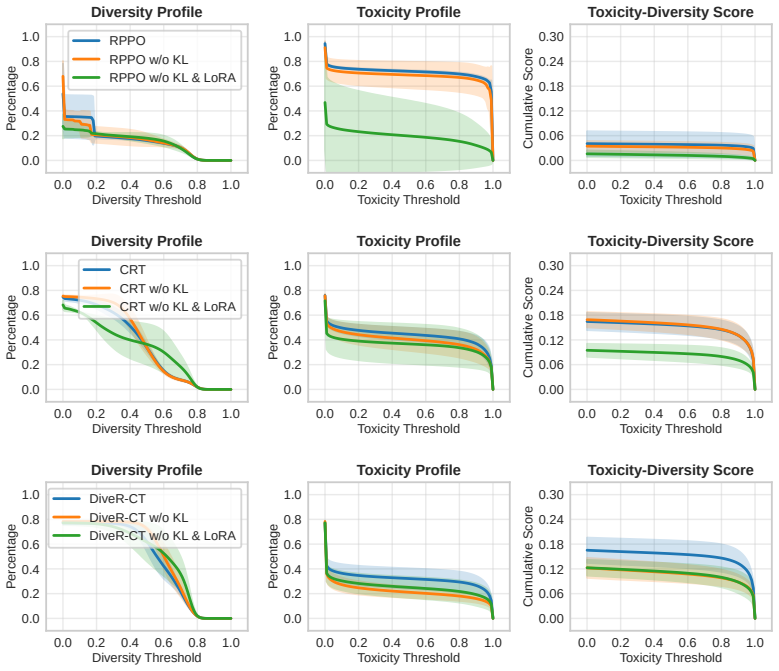
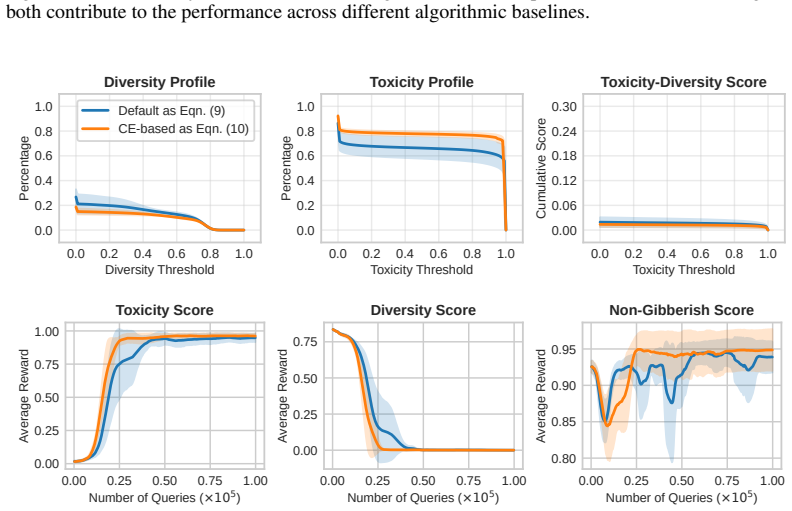
The central claim is that RFT-based red teaming can be standardized into a lightweight benchmark that makes methods comparable, and that the benchmark's proposed evaluation metric identifies a better red teaming recipe. The paper defines the red teaming loop as a rollout pipeline (initial prompt, adversarial prompt, target response, judge report), a rollout buffer, and a reward system separating extrinsic toxicity rewards, intrinsic novelty rewards, and gibberish costs. Its proposed diversity score is $r_{\mathrm{div}} = -\ln \rho_{a_T}(a_T)$, estimated by a k-nearest-neighbor density over sentence embeddings of the sampled adversarial prompts, and the headline metric is the cumulative toxicity-diversity score $\sum r_{\mathrm{tox}} r_{\mathrm{div}}$ restricted to feasible prompts. On this metric, the prototype method RedRFT, which swaps DiveR-CT's intrinsic reward for $r_{\mathrm{div}}$, is reported to beat CRT and DiveR-CT by a large margin on text continuation and to match them on instruction following. The paper also reports ablations showing that constrained optimization helps, that state-level and prompt-level intrinsic rewards are comparable, that large rollout batches stabilize PPO, and that LoRA and KL-divergence terms are needed for stable fine-tuning; all experiments use GPT-2 as both red-team and target model.
Load-bearing premise
The benchmark's evaluation metric assumes that a k-nearest-neighbor density estimate over sentence embeddings correctly measures how diverse the generated adversarial prompts are, and that ranking methods by this score reflects real red teaming quality.
Editorial extensions
If this is right
- New RFT red teaming methods can be built and evaluated against five baselines without re-implementing the PPO backbone or the reward pipeline.
- If the ablations hold, practitioners should use large rollout batches, LoRA, KL-divergence regularization, and constrained gibberish objectives as default settings.
- The cumulative toxicity-diversity score gives a single composite number for comparing methods, replacing separate toxicity and diversity curves.
- Using an entropy-based diversity reward as intrinsic motivation appears to improve the toxicity-diversity trade-off, at least on the text-continuation task.
Reading between the lines
- The entropy-based diversity score depends on the choice of sentence embedder and the k-NN neighborhood size; changing those choices could change rankings even if the benchmark code is fixed.
- Because all experiments use GPT-2 on both sides, the benchmark's conclusions about which rewards and constraints work best may not transfer to larger target models; a natural extension is rerunning the same suite with a larger open-weight target.
- The same rollout-buffer diversity estimator could be dropped into other LLM fine-tuning settings, such as instruction diversity or dataset generation, where novelty of generated text matters.
- The derivation in Appendix B identifies the sum of $r_{\mathrm{div}}$ with the differential entropy of the prompt distribution; with finite buffers this is an approximation, and whether it affects the reported ordering is testable.
Editorial analysis
A structured set of objections, weighed in public.
Referee Report
Summary. The paper proposes RedRFT, a lightweight benchmark for reinforcement fine-tuning (RFT)-based red teaming of large language models. It introduces a standardized rollout and evaluation pipeline, a unified PPO backbone, implementations of five baseline algorithms (RPPO, TDiv, CRT, DiveR-CT, CALM), and a new diversity score rdiv = -ln(rho_aT) estimated by k-NN. The authors present experiments on text continuation and instruction following, including ablations on batch size, LoRA, KL divergence, and Lagrange multiplier updates. A case study prototypes a method also named RedRFT that replaces DiveR-CT's intrinsic reward with rdiv, and KF6 claims this prototype outperforms CRT and DiveR-CT by a large margin on the cumulative toxicity-diversity score.
Significance. If the evaluation metric and the case-study comparison were sound, the benchmark would be a useful contribution to standardizing RFT-based red teaming, and the ablation findings on implementation details would be practically valuable. The open-source release and the unified PPO backbone for several baselines are concrete strengths. However, the proposed diversity score and cumulative metric contain mathematical errors, and the headline comparison is confounded by the use of the evaluation score as the optimization objective. These problems undermine the central quantitative claims of the paper.
major comments (3)
- [Appendix B, Eq. (11)] The identity H(rho_aT) = E[-ln rho_aT] = Sum_{aT~B} rdiv is incorrect. The differential entropy is the expectation over the distribution, so for a finite buffer of size |B| the right-hand side should be (1/|B|) Sum_{aT~B} rdiv, not the raw sum. As written, the claim that 'the sum of diversity scores ... is exactly the differential entropy' is false and does not justify rdiv as an entropy-based diversity score.
- [Appendix C, Eq. (13)] Starting from Eq. (12), rdiv = -ln(k/(|B| kappa^d)) = -ln(k/|B|) + d ln kappa, which is not approximately ln kappa as stated in Eq. (13). The derivation drops the constant -ln(k/|B|) and the dimension factor d without justification. Since Eq. (7) accumulates rtox * rdiv, any additive offset in rdiv changes the cumulative toxicity-diversity score for all methods, so the quantitative comparisons in Figures 2 and 4 are not well defined as presented.
- [Section 6, KF6; Appendix K] The prototype method RedRFT uses rdiv as its intrinsic reward and is subsequently evaluated with the cumulative toxicity-diversity score computed from the same rdiv. CRT and DiveR-CT optimize different intrinsic rewards (Eqs. (20) and (22)-(23)). This setup is circular: the prototype directly optimizes the diversity component of the evaluation metric, so its reported 'large margin' partly reflects evaluation leakage rather than a genuine improvement in red-teaming capability. An independent diversity measure should be used to assess the comparison.
minor comments (6)
- [Appendix C] The phrase 'Based on ??' is an unresolved reference and should be replaced with a proper equation citation.
- [Section 4, Eq. (5)] The notation rho_aT is used both for the density of adversarial prompts and for the distribution itself; this conflation should be clarified.
- [Section 3] There are several typos in the text, including 'inital', 'seperatively', 'estiamted', 'variaty', and 'refenrece'. These should be corrected.
- [Section 5.1, Eq. (8)] The objective in Eq. (8) is written with a clipped ratio inside the min; the standard PPO form should clip the ratio multiplied by the advantage. The notation is confusing and should be fixed.
- [Appendix E, Eq. (18)] The definition of TDiv samples y' ~ pi_alpha, but pi_alpha generates adversarial prompts, not target responses; this should be aligned with the oracle or rollout distribution.
- [Section 6 and Figure 2] The experiments claim three random seeds, but the figure captions do not describe error bars or shaded regions; the text should state how variability is represented.
Circularity Check
KF6 prototype claim is partially circular: RedRFT is trained on rdiv and then declared superior on a cumulative score built from the same rdiv; the benchmark infrastructure itself is otherwise self-contained.
-
self definitional
[Section 4 'Evaluation metric' (Eqs. 5 and 7); Section 6 KF6; Appendix K]
"rdiv = − ln(ρaT (aT )) ... τtox 7→ X (aT ,rE)∼B rtoxrdiv1(rtox > τtox, cgib < τgib) ... we conducted a case study by prototyping a novel RFT-based red teaming method, RedRFT, with our proposed rdiv as the intrinsic rewards and keeping other components the same as DiveR-C. As shown in Figure 4, RedRFT outperforms the state-of-the-art methods CRT and DiveR-CT by a large margin regarding the cumulative toxicity-diversity score."
The RedRFT prototype is trained with rdiv as its intrinsic reward (KF6/Appendix K), and rdiv is the score entering the cumulative toxicity-diversity metric (Eq. 7, with rdiv from Eq. 5). Thus the evaluation is not an external benchmark: it is a function of the prototype's own training reward. CRT and DiveR-CT were trained on different novelty measures (negative cosine similarity and k-NN cosine variants), so the Figure 4 margin partly reflects that RedRFT directly maximizes the metric's diversity term. The paper faults prior work for using intrinsic rewards as evaluation metrics, but here the intrinsic reward function rdiv is the evaluation metric (recomputed on the final buffer), making the 'large margin' over baselines at least partly definitional.
full rationale
Partial circularity, localized to the fast-prototyping case study. The benchmark's central contributions—the unified PPO backbone, rollout/evaluation pipelines, open-sourced five baselines, and ablations on batch size, LoRA/KL, and Lagrange multiplier—are self-contained empirical engineering results; the Figure 2 comparisons among baselines do not use any baseline's own training reward as the metric, and no load-bearing claim is imported from a self-citation chain. CALM [14] and CIM [44] are cited for attribution and context, not as external uniqueness theorems or hidden ansatze. The circular step is KF6/Figure 4: the RedRFT prototype is trained with rdiv as intrinsic reward, while the cumulative toxicity-diversity score used to declare superiority is composed of that same rdiv (Eqs. 5 and 7). The outperformance over CRT and DiveR-CT is therefore partly forced by construction rather than by independent superiority. Additionally, the Appendix B/C derivation of rdiv is mathematically inconsistent—Eq. (11) equates a raw sum with an expectation and Eq. (13) drops the -ln(k/|B|) and d ln κ constants—which is a correctness risk for the metric, though not itself a circularity; the Limitations section does not acknowledge either concern. Overall score 6: one key comparison reduces, in part, to the method's own objective, while the benchmark infrastructure retains independent content.
Assumptions & free parameters
free parameters (4)
- Reward coefficients λtox, λCos, λgib, λCRT, λDiveR-CT, λCALM, λRedRFT =
various, see Table 3
- Gibberish cost threshold τgib =
0.1
- k in k-NN density estimator =
not reported
- Batch size / mini-batch size =
256/16
assumptions (4)
- domain assumption Token generation is a Markov decision process with state = prefix, action = next token, deterministic concatenation transitions
- domain assumption Cosine similarity of sentence embeddings of prompts/responses measures semantic diversity
- domain assumption The k-NN density estimator in embedding space is a valid estimate of prompt density
- domain assumption Hate speech classifiers and the gibberish detector produce reliable toxicity and cost labels
Cite this review
Pith. "Pith review of RedRFT: A Light-Weight Benchmark for Reinforcement Fine-Tuning-Based Red Teaming." pith.science (2026). https://pith.science/paper/ZNSOJVBL
@misc{pith2026250604302,
  author       = {Pith},
  title        = {Pith review of: RedRFT: A Light-Weight Benchmark for Reinforcement Fine-Tuning-Based Red Teaming},
  year         = {2026},
  howpublished = {\url{https://pith.science/paper/ZNSOJVBL}},
  note         = {Machine review of arXiv:2506.04302}
}
read the original abstract
Red teaming has proven to be an effective method for identifying and mitigating vulnerabilities in Large Language Models (LLMs). Reinforcement Fine-Tuning (RFT) has emerged as a promising strategy among existing red teaming techniques. However, a lack of a unified benchmark hinders current RFT-based red teaming methods. Implementation details, especially in Proximal Policy Optimization (PPO)-based RFT, significantly affect outcome stability and reproducibility. To address this issue, we introduce RedRFT, a lightweight benchmark designed to simplify and standardize the implementation and evaluation of RFT-based red teaming. RedRFT combines the design strengths of both single-file CleanRL and highly modularized Tianshou, offering high-quality single-file red teaming implementations and modular PPO core components, such as the General Advantage Estimator. It supports a variety of token and sentence diversity metrics, featuring modularized intrinsic reward computation that facilitates plug-and-play experimentation. To clarify their influence on RFT performance, we conducted an extensive ablation study on key components, including Low-Rank Adaptation (LoRA), Kullback-Leibler (KL) divergence, and Lagrange Multiplier. We hope this work contributes to 1) gaining a comprehensive understanding of the implementation nuances of RFT-based red teaming algorithms, and 2) enabling rapid prototyping of innovative features for RFT-based red teaming. Code for the benchmark can be accessed at https://github.com/x-zheng16/RedRFT.git.
Figures


Figures from the paper (7 more)



Reference graph
Works this paper leans on
-
[1]
Training language models to follow instructions with human feedback
Long Ouyang et al. “Training language models to follow instructions with human feedback”. In: Advances in neural information processing systems 35 (2022), pp. 27730–27744
work page 2022
-
[2]
Unsolved problems in ml safety
Dan Hendrycks et al. “Unsolved problems in ml safety”. In: arXiv preprint arXiv:2109.13916 (2021)
arXiv 2021
-
[3]
Red teaming language models to reduce harms: Methods, scaling behav- iors, and lessons learned
Deep Ganguli et al. “Red teaming language models to reduce harms: Methods, scaling behav- iors, and lessons learned”. In: arXiv preprint arXiv:2209.07858 (2022)
arXiv 2022
-
[4]
Jailbreaking leading safety-aligned llms with simple adaptive attacks
Maksym Andriushchenko, Francesco Croce, and Nicolas Flammarion. “Jailbreaking leading safety-aligned llms with simple adaptive attacks”. In: arXiv preprint arXiv:2404.02151 (2024)
arXiv 2024
-
[5]
Autodan: Generating stealthy jailbreak prompts on aligned large language models
Xiaogeng Liu et al. “Autodan: Generating stealthy jailbreak prompts on aligned large language models”. In: arXiv preprint arXiv:2310.04451 (2023)
arXiv 2023
-
[6]
Query-efficient black-box red teaming via bayesian optimization
Deokjae Lee et al. “Query-efficient black-box red teaming via bayesian optimization”. In: arXiv preprint arXiv:2305.17444 (2023)
arXiv 2023
-
[7]
Large language models as optimizers
Chengrun Yang et al. “Large language models as optimizers”. In: arXiv preprint arXiv:2309.03409 (2023)
arXiv 2023
-
[8]
Red teaming language models with language models
Ethan Perez et al. “Red teaming language models with language models”. In: arXiv preprint arXiv:2202.03286 (2022)
arXiv 2022
Show all 61 references
-
[9]
Discovering language model behaviors with model-written evaluations
Ethan Perez et al. “Discovering language model behaviors with model-written evaluations”. In: Findings of the Association for Computational Linguistics: ACL 2023. 2023, pp. 13387–13434
2023
-
[10]
Attack prompt generation for red teaming and defending large language models
Boyi Deng et al. “Attack prompt generation for red teaming and defending large language models”. In: arXiv preprint arXiv:2310.12505 (2023)
2023 arXiv
-
[11]
Explore, establish, exploit: Red teaming language models from scratch
Stephen Casper et al. “Explore, establish, exploit: Red teaming language models from scratch”. In: arXiv preprint arXiv:2306.09442 (2023)
2023 arXiv
-
[12]
Curiosity-driven red-teaming for large language models
Zhang-Wei Hong et al. “Curiosity-driven red-teaming for large language models”. In:arXiv preprint arXiv:2402.19464 (2024)
2024 arXiv
-
[13]
DiveR-CT: Diversity-enhanced Red Teaming Large Language Model Assistants with Relaxing Constraints
Andrew Zhao et al. “DiveR-CT: Diversity-enhanced Red Teaming Large Language Model Assistants with Relaxing Constraints”. In: Proceedings of the AAAI Conference on Artificial Intelligence. V ol. 39. 24. 2025, pp. 26021–26030
2025
-
[14]
CALM: Curiosity-Driven Auditing for Large Language Models
Xiang Zheng et al. “CALM: Curiosity-Driven Auditing for Large Language Models”. In:arXiv preprint arXiv:2501.02997 (2025)
2025 arXiv
-
[15]
CIM: Constrained Intrinsic Motivation for Reinforcement Learning
Xiang Zheng et al. “CIM: Constrained Intrinsic Motivation for Reinforcement Learning”. In: ()
-
[16]
Proximal policy optimization algorithms
John Schulman et al. “Proximal policy optimization algorithms”. In: arXiv preprint arXiv:1707.06347 (2017)
2017 arXiv
-
[17]
Jailbreaking black box large language models in twenty queries
Patrick Chao et al. “Jailbreaking black box large language models in twenty queries”. In:arXiv preprint arXiv:2310.08419 (2023)
2023 arXiv
-
[18]
Tree of attacks: Jailbreaking black-box llms automatically
Anay Mehrotra et al. “Tree of attacks: Jailbreaking black-box llms automatically”. In:Advances in Neural Information Processing Systems 37 (2024), pp. 61065–61105
2024
-
[19]
How johnny can persuade llms to jailbreak them: Rethinking persuasion to challenge ai safety by humanizing llms
Yi Zeng et al. “How johnny can persuade llms to jailbreak them: Rethinking persuasion to challenge ai safety by humanizing llms”. In: Proceedings of the 62nd Annual Meeting of the Association for Computational Linguistics (Volume 1: Long Papers). 2024, pp. 14322–14350
2024
-
[20]
Gptfuzzer: Red teaming large language models with auto-generated jailbreak prompts
Jiahao Yu et al. “Gptfuzzer: Red teaming large language models with auto-generated jailbreak prompts”. In: arXiv preprint arXiv:2309.10253 (2023)
2023 arXiv
-
[21]
https://github.com/ huggingface/trl
Leandro von Werra et al.TRL: Transformer Reinforcement Learning. https://github.com/ huggingface/trl. 2020
2020
-
[22]
Direct preference optimization: Your language model is secretly a reward model
Rafael Rafailov et al. “Direct preference optimization: Your language model is secretly a reward model”. In: Advances in Neural Information Processing Systems 36 (2023), pp. 53728– 53741
2023
-
[23]
OpenRLHF: An Easy-to-use, Scalable and High-performance RLHF Frame- work
Jian Hu et al. “OpenRLHF: An Easy-to-use, Scalable and High-performance RLHF Frame- work”. In: arXiv preprint arXiv:2405.11143 (2024)
2024 arXiv
-
[24]
Deepseekmath: Pushing the limits of mathematical reasoning in open language models
Zhihong Shao et al. “Deepseekmath: Pushing the limits of mathematical reasoning in open language models”. In: arXiv preprint arXiv:2402.03300 (2024)
2024 arXiv
-
[25]
Is reinforcement learning (not) for natural language processing: Benchmarks, baselines, and building blocks for natural language policy optimization
Rajkumar Ramamurthy et al. “Is reinforcement learning (not) for natural language processing: Benchmarks, baselines, and building blocks for natural language policy optimization”. In: arXiv preprint arXiv:2210.01241 (2022). 10
2022 arXiv
-
[26]
Gpt-4o system card
Aaron Hurst et al. “Gpt-4o system card”. In: arXiv preprint arXiv:2410.21276 (2024)
2024 arXiv
-
[27]
Deepseek-r1: Incentivizing reasoning capability in llms via reinforcement learning
Daya Guo et al. “Deepseek-r1: Incentivizing reasoning capability in llms via reinforcement learning”. In: arXiv preprint arXiv:2501.12948 (2025)
2025 arXiv
-
[28]
What matters in on-policy reinforcement learning? a large-scale empirical study
Marcin Andrychowicz et al. “What matters in on-policy reinforcement learning? a large-scale empirical study”. In: arXiv preprint arXiv:2006.05990 (2020)
2020 arXiv
-
[29]
Urlb: Unsupervised reinforcement learning benchmark
Michael Laskin et al. “Urlb: Unsupervised reinforcement learning benchmark”. In: arXiv preprint arXiv:2110.15191 (2021)
2021 arXiv
-
[30]
Exploration by random network distillation
Yuri Burda et al. “Exploration by random network distillation”. In: arXiv preprint arXiv:1810.12894 (2018)
2018 arXiv
-
[31]
Large-scale study of curiosity-driven learning
Yuri Burda et al. “Large-scale study of curiosity-driven learning”. In: arXiv preprint arXiv:1808.04355 (2018)
2018 arXiv
-
[32]
Made: Exploration via maximizing deviation from explored regions
Tianjun Zhang et al. “Made: Exploration via maximizing deviation from explored regions”. In: Advances in Neural Information Processing Systems 34 (2021), pp. 9663–9680
2021
-
[33]
Aps: Active pretraining with successor features
Hao Liu and Pieter Abbeel. “Aps: Active pretraining with successor features”. In:International Conference on Machine Learning. PMLR. 2021, pp. 6736–6747
2021
-
[34]
Provably efficient maximum entropy exploration
Elad Hazan et al. “Provably efficient maximum entropy exploration”. In: International Confer- ence on Machine Learning. PMLR. 2019, pp. 2681–2691
2019
-
[35]
Task-agnostic exploration via policy gradient of a non-parametric state entropy estimate
Mirco Mutti, Lorenzo Pratissoli, and Marcello Restelli. “Task-agnostic exploration via policy gradient of a non-parametric state entropy estimate”. In: Proceedings of the AAAI Conference on Artificial Intelligence. V ol. 35. 10. 2021, pp. 9028–9036
-
[36]
Behavior from the void: Unsupervised active pre-training
Hao Liu and Pieter Abbeel. “Behavior from the void: Unsupervised active pre-training”. In: Advances in Neural Information Processing Systems 34 (2021), pp. 18459–18473
2021
-
[37]
Metra: Scalable unsupervised rl with metric- aware abstraction
Seohong Park, Oleh Rybkin, and Sergey Levine. “Metra: Scalable unsupervised rl with metric- aware abstraction”. In: arXiv preprint arXiv:2310.08887 (2023)
2023 arXiv
-
[38]
Variational intrinsic control
Karol Gregor, Danilo Jimenez Rezende, and Daan Wierstra. “Variational intrinsic control”. In: arXiv preprint arXiv:1611.07507 (2016)
2016 arXiv
-
[39]
Dynamics-aware unsupervised discovery of skills
Archit Sharma et al. “Dynamics-aware unsupervised discovery of skills”. In: arXiv preprint arXiv:1907.01657 (2019)
2019 arXiv
-
[40]
Cic: Contrastive intrinsic control for unsupervised skill discovery
Michael Laskin et al. “Cic: Contrastive intrinsic control for unsupervised skill discovery”. In: arXiv preprint arXiv:2202.00161 (2022)
2022 arXiv
-
[41]
Lipschitz-constrained unsupervised skill discovery
Seohong Park et al. “Lipschitz-constrained unsupervised skill discovery”. In: International Conference on Learning Representations. 2022
2022
-
[42]
Contrastive learning as goal-conditioned reinforcement learning
Benjamin Eysenbach et al. “Contrastive learning as goal-conditioned reinforcement learning”. In: Advances in Neural Information Processing Systems 35 (2022), pp. 35603–35620
2022
-
[43]
Behavior contrastive learning for unsupervised skill discovery
Rushuai Yang et al. “Behavior contrastive learning for unsupervised skill discovery”. In: International conference on machine learning. PMLR. 2023, pp. 39183–39204
2023
-
[44]
Constrained intrinsic motivation for reinforcement learning
Xiang Zheng et al. “Constrained intrinsic motivation for reinforcement learning”. In: arXiv preprint arXiv:2407.09247 (2024)
2024 arXiv
-
[45]
Texygen: A benchmarking platform for text generation models
Yaoming Zhu et al. “Texygen: A benchmarking platform for text generation models”. In:The 41st international ACM SIGIR conference on research & development in information retrieval. 2018, pp. 1097–1100. 11 A Related Work on Intrinsic Motivation in Reinforcement Learning To bett...
2018
-
[46]
Guidelines: • The answer NA means that the abstract and introduction do not include the claims made in the paper
Claims Question: Do the main claims made in the abstract and introduction accurately reflect the paper’s contributions and scope? Answer: [Yes] Justification: Please refer to the main body of the paper, especially Section 4, Section 5, Section 6. Guidelines: • The answer NA me...
-
[47]
Limitations
Limitations Question: Does the paper discuss the limitations of the work performed by the authors? Answer: [Yes] Justification: Please refer to Section 7. Guidelines: • The answer NA means that the paper has no limitation while the answer No means that the paper has limitation...
-
[48]
Thus, we do not provide original theoretical results of the each baseline method
Theory assumptions and proofs Question: For each theoretical result, does the paper provide the full set of assumptions and a complete (and correct) proof? Answer: [NA] 20 Justification: Our benchmark RedRFT focuses on the framework standardization of the RFT-based red teaming...
-
[49]
Our experiment results can be easily reproduced with a simple environment setup, the default config files, and the prepared shell scripts
Experimental result reproducibility Question: Does the paper fully disclose all the information needed to reproduce the main ex- perimental results of the paper to the extent that it affects the main claims and/or conclusions of the paper (regardless of whether the code and da...
-
[50]
Guidelines: • The answer NA means that paper does not include experiments requiring code
Open access to data and code Question: Does the paper provide open access to the data and code, with sufficient instruc- tions to faithfully reproduce the main experimental results, as described in supplemental material? Answer: [Yes] Justification: Please refer to https://git...
-
[51]
Guidelines: • The answer NA means that the paper does not include experiments
Experimental setting/details Question: Does the paper specify all the training and test details (e.g., data splits, hyper- parameters, how they were chosen, type of optimizer, etc.) necessary to understand the results? Answer: [Yes] Justification: Please refer to Section 6 and...
-
[52]
Guidelines: • The answer NA means that the paper does not include experiments
Experiment statistical significance Question: Does the paper report error bars suitably and correctly defined or other appropriate information about the statistical significance of the experiments? Answer: [Yes] Justification: We report error bars in all our experiments, as sh...
-
[53]
Guidelines: • The answer NA means that the paper does not include experiments
Experiments compute resources Question: For each experiment, does the paper provide sufficient information on the com- puter resources (type of compute workers, memory, time of execution) needed to reproduce the experiments? Answer: [Yes] Justification: Please refer to Section...
-
[54]
Guidelines: • The answer NA means that the authors have not reviewed the NeurIPS Code of Ethics
Code of ethics Question: Does the research conducted in the paper conform, in every respect, with the NeurIPS Code of Ethics https://neurips.cc/public/EthicsGuidelines? Answer: [Yes] Justification: We confirm that our Benchmark conforms, in every respect, with the NeurIPS Code...
-
[55]
Guidelines: • The answer NA means that there is no societal impact of the work performed
Broader impacts Question: Does the paper discuss both potential positive societal impacts and negative societal impacts of the work performed? Answer: [Yes] Justification: Since the main paper has limited space, we include the discussion on the potential societal and ethical i...
-
[56]
Guidelines: • The answer NA means that the paper poses no such risks
Safeguards Question: Does the paper describe safeguards that have been put in place for responsible release of data or models that have a high risk for misuse (e.g., pretrained language models, image generators, or scraped datasets)? Answer: [NA] Justification: The baseline me...
-
[57]
Guidelines: • The answer NA means that the paper does not use existing assets
Licenses for existing assets Question: Are the creators or original owners of assets (e.g., code, data, models), used in the paper, properly credited and are the license and terms of use explicitly mentioned and properly respected? Answer: [Yes] Justification: We respect and c...
-
[58]
Please refer to https: //github.com/x-zheng16/RedRFT.git for the document
New assets Question: Are new assets introduced in the paper well documented and is the documentation provided alongside the assets? Answer: [Yes] Justification: We provide a detailed document for all new assets. Please refer to https: //github.com/x-zheng16/RedRFT.git for the ...
-
[59]
Guidelines: • The answer NA means that the paper does not involve crowdsourcing nor research with human subjects
Crowdsourcing and research with human subjects Question: For crowdsourcing experiments and research with human subjects, does the paper include the full text of instructions given to participants and screenshots, if applicable, as well as details about compensation (if any)? A...
-
[60]
Guidelines: 25 • The answer NA means that the paper does not involve crowdsourcing nor research with human subjects
Institutional review board (IRB) approvals or equivalent for research with human subjects Question: Does the paper describe potential risks incurred by study participants, whether such risks were disclosed to the subjects, and whether Institutional Review Board (IRB) approvals...
-
[61]
Declaration of LLM usage Question: Does the paper describe the usage of LLMs if it is an important, original, or non-standard component of the core methods in this research? Note that if the LLM is used only for writing, editing, or formatting purposes and does not impact the ...
2025
Reviewed August 7, 2026 · model on record in the stance chip above.
Discussion (0). Sign in to comment.