REVIEW 4 major objections 5 minor 1 cited by
Exploring nuclear force with pulsar glitch observation
T0 review · 4 major / 5 minor · reviewed 2026-08-11 · deepseek-v4-flash
Pith's one-line read Vela glitch forces symmetry energy slope below 40 MeV
desk verdict A self-consistent RMF-to-glitch pipeline that credibly shows L0 matters for pinning, but the headline constraint (L0<40, Vela ~2.2 solar masses) sits exactly in the density range the calculation itself cannot yet do. read the letter →
The pith
A machine-rendered reading of the paper's core claim, the machinery that carries it, and where it could break.
The reading
What carries the argument
The central object is the pinning energy $E_p(\rho_B)$, computed semi-classically as the difference in energy cost between a vortex pinned interstitially and one pinned to a nucleus, integrated over a Wigner-Seitz cell with the local density approximation; the nuclear-medium effective mass and pairing gap are used consistently. From $E_p$ the paper builds the pinning force per unit length $f_{\rm pin}$, then the total pinning force on a rigid vortex, and finally the critical angular-velocity lag $\Delta\Omega_{\rm cr}$ in the snowplow model, whose maximum sets the avalanche region and the angular momentum transferred in the glitch.
What would settle it
Recompute the same snowplow chain with non-spherical pasta phases, such as rods or slabs, included in the pinning-energy calculation; if the resulting profile still matches Vela 2000 with $L_0 > 40$ MeV, or yields a Vela mass near $1.4\,M_\odot$, the paper's constraint breaks. A direct independent measurement of Vela's mass below $2\,M_\odot$ would likewise falsify the claim.
Extended reading notes
Core claim
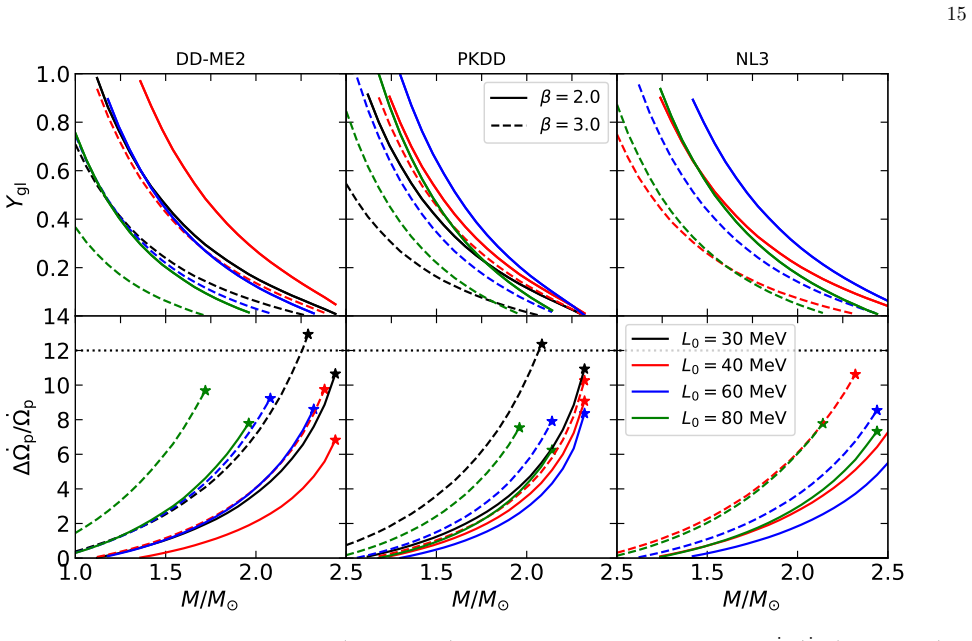
On its own terms, the paper establishes that the pinning strength of superfluid vortices in the neutron-star inner crust is controlled mainly by the symmetry energy slope, with smaller $L_0$ producing larger pinning energies and forces that peak at higher densities. Combining these self-consistently computed pinning-force profiles with the snowplow model of vortex avalanches, the paper shows that the observed jump and short-time relaxation of the 2000 Vela glitch can only be reproduced for $L_0 < 40$ MeV together with strong polarization $\beta \simeq 3.0$; weaker polarization or steeper symmetry energy fails the spin-down step constraint. The same fit forces the Vela pulsar to be massive, about $2.255$–$2.290\,M_\odot$ for the DD-ME2 isoscalar interaction and $2.069$–$2.084\,M_\odot$ for PKDD, with the NL3 family ruled out.
Load-bearing premise
The load-bearing premise is that the inner crust can be represented by spherical Wigner-Seitz droplets all the way to the crust-core boundary, even though the calculation itself fails to converge to stable droplets at the highest densities, exactly where the pinning force peaks, and non-spherical pasta structures are neglected.
Editorial extensions
If this is right
- The 2000 Vela glitch, treated in the snowplow model, singles out equations of state with $L_0 < 40$ MeV, excluding steep-symmetry-energy families such as NL3.
- The required $\beta \sim 3.0$ implies that strong medium polarization suppresses the $^1S_0$ neutron pairing gap, so pinning in the deep crust is much weaker than in bare BCS estimates.
- Vela must be a massive neutron star, near $2.3\,M_\odot$ for DD-ME2 and $2.08\,M_\odot$ for PKDD, rather than a typical $1.4\,M_\odot$ pulsar.
- Only a small fraction ($Y_{gl} < 1\%$) of core superfluid vorticity is coupled to the crust during the glitch.
- Short vortex lengths are disfavored, implying strong vortex tension in the inner crust.
Reading between the lines
- If pasta phases dominate the densities where the droplet solution fails, the pinning-force peak could move or split, and the inferred $L_0$ and Vela mass could shift; the current constraint is therefore conditional on sphericity.
- The same self-consistent machinery could be applied to other large glitches, such as the 2016 Vela event, or to glitch statistics, turning a single-event constraint into a population-level test of $L_0$.
- Including entrainment between superfluid neutrons and the crustal lattice, which is omitted here, would change the effective superfluid inertia and could relax or sharpen the mass and $L_0$ bounds.
- The discrepancy with the much larger pinning force inferred from glitch-rate statistics suggests tension between nuclear-theory pinning and avalanche models that future microscopic calculations of the pasta layer could resolve.
Signed reviews
Editorial analysis
A structured set of objections, weighed in public.
Referee Report
Summary. The paper connects a relativistic mean field (RMF) description of neutron star matter to the 2000 Vela glitch through the snowplow model of vortex unpinning. The authors construct unified equations of state from DD-ME2, PKDD, and NL3 with adjusted symmetry energy slopes L0 = 30, 40, 60, 80 MeV, compute Wigner-Seitz cell structures of the inner crust, calculate BCS pairing gaps with a phenomenological force and polarization factors β = 2.0 and 3.0, and then use a semiclassical local-density method to obtain the vortex pinning energy and pinning force. These are mapped onto the star using TOV density profiles and fed into the snowplow model. By fitting the fraction Ygl of coupled core superfluid to the observed glitch amplitude and comparing the predicted post-glitch spin-down change with the observed value, the paper concludes that L0 is below 40 MeV, polarization is strong (β ≈ 3.0), and Vela is massive: about 2.255–2.290 solar masses for DD-ME2 and 2.069–2.084 solar masses for PKDD.
Significance. The paper is valuable as a self-consistent pipeline: the unified EoS, crust composition, pairing properties, pinning forces, and stellar structure are all computed within one RMF framework, and the pinning input is not fitted to glitch data. The use of the observed glitch amplitude only through Ygl and the independent comparison of the predicted ΔΩdot/Ωdot is a legitimate and potentially falsifiable strategy. If the technical gaps in the high-density crust treatment can be closed or bounded, a nuclear-force constraint such as L0 < 40 MeV from a single well-observed glitch would be a meaningful result. At present, however, the advertised conclusion relies on a density region in which the authors' own calculation is explicitly incomplete, so the significance is conditional rather than established.
major comments (4)
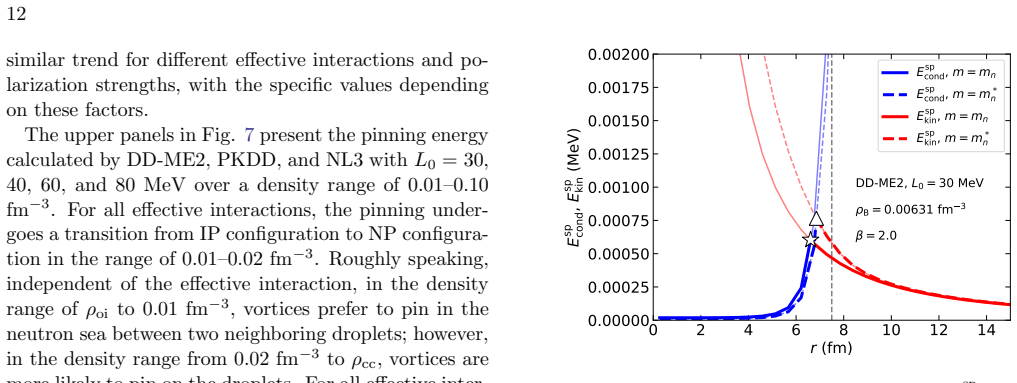
- [Sec. 3.1 and Fig. 7; Sec. 3.2 and Fig. 9] The central constraint L0 < 40 MeV and the associated Vela masses are controlled by the maximum of fpin near the crust-core transition, but the manuscript does not compute fpin there. The authors state in Sec. 3.1 that 'our calculations fail to yield a stable droplet structure in these densities, which strongly suggests that the non-spherical structures should be included,' and in Sec. 2.3 that pasta structures are neglected because 'the reliable method to calculate pinning energy that pinning to non-spherical nuclei is still lack.' Since Fig. 9 places the strong-pinning peak of ΔΩcr just at this density interval, the quantities rmax = R*_L, ro = R*_M, and the integral in Eq. (31) are either extrapolated or truncated in the very region that dominates the angular momentum transfer. Please provide a quantitative sensitivity analysis of the excluded interval—for example, alternative pinning estimates for pasta configurations, or tests with different cutoffs/extrapolations—and, until then, soften the L0 and mass conclusions to be explicitly conditional on spherical droplet structures.
- [Sec. 2.5 and Eq. (27)] The interstitial pinning configuration is computed for a single droplet in a cylindrical container, and the authors note that the calculation 'loses the energy contributions from the neighboring droplets' when the inter-droplet spacing becomes smaller than the vortex core. This is exactly the high-density regime where the pinning energy reaches tens to hundreds of MeV for small L0 (upper panels of Fig. 7). A single-site IP treatment can bias Ep and hence fpin upward in the region that drives the snowplow constraint. The manuscript should at least state the sign and approximate magnitude of this bias, and ideally estimate the multi-site correction, because fpin enters linearly in Fpin and therefore directly in the derived L0 and mass constraints.
- [Sec. 3.3 and Fig. 11] The vortex rigidity length l is an input parameter, not a derived quantity. The statement that 'Vela 2000 does not support a short vortex length' is an output of the model for l = 5000 Rws, not a validation of that choice. Since Fig. 11 shows that fpin and the resulting ΔΩdot/Ωdot constraint change substantially with l, the Sec. 3.2 conclusions inherit this model dependence. Please add an explicit statement of how the L0 and Vela-mass constraints vary over the range l = 1000–5000 Rws, or otherwise justify why the chosen value is physically preferred for Vela.
- [Sec. 2.6, Eqs. (32)–(33)] The comparison procedure fits Ygl from the observed glitch amplitude, leaving only one independent prediction per model family. The accepted models require Ygl below 1 percent, i.e., essentially complete decoupling of the core superfluid from the normal crust. This is a strong physical assumption about the coupling between the 3P2 core superfluid and the crust; the manuscript does not discuss whether such a small Ygl is plausible. Please add a discussion of the physical interpretation of Ygl and of the sensitivity of the conclusions to the assumed core-crust coupling.
minor comments (5)
- [Abstract] The abstract refers to the '2001 glitch of the Vela pulsar,' while the rest of the paper consistently uses the '2000 Vela glitch'; please make the epoch consistent.
- [Sec. 2.2, Eq. (17)] The energy density expression contains stray factors of 1/2 in the meson gradient terms, e.g., '1/2 (∇ω)^2 1/2' and '1/2 (∇A0)^2 1/2'; these appear to be typographical artifacts and should be corrected.
- [Sec. 2.4] Polarization is sampled only at β = 2.0 and 3.0, yet one of the conclusions is that β ≈ 3.0 is preferred. A continuous scan of β, or at least an intermediate value such as β = 2.5, would make the conclusion about the polarization strength more robust.
- [Sec. 2.6] The text says 'the constant κ is the quantum of circulation of a neutron fluid'; for a paired neutron superfluid the quantum of circulation is κ = h/(2m_n), and specifying this explicitly would avoid ambiguity.
- [Sec. 3.2] The phrase 'the lower limit of observation can be satisfied' is imprecise: the comparison is with the observed ΔΩdot/Ωdot range including 1σ uncertainty, and the wording should distinguish lower limits on the observable from lower limits on model parameters.
Circularity Check
No significant circularity: the L0 constraint and Vela mass inference are obtained by forward-modeling scanned nuclear parameters through self-consistently computed pinning forces and comparing with Vela's two glitch observables.
full rationale
The paper's derivation chain is not circular. The nuclear symmetry-energy slope L0 is an input parameter, not an output fitted to the glitch: the authors refit the isovector channel of DD-ME2, PKDD, and NL3 to fixed L0 values of 30, 40, 60, and 80 MeV, construct unified equations of state, and compute the pinning energy and force from the resulting inner-crust compositions. The Vela 2000 glitch then selects among these pre-scan values, which is a legitimate forward-model test rather than a fit of L0 to the glitch. Similarly, the fraction Ygl is determined by fitting Eq. (32) to the observed glitch amplitude, but the independent observed quantity DeltaOmegaDot/OmegaDot is then predicted from Eq. (33) and compared with the measured value; this two-observable comparison is not forced by construction. The main caveats, explicitly acknowledged by the authors, are that spherical Wigner-Seitz droplet calculations fail to converge near the crust-core transition and that pasta structures are neglected, which could shift the inferred constraints. These are model-completeness or correctness risks, not circularity: they concern whether the input microphysics is complete, not whether the outputs are already contained in the inputs. The self-citation to Shang & Li (2021) is contextual and comparative rather than load-bearing, since the pinning force here is computed self-consistently rather than adopted from that prior fit.
Assumptions & free parameters
free parameters (5)
- Symmetry energy slope L0 =
30, 40, 60, 80 MeV (scan)
- Polarization strength beta =
2.0, 3.0
- Vortex length l =
5000 Rws
- Ygl (coupled core-superfluid fraction) =
Determined by fitting Eq. (32) to the observed glitch amplitude; up to 1% for acceptable cases
- Pairing force parameters GN, alpha =
GN = 738 MeV fm^3, alpha = 0.636 fm
assumptions (6)
- domain assumption Relativistic mean-field approximation with meson-exchange interaction (Eq. 1) describes nucleonic matter in the crust and core.
- domain assumption BCS approximation with a separable pairing force for the 1S0 neutron pairing gap (Eq. 21).
- domain assumption Local density approximation and semi-classical energy cost for vortices (Eqs. 23-27).
- domain assumption Snowplow model assumptions in Sec. 2.6: straight rigid vortices, axial symmetry, and superfluid density rho_s = (1 - Yp)rho throughout the star.
- ad hoc to paper Spherical Wigner-Seitz droplets throughout the inner crust, with pasta phases neglected (Sec. 2.3).
- standard math Unified EoS with crust-core transition defined by epsilon_uni < epsilon_non (Sec. 2.2).
Cite this review
Pith. "Pith review of Exploring nuclear force with pulsar glitch observation." pith.science (2026). https://pith.science/paper/ZOACYVRZ
@misc{pith2026241209219,
  author       = {Pith},
  title        = {Pith review of: Exploring nuclear force with pulsar glitch observation},
  year         = {2026},
  howpublished = {\url{https://pith.science/paper/ZOACYVRZ}},
  note         = {Machine review of arXiv:2412.09219}
}
read the original abstract
We connect nuclear forces to one of the most notable irregular behaviors observed in pulsars, already detected in approximately 6\% known pulsars, with increasingly accurate data expected from upcoming high-precision timing instruments on both ground and space. Built on Shang & Li (2021), we conduct a case study on the 2001 glitch of the Vela pulsar. For our purpose, we adopt the Relativistic Mean Field (RMF) model as the theoretical many-body framework to describe nuclear systems. We refit three representative RMF parameter sets (DD-ME2, PKDD, NL3), considering the uncertainties in nuclear matter saturation properties. Utilizing the resulting star structure, composition and nucleon properties in the medium obtained in a consistent manner, we calculate the pinning energy of superfluid vortex in the nuclear lattice in the inner crust. This leads to the evolution of associated pinning force that acts on the vortex, which can be confronted with observed glitch amplitude and short-time relaxation in the 2000 Vela glitch event, following the snowplow model of pulsar glitch. We discuss how the vortex configuration and pinning properties depend on the nuclear parameters, and find an interesting and dominant role of the nuclear symmetry energy slope on pinning strength.
Figures


Figures from the paper (9 more)





Forward citations
Cited by 1 Pith paper
-
Unified QMF equation of state for neutron star matter: Static and dynamic properties
The quark mean-field model predicts larger crust clusters and a slower direct-Urca cooling phase than the relativistic mean-field model, while both reproduce the observed crustal cooling of the transient KS 1731-260.
Reference graph
Works this paper leans on
-
[1]
, " * write output.state after.block = add.period write newline
ENTRY address archivePrefix author booktitle chapter doi edition editor eprint howpublished institution journal key month number organization pages publisher school series title misctitle type volume year version url label extra.label sort.label short.list INTEGERS output.state before.all mid.sentence after.sentence after.block FUNCTION init.state.consts ...
-
[2]
write newline
" write newline "" before.all 'output.state := FUNCTION format.url url empty "" new.block "" url * "" * if FUNCTION format.eprint eprint empty "" archivePrefix empty "" archivePrefix "arXiv" = new.block " " eprint * " " * new.block " " eprint * " " * if if if FUNCTION format.doi doi empty "" " " doi * " " * if FUNCTION format.pid doi empty eprint empty ur...
-
[3]
9 p 1 @n+ &M 3\
thebibliography [1] 20pt to REFERENCES 6pt =0pt -12pt 10pt plus 3pt =0pt =0pt =1pt plus 1pt =0pt =0pt -12pt =13pt plus 1pt =20pt =13pt plus 1pt \@M =10000 =-1.0em =0pt =0pt 0pt =0pt =1.0em @enumiv\@empty 10000 10000 `\.\@m \@noitemerr \@latex@warning Empty `thebibliography' environment \@ifnextchar \@reference \@latexerr Missing key on reference command E...
2021
-
[4]
Abbott, B., Abbott, R., Abbott, T., et al. 2017, Phys. Rev. Lett, 119, 161101, 10.1103/physrevlett.119.161101
-
[5]
Ala\ na, A., Modugno, M., Capuzzi, P., & Jezek, D. M. 2024, Phys. Rev. A, 110, 023306, 10.1103/PhysRevA.110.023306
-
[6]
Alpar, M. A. 1977, Astrophys. J, 213, 527, 10.1086/155183
-
[7]
Alpar, M. A., Chau, H. F., Cheng, K. S., & Pines, D. 1993, Astrophys. J, 409, 345, 10.1086/172668
doi:10.1086/172668 1993
-
[8]
Alpar, M. A., Pines, D., Anderson, P. W., & Shaham, J. 1984, Astrophys. J, 276, 325, 10.1086/161616
doi:10.1086/161616 1984
Show all 87 references
- [9]
-
[10]
Antonelli, M., Montoli, A., & Pizzochero, P. M. 2022, Insights Into the Physics of Neutron Star Interiors from Pulsar Glitches (WORLD SCIENTIFIC), 219--281, 10.1142/9789811220944_0007
2022 doi
-
[11]
Antonopoulou, D., Haskell, B., & Espinoza, C. M. 2022, Rep. Prog. Phys, 85, 126901, 10.1088/1361-6633/ac9ced
2022 doi
-
[12]
D., Graber, V., & Palfreyman, J
Ashton, G., Lasky, P. D., Graber, V., & Palfreyman, J. 2019, Nature Astronomy, 36, 844, 10.1038/s41550-019-0844-6
2019 doi
-
[13]
2008, Nucl
Avogadro, P., Barranco, F., Broglia, R., & Vigezzi, E. 2008, Nucl. Phys. A, 811, 378, 10.1016/j.nuclphysa.2008.07.010
2008 doi
-
[14]
A., & Vigezzi, E
Avogadro, P., Barranco, F., Broglia, R. A., & Vigezzi, E. 2007, Phys. Rev. C, 75, 012805, 10.1103/PhysRevC.75.012805
2007 doi
- [15]
-
[16]
2021, Mon
Basu, A., Shaw, B., Antonopoulou, D., et al. 2021, Mon. Not. R. Astron. Soc, 510, 4049, 10.1093/mnras/stab3336
2021 doi
-
[17]
1969, Nature, 224, 872, 10.1038/224872a0
Baym, G., Pethick, C., Pines, D., & Ruderman, M. 1969, Nature, 224, 872, 10.1038/224872a0
1969 doi
-
[18]
2003, Rev
Bender, M., Heenen, P.-H., & Reinhard, P.-G. 2003, Rev. Mod. Phys, 75, 121, 10.1103/revmodphys.75.121
2003 doi
-
[19]
2024, Few-Body System, 65, 10.1007/s00601-024-01949-7
Bland, T., Ferlaino, F., Mannarelli, M., Poli, E., & Trabucco, S. 2024, Few-Body System, 65, 10.1007/s00601-024-01949-7
2024 doi
-
[20]
1977, Nucl
Boguta, J., & Bodmer, A. 1977, Nucl. Phys. A, 292, 413, 10.1016/0375-9474(77)90626-1
1977 doi
-
[21]
Campbell, L. J. 1979, Phys. Rev. Lett, 43, 1336, 10.1103/PhysRevLett.43.1336
1979 doi
- [22]
-
[23]
---. 2024. 2412.05599
2024 arXiv
-
[24]
Donati, P., & Pizzochero, P. M. 2004, Nucl. Phys. A, 742, 363, https://doi.org/10.1016/j.nuclphysa.2004.07.002
2004 doi
- [25]
-
[26]
S., et al
Dutra, M., Lourenco, O., Avancini, S. S., et al. 2014, Phys. Rev. C, 90, 055203, 10.1103/PhysRevC.90.055203
2014 doi
- [27]
-
[29]
F., Chamel, N., Mutafchieva, Y
Fantina, A. F., Chamel, N., Mutafchieva, Y. D., et al. 2016, Phys. Rev. C, 93, 015801, 10.1103/physrevc.93.015801
2016 doi
-
[30]
L., Walecka, J
Fetter, A. L., Walecka, J. D., & Kadanoff, L. P. 1971, Physics Today, 25, 54. https://api.semanticscholar.org/CorpusID:5661190
1971
-
[31]
Fuchs, C., Lenske, H., & Wolter, H. H. 1995, Phys. Rev. C, 52, 3043, 10.1103/PhysRevC.52.3043
1995 doi
-
[32]
Glendenning, N. K. 1996, Compact Stars: Nuclear Physics, Particle Physics and General Relativity (Springer US)
1996
-
[33]
2018, Astrophys
Graber, V., Cumming, A., & Andersson, N. 2018, Astrophys. J, 865, 23, 10.3847/1538-4357/aad776
2018 doi
-
[34]
2012, Jour
Grill, F., & Pizzochero, P. 2012, Jour. Phys. Conf. Ser, 342, 012004, 10.1088/1742-6596/342/1/012004
2012 doi
-
[35]
Gügercinoğlu, E., & Alpar, M. A. 2020, Mon. Not. R. Astron. Soc, 496, 2506, 10.1093/mnras/staa1672
2020 doi
-
[36]
2015, Inter
Haskell, B., & Melatos, A. 2015, Inter. Jour. Mod. Phys. D, 24, 1530008, 10.1142/s0218271815300086
2015 doi
-
[37]
M., & Seveso, S
Haskell, B., Pizzochero, P. M., & Seveso, S. 2013, Astrophys. J, 764, L25, 10.1088/2041-8205/764/2/l25
2013 doi
-
[38]
M., & Sidery, T
Haskell, B., Pizzochero, P. M., & Sidery, T. 2011, Mon. Not. R. Astron. Soc, 420, 658, 10.1111/j.1365-2966.2011.20080.x
2011
-
[39]
G., & Li, B.-A
Hooker, J., Newton, W. G., & Li, B.-A. 2013, Jour. Phys. Conf. Ser, 420, 012153, 10.1088/1742-6596/420/1/012153
2013 doi
-
[40]
1996, Nucl
Khodel, V., Khodel, V., & Clark, J. 1996, Nucl. Phys. A, 598, 390, https://doi.org/10.1016/0375-9474(95)00477-7
1996 doi
-
[41]
M., Roca-Maza, X., & Vigezzi, E
Klausner, P., Barranco, F., Pizzochero, P. M., Roca-Maza, X., & Vigezzi, E. 2023, Phys. Rev. C, 108, 035808, 10.1103/PhysRevC.108.035808
2023 doi
-
[42]
A., Niksi \' c , T., Vretenar, D., & Ring, P
Lalazissis, G. A., Niksi \' c , T., Vretenar, D., & Ring, P. 2005, Phys. Rev. C, 71, 024312, 10.1103/PhysRevC.71.024312
2005 doi
-
[43]
M., Wang, J
Li, A., Dong, J. M., Wang, J. B., & Xu, R. X. 2016, Astrophys. J. Suppl. Ser., 223, 16, 10.3847/0067-0049/223/1/16
2016 doi
-
[44]
Y., Zhou , E
Li , A., Zhu , Z. Y., Zhou , E. P., et al. 2020, Journal of High Energy Astrophysics, 28, 19, 10.1016/j.jheap.2020.07.001
2020 doi
-
[45]
J., & Sedrakian, A
Li, J. J., & Sedrakian, A. 2019, Phys. Rev. C, 100, 015809, 10.1103/PhysRevC.100.015809
2019 doi
-
[46]
P., Ge , M
Liu , P., Yuan , J. P., Ge , M. Y., et al. 2024 a , , 533, 4274, 10.1093/mnras/stae1973
2024 doi
- [47]
-
[48]
Lombardo, U., & Schulze, H. J. 2000, Lect.Notes Phys.578:30-53,2001. astro-ph/0012209
2000 arXiv
-
[49]
V., & Zhou, S.-G
Long, W., Meng, J., Giai, N. V., & Zhou, S.-G. 2004, Phys. Rev. C, 69, 034319, 10.1103/PhysRevC.69.034319
2004 doi
-
[50]
E., Johnston, S., Dunn, L., et al
Lower, M. E., Johnston, S., Dunn, L., et al. 2021, Mon. Not. R. Astron. Soc, 508, 3251, 10.1093/mnras/stab2678
2021 doi
-
[51]
2023, Astrophys
Melatos, A., & Millhouse, M. 2023, Astrophys. J, 948, 106, 10.3847/1538-4357/acbb6e
2023 doi
-
[52]
1973, Nuc
Negele, J., & Vautherin, D. 1973, Nuc. Phys. A, 207, 298, 10.1016/0375-9474(73)90349-7
1973 doi
-
[53]
Neill, D., Tsang, D., & Newton, W. G. 2024, Mon. Not. R. Astron. Soc, 532, 827, 10.1093/mnras/stae1481
2024 doi
-
[54]
G., Murphy, K., Hooker, J., & Li, B.-A
Newton, W. G., Murphy, K., Hooker, J., & Li, B.-A. 2013, Astrophys. J. Lett, 779, L4, 10.1088/2041-8205/779/1/l4
2013 doi
-
[55]
2011, Prog
Nikšić, T., Vretenar, D., & Ring, P. 2011, Prog. Part. Nucl. Phys., 66, 519, 10.1016/j.ppnp.2011.01.055
2011 doi
-
[56]
2017, Rev
Oertel, M., Hempel, M., Kl\"ahn, T., & Typel, S. 2017, Rev. Mod. Phys, 89, 015007, 10.1103/RevModPhys.89.015007
2017 doi
-
[57]
R., & Volkoff, G
Oppenheimer, J. R., & Volkoff, G. M. 1939, Phys. Rev, 055, 374, 10.1103/PhysRev.55.374
1939 doi
-
[58]
2007, Phys
Oyamatsu, K., & Iida, K. 2007, Phys. Rev. C, 75, 015801, 10.1103/physrevc.75.015801
2007 doi
-
[59]
Pizzochero, P. M. 2011, Astrophys. J., 743, L20, 10.1088/2041-8205/743/1/l20
2011 doi
-
[60]
M., Viverit, L., & Broglia, R
Pizzochero, P. M., Viverit, L., & Broglia, R. A. 1997, Phys. Rev. Lett., 79, 3347, 10.1103/PhysRevLett.79.3347
1997 doi
-
[61]
Pizzochero, P. M. , Montoli, A. , & Antonelli, M. 2020, A&A, 636, A101, 10.1051/0004-6361/201937019
2020 doi
-
[62]
J., et al
Poli, E., Bland, T., White, S. J., et al. 2023, Phys. Rev. Lett, 131, 223401, 10.1103/physrevlett.131.223401
2023 doi
-
[63]
Reinhard, P. G. 1989, Rep. Prog. Phys., 52, 439, 10.1088/0034-4885/52/4/002
1989 doi
-
[64]
E., Watts, A
Riley, T. E., Watts, A. L., Ray, P. S., et al. 2021, Astrophys. J. Lett, 918, L27, 10.3847/2041-8213/ac0a81
2021 doi
- [65]
-
[66]
2021, Phys
Rong, Y.-T., Tu, Z.-H., & Zhou, S.-G. 2021, Phys. Rev. C, 104, 054321, 10.1103/physrevc.104.054321
2021 doi
-
[67]
2020, Phys
Rong, Y.-T., Zhao, P., & Zhou, S.-G. 2020, Phys. Lett. B, 807, 135533, 10.1016/j.physletb.2020.135533
2020
-
[68]
2000, Phys
Schaffner-Bielich, J., & Gal, A. 2000, Phys. Rev. C, 62, 034311, 10.1103/PhysRevC.62.034311
2000 doi
-
[69]
Serot, B. D. 1992, Rept. Prog. Phys", 55, 1855, 10.1088/0034-4885/55/11/001
1992 doi
-
[70]
M., Grill, F., & Haskell, B
Seveso, S., Pizzochero, P. M., Grill, F., & Haskell, B. 2016, Mon. Not. R. Astron. Soc, 455, 3952, 10.1093/mnras/stv2579
2016 doi
-
[71]
M., & Haskell, B
Seveso, S., Pizzochero, P. M., & Haskell, B. 2012, Mon. Not. R. Astron. Soc, 427, 1089, 10.1111/j.1365-2966.2012.21906.x
2012
- [72]
- [73]
-
[74]
2023, Astrophys
Sun, X., Miao, Z., Sun, B., & Li, A. 2023, Astrophys. J, 942, 55, 10.3847/1538-4357/ac9d9a
2023 doi
-
[75]
Y., & Ring, P
Tian, Y., Ma, Z. Y., & Ring, P. 2009, Phys. Lett. B, 676, 44, 10.1016/j.physletb.2009.04.067
2009 doi
-
[76]
Tolman, R. C. 1939, Phys. Rev., 55, 364, 10.1103/PhysRev.55.364
1939 doi
-
[77]
S., & Tsakadze, S
Tsakadze, J. S., & Tsakadze, S. J. 1980, J. Low. Temp. Phys, 39, 649, 10.1007/bf00114899
1980 doi
-
[78]
2022, Astrophys
Tu, Z.-H., & Zhou, S.-G. 2022, Astrophys. J, 925, 16, 10.3847/1538-4357/ac3996
2022 doi
-
[79]
1999, Nucl
Typel, S., & Wolter, H. 1999, Nucl. Phys. A, 656, 331, 10.1016/S0375-9474(99)00310-3
1999 doi
-
[80]
L., et al
Vinciguerra, S., Salmi, T., Watts, A. L., et al. 2024, Astrophys. J, 961, 62, 10.3847/1538-4357/acfb83
2024 doi
- [81]
-
[82]
N., & Shen, H
Wang, Y. N., & Shen, H. 2010, Phys. Rev. C, 81, 025801, 10.1103/PhysRevC.81.025801
2010 doi
-
[83]
2021, Phys
Wu, X., Bao, S., Shen, H., & Xu, R. 2021, Phys. Rev. C, 104, 015802, 10.1103/PhysRevC.104.015802
2021 doi
- [84]
-
[85]
N., Hobbs, G., et al
Yu, M., Manchester, R. N., Hobbs, G., et al. 2012, Mon. Not. R. Astron. Soc, 429, 688, 10.1093/mnras/sts366
2012 doi
-
[86]
2022, Universe, 8, 641, 10.3390/universe8120641
Zhou, S., Gügercinoğlu, E., Yuan, J., Ge, M., & Yu, C. 2022, Universe, 8, 641, 10.3390/universe8120641
2022 doi
-
[87]
2023, , 108, 025809, 10.1103/PhysRevC.108.025809
Zhu , Z., Li , A., Hu , J., & Shen , H. 2023, , 108, 025809, 10.1103/PhysRevC.108.025809
2023 doi
-
[88]
2024, Astron
Zubieta, E., García, F., del Palacio, S., et al. 2024, Astron. Astrophys, 689, A191, 10.1051/0004-6361/202450441
2024 doi
Reviewed August 11, 2026 · model on record in the stance chip above.
Discussion (0). Continue with ORCID to comment.