REVIEW 1 major objections 5 minor 101 references
A broad exploration of climate and observability of close-in rocky exoplanets: applications to Ross 128 b
T0 review · 1 major / 5 minor · reviewed 2026-08-11 · deepseek-v4-flash
Pith's one-line read Close-in rocky exoplanets around M dwarfs are likely much darker than the standard 0.3 Earth-like albedo used in detection forecasts.
desk verdict A genuinely useful albedo grid for Ross 128 b-like planets, but the headline low-albedo ranges silently depend on the assumed dark surface. read the letter →
The pith
A machine-rendered reading of the paper's core claim, the machinery that carries it, and where it could break.
The reading
What carries the argument
The carrying mechanism is the climate moist bistability of close-in, low-water-reservoir rocky planets: for the same star and orbit, the climate can settle into either a collapsed state with water frozen out on the nightside and a cloud-free dayside, or a runaway state with all water vaporized, with a narrow transient state between them. Because cloud formation occurs almost exclusively on the nightside in these regimes, the dayside that observers see lacks reflective clouds and ice, so the geometric albedo is controlled by the surface albedo, Rayleigh scattering by the atmospheric gas, and water vapor and carbon dioxide absorption in the near-infrared. The paper couples this climate output to a radiative-transfer computation of phase-dependent reflected-light spectra to convert each simulated climate into a wavelength-dependent geometric albedo in the instrument bandpasses.
What would settle it
Measure the reflected-light phase curve of Ross 128 b with PCS: a band-integrated geometric albedo above 0.2 in the 0.62 to 0.84 micron RISTRETTO band, or a near-infrared spectrum showing cloud or haze scattering instead of saturated water-vapor absorption, would rule out the paper's low-albedo conclusion for this population.
Extended reading notes
Core claim
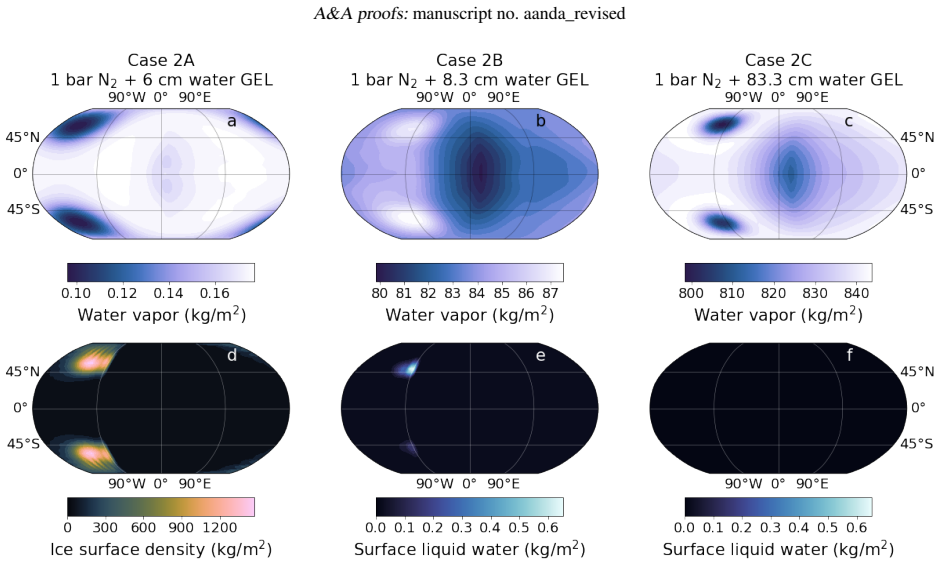
The central claim is that the reflectivity of close-in, non-transiting rocky planets is set by climate, not by an arbitrary Earth-like constant, and that for Ross 128 b-like irradiation the climate almost always acts to lower albedo. The 3D climate simulations produce two stable end states characteristic of moist bistability: a collapsed state where water is trapped as nightside surface ice and the dayside atmosphere is dry and cloud-free, and a runaway state where all water is vaporized and its strong near-infrared absorption darkens the planet, with a transient state of localized nightside liquid water between them. In all cases, dayside cloud decks and dayside ice are absent, so visible reflectivity stays close to the assumed dark rocky surface, while water vapor and carbon dioxide absorb most of the near-infrared flux. The resulting geometric albedo ranges are 0.07 to 0.2 in the RISTRETTO band and 0 to 0.14 in the ANDES YJH bands, with dense nitrogen or carbon dioxide atmospheres raising the visible albedo through Rayleigh scattering and water-rich runaway states driving it toward zero in the near-infrared.
Load-bearing premise
The low albedo range rests on assuming a dark rocky surface with albedo 0.2 and omitting photochemical hazes and dayside clouds; if real surfaces are brighter or hazes form, the reflectivity could be substantially higher.
Editorial extensions
If this is right
- Detection-limit charts that assume a 0.3 geometric albedo overstate the reflected-light contrast of Ross 128 b-like planets; using the simulated albedos lowers predicted contrast and lengthens required exposure times for RISTRETTO, ANDES, and PCS.
- The visible RISTRETTO bandpass mainly reports atmospheric density through Rayleigh scattering, while the ANDES near-infrared bands mainly report water vapor and carbon dioxide absorption, so combining both bands can distinguish a thick transparent atmosphere from a water-rich runaway atmosphere.
- Even a planet inside the inner edge of the habitable zone can host localized liquid water in nightside cold traps for a narrow range of water inventory, so the climate state is not a monotonic function of irradiation alone.
- Runaway states occur even at modest water inventories, with a transition around 8 cm of global equivalent layer, implying that highly irradiated rocky planets with small water reservoirs may commonly be dark in the near-infrared.
Reading between the lines
- If real planetary surfaces turn out to be brighter than the assumed 0.2 albedo, for example feldspathic, clay-like, or covered by photochemical hazes, the quoted albedo ranges would rise, so measuring surface mineralogy or haze refractive indices is the fastest way to tighten these forecasts.
- A null or very dark detection of Ross 128 b by PCS would corroborate the low-albedo picture, whereas a visible-band geometric albedo above 0.2 would point to missing reflectors such as dayside clouds or hazes.
- The paper's Case 2B water budget shows a small non-conservation of total water mass, of order 10^-3%, which the authors flag as needing investigation; the transient-state statistics rest on this approximation, even though the albedo impact is likely negligible.
- The same modeling chain could be run for less irradiated targets where dayside cloud formation is expected; the albedo suppression found here should not be assumed for planets near the outer part of the habitable zone.
Editorial analysis
A structured set of objections, weighed in public.
Referee Report
Summary. The paper uses the Generic-PCM 3D global climate model to simulate a broad suite of climate states for Ross 128 b, varying atmospheric composition (N2, N2+CO2, CO2), surface pressure (0.1-10 bar), water inventory (dry to 83.3 cm GEL), and spin-orbit resonance (1:1 and 5:2). The GCM outputs are post-processed with Pytmosph3R to produce synthetic reflectance spectra and mean Bond and geometric albedos in the RISTRETTO and ANDES bandpasses. The authors identify collapsed, transient, and runaway climate states, find geometric albedos of 0.07-0.2 in the RISTRETTO bandpass and 0-0.14 in the ANDES bandpass across all scenarios, and argue that the common 0.3 Earth-like albedo assumption likely overestimates reflectivity for this planet population.
Significance. If the low-albedo result is robust, it directly affects the predicted contrast ratios and exposure times for reflected-light characterization of non-transiting rocky planets with RISTRETTO, ANDES, and PCS, and it provides a useful alternative to the ad hoc 0.3 albedo assumption commonly used in observability studies. The paper is transparent about many of its limitations, publishes the GCM outputs on Zenodo, and grounds the climate bistability in earlier work rather than assuming it. The main weakness is that the headline albedo ranges are computed for a fixed surface albedo of 0.2, and the authors themselves state in Section 5 that the results are highly sensitive to this assumption; the abstract and conclusions do not carry this caveat forward.
major comments (1)
- [Abstract; Sections 4.3 and 5] The abstract and Section 4.3 state, as a population-level result, that "hazeless rocky planets receiving stellar irradiations similar to Ross 128 b exhibit rather low reflectivity, with geometric albedos ranging from 0.07 to 0.2 in the RISTRETTO bandpass and from 0 to 0.14 in the ANDES bandpass across all simulated scenarios," and conclude that the 0.3 Earth-like value overestimates reflectivity. These statements omit the fact that every simulation assumes a surface albedo of A_surf = 0.2 (Section 2.1, Table 2). As Section 2.2.2 notes, a Lambertian surface alone gives A_g = 2/3 A_surf; hence the upper end of the quoted RISTRETTO range is set by the assumed dark surface plus Rayleigh scattering. Section 5 concedes that "these results are highly sensitive to the assumed surface albedo" and lists feldspathic, granitoid, and clay surfaces as plausible brighter alternatives; with A_surf = 0.4-0.6 the clear-atmosphere geometric albedo would reach 0.27-0.40, at or above the 0.3 value the paper argues is an overestimate. The central population-level conclusion is therefore scoped more narrowly than the abstract and conclusions suggest. Please qualify the abstract and conclusions with the A_surf = 0.2 assumption, or add a sensitivity analysis (e.g., recompute clear-atmosphere and thin-atmosphere geometric albedos for A_surf = 0.3-0.6) to determine the range of surface albedos over which the low-albedo conclusion holds.
minor comments (5)
- [Section 3.1.3, footnote 1] The footnote reporting a 10^-3% non-conservation of global water mass is important for reproducibility; please move this information into the main text or appendix with a brief explanation of the likely cause, since the transient state (Case 2B) is a central result.
- [Sections 2.1.3 and 4.2.2] The "dry" scenarios still include a residual water amount in the correlated-k tables, which leaves trace water features in the spectra (footnote 3 of Section 4.2.2). Please state quantitatively how much residual water is present and how it affects the reported albedo values, so that readers do not interpret the dry cases as strictly water-free.
- [Figures 3, 4, and 5] The color scales differ between panels in several multi-panel maps, which makes cross-case comparison difficult; consider using unified color scales or explicitly labeling the color-bar limits in each panel.
- [Section 2.2.1] The text mentions both the lower spectral resolution of the GCM correlated-k tables (58/28 bands) and the higher resolution used by Pytmosph3R (R=300 or 500); please clarify the distinction between these two resolutions to avoid confusion about the fidelity of the synthetic spectra.
- [Title page and Data availability] There are a few typographical errors, including "Institut Poytechnique" in the affiliations and "https://svn.lmd.jussieu.fr/Planeto/" in the Data availability section; these should be corrected before publication.
Circularity Check
No circularity: the albedo ranges are independent model outputs conditional on a disclosed surface-albedo assumption, and the self-citations provide code, opacity tables, and prior climate frameworks rather than the target result.
full rationale
The paper's derivation chain is self-contained and non-circular. The central claim, that hazeless rocky planets at Ross 128 b-like irradiation have geometric albedos of 0.07-0.2 in the RISTRETTO bandpass and 0-0.14 in the ANDES bandpass, is produced by an explicit forward model: Generic-PCM 3D climate simulations with varying composition, surface pressure, water inventory, and spin-orbit state, followed by Pytmosph3R reflectance spectra and the geometric albedo definition in Eq. (1) with a Lambertian phase function. The surface albedo A_surf = 0.2 is an assumed input, not a parameter fitted to the reported albedo outputs, so the low-albedo result is a conditional model prediction rather than a restatement of the input. The paper explicitly discloses the sensitivity in Section 5: 'these results are highly sensitive to the assumed surface albedo,' and it lists brighter surface types that could raise reflectivity; this is a robustness limitation, not circularity. Self-citations are present (Leconte et al. 2013a,b; Chaverot et al. 2022, 2023; Turbet et al. 2016, 2019, 2021; Leconte 2021), but they supply correlated-k opacity tables, GCM water-cycle schemes, prior labels for climate states, and radiative-transfer code; the paper reproduces the moist bistability in its own simulations rather than importing the conclusion from those citations. No fitted input is renamed as a prediction, no uniqueness theorem from prior work is invoked to force the choice, and no empirical pattern is repackaged solely under new coordinates. The skeptical concerns about surface albedo and omitted hazes are legitimate scoping/robustness issues, but they do not make any step of the derivation equivalent to its own input by construction.
Assumptions & free parameters
free parameters (4)
- Surface albedo A_surf =
0.2
- Global water inventory (GEL) =
6, 8.3, 83.3 cm
- Cloud condensation nuclei concentration =
1e5 kg^-1
- Thermal inertia =
1000 J m^-2 K^-1 s^-1/2
assumptions (4)
- domain assumption Primitive equations and two-stream radiative transfer adequately represent the climate
- domain assumption The 5:2 spin-orbit resonance with 0.09 eccentricity and 79 deg obliquity is a plausible Ross 128 b state
- ad hoc to paper Atmospheres are hazeless and dominated by N2 or CO2 with water as the only condensable
- domain assumption Low water inventories (cm-scale GEL) are representative
Cite this review
Pith. "Pith review of A broad exploration of climate and observability of close-in rocky exoplanets: applications to Ross 128 b." pith.science (2026). https://pith.science/paper/ZOIQTQ2V
@misc{pith2026260803857,
  author       = {Pith},
  title        = {Pith review of: A broad exploration of climate and observability of close-in rocky exoplanets: applications to Ross 128 b},
  year         = {2026},
  howpublished = {\url{https://pith.science/paper/ZOIQTQ2V}},
  note         = {Machine review of arXiv:2608.03857}
}
read the original abstract
VLT/RISTRETTO, ELT/ANDES and ELT/PCS will soon enable atmospheric characterization of non-transiting, small rocky exoplanets orbiting closer than the inner edge of the Habitable Zone around M dwarfs, combining high-contrast imaging with high-resolution spectroscopy in reflected light. A key parameter for reflected-light observability is wavelength-dependent reflectivity, shaped by climate, surface and atmospheric properties. This work refines spectral reflectivity predictions for this population. Using Ross 128 b as a prototype, we provide physically consistent geometric albedo estimates within the RISTRETTO and ANDES spectral ranges across diverse atmospheric scenarios. We run 3D global climate model simulations of Ross 128 b for varying atmospheric compositions, surface pressures, water inventories and spin-orbit resonances to explore its possible climate regimes. We then compute synthetic reflectance spectra with Pytmosph3R to assess spectral signatures per scenario and discuss detectability and instrument capacity for constraining climate. Results show hazeless rocky planets receiving irradiation similar to Ross 128 b exhibit low reflectivity, with geometric albedos of 0.07-0.2 in the RISTRETTO bandpass and 0-0.14 in the ANDES bandpass across all scenarios. This low reflectivity can stem from the lack of clouds or surface ice deposits on the dayside, or from strong atmospheric absorption due to high water vapor concentrations, depending on the parameter configurations. These features are characteristic of the climate moist bistability found in close-in, low-water-reservoir planets in previous studies. Our results suggest arbitrary albedo assumptions, such as the common 0.3 Earth-like value, can overestimate reflectivity for this population, highlighting the need for accurate climate models to improve reflectivity predictions and optimize preparation for next-generation spectrographs.
Figures


Figures from the paper (7 more)


Reference graph
Works this paper leans on
-
[1]
J., Barnes, J., et al
Anglada-Escudé, G., Amado, P. J., Barnes, J., et al. 2016, Nature, 536, 437
2016
-
[2]
2017, A&A, 602, A88
Astudillo-Defru, N., Forveille, T., Bonfils, X., et al. 2017, A&A, 602, A88
2017
-
[3]
M., Rowe, J
Batalha, N. M., Rowe, J. F., Bryson, S. T., et al. 2013, ApJS, 204, 24
2013
-
[4]
2016, A&A, 591, A106
Bolmont, E., Libert, A.-S., Leconte, J., & Selsis, F. 2016, A&A, 591, A106
2016
-
[5]
E., et al
Bolmont, E., Selsis, F., Owen, J. E., et al. 2017, MNRAS, 464, 3728
2017
-
[6]
2018, A&A, 613, A25
Bonfils, X., Astudillo-Defru, N., Díaz, R., et al. 2018, A&A, 613, A25
2018
-
[7]
A., Mayne, N
Boutle, I. A., Mayne, N. J., Drummond, B., et al. 2017, A&A, 601, A120
2017
-
[8]
J., Thompson, M
Bower, D. J., Thompson, M. A., Hakim, K., Tian, M., & Sossi, P. A. 2025, ApJ, 995, 59
2025
Show all 101 references
-
[9]
2025, A&A, 702, A230
Bugatti, M., Lovis, C., Billot, N., et al. 2025, A&A, 702, A230
2025
-
[10]
J., Hillier, J
Buratti, B. J., Hillier, J. K., & Wang, M. 1996, Icarus, 124, 490
1996
-
[11]
2019, A&A, 623, A161
Caldas, A., Leconte, J., Selsis, F., et al. 2019, A&A, 623, A161
2019
-
[12]
& Hapke, B
Cassidy, W. & Hapke, B. 1975, Icarus, 25, 371
1975
-
[13]
2023, A&A, 680, A103
Chaverot, G., Bolmont, E., & Turbet, M. 2023, A&A, 680, A103
2023
-
[14]
2022, A&A, 658, A40 Del Genio, A
Chaverot, G., Turbet, M., Bolmont, E., & Leconte, J. 2022, A&A, 658, A40 Del Genio, A. D., Way, M. J., Amundsen, D. S., et al. 2019, Astrobiology, 19, 99
2022
-
[15]
2025, A&A, 698, A76
Drant, T., Tian, M., Carrasco, N., & Heng, K. 2025, A&A, 698, A76
2025
-
[16]
Dressing, C. D. & Charbonneau, D. 2015, ApJ, 807, 45
2015
-
[17]
H., Glidden, A., et al
Espinoza, N., Allen, N. H., Glidden, A., et al. 2025, ApJ, 990, L52
2025
-
[18]
2022, A&A, 658, A41 Article number, page 17 of 24 A&A proofs:manuscript no
Falco, A., Zingales, T., Pluriel, W., & Leconte, J. 2022, A&A, 658, A41 Article number, page 17 of 24 A&A proofs:manuscript no. aa60174-26
2022
-
[19]
J., Turbet, M., Villanueva, G
Fauchez, T. J., Turbet, M., Villanueva, G. L., et al. 2019, ApJ, 887, 194
2019
-
[20]
& Leconte, J
Forget, F. & Leconte, J. 2014, Philosophical Transactions of the Royal Society of London Series A, 372, 20130084
2014
-
[21]
Fulton, B. J. & Petigura, E. A. 2018, AJ, 156, 264
2018
-
[22]
Gill, A. E. 1980, Quarterly Journal of the Royal Meteorological Society, 106, 447
1980
-
[23]
J., et al
Gillon, M., Ducrot, E., Bell, T. J., et al. 2025, Nature Astronomy, arXiv:2509.02128
2025 arXiv
-
[24]
M., et al
Gillon, M., Jehin, E., Lederer, S. M., et al. 2016, Nature, 533, 221
2016
-
[25]
H., Demory, B.-O., et al
Gillon, M., Triaud, A. H., Demory, B.-O., et al. 2017, Nature, 542, 456
2017
-
[26]
2025, ApJ, 990, L53
Glidden, A., Ranjan, S., Seager, S., et al. 2025, ApJ, 990, L53
2025
-
[27]
D., Zahnle, K
Goldblatt, C., Robinson, T. D., Zahnle, K. J., & Crisp, D. 2013, Nature Geo- science, 6, 661
2013
-
[28]
P., Bell, T
Greene, T. P., Bell, T. J., Ducrot, E., et al. 2023, Nature, 618, 39
2023
-
[29]
Hammond, M., Tsai, S.-M., & Pierrehumbert, R. T. 2020, ApJ, 901, 78
2020
-
[30]
Y ., Ford, E
He, M. Y ., Ford, E. B., & Ragozzine, D. 2019, MNRAS, 490, 4575
2019
-
[31]
2006, Climate Dynamics, 27, 787
Hourdin, F., Musat, I., Bony, S., et al. 2006, Climate Dynamics, 27, 787
2006
-
[32]
Y ., Carrasco, N., & Charnay, B
Jaziri, A. Y ., Carrasco, N., & Charnay, B. 2026, Nature Scientific Report, arXiv:2601.18324
2026
-
[33]
R., Bott, K
Kane, S. R., Bott, K. M., Goodis Gordon, K. E., et al. 2026, PASP, 138, 024404
2026
-
[34]
E., van der Avoird, A., et al
Karman, T., Gordon, I. E., van der Avoird, A., et al. 2019, Icarus, 328, 160
2019
-
[35]
2021, The Messenger, 182, 38
Kasper, M., Cerpa Urra, N., Pathak, P., et al. 2021, The Messenger, 182, 38
2021
-
[36]
Kasting, J. F. 1988, Icarus, 74, 472
1988
-
[37]
F., Whitmire, D
Kasting, J. F., Whitmire, D. P., & Reynolds, R. T. 1993, Icarus, 101, 108
1993
-
[38]
2019, Journal of Geophysical Research (Planets), 124, 2306
Kodama, T., Genda, H., O’ishi, R., Abe-Ouchi, A., & Abe, Y . 2019, Journal of Geophysical Research (Planets), 124, 2306
2019
-
[39]
Koll, D. D. B. & Abbot, D. S. 2016, ApJ, 825, 99
2016
-
[40]
K., Ramirez, R., Kasting, J
Kopparapu, R. K., Ramirez, R., Kasting, J. F., et al. 2013, ApJ, 765, 131
2013
-
[41]
K., Ramirez, R
Kopparapu, R. K., Ramirez, R. M., SchottelKotte, J., et al. 2014, ApJ, 787, L29
2014
-
[42]
k., Wolf, E
Kopparapu, R. k., Wolf, E. T., Arney, G., et al. 2017, ApJ, 845, 5
2017
-
[43]
k., Wolf, E
Kopparapu, R. k., Wolf, E. T., Haqq-Misra, J., et al. 2016, ApJ, 819, 84
2016
-
[44]
& Stevenson, K
Kreidberg, L. & Stevenson, K. B. 2025, Proceedings of the National Academy of Science, 122, e2416190122
2025
-
[45]
2021, A&A, 645, A20
Leconte, J. 2021, A&A, 645, A20
2021
-
[46]
2023, ApJ, 955, L22
Lim, O., Benneke, B., Doyon, R., et al. 2023, ApJ, 955, L22
2023
-
[47]
2022, in Society of Photo-Optical Instru- mentation Engineers (SPIE) Conference Series, V ol
Lovis, C., Blind, N., Chazelas, B., et al. 2022, in Society of Photo-Optical Instru- mentation Engineers (SPIE) Conference Series, V ol. 12184, Ground-based and Airborne Instrumentation for Astronomy IX, ed. C. J. Evans, J. J. Bryant, & K. Motohara, 121841Q
2022
-
[48]
2024, in Society of Photo-Optical Instru- mentation Engineers (SPIE) Conference Series, V ol
Lovis, C., Blind, N., Chazelas, B., et al. 2024, in Society of Photo-Optical Instru- mentation Engineers (SPIE) Conference Series, V ol. 13096, Ground-based and Airborne Instrumentation for Astronomy X, ed. J. J. Bryant, K. Moto- hara, & J. R. D. Vernet, 130961I
2024
-
[49]
2017, A&A, 599, A16
Lovis, C., Snellen, I., Mouillet, D., et al. 2017, A&A, 599, A16
2017
-
[50]
& Barnes, R
Luger, R. & Barnes, R. 2015, Astrobiology, 15, 119
2015
-
[51]
Madden, J. H. & Kaltenegger, L. 2018, Astrobiology, 18, 1559
2018
-
[52]
2017, arXiv e-prints, arXiv:1703.02670
Mallama, A. 2017, arXiv e-prints, arXiv:1703.02670
2017 arXiv
-
[53]
W., Feiden, G
Mann, A. W., Feiden, G. A., Gaidos, E., Boyajian, T., & von Braun, K. 2015, ApJ, 804, 64
2015
-
[54]
2022, in Society of Photo-Optical Instrumentation Engineers (SPIE) Conference Series, V ol
Marconi, A., Abreu, M., Adibekyan, V ., et al. 2022, in Society of Photo-Optical Instrumentation Engineers (SPIE) Conference Series, V ol. 12184, Ground- based and Airborne Instrumentation for Astronomy IX, ed. C. J. Evans, J. J. Bryant, & K. Motohara, 1218424
2022
-
[55]
1966, Journal of the Meteorological Society of Japan, 44, 25
Matsuno, T. 1966, Journal of the Meteorological Society of Japan, 44, 25
1966
-
[56]
2025, A&A, 701, A193
Maurel, A., Turbet, M., Ducrot, E., et al. 2025, A&A, 701, A193
2025
-
[57]
2024, A&A, 688, A47
Maurice, M., Dasgupta, R., & Hassanzadeh, P. 2024, A&A, 688, A47
2024
-
[58]
Meador, W. E. & Weaver, W. R. 1980, Journal of the Atmospheric Sciences, 37, 630
1980
-
[59]
2025, A&A, 700, A146
Mignon, L., Delfosse, X., Meunier, N., et al. 2025, A&A, 700, A146
2025
-
[60]
1941, Kanon der Erdebestrahlung und seine anwendung auf das eiszeitenproblem (Koniglich Serbische Akademie)
Milankovitch, M. 1941, Kanon der Erdebestrahlung und seine anwendung auf das eiszeitenproblem (Koniglich Serbische Akademie)
1941
-
[61]
J., Payne, V
Mlawer, E. J., Payne, V . H., Moncet, J.-L., et al. 2012, Philosophical Transactions of the Royal Society of London Series A, 370, 2520
2012
-
[62]
R., Irwin, J., Charbonneau, D., et al
Newton, E. R., Irwin, J., Charbonneau, D., et al. 2016, ApJ, 821, 93
2016
-
[63]
2025, Experimental Astronomy, 59, 29
Palle, E., Biazzo, K., Bolmont, E., et al. 2025, Experimental Astronomy, 59, 29
2025
-
[64]
2024, A&A, 688, A59
Parc, L., Bouchy, F., Venturini, J., Dorn, C., & Helled, R. 2024, A&A, 688, A59
2024
-
[65]
A., Howard, A
Petigura, E. A., Howard, A. W., & Marcy, G. W. 2013, Proceedings of the Na- tional Academy of Science, 110, 19273
2013
-
[66]
2025, ApJ, 989, 181
Piaulet-Ghorayeb, C., Benneke, B., Turbet, M., et al. 2025, ApJ, 989, 181
2025
-
[67]
Pierrehumbert, R. T. 2010, Principles of Planetary Climate
2010
-
[68]
Pieters, C. M. & Noble, S. K. 2016, Journal of Geophysical Research (Planets), 121, 1865
2016
-
[69]
2023, MNRAS, 523, L86
Quirino, D., Gilli, G., Kaltenegger, L., et al. 2023, MNRAS, 523, L86
2023
-
[70]
V ., Apai, D., & Giampapa, M
Rackham, B. V ., Apai, D., & Giampapa, M. S. 2019, The Astronomical Journal, 157, 96, arXiv: 1812.06184
2019 arXiv
-
[71]
S., Reylé, C., Allard, F., et al
Rajpurohit, A. S., Reylé, C., Allard, F., et al. 2013, A&A, 556, A15
2013
-
[72]
D., Boyajian, T
Ribas, I., Gregg, M. D., Boyajian, T. S., & Bolmont, E. 2017, A&A, 603, A58
2017
-
[73]
2024, Atmospheric Measurement Techniques, 17, 6025
Roccetti, G., Bugliaro, L., Gödde, F., et al. 2024, Atmospheric Measurement Techniques, 17, 6025
2024
-
[74]
F., et al
Roccetti, G., Emde, C., Sterzik, M. F., et al. 2025, A&A, 697, A170
2025
-
[75]
D., & Forget, F
Selsis, F., Wordsworth, R. D., & Forget, F. 2011, A&A, 532, A1
2011
-
[76]
Showman, A. P. & Polvani, L. M. 2011, ApJ, 738, 71
2011
-
[77]
P., Wordsworth, R
Showman, A. P., Wordsworth, R. D., Merlis, T. M., & Kaspi, Y . 2013, in Com- parative Climatology of Terrestrial Planets, ed. S. J. Mackwell, A. A. Simon-
2013
-
[78]
L., et al
Snellen, I., de Kok, R., Birkby, J. L., et al. 2015, A&A, 576, A59
2015
-
[79]
T., Smith, V
Souto, D., Unterborn, C. T., Smith, V . V ., et al. 2018, ApJ, 860, L15 Suárez Mascareño, A., Artigau, É., Mignon, L., et al. 2025, A&A, 700, A11
2018
-
[80]
2026, ApJ, 1000, 99
Taniguchi, K., Kodama, T., Turbet, M., et al. 2026, ApJ, 1000, 99
2026
-
[81]
B., McKay, C
Toon, O. B., McKay, C. P., Ackerman, T. P., & Santhanam, K. 1989, J. Geo- phys. Res., 94, 16287
1989
-
[82]
2021, Nature, 598, 276
Turbet, M., Bolmont, E., Chaverot, G., et al. 2021, Nature, 598, 276
2021
-
[83]
2018, A&A, 612, A86
Turbet, M., Bolmont, E., Leconte, J., et al. 2018, A&A, 612, A86
2018
-
[84]
J., Leconte, J., et al
Turbet, M., Fauchez, T. J., Leconte, J., et al. 2023, A&A, 679, A126
2023
-
[85]
2016, A&A, 596, A112
Turbet, M., Leconte, J., Selsis, F., et al. 2016, A&A, 596, A112
2016
-
[86]
2019, Icarus, 321, 189
Turbet, M., Tran, H., Pirali, O., et al. 2019, Icarus, 321, 189
2019
-
[87]
Valente, E. F. S. & Correia, A. C. M. 2022, A&A, 665, A130
2022
-
[88]
J., Del Genio, A
Way, M. J., Del Genio, A. D., Kiang, N. Y ., et al. 2016, Geophys. Res. Lett., 43, 8376
2016
-
[89]
T., Kopparapu, R
Wolf, E. T., Kopparapu, R. K., & Haqq-Misra, J. 2019, ApJ, 877, 35
2019
-
[90]
T., Schwieterman, E
Wolf, E. T., Schwieterman, E. W., Haqq-Misra, J., et al. 2025, The Planetary Science Journal, 6, 231
2025
-
[91]
D., Forget, F., Selsis, F., et al
Wordsworth, R. D., Forget, F., Selsis, F., et al. 2010, A&A, 522, A22
2010
-
[92]
D., Forget, F., Selsis, F., et al
Wordsworth, R. D., Forget, F., Selsis, F., et al. 2011, ApJ, 733, L48
2011
-
[93]
J., Wittenmyer, R
Wright, D. J., Wittenmyer, R. A., Tinney, C. G., Bentley, J. S., & Zhao, J. 2016, ApJ, 817, L20
2016
-
[94]
A., Maehara, H., Airapetian, V ., et al
Yamashiki, Y . A., Maehara, H., Airapetian, V ., et al. 2019, ApJ, 881, 114
2019
-
[95]
C., & Abbot, D
Yang, J., Boué, G., Fabrycky, D. C., & Abbot, D. S. 2014, ApJ, 787, L2
2014
-
[96]
B., & Abbot, D
Yang, J., Cowan, N. B., & Abbot, D. S. 2013, ApJ, 771, L45
2013
-
[97]
2020, Nature Astronomy, 4, 58
Yang, J., Ji, W., & Zeng, Y . 2020, Nature Astronomy, 4, 58
2020
-
[98]
T., et al
Yang, J., Leconte, J., Wolf, E. T., et al. 2019, ApJ, 875, 46
2019
-
[99]
B., Sasselov, D
Zeng, L., Jacobsen, S. B., Sasselov, D. D., et al. 2019, Proceedings of the Na- tional Academy of Science, 116, 9723
2019
-
[100]
P., et al
Zieba, S., Kreidberg, L., Coy, B. P., et al. 2026, Nature Astronomy [arXiv:2605.00100]
2026 arXiv
-
[101]
2023, Nature, 620, 746 Article number, page 18 of 24 M
Zieba, S., Kreidberg, L., Ducrot, E., et al. 2023, Nature, 620, 746 Article number, page 18 of 24 M. Houelle et al.: A broad exploration of climate and observability of close-in rocky exoplanets Appendix A: Calculations of the dimensionless Rossby deformation length Following ...
2013
Reviewed August 11, 2026 · model on record in the stance chip above.
Discussion (0). Continue with ORCID to comment.