REVIEW 2 major objections 4 minor 45 references
Modeling Event Propagation via Graph Biased Temporal Point Process
T0 review · 2 major / 4 minor · reviewed 2026-08-14 · deepseek-v4-flash
Pith's one-line read The paper claims that separating direct node influence from historical influence in a temporal point process improves propagation prediction on real-world networks.
desk verdict The graph-bias idea is a plausible incremental extension of RMTPP, but the evaluation leaks test-fold transitions into the graph embeddings, so the reported gains are not trustworthy as written. read the letter →
The pith
A machine-rendered reading of the paper's core claim, the machinery that carries it, and where it could break.
The reading
What carries the argument
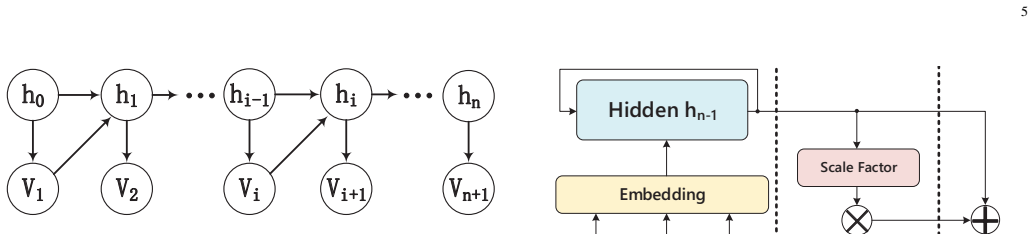
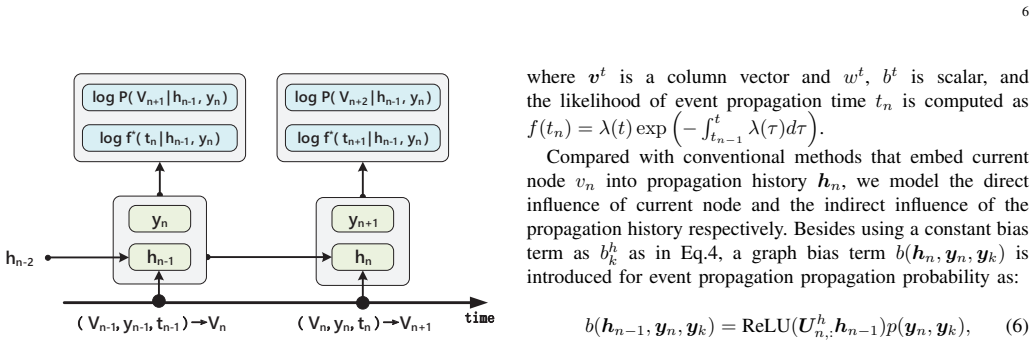
The central object is the graph bias term $b(h_{n-1}, y_n, y_k) = \mathrm{ReLU}(U^h_{n,:}h_{n-1})\, p(y_n, y_k)$, where $p(y_n, y_k) = \sigma(y_n^{s\top} y_k^e)$ is the first-order proximity learned from node embeddings. The embeddings are obtained by minimizing the KL divergence between this embedding-based proximity and an empirical adjacency matrix $A_{i,j} = N_{ij}/N_{\max}$ built from normalized propagation counts, as in Eq.\ (2). The ReLU factor lets the history modulate how strongly the direct edge influences the next node, and the node embedding vectors are also injected into the recurrent history embedding of Eq.\ (3) as side information.
What would settle it
Re-estimate the adjacency matrix $A_{i,j}$ and node embeddings using only training sequences in each 10-fold split, then retrain GBTPP and compare node accuracy and time RMSE against RMTPP. If the advantage shrinks or reverses, the reported gains came from test-fold information entering the graph bias term.
Extended reading notes
Core claim
GBTPP predicts the next propagation node $v_{n+1}$ and time $t_n$ given history $H_{n-1}$ and current node $v_n$. The probability of each candidate node $k$ is a softmax over $V^h_{k,:}h_{n-1} + b(h_{n-1}, y_n, y_k) + b^h_k$, where the graph bias term $b(h_{n-1}, y_n, y_k) = \mathrm{ReLU}(U^h_{n,:}h_{n-1})\, p(y_n, y_k)$ multiplies a history-dependent scale factor by the first-order proximity between the current node and the candidate. The conditional intensity in Eq.\ (8) likewise adds an explicit direct-influence term $v_y^\top y_n$ to the history term. The full model is trained by maximizing the joint log-likelihood of propagation node and time via backpropagation through time, and the paper reports that this explicit decomposition of direct and indirect influence yields better accuracy and lower RMSE than RMTPP, especially on Higgs and MemeTracker data.
Load-bearing premise
The graph representation is learned from the complete observed dataset, including test-fold transition counts, before the cross-validation splits are made; the central performance claim collapses if the adjacency matrix must be estimated from training folds only.
Editorial extensions
If this is right
- If the claim holds, propagation modeling in social and information networks can be improved by explicitly encoding graph structure into neural temporal point processes.
- The direct-versus-indirect decomposition offers a modular design: any RNN-based point process can be augmented with a pre-learned graph bias without changing its recurrent core.
- The history-dependent scale factor $\mathrm{ReLU}(U^h_{n,:}h_{n-1})$ effectively gives each static edge a time-varying strength, which may help in cascades where influence wanes or surges.
- The top-$K$ prediction formulation positions the model as a recommender that can suggest likely next nodes and their propagation times.
- The framework extends naturally to dynamic graphs and to event sequences with richer semantic side information, as the paper itself points to as future work.
Reading between the lines
- A critical control study would re-estimate the adjacency matrix and node embeddings using only training-fold sequences in each 10-fold split; the reported advantage over RMTPP may shrink if the graph bias currently encodes test-fold transition counts.
- The same bias mechanism could be combined with continuous-time graph neural networks or temporal graph embeddings to handle evolving network structure, going beyond the static-graph setting.
- The exponential kernel assumption in the intensity function is a parametric choice; replacing it with a learned kernel might further improve time prediction on irregular propagation patterns.
- The first-order proximity bias only uses direct edges; extending the bias to second-order proximity could capture the paper's motivating example of $V_2 \to V_4 \to V_5$ without relying solely on the RNN history.
Signed reviews
Editorial analysis
A structured set of objections, weighed in public.
Referee Report
Summary. The paper proposes a Graph Biased Temporal Point Process (GBTPP) for modeling event propagation in a graph. The method first learns node embeddings by reconstructing an adjacency matrix A_{ij}=N_{ij}/N_{max} estimated from observed propagation sequences, then feeds these embeddings into a recurrent marked temporal point process. The next-node probability adds a graph bias term p(y_n,y_k) modulated by a history-dependent scale, and the time intensity adds a direct-influence term v_y^T y_n. The authors evaluate on a synthetic Hawkes dataset, the Higgs Twitter dataset, and MemeTracker, comparing against RMTPP, Markov chains, point-process baselines, and an NRPP ablation, and report improved accuracy and RMSE.
Significance. If the reported evaluation were sound, the paper would make a useful contribution by separating direct graph influence from indirect history influence in neural temporal point processes, and the NRPP ablation is a sensible control for isolating the graph bias term. The experimental setup covers a synthetic and two real datasets, which is appropriate for the claim. However, the graph representation step appears to use test-fold information, and Eq. (9) is internally inconsistent, so the empirical claims are not currently supported. The underlying modeling idea remains plausible and could be of interest after a corrected within-fold evaluation.
major comments (2)
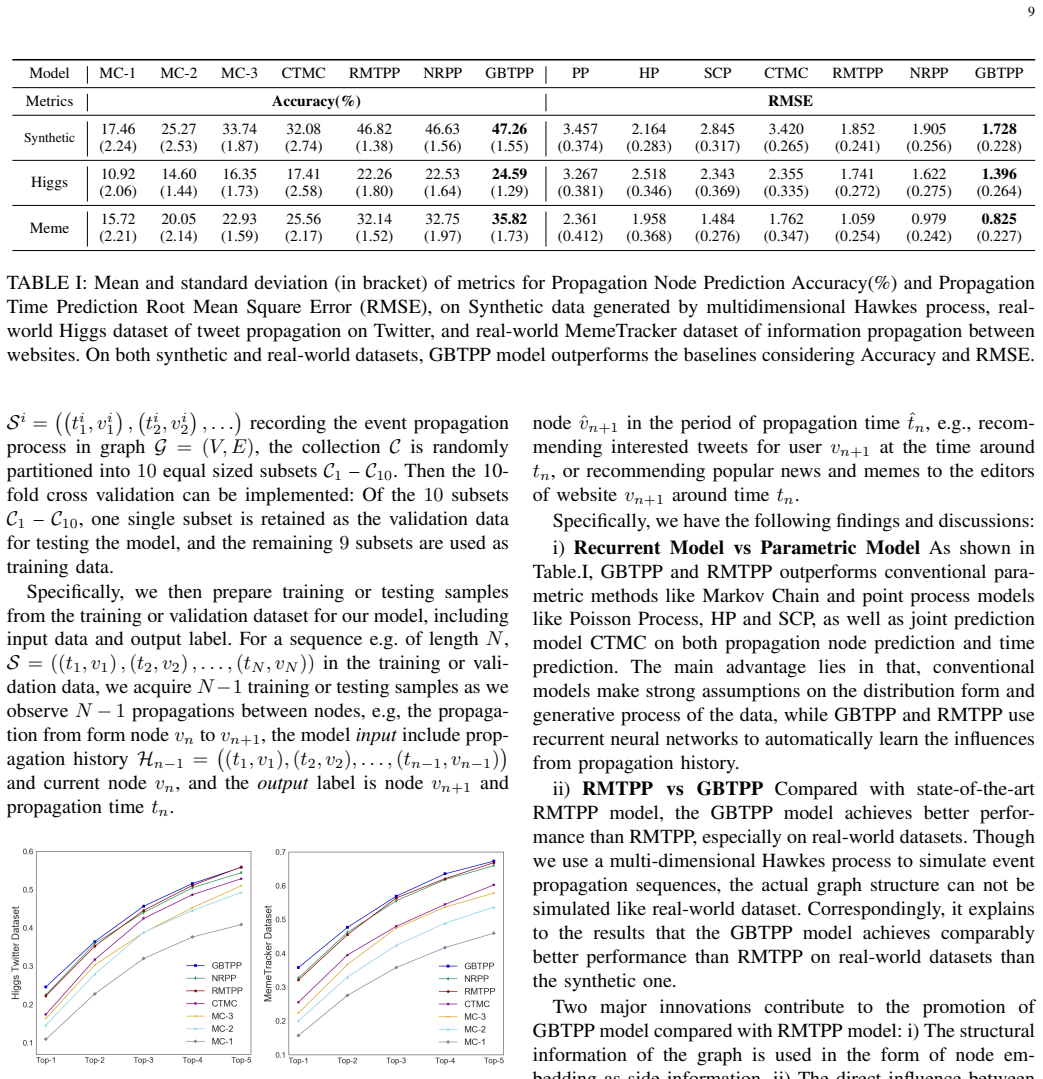
- [Section III-A / IV-B] The graph representation is learned from the full dataset before the 10-fold split. In Section III-A, A_{ij}=N_{ij}/N_{max} is computed from all observed propagation sequences C, and the node embeddings y_i are fitted to A via Eq. (2). Section IV-B then partitions C into folds without stating that A or the embeddings are re-estimated inside each training fold; for MemeTracker this is explicit ('Firstly, the adjacent matrix is estimated by A_{ij}=N_{ij}/N_{max}... Given adjacent matrix A, the graph embedding {y_k} is learned... then the GBTPP model is trained'), and the Higgs description follows the same order. Because Eq. (6) inserts p(y_n,y_k) into the next-node probability, the graph bias term can act as a lookup over transition counts that include test-fold events. This gives GBTPP an information advantage that RMTPP and NRPP do not have and invalidates the comparisons in Table I and Fig. 6. Please re-estimate A and the node embeddings separately inside each training fold, or use a graph source that is independent of the propagation labels, and report the results.
- [Section III-B, Eq. (9)] Equation (9) is not the correct density for the intensity in Eq. (8). Integrating over [t_{n-1}, t] gives a lower-limit term (1/w) exp(v_h^T h_{n-1} + v_y^T y_n + b_t), but Eq. (9) writes (1/w) exp(v_t^T h_{n-1} + b_t), omitting the direct-influence term v_y^T y_n; the first exponent also uses v_t^T where Eq. (8) uses v_h^T. As written the density is not normalized, so the time log-likelihood in Eq. (12) and the reported time RMSE are not trustworthy. Please correct the expression, harmonize the notation, and re-run the time-prediction experiments.
minor comments (4)
- [Section IV-B] The experimental section does not report the embedding dimension d, hidden state dimension H, learning rate, BPTT length b, or number of training epochs; these details are needed to reproduce the results.
- [Section IV-C] No error bars are shown in the top-K curves of Fig. 6, and no significance tests accompany Table I; given the small differences on the synthetic accuracy (e.g., 46.82 vs 47.26 with overlapping standard deviations), 'better performance' should be qualified.
- [Section III-A] Eq. (2) is described as KL-divergence minimization, but the expression is a weighted cross-entropy; the relationship to the empirical distribution \hat{p}^{(1)} should be clarified.
- [Throughout] There are numerous typos, such as 'defining the the grain' in Section II-A, and inconsistent use of v_t and v_h in Section III-B; a careful proofread is needed.
Circularity Check
The graph-bias term is fitted to the full dataset before the 10-fold split, so test-fold transitions are encoded in the prediction term; the central empirical claim is partially forced.
-
fitted input called prediction
[Section III-A Eq.2; Section III-B Eqs.6-7; Section IV-B (Meme dataset, cross-validation)]
"From event propagation sequences C in weighted directed graph G, we have the empirical estimation of the adjacent matrix A, in which A_{i,j} is the empirical estimation for the weight of edge e_{ij} computed by the normalized propagation number from v_i to v_j as A_{i,j} = N_{ij}/N_{max}. ... For each node v_i, we can learn the corresponding node embedding vector y_i = {y^s_i, y^e_i} by Eq.2, indicating the first order proximity by Eq.1. ..."
The paper states the cross-validation setup as: 'All the experimental results are given by 10-fold cross validation... we consider a sequence as one complete and independent sample when dividing the whole dataset into 10 subsets.' The adjacency matrix A and the node embeddings {y_k} are estimated once from the full collection C before this split (Meme paragraph: 'Firstly, the adjacent matrix is estimated by A_{ij}=N_{ij}/N_{max}... Given adjacent matrix A_{ij}, the graph embedding {y_k} is learned... then the GBTPP model is trained'), with no per-fold re-estimation described. Therefore p(y_n,y_k) entering Eqs.6-7 is a fitted function of all observed transition counts, including the held-out fold's transitions.
full rationale
The core derivation of GBTPP (equations 1-12) is self-contained and does not rest on a self-citation chain; the model equations are internally consistent as a parametric proposal. The circularity is in the evaluation of the central empirical claim, not in the mathematical derivation. The graph bias term in Eq.6 is trained, via Eq.2, to reconstruct the empirical adjacency matrix A_{ij}=N_{ij}/N_{max}, which is computed from all propagation sequences before the dataset is partitioned into 10 folds. Because the 10-fold split (Section IV-B) only partitions sequences after the graph embedding is learned, the bias term p(y_n,y_k) encodes transition counts that include test-fold examples. At test time, a transition that appears anywhere in the full dataset receives an inflated score in Eq.7, which is a direct and quotable reduction of the 'prediction' to the fitted input. This is a classic fitted-input-called-prediction pattern and partially explains the reported advantage over RMTPP. There is also a separate correctness concern in Eq.9: after integrating the intensity of Eq.8, the lower-limit term lacks the v_y^T y_n contribution, so the density is not correctly normalized; this affects the time-likelihood component and RMSE results, but it is a correctness issue rather than circularity. The NRPP ablation provides some internal control, and no load-bearing self-citation was found, but the main headline result is not trustworthy as reported because the graph bias term is fit to the test folds.
Assumptions & free parameters
free parameters (2)
- node embedding vectors y_v =
not reported; learned via Eq.2
- neural TPP parameters (Wem, Wv, Wt, Wy, Wh, Vh, U, vh, vy, wt, bt) =
not reported
assumptions (4)
- domain assumption The propagation process is a marked temporal point process with intensity of the form in Eq.8.
- domain assumption First-order proximity between nodes, reconstructed from event propagation counts, captures the direct influence relevant for future propagation.
- domain assumption The observed propagation sequences provide a reliable estimate of the underlying graph's adjacency matrix.
- domain assumption RNN hidden state h_{n-1} sufficiently summarizes propagation history.
Cite this review
Pith. "Pith review of Modeling Event Propagation via Graph Biased Temporal Point Process." pith.science (2026). https://pith.science/paper/ZPAOOBI4
@misc{pith2026190801623,
  author       = {Pith},
  title        = {Pith review of: Modeling Event Propagation via Graph Biased Temporal Point Process},
  year         = {2026},
  howpublished = {\url{https://pith.science/paper/ZPAOOBI4}},
  note         = {Machine review of arXiv:1908.01623}
}
read the original abstract
Temporal point process is widely used for sequential data modeling. In this paper, we focus on the problem of modeling sequential event propagation in graph, such as retweeting by social network users, news transmitting between websites, etc. Given a collection of event propagation sequences, conventional point process model consider only the event history, i.e. embed event history into a vector, not the latent graph structure. We propose a Graph Biased Temporal Point Process (GBTPP) leveraging the structural information from graph representation learning, where the direct influence between nodes and indirect influence from event history is modeled respectively. Moreover, the learned node embedding vector is also integrated into the embedded event history as side information. Experiments on a synthetic dataset and two real-world datasets show the efficacy of our model compared to conventional methods and state-of-the-art.
Figures


Figures from the paper (3 more)

Reference graph
Works this paper leans on
-
[1]
R. Begleiter, R. El-Yaniv, and G. Yona. On prediction using variable order markov models. Journal of Artificial Intelligence Research , 22:385–421, 2004
work page 2004
- [2]
-
[3]
H. Cai, V . W. Zheng, and K. C.-C. Chang. A comprehensive survey of graph embedding: Problems, techniques, and applications. IEEE Transactions on Knowledge and Data Engineering , 30(9):1616–1637, 2018
work page 2018
-
[4]
D. Daley and D. Vere-Jones. An introduction to the theory of point processes: volume II: general theory and structure . Springer Science & Business Media, 2007
work page 2007
-
[5]
M. De Domenico, A. Lima, P. Mougel, and M. Musolesi. The anatomy of a scientific rumor. Scientific reports, 3:2980, 2013
work page 2013
-
[6]
N. Du, H. Dai, R. Trivedi, U. Upadhyay, M. Gomez-Rodriguez, and L. Song. Recurrent marked temporal point processes: Embedding event history to vector. In Proceedings of the 22nd ACM SIGKDD International Conference on Knowledge Discovery and Data Mining , pages 1555–1564. ACM, 2016
work page 2016
-
[7]
P. Embrechts, T. Liniger, and L. Lin. Multivariate hawkes processes: an application to financial data. Journal of Applied Probability , 2011
work page 2011
-
[8]
S. Ertekin, C. Rudin, and T. H. McCormick. Reactive point processes: A new approach to predicting power failures in underground electrical systems. The Annals of Applied Statistics , 9(1):122–144, 2015
work page 2015
Show all 45 references
-
[9]
T. R. Etherington and G. L. Perry. Using point process intensity to establish the spatio-temporal grain of continuous landscape tessellations and graphs. Landscape ecology, 27(8):1083–1090, 2012
2012
-
[10]
J. Feng, M. Huang, Y . Yang, et al. Gake: graph aware knowledge embedding. In Proceedings of COLING 2016, the 26th International Conference on Computational Linguistics: Technical Papers, pages 641– 651, 2016
2016
-
[11]
E. Fox, M. Short, F. Schoenberg, K. Coronges, and A. Bertozzi. Modeling e-mail networks and inferring leadership using self-exciting point processes. Journal of the American Statistical Association , 2016
2016
-
[12]
A. G. Hawkes. Point spectra of some mutually exciting point processes. Journal of the Royal Statistical Society. Series B (Methodological), 1971
1971
-
[13]
A. G. Hawkes. Spectra of some self-exciting and mutually exciting point processes. Biometrika, 1971
1971
-
[14]
Janssen and N
J. Janssen and N. Limnios. Semi-Markov models and applications . Springer Science & Business Media, 2013
2013
-
[15]
S. K. Karmaker Santu, L. Li, D. H. Park, Y . Chang, and C. Zhai. Modeling the influence of popular trending events on user search behavior. In Proceedings of the 26th International Conference on World Wide Web Companion, pages 535–544. International World Wide Web Conferences S...
2017
-
[16]
J. F. C. Kingman. Poisson processes. Wiley Online Library, 1993
1993
-
[17]
Leskovec, L
J. Leskovec, L. Backstrom, and J. Kleinberg. Meme-tracking and the dynamics of the news cycle. In Proceedings of the 15th ACM SIGKDD international conference on Knowledge discovery and data mining , pages 497–506. ACM, 2009
2009
-
[18]
Li and H
L. Li and H. Zha. Dyadic event attribution in social networks with mixtures of hawkes processes. In Proceedings of the 22nd ACM international conference on Information & Knowledge Management , pages 1667–1672. ACM, 2013
2013
-
[19]
Li and H
L. Li and H. Zha. Learning parametric models for social infectivity in multi-dimensional hawkes processes. In Twenty-Eighth AAAI Conference on Artificial Intelligence , 2014
2014
-
[20]
L. Liu, W. K. Cheung, X. Li, and L. Liao. Aligning users across social networks using network embedding. In Proceedings of the Twenty-Fifth International Joint Conference on Artificial Intelligence, IJCAI 2016, New York, NY, USA, 9-15 July 2016 , pages 1774–1780, 2016
2016
-
[21]
T. Man, H. Shen, S. Liu, X. Jin, and X. Cheng. Predict anchor links across social networks via an embedding approach. In Proceedings of the Twenty-Fifth International Joint Conference on Artificial Intelligence, IJCAI 2016, New York, NY, USA, 9-15 July 2016 , pages 1823–1829, 2016
2016
-
[22]
Mei and J
H. Mei and J. M. Eisner. The neural hawkes process: A neurally self-modulating multivariate point process. In Advances in Neural Information Processing Systems , pages 6754–6764, 2017
2017
-
[23]
Y . Ogata. Statistical models for earthquake occurrences and residual analysis for point processes. Journal of the American Statistical association, 83(401):9–27, 1988
1988
-
[24]
Y . Ogata. Space-time point-process models for earthquake occurrences. Annals of the Institute of Statistical Mathematics , 50(2):379–402, 1998
1998
-
[25]
Pemantle
R. Pemantle. A survey of random processes with reinforcement. Probability Survey, 4(0):1–79, 2007
2007
-
[26]
Reinhart et al
A. Reinhart et al. A review of self-exciting spatio-temporal point processes and their applications. Statistical Science , 33(3):299–318, 2018
2018
-
[27]
M. C. Seiler and F. A. Seiler. Numerical recipes in c: the art of scientific computing. Risk Analysis, 9(3):415–416, 1989
1989
-
[28]
Singer, I
U. Singer, I. Guy, and K. Radinsky. Node embedding over temporal graphs. arXiv preprint arXiv:1903.08889 , 2019
1903 arXiv
-
[29]
Stomakhin, M
A. Stomakhin, M. Short, and A. Bertozzi. Reconstruction of missing data in social networks based on temporal patterns of interactions. Inverse Problems, 2011
2011
-
[30]
J. Tang, M. Qu, M. Wang, M. Zhang, J. Yan, and Q. Mei. LINE: large-scale information network embedding. In Proceedings of the 24th International Conference on World Wide Web, WWW 2015, Florence, Italy, May 18-22, 2015 , pages 1067–1077, 2015
2015
-
[31]
D. Wang, C. Song, and A. Barab ´asi. Quantifying long-term scientific impact. Science, 342(6154):127–132, 2013
2013
-
[32]
Y . Wang, H. Shen, S. Liu, J. Gao, and X. Cheng. Cascade dynamics modeling with attention-based recurrent neural network. In Proceedings of the Twenty-Sixth International Joint Conference on Artificial Intel- ligence, IJCAI 2017, Melbourne, Australia, August 19-25, 2017 , pages...
2017
-
[33]
X. Wei, L. Xu, B. Cao, and P. S. Yu. Cross view link prediction by learning noise-resilient representation consensus. In Proceedings of the 26th International Conference on World Wide Web , pages 1611–1619. International World Wide Web Conferences Steering Committee, 2017
2017
-
[34]
W. Wu, J. Yan, X. Yang, and H. Zha. Decoupled learning for factorial marked temporal point processes. In Proceedings of the 24th ACM SIGKDD International Conference on Knowledge Discovery and Data Mining, KDD ’18, pages 2516–2525, New York, NY , USA, 2018. ACM
2018
-
[35]
S. Xiao, M. Farajtabar, X. Ye, J. Yan, L. Song, and H. Zha. Wasserstein learning of deep generative point process models. In Advances in Neural Information Processing Systems , pages 3247–3257, 2017
2017
-
[36]
S. Xiao, J. Yan, X. Yang, H. Zha, and S. M. Chu. Modeling the intensity function of point process via recurrent neural networks. In Thirty-First AAAI Conference on Artificial Intelligence , 2017
2017
-
[37]
H. Xu, W. Wu, S. Nemati, and H. Zha. Patient flow prediction via discriminative learning of mutually-correcting processes. IEEE transactions on Knowledge and Data Engineering, 29(1):157–171, 2017
2017
-
[38]
J. Yan, Y . Wang, K. Zhou, J. Huang, C. Tian, H. Zha, and W. Dong. Towards effective prioritizing water pipe replacement and rehabilitation. In Twenty-Third International Joint Conference on Artificial Intelligence, 2013
2013
-
[39]
J. Yan, S. Xiao, C. Li, B. Jin, X. Wang, B. Ke, X. Yang, and H. Zha. Modeling contagious merger and acquisition via point processes with a profile regression prior. In IJCAI, pages 2690–2696, 2016
2016
-
[40]
J. Yan, C. Zhang, H. Zha, M. Gong, C. Sun, J. Huang, S. Chu, and X. Yang. On machine learning towards predictive sales pipeline analytics. In Twenty-ninth AAAI conference on artificial intelligence , 2015
2015
-
[41]
Zammit-Mangion, M
A. Zammit-Mangion, M. Dewar, V . Kadirkamanathan, and G. San- guinetti. Point process modelling of the afghan war diary. Proceedings of the National Academy of Sciences , 109(31):12414–12419, 2012
2012
-
[42]
Zhang, K
C. Zhang, K. Zhang, Q. Yuan, H. Peng, Y . Zheng, T. Hanratty, S. Wang, and J. Han. Regions, periods, activities: Uncovering urban dynamics via cross-modal representation learning. In Proceedings of the 26th Inter- national Conference on World Wide Web , pages 361–370. Internat...
2017
-
[43]
Zhang and H
Q. Zhang and H. Wang. Not all links are created equal: An adaptive embedding approach for social personalized ranking. In Proceedings of the 39th International ACM SIGIR conference on Research and Development in Information Retrieval, SIGIR 2016, Pisa, Italy, July 17- 21, 2016...
2016
-
[44]
K. Zhou, H. Zha, and L. Song. Learning social infectivity in sparse low- rank networks using multi-dimensional hawkes processes. In AISTATS, 2013
2013
-
[45]
Zhu and Y
S. Zhu and Y . Xie. Crime linkage detection by spatial-temporal-textual point processes. arXiv preprint arXiv:1902.00440 , 2019. Weichang Wu received the B.S. degree in electronic engineering from Huazhong University of Science and Technology, Wu Han, China, in 2013. He is cur...
1902 arXiv
Reviewed August 14, 2026 · model on record in the stance chip above.
Discussion (0). Continue with ORCID to comment.