REVIEW 3 major objections 3 minor 11 references
Lattice approach to plane colorings
T0 review · 3 major / 3 minor · reviewed 2026-08-14 · deepseek-v4-flash
Pith's one-line read A fixed-range lattice spin model is proposed as an analog of the plane-coloring problem; its ground states suggest that seven colors are needed to avoid unit-distance same-color pairs.
desk verdict A promising new computational probe of plane colorings that validates on known cases and honestly flags why its 5- and 6-color evidence is not conclusive. read the letter →
The pith
A machine-rendered reading of the paper's core claim, the machinery that carries it, and where it could break.
The reading
What carries the argument
The central object is the fixed-range interaction multicomponent spin model, technically a q-state Potts model with Hamiltonian H = sum_{i,j} delta_{s_i,s_j} $a^{{-1}}$ $\varphi$((|r_i-r_j|-1)/a), where $\varphi$ is a smooth bounded-support kernel approximating a delta function. As a goes to zero, the kernel becomes delta(|r_i-r_j|-1), so the normalized energy epsilon(a) equals the probability that two unit-separated lattice sites share a color. Simulated annealing with Metropolis updates and a geometric cooling schedule searches for the ground state; the behavior of epsilon(a) as a decreases is the diagnostic for whether a true coloring exists in the continuum limit.
What would settle it
Run the same model for q=5 and q=6 at lattice constants below 0.01 while enlarging the lattice to keep the physical area fixed; if epsilon(a) continues to decrease toward zero instead of plateauing, the numerical case for chromatic number seven collapses. Equally, exhibiting any explicit five- or six-coloring of the plane would directly contradict the paper's central suggestion.
Extended reading notes
Core claim
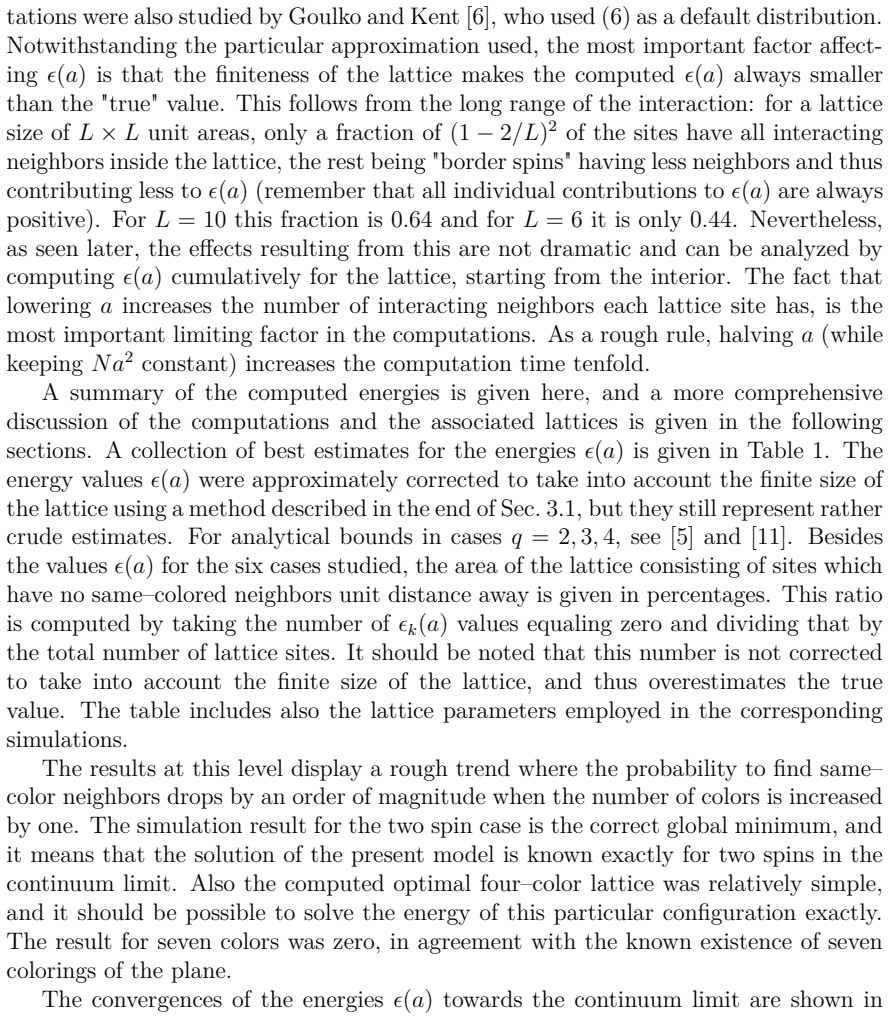
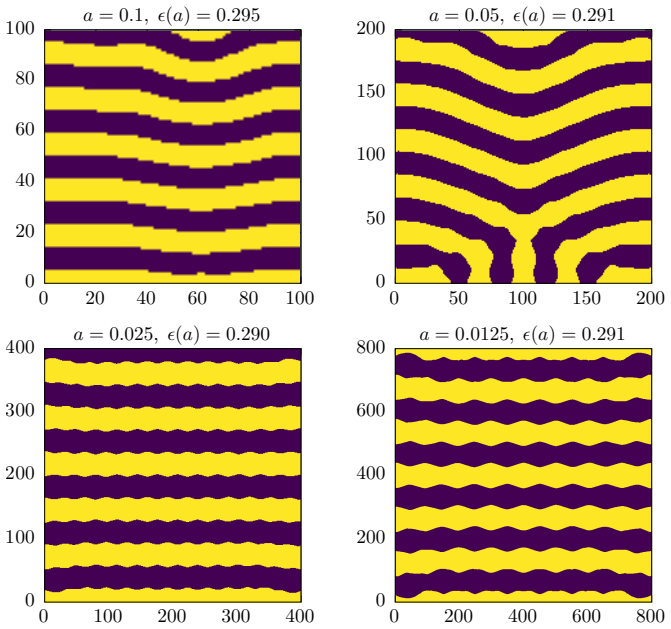
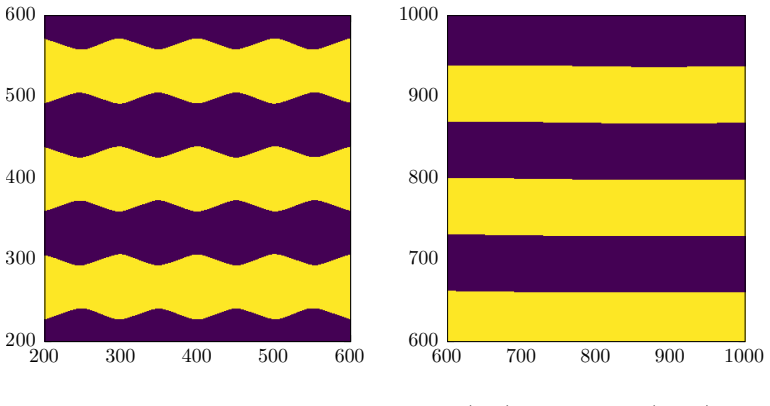
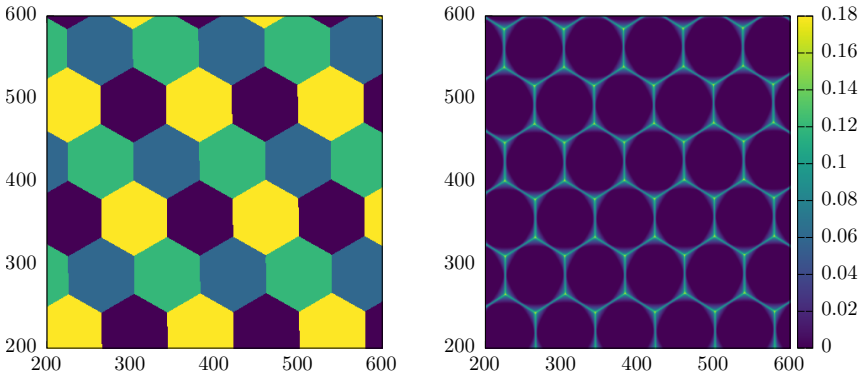
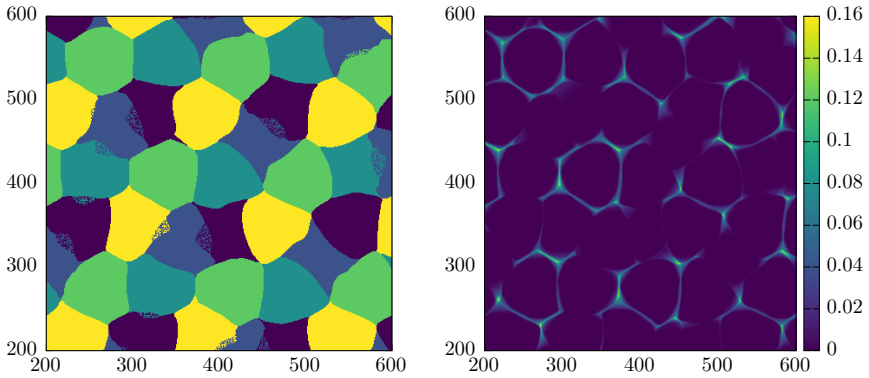
The central discovery is that the minimum-energy configurations of a unit-range Potts model, interpreted as lattice approximations to plane colorings, show a sharp qualitative change between six and seven colors: the probability epsilon(a) of finding same-colored points at unit distance converges to a positive constant for q=2 through q=6 (with a plateau for q=5 and q=6) and to zero for q=7. The author proposes that this identifies seven as the chromatic number of the plane. The interpretation is supported by matching the exact two-coloring result, by observing regular periodic frustrations for q below seven, and by noting that the q=7 solution vanishes within double precision on a modest 6 by 6 unit-area lattice.
Load-bearing premise
The load-bearing premise is that simulated annealing with the chosen cooling schedule and finite lattices finds the true ground-state energy for q=5 and q=6; if it instead settles in local minima, the observed plateau in epsilon(a) does not imply that five- or six-colorings are impossible.
Editorial extensions
If this is right
- If the plateau in epsilon(a) for q=5 and q=6 is real, the chromatic number of the plane is seven; the paper's evidence is convergence to small positive energies with regular frustration patterns.
- The model reproduces the known optimal two-coloring, stripes of width sqrt(3)/2 with energy 1/3, validating the approach on a solvable case.
- The same energy functional gives a natural definition of optimal coloring even when zero energy is impossible, connecting to the probabilistic formulation of the plane-coloring problem.
- The method generalizes to other topologies (cylinder, torus), higher dimensions, and other coloring problems such as polychromatic numbers, by changing boundary conditions or adding interaction terms.
Reading between the lines
- A sharper test would be to run the same annealing protocol for q=6 at lattice constants below 0.01 while enlarging the lattice to keep the physical area fixed; if epsilon(a) keeps falling, the plateau is a finite-size artifact rather than a fundamental obstruction.
- The regular frustration patterns for q=5 and q=6 resemble structures one would expect if the obstruction is encoded in finite unit-distance subgraphs; extracting such subgraphs from the frustrated regions could convert the numerical evidence into a graph-theoretic proof.
- Because the q=7 ground state appears highly degenerate, annealing may interpolate between distinct seven-colorings; this suggests that many independent runs are needed to map the full ground-state space, and that the zero-energy result is robust even if individual realized colorings differ.
Signed reviews
Editorial analysis
A structured set of objections, weighed in public.
Referee Report
Summary. The paper proposes a fixed-range Potts model on a square lattice, with Hamiltonian (1) and normalized energy ε(a) in (3)–(5), as a numerical analog of the Hadwiger–Nelson problem. Using simulated annealing, the author computes low-energy configurations for q=2,...,7 colors at decreasing lattice constants. The two-color case reproduces the exact stripe solution (ε=1/3), the three- and four-color cases yield hexagonal patterns with ε≈0.12 and 0.01, five and six colors show apparent plateaus at small lattice constants (ε≈4×10^-3 and 2×10^-4), and a seven-color computation reaches zero energy on a 6×6-area lattice. The paper interprets the regular frustration patterns and the non-convergence for q=5,6 as evidence that the chromatic number of the plane is seven, while explicitly acknowledging that no proof is provided.
Significance. If the proposed heuristic could be validated, it would offer a new computational window into the Hadwiger–Nelson problem and into optimal colorings for small q. The paper has genuine strengths: the model is not tuned to force the seven-color result (the q=2 case matches an independent analytical solution, and q=7 matches known colorability), and the simulation code and lattices are made publicly available. The caution is that the decisive inference for q=5,6 depends on the ability of simulated annealing to reach global ground states, which is neither certified nor demonstrated; the paper itself flags this limitation. As an exploratory numerical study with honest caveats it is of interest, but the abstract's phrasing overstates the strength of the evidence.
major comments (3)
- [§4, §3.3, Table 1] The main claim that the plane is not colorable with five or six colors rests on the observed plateau of ε(a) for small lattice constants, i.e., on the absence of convergence to zero. This inference is valid only if the annealed configurations are true ground states of the lattice model. The paper concedes exactly this in Section 4: 'The other possibility for five and/or six colors not converging to zero would be that simulated annealing could not find the true minima.' No independent certification of global optimality is provided; in particular, the q=6 entry in Table 1 is a single 6×6-area lattice with a=0.0060 using one cooling schedule (c=0.83), and the reported plateau near 2×10^-4 is too fragile to support a positive continuum limit. Please add multiple independent cooling schedules, different random seeds, larger lattices, and, if possible, a control case with a known optimum (other than q=2) to calibrate the annealing.
- [§3 (boundary conditions), Eqs. (3)–(5)] The finite-lattice implementation biases ε(a) downward in a way that is largest exactly in the decisive q=6 case. Free boundaries mean that border sites have fewer interacting neighbors and that a never-updated zero spin acts as an extra color; the paper notes that for a 6×6-area lattice only (1−2/6)^2=44% of sites are interior. The approximate cumulative correction described in Sec. 3.1 is not reported for the q=6 run, so the plateau could be a finite-size artifact. Please quantify the boundary contribution to the quoted ε values, especially for Table 1, and show that the plateau persists after a conservative finite-size correction.
- [Abstract and Sec. 2] The statement that 'minimum energy configurations of the model give optimal colorings' is an idealization: Eqs. (3)–(5) define an average over a finite lattice with free boundaries, not the probability for a random unit-distance pair in the infinite plane. The paper acknowledges the finite-size issue later, but the abstract and several figure captions (e.g., 'computed optimal five-coloring' and 'computed optimal seven-coloring') use the word 'optimal' for configurations whose global optimality is not established. The text should consistently distinguish between low-energy annealed configurations and proven optimal colorings.
minor comments (3)
- [Fig. 10 caption and §3.4] The zero-energy seven-color result is a finite-lattice configuration, not a plane coloring; the paper itself notes that it cannot be generalized to the infinite lattice. Calling it 'optimal' is therefore misleading; 'a computed low-energy seven-coloring' would be more accurate.
- [Table 1 and end of §3.1] The method used to obtain the finite-size-corrected estimates in Table 1 is described only for the two-color case; a short description of how the cumulative-average correction was applied for q=3,...,6 would improve reproducibility.
- [§3] The paper would benefit from a table or plot showing the sensitivity of the q=5,6 plateaus to the cooling factor c and to lattice size; the current report gives only a single representative run for the decisive cases.
Circularity Check
No circularity: the model is validated against external analytic and known constructive results, and the q=5/6 caveat is an admitted heuristic limitation, not a self-referential reduction.
full rationale
The derivation chain is not circular. The Hamiltonian and the energy functional epsilon(a) are defined independently of the target claim about the chromatic number, and no parameter is fitted to force the seven-color result. The two-color case is checked against the external analytical result of Bourgeat et al. (arXiv:1501.02441), yielding the matching stripe probability 1/3; the seven-color case is checked against known explicit plane colorings, with the paper stating that the zero result is 'in agreement with the known existence of seven colorings of the plane.' These are external benchmarks, not inputs. For q=5 and q=6, the inference from a positive plateau in epsilon(a) to non-colorability is explicitly conditional on simulated annealing reaching true ground states; Section 4 concedes: 'The other possibility for five and/or six colors not converging to zero would be that simulated annealing could not find the true minima.' This is a clearly stated methodological limitation rather than a circular step. No fitted input is renamed as a prediction, no load-bearing self-citation is used, and no uniqueness theorem from the author's prior work is imported. The only self-reference is the public code link, cited for reproducibility, which is not load-bearing. Therefore the paper contains no significant circularity.
Assumptions & free parameters
free parameters (2)
- Annealing cooling factor c =
0.83 to 0.95
- Interaction profile phi(x) =
cosine window in Eq. (6)
assumptions (4)
- domain assumption The continuum limit of the lattice Hamiltonian (Eq. 2) preserves the unit-distance coloring condition on the plane.
- domain assumption Free boundaries with surrounding zero spins have a negligible effect on the optimal bulk coloring.
- domain assumption The simulated annealing schedule finds global minima for q=5 and q=6.
- domain assumption Regular periodic frustration patterns are signatures of fundamental non-colorability rather than numerical artifacts.
Cite this review
Pith. "Pith review of Lattice approach to plane colorings." pith.science (2026). https://pith.science/paper/ZPGNLCHX
@misc{pith2026190803880,
  author       = {Pith},
  title        = {Pith review of: Lattice approach to plane colorings},
  year         = {2026},
  howpublished = {\url{https://pith.science/paper/ZPGNLCHX}},
  note         = {Machine review of arXiv:1908.03880}
}
read the original abstract
I propose a fixed-range interaction multicomponent spin model, to be used as a physical analog to problems in plane geometry. Specifically, the model is applied to the open problem of the chromatic number of the plane. When spin values are interpreted as colors, the lowest energy configurations of the lattice spin system can be interpreted as approximations to plane colorings. In general minimum energy configurations of the model give optimal colorings, corresponding to minimum probability of any color realizing distance one. Approximate optimal lattice colorings with two to seven colors towards the continuum limit suggest that a true coloring of the plane cannot be achieved with less than seven colors.
Figures

Figures from the paper (8 more)




Reference graph
Works this paper leans on
- [1]
-
[2]
A. D. N. J. de Grey, ArXiv e-prints (2018), arXiv:1804.02385 [math.CO]
arXiv 2018
-
[3]
Polymath project,http://michaelnielsen.org/polymath1/index.php?title= Hadwiger-Nelson_problem (), [Online; accessed 5–July–2019]
work page 2019
-
[4]
Soifer,The Mathematical Coloring Book(Springer-Verlag, 2009)
A. Soifer,The Mathematical Coloring Book(Springer-Verlag, 2009)
work page 2009
-
[5]
A probabilistic Hadwiger-Nelson problem
T. Bourgeat, M. Heinrich, P. Melotti, and J.-M. Robert, ArXiv e-prints (2015), arXiv:1501.02441 [math.CO]
work page Pith review arXiv 2015
-
[6]
O. Goulko and A. Kent, Proceedings of the Royal Society of London Series A473, 20170494 (2017), arXiv:1705.07621 [cond-mat.stat-mech]
arXiv 2017
-
[7]
C. S. Peskin, Acta Numerica11, 479–517 (2002)
work page 2002
- [8]
Show all 11 references
-
[9]
Colorplane,
S. Heinäsmäki, “Colorplane,” https://github.com/heinasmaki/colorplane (2019)
2019
-
[10]
X. Yang, X. Zhang, Z. Li, and G.-W. He, Journal of Computational Physics228, 7821 (2009)
2009
-
[11]
Aalto University, P.O.Box 11000, 00076 AALTO, Finland E-mail: sami.heinasmaki@aalto.fi 20
Polymath project,http://michaelnielsen.org/polymath1/index.php?title= Probabilistic_formulation_of_Hadwiger-Nelson_problem (), [Online; ac- cessed 26–Aug–2019]. Aalto University, P.O.Box 11000, 00076 AALTO, Finland E-mail: sami.heinasmaki@aalto.fi 20
2019
Reviewed August 14, 2026 · model on record in the stance chip above.
Discussion (0). Continue with ORCID to comment.