REVIEW 3 major objections 4 minor 47 references
GeoRoute: Geometry-Aware Hybrid Inference for Traffic Future-Frame Prediction
T0 review · 3 major / 4 minor · reviewed 2026-08-11 · deepseek-v4-flash
Pith's one-line read A training-free pipeline stabilizes traffic video futures and ranks fifth on the AI City Challenge Track 5 leaderboard.
desk verdict Solid challenge-system paper with a confounded ablation: the official leaderboard score doesn't isolate the geometry refinement from the routing switch. read the letter →
The pith
A machine-rendered reading of the paper's core claim, the machinery that carries it, and where it could break.
The reading
What carries the argument
The load-bearing mechanism is the confidence-aware static-refinement equation $w_j(u) = C_j(u)(1 - A_j(u))\exp(-\Delta_j(u)/32)\,Q_j$, followed by the convex blend $\hat{y}_j(u) = (1 - \alpha w_j(u))\,b_j(u) + \alpha w_j(u)\,r_j(u)$ with $\alpha = 0.75$. Coverage $C_j$ marks pixels with projected history evidence, $A_j$ masks actors, $\Delta_j$ is the photometric agreement between rendered and generated pixels, and $Q_j$ encodes pose reliability (1 for accepted poses, 0.35 for interpolated poses, 0 for missing poses). This product gates a multi-frame point-splatting renderer that composes older history frames into the most recent observation's coordinate frame and resolves occlusions with a z-buffer, so only confident static pixels replace the generated content.
What would settle it
Take a front-camera video with strong ego-motion and disocclusion, run the pipeline with the photometric-agreement term disabled, and inspect the rendered static layer for visible double edges on lane markings or buildings across consecutive history frames; such misalignment would indicate that independently canonicalized depth scales do not compose, breaking the central static-refinement claim.
Extended reading notes
Core claim
GeoRoute claims that the static-structure errors in generated traffic futures are separable from dynamic-content errors, and that a training-free rendering step can repair the former without hurting the latter. For front-camera clips, up to eight history frames are masked into static and dynamic regions, depth and actor masks are estimated, and feature-based alignment projects the static pixels into each generated future frame; z-buffer splatting fuses the projected layers, and a confidence product of coverage, staticness, color agreement, and pose quality blends the rendered static layer with the base generator's output. For overhead, fixed, and vehicle-mounted views, a frozen vision-language model routes the clip to a deterministic flow-based propagation branch instead. The paper reports that the full system achieves a challenge score of 73.28 and ranks fifth on the official leaderboard, with PSNR and SSIM close to the best among the top systems, supporting the intended static-geometry-stability effect.
Load-bearing premise
The multi-frame static refinement assumes that depth maps estimated separately from different history frames can be treated as if they used the same scale, so that their projected views line up when composed.
Editorial extensions
If this is right
- Pretrained traffic-video generators can be used for long-horizon prediction without retraining or fine-tuning; static anchors recover much of the structural stability that the base model lacks.
- Static regions such as lane markings, curbs, roads, and buildings are predicted with higher PSNR and SSIM than the base generator alone.
- A fixed three-way view router, driven by a frozen vision-language model, is enough to assign clips to appropriate prediction branches across both front-camera and traffic-camera datasets.
- Remaining perceptual gaps in LPIPS, FID, and FVD concentrate in dynamic and disoccluded content, so further gains require stronger dynamic-object priors rather than more static refinement.
- Because the pipeline leaves the generator architecture unchanged, it can be stacked on top of improved base video models as they become available.
Reading between the lines
- Beyond the paper: if the common-depth-scale weakness is addressed, the same recent-history-anchored refinement could be extended to longer horizons or to other structured-scene domains such as city-scale rendering, where static geometry dominates.
- Beyond the paper: the router's three hand-defined visual regimes are a deliberately simple choice; learned or automatically discovered regime clusters could replace the fixed prototypes without changing the overall architecture.
- Beyond the paper: the confidence product provides a per-pixel diagnostic; regions where $w_j$ is low over large areas indicate projection-geometry failure rather than generator failure, which could be used to decide when to trust the static branch.
Editorial analysis
A structured set of objections, weighed in public.
Referee Report
Summary. GeoRoute proposes a training-free inference-time framework for long-horizon traffic future-frame prediction. For front-camera driving clips, a frozen LTX-Video generator produces base predictions, and a multi-frame depth-based point-splatting renderer projects reliable static pixels from observed history frames into each future view; confidence-aware blending then fuses the rendered static layer with the generated frame while preserving dynamic regions. For other traffic viewpoints, a frozen Qwen2.5-VL router classifies each clip into one of three hand-defined visual regimes and routes the clip to either a median-background actor-propagation predictor or a region-normalized flow predictor. The framework is validated on AI City Challenge Track 5, where the paper reports an official full-test score of 73.28 and rank 5 among the submitted teams. The paper's central claim is that geometry-aware inference-time refinement and view-conditioned hybrid inference improve static-geometry stability and low-level structural fidelity without changing the pretrained generator architecture.
Significance. If the central claim holds, the paper offers a practically useful, training-free recipe: the official leaderboard result is an external evaluation, the method is described with concrete hyperparameters, and the qualitative controlled comparison in Fig. 6 supports the intended static-structure effect. The paper also gives an explicit failure analysis and states that no future ground-truth frames are used, so the design is not circular relative to the test set. However, the evidence is currently built on a single official score and a cumulative ablation that the authors themselves label as development-trend data rather than an independent validation. The geometry-refinement mechanism is not cleanly isolated from the routing switch, and no error bars or per-view decompositions are provided. The contribution is therefore plausible but not yet fully established as presented.
major comments (3)
- [Sec. 4.3, Table 2] The central claim that the geometry-refinement branch improves static fidelity is not cleanly supported. The largest increment in Table 2 (+1.68 from the 'Confidence blending' row at 71.6 to the 'Full routed system' at 73.28) is obtained by adding the Qwen routing branch, which simultaneously reassigns most WTS samples to motion-based predictors that do not use the base generator or the geometry branch at all. The table is explicitly described as 'challenge-server development trends rather than an independent validation-set ablation', and it contains no per-view or per-branch decomposition. To support the claim, please provide an ablation that isolates the geometry branch on the front-camera route only, for example 'Full routed system with geometry disabled on the front-camera branch', or report official per-view scores if the benchmark provides them.
- [Sec. 4.5, Sec. 3.5] The multi-frame depth-based static projection relies on the assumption that independently canonicalized monocular depth maps share a common translation scale, and the paper admits in Sec. 4.5 that this is not guaranteed. This is a load-bearing assumption for the multi-frame history component that is central to the method. The aggregated development trend from 'Static geometry' to 'Multi-frame history' in Table 2 shows only a small gain (69.2 to 69.4), which does not demonstrate that multi-frame composition helps in the front-camera regime where it is applied. Please provide a controlled front-camera comparison of single-frame versus multi-frame rendering and report the fraction of frames where composed pseudo-transforms are rejected or down-weighted.
- [Sec. 4.1, Table 4.1] The method has many hand-tuned hyperparameters, including alpha=0.75, focal scale 0.9, pose thresholds (20 ORB matches, 12 RANSAC inliers), pose-quality weight Q_j=0.35, confidence EMA 0.65, and the WTS flow parameters, and these were selected by iterating on challenge-server development trends. The paper provides no error bars, no number of server submissions, and no independent validation split. This makes it difficult to assess how much of the reported gain reflects overfitting to the single official test score. Please report variance over at least a few seeds or a held-out split, and state how many development-set evaluations were used during tuning.
minor comments (4)
- [Sec. 3.1] The sentence 'our goal is to predict the nextKfaicity2026track5{ˆy 1, . . . ,ˆyK}' contains a garbled LaTeX macro ('faicity2026track5') and should be corrected to 'the next K future frames {\hat{y}_1, ..., \hat{y}_K}'.
- [Sec. 4.1] The settings table is referred to as 'Table 4.1' in the text but the numbering is inconsistent with the other tables in the paper; please renumber it consistently.
- [Sec. 3.3] The claim that Qwen receives 'no dataset identity, metadata, file name, target frame, or manual label' would be clearer if the paper specified whether the 'available textual description' used for prompting may contain dataset-specific metadata that could inadvertently leak view information.
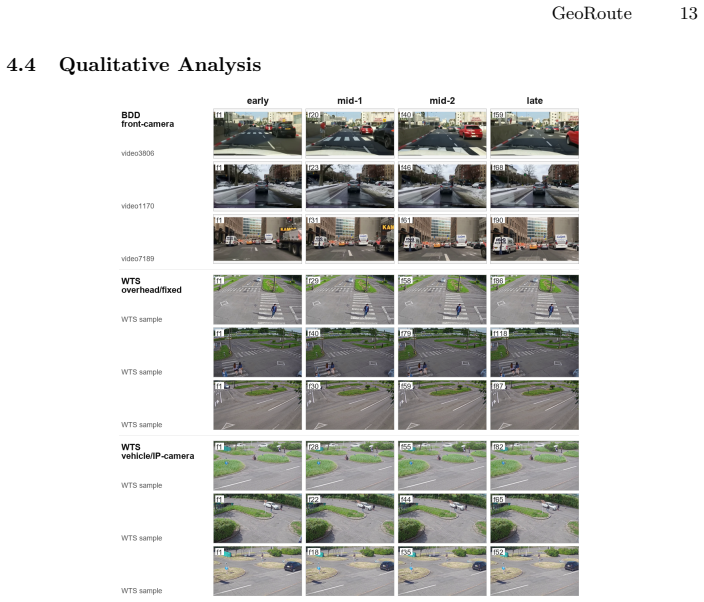
- [Fig. 6] The caption of Figure 6 refers to 'video3806' without indicating the source dataset or view regime; please state whether this is a BDD front-camera clip or a WTS clip, since the claim of reduced static-region ghosting is regime-dependent.
Circularity Check
No significant circularity: GeoRoute's claims rest on an external benchmark; no equation reduces to its inputs.
full rationale
GeoRoute's pipeline is an inference-time composition of external pretrained components (Qwen, LTX-Video, DPT, DeepLabV3, ORB/EPnP) applied to observed history frames; the refinement target is generated base frames, not ground-truth future frames. The main claimed result is an official AI City Challenge Track 5 leaderboard score of 73.28 with rank 5, which is external benchmark evidence and cannot reduce to the method's own equations. The blending formula in Sec. 3.6, y_hat = (1 - alpha w) b + alpha w r, uses only observed history, estimated pose/depth/masks, and the generated base prediction; no equation defines the output in terms of the reported score or vice versa. The routing branch uses a frozen Qwen model with fixed visual-regime prototypes and no fitted test-set parameters, and the paper explicitly states that routing is label-free zero-shot. The ablation table is labeled 'challenge-server development trends rather than an independent validation-set ablation' (Sec. 4.3), which weakens attribution of gains to individual components, but that is a validation and selection-bias concern, not circularity. No load-bearing self-citation chain, no renamed known result, and no fitted parameter presented as a prediction were found. The derivation is therefore self-contained with respect to the paper's stated contributions.
Assumptions & free parameters
free parameters (9)
- Blend strength alpha =
0.75
- Focal scale =
0.9
- Pose acceptance thresholds =
20 ORB matches, 12 RANSAC inliers
- Interpolated pose confidence weight Q_j =
0.35
- Confidence map constants =
photometric scale 32, EMA 0.65, smoothing window 7
- Overhead and fixed WTS branch settings =
flow threshold 0.35, RGB thresholds 7/22, area 20px to 2.5%, blur sigma 1.0, decay 0.985, max scale 12.0
- Vehicle and IP WTS branch settings =
threshold 1.5, temperature 0.75, blur sigma 3.0, decay 0.96, max scale 6.0
- Generation sampling settings =
8 diffusion steps, guidance 1.0, seed 17, 1280x720, 30 FPS
- Router prototypes and prompt template =
three fixed visual-regime prototypes and one deterministic prompt schema
assumptions (6)
- domain assumption Monocular depth from DPT Hybrid-MiDaS, after percentile normalization, is reliable enough to serve as relative geometry for static-region projection.
- domain assumption Static regions contain enough ORB features and satisfy a rigid pinhole model so EPnP-RANSAC pose estimates are accurate when accepted.
- domain assumption Depth maps from different history frames share a common translation scale after independent canonicalization when composed as pseudo-transforms.
- ad hoc to paper The three hand-defined visual regimes (front, overhead and fixed, and vehicle and IP) are sufficient for all traffic views, and Qwen2.5-VL assigns clips to them reliably from observed frames.
- domain assumption The pretrained LTX-Video generator produces plausible dynamic content, so leaving dynamic and disoccluded regions untouched is acceptable.
- standard math Standard algorithms (EPnP, RANSAC, z-buffer splatting, Farneback flow) behave as described in their cited papers.
Cite this review
Pith. "Pith review of GeoRoute: Geometry-Aware Hybrid Inference for Traffic Future-Frame Prediction." pith.science (2026). https://pith.science/paper/ZPILZD33
@misc{pith2026260809493,
  author       = {Pith},
  title        = {Pith review of: GeoRoute: Geometry-Aware Hybrid Inference for Traffic Future-Frame Prediction},
  year         = {2026},
  howpublished = {\url{https://pith.science/paper/ZPILZD33}},
  note         = {Machine review of arXiv:2608.09493}
}
read the original abstract
Long-horizon future-frame prediction is important for autonomous driving, traffic surveillance, and intelligent transportation systems, yet remains challenging due to temporal ghosting, geometry drift, and inconsistent object motion. Recent latent video diffusion models have achieved impressive visual quality, but directly applying them to structured traffic scenes often leads to unstable geometry and degraded temporal coherence over extended horizons. We present a training-free inference framework that stabilizes reliable static structure in pretrained video predictions through multi-frame temporal context and view-conditioned routing. For front-camera videos, our method refines generated futures with a multi-frame depth-layered renderer that projects static geometry from observed history frames while preserving dynamic regions from the generative base model. For heterogeneous traffic views, a frozen vision-language model infers a coarse camera group from the observed clip and selects a specialized motion-based predictor. The framework requires neither retraining nor fine-tuning of the underlying video model and can be applied directly to pretrained generators. We validate the proposed framework on the AI City Challenge Track 5 benchmark, where our final system achieves competitive performance among the top-ranked teams. These results demonstrate that geometry-aware inference-time refinement and view-conditioned hybrid inference can improve static-geometry stability and low-level structural fidelity without changing the original model architecture.
Figures


Figures from the paper (3 more)


Reference graph
Works this paper leans on
-
[1]
Bai, S., Chen, K., Liu, X., Wang, J., Ge, W., Song, S., Dang, K., Wang, P., Wang, S., Tang, J., Zhong, H., Zhu, Y., Yang, M., Li, Z., Wan, J., Wang, P., Ding, W., Fu, Z., Xu, Y., Ye, J., Zhang, X., Xie, T., Cheng, Z., Zhang, H., Yang, Z., Xu, H., Lin, J.: Qwen2.5-vl technical report (2025),https://arxiv.org/abs/2502.13923
arXiv 2025
-
[2]
arXiv preprint arXiv:2311.15127 (2023),https://arxiv.org/abs/2311.15127
Blattmann, A., Dockhorn, T., Kulal, S., Mendelevitch, D., Kilian, M., Lorenz, D., Levi, Y., English, Z., Voleti, V., Letts, A., Jampani, V., Rombach, R.: Stable video diffusion: Scaling latent video diffusion models to large datasets. arXiv preprint arXiv:2311.15127 (2023),https://arxiv.org/abs/2311.15127
arXiv 2023
-
[3]
Blattmann, A., Rombach, R., Ling, H., Dockhorn, T., Kim, S.W., Fidler, S., Kreis, K.: Align your latents: High-resolution video synthesis with latent diffusion models (2023),https://arxiv.org/abs/2304.08818
arXiv 2023
-
[4]
Cao, M., Wang, X., Qi, Z., Shan, Y., Qie, X., Zheng, Y.: Masactrl: Tuning-free mutual self-attention control for consistent image synthesis and editing (2023), https://arxiv.org/abs/2304.08465
arXiv 2023
-
[5]
In: Proceedings of the IEEE/CVF International Conference on Computer Vision (ICCV)
Ceylan, D., Huang, C.H.P., Mitra, N.J.: Pix2video: Video editing via image dif- fusion. In: Proceedings of the IEEE/CVF International Conference on Computer Vision (ICCV). pp. 23149–23160 (2023),https://arxiv.org/abs/2303.12688
arXiv 2023
-
[6]
In: Proceedings of the IEEE/CVF Conference on Computer Vision and Pattern Recognition
Chen, H., Zhang, Y., Cun, X., Xia, M., Wang, X., Weng, C., Shan, Y.: Videocrafter2: Overcoming data limitations for high-quality video diffusion mod- els. In: Proceedings of the IEEE/CVF Conference on Computer Vision and Pattern Recognition. pp. 7310–7320 (2024),https://arxiv.org/abs/2401.09047
arXiv 2024
-
[7]
arXiv preprint arXiv:1706.05587 (2017),https: //arxiv.org/abs/1706.05587
Chen, L.C., Papandreou, G., Schroff, F., Adam, H.: Rethinking atrous convolution for semantic image segmentation. arXiv preprint arXiv:1706.05587 (2017),https: //arxiv.org/abs/1706.05587
arXiv 2017
-
[8]
In: Proceedings of the 35th International Conference on Machine Learning
Denton, E., Fergus, R.: Stochastic video generation with a learned prior. In: Proceedings of the 35th International Conference on Machine Learning. Pro- ceedings of Machine Learning Research, vol. 80, pp. 1174–1183. PMLR (2018), https://arxiv.org/abs/1802.07687
arXiv 2018
Show all 47 references
-
[9]
2749, pp
Farneb¨ ack, G.: Two-Frame Motion Estimation Based on Polynomial Expansion, vol. 2749, pp. 363–370 (06 2003).https://doi.org/10.1007/3-540-45103-X_50
2003 doi
-
[10]
Fischler, M.A., Bolles, R.C.: Random sample consensus: a paradigm for model fitting with applications to image analysis and automated cartography. Commun. ACM24, 381–395 (1981),https://api.semanticscholar.org/CorpusID:972888
1981
-
[11]
In: Proceedings of the IEEE/CVF Conference on Computer Vision and Pattern Recognition
Gao, Z., Tan, C., Wu, L., Li, S.Z.: SimVP: Simpler yet better video prediction. In: Proceedings of the IEEE/CVF Conference on Computer Vision and Pattern Recognition. pp. 3170–3180 (2022),https://arxiv.org/abs/2206.05099
2022 arXiv
-
[12]
In: International Conference on Learning Rep- resentations (ICLR) (2024),https://arxiv.org/abs/2307.10373
Geyer, M., Bar-Tal, O., Bagon, S., Dekel, T.: Tokenflow: Consistent diffusion fea- tures for consistent video editing. In: International Conference on Learning Rep- resentations (ICLR) (2024),https://arxiv.org/abs/2307.10373
2024 arXiv
-
[13]
In: The Twelfth International Conference on Learning Representations (ICLR) (2024),https://arxiv.org/abs/2307.04725
Guo, Y., Yang, C., Rao, A., Liang, Z., Wang, Y., Qiao, Y., Agrawala, M., Lin, D., Dai, B.: Animatediff: Animate your personalized text-to-image diffusion models without specific tuning. In: The Twelfth International Conference on Learning Representations (ICLR) (2024),https://...
2024 arXiv
-
[14]
arXiv preprint arXiv:2501.00103 (2024),https://arxiv.org/abs/2501.00103 16 K
HaCohen, Y., Chiprut, N., Brazowski, B., Shalem, D., Moshe, D., Richardson, E., Levin, E., Shiran, G., Zabari, N., Gordon, O., Panet, P., Weissbuch, S., Kulikov, V., Bitterman, Y., Melumian, Z., Bibi, O.: Ltx-video: Realtime video latent diffusion. arXiv preprint arXiv:2501.00...
2024 arXiv
-
[15]
In: The Eleventh International Conference on Learning Representations (ICLR) (2023),https:// arxiv.org/abs/2208.01626
Hertz, A., Mokady, R., Tenenbaum, J., Aberman, K., Pritch, Y., Cohen-Or, D.: Prompt-to-prompt image editing with cross-attention control. In: The Eleventh International Conference on Learning Representations (ICLR) (2023),https:// arxiv.org/abs/2208.01626
2023 arXiv
-
[16]
In: Advances in Neural Information Processing Systems
Heusel, M., Ramsauer, H., Unterthiner, T., Nessler, B., Hochreiter, S.: GANs trained by a two time-scale update rule converge to a local nash equilibrium. In: Advances in Neural Information Processing Systems. vol. 30, pp. 6626–6637 (2017), https://arxiv.org/abs/1706.08500
2017 arXiv
-
[17]
In: Advances in Neural Information Processing Systems
Ho, J., Salimans, T., Gritsenko, A.A., Chan, W., Norouzi, M., Fleet, D.J.: Video diffusion models. In: Advances in Neural Information Processing Systems. vol. 35, pp. 8633–8646 (2022),https://arxiv.org/abs/2204.03458
2022 arXiv
-
[18]
In: Proceedings of the IEEE/CVF International Conference on Computer Vision (ICCV)
Khachatryan, L., Movsisyan, A., Tadevosyan, V., Henschel, R., Wang, Z., Navasardyan, S., Shi, H.: Text2video-zero: Text-to-image diffusion models are zero- shot video generators. In: Proceedings of the IEEE/CVF International Conference on Computer Vision (ICCV). pp. 15954–1596...
2023 arXiv
-
[19]
arXiv preprint arXiv:2407.15350 (2024),https://arxiv.org/abs/2407.15350
Kong, Q., Kawana, Y., Saini, R., Kumar, A., Pan, J., Gu, T., Ozao, Y., Opra, B., Anastasiu, D.C., Sato, Y., Kobori, N.: Wts: A pedestrian-centric traffic video dataset for fine-grained spatial-temporal understanding. arXiv preprint arXiv:2407.15350 (2024),https://arxiv.org/abs...
2024 arXiv
-
[20]
arXiv preprint arXiv:2412.03603 (2024),https://arxiv.org/abs/2412
Kong, W., Tian, Q., Zhang, Z., Min, R., Dai, Z., Zhou, J., Xiong, J., Li, X., Wu, B., Zhang, J., et al.: Hunyuanvideo: A systematic framework for large video generative models. arXiv preprint arXiv:2412.03603 (2024),https://arxiv.org/abs/2412. 03603
2024 arXiv
-
[21]
International Journal of Computer Vision81(02 2009).https:// doi.org/10.1007/s11263-008-0152-6
Lepetit, V., Moreno-Noguer, F., Fua, P.: Epnp: An accurate o(n) solution to the pnp problem. International Journal of Computer Vision81(02 2009).https:// doi.org/10.1007/s11263-008-0152-6
2009 doi
-
[22]
In: Proceedings of the IEEE/CVF Conference on Computer Vision and Pattern Recognition
Li, X., Ma, C., Yang, X., Yang, M.H.: VidToMe: Video token merging for zero-shot video editing. In: Proceedings of the IEEE/CVF Conference on Computer Vision and Pattern Recognition. pp. 7486–7495 (2024),https://arxiv.org/abs/2312. 10656
2024
-
[23]
In: Proceedings of the IEEE/CVF Conference on Computer Vision and Pattern Recognition
Liang, F., Wu, B., Wang, J., Yu, L., Li, K., Zhao, Y., Misra, I., Huang, J.B., Zhang, P., Vajda, P., Marculescu, D.: FlowVid: Taming imperfect optical flows for consistent video-to-video synthesis. In: Proceedings of the IEEE/CVF Conference on Computer Vision and Pattern Recog...
2024 arXiv
-
[24]
In: Proceedings of the IEEE International Conference on Com- puter Vision (ICCV)
Liang, X., Lee, L., Dai, W., Xing, E.P.: Dual motion gan for future-flow embedded video prediction. In: Proceedings of the IEEE International Conference on Com- puter Vision (ICCV). pp. 1744–1752 (2017),https://arxiv.org/abs/1708.00284
2017 arXiv
-
[25]
In: Proceedings of the IEEE International Conference on Computer Vision (ICCV)
Liu, Z., Yeh, R.A., Tang, X., Liu, Y., Agarwala, A.: Video frame synthesis using deep voxel flow. In: Proceedings of the IEEE International Conference on Computer Vision (ICCV). pp. 4463–4471 (2017),https://arxiv.org/abs/1702.02463
2017 arXiv
-
[26]
In: International Conference on Learning Rep- resentations (ICLR) (2017),https://arxiv.org/abs/1605.08104
Lotter, W., Kreiman, G., Cox, D.: Deep predictive coding networks for video pre- diction and unsupervised learning. In: International Conference on Learning Rep- resentations (ICLR) (2017),https://arxiv.org/abs/1605.08104
2017 arXiv
-
[27]
In: Proceed- ings of the IEEE/CVF Conference on Computer Vision and Pattern Recognition
Niklaus, S., Liu, F.: Softmax splatting for video frame interpolation. In: Proceed- ings of the IEEE/CVF Conference on Computer Vision and Pattern Recognition. pp. 5437–5446 (2020),https://arxiv.org/abs/2003.05534
2020 arXiv
-
[28]
In: Proceedings of the GeoRoute 17 IEEE/CVF International Conference on Computer Vision
Qi, C., Cun, X., Zhang, Y., Lei, C., Wang, X., Shan, Y., Chen, Q.: FateZero: Fusing attentions for zero-shot text-based video editing. In: Proceedings of the GeoRoute 17 IEEE/CVF International Conference on Computer Vision. pp. 15932–15942 (2023), https://arxiv.org/abs/2303.09535
2023 arXiv
-
[29]
In: Proceed- ings of the 38th International Conference on Machine Learning
Radford, A., Kim, J.W., Hallacy, C., Ramesh, A., Goh, G., Agarwal, S., Sas- try, G., Askell, A., Mishkin, P., Clark, J., Krueger, G., Sutskever, I.: Learn- ing transferable visual models from natural language supervision. In: Proceed- ings of the 38th International Conference ...
2021 arXiv
-
[30]
In: Proceedings of the IEEE/CVF International Conference on Computer Vision (ICCV)
Ranftl, R., Bochkovskiy, A., Koltun, V.: Vision transformers for dense prediction. In: Proceedings of the IEEE/CVF International Conference on Computer Vision (ICCV). pp. 12179–12188 (2021),https://arxiv.org/abs/2103.13413
2021 arXiv
-
[31]
IEEE Transactions on Pattern Analysis and Machine Intelligence (TPAMI)44(3), 1623–1637 (2022),https://arxiv.org/abs/1907.01341
Ranftl, R., Lasinger, K., Hafner, D., Schindler, K., Koltun, V.: Towards robust monocular depth estimation: Mixing datasets for zero-shot cross-dataset transfer. IEEE Transactions on Pattern Analysis and Machine Intelligence (TPAMI)44(3), 1623–1637 (2022),https://arxiv.org/abs...
2022 arXiv
-
[32]
In: Proceedings of the IEEE/CVF Conference on Computer Vision and Pattern Recognition (CVPR)
Rombach, R., Blattmann, A., Lorenz, D., Esser, P., Ommer, B.: High-resolution image synthesis with latent diffusion models. In: Proceedings of the IEEE/CVF Conference on Computer Vision and Pattern Recognition (CVPR). pp. 10684– 10695 (2022),https://arxiv.org/abs/2112.10752
2022 arXiv
-
[33]
Rublee, E., Rabaud, V., Konolige, K., Bradski, G.: Orb: an efficient alternative to sift or surf. pp. 2564–2571 (11 2011).https://doi.org/10.1109/ICCV.2011. 6126544
2011 doi
-
[34]
In: Proceedings of the IEEE/CVF Conference on Com- puter Vision and Pattern Recognition
Shih, M.L., Su, S.Y., Kopf, J., Huang, J.B.: 3d photography using context-aware layered depth inpainting. In: Proceedings of the IEEE/CVF Conference on Com- puter Vision and Pattern Recognition. pp. 8028–8038 (2020),https://arxiv.org/ abs/2004.04727
2020 arXiv
-
[35]
In: International Conference on Machine Learning (ICML)
Srivastava, N., Mansimov, E., Salakhutdinov, R.: Unsupervised learning of video representations using lstms. In: International Conference on Machine Learning (ICML). pp. 843–852 (2015),https://arxiv.org/abs/1502.04681
2015 arXiv
-
[36]
In: ECCV Workshops
Tang, Z., Wang, S., Anastasiu, D.C., Chang, M.C., et al.: The 10th AI City Chal- lenge. In: ECCV Workshops. Malm¨ o, Sweden (2026)
2026
-
[37]
In: Proceedings of the European Conference on Computer Vision (ECCV)
Teed, Z., Deng, J.: RAFT: Recurrent all-pairs field transforms for optical flow. In: Proceedings of the European Conference on Computer Vision (ECCV). pp. 402–419 (2020),https://arxiv.org/abs/2003.12039
2020 arXiv
-
[38]
arXiv preprint arXiv:1812.01717 (2018),https://arxiv.org/abs/1812.01717
Unterthiner, T., van Steenkiste, S., Kurach, K., Marinier, R., Michalski, M., Gelly, S.: Towards accurate generative models of video: A new metric and challenges. arXiv preprint arXiv:1812.01717 (2018),https://arxiv.org/abs/1812.01717
2018 arXiv
-
[39]
In: International Conference on Machine Learning (ICML)
Villegas, R., Yang, J., Zou, Y., Sohn, S., Lin, X., Lee, H.: Learning to generate long- term future via hierarchical prediction. In: International Conference on Machine Learning (ICML). pp. 3560–3569 (2017),https://arxiv.org/abs/1704.05831
2017 arXiv
-
[40]
In: Advances in Neural Infor- mation Processing Systems
Voleti, V., Jolicoeur-Martineau, A., Pal, C.: MCVD: Masked conditional video dif- fusion for prediction, generation, and interpolation. In: Advances in Neural Infor- mation Processing Systems. vol. 35 (2022),https://arxiv.org/abs/2205.09853
2022 arXiv
-
[41]
Wang, Y., Wu, H., Zhang, J., Gao, Z., Wang, J., Yu, P.S., Long, M.: PredRNN: A recurrent neural network for spatiotemporal predictive learning (2017)
2017
-
[42]
IEEE Transactions on Image Pro- cessing13(4), 600–612 (2004),https://ece.uwaterloo.ca/ ~z70wang/research/ ssim/ 18 K
Wang, Z., Bovik, A.C., Sheikh, H.R., Simoncelli, E.P.: Image quality assessment: From error visibility to structural similarity. IEEE Transactions on Image Pro- cessing13(4), 600–612 (2004),https://ece.uwaterloo.ca/ ~z70wang/research/ ssim/ 18 K. M. Le et al
2004
-
[43]
In: Proceedings of the IEEE/CVF Conference on Computer Vision and Pattern Recognition
Wiles, O., Gkioxari, G., Szeliski, R., Johnson, J.: SynSin: End-to-end view synthesis from a single image. In: Proceedings of the IEEE/CVF Conference on Computer Vision and Pattern Recognition. pp. 7467–7477 (2020),https://arxiv.org/abs/ 1912.08804
2020 arXiv
-
[44]
ACM Transactions on Graphics (TOG)42(6), 1–11 (2023),https://arxiv.org/abs/2306.07954
Yang, S., Zhou, Y., Liu, Z., Loy, C.C.: Rerender a video: Zero-shot text-guided video-to-video translation. ACM Transactions on Graphics (TOG)42(6), 1–11 (2023),https://arxiv.org/abs/2306.07954
2023 arXiv
-
[45]
In: Proceedings of the IEEE/CVF Conference on Computer Vision and Pattern Recognition (CVPR)
Yu, F., Chen, H., Wang, X., Xian, W., Chen, Y., Liu, F., Madhavan, V., Dar- rell, T.: Bdd100k: A diverse driving dataset for heterogeneous multitask learning. In: Proceedings of the IEEE/CVF Conference on Computer Vision and Pattern Recognition (CVPR). pp. 2636–2645 (2020),htt...
2020 arXiv
-
[46]
In: Proceedings of the IEEE Conference on Computer Vision and Pattern Recognition
Zhang, R., Isola, P., Efros, A.A., Shechtman, E., Wang, O.: The unreasonable effectiveness of deep features as a perceptual metric. In: Proceedings of the IEEE Conference on Computer Vision and Pattern Recognition. pp. 586–595 (2018), https://arxiv.org/abs/1801.03924
2018 arXiv
-
[47]
In: Proceedings of the 17th International Conference on Pattern Recognition
Zivkovic, Z.: Improved adaptive gaussian mixture model for background subtrac- tion. In: Proceedings of the 17th International Conference on Pattern Recognition. vol. 2, pp. 28–31. IEEE Computer Society (2004),https://dblp.org/rec/conf/ icpr/Zivkovic04
2004
Reviewed August 11, 2026 · model on record in the stance chip above.
Discussion (0). Continue with ORCID to comment.