Theory of High-Tc Superconductivity in Cuprates
Pith reviewed 2026-06-30 08:31 UTC · model grok-4.3
The pith
The Spin-Fermion-Hubbard Model successfully describes high-Tc superconductivity in hole-doped cuprates.
A machine-rendered reading of the paper's core claim, the machinery that carries it, and where it could break.
Core claim
The author maintains that the Spin-Fermion-Hubbard Model, in which the Cu++ electrons form a square lattice of localized spins while the doped holes move along the oxygen sub-lattices and undergo a Kondo-like magnetic interaction with the localized spins besides the Hubbard-like electric repulsion, has led to a successful theory for High-Tc superconductivity in hole-doped cuprates, in contrast to the alternative that forms Zhang-Rice singlets and yields the t-J model.
What carries the argument
The Spin-Fermion-Hubbard Model, which keeps doped holes on the oxygen sublattice interacting with localized copper spins via Kondo-like coupling and on-site repulsion.
If this is right
- The Kondo-like interaction between oxygen holes and copper spins supplies the pairing glue for superconductivity.
- Explicit retention of oxygen degrees of freedom resolves features of the cuprate phase diagram that the t-J model misses.
- The three-band Hubbard model reduces to an effective description that remains tractable yet faithful to the CuO2 plane physics.
Where Pith is reading between the lines
- The same modeling logic could be tested in electron-doped cuprates where the carrier sign changes the interaction character.
- Analogous Kondo-lattice reductions might apply to other doped Mott insulators beyond the cuprates.
- Numerical simulations that keep oxygen sites explicit could directly compare the two model families on equal footing.
Load-bearing premise
The Spin-Fermion-Hubbard Model rather than the t-J model correctly captures the essential physics of doped holes interacting with localized spins in the CuO2 planes.
What would settle it
Spectroscopic or transport data showing that Zhang-Rice singlet formation dominates the low-energy dynamics of doped holes would falsify the central modeling choice.
Figures
read the original abstract
The essential physical processes underlying the phenomenon of High-Tc superconductivity in cuprates occur in the $CuO_2$ planes, found in these materials. The dynamics of the active electrons belonging to such planes is well described by the Three Bands Hubbard Model (3BHM). The complexity of such model, however, led the researchers to look for simpler and yet relevant alternatives. In the attempts to circumvent the complexity of this model,two main simplified versions of the (3BHM) were considered. In the first alternative, one eliminates the doped holes and their respective sub-lattices by tying them to the $Cu^{++}$ electrons, thereby forming the so called Zhang-Rice singlets. The remaining dynamics consists in doping a Mott-Hubbard insulator and is described by the t-J Model. The second alternative maintains that the $Cu^{++}$ electrons form a square lattice of localized spins, while the doped holes move along the oxygen sub-lattices and undergo a Kondo like magnetic interaction with the localized spins, besides the Hubbard-like electric repulsion. This scenario is described by the Spin-Fermion-Hubbard Model. Most of the researchers in the field chose to follow the first road, while, I chose the second one. In this article I review in detail the reasons why that choice has led to a successful theory for High-Tc superconductivity in hole doped cuprates.
Editorial analysis
A structured set of objections, weighed in public.
Referee Report
Summary. The manuscript reviews the dynamics of electrons in the CuO2 planes of cuprates, contrasting two simplifications of the three-band Hubbard model: the t-J model (via Zhang-Rice singlets) and the Spin-Fermion-Hubbard Model (localized Cu spins with doped holes on oxygen sublattices interacting via Kondo-like coupling plus Hubbard repulsion). The author asserts that the latter choice has produced a successful theory of high-Tc superconductivity in hole-doped cuprates and reviews the reasons for preferring it.
Significance. A well-substantiated microscopic theory capable of reproducing key cuprate phenomenology (d-wave pairing, doping dependence of Tc, spectral functions) would be highly significant. The manuscript functions as a perspective advocating one model over another, but its assertion of success is not accompanied by new derivations or quantitative results, limiting its contribution to a discussion of model selection rather than a demonstration of predictive power.
major comments (1)
- [Abstract] Abstract: the central claim that the Spin-Fermion-Hubbard Model 'has led to a successful theory' is stated without reference to any concrete outputs (e.g., solution of a gap equation, predicted Tc versus doping curve, or computed spectral functions) or direct experimental comparisons. This renders the claim non-load-bearing as presented.
minor comments (2)
- [Abstract] Abstract: missing space after comma in 'model,two main simplified versions'.
- [Abstract] Abstract: notation 'Cu^{++}' is nonstandard; consistency with Cu^{2+} would improve clarity.
Simulated Author's Rebuttal
We thank the referee for the constructive comment on the abstract. We address it below and will revise the manuscript accordingly.
read point-by-point responses
-
Referee: [Abstract] Abstract: the central claim that the Spin-Fermion-Hubbard Model 'has led to a successful theory' is stated without reference to any concrete outputs (e.g., solution of a gap equation, predicted Tc versus doping curve, or computed spectral functions) or direct experimental comparisons. This renders the claim non-load-bearing as presented.
Authors: We agree that the abstract would be strengthened by explicit reference to concrete results obtained with the Spin-Fermion-Hubbard Model. The manuscript is a perspective that reviews the body of work showing that the model yields d-wave pairing via solution of the gap equation, reproduces the dome-shaped Tc versus doping curve, and matches key features of ARPES spectral functions. In the revised version we will add a sentence in the abstract that briefly cites these specific achievements together with the relevant references, thereby making the claim more directly supported while preserving the review character of the paper. revision: yes
Circularity Check
No significant circularity identified
full rationale
The supplied text consists of an abstract that qualitatively contrasts the t-J model and the Spin-Fermion-Hubbard Model, states the author's preference for the latter, and asserts that this choice 'has led to a successful theory.' No equations, derivations, fitted parameters, predictions, or explicit self-citations appear. Without any load-bearing derivation chain or observable that reduces to an input by construction, none of the enumerated circularity patterns can be exhibited. The central claim remains an interpretive summary rather than a demonstrated result that could be checked for self-definition or fitted-input renaming.
Axiom & Free-Parameter Ledger
Reference graph
Works this paper leans on
-
[1]
INTRODUCTION The discovery of high-Tc superconductivity in cuprates [1] was a lan dmark in physics. Yet, in the 40 years that have elapsed since then, the theories that have been proposed to desc ribe the new phenomenon, were partially successful in describing the vast amount of experimental results that have be en generated so far. There is a general agr...
-
[2]
Theory of High-Tc Superconductivity in Cuprates
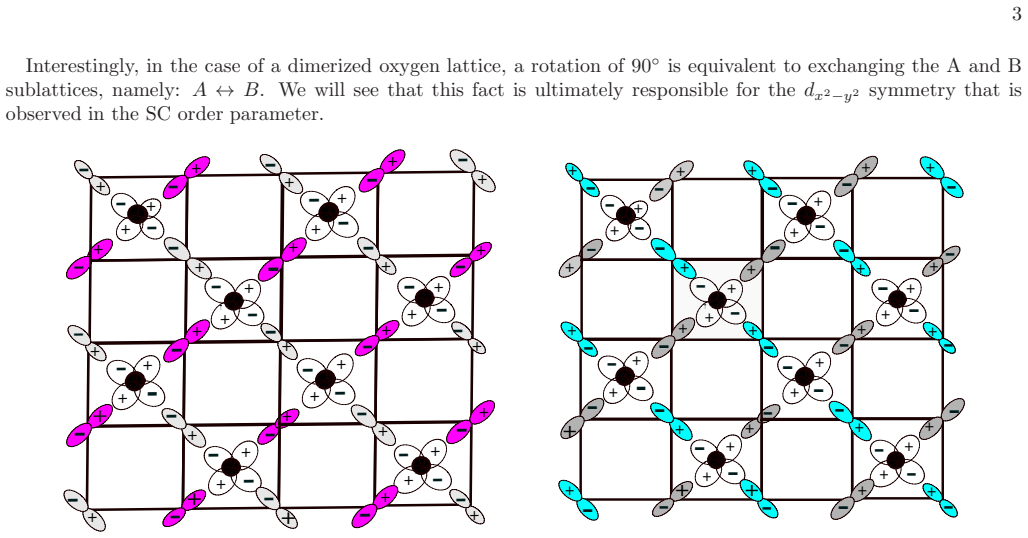
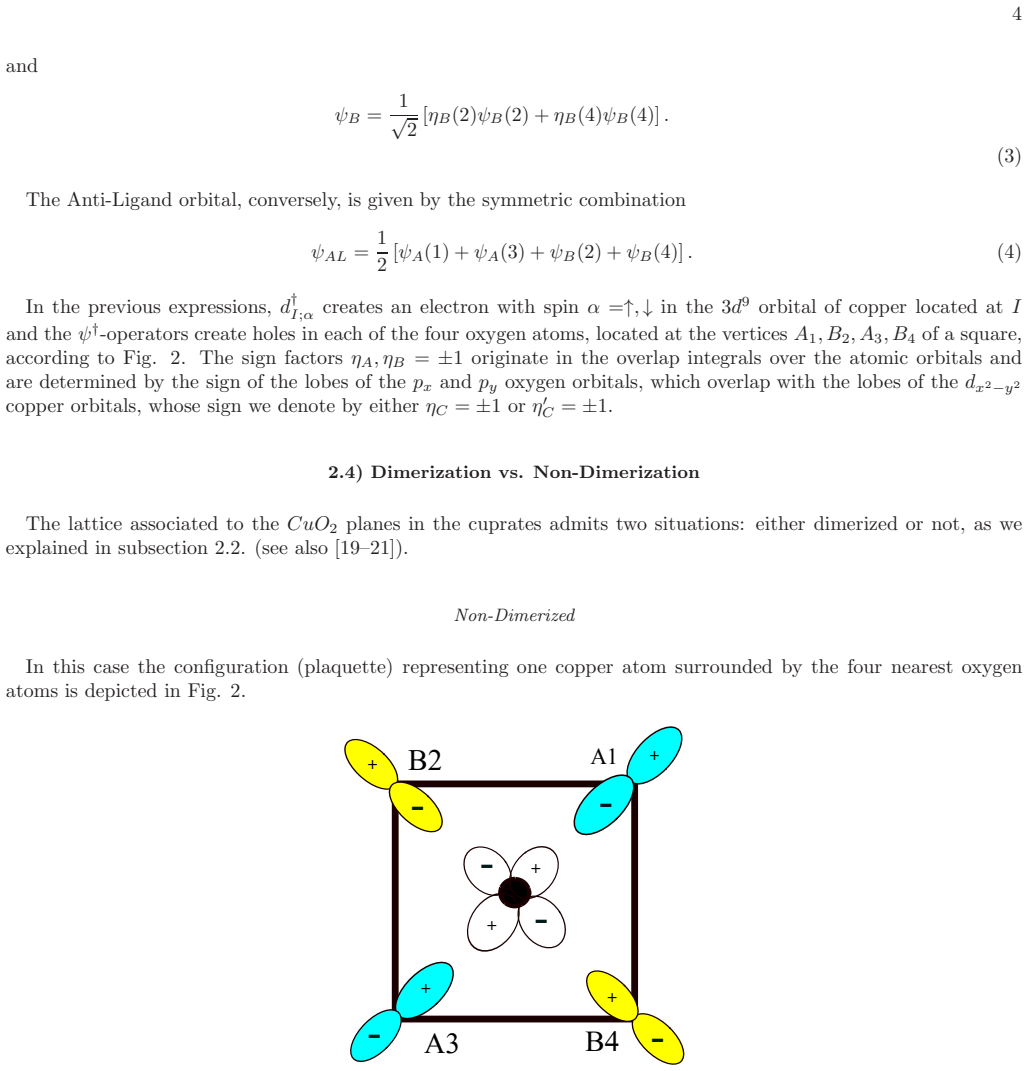
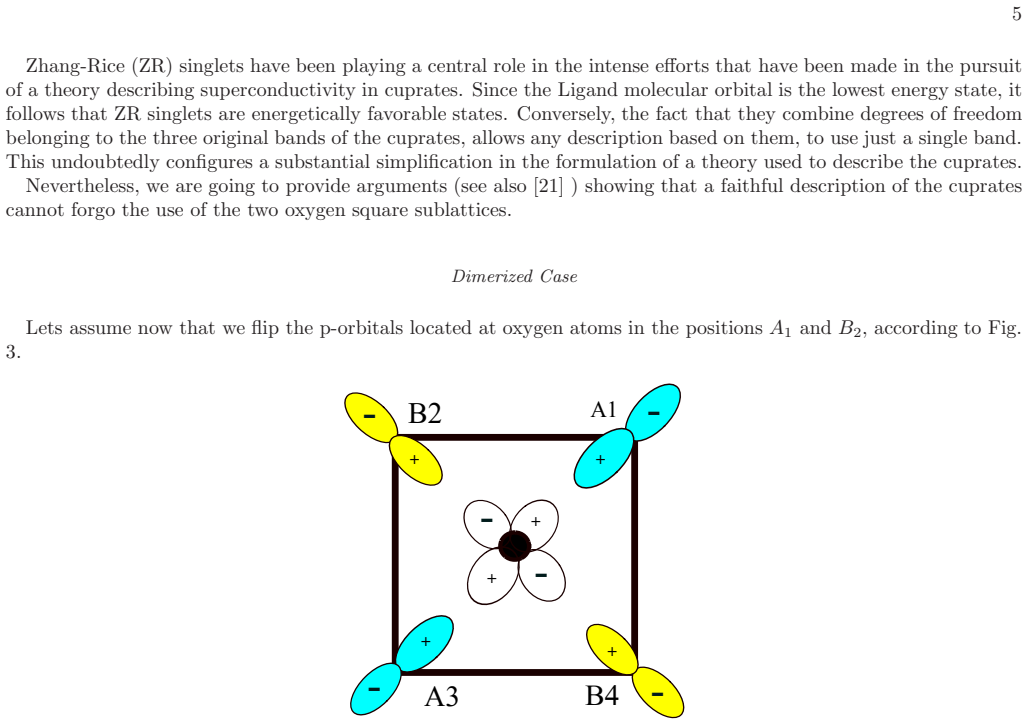
This relates the presence or not of a dimerization in the underlying lattice to the nature of the the lowest energy states. For the Zhang-Rice singlets to be the lowest energy state s produced by doping we need a non-dimerized lattice. Conversely, the occurrence of dimerization leads directly to a supe rconducting R VB-like state formed by a coherent arXi...
work page internal anchor Pith review Pith/arXiv arXiv 2026
-
[3]
THEOR Y 2.1) Microscopic degrees of freedom The formulation of a theory, meant to describe any given physical s ystem, necessarily starts from a judicious choice of the microscopic variables that will represent such a system at a m icroscopic level. In the case of the High-Tc cuprates, we assume these are analogous to the Spin-Fermion [15, 30] degrees of ...
-
[4]
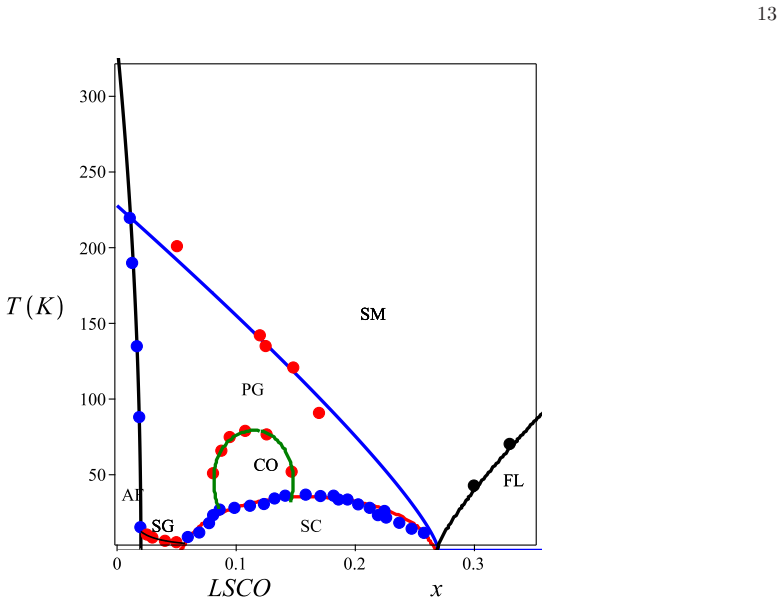
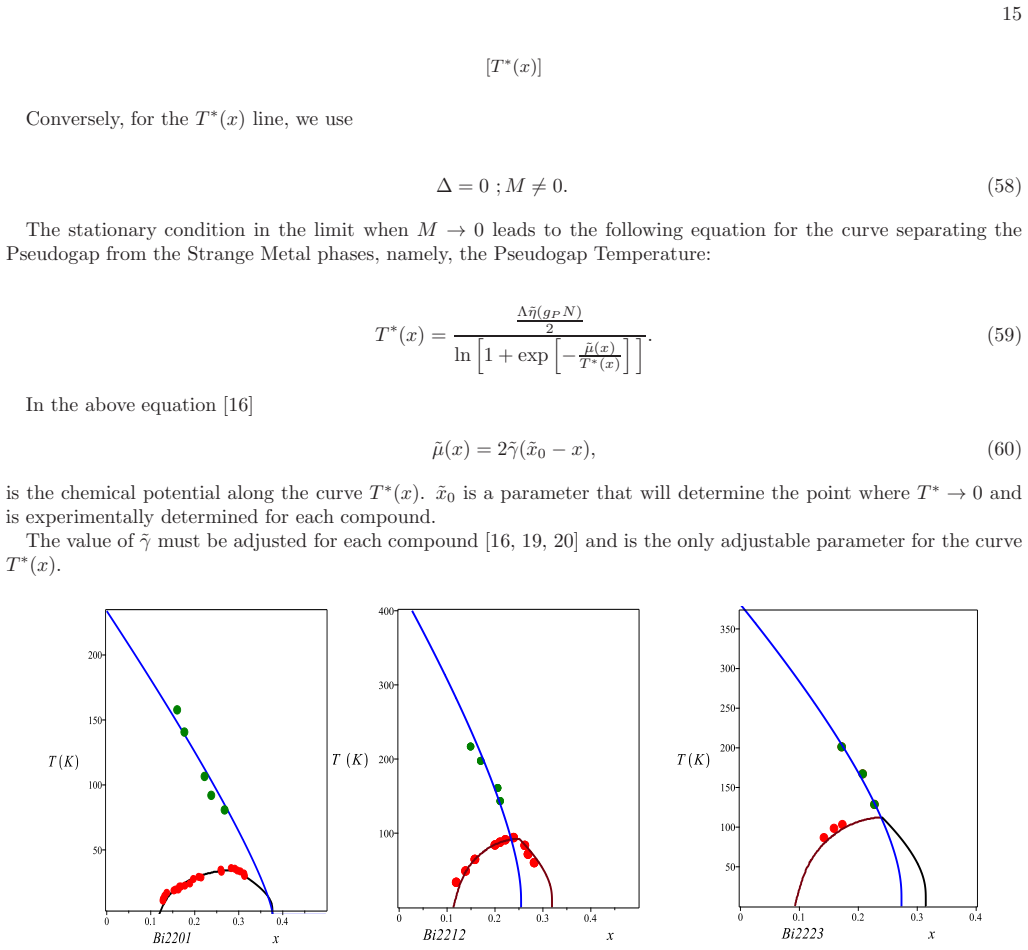
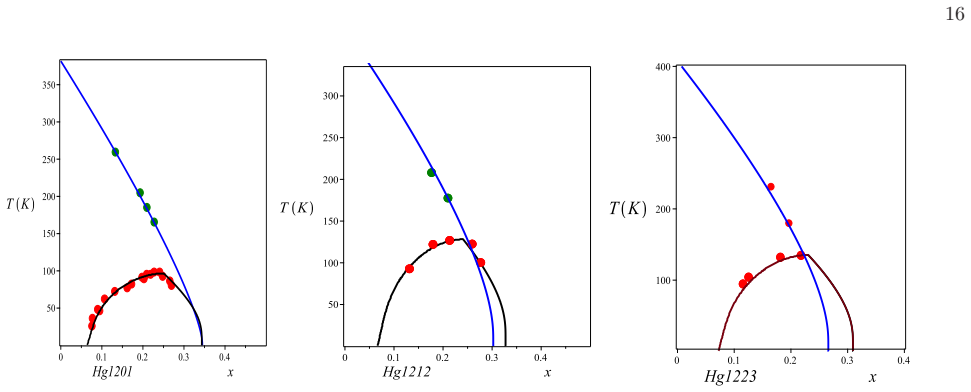
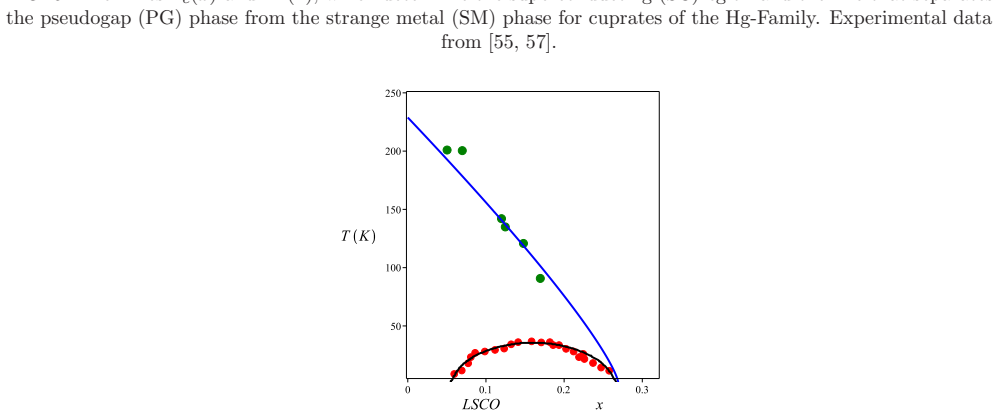
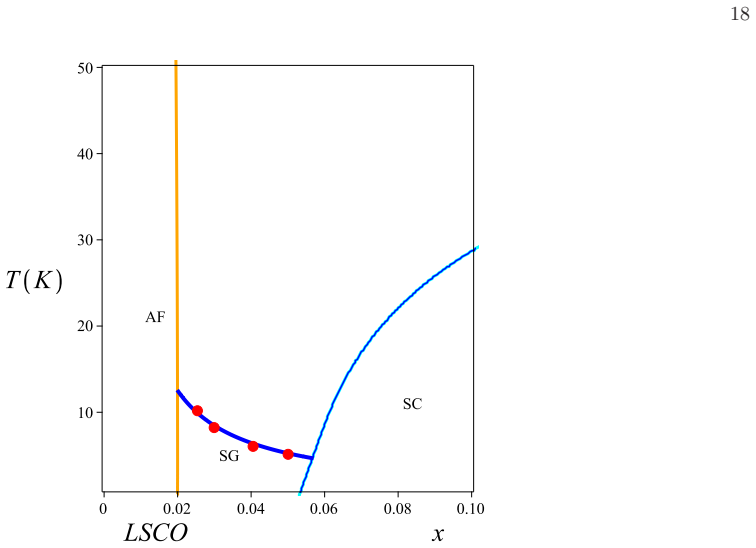
PHASE DIAGRAM Using the thermodynamic potentials found in the previous section, w e may determine the full T × x phase diagram of the hole-doped cuprates [21]. We show below a sample of this proce dure for the Tc(x) and T ∗(x) lines of this phase diagram and refer the reader to [21] for the complete result, exhib iting TNeel (x), TSpinGlass(x), TChargeOrd...
-
[5]
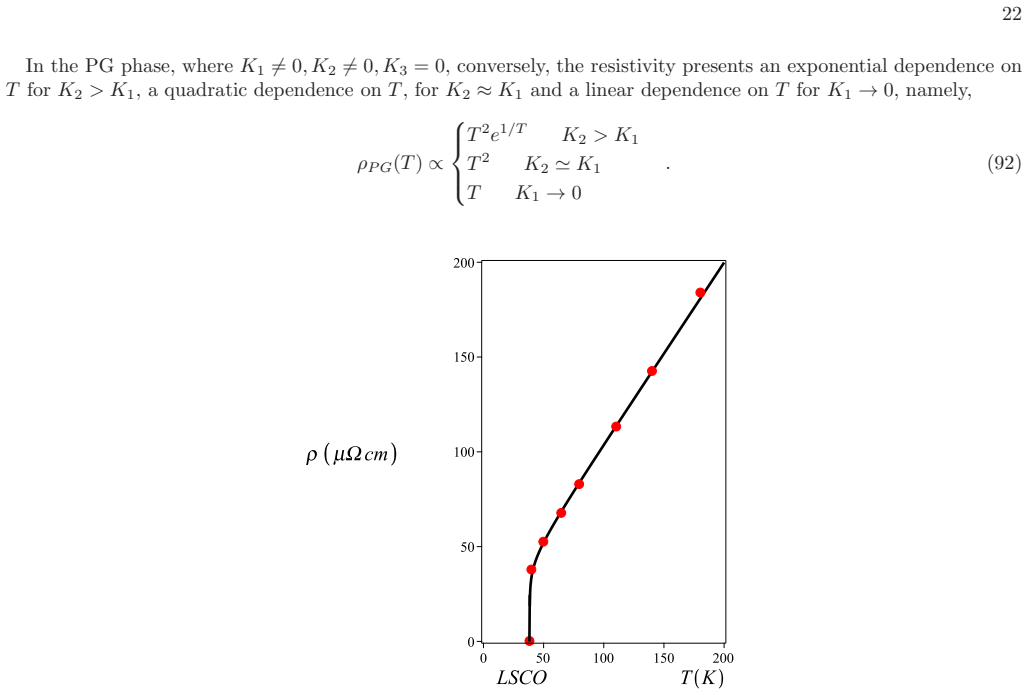
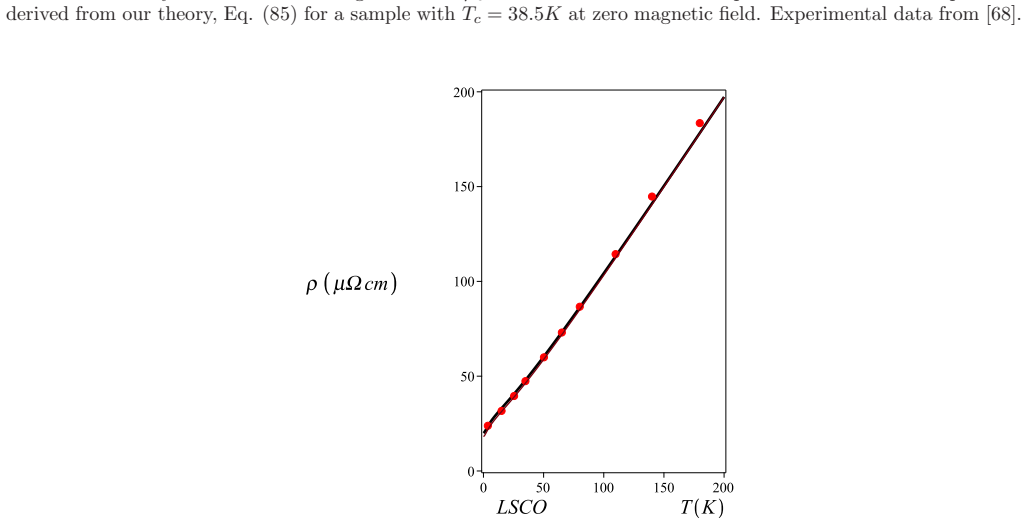
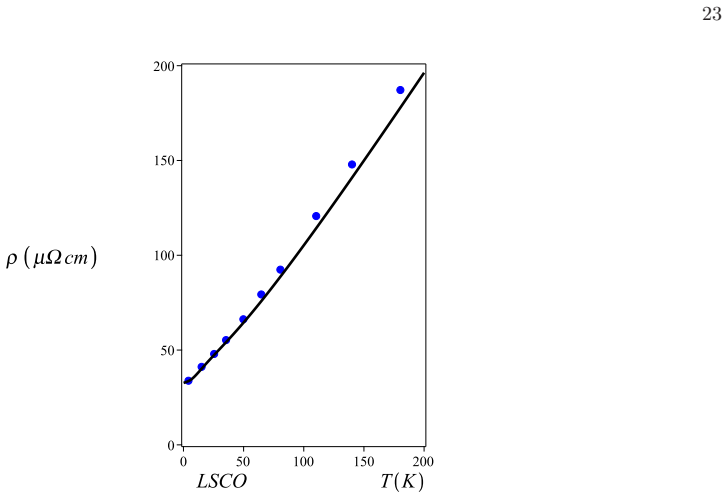
THE RESISTIVITY OF HIGH-TC CUPRATES We describe here how we can derive from our theory a general expr ession for the resistivity of the high-Tc cuprates, as well as the effects of an applied magnetic field on it [17, 18]. From the very outset, let us remark that, assuming the resistivity is produced by hole-exciton scattering, using a Drude formula approach...
-
[6]
Particularly interesting is the strange metal phase, where we have , both the SC and PG parameters vanishing: ∆ = 0 and M = 0
1 nΩcm/K 2.[17, 18]. Particularly interesting is the strange metal phase, where we have , both the SC and PG parameters vanishing: ∆ = 0 and M = 0. The chemical potential, conversely, scales with T , namely µ = DT , where D = 2. 69 eV/K [18]. Consequently, we will have K1 = 0, K2 =D/k B, K3 = µ Bµ 0H kBT . The general expression (88) implies the resistivi...
-
[7]
This should, in principle, influence the coupling parameter s gS = J 2 K 8JAF and gP = 2t2 U
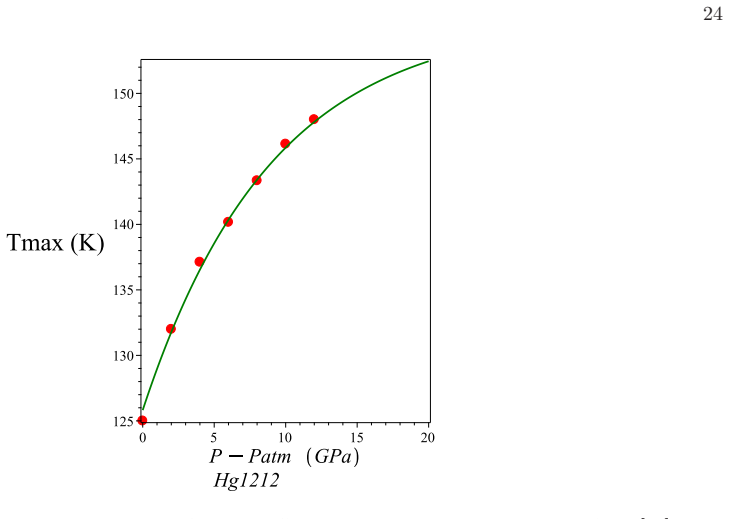
THE EFFECT OF AN EXTERNAL APPLIED PRESSURE ON THE PHASE DIA GRAM 5.1) Variation of Tmax with the External Pressure It is natural to expect that the overlap integrals JAF,J AF,U,t , will be modified under the action of an external pressure. This should, in principle, influence the coupling parameter s gS = J 2 K 8JAF and gP = 2t2 U . However, since U and J p...
-
[8]
The forme r provides the framework for Anderson’s R VB- Theory
CONCLUSION Two roads emerge from the simplifications that were obtained from t he 3BHM, respectively associated to the t-J Model, and to the Spin-Fermion-Hubbard Model (SFHM). The forme r provides the framework for Anderson’s R VB- Theory. In the framework of this theory, an effective ground-st ate |GS⟩, the R VB-state, was conjectured and it was shown to c...
2024
-
[9]
J. G. Bednorz and K. A. M¨ uller, Possible high-Tc superconductivity in the Ba-La-Cu-O syst em, Z. Phys. B64, 189 (1986)
1986
-
[10]
V. J. Emery, Theory of high- Tc superconductivity in oxides , Phys. Rev. Lett. 58, 2794 (1987)
1987
-
[11]
J. E. Hirsch, Antiferromagnetism, localization, and pairing in a two-di mensional model for CuO 2, Phys. Rev. Lett. 59, 228 (1987)
1987
-
[12]
Varma, S
C.M. Varma, S. Schmitt-Rink and E. Abrahams, Charge transfer excitations and superconductivity in “ion ic” metals Solid State Commun. 62, 681 (1987)
1987
-
[13]
R. T. Scalettar et al. , Antiferromagnetic, charge-transfer, and pairing correla tions in the three-band Hubbard model , Phys. Rev. B44, 770 (1991)
1991
-
[14]
Y. F. Kung et al. , Characterizing the three-orbital Hubbard model with deter minant quantum Monte Carlo. , Phys. Rev. B93.15: 155166 (2016)
2016
-
[15]
E. W. Huang et al. , Numerical evidence of fluctuating stripes in the normal stat e of high-Tc cuprate superconductors , Science 358, 1161 (2017)
2017
-
[16]
Macridin, Phonons, charge and spin in correlated systems
A. Macridin, Phonons, charge and spin in correlated systems. , Rijksuniversiteit Gr¨ oningen, The Netherlands, PhD Thes is (2003)
2003
-
[17]
Edegger, V
B. Edegger, V. N. Muthukumar and C. Gros, Gutzwiller-R VB theory of high-temperature superconducti vity: Results from renormalized mean-field theory and variational Monte Carlo calculations, Advances in Physics 56, 927 (2007)
2007
-
[18]
J. R. Schrieffer and P. A. Wolff, Relation between the Anderson and Kondo Hamiltonians , Phys. Rev. 149, 491 (1966)
1966
-
[19]
Bravyi, D
S. Bravyi, D. DiVincenzo and D. Loss, Schrieffer-Wolff transformation for quantum many-body syste ms Ann. of Phys. 326, 2793 (2011)
2011
-
[20]
K. A. Chao, J. Spalek and A. M. Ol´ es, Phys. Rev. B18, 3453 (1978) Canonical perturbation expansion of the Hubbard model
1978
-
[21]
D. I. Khomskii, Transition Metal Compounds Cambridge University Press, Cambridge, UK (2014)
2014
-
[22]
F. C. Zhang and T. M. Rice, Effective Hamiltonian for the superconducting Cu oxides , Phys. Rev. B37, 3759 (1988)
1988
-
[23]
J. Bala, A. Ol´ es and J. Zaanen, Quasiparticles in the Spin-Fermion Model for the CuO2 Planes Phys. Rev. B54, 10161 (1996)
1996
-
[24]
E. C. Marino, R. O. Corrˆ ea Jr, R. Arouca, L. H. C. M. Nunes , and V. S. Alves, Superconducting and Pseudogap Transition Temperatures in High-Tc Cuprates and the Tc Dependence on Pr essure, Supercond. Sci. and Tech. 33, 035009 (2020)
2020
-
[25]
Arouca and E
R. Arouca and E. C. Marino The resistivity of High-Tc Cuprates , Supercond. Sci. and Tech. 34, 035004 (2021)
2021
-
[26]
E. C. Marino and R. Arouca, Magnetic Field Effect on the transport properties of high-Tc C uprates, Supercond. Sci. and Tech. 34, 085008 (2021)
2021
-
[27]
E. C. Marino Three Studies in High-Tc Cuprates New Journal of Physics, 24, 063009 (2022)
2022
-
[28]
E. C. Marino A Testable Model for High-Tc Superconductivity in Cuprates SciPost Phys. Proc. 11 , 004 (2023) [SCES 2022 Amsterdam (Invited Talk)]
2023
-
[29]
E. C. Marino The Phase Diagram of High-Tc Cuprates , Physica B: Cond. Matt. 699, 416815 (2025)
2025
-
[30]
Ando et al
Y. Ando et al. Phys. Rev. B61, R14596 (2000)
2000
-
[31]
Takemura et al
T. Takemura et al. J. of Phys.: Cond. Matt. 12, 6199 (2000 )
2000
-
[32]
P. G. Radaelli, D. G. Hinks, A. W. Mitchell, B. A. Hunter, J. L. Wagner, B. Dabrowski, K. G. Vandervoort, H. K. Viswanathan and J. D. Jorgensen, Structural and superconducting properties of La2-xSrxCuO 4 as a function of Sr content , Phys. Rev. B 49, 4163 (1994)
1994
-
[33]
Eskes, L
H. Eskes, L. H. Tjeng and G. A. Sawatzky, Cluster-model calculation of the electronic structure of C uO: A model material for the high- Tc superconductors, Phys. Rev. B41, 288 (1990)
1990
-
[34]
Zaanen, G
J. Zaanen, G. A. Sawatzky and J. W. Allen, Band gaps and electronic structure of transition-metal com pounds, Phys. Rev. Lett. 55, 418 (1985)
1985
-
[35]
V. J. Emery and G. Reiter, Mechanism for high-temperature superconductivity , Phys. Rev. B38, 4547 (1988)
1988
-
[36]
C. M. Varma and S. Schmitt-Rink, Charge transfer excitations and superconductivity in ”ion ic” metals , Sol. St. Comm. 62, 681 (1987)
1987
-
[37]
Hansmann, N
P. Hansmann, N. Parragh, A. Toschi, G. Sangiovanni and K . Held, Importance of d-p Coulomb interactions for High-Tc cuprates and other oxides N. J. of Phys. 16, 033009 (2014)
2014
-
[38]
Zaanen and A
J. Zaanen and A. M. Ol´ es, Canonical perturbation theory and the two-band model for hi gh-Tc, superconductors, Phys. Rev. B37, 9423 (1988)
1988
-
[39]
P. W. Anderson, Resonating valence bonds: A new kind of insulator? , Materials Research Bulletin 8, 153 (1973); P. Fazekas and P. W. Anderson, On the ground state properties of the anisotropic triangula r antiferromagnet, Philosophical Magazine 30, 423 (1974)
1973
-
[40]
P. W. Anderson, The resonating valence bond state in La2CuO4 and superconductivity, Science 235, 1196 (1987)
1987
-
[41]
Baskaran, Z
G. Baskaran, Z. Zou and P. W. Anderson, The resonating-valence-bond state and high-Tc supercondu ctivity Solid State Commun. 63, 973 (1987)
1987
-
[42]
P. W. Anderson, G. Baskaran, Z. Zou, and T. Hsu, Resonating-valence-bond theory of phase transitions and s uperconductivity in La2CuO4-based compounds Phys. Rev. Lett. 58, 2790 (1987)
1987
-
[43]
D. S. Rokhsar and S. A. Kivelson, Superconductivity and the quantum-hard core dimer gas Phys. Rev. Lett. 61, 2376 (1988)
1988
-
[44]
S. A. Kivelson, D. S. Rokhsar, and J. P. Sethna, Topology of the resonating-valence-bond ground state: Sol itons and high 31 Tc superconductivity. Phys. Rev. B35, 8865 (1987)
1987
-
[45]
Plain Vanilla
P. W. Anderson, P. A. Lee, M. Randeria, T. M. Rice, N. Triv edi and F. C. Zhang, The Physics Behind High-Temperature Superconducting Cuprates: The “Plain Vanilla” Version Of R VB J Phys. Condens. Matter 16 (2004) R755
2004
-
[46]
N. P. Armitage, P. Fournier, and R. L. Greene, Progress and perspectives on electron-doped cuprates , Rev. Mod. Phys. 82, 2421 (2010)
2010
-
[47]
V. J. Emery, Electron doping tests theories Nature 337, 306 (1989)
1989
-
[48]
Yuxin Wang , Kun Jiang , Jianjun Ying , Tao Wu , Jinguang Ch eng , Jiangping Hu , Xianhui Chen Re- cent progress in nickelate superconductors National Science Review, Volume 12, Issue 10, October 2025, nwaf373, https://doi.org/10.1093/nsr/nwaf373
-
[49]
J. M. Tranquada, S. M. Heald and A. R. Moodenbaugh, X-ray-absorption near-edge-structure study of La2− x (Ba, Sr )x Cu O4− y superconductors Phys. Rev. B36, 5263(1987)
1987
-
[50]
J. M. Tranquada, S. M. Heald, A. R. Moodenbaugh, G. Liang and M. Croft, Nature of the charge carriers in electron-doped copper oxide superconductors Nature 337, 720 (1989)
1989
-
[51]
M. K. Chan, C. J. Dorow, L. Mangin-Thro, Y. Tang, Y. Ge, M. J. Veit, G. Yu, X. Zhao, A. D. Christianson, J. T. Park, Y. Sidis, P. Steffens, D. L. Abernathy, P. Bourges and M. Greven Commensurate antiferromagnetic excitations as a signatur e of the pseudogap in the tetragonal high-Tc cuprate HgBa 2CuO4+δ Nature Communications 7, 10819 (2016)
2016
-
[52]
Stilp, A
E. Stilp, A. Suter, T. Prokscha, E. Morenzoni, H. Keller , B. M. Wojek, H. Luetkens, A. Gozar, G. Logvenov, and I. Bozovic, Magnetic phase diagram of low-doped La2− xSrxCuO4 thin films studied by low-energy muon-spin rotation , Phys. Rev. B88, 064419 (2013)
2013
-
[53]
R. B. Laughlin, Anomalous Quantum Hall Effect: An Incompressible Quantum Flu id with Fractionally Charged Excitations , Phys. Rev. Lett. 50, 1395
-
[54]
E.C Marino, Quantum Field Theory Approach to Condensed Matter Physics , Cambridge University Press, Cambridge, UK (2017)
2017
-
[55]
Hucker, V
M. Hucker, V. Kataev, J. Pommer, U. Ammerhal, A. Revcole vschi, J. M. Tranquada, and B. Buchner, Phys. Rev. B70, 214515 (2004)
2004
-
[56]
Niedermayer, C
Ch. Niedermayer, C. Bernhard, T. Blasius, A. Golnik, A. Moodenbaugh, and J. I. Budnick, Common Phase Diagram for Antiferromagnetism in LSCO and YBCO as Seen by Muon Spin Rota tion, Phys. Rev. Lett. 80, 3843 (1998)
1998
-
[57]
Cyr-Choini` ere, R
O. Cyr-Choini` ere, R. Daou, F. Lalibert´ e, C. Colligno n, S. Badoux, D. LeBoeuf, J. Chang, B. J. Ramshaw, D. A. Bonn, W. N. Hardy, R. Liang, J.-Q. Yan, J.-G. Cheng, J.-S. Zhou, J. B . Goodenough, S. Pyon, T. Takayama, H. Takagi, N. Doiron-Leyraud, and Louis Taillefer, Pseudogap temperature T ∗ of cuprate superconductors from the Nernst effect Phys. Rev. ...
2018
-
[58]
J.-J. Wen, H. Huang, S.-J. Lee, H.Jang, J. Knight, Y.S. L ee, M. Fujita, K.M. Suzuki, S. Asano, S.A. Kivelson, C.-C. Kao1 and J.-S. Lee, Observation of two types of charge-density-wave orders in s uperconducting La2− xSrxCuO4 Nature Communications 10, 3269 (2019)
2019
-
[60]
Honma, P
T. Honma, P. H. Hor, H. H. Hsieh and M. Tanimoto, Phys. Rev . B70, 214517 (2004)
2004
-
[61]
Shimizu et al
S. Shimizu et al. Phys. Rev. B83, 214514 (2011)
2011
-
[62]
Cyr-Choini` ere, R
O. Cyr-Choini` ere, R. Daou, F. Lalibert´ e, C. Colligno n, S. Badoux, D. LeBoeuf, J. Chang, B. J. Ramshaw, D. A. Bonn, W. N. Hardy, R. Liang, J.-Q. Yan, J.-G. Cheng, J.-S. Zhou, J. B . Goodenough, S. Pyon, T. Takayama, H. Takagi, N. Doiron-Leyraud, and Louis Taillefer Pseudogap temperature T ∗ of cuprate superconductors from the Nernst effect , Phys. Rev....
2018
-
[63]
Yamamoto, W
A. Yamamoto, W. Z. Hu and S. Tajima, Thermoelectric power and resistivity of HgBa 2CuO4+δ over a wide doping range , Phys. Rev. B 63, 024504 (2000)
2000
-
[64]
J. A. Wilson and M. Farbod, A view of pseudogap formation and the HTSC mechanism from the perspective of Seebeck results on HgBa 2CuO4+δ Supercond. Sci. Tech. 13, 307 (2000)
2000
-
[65]
Fukuoka, A
A. Fukuoka, A. Tokiwa-Yamamoto, M. Itoh, R. Usami, S. Ad achi and K. Tanabe, Dependence of Tc and transport properties on the Cu valence in HgBa 2Ca n− 1Cu nO2(n+1)+δ (n=2,3) superconductors, Phys. Rev. B 55, 6612 (1997)
1997
-
[66]
Ando and T
Y. Ando and T. Murayama, Nonuniversal power law of the Hall scattering rate in a singl e-layer cuprate Bi2Sr2− xLaxCuO6 Phys. Rev. B 60, R6991 (1999)
1999
-
[67]
Akoshima, T
M. Akoshima, T. Noji, Y. Ono and Y. Koike, Anomalous suppression of superconductivity in Zn-substitu ted Bi2Sr2Ca 1− xYx(Cu 1− yZny)2O8+δ , Phys. Rev. B 57, 7491 (1998)
1998
-
[68]
Fujii, I
T. Fujii, I. Terasaki, T. Watanabe and A. Matsuda, Doping dependence of anisotropic resistivities in the tril ayered super- conductor Bi2Sr2Ca 2Cu 3O10+δ , Phys. Rev. B 66, 024507 (2002)
2002
-
[69]
von Arx, Q
K. von Arx, Q. Wang, S. Mustafi, D. G. Mazzone, M. Horio, D. Mukkattukavil, E. Pomjakushina, S. Pyon, T. Takayama, H. Takagi, T. Kurosawa, N. Momono, M. Oda, N. B. Brookes, D. Be tto, W. Zhang, T. C. Asmara, Y. Tseng, T. Schmitt, Y. Sassa and J. Chang, Fate of charge order in overdoped La-based cuprates , NPJ Quantum Materials 8, 7 2023
2023
-
[70]
Tabis, B
W. Tabis, B. Yu, I. Bialo, M. Bluschke, T. Kolodziej, A. K ozlowski, E. Blackburn, K. Sen, E. M. Forgan, M. v. Zimmerman n, Y. Tang, E. Weschke, B. Vignolle, M. Hepting, H. Gretarsson, R. Sutarto, F. He, M. Le Tacon, N. Barisic, G. Yu, and M. Greven Synchrotron x-ray scattering study of charge-density-wav e order in HgBa 2CuO4+δ Phys. Rev. B96, 134510 (2017)
2017
-
[71]
Tabis, Y
W. Tabis, Y. Li, M. Le Tacon, L. Braicovich, A. Kreyssig, M. Minola, G. Dellea, E. Weschke, M.J. Veit, M. Ramazanoglu, A.I. Goldman, T. Schmitt, G. Ghiringhelli, N. Barisic, M.K. Chan, C.J. Dorow, G. Yu , X. Zhao, B. Keimer and M. Greven Charge order and its connection with Fermi-liquid charge tr ansport in a pristine high-Tc cuprate Nature Commun. 5, 587...
2014
-
[72]
H. Miao, R. Fumagalli, M. Rossi, J. Lorenzana, G. Seibol d, F. Yakhou-Harris, K. Kummer, G. D. Gu, L. Braicovich, G. Ghiringhelli, and M. P. M. Dean, Formation of Incommensurate Charge Density Waves in Cuprat es Phys. Rev. X9, 031042 (2019)
2019
-
[73]
H. Miao, G. Fabbris, R. J. Koch, D. G. Mazzone, C. S. Nelso n, R. Acevedo-Esteves, G. D. Gu, Y. Li1, T. Yilimaz, K. Kaznatcheev, E. Vescovo, M. Oda, T. Kurosawa, N. Momono, T. A ssefa, I. K. Robinson, E. S. Bozin, J. M. Tranquada, P. D. Johnson and M. P. M. Dean, Charge density waves in cuprate superconductors beyond the critical doping NPJ Quantum Materi...
2021
-
[74]
Ayres, M
J. Ayres, M. Berben, M. Culo, Y-T. Hsu, Y-T. van Heumen ,Y -T. Huang, J. Zaanen, T. Kondo, T. Takeuchi, C. Cooper JR, S. Putzkel, S. Friedemann, T. Carrington and N. E. Hussey Incoherent transport across the strange metal regime of highly overdoped cuprates. Nature 595, 661 (2021)
2021
-
[75]
Nakamae, K
S. Nakamae, K. Behnia, N. Mangkorntong, M. Nohara, H. Ta kagi, S. J. C. Yates, and N. E. Hussey, Physical Review B 68, 100502 (2003)
2003
-
[76]
Giraldo-Gallo, Paula; Galvis, JA; Stegen, Zachary; Mo dic, A; Kimberly, A; Balakirev, FF; Betts, JB; Lian, Xiujun; Moir, Camilla; Riggs, SC; Wu, J; Bollinger,AT; He, X; Bozovic, I; R amshaw, BJ; McDonald, RD; Boebinger, GS; and Shekhter, A Scale-invariant magnetoresistance in a cuprate supercond uctor, Science 361, 479 (2018)
2018
-
[77]
Mahan, Many Particle Physics , Plenum, New York (2012)
G. Mahan, Many Particle Physics , Plenum, New York (2012)
2012
-
[78]
J.-J. Wen, H. Huang, S.-J. Lee, H.Jang, J. Knight, Y.S. L ee, M. Fujita, K.M. Suzuki, S. Asano, S.A. Kivelson, C.-C. Ka o1 and J.-S. Lee, Observation of two types of charge-density-wave orders in s uperconducting La2− xSrxCuO4
-
[79]
Murayama, Y
H. Murayama, Y. Sato, R. Kurihara, S. Kasahara, Y. Mizuk ami, Y. Kasahara, H. Uchiyama, A. Yamamoto, E.-G. Moon, J. Cai, J. Freyermuth, M. Greven, T. Shibauchi and Y. Ma tsuda Diagonal nematicity in the pseudogap phase of HgBa 2CuO4+δ , Nature Communications 10, 3282 (2019)
2019
-
[80]
and Tokura Y., High pressure effects revisited for the cuprate superconduct or family with highest critical temperature , Nature Communications 6, 8990 (2015)
Yamamoto A., Takeshita N., Terakura C. and Tokura Y., High pressure effects revisited for the cuprate superconduct or family with highest critical temperature , Nature Communications 6, 8990 (2015)
2015
-
[81]
E. C. Marino, A model for doping in high-temperature superconductors Phys. Lett. A263, 446 (1999)
1999
discussion (0)
Sign in with ORCID, Apple, or X to comment. Anyone can read and Pith papers without signing in.