Pinching-Antenna Enabled Multicell Wireless Systems
Pith reviewed 2026-06-27 06:01 UTC · model grok-4.3
The pith
Pinching-antenna systems maximize multi-cell weighted sum rate by jointly optimizing precoding, power allocation, and dynamic antenna placement.
A machine-rendered reading of the paper's core claim, the machinery that carries it, and where it could break.
Core claim
In multi-cell scenarios with inter-cell interference, the joint optimization of precoding, power allocation, and pinching antenna placement via alternating optimization and particle swarm search delivers higher weighted sum rates than fixed or conventional antenna systems by exploiting the additional spatial degrees of freedom from movable pinching elements.
What carries the argument
Alternating optimization framework that uses fractional programming to reformulate the objective, block coordinate descent for closed-form precoding and power updates, and particle swarm optimization for the nonconvex high-dimensional antenna placement subproblem.
Load-bearing premise
Particle swarm optimization can consistently locate high-quality antenna placements in the nonconvex high-dimensional space without excessive computation time or convergence to poor local solutions.
What would settle it
A simulation run in which the particle swarm optimizer returns antenna placements whose achieved weighted sum rate is no higher than that of fixed placement under the same precoding and power allocation would falsify the claimed performance advantage.
Figures
read the original abstract
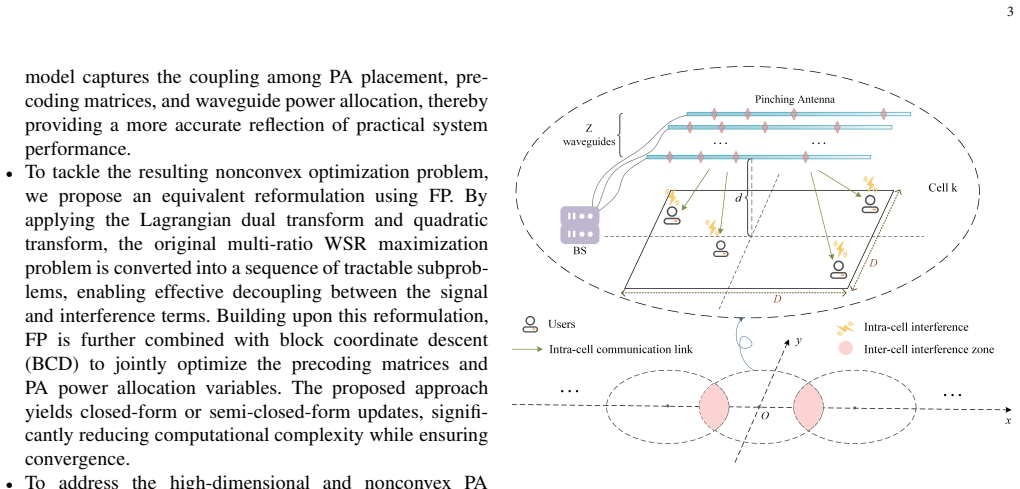
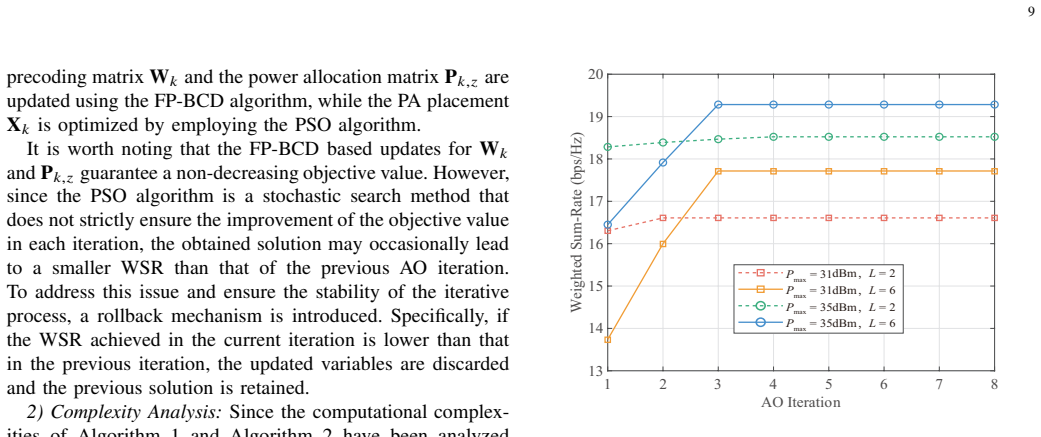
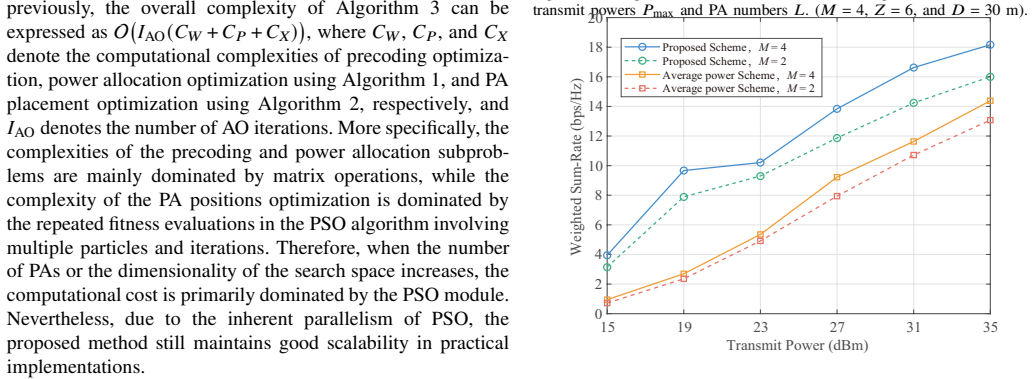
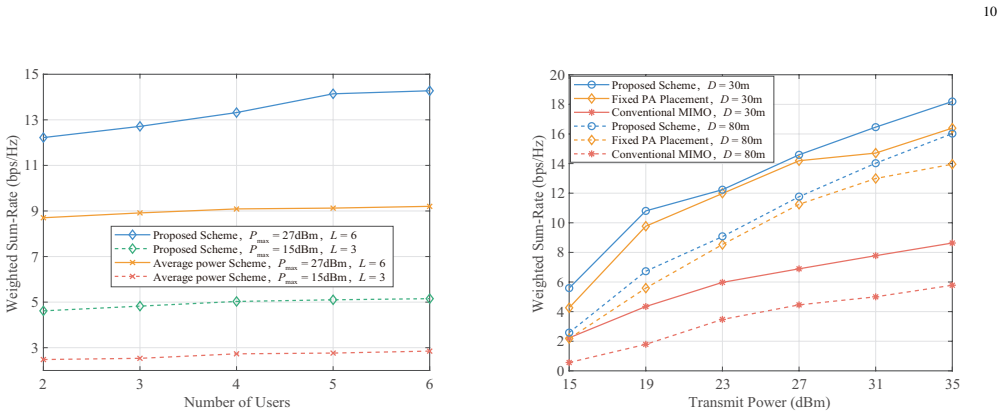
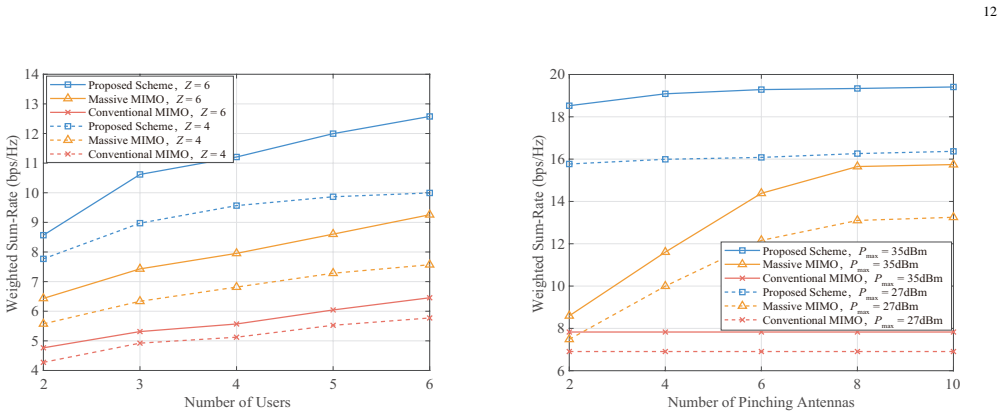
Pinching antenna (PA) systems have recently emerged as a promising flexible-antenna technology, which can reconstruct the wireless propagation environment by dynamically adjusting the positions of pinching elements along dielectric waveguides, thereby providing new spatial degrees of freedom (DoFs) for enhancing wireless system performance. This paper investigates a multi-waveguide PA-based multi-cell communication system, focusing on the joint optimization of precoding matrices, waveguide power allocation, and antenna placement to maximize the weighted sum rate (WSR). In multi-cell scenarios, inter-cell interference typically leads to a highly coupled and nonconvex WSR maximization problem. To address this challenge, an efficient alternating optimization framework is adopted to optimize each variable in an iterative way. Specifically, fractional programming is first employed to reformulate the original problem by introducing auxiliary variables that decouple the signal and interference terms. Based on this reformulation, block coordinate descent is then applied to optimize the precoding matrices and power allocation, leading to closed-form or semi-closed-form updates. For the high-dimensional and nonconvex PA placement problem, particle swarm optimization (PSO) is utilized to perform an efficient search and improve scalability. Numerical results demonstrate that, under various system configurations, the proposed scheme significantly outperforms baseline methods, including average power allocation, fixed antenna placement, conventional multiple-input multiple-output (MIMO), and massive MIMO. These results highlight the strong potential of PA systems for large-scale multi-cell wireless communications.
Editorial analysis
A structured set of objections, weighed in public.
Referee Report
Summary. The paper studies a multi-waveguide pinching-antenna (PA) multicell system and proposes an alternating-optimization framework to maximize weighted sum rate. Fractional programming is used to decouple signal and interference terms, block coordinate descent yields closed-form or semi-closed-form updates for the precoding matrices and waveguide power allocation, and particle swarm optimization is applied to the high-dimensional nonconvex PA placement subproblem. The central claim, supported only by the abstract, is that the resulting scheme significantly outperforms baselines including average power allocation, fixed antenna placement, conventional MIMO, and massive MIMO under various system configurations.
Significance. If the numerical gains can be shown to be robust to the heuristic nature of the placement step, the work would demonstrate that PA technology supplies additional spatial degrees of freedom capable of mitigating inter-cell interference, thereby extending the applicability of flexible-antenna architectures to large-scale multicell networks.
major comments (2)
- [Abstract] Abstract: the claim that the proposed scheme 'significantly outperforms' the listed baselines supplies no numerical values, error bars, baseline definitions, or channel-model parameters, so the magnitude and statistical reliability of the reported WSR gains cannot be assessed from the provided text.
- [Optimization framework] Optimization framework (PA placement paragraph): PSO is invoked for the explicitly nonconvex, high-dimensional placement subproblem without any convergence analysis, multiple independent runs with varied initializations, or comparison to alternative global or local solvers; because the FP+BCD blocks admit closed-form updates once positions are fixed, the headline performance advantage is entirely load-bearing on the quality of the PSO solutions.
minor comments (1)
- [Abstract] The abstract would be clearer if it stated the number of cells, waveguides per cell, and the precise channel model (e.g., path-loss exponent, Rician factor) used to generate the numerical results.
Simulated Author's Rebuttal
We thank the referee for the constructive comments, which help improve the clarity and rigor of our work. We address each major comment below and will revise the manuscript accordingly.
read point-by-point responses
-
Referee: [Abstract] Abstract: the claim that the proposed scheme 'significantly outperforms' the listed baselines supplies no numerical values, error bars, baseline definitions, or channel-model parameters, so the magnitude and statistical reliability of the reported WSR gains cannot be assessed from the provided text.
Authors: We agree that the abstract, as a high-level summary, does not include specific numerical values or parameters. The detailed simulation results, including WSR gains, baseline definitions, channel models, and figures with performance comparisons, are provided in the Numerical Results section. To address this concern, we will revise the abstract to incorporate concise quantitative statements (e.g., approximate percentage improvements in WSR under the considered configurations) while maintaining brevity. revision: yes
-
Referee: [Optimization framework] Optimization framework (PA placement paragraph): PSO is invoked for the explicitly nonconvex, high-dimensional placement subproblem without any convergence analysis, multiple independent runs with varied initializations, or comparison to alternative global or local solvers; because the FP+BCD blocks admit closed-form updates once positions are fixed, the headline performance advantage is entirely load-bearing on the quality of the PSO solutions.
Authors: We acknowledge that the current manuscript does not include convergence analysis, results from multiple independent PSO runs, or comparisons to alternative solvers for the PA placement subproblem. This is a valid point, as the overall gains depend on the effectiveness of the placement optimization. In the revision, we will add a discussion of observed PSO convergence behavior, statistics from multiple runs with varied initializations to demonstrate solution consistency, and a limited comparison against another heuristic (e.g., genetic algorithm) on representative scenarios. revision: yes
Circularity Check
No circularity; standard alternating optimization with external heuristic yields independent numerical claims.
full rationale
The paper's core chain is an alternating optimization: fractional programming reformulation of WSR, followed by BCD yielding closed-form updates for precoding and power allocation, plus PSO as a black-box search heuristic for the nonconvex placement subproblem. None of these steps define the claimed WSR gains in terms of themselves, rename fitted quantities as predictions, or rely on self-citations for uniqueness or ansatz. Numerical outperformance is reported from explicit simulation runs against external baselines; the results are not forced by construction from the objective or from prior author work. This is the typical self-contained case for algorithmic papers.
Axiom & Free-Parameter Ledger
Reference graph
Works this paper leans on
-
[1]
Reconfigurable intelligent surfaces for energy ef ficiency in wireless communication,
C. Huang, A. Zappone, G. C. Alexandropoulos, M. Debbah, a nd C. Y uen, “Reconfigurable intelligent surfaces for energy ef ficiency in wireless communication,” IEEE Trans. Wireless Commun., vol. 18, no. 8, pp. 4157–4170, Aug. 2019
2019
-
[2]
Towards smart and reconfigurable envi ronment: Intelligent reflecting surface aided wireless network,
Q. Wu and R. Zhang, “Towards smart and reconfigurable envi ronment: Intelligent reflecting surface aided wireless network,” IEEE Commun. Mag., vol. 58, no. 1, pp. 106–112, Jan. 2020
2020
-
[3]
Fl uid antenna systems,
K.-K. Wong, A. Shojaeifard, K.-F. Tong, and Y . Zhang, “Fl uid antenna systems,” IEEE Trans. Wireless Commun., vol. 20, no. 3, pp. 1950–1962, Mar. 2021
1950
-
[4]
A tutorial on fluid antenna system for 6G ne tworks: En- compassing communication theory, optimization methods an d hardware designs,
W. K. N. et al., “A tutorial on fluid antenna system for 6G ne tworks: En- compassing communication theory, optimization methods an d hardware designs,” IEEE Commun. Surv. Tutor . , vol. 27, no. 4, pp. 2325–2377, Aug. 2025
2025
-
[5]
Movable antennas for wireles s commu- nication: Opportunities and challenges,
L. Zhu, W. Ma, and R. Zhang, “Movable antennas for wireles s commu- nication: Opportunities and challenges,” IEEE Commun. Mag. , vol. 62, no. 6, pp. 114–120, Jun. 2024
2024
-
[6]
MIMO capacity characterizat ion for movable antenna systems,
W. Ma, L. Zhu, and R. Zhang, “MIMO capacity characterizat ion for movable antenna systems,” IEEE Trans. Wireless Commun. , vol. 23, no. 4, pp. 6234–6250, Apr. 2024
2024
-
[7]
Pinc hing- antenna systems (PASS)-enabled secure wireless communica tions,
G. Zhu, X. Mu, L. Guo, S. Xu, Y . Liu, and N. Al-Dhahir, “Pinc hing- antenna systems (PASS)-enabled secure wireless communica tions,” IEEE Trans. Commun. , vol. 74, pp. 490–505, 2026
2026
-
[8]
Pinch ing- antenna systems: Architecture designs, opportunities, an d outlook,
Y . Liu, Z. Wang, X. Mu, C. Ouyang, X. Xu, and Z. Ding, “Pinch ing- antenna systems: Architecture designs, opportunities, an d outlook,” IEEE Commun. Mag. , vol. 64, no. 1, pp. 190–196, Jan. 2026
2026
-
[9]
Pinch ing-antenna systems (PASS): A tutorial,
Y . Liu, H. Jiang, X. Xu, Z. Wang, J. Guo, C. Ouyang, X. Mu, Z. Ding, A. Nallanathan, G. K. Karagiannidis, and R. Schober, “Pinch ing-antenna systems (PASS): A tutorial,” IEEE Trans. Commun. , vol. 74, pp. 4881– 4918, 2026
2026
-
[10]
Pinching antenna: Using a dielectric waveguide as an anten na,
A. Fukuda, H. Y amamoto, H. Okazaki, Y . Suzuki, and K. Kaw ai, “Pinching antenna: Using a dielectric waveguide as an anten na,” NTT DOCOMO Tech. J. , vol. 23, no. 3, pp. 5–12, Jan. 2022
2022
-
[11]
Flexible-ant enna systems: A pinching-antenna perspective,
Z. Ding, R. Schober, and H. Vincent Poor, “Flexible-ant enna systems: A pinching-antenna perspective,” IEEE Trans. Commun. , vol. 73, no. 10, pp. 9236–9253, Oct. 2025
2025
-
[12]
Toward flexible and intelligent indo or NFC: The role of pinching antennas in 6G networks,
X. Fan and L. Peng, “Toward flexible and intelligent indo or NFC: The role of pinching antennas in 6G networks,” IEEE Netw., vol. 39, no. 6, pp. 70–77, Nov. 2025
2025
-
[13]
Capacit y character- ization of pinching-antenna systems,
C. Ouyang, Z. Wang, Y . Liu, H. Shin, and Z. Ding, “Capacit y character- ization of pinching-antenna systems,” IEEE Trans. Wireless Commun. , vol. 25, pp. 10 387–10 404, 2026
2026
-
[14]
Wirel ess powered MEC systems via discrete pinching antennas: TDMA versus NOM A,
P . Liu, Z. Fei, M. Hua, G. Chen, X. Wang, and R. Liu, “Wirel ess powered MEC systems via discrete pinching antennas: TDMA versus NOM A,” IEEE Trans. Wireless Commun. , vol. 25, pp. 12 034–12 049, 2026
2026
-
[15]
Rate optim ization for downlink URLLC via pinching antenna arrays,
T. Lin, J. Zhu, W. Huang, M. Hua, and Z. Zhang, “Rate optim ization for downlink URLLC via pinching antenna arrays,” IEEE Trans. V eh. Technol., early access, Mar. 2, 2026, doi: 10.1109/TVT.2026.366895 2
-
[16]
Array gain for pi nching- antenna systems (PASS),
C. Ouyang, Z. Wang, Y . Liu, and Z. Ding, “Array gain for pi nching- antenna systems (PASS),” IEEE Commun. Lett., vol. 29, no. 6, pp. 1471– 1475, Jun. 2025
2025
-
[17]
How m any pinching antennas are enough?
D. Tyrovolas, S. A. Tegos, Y . Xiao, P . D. Diamantoulakis , S. Ioannidis, C. K. Liaskos, G. K. Karagiannidis, and S. D. Asimonis, “How m any pinching antennas are enough?” IEEE Internet of Things J. , early access, Feb. 26, 2026, doi: 10.1109/JIOT.2026.3668307
-
[18]
Antenna activation fo r NOMA as- sisted pinching-antenna systems,
K. Wang, Z. Ding, and R. Schober, “Antenna activation fo r NOMA as- sisted pinching-antenna systems,” IEEE Wireless Commun. Lett., vol. 14, no. 5, pp. 1526–1530, May 2025
2025
-
[19]
Rate maximizat ion for downlink pinching-antenna systems,
Y . Xu, Z. Ding, and G. K. Karagiannidis, “Rate maximizat ion for downlink pinching-antenna systems,” IEEE Wireless Commun. Lett. , vol. 14, no. 5, pp. 1431–1435, May 2025
2025
-
[20]
Dynamic placemen t of pinching antennas for multicast MU-MISO downlinks,
J.-C. Chen, P .-C. Wu, and K.-K. Wong, “Dynamic placemen t of pinching antennas for multicast MU-MISO downlinks,” IEEE Open J. Commun. Soc., vol. 6, pp. 5611–5625, 2025
2025
-
[21]
Pinching antenna placement for LMMSE- based detection in MU-MISO uplink systems,
J.-C. Chen and T.-Y . Chao, “Pinching antenna placement for LMMSE- based detection in MU-MISO uplink systems,” IEEE Wireless Commun. Lett., vol. 15, pp. 650–654, 2026
2026
-
[22]
Exploiting pinchi ng-antenna systems in multicast communications,
S. Shan, C. Ouyang, Y . Li, and Y . Liu, “Exploiting pinchi ng-antenna systems in multicast communications,” IEEE Trans. Commun. , vol. 74, pp. 419–432, 2026
2026
-
[23]
MIMO-PASS: Uplink and downlink transmission via MIMO pinc hing- antenna systems,
A. Bereyhi, C. Ouyang, S. Asaad, Z. Ding, and H. Vincent P oor, “MIMO-PASS: Uplink and downlink transmission via MIMO pinc hing- antenna systems,” IEEE Trans. Commun., vol. 74, pp. 5701–5716, 2026
2026
-
[24]
Multiuser beamform ing for pinching-antenna systems: An element-wise optimization f ramework,
M. Sun, C. Ouyang, S. Wu, and Y . Liu, “Multiuser beamform ing for pinching-antenna systems: An element-wise optimization f ramework,” IEEE Trans. Wireless Commun. , vol. 25, pp. 6538–6552, Aug. 2026
2026
-
[25]
A gradient meta-learning joint optimization for beamformin g and antenna position in pinching-antenna systems,
K. Zhou, W. Zhou, D. Cai, X. Lei, Y . Xu, Z. Ding, and P . Fan, “A gradient meta-learning joint optimization for beamformin g and antenna position in pinching-antenna systems,” IEEE Trans. Commun. , vol. 74, pp. 1099–1112, Feb. 2026
2026
-
[26]
MIMO p inching- antenna-aided SWIPT,
H. Li, Z. Lyu, Y . Gao, M. Xiao, and H. Vincent Poor, “MIMO p inching- antenna-aided SWIPT,” IEEE Wireless Commun. Lett. , vol. 15, pp. 41– 45, 2026
2026
-
[27]
QoS-aware NOMA des ign for downlink pinching-antenna systems,
Y . Xu, Z. Ding, D. Cai, and V . W. Wong, “QoS-aware NOMA des ign for downlink pinching-antenna systems,” IEEE Trans. Commun., vol. 73, no. 12, pp. 13 611–13 625, Dec. 2025
2025
-
[28]
Robust resource allocation for pinching-antenna sy stems under user location uncertainty,
M. Zeng, X. Wang, Y . Liu, Z. Ding, G. K. Karagiannidis, an d H. V . Poor, “Robust resource allocation for pinching-antenna sy stems under user location uncertainty,” IEEE Trans. V eh. Technol., early access, Jan. 12, 2026, doi: 10.1109/TVT.2026.3651617
-
[29]
Computation capacity maximization for pinching antennas-assisted wireless pow ered MEC systems,
P . Liu, M. Hua, G. Chen, X. Wang, and Z. Fei, “Computation capacity maximization for pinching antennas-assisted wireless pow ered MEC systems,” in Proc. IEEE 102nd V eh. Technol. Conf. (VTC2025-Fall) , Chengdu, China, Oct. 2025, pp. 1–6
2025
-
[30]
Pinchi ng-antenna systems (PASS): Power radiation model and optimal beamform ing design,
X. Xu, X. Mu, Z. Wang, Y . Liu, and A. Nallanathan, “Pinchi ng-antenna systems (PASS): Power radiation model and optimal beamform ing design,” IEEE Trans. Commun. , vol. 74, pp. 2160–2175, 2026
2026
-
[31]
Joint beamformin g for NOMA assisted pinching antenna systems (PASS),
D. Gan, X. Xu, J. Zuo, X. Ge, and Y . Liu, “Joint beamformin g for NOMA assisted pinching antenna systems (PASS),” IEEE Trans. Commun., vol. 74, pp. 2450–2465, 2026
2026
-
[32]
A stochastic g eometric analysis on multi-cell pinching-antenna systems under blo ckage effect,
Y . Sun, Z. Ding, and G. K. Karagiannidis, “A stochastic g eometric analysis on multi-cell pinching-antenna systems under blo ckage effect,” IEEE Commun. Lett. , vol. 15, pp. 1085–1089, 2026
2026
-
[33]
Robust linear precode r design for multi-cell downlink transmission,
A. Tajer, N. Prasad, and X. Wang, “Robust linear precode r design for multi-cell downlink transmission,” IEEE Trans. Signal Process. , vol. 59, no. 1, pp. 235–251, Jan. 2011
2011
-
[34]
Interferen ce mitigation in multi-cell ISAC systems: A three-dimensional MIMO preco ding approach,
Z. Wang, C. Xiao, X. Liu, M. Peng, and J. Guo, “Interferen ce mitigation in multi-cell ISAC systems: A three-dimensional MIMO preco ding approach,” IEEE Commun. Lett. , vol. 28, no. 11, pp. 2543–2547, Nov. 2024
2024
-
[35]
Pr ecoding for multi-cell ISAC: From coordinated beamforming to coordina ted multi- point and bi-static sensing,
N. Babu, C. Masouros, C. B. Papadias, and Y . C. Eldar, “Pr ecoding for multi-cell ISAC: From coordinated beamforming to coordina ted multi- point and bi-static sensing,” IEEE Trans. Wireless Commun. , vol. 23, no. 10, pp. 14 637–14 651, Oct. 2024
2024
-
[36]
Fractional programming for communic ation systems-part I: Power control and beamforming,
K. Shen and W. Y u, “Fractional programming for communic ation systems-part I: Power control and beamforming,” IEEE Trans. Signal Process., vol. 66, no. 10, pp. 2616–2630, May 2018
2018
-
[37]
Fractional programming for communication system s part II: Uplink scheduling via matching,
——, “Fractional programming for communication system s part II: Uplink scheduling via matching,” IEEE Trans. Signal Process. , vol. 66, no. 10, pp. 2631–2644, May 2018
2018
-
[38]
The particle swarm - explosion , stability, and convergence in a multidimensional complex space,
M. Clerc and J. Kennedy, “The particle swarm - explosion , stability, and convergence in a multidimensional complex space,” IEEE Trans. Evol. Comput., vol. 6, no. 1, pp. 58–73, Feb. 2002. 14
2002
-
[39]
Comprehe nsive learning particle swarm optimizer for global optimization of multim odal func- tions,
J. Liang, A. Qin, P . Suganthan, and S. Baskar, “Comprehe nsive learning particle swarm optimizer for global optimization of multim odal func- tions,” IEEE Trans. Evol. Comput. , vol. 10, no. 3, pp. 281–295, Jun. 2006
2006
-
[40]
Beam focusing for near-field multiuser MIMO communi cations,
H. Zhang, N. Shlezinger, F. Guidi, D. Dardari, M. F. Iman i, and Y . C. Eldar, “Beam focusing for near-field multiuser MIMO communi cations,” IEEE Trans. Wireless Commun. , vol. 21, no. 9, pp. 7476–7490, Sep. 2022
2022
-
[41]
Resource alloc ation for multi-waveguide pinching antenna-assisted broadcast net works,
R. Zhao, S. Hu, D. Mishra, and D. W. K. Ng, “Resource alloc ation for multi-waveguide pinching antenna-assisted broadcast net works,” 2025, arXiv:2507.03915
arXiv 2025
discussion (0)
Sign in with ORCID, Apple, or X to comment. Anyone can read and Pith papers without signing in.