REVIEW 4 major objections 7 minor 41 references
CookVoice: Unified Framework for Style Controllable Multi-Modal Human Voice Generation
T0 review · 4 major / 7 minor · reviewed 2026-08-16 · deepseek-v4-flash
Pith's one-line read CookVoice claims a single non-autoregressive model with frame-level alignment can generate both speech and singing voice, matching larger baselines on quality while exceeding them on style and prosody control.
desk verdict A practical unified TTS/singing framework with real efficiency gains, but its style-controllability lead rests on an in-house metric that needs independent verification. read the letter →
The pith
A machine-rendered reading of the paper's core claim, the machinery that carries it, and where it could break.
The reading
What carries the argument
The central mechanism is a flexible frame-level alignment strategy. Phoneme durations, discrete prosody tokens, style embeddings, and a continuous F0 contour are each expanded or projected so that every control signal is represented as a sequence of length $T$, the same number of frames as the target latent spectrogram; the expanded style, content, and prosody tensors are concatenated along the feature dimension into a conditioning tensor $C \in \mathbb{R}^{3D \times T}$ that a flow-matching DiT (a transformer trained to regress the vector field carrying Gaussian noise to the target latent audio) uses as cross-attention conditioning to regress the vector field $Y_1 - Y_0$. Task differences reduce to duration-expansion rules, learned or predicted for speech and score-derived for singing, and to a training-time condition-switching scheme that randomly samples style from text or voice and prosody from discrete tokens or continuous F0, so no task-specific heads or objectives are required. The prosody encoder removes the voice-level mean from F0, so the explicit contour carries only relative melody, avoiding entanglement with the style embedding.
What would settle it
Re-score the same generated samples with human style-similarity ratings or with an independently trained style encoder; if CookVoice's roughly 16-percentage-point TTS and 7-percentage-point TTSV S-SIM lead over the strongest baselines shrinks or reverses, the frame-level controllability advantage is not established.
Extended reading notes
Core claim
CookVoice's central claim is that frame-level alignment, not model scale or autoregressive decoding, is what enables precise style and prosody control across speech and singing. The model decomposes a voice into content (phonemes), prosody (lexical tones, stresses, MIDI notes, or a reference F0 contour), and style (text prompt or reference voice), expands each control signal to the acoustic frame length, concatenates them, and feeds the result to a flow-matching diffusion transformer that generates a latent acoustic embedding. Because the same conditioning machinery serves every task, text-to-speech, text-to-singing, style-controllable generation, voice mimicry, voice conversion, and voice editing are all just different combinations of the same three factors. In the reported evaluations, the best configurations reach style similarity of 91.65% for TTS and 95.00% for TTSV, F0 correlation of 0.7102 and 0.8425, and MOS of 3.98 for TTS and 3.40 for TTSV, with 43.51M parameters and real-time inference.
Load-bearing premise
The controllability claims rest on a style-similarity metric computed by a single pre-trained style encoder; if that encoder is biased toward this model's own conditioning design, the reported advantage over the baselines would not hold under an independent measure.
Editorial extensions
If this is right
- A single 43.51M-parameter model can cover TTS, text-to-singing, style-controllable generation, voice mimicry, voice conversion, and voice editing by toggling which of content, style, and prosody conditions are active.
- Users can combine style from a text prompt or reference voice with prosody from discrete tokens (tones, stresses, MIDI notes) or a continuous reference F0 contour in any pairing.
- At 4–8 ODE steps the system generates audio faster than real time, using about 5% of the parameters, about 20% of the GPU memory, and less than 1% of the inference time of the closest unified speech-and-singing baseline, while reporting higher style and prosody controllability.
- Voice-based style plus continuous F0 gives the strongest reported controllability (S-SIM 91.65/95.00, F0-CORR 0.7102/0.8425 for TTS/TTSV), while text-style plus discrete prosody still improves on the baselines by 41.48% and 13.11% S-SIM respectively.
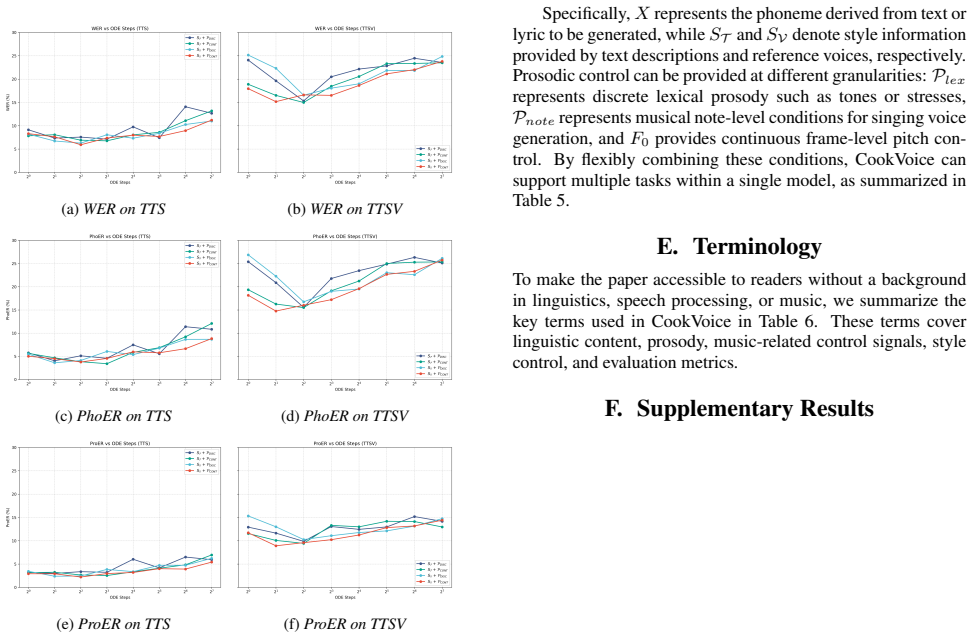
- Inference step count is a real trade-off in the reported results: style and prosody fidelity improve up to roughly 8 steps, while intelligibility peaks near 4 steps, so the model's operating point depends on whether content clarity or style adherence matters more.
Reading between the lines
- The paper reports experiments for TTS and TTSV; a direct test of the unified claim would be to measure whether the same frame-level conditioning also improves the listed but unevaluated tasks of voice conversion, speech/singing editing, sketch-to-voice, and humming-to-voice.
- Because the prosody encoder deliberately strips the voice-level mean from F0 and leaves absolute pitch to the style embedding, the design predicts that shifting a reference contour's mean while keeping style fixed should not change the generated pitch range; supplying a plain reference F0 with a different mean would test this decoupling directly.
- The reported optimum of 4–8 ODE steps is task-dependent: intelligibility is best near 4 steps while style and prosody fidelity keep improving to 8, so a deployment could pick the step count by which objective matters more.
- The authors note the model has not been scaled; if the architecture's ceiling is capacity, training the same design with a larger DiT backbone and more data could plausibly close the remaining MOS gap to large baselines while keeping the efficiency and controllability profile. This is an untested scaling prediction, not a claim of the paper.
Signed reviews
Editorial analysis
A structured set of objections, weighed in public.
Referee Report
Summary. The paper presents CookVoice, a non-autoregressive flow-matching DiT framework that unifies speech and singing voice generation by decomposing the voice into content, prosody, and style and expanding these control signals to the acoustic frame level. Style can be provided as a text prompt or a reference voice, and prosody can be provided as discrete lexical or note tokens or as a continuous F0 contour. A random condition-switching strategy is used during training so that a single model can support multiple task combinations. Experiments compare CookVoice against CosyVoice, F5-TTS, IndexTTS, ParaStyleTTS, Vevo2, DiffSinger, StyleSinger, TCSinger, and Vevo1.5. The paper claims comparable generation quality to baselines while providing stronger style similarity (S-SIM) and prosody controllability (F0-CORR), with only 43.51M parameters and inference using as few as 4 ODE steps.
Significance. The proposed design is clean and practically motivated: frame-level alignment of content, style, and prosody is an interpretable way to obtain fine-grained control, and random condition switching is an elegant mechanism for multi-task training. Objective prosody metrics such as F0-CORR and F0-RMSE are grounded in acoustic signals, and the efficiency analysis addresses a real deployment concern. However, the headline style-controllability claim rests almost entirely on S-SIM computed with an in-house style encoder from the same research group, subjective quality claims are not supported by statistical methodology, and the multi-task capability is not empirically demonstrated beyond TTS and TTSV. If these evaluation concerns are addressed, CookVoice would be a solid contribution to unified voice generation; as presented, the strongest claims are not yet adequately supported.
major comments (4)
- [§4.4, Eq. (9), Table 2]
- [§5.1, Table 3] The subjective MOS and MC-MOS evaluations lack essential methodology: the number of listeners, the number of utterances per system, and any significance testing are not reported. In the TTS condition, CookVoice's best MOS (3.98) is numerically below several baselines (IndexTTS 4.42, F5-TTS 4.35, CosyVoice 4.30, Vevo2 4.30), so the abstract's claim of 'comparable generation quality' is not supported by the table as it stands. In the TTSV condition, the difference between CookVoice (3.40) and Vevo2 (3.42) is too small to interpret without significance tests. Please report listener counts, confidence intervals, and paired significance tests for the MOS and MC-MOS comparisons.
- [Table 5, §5] The paper's central multi-task claim (contribution 1 and Section 3.5) lists 13 tasks including voice conversion, singing voice conversion, speech and singing editing, sketch-to-voice, and humming-to-voice, but the experiments in Section 5 only evaluate TTS and TTSV. As written, support for these additional tasks is purely conceptual, resting on the claim that condition-switching allows the same model to handle them. Please provide at least a small proof-of-concept evaluation (e.g., objective speaker-similarity for VC, or qualitative demos with clear task definitions) for the principal non-TTS tasks, or explicitly delimit the empirical claims to TTS, TTSV, and style/prosody-controllable speech and singing. Without this, the unified multi-task contribution is overstated.
- [§2.2, §5.5, Table 4] The claimed parameter efficiency ('only 43.51M parameters') appears to count only the trainable DiT-S generation backbone and not the frozen HiFi-GAN-style autoencoder or the style encoder that are part of the full generation pipeline. Since the parameter counts for baselines in Table 4 may use a different accounting convention, the efficiency comparison may be inconsistent. Please report a parameter breakdown for CookVoice (generation model, AE encoder and decoder, style encoder) and state whether the same accounting convention is applied to all baselines. In addition, report the real-time factor for the full pipeline, including latent encoding, ODE integration, and waveform decoding.
minor comments (7)
- [Table 2] The relative-percentage annotations for F0-RMSE are ambiguous because lower is better, yet the table mixes downward and upward arrows without stating which direction indicates an improvement.
- [§4.4, Appendix F] The main text mentions WER, PhoER, and ProER, but the full per-language results appear only in Appendix F; please add a pointer to that table at the relevant point in Section 5.
- [Appendix B vs. Tables 3–4] The metric is called M-CMOS in Appendix B but MC-MOS in Tables 3 and 4; please use one consistent name throughout the paper.
- [§4.2, Eq. (5)] The voiced-frame set U is used in Eq. (5) without a formal definition; please define U as the set of voiced frames and state how voiced frames are detected.
- [§5.3] The sentence beginning 'Which leads to an observable style-sim degradation...' is a grammatical fragment; please merge it with the preceding sentence.
- [Figure 2] The caption reads 'Redder indicate stronger performance'; this should be 'Redder colors indicate stronger performance'.
- [Table 4] Vevo2 appears twice in the table (once for TTS and once for TTSV); consider merging the rows or adding a footnote to explain that the same model is listed in both task groups.
Circularity Check
Style-controllability claim relies on the authors' own AutoSIFT style encoder [29]; the generation pipeline and prosody metrics are otherwise self-contained.
-
self citation load bearing
[Section 4.4 'Evaluation Metrics', Table 2 (RQ2), Appendix B Eq. (9), reference [29]]
"To evaluate style controllability, we compute Style Similarity (S-SIM) between the generated voice and the target style reference. Specifically, we extract style embeddings from both audio samples using a pre-trained style encoder [29] and calculate their cosine similarity, where a higher value indicates better style preservation."
The central claim of stronger style controllability is operationally the S-SIM column of Table 2 (91.65% vs. 75.11% for the best TTS baseline; 95.00% vs. 88.09% for the best TTSV baseline). Eq. (9) defines S-SIM as cosine similarity in the embedding space of a pre-trained style encoder [29], and [29] is the authors' own AutoSIFT work, sharing the same style-representation lineage as ParaMeta [10] and LanStyleTTS [19]. The paper reports neither AutoSIFT's training data nor any evidence that its embedding space is impartial with respect to CookVoice's voice-style conditioning scheme, so the claimed style advantage reduces to a comparison inside a same-group artifact rather than an externally validated metric.
full rationale
No full derivation-level circularity was found in the core pipeline. The flow-matching objective (Eq. 1) and Euler ODE solver (Eq. 2) are standard and train v_theta to regress Y1-Y0 from the conditioning C; the duration expansion and beat-relative frame assignment are deterministic computations, not fitted parameters renamed as predictions. The multi-task training switch (Eq. 3) is a task specification rather than an evaluation target. The prosody claim is supported by F0-RMSE and F0-CORR computed directly on acoustic contours, and the efficiency claim is arithmetic from Table 4, so those parts are self-contained against external baselines. The one load-bearing same-group element is the S-SIM evaluator: Section 4.4 defines style similarity through the authors' own pre-trained style encoder [29], and Table 2's style-controllability advantage is the main RQ2 result. Because the paper gives no evidence that AutoSIFT's embedding space is independent of CookVoice's conditioning scheme, the headline style-controllability superiority is partly carried by a self-citation. CookVoice's own voice-style encoder is trained with the flow-matching objective rather than directly to maximize AutoSIFT S-SIM, so this is self-citation load-bearing rather than full definitional circularity. Same-group duration and G2P modules [3, 19] are preprocessing utilities and do not further raise the score.
Assumptions & free parameters
free parameters (4)
- F0 normalization bounds =
f_min=50 Hz; f_max unspecified
- Unvoiced-frame placeholder =
-2
- Style and prosody source sampling probability =
p=0.5
- Singing-to-speech training ratio =
1:9 on 110k samples
assumptions (6)
- standard math Flow-matching objective and Euler solver are valid generative tools for latent acoustic generation.
- domain assumption HiFi-GAN-style autoencoder provides a high-fidelity latent acoustic representation that can serve as both training target and conditioning space.
- domain assumption ParaStyleTTS alignments and duration predictor provide correct ground-truth phoneme durations for speech.
- domain assumption LanStyleTTS G2P provides accurate phoneme and lexical prosody tokens for English and Chinese.
- ad hoc to paper Relative F0 after mean removal is a sufficient prosody condition that does not conflict with style encoding.
- ad hoc to paper Random 50/50 condition switching during training is sufficient for the model to learn all task combinations.
Cite this review
Pith. "Pith review of CookVoice: Unified Framework for Style Controllable Multi-Modal Human Voice Generation." pith.science (2026). https://pith.science/paper/ZPYKLRHR
@misc{pith2026260811590,
  author       = {Pith},
  title        = {Pith review of: CookVoice: Unified Framework for Style Controllable Multi-Modal Human Voice Generation},
  year         = {2026},
  howpublished = {\url{https://pith.science/paper/ZPYKLRHR}},
  note         = {Machine review of arXiv:2608.11590}
}
read the original abstract
Human voice generation has made rapid progress in speech generation, singing voice generation, voice cloning, and voice editing. However, most existing systems are designed for specific tasks and often rely on task-dependent architectures, control signals, or autoregressive decoding, limiting fine-grained controllability and inference efficiency. In this paper, we propose CookVoice, a unified framework for multimodal, multi-style, and multi-task human voice generation. CookVoice decomposes the human voice into three key factors: content, prosody, and style, enabling both speech and singing voice generation within a unified model. To achieve precise and flexible controllability, we design a flexible alignment strategy that maps text, style, and prosody control signals onto the frame-level of spectrogram. This design allows CookVoice to support a wide range of tasks, including text-to-speech, text-to-singing voice, style-controllable generation, voice mimicry, voice conversion, and voice editing. Experimental results show that CookVoice achieves generation quality comparable to existing Text-to-Speech and text-to-singing voice baselines, while providing stronger style and prosody controllability. Moreover, CookVoice achieves comparable performance to large-scale baselines with only 43.51 million parameters and efficient inference using as few as 4 ODE steps, making it a practical solution for real-world human voice generation applications. Demo page is available at https://haoweilou.github.io/CookVoice/.
Figures


Figures from the paper (3 more)


Reference graph
Works this paper leans on
-
[29]
Attention is all you need,
A. Vaswani, N. Shazeer, N. Parmar, J. Uszkoreit, L. Jones, A. N. Gomez, Ł. Kaiser, and I. Polosukhin, “Attention is all you need,” Advances in neural information processing systems, vol. 30, 2017
2017
-
[1]
Introduction Recent years have witnessed an emergence of human voice generative AI, with models capable of high-quality text-to- speech (TTS) [1, 2, 3, 4], singing voice generation [5, 6, 7], zero-shot voice cloning [2, 4, 1], and voice editing [8]. Driven by advances in acoustic representation learning [9, 10], and gen- erative artificial intelligence [1...
work page Pith review arXiv 2026
-
[2]
We proposeCookVoice, a unified framework for multi-task human voice generation. By decomposing human voice into style, content, and prosody, CookV oice successfully unifying multiple voice generation task within a unified model
-
[3]
We design a flexible alignment mechanism for fine-grained controllable human voice generation. By aligning different control signals at frame level, CookV oice can flexibly support multimodal style and prosody control, enabling more pre- cise control over paralinguistic style, melody, duration, and prosodic expression
-
[4]
Our experiment demonstrate CookV oice achieves higher style and prosody controllability than existing baselines, in- cluding models trained with larger-scale data or larger model sizes. Despite using a lightweight architecture and a much smaller training data, CookV oice achieves superior style sim- ilarity and F0 controllability while maintaining efficie...
-
[5]
Preliminary 2.1. Problem Formulation Human V oice Generation (HVG) is to generate waveform from different modality of control signal. In this study, we define the human voice as a combination of human speech and the singing voice. Control signals includetext,lyric,note, andreference voice. Full details covered tasks are presented in Appendix D. For reader...
-
[6]
This section will present the architecture of CookV oice in detail
CookVoice The overall architecture of CookV oice is presented in Figure 1. This section will present the architecture of CookV oice in detail. 3.1. Style Encoder Style Encoder is designed to generate a style embeddingS, which dictates the stylistic characteristics of the generated voice. In CookV oice, style conditioning can be derived from two modalities...
-
[7]
to find optimal alignments between the speech audio and the phoneme sequence, yielding ground-truth durationsD X. For singing voice, where score durations are denoted in rela- tive beats rather than absolute time (e.g., seconds), we compute the relative temporal proportion of each phoneme based on its assigned beats. This relative proportion is then multi...
Show all 41 references
-
[8]
Experiments 4.1. Dataset We combine multiple open-sourced bilingual (english and chi- nese ) speech and singing voice dataset to conduct the experi- ment includingBaker[21],LJSpeech[22],ESD[23],CREMA- D[24],CommonPhone[25],Genshin Voicedataset [26], GTSinger [27]. The combined...
-
[9]
Results & Discussion In this section, we provide an analysis of experimental results and organize the discussion to answer the following five re- search questions (RQs): •RQ1:How does CookV oice perform compared with existing TTS and TTSV baselines in term of audio? •RQ2:How c...
-
[10]
Conclusion In this paper, we presentCookVoice, a unified framework for multimodal, multi-style, and multi-task human voice genera- tion. By decomposing human voice into content, prosody, and style, CookV oice supports a wide range of speech and singing voice generation tasks w...
-
[11]
First, due to re- source constraints, CookV oice has not yet been scaled up
Limitation CookV oice shows potential for unified and controllable human voice generation, several limitations remain. First, due to re- source constraints, CookV oice has not yet been scaled up. The current model only use the DiT-S version of diffusion trans- former (43.51M p...
-
[12]
Cosyvoice: A scalable multi- lingual zero-shot text-to-speech synthesizer based on supervised semantic tokens,
Z. Du, Q. Chen, S. Zhang, K. Hu, H. Lu, Y . Yang, H. Hu, S. Zheng, Y . Gu, Z. Maet al., “Cosyvoice: A scalable multi- lingual zero-shot text-to-speech synthesizer based on supervised semantic tokens,”arXiv preprint arXiv:2407.05407, 2024
2024 arXiv
-
[13]
Indextts: An industrial-level controllable and efficient zero-shot text-to-speech system,
W. Deng, S. Zhou, J. Shu, J. Wang, and L. Wang, “Indextts: An industrial-level controllable and efficient zero-shot text-to-speech system,”arXiv preprint arXiv:2502.05512, 2025
2025 arXiv
-
[14]
Parastyletts: Toward effi- cient and robust paralinguistic style control for expressive text-to- speech generation,
H. Lou, H.-Y . Paik, W. Hu, and L. Yao, “Parastyletts: Toward effi- cient and robust paralinguistic style control for expressive text-to- speech generation,” inProceedings of the 34th ACM International Conference on Information and Knowledge Management, 2025, pp. 1979–1988
2025
-
[15]
F5-tts: A fairytaler that fakes fluent and faithful speech with flow matching,
Y . Chen, Z. Niu, Z. Ma, K. Deng, C. Wang, J. JianZhao, K. Yu, and X. Chen, “F5-tts: A fairytaler that fakes fluent and faithful speech with flow matching,” inProceedings of the 63rd Annual Meeting of the Association for Computational Linguistics (Volume 1: Long Papers), 2025,...
2025
-
[16]
Diffsinger: Singing voice synthesis via shallow diffusion mechanism,
J. Liu, C. Li, Y . Ren, F. Chen, and Z. Zhao, “Diffsinger: Singing voice synthesis via shallow diffusion mechanism,” inProceedings of the AAAI conference on artificial intelligence, vol. 36, no. 10, 2022, pp. 11 020–11 028
2022
-
[17]
Stylesinger: Style transfer for out-of- domain singing voice synthesis,
Y . Zhang, R. Huang, R. Li, J. He, Y . Xia, F. Chen, X. Duan, B. Huai, and Z. Zhao, “Stylesinger: Style transfer for out-of- domain singing voice synthesis,” inProceedings of the AAAI Conference on Artificial Intelligence, vol. 38, no. 17, 2024, pp. 19 597–19 605
2024
-
[18]
Tcsinger: Zero-shot singing voice synthesis with style transfer and multi-level style control,
Y . Zhang, Z. Jiang, R. Li, C. Pan, J. He, R. Huang, C. Wang, and Z. Zhao, “Tcsinger: Zero-shot singing voice synthesis with style transfer and multi-level style control,” inProceedings of the 2024 Conference on Empirical Methods in Natural Language Process- ing, 2024, pp. 1960–1975
2024
-
[19]
Vevo2: A unified and controllable framework for speech and singing voice generation,
X. Zhang, J. Zhang, Y . Wang, C. Wang, Y . Chen, D. Jia, Z. Chen, and Z. Wu, “Vevo2: A unified and controllable framework for speech and singing voice generation,”IEEE Transactions on Au- dio, Speech and Language Processing, 2026
2026
-
[20]
Hifi-gan: Generative adversarial net- works for efficient and high fidelity speech synthesis,
J. Kong, J. Kim, and J. Bae, “Hifi-gan: Generative adversarial net- works for efficient and high fidelity speech synthesis,”Advances in neural information processing systems, vol. 33, pp. 17 022– 17 033, 2020
2020
-
[21]
Param- eta: Towards learning disentangled paralinguistic speak- ing styles representations from speech,
H. Lou, H. young Paik, W. Hu, and L. Yao, “Param- eta: Towards learning disentangled paralinguistic speak- ing styles representations from speech,” inAAAI Confer- ence on Artificial Intelligence, 2026. [Online]. Available: https://api.semanticscholar.org/CorpusID:284910281
2026
-
[22]
Scalable diffusion models with transform- ers,
W. Peebles and S. Xie, “Scalable diffusion models with transform- ers,” inProceedings of the IEEE/CVF international conference on computer vision, 2023, pp. 4195–4205
2023
-
[23]
Flow matching for generative modeling,
Y . Lipman, R. T. Chen, H. Ben-Hamu, M. Nickel, and M. Le, “Flow matching for generative modeling,”arXiv preprint arXiv:2210.02747, 2022
2022 arXiv
-
[24]
Fastspeech: Fast, robust and controllable text to speech,
Y . Ren, Y . Ruan, X. Tan, T. Qin, S. Zhao, Z. Zhao, and T.-Y . Liu, “Fastspeech: Fast, robust and controllable text to speech,” Advances in neural information processing systems, vol. 32, 2019
2019
-
[25]
M4singer: A multi-style, multi- singer and musical score provided mandarin singing corpus,
L. Zhang, R. Li, S. Wang, L. Deng, J. Liu, Y . Ren, J. He, R. Huang, J. Zhu, X. Chenet al., “M4singer: A multi-style, multi- singer and musical score provided mandarin singing corpus,”Ad- vances in Neural Information Processing Systems, vol. 35, pp. 6914–6926, 2022
2022
-
[26]
Vevo: Controllable zero-shot voice imitation with self- supervised disentanglement,
X. Zhang, X. Zhang, K. Peng, Z. Tang, V . Manohar, Y . Liu, J. Hwang, D. Li, Y . Wang, J. Chan, Y . Huang, Z. Wu, and M. Ma, “Vevo: Controllable zero-shot voice imitation with self- supervised disentanglement,” inICLR. OpenReview.net, 2025
2025
-
[27]
Conditional variational autoencoder with adversarial learning for end-to-end text-to-speech,
J. Kim, J. Kong, and J. Son, “Conditional variational autoencoder with adversarial learning for end-to-end text-to-speech,” inInter- national conference on machine learning. PMLR, 2021, pp. 5530–5540
2021
-
[28]
Mpnet: Masked and permuted pre-training for language understanding,
K. Song, X. Tan, T. Qin, J. Lu, and T.-Y . Liu, “Mpnet: Masked and permuted pre-training for language understanding,”Advances in neural information processing systems, vol. 33, pp. 16 857– 16 867, 2020
2020
-
[30]
Generalized multi- lingual text-to-speech generation with language-aware style adap- tation,
H. Lou, H.-y. Paik, S. Li, W. Hu, and L. Yao, “Generalized multi- lingual text-to-speech generation with language-aware style adap- tation,”arXiv preprint arXiv:2504.08274, 2025
2025 arXiv
-
[31]
Tacotron: Towards end-to-end speech synthesis,
Y . Wang, R. Skerry-Ryan, D. Stanton, Y . Wu, R. J. Weiss, N. Jaitly, Z. Yang, Y . Xiao, Z. Chen, S. Bengioet al., “Tacotron: Towards end-to-end speech synthesis,”arXiv preprint arXiv:1703.10135, 2017
2017 arXiv
-
[32]
Chinese mandarin female corpus,
Databaker, “Chinese mandarin female corpus,” https://en. data-baker.com/datasets/freeDatasets/, 2020, accessed: 2023-04- 20
2020
-
[33]
The lj speech dataset,
K. Ito and L. Johnson, “The lj speech dataset,” https://keithito. com/LJ-Speech-Dataset/, 2017
2017
-
[34]
Seen and unseen emo- tional style transfer for voice conversion with a new emotional speech dataset,
K. Zhou, B. Sisman, R. Liu, and H. Li, “Seen and unseen emo- tional style transfer for voice conversion with a new emotional speech dataset,” inICASSP 2021-2021 IEEE International Con- ference on Acoustics, Speech and Signal Processing (ICASSP). IEEE, 2021, pp. 920–924
2021
-
[35]
Crema-d: Crowd-sourced emotional multimodal actors dataset,
H. Cao, D. G. Cooper, M. K. Keutmann, R. C. Gur, A. Nenkova, and R. Verma, “Crema-d: Crowd-sourced emotional multimodal actors dataset,”IEEE transactions on affective computing, vol. 5, no. 4, pp. 377–390, 2014
2014
-
[36]
Common phone: A multilingual dataset for robust acoustic modelling,
P. Klumpp, T. Arias, P. A. P ´erez-Toro, E. Noeth, and J. Orozco- Arroyave, “Common phone: A multilingual dataset for robust acoustic modelling,” inProceedings of the Thirteenth Language Resources and Evaluation Conference, 2022, pp. 763–768
2022
-
[37]
Genshin voice: A multi-lingual voice dataset from Genshin Impact,
Simon3000, “Genshin voice: A multi-lingual voice dataset from Genshin Impact,” https://huggingface.co/datasets/simon3000/ genshin-voice, 2025, hugging Face Datasets
2025
-
[38]
Gtsinger: A global multi-technique singing corpus with realistic music scores for all singing tasks,
Y . Zhang, C. Pan, W. Guo, R. Li, Z. Zhu, J. Wang, W. Xu, J. Lu, Z. Hong, C. Wanget al., “Gtsinger: A global multi-technique singing corpus with realistic music scores for all singing tasks,” Advances in Neural Information Processing Systems, vol. 37, pp. 1117–1140, 2024
2024
-
[39]
Robust speech recognition via large-scale weak supervision,
A. Radford, J. W. Kim, T. Xu, G. Brockman, C. McLeavey, and I. Sutskever, “Robust speech recognition via large-scale weak supervision,” inInternational conference on machine learning. PMLR, 2023, pp. 28 492–28 518
2023
-
[40]
Autosift: Automatic style sifting for controllable speech generation with arbitrary style infilling,
H. Lou, J. Wu, C. Huang, T. Yu, H.-y. Paik, W. Hu, and L. Yao, “Autosift: Automatic style sifting for controllable speech generation with arbitrary style infilling,”arXiv preprint arXiv:2607.12706, 2026
2026 arXiv
-
[41]
Denoising diffusion probabilis- tic models,
J. Ho, A. Jain, and P. Abbeel, “Denoising diffusion probabilis- tic models,”Advances in neural information processing systems, vol. 33, pp. 6840–6851, 2020. A. Related Work Autoregressive voice generation.Recent advances in neural voice generation have significantly improved t...
2020
Reviewed August 16, 2026 · model on record in the stance chip above.
Discussion (0). Continue with ORCID to comment.