REVIEW 3 major objections 3 minor 45 references
Quantum and classical algorithms for SOCP based on the multiplicative weights update method
T0 review · 3 major / 3 minor · reviewed 2026-08-06 · deepseek-v4-flash
Pith's one-line read A multiplicative-weights method solves second-order cone programs with $\widetilde{O}(\sqrt{r}\gamma^5 + \sqrt{m}\gamma^4)$ quantum query complexity, nearly matching linear programs and beating the naive SDP embedding.
desk verdict Genuinely new end-to-end MW-based algorithms for general SOCPs, with honest complexity statements and a real speedup claim, but the advertised quantum query count leans on a cheap-QRAM assumption and one degenerate first iteration needs a patch. read the letter →
The pith
A machine-rendered reading of the paper's core claim, the machinery that carries it, and where it could break.
The reading
What carries the argument
The central object is the Euclidean Jordan algebra of the second-order cone, whose defining gadget is the Arrowhead matrix: a cone vector $v^{(k)} = (v_0, \vec v)$ maps to $\operatorname{Arw}(v^{(k)}) = \begin{pmatrix} v_0 & \vec v^{\top} \\ \vec v & v_0 I \end{pmatrix}$, a matrix that is positive semidefinite exactly when $v^{(k)}$ lies in the cone. Every cone vector splits into two eigen-components $v^{(k)} = \lambda_+ c_+ + \lambda_- c_-$, so the multiplicative-weights candidate $x \propto e^{-A^{\top} y}$—an exponential computed in the Jordan algebra—is represented by a pure two-level state per cone, and the whole candidate becomes the 'cone-index Gibbs state' $|\sqrt{2x}\rangle = \sum_k \sqrt{Z^{(k)}/Z}\,|k\rangle|\sqrt{2p^{(k)}}\rangle$ whose preparation dominates the cost. The outer loop is the standard multiplicative-weights update (raise the weight of a violated constraint by $\theta/6$), needing only $O(\log r/\theta^2)$ iterations because the potential function $\Phi(t) = \operatorname{Tr}(e^{\delta \sum M^{(\tau)}})$ shrinks multiplicatively; the Golden–Thompson inequality for Jordan algebras supplies the key bound. The violated-constraint oracle is split into a two-step procedure whose costs add: the cone-index Gibbs sampler, built quantumly from minimum-finding on the Arrowhead block-encoding followed by a QSVT polynomial approximation of the exponential, and the sampled violated-constraint search, built from a block-encoding of the violation matrix $\hat V$ filtered through a QSVT Heaviside step and boosted by fixed-point amplitude amplification.
What would settle it
Count, on a fixed instance family (say $r = 2^k$ identical second-order cones with a single linear constraint), the actual number of data-oracle queries the two-step violated-constraint oracle uses per iteration. The paper predicts $\widetilde{O}(\sqrt{r}/\theta^2)$ quantum queries and $\widetilde{O}(n/\theta^4)$ classical samples-and-queries; measured growth beyond these powers of $r$ and $n$, ignoring log factors, would refute the complexity claims. A second, cheaper check targets the load-bearing access assumption directly: implement the row-prep and state-prep oracles on a concrete QRAM architecture and measure their circuit depth—if it grows polynomially in $m$ or $n$ rather than polylogarithmically, the end-to-end quantum gate complexity no longer exhibits the advertised near-LP speedup.
Extended reading notes
Core claim
The central claim is that the multiplicative-weights framework, previously applied to linear and semidefinite programs, carries over to second-order cone programs with near-linear-program cost. The paper reduces approximate SOCP optimization to a sequence of feasibility checks, each solved by iterating a sparse nonnegative weight vector $y$ for $T = O(\log r / \theta^2)$ steps; every step queries a violated-constraint oracle that either certifies all constraints are satisfied or returns a constraint violated by at least $\theta$. The oracle is implemented in two additive-cost steps: a cone-index Gibbs sampler that draws cone indices $k$ with probability proportional to $Z^{(k)} = \operatorname{Tr}(e^{-A^{(k)\top}y})$, and a sampled violated-constraint search that estimates each constraint's violation from those samples. Because the Jordan-algebra exponential of a cone vector decomposes into just two eigen-components, the candidate solution's 'Gibbs state' is a pure state, so the quantum implementation prepares it via quantum singular value transformation on a block-encoding of the Arrowhead matrix at cost $\widetilde{O}(\sqrt{r}\,\beta)$ per iteration; adding the cost of finding a violated constraint among $m$ candidates gives the total quantum query complexity $\widetilde{O}(\sqrt{r}\,\gamma^5 + \sqrt{m}\,\gamma^4)$, with $\gamma = R\widetilde{R}/\epsilon$. The classical implementation computes the cone weights by exact sparse matrix-vector products, giving $\widetilde{O}(n\gamma^4 + m\gamma^6)$, and the authors present the pair of results as evidence that SOCP's intermediate expressiveness carries an intermediate, additive query cost.
Load-bearing premise
The advertised quantum query count is only the number of calls to data oracles whose circuits are assumed to be very shallow (polylogarithmic depth), which the paper itself equates to assuming cheap quantum random-access memory; if building that memory is expensive, the end-to-end quantum gate count grows by that overhead.
Editorial extensions
If this is right
- In the dense regime $r = \Theta(n)$, the quantum bound $\widetilde{O}(\sqrt{r}\gamma^5 + \sqrt{m}\gamma^4)$ is a near-quadratic improvement over the classical $\widetilde{O}(n\gamma^4 + m\gamma^6)$, and the speedup is even larger when $r \ll n$.
- Embedding an SOCP into an SDP is dominated for large $n$: the naive bound $\widetilde{O}(\gamma^4(n + \gamma\sqrt{n} + \sqrt{m}))$ is beaten whenever $n \gg \sqrt{r}$, so cone structure should be exploited directly rather than through the arrowhead-matrix SDP reformulation.
- The multiplicative-weights route becomes competitive with interior-point methods for large, low-precision instances: IPM complexity grows superlinearly in problem size (roughly $O(\sqrt{r}\,n^{\omega})$ for SOCP), while here the number of iterations depends only logarithmically on $r$ and polynomially on $\gamma$.
- Because Lemma 1 converts any feasibility oracle into an $\epsilon$-approximate optimizer with $\widetilde{O}(\log(R/\epsilon))$ oracle calls, the query bounds transfer from decision problems to full optimization without changing the $\gamma$ scaling.
- In the sample-and-query access model, the classical algorithm's $\widetilde{O}(n\gamma^4 + m\gamma^6)$ cost means feasibility can be certified without writing down the full $m \times n$ instance, which the authors note is the reason sublinear classical complexity is achievable in this model.
Reading between the lines
- If quantum random-access memory turns out to be expensive, the end-to-end gate count for implementing the row-prep and state-prep oracles would add a polynomial-in-size overhead per query, so the near-LP speedup would hold at the query level but not necessarily at the physical-gate level; the paper's own 'essentially equivalent to an assumption of cheap QRAM' remark marks this as the point to watc
- The reduction of SOCP solving to preparing a pure per-cone Gibbs state is the paper's most reusable idea: any faster preparation of $|\sqrt{2x}\rangle$—for instance, when the two Jordan-frame eigenvalues are well separated so the state thermalizes faster—would directly lower the $\widetilde{O}(\sqrt{r})$ term, a route to larger speedups the paper explicitly leaves open.
- The classical algorithm's $\widetilde{O}(n)$-dependence comes from computing each cone weight $Z^{(k)}$ exactly, and the paper explains why a direct sampling estimate needs precision $1/r$ per cone; a quantum-inspired estimator that reaches the needed precision in $\operatorname{polylog}$ time would close the gap to $\widetilde{O}(r + m)$ and determine how much of the quantum advantage is genuine
- Because the two-step oracle decomposition keeps the $r$-dependence and $m$-dependence additive, the same design should transfer to other low-rank conic programs, and with care to the full symmetric-cone case, suggesting the framework is a template for conic optimization rather than a one-off SOCP construction.
Editorial analysis
A structured set of objections, weighed in public.
Referee Report
Summary. The paper presents multiplicative-weights (MW) based classical and quantum algorithms for approximately solving second-order cone programs (SOCPs). The quantum algorithm implements a two-step violated-constraint oracle: a cone-index Gibbs sampler and a sampled violated-constraint search, both built from block-encodings, QSVT, and amplitude amplification. The claimed quantum query complexity is O~(sqrt(r) gamma^5 + sqrt(m) gamma^4), and the classical sample-and-query complexity is O~(n gamma^4 + m gamma^6), where gamma = R R~ / epsilon. The paper includes a reduction from general SOCPs to a unit-trace feasibility problem, a convergence proof for the MW feasibility algorithm, and explicit circuit constructions in Appendix A.
Significance. If the main claims are correct, this is a significant contribution: it specializes the MW framework to SOCPs in a way that nearly matches the query complexity of linear programs and improves on the naive SOCP-to-SDP embedding. The paper is largely self-contained, uses established tools (QSVT, Golden-Thompson for Euclidean Jordan algebras, minimum finding), and provides explicit oracles and circuits. The advertised speedup is, however, stated in a query model that relies on cheap QRAM for the state-preparation oracles Oy and OT, a caveat the paper acknowledges in Section 2.3.2. More importantly, the convergence proof of the central MW feasibility algorithm contains a normalization error that undermines the claimed iteration count; this must be corrected before the complexity statements can be accepted.
major comments (3)
- [Theorem 1 (Section 3.3), equations (3.43)-(3.44)] The proof of Theorem 1 uses the identity e^T p = 1 for unit-trace vectors p, but with the trace defined as Tr(v) = 2 v_0 in Section 2.1, the correct identity is e^T p = 1/2. As a result, inequality (3.44) is false: Tr(M(t) o Q) = 1/2 - (A Q)_j, and feasibility of Q only gives (A Q)_j <= b_j, hence Tr(M(t) o Q) >= 1/2 - b_j, not 1 - b_j. Equation (3.43) is a valid but loose upper bound for the same reason. If the correct inequalities are used together with Proposition 1 (which applies with delta = theta/3 given the definition of P(t) in (3.41)), the chain (3.45)-(3.47) does not yield T <= 36 log(2r)/theta^2; a direct rederivation gives T = O(log r / theta^3). Since the iteration count T is used in Corollaries 1 and 2, the advertised quantum complexity exponents gamma^5 and gamma^4 are not established by the proof as written.
- [Lemma 1 (Section 2.2), last paragraph of proof] The probability accounting in the reduction from SOCP optimization to feasibility is incomplete. After the binary search, the proof runs the oracle O_theta one final time to obtain the vector y, but O_theta has failure probability at most 1/3. The binary search steps are boosted to failure probability 1/3 overall (via zeta = 1/(3 T_bs)), so the combined success probability of the binary search and the final oracle call is at most (2/3)*(2/3) = 4/9, not at least 2/3 as stated. The final call must also be boosted (e.g., to failure probability 1/6) or the failure budget zeta must be redistributed, which only changes the O-tilde(log(R/theta)) call count by a constant.
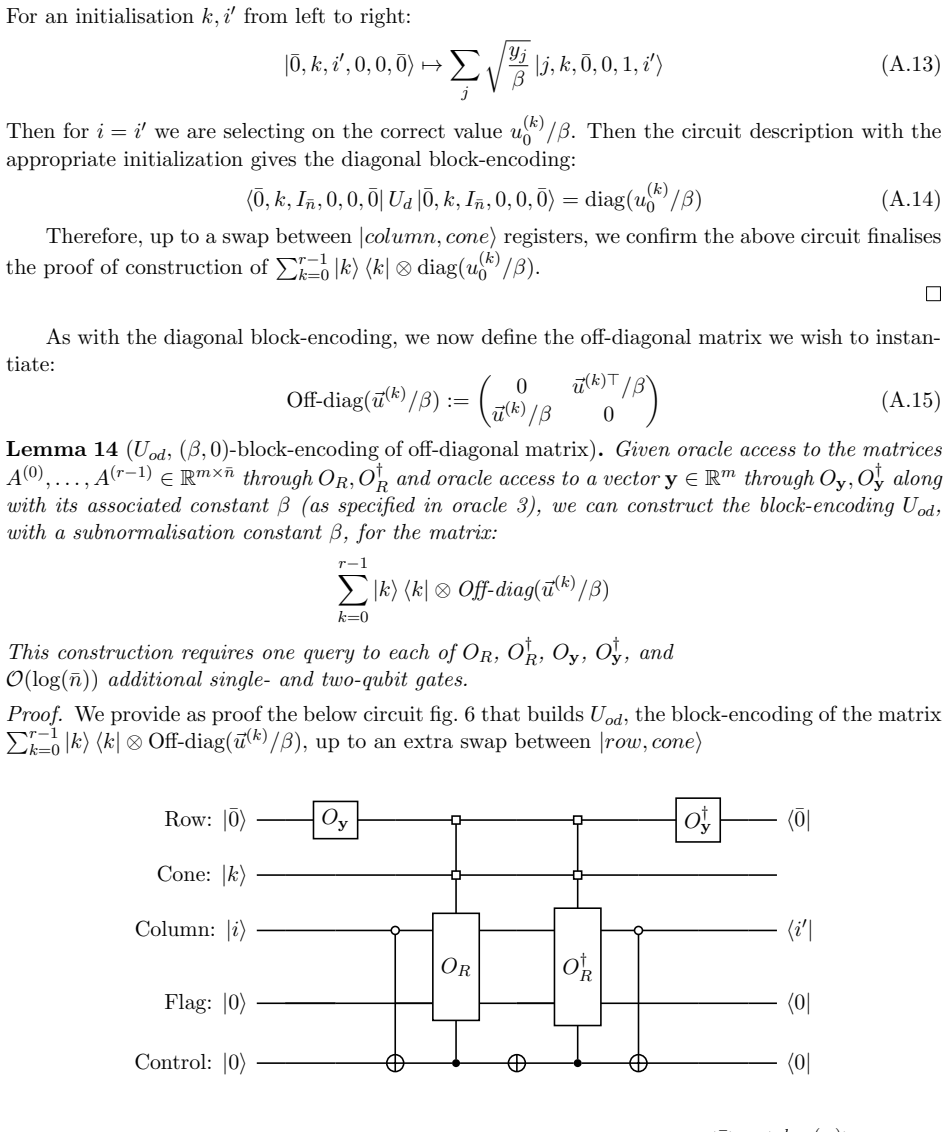
- [Section 4.1, Lemma 5 and Corollary 3] The quantum Gibbs sampler construction assumes a nonzero norm beta = ||y||_1. In the first iteration of Algorithm 1, y = 0, so the (2 beta, 0)-block-encoding of Arw(A^T y) in (4.5) is degenerate (division by zero), and the subsequent minimum-finding and QSVT steps in Lemma 5 are undefined. Moreover, for 0 < beta < 1/2, the claim that the shifted eigenvalues lie in [0,1] is false: with eta_lambda = 1/2, the upper bound is (2 beta + 2 eta_lambda)/(4 beta) > 1, violating the QSVT polynomial domain. The paper needs to handle the small-beta regime separately, either by special-casing beta = 0 (where the cone-index distribution is uniform and the desired state can be prepared directly) or by replacing beta with max(beta,1) in the normalization. This is load-bearing because the first oracle call has beta = 0 and still requires data queries to find a violated constraint, so the claimed query bound for that call is not captured by the formula in Theorem 3.
minor comments (3)
- [Lemma 5 (Section 4.1)] The trace-distance bound is stated as 32 sqrt(2r) delta_exp log(1/omega_AA) + omega_AA + sqrt(2 omega_AA), but the corresponding bound in Lemma 18 contains a square root of the approximation error, i.e., 32 sqrt(2r) sqrt(delta_exp) log(1/omega_AA). The chosen value of delta_exp still makes the final bound work, so this appears to be a typographical error.
- [Lemma 12 (Section 5.2)] The text says that computing u^(k_h) = (A^(k_h))^T y for each h = 0, ..., T'-1 costs a total of O(n s), but a naive per-sample computation would cost O(T' n s). The O(n s) bound is only valid if the computation is memoized across repeated cone indices; this should be stated explicitly.
- [Section 2.3.2] The caveat that the complexity statements assume cheap QRAM for the oracles Oy and OT is important and should be restated prominently in the abstract or introduction, since the advertised speedup relative to classical algorithms depends on this access-model assumption.
Circularity Check
No significant circularity: the SOCP MW derivation is self-contained and external benchmark tools carry the load.
full rationale
The paper's central complexity statements (Theorem 3 and Corollaries 1–2) count coherent queries to specified oracles (OR, Ob, Oy, OT) and are derived from explicit subroutine constructions, not from fitting a parameter to a subset of data and renaming it a prediction. The MW convergence proof (Theorem 1) is proved in-paper using the Golden–Thompson inequality in Euclidean Jordan algebras cited to external work [TWK21] and the standard MW potential framework from [Kal07]; neither is the authors' own prior result. The quantum subroutines rely on QSVT [GSLW19], minimum finding [LT20], and polynomial approximation lemmas [vAG19b], all external, machine-checkable-style results. The block-encodings of Arrowhead matrices are constructed explicitly in Appendix A from the stated access oracles. The only self-citations are [DCS+23], used as background comparison for quantum interior-point SOCP solvers, and [DGH+25], used in the remark that implementing Oy/OT with polylog-depth circuits is 'essentially equivalent to an assumption of cheap QRAM.' That remark is a transparent limitation of the end-to-end gate count, not a load-bearing circular step: the advertised complexity is a query complexity, and the cheap-QRAM dependence is explicitly stated as an assumption. No step reduces, by construction or by self-citation, to its own input. The skeptical concern about QRAM costs is a resource-model caveat, not circularity, and the paper acknowledges it honestly.
Assumptions & free parameters
assumptions (8)
- standard math Golden-Thompson inequality holds in the Euclidean Jordan algebra of the second-order cone (Tr(e^{m+q}) ≤ Tr(e^m ∘ e^q))
- standard math QSVT polynomial transformation allows implementing polynomial functions of block-encoded Hermitian matrices with precision guarantees
- standard math Fixed-point amplitude amplification can boost success probability of an imperfect block-encoding (Lemma 18)
- standard math Minimum eigenvalue of a Hamiltonian can be estimated with query complexity O(β/(ν η)) given a block-encoding and overlap guarantee ν
- domain assumption Strong duality holds for the SOCP instance (primal and dual optimal objective values coincide)
- domain assumption The SOCP satisfies normalization conditions and R-trace / R~-dual-trace constraints with known R, R~
- domain assumption The feasibility problem satisfies the promise that either S0 is nonempty or Sθ is empty
- domain assumption Quantum access model with row-prep and state-prep oracles (Oracles 1-3) implementable with polylog-depth circuits, i.e., cheap QRAM
Cite this review
Pith. "Pith review of Quantum and classical algorithms for SOCP based on the multiplicative weights update method." pith.science (2026). https://pith.science/paper/ZQ4CUCA4
@misc{pith2026250714127,
  author       = {Pith},
  title        = {Pith review of: Quantum and classical algorithms for SOCP based on the multiplicative weights update method},
  year         = {2026},
  howpublished = {\url{https://pith.science/paper/ZQ4CUCA4}},
  note         = {Machine review of arXiv:2507.14127}
}
abstract
We give classical and quantum algorithms for approximately solving second-order cone programs (SOCPs) based on the multiplicative weights (MW) update method. Our approach follows the MW framework previously applied to semidefinite programs (SDPs), of which SOCP is a special case. We show that the additional structure of SOCPs can be exploited to give better runtime with SOCP-specific algorithms. For an SOCP with $m$ linear constraints over $n$ variables partitioned into $r \leq n$ second-order cones, our quantum algorithm requires $\widetilde{O}(\sqrt{r}\gamma^5 + \sqrt{m}\gamma^4)$ (coherent) queries to the underlying data defining the instance, where $\gamma$ is a scale-invariant parameter proportional to the inverse precision. This nearly matches the complexity of solving linear programs (LPs), which are a less expressive subset of SOCP. It also outperforms (especially if $n \gg r$) the naive approach that applies existing SDP algorithms onto SOCPs, which has complexity $\widetilde{O}(\gamma^{4}(n + \gamma \sqrt{n} + \sqrt{m}))$. Our classical algorithm for SOCP has complexity $\widetilde{O}(n\gamma^4 + m \gamma^6)$ in the sample-and-query model.
Figures


Figures from the paper (4 more)


Reference graph
Works this paper leans on
-
[1]
Farid Alizadeh and Donald Goldfarb. Second-order cone programming. Mathematical programming , 95(1):3--51, 2003
work page 2003
-
[2]
Babak Akbari and Melissa Greeff. A computationally efficient learning-based model predictive control for multirotors under aerodynamic disturbances. In 2024 International Conference on Unmanned Aircraft Systems (ICUAS) , page 185–192. IEEE, June 2024
work page 2024
-
[3]
Quantum speedups for linear programming via interior point methods, 2024
Simon Apers and Sander Gribling. Quantum speedups for linear programming via interior point methods, 2024
work page 2024
-
[4]
A quantum central path algorithm for linear optimization, 2024
Brandon Augustino, Jiaqi Leng, Giacomo Nannicini, Tamás Terlaky, and Xiaodi Wu. A quantum central path algorithm for linear optimization, 2024
work page 2024
-
[5]
Amir Ali Ahmadi and Anirudha Majumdar. DSOS and SDSOS optimization: More tractable alternatives to sum of squares and semidefinite optimization. SIAM Journal on Applied Algebra and Geometry , 3(2):193–230, January 2019
work page 2019
-
[6]
Fernando G. S. L. Brand\ a o, Amir Kalev, Tongyang Li, Cedric Yen-Yu Lin, Krysta M. Svore, and Xiaodi Wu. Quantum SDP Solvers: Large Speed-Ups, Optimality, and Applications to Quantum Learning . In Christel Baier, Ioannis Chatzigiannakis, Paola Flocchini, and Stefano Leonardi, editors, 46th International Colloquium on Automata, Languages, and Programming ...
work page 2019
-
[7]
Fernando G.S.L. Brandao and Krysta M. Svore. Quantum speed-ups for solving semidefinite programs. In 2017 IEEE 58th Annual Symposium on Foundations of Computer Science (FOCS) , page 415–426. IEEE, October 2017
work page 2017
-
[8]
Shantanav Chakraborty, András Gilyén, and Stacey Jeffery. The power of block-encoded matrix powers: Improved regression techniques via faster hamiltonian simulation. In 46th International Colloquium on Automata, Languages, and Programming (ICALP 2019) . Schloss Dagstuhl – Leibniz-Zentrum f\" u r Informatik, 2019
work page 2019
Show all 45 references
-
[9]
Quantum-inspired sublinear algorithm for solving low-rank semidefinite programming
Nai-Hui Chia, Tongyang Li, Han-Hsuan Lin, and Chunhao Wang. Quantum-inspired sublinear algorithm for solving low-rank semidefinite programming. In MFCS 2020 . Schloss Dagstuhl – Leibniz-Zentrum f\" u r Informatik, 2020
2020
-
[10]
Two-dimensional beampattern synthesis for polarized smart antenna array and its sparse array optimization
Zhikun Chen, Tao Li, Dongliang Peng, and Kang Du. Two-dimensional beampattern synthesis for polarized smart antenna array and its sparse array optimization. International Journal of Antennas and Propagation , 2020:1–13, June 2020
2020
-
[11]
Multiplicative updates for online convex optimization over symmetric cones
Ilayda Canyakmaz, Wayne Lin, Georgios Piliouras, and Antonios Varvitsiotis. Multiplicative updates for online convex optimization over symmetric cones. ArXiv , abs/2307.03136, 2023
2023 arXiv
-
[12]
Cohen, Yin Tat Lee, and Zhao Song
Michael B. Cohen, Yin Tat Lee, and Zhao Song. Solving linear programs in the current matrix multiplication time. J. ACM , 68(1), January 2021
2021
-
[13]
Dalzell, B
Alexander M. Dalzell, B. David Clader, Grant Salton, Mario Berta, Cedric Yen-Yu Lin, David A. Bader, Nikitas Stamatopoulos, Martin J. A. Schuetz, Fernando G. S. L. Brandão, Helmut G. Katzgraber, and William J. Zeng. End-to-end resource analysis for quantum interior-point metho...
2023
-
[14]
A distillation-teleportation protocol for fault-tolerant QRAM
Alexander M Dalzell, Andr \'a s Gily \'e n, Connor T Hann, Sam McArdle, Grant Salton, Quynh T Nguyen, Aleksander Kubica, and Fernando GSL Brand \ a o. A distillation-teleportation protocol for fault-tolerant QRAM . arXiv preprint arXiv:2505.20265 , 2025
2025 arXiv
-
[15]
An efficient support vector machine learning method with second-order cone programming for large-scale problems
Rameswar Debnath, Masakazu Muramatsu, and Haruhisa Takahashi. An efficient support vector machine learning method with second-order cone programming for large-scale problems. Applied Intelligence , 23(3):219–239, December 2005
2005
-
[16]
Computing a task-dependent grasp metric using second-order cone programs
Amin Fakhari, Aditya Patankar, Jiayin Xie, and Nilanjan Chakraborty. Computing a task-dependent grasp metric using second-order cone programs. In 2021 IEEE/RSJ International Conference on Intelligent Robots and Systems (IROS) , page 4009–4016. IEEE, September 2021
2021
-
[17]
Risk return trade-off in relaxed risk parity portfolio optimization
Vaughn Gambeta and Roy Kwon. Risk return trade-off in relaxed risk parity portfolio optimization. Journal of Risk and Financial Management , 13(10):237, October 2020
2020
-
[18]
Nonlinear transformation of complex amplitudes via quantum singular value transformation
Naixu Guo, Kosuke Mitarai, and Keisuke Fujii. Nonlinear transformation of complex amplitudes via quantum singular value transformation. Phys. Rev. Res. , 6:043227, Dec 2024
2024
-
[19]
Quantum singular value transformation and beyond: exponential improvements for quantum matrix arithmetics
András Gilyén, Yuan Su, Guang Hao Low, and Nathan Wiebe. Quantum singular value transformation and beyond: exponential improvements for quantum matrix arithmetics. In Proceedings of the 51st Annual ACM SIGACT Symposium on Theory of Computing , STOC ’19. ACM, June 2019
2019
-
[20]
Sequential measurements, disturbance and property testing
Aram W Harrow, Cedric Yen-Yu Lin, and Ashley Montanaro. Sequential measurements, disturbance and property testing. In Proceedings of the Twenty-Eighth Annual ACM-SIAM Symposium on Discrete Algorithms , pages 1598--1611. SIAM, 2017
2017
-
[21]
A SOCP -based ACOPF for operational scheduling of three-phase unbalanced distribution systems and coordination of PV smart inverters
Mingyue He, Zahra Soltani, Mohammad Ghaljehei, Masoud Esmaili, Shanshan Ma, Mengxi Chen, Mojdeh Khorsand, Raja Ayyanar, and Vijay Vittal. A SOCP -based ACOPF for operational scheduling of three-phase unbalanced distribution systems and coordination of PV smart inverters. IEEE ...
2024
-
[22]
Second order cone relaxations for quantum Max Cut , 11 2024
Felix Huber, Kevin Thompson, Ojas Parekh, and Sevag Gharibian. Second order cone relaxations for quantum Max Cut , 11 2024
2024
-
[23]
R.A. Jabr. Radial distribution load flow using conic programming. IEEE Transactions on Power Systems , 21(3):1458–1459, August 2006
2006
-
[24]
Minimax design of IIR digital filters using iterative SOCP
Aimin Jiang and Hon Keung Kwan. Minimax design of IIR digital filters using iterative SOCP . IEEE Transactions on Circuits and Systems I: Regular Papers , 57(6):1326–1337, June 2010
2010
-
[25]
Samuel Jaques and Arthur G. Rattew. QRAM : A survey and critique, 2023
2023
-
[26]
Efficient algorithms using the multiplicative weights update method
Satyen Kale. Efficient algorithms using the multiplicative weights update method . PhD thesis, Princeton University, USA, 2007. AAI3286120
2007
-
[27]
Dey, and X
Burak Kocuk, Santanu S. Dey, and X. Andy Sun. Matrix minor reformulation and socp-based spatial branch-and-cut method for the AC optimal power flow problem. Mathematical Programming Computation , 10(4):557–596, October 2018
2018
-
[28]
Alternating direction method of multipliers for truss topology optimization with limited number of nodes: a cardinality-constrained second-order cone programming approach
Yoshihiro Kanno and Shinnosuke Fujita. Alternating direction method of multipliers for truss topology optimization with limited number of nodes: a cardinality-constrained second-order cone programming approach. Optimization and Engineering , 19(2):327–358, February 2018
2018
-
[29]
Quantum recommendation systems
Iordanis Kerenidis and Anupam Prakash. Quantum recommendation systems. In ITCS 2017 . Schloss Dagstuhl – Leibniz-Zentrum f\" u r Informatik, 2017
2017
-
[30]
Quantum algorithms for second-order cone programming and support vector machines
Iordanis Kerenidis, Anupam Prakash, and Dániel Szilágyi. Quantum algorithms for second-order cone programming and support vector machines. Quantum , 5:427, April 2021
2021
-
[31]
Robust portfolio optimization using second-order cone programming , page 1–22
Fiona Kolbert and Laurence Wormald. Robust portfolio optimization using second-order cone programming , page 1–22. Elsevier, 2010
2010
-
[32]
Near-optimal ground state preparation
Lin Lin and Yu Tong. Near-optimal ground state preparation. Quantum , 4:372, 2020
2020
-
[33]
Applications of second-order cone programming
Miguel Sousa Lobo, Lieven Vandenberghe, Stephen Boyd, and Hervé Lebret. Applications of second-order cone programming. Linear Algebra and its Applications , 284(1–3):193–228, November 1998
1998
-
[34]
Martyn, Zane M
John M. Martyn, Zane M. Rossi, Andrew K. Tan, and Isaac L. Chuang. Grand unification of quantum algorithms. PRX Quantum , 2(4), December 2021
2021
-
[35]
Renato D. C. Monteiro and Takashi Tsuchiya. Polynomial convergence of primal-dual algorithms for the second-order cone program based on the MZ -family of directions. Mathematical Programming , 88(1):61--83, 2000
2000
-
[36]
Ivan Papusha and Richard M. Murray. Analysis of control systems on symmetric cones. In 2015 54th IEEE Conference on Decision and Control (CDC) , page 3971–3976. IEEE, December 2015
2015
-
[37]
Rattew and Patrick Rebentrost
Arthur G. Rattew and Patrick Rebentrost. Non-linear transformations of quantum amplitudes: Exponential improvement, generalization, and applications, 2023
2023
-
[38]
Biel Roig-Solvas and M. Sznaier. Globally convergent low complexity algorithms for semidefinite programming. In 2021 60th IEEE Conference on Decision and Control (CDC) , pages 1709--1714, 2021
2021
-
[39]
A quantum-inspired classical algorithm for recommendation systems
Ewin Tang. A quantum-inspired classical algorithm for recommendation systems. In Proceedings of the 51st annual ACM SIGACT symposium on theory of computing , pages 217--228, 2019
2019
-
[40]
A CS guide to the quantum singular value transformation , pages 121--143
Ewin Tang and Kevin Tian. A CS guide to the quantum singular value transformation , pages 121--143. Society for Industrial and Applied Mathematics (SIAM), 2024
2024
-
[41]
J. Tao, G. Q. Wang, and L. Kong. The A raki- L ieb- T hirring inequality and the G olden- T hompson inequality in E uclidean J ordan algebras. Linear and Multilinear Algebra , 70(19):4228–4243, January 2021
2021
-
[42]
Improvements in Quantum SDP-Solving with Applications
Joran van Apeldoorn and Andr\' a s Gily\' e n. Improvements in Quantum SDP-Solving with Applications . In Christel Baier, Ioannis Chatzigiannakis, Paola Flocchini, and Stefano Leonardi, editors, 46th International Colloquium on Automata, Languages, and Programming (ICALP 2019)...
2019
-
[43]
Quantum algorithms for zero-sum games, 2019
Joran van Apeldoorn and András Gilyén. Quantum algorithms for zero-sum games, 2019
2019
-
[44]
Quantum SDP -solvers: Better upper and lower bounds
Joran van Apeldoorn, András Gilyén, Sander Gribling, and Ronald de Wolf. Quantum SDP -solvers: Better upper and lower bounds. Quantum , 4:230, February 2020
2020
-
[45]
Second-order conic programming approach for W asserstein distributionally robust two-stage linear programs
Zhuolin Wang, Keyou You, Shiji Song, and Yuli Zhang. Second-order conic programming approach for W asserstein distributionally robust two-stage linear programs. IEEE Transactions on Automation Science and Engineering , 19(2):946–958, April 2022
2022
Reviewed August 6, 2026 · model on record in the stance chip above.
Discussion (0). Sign in to comment.