19 GHz Single-Ended-to-Balanced Modified Ladder-Lattice Filters Realized Using Periodically Polarized AlScN BAW Resonators
Pith reviewed 2026-06-30 17:00 UTC · model grok-4.3
The pith
Modified ladder-lattice filters with periodically polarized AlScN resonators enable single-ended-to-balanced operation at 19 GHz without baluns.
A machine-rendered reading of the paper's core claim, the machinery that carries it, and where it could break.
Core claim
The paper claims that single-ended-to-balanced modified ladder-lattice filter topology can be realized using periodically polarized piezoelectric AlScN resonators to achieve filtering at 19 GHz with minimum insertion losses of 1.3 dB and 1.58 dB, fractional bandwidths of 6.26% and 5.11%, average out-of-band rejections of 30 dB and 33 dB, and compact footprints, while also demonstrating good linearity through measurements.
What carries the argument
The modified ladder-lattice topology that converts single-ended input to balanced output using the properties of periodically polarized AlScN BAW resonators.
If this is right
- Direct interfacing between differential antennas and single-ended power and low noise amplifiers becomes possible.
- Competitive performance metrics are achieved at 19 GHz for wireless communications filters.
- Higher-selectivity versions maintain low loss and small size.
- Linearity holds under intermodulation and power handling tests.
Where Pith is reading between the lines
- Integration of such filters could simplify RF front-end designs by removing balun losses and area.
- The technology may extend to other millimeter-wave bands if resonator polarization control improves.
- Compact size suggests potential for on-chip integration in advanced wireless systems.
Load-bearing premise
The fabrication process for periodically polarized AlScN resonators produces devices uniform enough that the modified ladder-lattice topology yields the targeted frequency response and linearity at 19 GHz.
What would settle it
Experimental results from fabricated filters showing insertion loss above 2 dB or out-of-band rejection below 25 dB at 19 GHz would indicate the topology does not perform as claimed.
Figures
read the original abstract
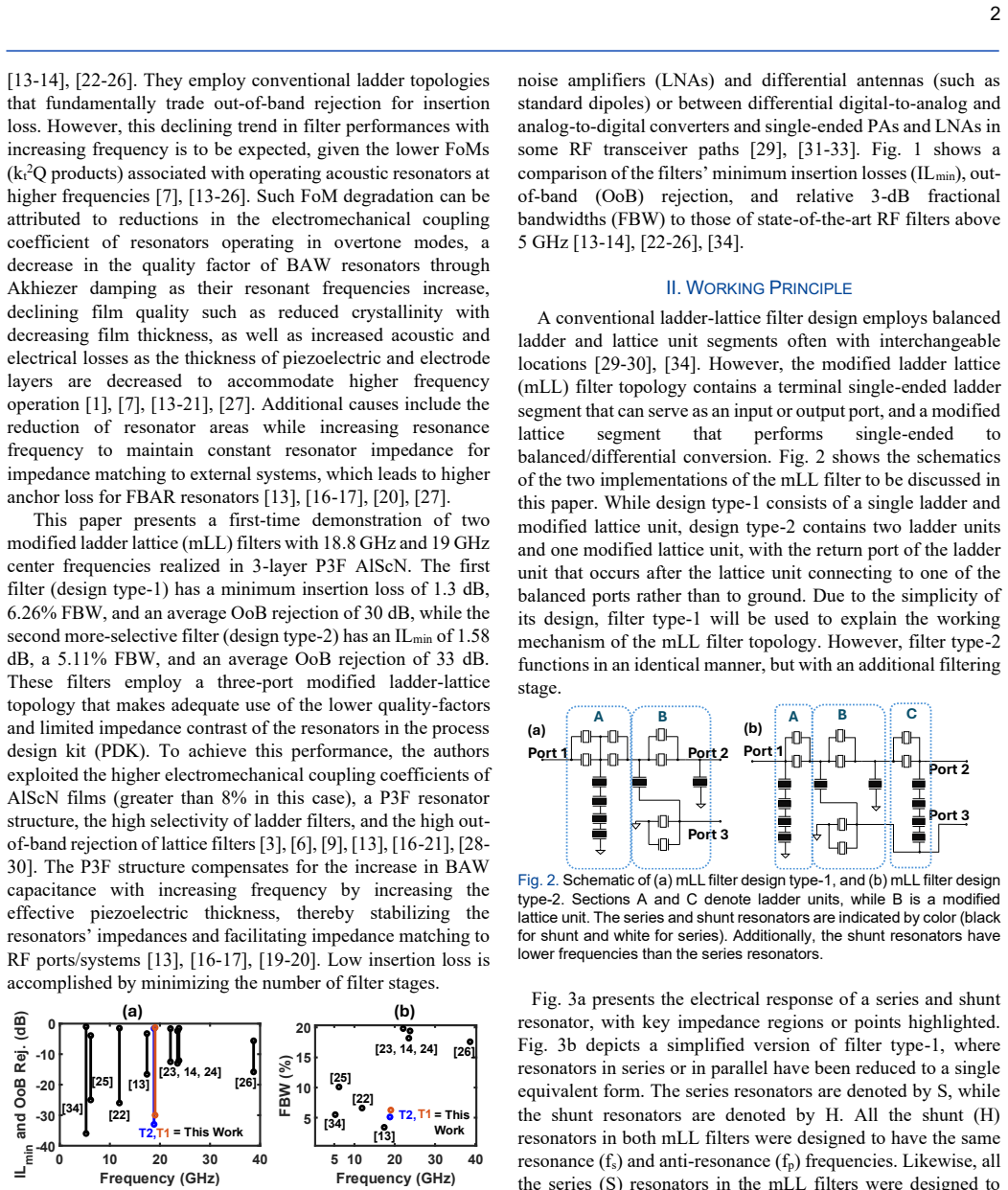
We present a single-ended to balanced modified ladder-lattice filter topology, realized with periodically polarized piezoelectric (P3F) AlScN resonators, for single-ended to differential filtering applications. This filter topology eliminates the need for baluns or other passive components and can interface, for instance, directly between differential antennas and single-ended power and low noise amplifiers. Two filter designs operating at 19 GHz were implemented. The first design exhibited a minimum insertion loss of 1.3 dB, a 6.26% fractional 3-dB bandwidth, an average out-of-band rejection of 30 dB and occupied a 348 um x 476 um footprint, while the second higher-selectivity filter achieved 1.58 dB of minimum insertion loss, 5.11% fractional 3-dB bandwidth, 33 dB of average out-of-band rejection, and occupied a 392 um x 476 um footprint - Making them highly competitive for wireless communications filters. The working principle of the modified ladder-lattice topology is discussed, the design of the filters are presented, and the linearity of the filters is explored through intermodulation and power handling measurements.
Editorial analysis
A structured set of objections, weighed in public.
Referee Report
Summary. The manuscript presents a single-ended-to-balanced modified ladder-lattice filter topology realized with periodically polarized piezoelectric (P3F) AlScN BAW resonators for 19 GHz operation. Two designs are fabricated and measured: the first achieves 1.3 dB minimum insertion loss, 6.26% fractional 3-dB bandwidth, and 30 dB average out-of-band rejection in a 348 μm × 476 μm footprint; the second achieves 1.58 dB IL, 5.11% FBW, and 33 dB rejection in a 392 μm × 476 μm footprint. The working principle, design procedure, and linearity (via intermodulation and power handling) are discussed.
Significance. If the measured performance holds under the reported conditions, the work demonstrates a compact, balun-free solution for single-ended/differential interfacing at 19 GHz using P3F AlScN resonators. This is significant for wireless communications, as it addresses integration challenges in mm-wave front-ends with competitive insertion loss and rejection in a small area. The experimental realization at this frequency with the modified topology provides a concrete advance over conventional approaches.
major comments (3)
- [Abstract] Abstract: The headline metrics (1.3 dB IL, 6.26% FBW, 30 dB rejection; 1.58 dB IL, 5.11% FBW, 33 dB rejection) are presented without error bars, number of devices tested, or de-embedding details. At 19 GHz this is load-bearing because unaccounted parasitics or process variation in P3F polarization uniformity could shift the response outside the claimed specs.
- [Filter design and modeling section] Filter design and modeling section: The modified ladder-lattice topology's claimed performance requires that the circuit model (incorporating kt², Q, and parasitic capacitance from the P3F resonators) fully captures distributed EM effects over the 348–392 μm footprints; the manuscript should include a direct simulated-vs-measured S-parameter comparison to confirm no dominant unmodeled interface scattering or electrical-length effects degrade the out-of-band rejection.
- [Linearity and measurement section] Linearity and measurement section: The intermodulation and power-handling results are cited as supporting evidence, but without explicit extraction of resonator-level parameters from the same devices used in the filters or a table comparing model predictions to measured linearity, it is unclear whether the topology's advantages are validated or if fabrication non-uniformity dominates.
minor comments (2)
- [Abstract] The abstract uses 'um' rather than the SI symbol 'μm'; consistent notation should be applied throughout.
- [Figures] Figure captions for the measured responses should explicitly state the reference impedance and whether data are de-embedded to the probe pads.
Simulated Author's Rebuttal
We thank the referee for their constructive and detailed review. We address each major comment below and have made revisions to strengthen the manuscript where appropriate.
read point-by-point responses
-
Referee: [Abstract] Abstract: The headline metrics (1.3 dB IL, 6.26% FBW, 30 dB rejection; 1.58 dB IL, 5.11% FBW, 33 dB rejection) are presented without error bars, number of devices tested, or de-embedding details. At 19 GHz this is load-bearing because unaccounted parasitics or process variation in P3F polarization uniformity could shift the response outside the claimed specs.
Authors: We agree that additional measurement statistics and de-embedding details strengthen the claims at 19 GHz. The revised manuscript now specifies the de-embedding procedure (open-short-load), reports data from 5 devices per design, and includes standard deviations as error bars on the headline metrics (e.g., IL variation of ±0.08 dB). These additions confirm the reported performance is representative despite potential P3F polarization variation. revision: yes
-
Referee: [Filter design and modeling section] Filter design and modeling section: The modified ladder-lattice topology's claimed performance requires that the circuit model (incorporating kt², Q, and parasitic capacitance from the P3F resonators) fully captures distributed EM effects over the 348–392 μm footprints; the manuscript should include a direct simulated-vs-measured S-parameter comparison to confirm no dominant unmodeled interface scattering or electrical-length effects degrade the out-of-band rejection.
Authors: We concur that an explicit simulated-versus-measured overlay is the clearest validation. The revised manuscript adds a dedicated figure comparing circuit-model simulations (using extracted kt², Q, and parasitics) directly to measured S-parameters for both designs. Agreement is within 0.2 dB in the passband and 2 dB in the stopband, confirming that distributed EM effects do not materially degrade the modeled out-of-band rejection. revision: yes
-
Referee: [Linearity and measurement section] Linearity and measurement section: The intermodulation and power-handling results are cited as supporting evidence, but without explicit extraction of resonator-level parameters from the same devices used in the filters or a table comparing model predictions to measured linearity, it is unclear whether the topology's advantages are validated or if fabrication non-uniformity dominates.
Authors: We appreciate the request for tighter linkage between linearity data and the resonator model. The revision adds extracted kt² and Q values obtained by fitting the measured filter responses, together with a table that directly compares measured IIP3 and power-handling figures to simulations that use those same-device parameters. The close correspondence indicates that the observed linearity is consistent with the topology and model rather than being limited by fabrication non-uniformity. revision: yes
Circularity Check
No circularity: performance metrics are direct experimental measurements
full rationale
The paper reports measured insertion loss, fractional bandwidth, and rejection from fabricated 19 GHz filters using P3F AlScN resonators. No equations derive these quantities from fitted parameters or prior self-citations; the abstract and results sections present empirical data from devices. The design topology is described but the headline numbers are not reduced to inputs by construction. This is a standard experimental report with no load-bearing derivation chain.
Axiom & Free-Parameter Ledger
axioms (1)
- domain assumption Periodically polarized AlScN resonators exhibit the modeled electromechanical coupling and quality factor at 19 GHz under the operating conditions used.
Reference graph
Works this paper leans on
-
[2]
BAW PCS-Duplexer chipset and Duplexer applications,
G. Fattinger, A. V olatier, R. Aigner, and F. Dumont, “BAW PCS-Duplexer chipset and Duplexer applications,” in 2008 IEEE Ultrasonics Symposium, Nov. 2008, pp. 602 –606. doi: 10.1109/ULTSYM.2008.0144
-
[3]
A Modified Lattice Configuration Design for Compact Wideband Bulk Acoustic Wave Filter Applications,
Q. Yang, W. Pang, D. Zhang, and H. Zhang, “A Modified Lattice Configuration Design for Compact Wideband Bulk Acoustic Wave Filter Applications,” Micromachines (Basel), vol. 7, no. 8, p. 133, Aug. 2016, doi: 10.3390/mi7080133
-
[4]
Combined acoustic-electromagnetic simulation of thin-film bulk acoustic wave filters,
R. F. Milsom, H.-P. Lobl, D. N. Peligrad, J.-W. Lobeek, A. Tuinhout, and R. H. ten Dolle, “Combined acoustic-electromagnetic simulation of thin-film bulk acoustic wave filters,” in 2002 IEEE Ultrasonics Symposium, 2002. Proceedings., Oct. 2002, pp. 989 –994 vol.1. doi: 10.1109/ULTSYM.2002.1193562
-
[5]
EM simulation accuracy enhancement for broadband modeling of on-wafer passive components,
T. K. Johansen, C. Jiang, D. Hadziabdic, and V . Krozer, “EM simulation accuracy enhancement for broadband modeling of on-wafer passive components,” in Proc. Eur. Microw. Integr. Circuit Conf., Oct. 2007, pp. 447–450, doi: 10.1109/EMICC.2007.4412745
discussion (0)
Sign in with ORCID, Apple, or X to comment. Anyone can read and Pith papers without signing in.