Multi-Objective Coevolution of Prompts and Templates for Circuit Approximation
Pith reviewed 2026-06-27 05:18 UTC · model grok-4.3
The pith
Co-evolving prompt templates with circuits lets an LLM discover superior 8-bit approximate multipliers.
A machine-rendered reading of the paper's core claim, the machinery that carries it, and where it could break.
Core claim
The paper claims that a co-evolutionary algorithm simultaneously evolving candidate circuits and prompt templates can steer an unmodified LLM to generate modifications that yield 8-bit approximate multipliers with improved error-area trade-offs over those in EvoApproxLib.
What carries the argument
The co-evolutionary algorithm maintaining separate populations for circuits and for prompt templates that direct LLM-based circuit edits.
If this is right
- Approximate circuit design can be automated for error-resilient applications without expert intervention.
- Multi-objective optimization becomes feasible for other circuit components using similar LLM guidance.
- The method scales to different target objectives like power or latency in addition to error and area.
- Library-based approximate designs can be surpassed by dynamically evolved prompts and circuits.
Where Pith is reading between the lines
- LLMs might serve as general-purpose design assistants in hardware when paired with evolutionary steering.
- Similar co-evolution could apply to prompt engineering in other technical domains beyond circuits.
- Testing on larger multipliers or different arithmetic units would reveal the method's broader applicability.
Load-bearing premise
The off-the-shelf LLM can produce useful circuit changes when directed by the evolved prompt templates.
What would settle it
A run of the algorithm that fails to produce any 8-bit multiplier improving the error-area Pareto front of EvoApproxLib across the tested objectives.
Figures
read the original abstract
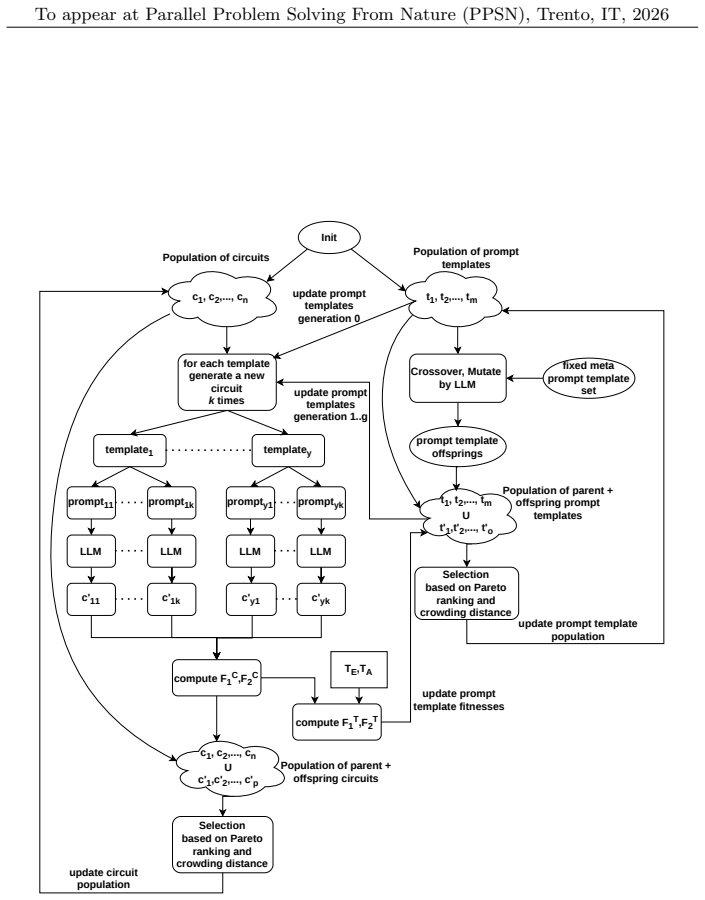
Approximate multipliers deliberately relax computational accuracy to achieve gains in power efficiency, latency, and silicon area, which makes them well-suited for error-resilient applications such as neural networks. In this work, we introduce a co-evolutionary algorithm that leverages an off-the-shelf large language model (LLM) without requiring domain-specific training to automate the design of optimized 8-bit approximate multipliers. The approach simultaneously evolves a population of candidate circuits and a population of prompt templates that steer LLM-driven modifications. Experimental results for several target design objectives demonstrate that the proposed method discovers approximate multipliers with improved error-area trade-offs compared to highly optimized circuits from the EvoApproxLib library.
Editorial analysis
A structured set of objections, weighed in public.
Referee Report
Summary. The manuscript introduces a co-evolutionary algorithm that simultaneously evolves populations of 8-bit approximate multiplier circuits and prompt templates to steer modifications generated by an off-the-shelf LLM. The central experimental claim is that the resulting circuits achieve improved error-area trade-offs relative to entries from the EvoApproxLib library across multiple design objectives.
Significance. If the experimental claims are substantiated with reproducible protocols, the work would demonstrate a practical method for using prompt evolution to adapt general-purpose LLMs to circuit approximation tasks without domain-specific fine-tuning. This could extend evolutionary design techniques into LLM-augmented hardware optimization and provide a template for coevolving steering mechanisms in other engineering domains.
major comments (2)
- [Section 4] Section 4 (Experimental Evaluation): the manuscript reports superior error-area trade-offs but does not specify the number of independent evolutionary runs, the statistical tests applied to the Pareto fronts, or the precise definitions and measurement procedures for the error and area metrics used in the comparison with EvoApproxLib. These omissions prevent verification of the central claim.
- [Section 3.2] Section 3.2 (LLM Integration): the mechanism by which evolved prompt templates are applied to generate circuit modifications, including the exact format of LLM outputs, the parsing of those outputs into netlist changes, and any rejection or repair steps, is described at a level that does not permit independent reproduction of the reported circuits.
minor comments (2)
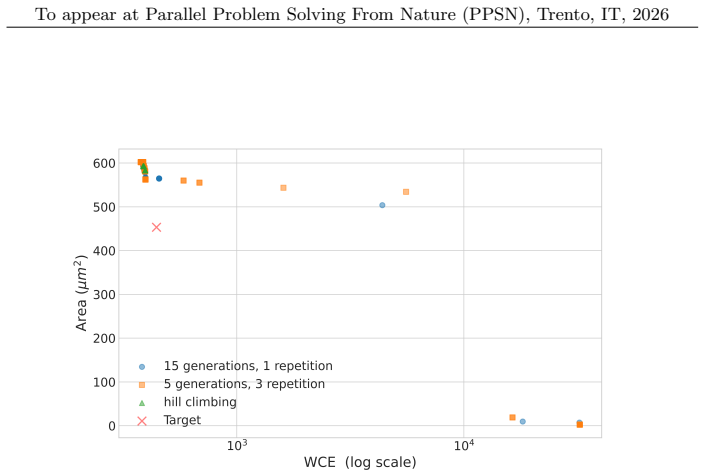
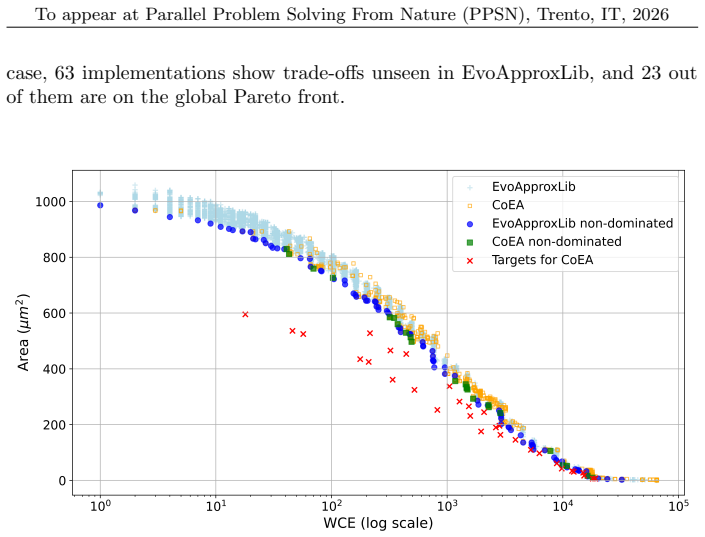
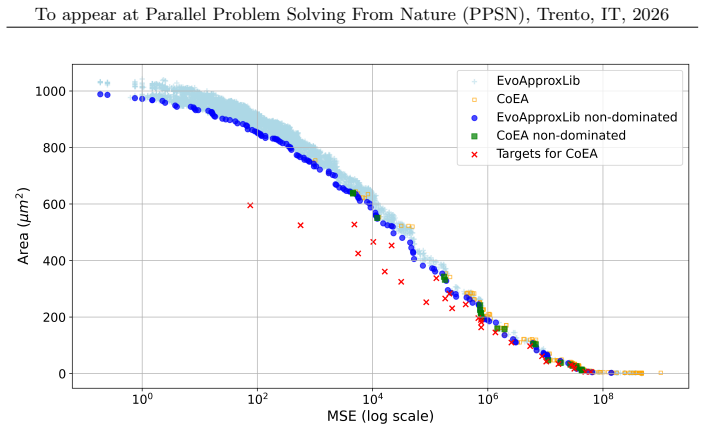
- [Figure 3] Figure 3: axis labels and legend entries use inconsistent abbreviations for error metrics; standardize notation with the definitions given in Section 2.
- [Introduction] The reference list omits the original EvoApproxLib publication; add the citation when first mentioning the library in the introduction.
Simulated Author's Rebuttal
We thank the referee for the constructive comments, which identify key gaps in reproducibility. We will revise the manuscript to address both points and provide the requested details.
read point-by-point responses
-
Referee: [Section 4] Section 4 (Experimental Evaluation): the manuscript reports superior error-area trade-offs but does not specify the number of independent evolutionary runs, the statistical tests applied to the Pareto fronts, or the precise definitions and measurement procedures for the error and area metrics used in the comparison with EvoApproxLib. These omissions prevent verification of the central claim.
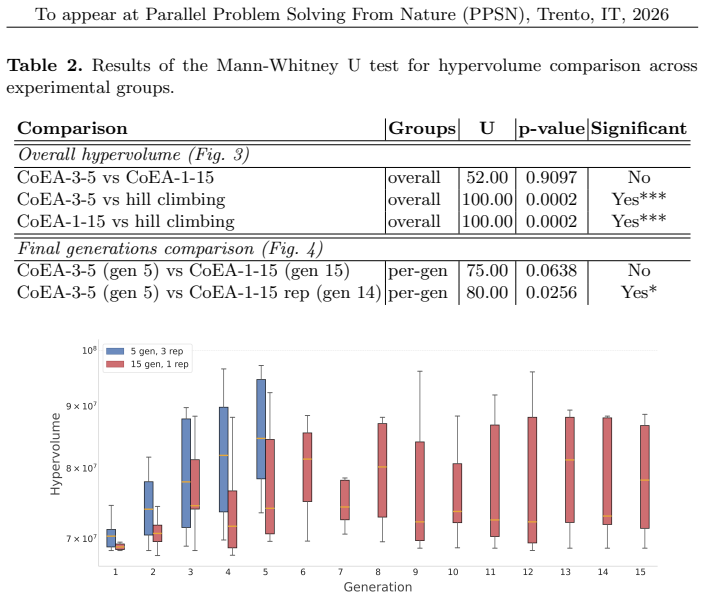
Authors: We agree these details are necessary. The revised Section 4 will report that 30 independent runs were executed per objective, that the Mann-Whitney U test was used to assess statistical significance of Pareto-front differences, and that error is defined as mean absolute relative error obtained by exhaustive enumeration over all 65536 input combinations while area is the gate count reported by the ABC synthesis tool under the identical script used for EvoApproxLib. revision: yes
-
Referee: [Section 3.2] Section 3.2 (LLM Integration): the mechanism by which evolved prompt templates are applied to generate circuit modifications, including the exact format of LLM outputs, the parsing of those outputs into netlist changes, and any rejection or repair steps, is described at a level that does not permit independent reproduction of the reported circuits.
Authors: We concur that the current description is insufficient for reproduction. The revised Section 3.2 will include the precise prompt-template syntax, the expected LLM output format (Verilog module fragments), the deterministic parser that converts outputs into netlist edits, and the validation/repair procedure that discards syntactically invalid edits and retries the LLM call up to three times before falling back to the parent circuit. revision: yes
Circularity Check
No significant circularity
full rationale
The paper introduces a co-evolutionary algorithm that jointly evolves circuits and LLM prompt templates for 8-bit approximate multiplier design, then reports empirical error-area trade-offs against the external EvoApproxLib library. No derivation step reduces by construction to fitted inputs, self-definitions, or load-bearing self-citations; the central claim is an experimental comparison that remains independently verifiable. This matches the reader's assessment of minimal circularity risk.
Axiom & Free-Parameter Ledger
Reference graph
Works this paper leans on
-
[1]
Armeniakos, G., Zervakis, G., Soudris, D., Henkel, J.: Hardware approximate tech- niques for deep neural network accelerators: A survey. ACM Comput. Surv.55(4), 83:1–83:36 (2023). https://doi.org/10.1145/3527156
-
[2]
Caetano, V., Teixeira, M.C., Pappa, G.L.: Symbolic regression trees as embedded representations. In: Proc. of the Genetic and Evolutionary Computation Confer- ence. pp. 411–419. ACM (2023). https://doi.org/10.1145/3583131.3590423
-
[3]
In: Proc
Ceska, M., Matyas, J., Mrazek, V., Sekanina, L., Vasicek, Z., Vojnar, T.: Approxi- mating complex arithmetic circuits with formal error guarantees: 32-bit multipliers accomplished. In: Proc. of 36th IEEE/ACM Int. Conf. On Computer Aided Design. pp. 416–423. IEEE (2017)
2017
-
[4]
A fast and elitist multiobjective genetic algorithm: NSGA-II
Deb, K., et al.: A fast and elitist multiobjective genetic algorithm: NSGA- II. IEEE Transactions on Evolutionary Computation6(2), 182–197 (2002). https://doi.org/10.1109/4235.996017
-
[5]
Hemberg, E., Jorgensen, S., O’Reilly, U.M.: Survey of Genetic Programming and Large Language Models, pp. 67–86. Springer Nature Singapore (2025). https://doi.org/10.1007/978-981-96-0077-9˙4
-
[6]
In: 7th ACM/IEEE Symposium on Machine Learning for CAD
Hong, C., Roberts, B., An, H., Um, A., Ratan, A., Shao, Y.S.: hdl2v: A code translation dataset for enhanced LLM verilog generation. In: 7th ACM/IEEE Symposium on Machine Learning for CAD. pp. 1–8. IEEE (2025). https://doi.org/10.1109/MLCAD65511.2025.11189055
-
[7]
Hrbacek, R., Drahosova, M.: Coevolutionary cartesian genetic programming in FPGA. In: Advances in Artificial Life, ECAL 2013, Proceedings of the Twelfth Eu- ropean Conference on the Synthesis and Simulation of Living Systems. pp. 431–438. MIT Press, Cambridge (2013). https://doi.org/10.7551/978-0-262-31709-2-ch062
-
[8]
In: Reda, S., Shafique, M
Jiang, H., Liu, L., Lombardi, F., Han, J.: Approximate arithmetic circuits: Design and evaluation. In: Reda, S., Shafique, M. (eds.) Approximate Circuits, Method- ologies and CAD, pp. 67–98. Springer (2019)
2019
-
[9]
Jiang, H., Santiago, F.J.H., Mo, H., Liu, L., Han, J.: Approximate arithmetic circuits: A survey, characterization, and recent applications. Proc. IEEE108(12), 2108–2135 (2020)
2020
-
[10]
Liu, W., Xu, J., Wang, D., Lombardi, F.: Design of approximate logarithmic mul- tipliers. In: Proc. of the Great Lakes Symposium on VLSI. p. 47–52. ACM (2017). https://doi.org/10.1145/3060403.3060409
-
[11]
In: Proc of the Genetic and Evolutionary Computation Conference
Liventsev, V., Grishina, A., H¨ arm¨ a, A., Moonen, L.: Fully autonomous programming with large language models. In: Proc of the Genetic and Evolutionary Computation Conference. pp. 1146–1155. ACM (2023). https://doi.org/10.1145/3583131.3590481
-
[12]
In: Design, Automation & Test in Europe Conference & Exhibi- tion
Mrazek, V., Hrbacek, R., Vasicek, Z., Sekanina, L.: Evoapprox8b: Library of ap- proximate adders and multipliers for circuit design and benchmarking of approxi- mation methods. In: Design, Automation & Test in Europe Conference & Exhibi- tion. pp. 258–261 (2017). https://doi.org/10.23919/DATE.2017.7926993 To appear at Parallel Problem Solving From Nature ...
-
[13]
IEEE Journal on Emerg- ing and Selected Topics in Circuits and Systems10(4), 406–418 (2020)
Mrazek, V., Sekanina, L., Vasicek, Z.: Libraries of approximate circuits: Auto- mated design and application in CNN accelerators. IEEE Journal on Emerg- ing and Selected Topics in Circuits and Systems10(4), 406–418 (2020). https://doi.org/10.1109/JETCAS.2020.3032495
-
[14]
Coevolutionary Principles, pp
Popovici, E., Bucci, A., Wiegand, R.P., De Jong, E.D.: Handbook of Natural Com- puting, chap. Coevolutionary Principles, pp. 987–1033. Springer (2012)
2012
-
[15]
Evolutionary computation8(1), 1–29 (2000)
Potter, M.A., De Jong, K.A.: Cooperative coevolution: An architecture for evolving coadapted subcomponents. Evolutionary computation8(1), 1–29 (2000)
2000
-
[16]
Shem-Tov, E., Sipper, M., Elyasaf, A.: Bert mutation: Deep transformer model for masked uniform mutation in genetic programming. Mathematics13(5) (2025). https://doi.org/10.3390/math13050779
-
[17]
Sobania, D., Petke, J., Briesch, M., Rothlauf, F.: A comparison of large language models and genetic programming for program synthesis. IEEE Trans. Evol. Com- put.29(4), 1434–1448 (2025). https://doi.org/10.1109/TEVC.2024.3410873
-
[18]
ACM Comput
Stanley-Marbell, P., Alaghi, A., Carbin, M., Darulova, E., Dolecek, L., Gerstlauer, A., Gillani, G., Jevdjic, D., Moreau, T., Cacciotti, M., Daglis, A., Jerger, N.E., Falsafi, B., Misailovic, S., Sampson, A., Zufferey, D.: Exploiting errors for efficiency: A survey from circuits to applications. ACM Comput. Surv.53(3) (2020)
2020
-
[19]
Team, Q.: Qwen3 technical report (2025), https://arxiv.org/abs/2505.09388
work page internal anchor Pith review Pith/arXiv arXiv 2025
-
[20]
Teixeira, M.C., Pappa, G.L.: Transformers as surrogate models for genetic pro- gramming in automl tasks. In: Proc. of the Genetic and Evolutionary Computation Conference. p. 472–480. ACM (2025). https://doi.org/10.1145/3712256.3726396
-
[21]
Verigen: A large language model for verilog code generation,
Thakur, S., Ahmad, B., Pearce, H., Tan, B., Dolan-Gavitt, B., Karri, R., Garg, S.: Verigen: A large language model for verilog code generation. ACM Trans. Design Autom. Electr. Syst.29(3), 46:1–46:31 (2024). https://doi.org/10.1145/3643681
-
[22]
IEEE Transactions on Evolutionary Computation29(2), 534–554 (2025)
Wu, X., Wu, S.H., Wu, J., Feng, L., Tan, K.C.: Evolutionary computation in the era of large language model: Survey and roadmap. IEEE Transactions on Evolutionary Computation29(2), 534–554 (2025). https://doi.org/10.1109/TEVC.2024.3506731
-
[23]
Xie, L., Zhang, Y., Tang, Z., Chung, E., Li, G., Wang, Z.: Co-evolution of large language models and configuration strategies to enhance surrogate- assisted evolutionary algorithm. In: Proc. of the 31st ACM SIGKDD Conf. on Knowledge Discovery and Data Mining V.2. p. 3321–3332. ACM (2025). https://doi.org/10.1145/3711896.3736882
-
[24]
In: 2025 IEEE 38th International System-on-Chip Conference (SOCC)
Xu, K., Schwachhofer, D., Blocklove, J., Polian, I., Domanski, P., Pfl¨ uger, D., Garg, S., Karri, R., Sinanoglu, O., Knechtel, J., Zhao, Z., Schlichtmann, U., Li, B.: Large language models (LLMs) for electronic design automation (EDA) : Spe- cial session paper. In: 2025 IEEE 38th International System-on-Chip Conference (SOCC). pp. 1–6 (2025). https://doi...
-
[25]
IEEE Journal on Emerging and Selected Topics in Circuits and Systems15(2), 349–360 (2025)
Yi, S., Zuo, W., Wu, H., Dai, R., Qian, W., Chen, J.: GPTAC: Domain-specific gen- erative pre-trained model for approximate circuit design exploration. IEEE Journal on Emerging and Selected Topics in Circuits and Systems15(2), 349–360 (2025)
2025
-
[26]
Zarb, D.V., Parks, G.T., Kipouros, T.: Program synthesis with LLM- predicted minimal specialized grammars. In: Proc. of the Genetic and Evolutionary Computation Conference. pp. 1072–1080. ACM (2025). https://doi.org/10.1145/3712256.3726430
discussion (0)
Sign in with ORCID, Apple, or X to comment. Anyone can read and Pith papers without signing in.