REVIEW 5 major objections 8 minor 48 references
Encapsulated Composition of Text-to-Image and Text-to-Video Models for High-Quality Video Synthesis
T0 review · 5 major / 8 minor · reviewed 2026-08-06 · deepseek-v4-flash
Pith's one-line read EVS composes a pre-trained text-to-image model with a text-to-video model into a training-free post-processor that sharpens frames and stabilizes motion in generated videos, cutting inference time by 1.6$\times$--4.5$\times$.
desk verdict EVS is a genuinely new, training-free composition trick that improves T2V imaging quality at a real speedup, but the evaluation is thin and the clean-latent bridge is plausible yet untested. read the letter →
The pith
A machine-rendered reading of the paper's core claim, the machinery that carries it, and where it could break.
The reading
What carries the argument
The load-bearing device is the encapsulated block $[\mathrm{T2V}]$ inside a $\mathrm{T2I} \to [\mathrm{T2V}] \to \mathrm{T2I}$ denoising pipeline. The T2I phase treats input frames as out-of-distribution samples and applies a noising-denoising repair, and at timestep $t_{\mathrm{T2V}}$ the predicted clean latent serves as a bridge into a short T2V noising-denoising pass (Eqs. 8--9), after which the result is re-noised and the T2I process finishes. Selective Feature Injection, with blending rate $\gamma$, replaces the denoising queries with a mix of inversion and current queries while injecting inversion keys and values in chosen U-Net layers, so the pipeline keeps spatial style and detail while gaining temporal consistency.
What would settle it
Take a set of generated videos, run only the T2I part of EVS to an intermediate timestep, and feed the resulting predicted clean latent into the T2V denoising block with varying noising strengths. If no setting improves both a per-frame fidelity score (e.g., PSNR against the best T2I frame) and a motion-smoothness score (e.g., VBench Motion Smoothness), then the claimed clean-latent bridge does not actually align the two model distributions.
Extended reading notes
Core claim
The paper's central claim is that a well-trained T2I diffusion model and a T2V diffusion model can be composed in a single denoising run without retraining, with each doing what it is good at. The T2I phase restores imaging quality by SDEdit-style noising and denoising of the video latents; the T2V model is reduced to a temporal-only prior, inserted once at an intermediate timestep through the predicted clean latent, so it stabilizes motion without dragging the final appearance back down to the T2V model's imaging level. Selective feature injection from DDIM inversion preserves the spatial details the T2I model just added while letting the shared autoencoder bridge the two latent distributions. The authors validate the composition on videos from VideoCrafter-2.0 and AnimateDiff-V2, reporting higher overall quality scores on imaging and consistency metrics and a 1.6$\times$--4.5$\times$ inference speedup.
Load-bearing premise
The load-bearing premise is that the image model's cleaned snapshot of the video frames, taken at an intermediate step, is close enough to what the video model normally expects that a short video-model denoising pass can remove flicker without erasing the detail the image model just added.
Editorial extensions
If this is right
- Existing text-to-video outputs can be post-processed with EVS with no retraining or fine-tuning, using the same prompt and a compatible pair of public T2I and T2V models.
- Flicker and artifacts from frame-wise T2I refinement are suppressed by one short T2V denoising pass, avoiding the optical-flow or nearest-neighbour correspondence estimates that earlier refiners depend on.
- Final imaging quality tracks the T2I model rather than reverting to the T2V level, because the T2V block is applied once at an intermediate timestep instead of at the end of the pipeline.
- The same procedure improves both local inconsistency (VideoCrafter-2.0-style flicker in details) and global inconsistency (AnimateDiff-V2-style color shifting), according to the paper's VBench-based measurements.
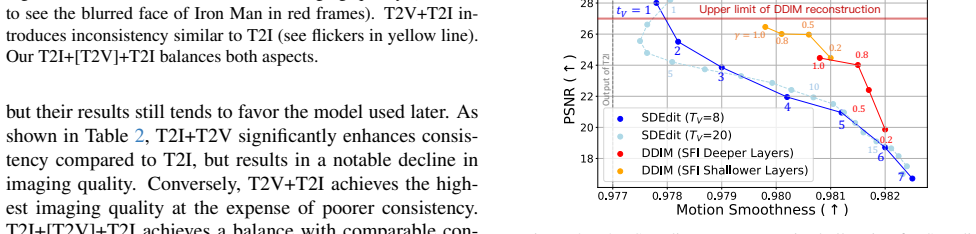
- Using DDIM inversion with selective feature injection, out-of-domain styles survive the temporal smoothing better than with SDEdit at matched motion smoothness.
Reading between the lines
- The paper tests one T2I model and two T2V backbones; in our reading, whether EVS generalizes to other model pairs is an extrapolation, and the clean-latent compatibility between the two autoencoders is the deciding factor.
- A natural stress test is to measure the distribution gap between the T2I predicted clean latents and the T2V native clean latents; if that gap predicts quality loss, the insertion timestep could be chosen adaptively rather than fixed.
- We see the selective feature injection as a continuous temporal-consistency dial (blending rate and injected layer depth) that could be reused in video editing beyond generation, since it separates spatial style from motion prior.
- Because the paper inserts the T2V block only once, longer or more dynamic videos may need later or repeated insertions; we would test whether a single block still holds as clip length and motion amplitude grow.
Editorial analysis
A structured set of objections, weighed in public.
Referee Report
Summary. The manuscript proposes EVS, a training-free pipeline that composes a pre-trained T2I diffusion model and a T2V model to refine videos produced by base generators such as VideoCrafter-2.0 and AnimateDiff-V2. The method (Algorithm 1) runs T2I noising/denoising, pauses at an intermediate timestep t_T2V, treats the predicted clean latent z^I_0 as a bridge into a T2V block (DDIM inversion followed by n_V denoising steps), and then returns to T2I for the remaining steps. Selective Feature Injection (SFI, Eq. (11)) injects DDIM-inversion attention features to preserve spatial detail while exposing the latent to the T2V temporal prior. Experiments on a 186-video VBench subset compare against Rerender-A-Video, FRESCO, TokenFlow, BIVDiff, and AnyV2V, reporting improved aggregated imaging/consistency scores and 1.6x-4.5x speedups. The paper includes the algorithm, ablations, hyperparameter discussion, and a link to source code.
Significance. EVS is a practically appealing instantiation of a useful idea: rather than choosing between frame-wise T2I refinement and T2V temporal smoothing, it alternates the two within one denoising trajectory and uses DDIM-inversion features to limit spatial drift. If the reported numbers hold with proper statistical support, the method would be a strong training-free baseline for video post-processing, with the additional merit of releasing code and avoiding optical-flow/NNF dependencies. The central limitation is that the current evidence is a single-run, single-subset evaluation whose key distributional bridge is asserted rather than quantified; the contribution is therefore plausible but not yet fully established. The paper does not claim formal proofs, but the pseudocode and ablation structure make the method easy to reproduce and extend.
major comments (5)
- [Section 3.2, Eqs. (8)-(9), Algorithm 1] Equations (8)-(9) hinge on the claim that the T2I-predicted clean latent z^I_0 = z_{t_T2V->0} is a valid starting point for T2V noising/denoising because both models share a frame-wise autoencoder. Shared VAE only places both clean-latent spaces in the same coordinate frame; it does not make the set of T2I denoising estimates coincide with the T2V clean-latent distribution. z^I_0 is an estimate, and for out-of-distribution inputs it can be blurry or contain artifacts, as the paper itself shows for limited-step reconstruction in Figure 4. The paper does not quantify how far z^I_0 is from the T2V clean-latent manifold, nor does it report content-preservation or reconstruction error as a function of t_V, n_V, or t_T2V. Without such a failure boundary, the central claim that EVS leverages the strengths of both models is not established: if the bridge is lossy for a substantial fraction of inputs, the downstream T2V block can erase or distort content and the quality improvement collapses. A concrete addition would be measuring the distance (or downstream FID/CLIP/PSNR) between z^I_0 and native T2V clean latents, plus an ablation with deliberately degraded z^I_0.
- [Table 1, Section 4.2] All metrics in Table 1 are point estimates from a single evaluation; no seeds, no number of runs, and no error bars are reported. Several differences that the text interprets as improvements are within the rounding granularity of the table (e.g., VC2 MS: Ours 0.9881 vs. BIVDiff 0.9885; VC2 SC: Ours 0.9808 vs. BIVDiff 0.9800; AD2 MS: BIVDiff 0.9758 vs. Ours 0.9825 but no variance). Without variance estimates or at least multiple seeds, the significance of the headline highest overall score cannot be assessed. The authors should report mean plus/minus standard deviation over at least three runs and state whether the differences are statistically meaningful.
- [Section 4.1, Dataset] The evaluation is restricted to the VBench Overall Consistency subset: 93 prompts, one video id per model, 186 videos total. This is a narrow slice of the VBench suite and does not cover many dimensions shown in Figure 2 (appearance style, dynamic degree, multiple-object scenes, etc.). The abstract and conclusion claim improved imaging and motion quality generally, but the evidence supports only this subset. The authors should either broaden the evaluation to additional VBench subsets or substantially soften the generality claim. At minimum, the captions and conclusion should state the subset restriction.
- [Section 4.3, Hyperparameter Analysis] Algorithm 1 has four user-set hyperparameters (t_I, t_V, t_T2V, n_V) in addition to SFIs injected layers and gamma. The main text gives only qualitative trends in Figures 7 and 8, and the claimed full combination is deferred to the supplementary material. If these values were selected on the same 186 test videos, the reported scores are upper bounds rather than expected performance. The paper should report the hyperparameter grid, the selection criterion, and a sensitivity table (or at least a validation split) so readers can judge how robust the method is to the manual choices.
- [Section 3.2, Eq. (11), SFI] The paper describes SFI as leveraging the temporal-only prior of the T2V model. The mechanism of injecting K_inv and V_inv and blending Q_inv with gamma is plausible, but the evidence in Figure 8 is only a PSNR-versus-MotionSmoothness tradeoff curve. That does not establish that the injected features carry zero spatial prior; it only shows that some balance point has higher PSNR than SDEdit at comparable smoothness. An ablation that separates spatial leakage from temporal smoothing (e.g., measuring appearance change with a style/color metric, or comparing SFI against full-feature injection at matched PSNR) would be needed to support the temporal-only claim, which is load-bearing for the method's stated advantage over BIVDiff or SDEdit-style composition.
minor comments (8)
- [Section 3.1] There is a typo in 'to obainztI'; it should read 'to obtain z_t_I'.
- [Section 4.1] The text says 'AnyV2V applys T2I model'; change 'applys' to 'applies'.
- [Figure 8 caption] The caption says 'are two optical points'; this should be 'are two optimal points'.
- [Equations (1)-(3)] Equation (1) uses \bar{\alpha}_t while Eq. (2) uses \alpha_{t-1} without defining the relationship between the two; please clarify the noise schedule notation.
- [Algorithm 1] The algorithm overwrites the input variable z0 and then returns 'zIVI_0 := z0', which is confusing; also, the DDIM-inv operation is not defined in the pseudocode, and the text should specify that it collects {f, QKV}_inv for SFI.
- [Figure 4] The first-row caption appears to contain 'T=500' while the text says T=50; please correct the inconsistency.
- [Table 1] Please report the hardware and timing setup, and state explicitly which baseline each speedup factor in the 1.6x-4.5x range is measured against.
- [Figure 2] The min-max normalization used for the radar-style scores is not specified; include the formula and normalization range so readers can reproduce the visualization.
Circularity Check
No significant circularity: EVS is an empirical composition system, and its self-citations are not load-bearing.
full rationale
The central claims of EVS are empirical: improved imaging and motion quality and 1.6x-4.5x speedup are measured on VBench, DOVER, and AP against external baselines (Rerender-A-Video, FRESCO, TokenFlow, BIVDiff, AnyV2V). Equations (1)-(11) and Algorithm 1 define the composition procedure rather than deriving a result from its conclusion; hyperparameters such as tT2V, tV, and nV are explored in Section 4.3, not fitted to a target and then renamed as predictions. The clean-latent bridge in Eqs. (8)-(9) relies on the assumption that predicted T2I clean latents are compatible with the T2V model because both share a frame-wise autoencoder; the paper says zI0 'aligns well with the distribution of clean latent representations in both T2I and T2V models' (Sec. 3.2), but no failure boundary is quantified. This is a genuine correctness and robustness risk, but it is not circularity, because the paper does not use that assumption to deduce the quality improvement; if the bridge fails on a significant fraction of inputs, the empirical claim simply fails. The self-citations [5], [20], and [21] are minor. [20] and [21] support the layer-role hypotheses behind Selective Feature Injection, but those hypotheses are also supported by external references [4] and [38] and by the paper's own probing experiments (Figure 8), so the method does not reduce to a self-citation chain. No renamed known result, no imported uniqueness theorem, and no equation-level equivalence between input and output were found.
Assumptions & free parameters
free parameters (6)
- t_I (T2I noising timestep) =
20 (s_I=0.4, T_I=50)
- t_T2V (insertion timestep of T2V block) =
not stated; ablated over {3,6,12} in Fig. 7
- t_V (T2V noising timestep) =
likely 8 (AnimateDiff-Lightning default T_V=8)
- n_V (number of T2V denoising steps) =
not stated
- gamma (Q blending rate in SFI) =
0.5 (shallow layers) or 0.8 (deep layers)
- injected_layers (U-Net layers for K/V injection and Q blending) =
shallow vs deep layers, empirically chosen per case
assumptions (4)
- domain assumption T2I and T2V models share a frame-wise autoencoder, so clean latents z0 live in the same distributional space.
- domain assumption Self-attention QK^T at deep layers encodes structure, V encodes style/color, and shallower layers encode texture, so injecting selected K/V preserves imaging information.
- domain assumption DDIM inversion with enough steps reconstructs out-of-distribution images; with limited steps, the diffusion prior can self-rectify low-quality images.
- ad hoc to paper SFI can isolate the temporal prior of the T2V model without spatial degradation.
Cite this review
Pith. "Pith review of Encapsulated Composition of Text-to-Image and Text-to-Video Models for High-Quality Video Synthesis." pith.science (2026). https://pith.science/paper/ZRCIDZ7N
@misc{pith2026250713753,
  author       = {Pith},
  title        = {Pith review of: Encapsulated Composition of Text-to-Image and Text-to-Video Models for High-Quality Video Synthesis},
  year         = {2026},
  howpublished = {\url{https://pith.science/paper/ZRCIDZ7N}},
  note         = {Machine review of arXiv:2507.13753}
}
read the original abstract
In recent years, large text-to-video (T2V) synthesis models have garnered considerable attention for their abilities to generate videos from textual descriptions. However, achieving both high imaging quality and effective motion representation remains a significant challenge for these T2V models. Existing approaches often adapt pre-trained text-to-image (T2I) models to refine video frames, leading to issues such as flickering and artifacts due to inconsistencies across frames. In this paper, we introduce EVS, a training-free Encapsulated Video Synthesizer that composes T2I and T2V models to enhance both visual fidelity and motion smoothness of generated videos. Our approach utilizes a well-trained diffusion-based T2I model to refine low-quality video frames by treating them as out-of-distribution samples, effectively optimizing them with noising and denoising steps. Meanwhile, we employ T2V backbones to ensure consistent motion dynamics. By encapsulating the T2V temporal-only prior into the T2I generation process, EVS successfully leverages the strengths of both types of models, resulting in videos of improved imaging and motion quality. Experimental results validate the effectiveness of our approach compared to previous approaches. Our composition process also leads to a significant improvement of 1.6x-4.5x speedup in inference time. Source codes: https://github.com/Tonniia/EVS.
Figures


Figures from the paper (4 more)


Reference graph
Works this paper leans on
-
[1]
Emerg- ing properties in self-supervised vision transformers
Mathilde Caron, Hugo Touvron, Ishan Misra, Herv ´e J´egou, Julien Mairal, Piotr Bojanowski, and Armand Joulin. Emerg- ing properties in self-supervised vision transformers. In Pro- ceedings of IEEE/CVF international conference on computer vision, pages 9650–9660, 2021. 6
work page 2021
-
[2]
Duygu Ceylan, Chun-Hao P. Huang, and Niloy J. Mitra. Pix2video: Video editing using image diffusion. In Proceed- ings of IEEE/CVF International Conference on Computer Vi- sion (ICCV), pages 23206–23217, 2023. 3
work page 2023
-
[3]
Videocrafter2: Overcoming data limitations for high-quality video diffusion models
Haoxin Chen, Yong Zhang, Xiaodong Cun, Menghan Xia, Xintao Wang, Chao Weng, and Ying Shan. Videocrafter2: Overcoming data limitations for high-quality video diffusion models. In Proceedings of IEEE/CVF Conference on Com- puter Vision and Pattern Recognition , pages 7310–7320,
-
[4]
Jiwoo Chung, Sangeek Hyun, and Jae-Pil Heo. Style in- jection in diffusion: A training-free approach for adapting large-scale diffusion models for style transfer. In Proceed- ings of IEEE/CVF Conference on Computer Vision and Pat- tern Recognition, pages 8795–8805, 2024. 4, 5
work page 2024
-
[5]
Diffsynth: La- tent in-iteration deflickering for realistic video synthesis
Zhongjie Duan, Lizhou You, Chengyu Wang, Cen Chen, Zi- heng Wu, Weining Qian, and Jun Huang. Diffsynth: La- tent in-iteration deflickering for realistic video synthesis. In Proceedings of European Conference on Machine Learn- ing and Principles and Practice of Knowledge Discovery in Databases 2024, pages 332–347. Springer, 2024. 2
work page 2024
-
[6]
Vchitect-2.0: Parallel trans- former for scaling up video diffusion models
Weichen Fan, Chenyang Si, Junhao Song, Zhenyu Yang, Yinan He, Long Zhuo, Ziqi Huang, Ziyue Dong, Jing- wen He, Dongwei Pan, et al. Vchitect-2.0: Parallel trans- former for scaling up video diffusion models. arXiv preprint arXiv:2501.08453, 2025. 2
arXiv 2025
-
[7]
Tokenflow: Consistent diffusion features for consistent video editing
Michal Geyer, Omer Bar-Tal, Shai Bagon, and Tali Dekel. Tokenflow: Consistent diffusion features for consistent video editing. arXiv preprint arXiv:2307.10373, 2023. 2, 3, 4, 6
arXiv 2023
-
[8]
Animatediff: Animate your personalized text- to-image diffusion models without specific tuning
Yuwei Guo, Ceyuan Yang, Anyi Rao, Zhengyang Liang, Yaohui Wang, Yu Qiao, Maneesh Agrawala, Dahua Lin, and Bo Dai. Animatediff: Animate your personalized text- to-image diffusion models without specific tuning. arXiv preprint arXiv:2307.04725, 2023. 2, 3, 6
arXiv 2023
Show all 48 references
-
[9]
Prompt-to-prompt im- age editing with cross attention control
Amir Hertz, Ron Mokady, Jay Tenenbaum, Kfir Aberman, Yael Pritch, and Daniel Cohen-Or. Prompt-to-prompt im- age editing with cross attention control. arXiv preprint arXiv:2208.01626, 2022. 4
2022 arXiv
-
[10]
Video dif- fusion models
Jonathan Ho, Tim Salimans, Alexey Gritsenko, William Chan, Mohammad Norouzi, and David J Fleet. Video dif- fusion models. Advances in Neural Information Processing Systems, 35:8633–8646, 2022. 2
2022
-
[11]
Videocontrolnet: A motion-guided video-to-video translation framework by using diffusion model with controlnet
Zhihao Hu and Dong Xu. Videocontrolnet: A motion-guided video-to-video translation framework by using diffusion model with controlnet. arXiv preprint arXiv:2307.14073 ,
-
[12]
Vbench: Comprehensive benchmark suite for video generative models
Ziqi Huang, Yinan He, Jiashuo Yu, Fan Zhang, Chenyang Si, Yuming Jiang, Yuanhan Zhang, Tianxing Wu, Qingyang Jin, Nattapol Chanpaisit, et al. Vbench: Comprehensive benchmark suite for video generative models. In Proceed- ings of IEEE/CVF Conference on Computer Vision and Pat- ...
2024
-
[13]
Text2video-zero: Text- to-image diffusion models are zero-shot video generators
Levon Khachatryan, Andranik Movsisyan, Vahram Tade- vosyan, Roberto Henschel, Zhangyang Wang, Shant Navasardyan, and Humphrey Shi. Text2video-zero: Text- to-image diffusion models are zero-shot video generators. In Proceedings of IEEE/CVF International Conference on Computer V...
2023
-
[14]
Hunyuanvideo: A systematic framework for large video generative models
Weijie Kong, Qi Tian, Zijian Zhang, Rox Min, Zuozhuo Dai, Jin Zhou, Jiangfeng Xiong, Xin Li, Bo Wu, Jianwei Zhang, et al. Hunyuanvideo: A systematic framework for large video generative models. arXiv preprint arXiv:2412.03603, 2024. 2
2024 arXiv
-
[15]
Anyv2v: A plug-and-play framework for any video- to-video editing tasks
Max Ku, Cong Wei, Weiming Ren, Huan Yang, and Wenhu Chen. Anyv2v: A plug-and-play framework for any video- to-video editing tasks. arXiv preprint arXiv:2403.14468 ,
-
[16]
Amt: All-pairs multi-field transforms for efficient frame interpolation
Zhen Li, Zuo-Liang Zhu, Ling-Hao Han, Qibin Hou, Chun- Le Guo, and Ming-Ming Cheng. Amt: All-pairs multi-field transforms for efficient frame interpolation. In Proceedings of IEEE/CVF Conference on Computer Vision and Pattern Recognition, pages 9801–9810, 2023. 6
2023
-
[17]
Flowvid: Taming imperfect op- tical flows for consistent video-to-video synthesis
Feng Liang, Bichen Wu, Jialiang Wang, Licheng Yu, Kun- peng Li, Yinan Zhao, Ishan Misra, Jia-Bin Huang, Peizhao Zhang, Peter Vajda, et al. Flowvid: Taming imperfect op- tical flows for consistent video-to-video synthesis. In Pro- ceedings of IEEE/CVF Conference on Computer Vis...
2024
-
[18]
Open-sora plan: Open-source large video generation model
Bin Lin, Yunyang Ge, Xinhua Cheng, Zongjian Li, Bin Zhu, Shaodong Wang, Xianyi He, Yang Ye, Shenghai Yuan, Li- uhan Chen, et al. Open-sora plan: Open-source large video generation model. arXiv preprint arXiv:2412.00131, 2024. 2
2024 arXiv
-
[19]
Animatediff-lightning: Cross-model diffusion distillation
Shanchuan Lin and Xiao Yang. Animatediff-lightning: Cross-model diffusion distillation. arXiv preprint arXiv:2403.12706, 2024. 3, 6
2024 arXiv
-
[20]
Towards understanding cross and self-attention in stable diffusion for text-guided image editing
Bingyan Liu, Chengyu Wang, Tingfeng Cao, Kui Jia, and Jun Huang. Towards understanding cross and self-attention in stable diffusion for text-guided image editing. In Pro- ceedings of IEEE/CVF Conference on Computer Vision and Pattern Recognition, pages 7817–7826, 2024. 5
2024
-
[21]
At- tentive linguistic tracking in diffusion models for training- free text-guided image editing
Bingyan Liu, Chengyu Wang, Jun Huang, and Kui Jia. At- tentive linguistic tracking in diffusion models for training- free text-guided image editing. In Proceedings of 32nd ACM International Conference on Multimedia, pages 4158–4166. ACM, 2024. 5
2024
-
[22]
Video-p2p: Video editing with cross-attention control
Shaoteng Liu, Yuechen Zhang, Wenbo Li, Zhe Lin, and Jiaya Jia. Video-p2p: Video editing with cross-attention control. In Proceedings of IEEE/CVF Conference on Computer Vision and Pattern Recognition, pages 8599–8608, 2024. 3, 4
2024
-
[23]
Evalcrafter: Benchmarking and evaluating large video generation models
Yaofang Liu, Xiaodong Cun, Xuebo Liu, Xintao Wang, Yong Zhang, Haoxin Chen, Yang Liu, Tieyong Zeng, Ray- mond Chan, and Ying Shan. Evalcrafter: Benchmarking and evaluating large video generation models. In Proceedings of IEEE/CVF Conference on Computer Vision and Pattern Recog...
2024
-
[24]
Sdedit: Guided image synthesis and editing with stochastic differential equa- tions
Chenlin Meng, Yutong He, Yang Song, Jiaming Song, Jia- jun Wu, Jun-Yan Zhu, and Stefano Ermon. Sdedit: Guided image synthesis and editing with stochastic differential equa- tions. arXiv preprint arXiv:2108.01073, 2021. 2, 3, 4, 5
2021 arXiv
-
[25]
Null-text inversion for editing real images using guided diffusion models
Ron Mokady, Amir Hertz, Kfir Aberman, Yael Pritch, and Daniel Cohen-Or. Null-text inversion for editing real images using guided diffusion models. In Proceedings of IEEE/CVF Conference on Computer Vision and Pattern Recognition , pages 6038–6047, 2023. 4
2023
-
[26]
Diffusion models for adversarial purification
Weili Nie, Brandon Guo, Yujia Huang, Chaowei Xiao, Arash Vahdat, and Anima Anandkumar. Diffusion models for adversarial purification. arXiv preprint arXiv:2205.07460 ,
-
[27]
OpenAI. Sora. [Online] https : / / openai . com / index/video- generation- models- as- world- simulators/, 2024. 1
2024
-
[28]
Pika 1.0
PikaLabs. Pika 1.0. [Online] https://www.pika. art/, 2023. 1
2023
-
[29]
Sdxl: Improving latent diffusion mod- els for high-resolution image synthesis
Dustin Podell, Zion English, Kyle Lacey, Andreas Blattmann, Tim Dockhorn, Jonas M ¨uller, Joe Penna, and Robin Rombach. Sdxl: Improving latent diffusion mod- els for high-resolution image synthesis. arXiv preprint arXiv:2307.01952, 2023. 2
2023 arXiv
-
[30]
Fatezero: Fus- ing attentions for zero-shot text-based video editing
Chenyang Qi, Xiaodong Cun, Yong Zhang, Chenyang Lei, Xintao Wang, Ying Shan, and Qifeng Chen. Fatezero: Fus- ing attentions for zero-shot text-based video editing. In Pro- ceedings of IEEE/CVF International Conference on Com- puter Vision, pages 15932–15942, 2023. 2, 3
2023
-
[31]
High-resolution image synthesis with latent diffusion models
Robin Rombach, Andreas Blattmann, Dominik Lorenz, Patrick Esser, and Bj ¨orn Ommer. High-resolution image synthesis with latent diffusion models. In Proceedings of IEEE/CVF Conference on Computer Vision and Pattern Recognition, pages 10684–10695, 2022. 3
2022
-
[32]
Runway. Gen-2. [Online] https : / / research . runwayml.com/gen2, 2023. 1
2023
-
[33]
Runway. Gen-3. [Online] https://runwayml.com/ research/introducing-gen-3-alpha , 2024. 1
2024
-
[34]
Bivdiff: A training-free framework for general-purpose video synthesis via bridging image and video diffusion models
Fengyuan Shi, Jiaxi Gu, Hang Xu, Songcen Xu, Wei Zhang, and Limin Wang. Bivdiff: A training-free framework for general-purpose video synthesis via bridging image and video diffusion models. In Proceedings of IEEE/CVF Con- ference on Computer Vision and Pattern Recognition, pag...
2024
-
[35]
Edit-a-video: Single video editing with object-aware consistency
Chaehun Shin, Heeseung Kim, Che Hyun Lee, Sang-gil Lee, and Sungroh Yoon. Edit-a-video: Single video editing with object-aware consistency. In Asian Conference on Machine Learning, pages 1215–1230, 2024. 2
2024
-
[36]
Make-a-video: Text-to-video generation without text-video data
Uriel Singer, Adam Polyak, Thomas Hayes, Xi Yin, Jie An, Songyang Zhang, Qiyuan Hu, Harry Yang, Oron Ashual, Oran Gafni, et al. Make-a-video: Text-to-video generation without text-video data. arXiv preprint arXiv:2209.14792 ,
-
[37]
Denoising diffusion implicit models
Jiaming Song, Chenlin Meng, and Stefano Ermon. Denoising diffusion implicit models. arXiv preprint arXiv:2010.02502, 2020. 3, 4, 5
2010 arXiv
-
[38]
Plug-and-play diffusion features for text-driven image-to-image translation
Narek Tumanyan, Michal Geyer, Shai Bagon, and Tali Dekel. Plug-and-play diffusion features for text-driven image-to-image translation. In Proceedings of the/CVF Con- ference on Computer Vision and Pattern Recognition, pages 1921–1930, 2023. 5
1921
-
[39]
Modelscope text-to-video technical report
Jiuniu Wang, Hangjie Yuan, Dayou Chen, Yingya Zhang, Xiang Wang, and Shiwei Zhang. Modelscope text-to-video technical report. arXiv preprint arXiv:2308.06571, 2023. 2
2023 arXiv
-
[40]
Lavie: High-quality video gener- ation with cascaded latent diffusion models
Yaohui Wang, Xinyuan Chen, Xin Ma, Shangchen Zhou, Ziqi Huang, Yi Wang, Ceyuan Yang, Yinan He, Jiashuo Yu, Peiqing Yang, et al. Lavie: High-quality video gener- ation with cascaded latent diffusion models. arXiv preprint arXiv:2309.15103, 2023. 2
2023 arXiv
-
[41]
Exploring video quality assessment on user generated contents from aesthetic and technical perspectives
Haoning Wu, Erli Zhang, Liang Liao, Chaofeng Chen, Jing- wen Hou, Annan Wang, Wenxiu Sun, Qiong Yan, and Weisi Lin. Exploring video quality assessment on user generated contents from aesthetic and technical perspectives. In Pro- ceedings of IEEE/CVF International Conference on...
2023
-
[42]
Tune-a-video: One-shot tun- ing of image diffusion models for text-to-video generation
Jay Zhangjie Wu, Yixiao Ge, Xintao Wang, Stan Weixian Lei, Yuchao Gu, Yufei Shi, Wynne Hsu, Ying Shan, Xiaohu Qie, and Mike Zheng Shou. Tune-a-video: One-shot tun- ing of image diffusion models for text-to-video generation. In Proceedings of IEEE/CVF International Conference o...
2023
-
[43]
Rerender a video: Zero-shot text-guided video-to-video translation
Shuai Yang, Yifan Zhou, Ziwei Liu, and Chen Change Loy. Rerender a video: Zero-shot text-guided video-to-video translation. In SIGGRAPH Asia 2023, pages 1–11, 2023. 2, 3, 4, 6
2023
-
[44]
Fresco: Spatial-temporal correspondence for zero-shot video translation
Shuai Yang, Yifan Zhou, Ziwei Liu, and Chen Change Loy. Fresco: Spatial-temporal correspondence for zero-shot video translation. In Proceedings of IEEE/CVF Conference on Computer Vision and Pattern Recognition , pages 8703– 8712, 2024. 3, 6
2024
-
[45]
Cogvideox: Text-to-video diffusion models with an expert transformer
Zhuoyi Yang, Jiayan Teng, Wendi Zheng, Ming Ding, Shiyu Huang, Jiazheng Xu, Yuanming Yang, Wenyi Hong, Xiao- han Zhang, Guanyu Feng, et al. Cogvideox: Text-to-video diffusion models with an expert transformer. arXiv preprint arXiv:2408.06072, 2024. 2
2024 arXiv
-
[46]
I2vgen-xl: High-quality image-to-video synthesis via cascaded diffusion models
Shiwei Zhang, Jiayu Wang, Yingya Zhang, Kang Zhao, Hangjie Yuan, Zhiwu Qin, Xiang Wang, Deli Zhao, and Jingren Zhou. I2vgen-xl: High-quality image-to-video synthesis via cascaded diffusion models. arXiv preprint arXiv:2311.04145, 2023. 2, 3, 6
2023 arXiv
-
[47]
Controlvideo: Training-free controllable text-to-video generation
Yabo Zhang, Yuxiang Wei, Dongsheng Jiang, Xiaopeng Zhang, Wangmeng Zuo, and Qi Tian. Controlvideo: Training-free controllable text-to-video generation. arXiv preprint arXiv:2305.13077, 2023. 2
2023 arXiv
-
[48]
Videoelevator: Elevating video generation quality with versatile text-to-image diffusion models
Yabo Zhang, Yuxiang Wei, Xianhui Lin, Zheng Hui, Peiran Ren, Xuansong Xie, Xiangyang Ji, and Wangmeng Zuo. Videoelevator: Elevating video generation quality with versatile text-to-image diffusion models. arXiv preprint arXiv:2403.05438, 2024. 3
2024 arXiv
Reviewed August 6, 2026 · model on record in the stance chip above.
Discussion (0). Sign in to comment.