REVIEW 5 major objections 6 minor 1 cited by
Light front holographic QCD theory in the generalized uncertainty principle framework
T0 review · 5 major / 6 minor · reviewed 2026-08-16 · deepseek-v4-flash
Pith's one-line read The paper claims that a GUP-induced minimal length shifts light-front holographic QCD's meson masses onto the measured pion and rho spectrum, with $\beta=0.65$ GeV$^{-2}$ and a minimal length near $1.65\times10^{-16}$ m.
desk verdict GUP meets LFH QCD is new, but the central mass shift is an uncontrolled estimate, vanishes for pions, and is fit to the same data it claims to predict. read the letter →
The pith
A machine-rendered reading of the paper's core claim, the machinery that carries it, and where it could break.
The reading
What carries the argument
The load-bearing object is the GUP-deformed derivative replacement $\partial_M \to \partial_M(1-\beta\hbar^2\square_5)$ in the five-dimensional soft-wall action, which maps to a light-front transverse kinetic term $-d^2/d\zeta^2 + 2\beta\hbar^2 d^4/d\zeta^4$ at first order in $\beta$. The fourth-derivative term is the mechanism that shifts the spectrum: it suppresses the small-$\zeta$ (ultraviolet) region and, through perturbation theory with the estimate $\langle d^4/d\zeta^4\rangle\sim\kappa^4(n+L+1/2)^2$, generates the correction $\beta\hbar^2\kappa^4(n+L+S/2)^2$. The soft-wall confinement potential is left unchanged, so the linear Regge structure survives while the GUP term bends the trajectory upward.
What would settle it
Solve the eigenvalue problem of Eq. (36) exactly, or numerically to high precision, for $\kappa=0.5$ GeV and $\beta=0.65$ GeV$^{-2}$, without replacing $\langle d^4/d\zeta^4\rangle$ by $\kappa^4(n+L+1/2)^2$; if the exact fourth-derivative correction differs from $\beta\hbar^2\kappa^4(n+L+S/2)^2$ enough to move the curves off the data, the fitted $\beta$ is an artifact of that estimate. Separately, identify the experimental states behind Table I: if the listed pion and rho masses are not successive radial excitations with $n=0,\ldots,5$, the comparison itself would be invalid.
Extended reading notes
Core claim
The paper's central claim is that the discrepancy between the soft-wall light-front holographic QCD trajectory and the measured masses of light mesons shrinks once GUP corrections are included, with the spectrum changing to $M^2\approx 4\kappa^2(n+L+J/2)+\beta\hbar^2\kappa^4(n+L+S/2)^2$. It presents this as a one-parameter improvement: with $\kappa=0.5$ GeV fixed by the confinement scale and $\beta=0.65$ GeV$^{-2}$ chosen by fit, both the pion and rho sequences in $M^2(n)$ and $M(n)$ track the experimental points far better than the uncorrected formula. The paper also states the interpretation carefully: the GUP here is an effective parametrization of short-distance QCD dynamics, the extracted $\beta$ is an upper bound, and the resulting minimal length is a scale associated with QCD rather than direct evidence for Planck-scale quantum gravity. The positive claim, though, is concrete: a minimal length near $1.65\times10^{-16}$ m leaves a quantitative imprint in hadron spectroscopy.
Load-bearing premise
The claim collapses if the GUP deformation cannot be traded for the higher-derivative replacement $\partial_M\to\partial_M(1-\beta\hbar^2\square_5)$ in the AdS action, if the estimate $\langle d^4/d\zeta^4\rangle\sim\kappa^4(n+L+1/2)^2$ is wrong, or if the six tabulated meson states are not the $n=0,\ldots,5$ radial excitations the fit assumes.
Editorial extensions
If this is right
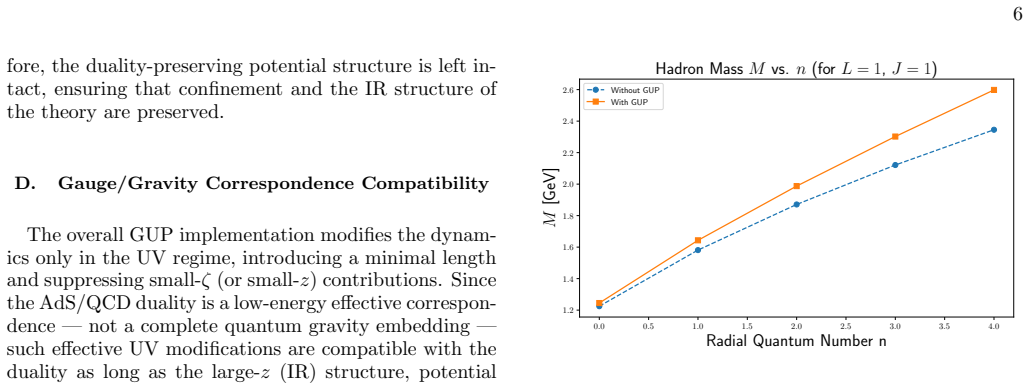
- With $\beta=0.65$ GeV$^{-2}$, the predicted $M^2(n)$ curves for the pion and rho move off the uncorrected light-front holographic QCD line and align with the experimental points across $n=0,\ldots,5$.
- The fitted minimal length of about $1.65\times10^{-16}$ m sits just below the QCD scale, making light-meson spectroscopy the observational window for minimal-length effects if the claim holds.
- Because the correction grows as $(n+L+S/2)^2$, the GUP effect is strongest for excited states, which gives a sharper test than the ground state alone.
- The Regge slope and confinement potential are unchanged, so the framework preserves the successful linear-trajectory phenomenology while modifying only the ultraviolet behavior.
- Read as an upper bound, $\beta<0.65$ GeV$^{-2}$ means additional non-GUP corrections would lower the needed minimal length rather than eliminate the need for short-distance regularization.
Reading between the lines
- A natural next target is the baryon or glueball sector: the same $\delta M^2\sim\beta\hbar^2\kappa^4(\ldots)^2$ rule should shift those trajectories too, and the shift's $(n+\ldots)^2$ growth could be tested against high-lying radial excitations.
- The fitted scale corresponds to a minimal length many orders above the Planck length, so what is actually being probed is an effective nonlocality at QCD scales; deriving the same shift from another short-distance mechanism would make the interpretation more robust.
- The paper's corrected wavefunction, $\psi_n=\psi_n^{(0)}+\beta\sum_{m\neq n}c_{nm}\psi_m^{(0)}$, implies small $\beta$-dependent changes in decay constants and form factors; those observables are a testable extension beyond masses.
- A direct check of the key estimate is to compute $\langle d^4/d\zeta^4\rangle$ exactly for the harmonic-oscillator-like light-front wavefunctions; if it differs from $\kappa^4(n+L+1/2)^2$, the extracted $\beta$ changes but the framework's structure survives.
Signed reviews
Editorial analysis
A structured set of objections, weighed in public.
Referee Report
Summary. The manuscript proposes to incorporate the Generalized Uncertainty Principle (GUP) into Light-Front Holographic QCD by modifying the 5D soft-wall action with a higher-derivative kinetic term, replacing ∂_M with ∂_M(1 − βℏ²□₅). It claims to derive a GUP-corrected light-front Schrödinger equation, estimates the mass correction as δM² ∼ βℏ²κ⁴(n+L+S/2)², fits the GUP parameter β to the PDG masses of the π and ρ trajectories (Table I), and reports that the corrected spectrum with κ=0.5 GeV and β=0.65 GeV⁻² yields significantly better agreement with experiment. The extracted minimal length is about 1.65×10⁻¹⁶ m, near the QCD scale. The paper concludes that the GUP serves as an effective UV regularization in hadron spectroscopy.
Significance. If the central claim were established, the paper would provide a concrete phenomenological probe of a minimal length in hadron spectroscopy, a topic of current interest. The strength of the paper is that it works within a well-defined framework (soft-wall AdS/QCD) and confronts the model with experimental data; it also cites the relevant GUP literature. However, the result currently rests on an un-demonstrated replacement of the derivative operator, an uncontrolled scaling estimate for the fourth-derivative matrix element, an unjustified spin replacement, and an in-sample fit, so the claimed improvement is not presently supported.
major comments (5)
- [III D, Eq. (31)] The equation of motion in Eq. (31) is stated to follow from varying the modified action in Eq. (30), but the derivation is not shown and does not follow straightforwardly from the stated action. With ∂̃_M = ∂_M(1 − βℏ²□₅), the variation of the kinetic term produces a fourth-order differential operator that acts on the dilaton factor e^{−κ²z²} and on the metric factor; it is not simply the replacement −∂_z² → −∂_z²(1 − βℏ²∂_z²)². The latter is an additional modeling assumption, and the difference affects the form of the correction that the paper then computes perturbatively.
- [III, Eqs. (39)–(41)] The central numerical result relies on the estimate ⟨d⁴/dζ⁴⟩ ∼ κ⁴(n+L+1/2)² in Eq. (41), which is not derived. For the actual soft-wall eigenfunctions (associated Laguerre polynomials) the matrix element is exactly computable; already in the pure harmonic limit in one dimension it behaves as (3κ⁴/2)(n²+n+1/2) in appropriate units, not as κ⁴(n+1/2)². The magnitude and n-dependence of δM² in Eq. (42) are therefore uncontrolled, and the fitted value of β cannot be trusted.
- [III, Eq. (43) and V, Table I] The replacement of (n+L+1/2)² by (n+L+S/2)² in Eq. (43) is introduced without derivation or citation. For the pion (S=0, L=0, n=0) this gives δM²=0, so the GUP correction cannot shift the pion mass away from zero. Table I nevertheless lists the π(0) mass as 0.135 GeV, and the paper claims the corrected spectrum describes the π data better. This is internally inconsistent: the ground-state pion cannot be improved by a correction that vanishes identically for it.
- [V] The value β=0.65 GeV⁻² is obtained by fitting the modified spectrum to the very same π and ρ data that are then presented as evidence of 'significantly improved agreement' (Figs. 2 and 3). Since β is a free parameter, the visual improvement is in-sample. The paper should provide a parameter-count-aware comparison, such as χ² per degree of freedom or an information criterion, and ideally a prediction for states not used in the fit.
- [V, Table I] The experimental assignments are not specified: the paper does not identify which PDG resonances correspond to n=0,…,5 for the π and ρ trajectories, nor the values of L, S, J used for each point. Without this information the fit is not reproducible and the plotted agreement cannot be independently evaluated.
minor comments (6)
- [Figure 1 caption] The caption quotes β=0.9 GeV², but the GUP parameter has dimensions GeV⁻²; this is likely a typographical error.
- [Section V] There is a typo in the text: 'respectivelly' should be 'respectively.'
- [Section IV] The consistency section is entirely qualitative; a quantitative check, such as the order-β shift in the conformal dimension or in the boundary two-point function, would strengthen the claim that the UV–IR mapping is preserved.
- [Section VI] The conclusion describes the minimal length as 'remarkably close to the QCD confinement scale' and later as 'slightly smaller than the QCD scale'; these statements should be reconciled.
- [Eq. (27)] The expression H_GUP = H_LF + βℏ² H_c leaves the dimensions and explicit form of H_c unspecified; a reader cannot assess the magnitude of the correction at the Hamiltonian level.
- [References] The reference list includes several self-citations by the author; the authors should verify that each is genuinely necessary for the arguments presented.
Circularity Check
The GUP parameter β is fitted to the very π/ρ masses that are then shown as evidence of improved agreement, and the spin-dependent correction that drives the fit is asserted rather than derived.
-
fitted input called prediction
[Section V, Phenomenology (after Eq. (37); Table I; Figs. 2-3)]
"Next, we fit the mass spectrum—with and without GUP corrections—as a function of the radial quantum number n to the experimental data for the π and ρ mesons, and deduce the value of β. ... Both plots show that the GUP corrected- mass spectrum describes much better the experimental data. The value of β that corresponds to the best fit is β=0.65 GeV−2."
The paper's central quantitative claim is that the GUP-corrected spectrum, Eqs. (37)+(43) with β=0.65 GeV⁻², reproduces the PDG π and ρ masses much better than the uncorrected formula. But β is not predicted from QCD or from the GUP deformation; it is obtained by fitting the same PDG masses listed in Table I and plotted as 'Experiment' in Figs. 2 and 3. The 'improved agreement' is therefore an in-sample property of a one-parameter fit to the target data, not an independent test. The functional form carries some theoretical content, but the parameter controlling the size of the claimed correction is read off the very data points that are then displayed as confirming the prediction.
-
other
[Section III.D, Eq. (43); Section V, Table I]
"If we now include spin (e.g., via J=L+S), the combination (n+L+S/2) naturally appears, and the expression becomes δM 2∼βℏ 2κ4 (n+L+ S/2)2 (43)"
The preceding Eq. (42) had the scale (n+L+1/2)², and the text substitutes (n+L+S/2)² with the phrase 'naturally appears,' without deriving it from the GUP-modified Hamiltonian. For the pion ground state n=L=S=0, Eq. (43) gives δM²=0, so the GUP term cannot raise the pionic mass at all. Yet Table I lists the pion mass 0.135 GeV as one of the experimental points, and Section V says the fit is made to both π and ρ data. Thus the claimed GUP improvement for the π column is definitionally absent: the correction term contributes zero to the very pion point used in the fit, so any apparent improvement in that column cannot be attributed to the GUP mechanism.
full rationale
The central numerical conclusion—that LFH QCD with GUP reproduces the π/ρ masses better than standard LFH QCD—is not an independent prediction. Section V explicitly fits the parameter β to the same PDG masses (Table I) that are then displayed as the experimental target in Figs. 2 and 3; the 'improved agreement' is thus an in-sample property of a fit, not a falsifiable outcome. The GUP kinetic-term deformation (Eqs. 29–36) and the first-order perturbation expression (Eq. 39) are coherent model steps, so the paper is not empty by construction; but the numerical evidence for the model is weakened by the fitted coefficient. The spin replacement in Eq. (43) is asserted rather than derived, and it makes the correction vanish for the pion ground state, so the π column of the fit cannot be credited to GUP. There are no load-bearing self-citations: refs. [3–7] are contextual applications of GUP, and the external inputs (soft-wall AdS/QCD model, PDG masses) are standard. Overall score 6: one central 'prediction' reduces to a fit of the data it claims to explain, while the model-building part retains independent content.
Assumptions & free parameters
free parameters (2)
- κ (confinement scale) =
0.5 GeV
- β (GUP parameter) =
0.65 GeV^-2
assumptions (6)
- domain assumption The AdS/CFT correspondence with a soft-wall dilaton is a valid effective description of confined QCD mesons.
- ad hoc to paper The quadratic GUP with β'=0 and momentum replacement p_i → p_i(1 - βℏ²p²) describes the minimal-length deformation.
- ad hoc to paper GUP effects in QCD are dual to the derivative replacement ∂M → ∂M(1 - βℏ²□5) in the 5D soft-wall action.
- ad hoc to paper The fourth-derivative matrix element scales as ⟨d⁴/dζ⁴⟩ ∼ κ⁴(n+L+1/2)².
- domain assumption The PDG states in Table I correspond to radial quantum numbers n=0..5 for π and ρ.
- domain assumption Chiral symmetry breaking is neglected, so the pion is treated with the same formula as other mesons.
Cite this review
Pith. "Pith review of Light front holographic QCD theory in the generalized uncertainty principle framework." pith.science (2026). https://pith.science/paper/ZRLPMS3P
@misc{pith2026250415462,
  author       = {Pith},
  title        = {Pith review of: Light front holographic QCD theory in the generalized uncertainty principle framework},
  year         = {2026},
  howpublished = {\url{https://pith.science/paper/ZRLPMS3P}},
  note         = {Machine review of arXiv:2504.15462}
}
read the original abstract
In this article, we develop the framework of light-front holographic QCD in the presence of a minimal length scale by incorporating the Generalized Uncertainty Principle (GUP) into the QCD Lagrangian. From this modified theory, we derive a GUP-corrected light-front holographic QCD (LFH QCD) equation and obtain the corresponding hadronic mass spectrum. Our results show that the hadronic mass spectrum acquires an additional GUP-dependent term that increases the masses. This mass enhancement leads to significantly improved agreement between the theoretical predictions and experimental data.
Figures


Forward citations
Cited by 1 Pith paper
-
Minimal length effect on meson form factors in light front AdS$_{5}$/QCD
A GUP-corrected pion wave function with multiple Fock states yields a positive correction to the form factor, but the decisive coefficients are asserted rather than derived.
Reference graph
Works this paper leans on
-
[1]
S. J. Brodsky, G. F. de T´ eramond, H. G. Dosch, and J. Erlich, Light-front holographic QCD and emerging confinement,Physics Reports, 584:1–105, July 2015, doi:10.1016/j.physrep.2015.05.001
- [2]
-
[3]
F. J. Twagirayezu, Generalized uncertainty principle cor- rections on atomic excitation,Annals Phys., 422:168294, 2020, doi:10.1016/j.aop.2020.168294
arXiv 2020
-
[4]
F. J. Twagirayezu, On generalized quantum scatter- ing theory: Rayleigh scattering and Thomson scattering with a minimal length,Phys. Lett. A, 400:127323, 2021, doi:10.1016/j.physleta.2021.127323
arXiv 2021
-
[5]
F. J. Twagirayezu, Quantum gravity modifications of magnetized ideal gas thermodynamics,Physica A: Sta- tistical Mechanics and its Applications, 580:126159, 2021, doi:10.1016/j.physa.2021.126159
arXiv 2021
-
[6]
F. J. Twagirayezu, Effect of minimal length uncertainty on neutrino oscillation,Z. Naturforsch. A, 78(5):405–410, 2023, doi:10.1515/zna-2022-0225
-
[7]
F. J. Twagirayezu, On magnetic monopole and Dirac quantization condition in the minimal length formalism, Can. J. Phys., 101(4):195–202, 2023, doi:10.1139/cjp- 2022-0028
doi:10.1139/cjp- 2023
-
[8]
F. Wagner, G. Var˜ ao, I. P. Lobo, and V. B. Bez- erra, Quantum-spacetime effects on nonrelativistic Schr¨ odinger evolution,Phys. Rev. D, 108(6):066008, 2023, doi:10.1103/PhysRevD.108.066008
Show all 16 references
-
[9]
Bosso, G
P. Bosso, G. G. Luciano, L. Petruzziello, and F. Wag- ner, 30 years in: Quo vadis generalized uncertainty principle?,Class. Quant. Grav., 40(19):195014, 2023, doi:10.1088/1361-6382/acf021
2023 doi
-
[10]
A. F. Ali, M. M. Khalil, and E. C. Vagenas, Minimal Length in quantum gravity and gravitational measure- ments, 2015, arXiv:1510.06365
2015 arXiv
-
[11]
A. F. Ali, S. Das, and E. C. Vagenas, Pro- posal for testing quantum gravity in the lab, Physical Review D, 84(4):044013, August 2011, doi:10.1103/physrevd.84.044013
2011 doi
-
[12]
Maggiore, The Algebraic structure of the general- ized uncertainty principle,Phys
M. Maggiore, The Algebraic structure of the general- ized uncertainty principle,Phys. Lett. B, 319:83–86, 1993, doi:10.1016/0370-2693(93)90785-G, arXiv:hep- th/9309034
1993
-
[13]
Kempf and G
A. Kempf and G. Mangano, Minimal length uncer- tainty relation and ultraviolet regularization,Phys. Rev. D, 55:7909–7920, 1997, doi:10.1103/PhysRevD.55.7909, arXiv:hep-th/9612084
1997 arXiv
-
[14]
Capozziello, G
S. Capozziello, G. Lambiase, and G. Scarpetta, Generalized uncertainty principle from quantum ge- ometry,Int. J. Theor. Phys., 39:15–22, 2000, doi:10.1023/A:1003634814685, arXiv:gr-qc/9910017
-
[15]
A. F. Ali, S. Das, and E. C. Vagenas, Dis- creteness of Space from the Generalized Uncer- tainty Principle,Phys. Lett. B, 678:497–499, 2009, doi:10.1016/j.physletb.2009.06.061, arXiv:0906.5396
2009 arXiv
-
[16]
R. L. Workman et al., Review of Particle Physics, Progress of Theoretical and Experimental Physics, 2022(8):083C01, 2022, doi:10.1093/ptep/ptac097, https://pdg.lbl.gov
2022 doi
Reviewed August 16, 2026 · model on record in the stance chip above.
Discussion (0). Continue with ORCID to comment.