REVIEW 1 major objections 4 minor 67 references
Effective dimensional reduction of complex systems based on tensor networks
T0 review · 1 major / 4 minor · reviewed 2026-08-12 · deepseek-v4-flash
Pith's one-line read Matrix product states compress the $2^n$-dimensional steady state of a network epidemic model, and with bond dimension of order $n$ the compressed distribution beats second-order mean-field theory by orders of magnitude.
desk verdict A useful MPS tool for network SIS steady states, but the stated DMRG objective in Eq. (15) is not a valid way to find a stationary distribution and must be fixed before the method description can be trusted. read the letter →
The pith
A machine-rendered reading of the paper's core claim, the machinery that carries it, and where it could break.
The reading
What carries the argument
The object that carries the argument is the matrix product state representation of the probability vector, $p_{i_1\dots i_n}\approx \sum_{\chi_1,\dots,\chi_{n-1}} U^1_{i_1\chi_1}U^2_{\chi_1 i_2\chi_2}\cdots U^n_{\chi_{n-1}i_n}$, with bond dimensions $\chi$ controlling the number of singular values kept between adjacent nodes. The infinitesimal generator of the $\epsilon$-SIS process is written exactly as a matrix product operator of bond dimension $2+2m$ (with $m$ the number of edges), using the local operators $\hat q^{si}$, $\hat q^{is}$ and the infection projector $\hat n$. The steady state is then approximated by sweeping the DMRG algorithm to minimize $p^TQp$, truncating singular values below $\delta$ or above $\chi_{\max}$; reordering nodes by the graph Laplacian's Fiedler vector reduces the MPO bond dimension and computation time. The compressibility measure is the Shannon entropy of the squared singular values across a bond, $S_{\mathrm{EE}}(s)=-\sum_k (s_k^2/|s|^2)\log(s_k^2/|s|^2)$, which the paper uses to quantify when the distribution is or is not reducible.
What would settle it
A decisive check is to run the identical DMRG minimization of $p^T Q p$ on a small Markov chain with a non-symmetric generator and a known stationary vector; if the converged MPS does not match the exact stationary distribution (or if the $\chi=1$ fixed point differs from the mean-field solution, as the paper reports), then the optimization objective is not the right fixed-point condition and the accuracy claims need to be re-evaluated.
Extended reading notes
Core claim
The central discovery is that the steady-state probability vector of the $\epsilon$-SIS process on an arbitrary network, a vector of length $2^n$, is highly compressible as an MPS away from a narrow window near criticality, and that the compression error is controlled by the truncated singular values. Concretely, the paper shows that with a bond dimension comparable to the system size, $\chi \sim O(n)$, the single-node infection probabilities $\langle \hat n_i\rangle$ computed from the MPS are already more accurate than those from a second-order mean-field closure, and that increasing $\chi$ further reduces the error by several orders of magnitude. It also finds that the entanglement entropy of the MPS peaks just after the phase transition, on the disordered side, and that the bond dimension at which this entropy saturates coincides with the point where the MPS outperforms second-order mean-field. On the 55-node railway network, the MPS matches Monte Carlo results within MCMC error bars and resolves probabilities of rare events that Monte Carlo would need enormous samples to see.
Load-bearing premise
The load-bearing premise is that running DMRG sweeps to minimize $p^T Q p$ produces the steady state of the non-Hermitian Markov generator $Q$; the paper supplies no proof or citation for this, and for a generic Markov chain the quadratic form is not minimized at the stationary distribution, so all MPS results inherit this assumption.
Editorial extensions
If this is right
- For any of the four random-graph topologies tested, choosing $\chi$ of order $n$ makes the MPS approximation of node infection rates more accurate than second-order mean-field theory, and larger $\chi$ improves on it by orders of magnitude.
- The bond dimension at which the entanglement entropy saturates is a practical indicator of the $\chi$ needed to beat mean-field, giving a data-free way to set the approximation's accuracy.
- In the inactive and endemic regimes even small $\chi$ gives good accuracy, while near the entanglement-entropy peak the approximation needs large $\chi$, so the hardest systems are those just past the epidemic threshold.
- The method provides the full $2^n$ distribution in compressed form, so rare-event probabilities such as the chance that exactly $k$ nodes are infected can be extracted at negligible extra cost, with probabilities as low as $10^{-14}$ stable over truncation thresholds.
- For the 55-node railway network, MPS density predictions agree with the Monte Carlo reference within the MCMC error bars, while first- and second-order mean-field deviate systematically.
Reading between the lines
- Beyond epidemic models, the same construction—an exact MPO for a local Markov generator plus DMRG sweeping—applies to any network Markov process whose transitions are local in the tensor-product basis, so opinion dynamics, SIR/SEIR, and contact processes should be compressible in the same way.
- The claim that entanglement entropy peaks just on the endemic side of the transition is made for one specific node ordering; if the peak location is truly ordering-independent, it could serve as a generic nonequilibrium criticality marker, and testing it with tree tensor networks or different orderings would sharpen the claim.
- The paper's rare-event probabilities suggest a potentially powerful use: with truncation thresholds as calibrated control parameters, the MPS could estimate large-deviation probabilities where direct Monte Carlo is exponentially costly, a use the paper mentions but does not explore quantitatively.
Editorial analysis
A structured set of objections, weighed in public.
Referee Report
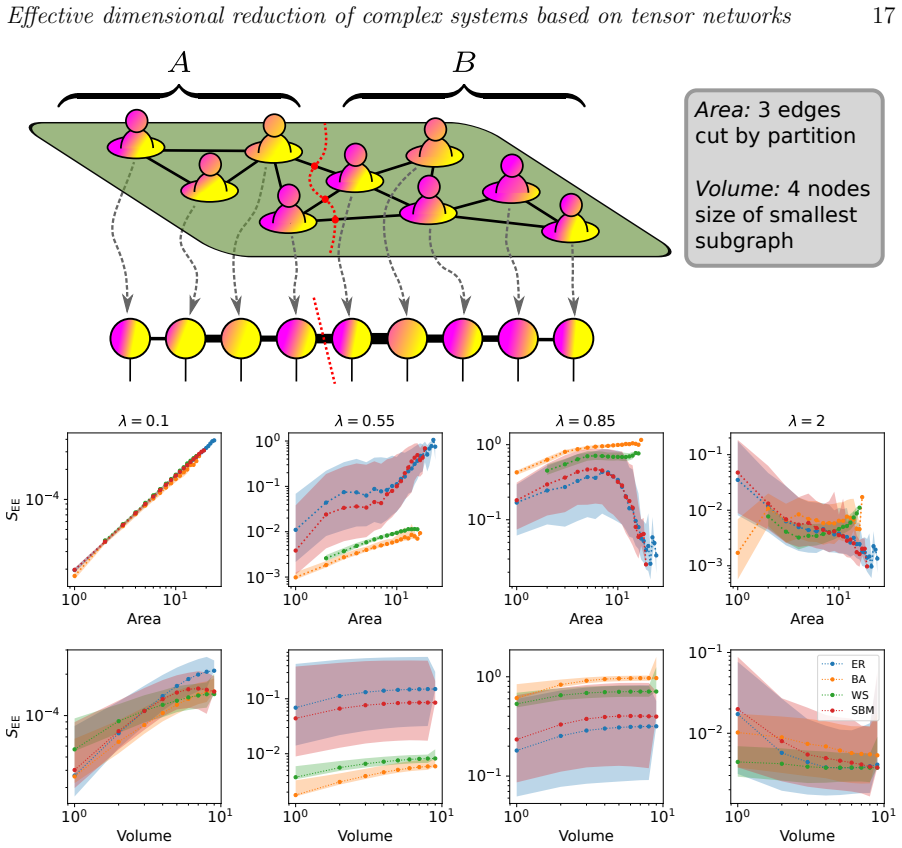
Summary. The paper introduces a Matrix Product State (MPS) approximation for the steady-state distribution of the epsilon-SIS Markovian spreading model on complex networks. The authors construct an MPO representation of the generator, use a DMRG-type algorithm to find an approximate null vector, and benchmark the resulting MPS against exact diagonalization for n=16 random graphs of four topologies and against kinetic Monte Carlo for a 55-node railway network. They define an entanglement entropy from the MPS singular-value spectrum and use it as a compressibility measure, finding that it saturates for bond dimensions of order n, that it peaks on the endemic side of the phase transition, and that the MPS outperforms second-order mean-field theory for sufficiently large bond dimensions. They also study area/volume scaling of the entanglement entropy and rare-event probabilities.
Significance. If the numerical method is as described, the paper makes a useful contribution: it demonstrates a tunable, tensor-network-based dimensional reduction for non-equilibrium Markovian dynamics on complex networks, with extensive validation against exact diagonalization and MCMC, and it connects MPS compressibility to the physics of the phase transition. The public stochasticTN code, the 100-graph averaging per topology, and the independent railway-network benchmark are concrete strengths that make the central accuracy claims reproducible in principle. The entanglement-entropy saturation criterion for choosing the bond dimension is a practical and falsifiable prescription. However, the paper currently contains a load-bearing ambiguity in the statement of the optimization objective, which must be resolved before the numerical claims can be fully assessed.
major comments (1)
- [Sec. 3.2, Eq. (15)] The stated DMRG objective is not a valid variational principle for the steady state of a non-Hermitian Markov generator. For a generator Q with column sums zero, p^T Q p = sum_{i != j} Q_ij p_j (p_i - p_j), which is indefinite and is not minimized at the stationary vector satisfying Q p_infinity = 0. For the symmetric two-state chain Q = [[-a,a],[a,-a]], this expression equals -a(p_1-p_2)^2 and is minimized at a pure state, while the steady state is uniform. Thus Eq. (15) cannot justify convergence to Q p_infinity = 0, and the surrounding claim that DMRG searches for a representation close to the exact steady state is unsupported. Every MPS result in Figs. 4-12 depends on this optimization step, so the manuscript must either correct Eq. (15) to the objective actually implemented (e.g., minimization of the residual norm ||Q p||^2 or a linear-system formulation) and describe that algorithm, or provide a valid proof or citation for a variant that is known to work. The observation in Sec. 4.1.1 that chi=1 DMRG moves away from the mean-field solution does not resolve the issue, because that behavior is consistent with both a correct and an incorrect objective. Please also add a convergence test against the exact null vector for the n=16 systems, such as the residual norm ||Q p_mps|| or the overlap with the Lanczos eigenvector, for the DMRG states shown.
minor comments (4)
- [Sec. 2.2] The phrase 'the mean-field steady-state solution to (6)' is imprecise, because Eq. (6) is an exact, unclosed evolution equation; the first-order mean-field fixed point should be defined by setting the right-hand side of Eq. (7) to zero.
- [Throughout] There are several typographical errors: 'non-equilibirium' in Sec. 3, 'Fielder' instead of 'Fiedler' in the caption of Fig. 2 and in Sec. 4.1.3, and 'believe propagation' instead of 'belief propagation' in Sec. 5.
- [Sec. 4.1.2, Fig. 6] The fitted power-law exponents for the area dependence of the entanglement entropy are quoted without fitting ranges or quality measures; given the small range of accessible areas at n=16, reporting fit residuals or confidence intervals would make the area-law claim more robust.
- [Sec. 4.2, Fig. 11] The statement that rare-event probabilities of order 10^{-14} to 10^{-16} are stable in the singular-value cutoff would be stronger if accompanied by a quantitative convergence measure, such as relative changes between successive cutoffs, rather than visual inspection alone.
Circularity Check
No significant circularity; the MPS accuracy claims are externally benchmarked against exact diagonalization and MCMC, and the entanglement-entropy observations are diagnostic rather than derived from the quantities they describe.
full rationale
The paper's central claims are that MPS approximations of the epsilon-SIS steady state become accurate at sufficiently large bond dimension and that the entanglement entropy peaks on the endemic side of the transition. Neither claim reduces to its inputs by construction. The MPS results are tested against exact leading eigenvectors for n=16 networks in Section 4.1 and against MCMC for the 55-node railway network in Section 4.2, so the accuracy statements are externally benchmarked numerical findings rather than restatements of fitted parameters or of the MPS ansatz itself. The entanglement entropy is defined from the MPS singular values, but the observation that its saturation coincides with improved accuracy is a diagnostic correlation; the accuracy is measured independently against exact or MCMC reference data, and no fitted constant is renamed as a prediction. The mean-field equations are recalled from the authors' prior work, but the relevant equations are displayed in the paper, and the comparison with MPS is again judged against external ground truth, so the self-citations are not load-bearing for the central claim. The questionable DMRG objective in Eq. (15), minimizing p^T Q p rather than directly solving Qp=0, is a method-correctness concern, not a circularity: the paper does not define the steady state as the minimum of that quadratic form by construction, and its external checks mean the numerical results are not self-referential even if the stated objective is invalid. No specific circular step can be exhibited from the text.
Assumptions & free parameters
free parameters (1)
- epsilon/gamma =
10^-2
assumptions (3)
- domain assumption The generator Q of the irreducible epsilon-SIS Markov chain has a unique steady state for epsilon > 0.
- ad hoc to paper Minimizing p^T Q p over MPS states yields the steady-state eigenvector of the non-Hermitian generator Q.
- domain assumption Fiedler-vector ordering of the network nodes keeps highly correlated nodes adjacent in the MPS chain.
Cite this review
Pith. "Pith review of Effective dimensional reduction of complex systems based on tensor networks." pith.science (2026). https://pith.science/paper/ZRVRQ7RY
@misc{pith2026241113364,
  author       = {Pith},
  title        = {Pith review of: Effective dimensional reduction of complex systems based on tensor networks},
  year         = {2026},
  howpublished = {\url{https://pith.science/paper/ZRVRQ7RY}},
  note         = {Machine review of arXiv:2411.13364}
}
abstract
The exact treatment of Markovian models of complex systems requires knowledge of probability distributions exponentially large in the number of components $n$. Mean-field approximations provide an effective reduction in complexity of the models, requiring only a number of phase space variables polynomial in system size. However, this comes at the cost of losing accuracy close to critical points in the systems dynamics and an inability to capture correlations in the system. In this work, we introduce a tunable approximation scheme for Markovian spreading models on networks based on Matrix Product States (MPS). By controlling the bond dimensions of the MPS, we can investigate the effective dimensionality needed to accurately represent the exact $2^n$ dimensional steady-state distribution. We introduce the entanglement entropy as a measure of the compressibility of the system and find that it peaks just after the phase transition on the disordered side, in line with the intuition that more complex states are at the 'edge of chaos'. We compare the accuracy of the MPS with exact methods on different types of small random networks and with Markov Chain Monte Carlo methods for a simplified version of the railway network of the Netherlands with 55 nodes. The MPS provides a systematic way to tune the accuracy of the approximation by reducing the dimensionality of the systems state vector, leading to an improvement over second-order mean-field approximations for sufficiently large bond dimensions.
Figures


Figures from the paper (10 more)




Reference graph
Works this paper leans on
-
[1]
Pastor-Satorras R, Castellano C, Van Mieghem P and Vespignani A 2015 Reviews of modern physics 87 925 URL https://doi.org/10.1103/RevModPhys.87.925
-
[2]
Van Mieghem P, Omic J and Kooij R 2008 IEEE/ACM Transactions On Networking17 1–14 URL https://doi.org/10.1109/TNET.2008.925623
arXiv 2008
-
[3]
Simon P L, Taylor M and Kiss I Z 2011 Journal of mathematical biology 62 479–508 URL https://doi.org/10.1007/s00285-010-0344-x
-
[4]
Castellano C, Fortunato S and Loreto V 2009 Reviews of modern physics81 591 URL https: //doi.org/10.1103/RevModPhys.81.591
-
[5]
Anderson R M and May R M 1992 Infectious diseases of humans (Oxford: Oxford University Press) ISBN 019854040X
work page 1992
-
[6]
Kiss I Z, Miller J C, Simon P L et al.2017 Mathematics of epidemics on networksvol 598 (Springer)
work page 2017
-
[7]
Van Mieghem P 2011 Computing 93 147–169 URL https://doi.org/10.1007/ s00607-011-0155-y
work page 2011
-
[8]
Cator E and Van Mieghem P 2012 Physical Review E—Statistical, Nonlinear, and Soft Matter Physics 85 056111 URL https://doi.org/10.1103/PhysRevE.85.056111
Show all 67 references
-
[9]
Merbis W 2021 arXiv:2102.11708 URL https://arxiv.org/abs/2102.11708
2021 arXiv
-
[10]
Merbis W and de Domenico M 2023 Phys. Rev. E108(1) 014312 URL https://link.aps.org/ doi/10.1103/PhysRevE.108.014312
2023 doi
-
[11]
Poulin D, Qarry A, Somma R and Verstraete F 2011 Physical review letters 106 170501 URL https://doi.org/10.1103/PhysRevLett.106.170501
2011 doi
-
[12]
Verstraete F and Cirac J I 2006 Physical Review B73 094423 URL https://doi.org/10.1103/ PhysRevB.73.094423
2006
-
[13]
Verstraete F, Murg V and Cirac J I 2008 Advances in Physics 57 143–224 URL https: //doi.org/10.1080/14789940801912366
2008 doi
-
[14]
013 Effective dimensional reduction of complex systems based on tensor networks 26
Or´ us R 2014Annals of Physics349 117–158 URL https://doi.org/10.1016/j.aop.2014.06. 013 Effective dimensional reduction of complex systems based on tensor networks 26
2014 doi
-
[15]
Schollw¨ ock U 2011Annals of physics326 96–192 URL https://doi.org/10.1016/j.aop.2010. 09.012
2010 doi
-
[16]
White S R 1992 Physical review letters69 2863 URL https://doi.org/10.1103/PhysRevLett. 69.2863
1992 doi
-
[17]
jp/doi/pdf/10.1143/JPSJ.67.369
Hieida Y 1998 Journal of the Physical Society of Japan67 369–372 URL https://journals.jps. jp/doi/pdf/10.1143/JPSJ.67.369
1998 doi
-
[18]
Carlon E, Henkel M and Schollw¨ ock U 1999The European Physical Journal B-Condensed Matter and Complex Systems12 99–114 URL https://doi.org/10.1007/s100510050983
-
[19]
1103/PhysRevE.82.036702
Johnson T, Clark S and Jaksch D 2010 Physical Review E82 036702 URL https://doi.org/10. 1103/PhysRevE.82.036702
2010
-
[20]
Johnson T H, Elliott T, Clark S R and Jaksch D 2015 Physical review letters114 090602 URL https://doi.org/10.1103/PhysRevLett.114.090602
2015 doi
-
[21]
Ba˜ nuls M C and Garrahan J P 2019 Physical review letters123 200601 URL https://doi.org/ 10.1103/PhysRevLett.123.200601
2019 doi
-
[22]
Causer L, Banuls M C and Garrahan J P 2022 Physical Review Letters 128 090605 URL https://doi.org/10.1103/PhysRevLett.128.090605
2022 doi
-
[23]
Merbis W, de Mulatier C and Corboz P 2023 Physical Review E 108 024303 URL https: //journals.aps.org/pre/abstract/10.1103/PhysRevE.108.024303
2023 doi
-
[24]
Dolgov S and Savostyanov D 2024 Applied Mathematics and Computation 460 128290 URL https://doi.org/10.1016/j.amc.2023.128290
2024
-
[25]
Dolgov S and Savostyanov D 2024 arXiv preprint arXiv:2401.15031 URL https://arxiv.org/ abs/2401.15031
2024 arXiv
-
[26]
Barthel T, De Bacco C and Franz S 2018 Physical Review E97 010104 URL https://doi.org/ 10.1103/PhysRevE.97.010104
2018 doi
-
[27]
Barthel T 2020 Journal of Statistical Mechanics: Theory and Experiment 2020 013217 URL https://iopscience.iop.org/article/10.1088/1742-5468/ab5701/
2020 doi
-
[28]
Crotti S and Braunstein A 2023 Proceedings of the National Academy of Sciences120 e2307935120 URL https://doi.org/10.1073/pnas.2307935120
2023 doi
-
[29]
Tindall J, Stoudenmire M and Levy R 2024 arXiv preprint arXiv:2410.03572 URL https: //arxiv.org/abs/2410.03572
2024 arXiv
-
[30]
Causer L, Rotskoff G M and Garrahan J P 2024 arXiv preprint arXiv:2407.11133URL https: //arxiv.org/abs/2407.11133
2024 arXiv
-
[31]
Fr ´ ıas P´ erez M, Mari¨ en M, P´ erez Garc ´ ıa D, Ba˜ nuls M C and Iblisdir S 2023SciPost Physics 14 123 URL https://doi.org/10.21468/SciPostPhys.14.5.123
-
[32]
Visco G V, Artime O, Nauta J, Scagliarini T and De Domenico M 2024 arXiv preprint arXiv:2404.11366 URL https://arxiv.org/abs/2404.11366
2024 arXiv
-
[33]
Rojas-Venegas J A, Gallarta-S´ aenz P, Hurtado R G, G´ omez-Garde˜ nes J and Soriano-Pa˜ nos D 2024 arXiv preprint arXiv:2409.06438URL https://arxiv.org/abs/2409.06438
2024 arXiv
-
[34]
del Razo M J, Lamma T and Merbis W 2024 arXiv preprint arXiv:2409.13377 URL https: //arxiv.org/abs/2409.13377
2024
-
[35]
Ortega E, Machado D and Lage-Castellanos A 2022 Physical Review E 105 024308 URL https://doi.org/10.1103/PhysRevE.105.024308
2022 doi
-
[36]
1103/PhysRevE.86.016116
Van Mieghem P and Cator E 2012 Physical Review E 86 016116 URL https://doi.org/10. 1103/PhysRevE.86.016116
2012
-
[37]
Merbis W and Lodato I 2022 Physical Review E 105 044303 URL https://doi.org/10.1103/ PhysRevE.105.044303
2022
-
[38]
1103/PhysRevE.87.012811
Cator E and Van Mieghem P 2013 Physical Review E 87 012811 URL https://doi.org/10. 1103/PhysRevE.87.012811
2013
-
[39]
Achterberg M A, Prasse B and Van Mieghem P 2022 Physical Review E 105 054305 URL https://doi.org/10.1103/PhysRevE.105.054305
2022 doi
-
[40]
Achterberg M A and Van Mieghem P 2023 arXiv preprint arXiv:2311.16721 URL https: Effective dimensional reduction of complex systems based on tensor networks 27 //arxiv.org/abs/2311.16721
2023 arXiv
-
[41]
Sahneh F D, Scoglio C and Van Mieghem P 2013 IEEE/ACM Transactions on Networking21 1609–1620 URL https://doi.org/10.1109/TNET.2013.2239658
2013
-
[42]
Bakker C and Merbis W 2024 Operator entanglement growth quantifies complexity of cellular automata International Conference on Computational Science(Springer) pp 33–47 URL https: //doi.org/10.1007/978-3-031-63749-0_3
2024 doi
-
[43]
Legeza ¨O and S´ olyom J 2003 Physical Review B 68 195116 URL https://doi.org/10.1103/ PhysRevB.68.195116
2003
-
[44]
Barcza G, Legeza ¨O, Marti K H and Reiher M 2011 Physical Review A 83 012508 URL https://doi.org/10.1103/PhysRevA.83.012508
2011 doi
-
[45]
Szalay S, Pfeffer M, Murg V, Barcza G, Verstraete F, Schneider R and ¨Ors Legeza 2015 International Journal of Quantum Chemistry115 1342–1391 URL https://doi.org/10.1002/ qua.24898
2015
-
[46]
Fiedler M 1973 Czechoslovak mathematical journal23 298–305
1973
-
[47]
Atkins J E, Boman E G and Hendrickson B 1998 SIAM Journal on Computing28 297–310 URL https://doi.org/10.1137/S0097539795285771
1998 doi
-
[48]
1960 Publ
Erd¨ os P, R´ enyi Aet al. 1960 Publ. Math. Inst. Hung. Acad. Sci5 17–60
1960
-
[49]
Barab´ asi A L and Albert R 1999 science 286 509–512
1999
-
[50]
Watts D J and Strogatz S H 1998 nature 393 440–442
1998
-
[51]
Holland P W, Laskey K B and Leinhardt S 1983 Social networks 5 109–137 URL https: //doi.org/10.1016/0378-8733(83)90021-7
1983 doi
-
[52]
Kuehn C and M¨ olter J 2024 SIAM Journal on Applied Dynamical Systems 23 791–812 URL https://doi.org/10.1137/23M158440X
2024 doi
-
[53]
Series A, containing papers of a mathematical and physical character138 55–83 URL https://doi.org/ 10.1098/rspa.1932.0171
Kermack W O and McKendrick A G 1932 Proceedings of the Royal Society of London. Series A, containing papers of a mathematical and physical character138 55–83 URL https://doi.org/ 10.1098/rspa.1932.0171
1932
-
[54]
Kendall D G 1956 Deterministic and stochastic epidemics in closed populations Proceedings of the third Berkeley symposium on mathematical statistics and probabilityvol 4 (University of California Press Berkeley) pp 149–165
1956
-
[55]
Dall’Asta L, Castellano C and Marsili M 2008 Journal of Statistical Mechanics: Theory and Experiment 2008 L07002 URL https://doi.org/10.1088/1742-5468/2008/07/L07002
2008 doi
-
[56]
Villegas P, Gili T, Caldarelli G and Gabrielli A 2023 Nature Physics 19 445–450 URL https: //doi.org/10.1038/s41567-022-01866-8
2023 doi
-
[57]
Garuccio E, Lalli M and Garlaschelli D 2023 Physical Review Research5 043101 URL https: //doi.org/10.1103/PhysRevResearch.5.043101
2023 doi
-
[58]
Keymer J E, Marquet P A, Velasco-Hern´ andez J X and Levin S A 2000 The American Naturalist 156 478–494 URL https://doi.org/10.1086/303407
2000 doi
-
[59]
Colizza V and Vespignani A 2008 Journal of theoretical biology 251 450–467 URL https: //doi.org/10.1016/j.jtbi.2007.11.028
2008 doi
-
[60]
Cantwell G T and Newman M E 2019 Proceedings of the National Academy of Sciences116 23398–23403 URL https://www.pnas.org/doi/abs/10.1073/pnas.1914893116
2019 doi
-
[61]
St-Onge G, Sun H, Allard A, H´ ebert-Dufresne L and Bianconi G 2021 Physical review letters127 158301 URL https://journals.aps.org/prl/abstract/10.1103/PhysRevLett.127.158301
2021 doi
-
[62]
Evenbly G, Pancotti N, Milsted A, Gray J and Chan G K 2024 arXiv preprint arXiv:2409.03108 URL https://arxiv.org/abs/2409.03108
2024
-
[63]
Vidal G 2003 Physical review letters91 147902 URL https://journals.aps.org/prl/abstract/ 10.1103/PhysRevLett.91.147902
2003 doi
-
[64]
Silvi P, Tschirsich F, Gerster M, J¨ unemann J, Jaschke D, Rizzi M and Montangero S 2019SciPost Physics Lecture Notes008 URL https://www.scipost.org/SciPostPhysLectNotes.8
-
[65]
Verstraete F and Cirac J I 2004 arXiv:cond-mat/0407066 URL http://arxiv.org/abs/ cond-mat/0407066 Effective dimensional reduction of complex systems based on tensor networks 28
2004 arXiv
-
[66]
Nishio Y, Maeshima N, Gendiar A and Nishino T 2004 arXiv:cond-mat/0401115
2004 arXiv
-
[67]
Vlaar P C G and Corboz P 2021 Phys. Rev. B 103 205137 URL https://link.aps.org/doi/ 10.1103/PhysRevB.103.205137
2021 doi
Reviewed August 12, 2026 · model on record in the stance chip above.
Discussion (0). Continue with ORCID to comment.