REVIEW 3 major objections 5 minor 2 cited by
CIIR@LiveRAG 2025: Optimizing Multi-Agent Retrieval Augmented Generation through Self-Training
T0 review · 3 major / 5 minor · reviewed 2026-08-07 · deepseek-v4-flash
Pith's one-line read A self-trained multi-agent RAG system that learns from its own best trajectories outperforms plain retrieve-then-read pipelines and ranked 7th in the SIGIR 2025 LiveRAG competition.
desk verdict A well-engineered competition system whose headline claim over vanilla RAG is undermined by using the same reward for training, checkpoint selection, and evaluation; still worth a referee's time. read the letter →
The pith
A machine-rendered reading of the paper's core claim, the machinery that carries it, and where it could break.
The reading
What carries the argument
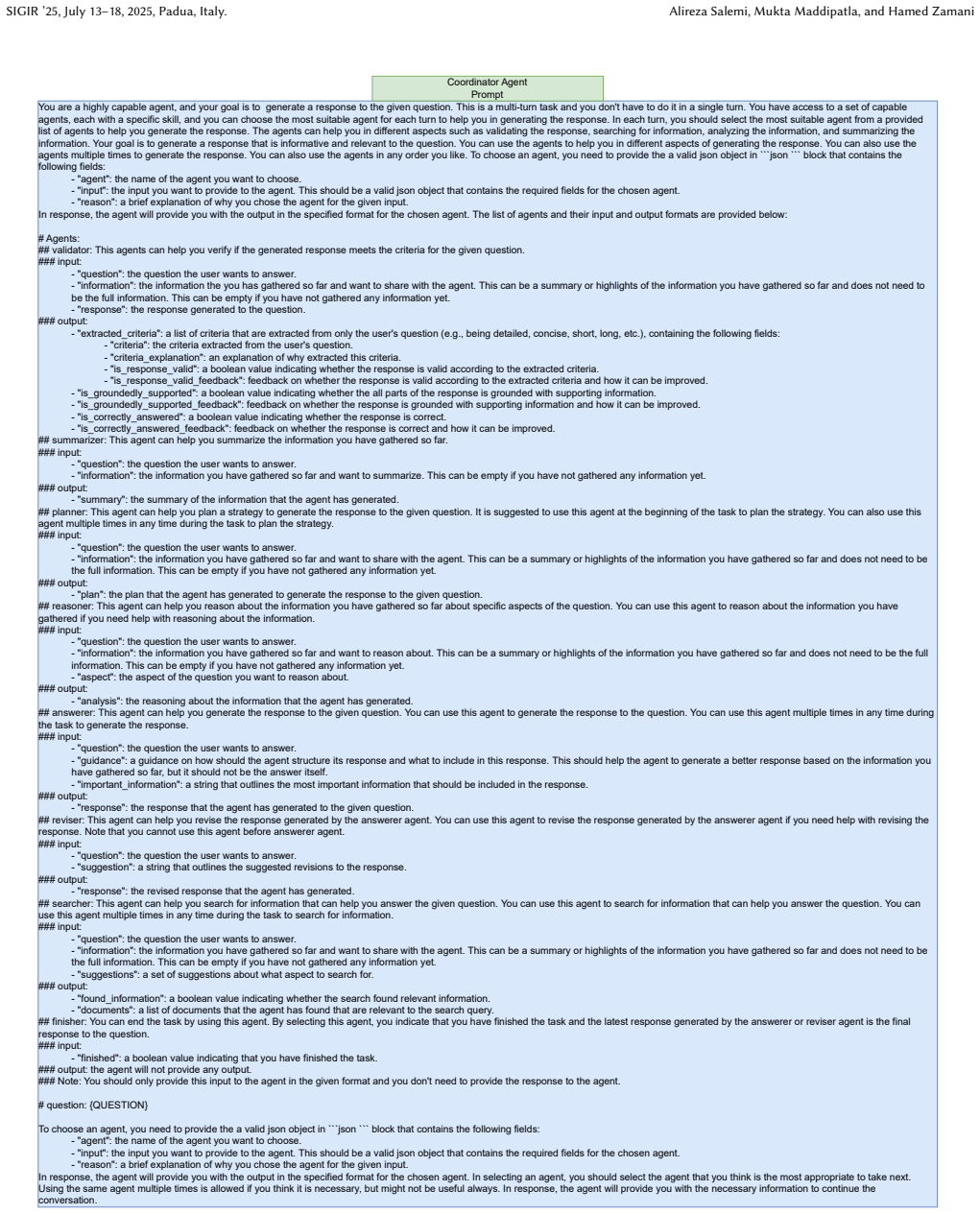
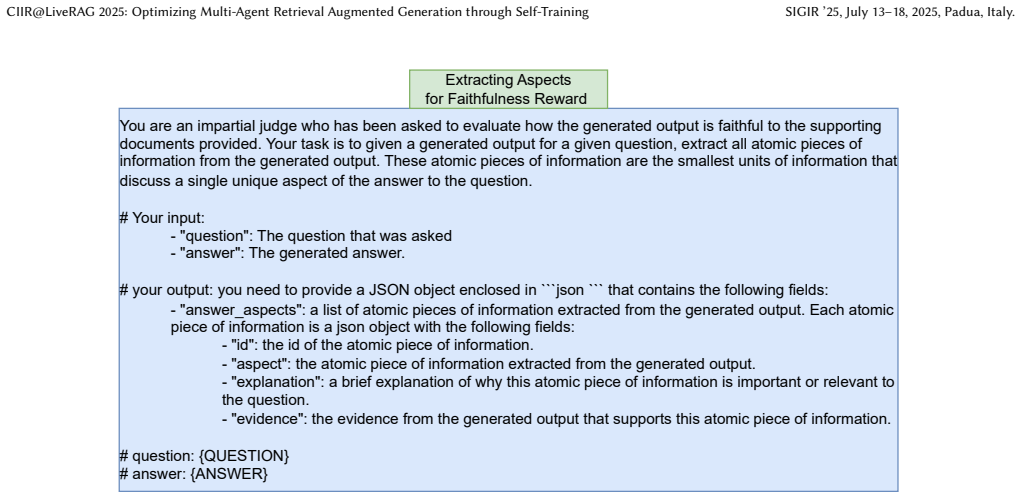
The central mechanism is the factorized trajectory model: by assuming each agent's action depends only on the input $x$, the joint probability of a trajectory $\tau=a_1\ldots a_n$ simplifies to $\prod_i p(a_i|x)$. This turns end-to-end multi-agent optimization, which would require gradients across cooperating systems, into supervised fine-tuning of each agent's language model on the actions found in high-reward trajectories. The reward signal comes from two LLM-based judges: a recall-oriented nugget correctness score that checks ground-truth atomic aspects against the response, and a faithfulness score that checks response claims against retrieved documents. The coordinator is a Qwen 2.5 7B model that iteratively selects agents, and the searcher uses the Lion sparse retriever to fetch documents.
What would settle it
Take the DataMorgana test set and compare mRAG against vanilla RAG after truncating or length-matching all responses to a fixed token budget before scoring with the same correctness and faithfulness rewards; if mRAG's advantage shrinks or reverses, the claimed gains are largely an artifact of reward models that reward verbosity. A second check is to have the competition's official hidden scorer run on the same outputs.
Extended reading notes
Core claim
The central claim is that the quality of multi-agent RAG depends on how agents collaborate, and that collaboration can be learned from the system's own successes. mRAG decomposes each question into subtasks executed by a coordinator, planner, searcher, summarizer, reasoner, validator, and generator/reviser. Training samples $T=8$ diverse trajectories per input at high temperature, scores each final response with a correctness reward based on nugget recall and a faithfulness reward based on claim-level support, then keeps only the best trajectory (up to three in ties) and maximizes the factorized log-probability of its action sequence, which reduces to supervised fine-tuning of the agents. With correctness weighted four times more than faithfulness, the trained system outperformed vanilla RAG and a non-retrieval baseline on the DataMorgana-derived test set and placed 7th in the LiveRAG 2025 competition. The paper presents case studies showing the trained coordinator decomposing multi-aspect questions and the searcher persisting with the same query before reformulating after retrieval failures.
Load-bearing premise
Everything rests on the two LLM-based judges of correctness and faithfulness being trustworthy measures of response quality, yet the paper's own verbosity experiment shows the correctness judge can be pushed up by writing longer answers, so the training signal may reward length rather than accuracy.
Editorial extensions
If this is right
- mRAG, trained by reward-guided self-training, reports higher correctness and faithfulness than vanilla retrieve-then-read RAG and a no-retrieval LLM on a DataMorgana-derived test set.
- A multi-agent RAG pipeline can be trained end to end without computing gradients across agents, by distilling the behaviors of its own best trajectories.
- The trained coordinator learns reusable orchestration policies, such as splitting questions into aspects and invoking the searcher per aspect, and the searcher learns to exhaust a query before reformulating it.
- The reported 7th-place result in the LiveRAG 2025 competition suggests the approach transfers to an external evaluation setting with a hidden scoring function.
Reading between the lines
- Because the training and the main test evaluation both use the same two reward models, the reported superiority may partly reflect optimizing the judge rather than answer quality; a fair test would use length-matched outputs or a judge the system never trained against.
- The paper's own verbosity experiment supports that caution: lengthening responses raised the correctness reward from 0.528 to 0.584, so part of the self-training gain could come from learning to say more rather than say better.
- The factorized trajectory assumption discards inter-agent dependencies; a natural extension is trajectory-level credit assignment or rewarding interactions as well as final answers, which could further improve coordination.
- The same self-training loop could be applied to other agent orchestrators that use a fixed retriever and generator, making the method a general recipe for learning when to call which tool.
Editorial analysis
A structured set of objections, weighed in public.
Referee Report
Summary. The paper introduces mRAG, a multi-agent retrieval-augmented generation framework composed of a coordinator and task-specialized agents (planner, searcher, reasoner, summarizer, validator, generator/reviser). Agents are trained with a reward-guided self-training procedure: multiple trajectories are sampled per question, scored by two LLM-based reward models (a nugget-based correctness reward and a RAGAS-style faithfulness reward), and the highest-reward trajectories are used as supervised fine-tuning targets for the trainable agents. The system is evaluated on a DataMorgana-derived test set of 1,000 question-answer pairs, where it is reported to outperform a vanilla RAG baseline and a no-retrieval baseline in both correctness and faithfulness. The paper also reports mRAG's 7th-place finish in the SIGIR 2025 LiveRAG competition and includes qualitative case studies of learned coordinator and searcher behaviors.
Significance. If the reported results are valid, the paper demonstrates a practical approach to optimizing multi-agent orchestration for RAG without end-to-end reinforcement learning. The release of code, the detailed prompts and algorithms in the appendices, and the concrete case studies of learned query-reformulation and aspect-decomposition behavior are valuable assets for reproducibility. However, the central comparative claim—that self-trained mRAG outperforms vanilla RAG—rests on an evaluation that uses the same reward models employed for training and for checkpoint selection. The paper's own Section 4 finding that simply prompting longer responses raises the correctness reward from 0.528 to 0.584 indicates that these rewards are sensitive to response length, and thus the reported gains in Figure 2 may partly reflect reward overfitting rather than genuine quality improvements. The LiveRAG competition result is a useful external signal, but it does not include a vanilla RAG baseline, so it cannot validate the specific comparative claim made in the paper. The significance of the work therefore depends on whether the evaluation can be made reward-independent.
major comments (3)
- [Section 4, Figure 2, Appendix D.2, Section 3.2] The main comparative evaluation is circular with respect to the training objective. The same LLM-based correctness and faithfulness reward models are used for three purposes: selecting high-reward trajectories in Section 3.2, selecting the best checkpoint by evaluating on the test set every 500 steps in Appendix D.2, and computing the headline results in Figure 2. Consequently, the reported superiority of mRAG over vanilla RAG may reflect optimization of these specific reward models rather than a genuine improvement in response quality. This concern is substantiated by the paper's own observation in Section 4 that prompting for longer responses—without any training—raises the recall-oriented correctness reward from 0.528 to 0.584. To support the central claim, the authors should provide an evaluation that is independent of the training rewards, such as human judgment on a sample of responses, or an official competition metric on a held-out set. At minimum, they should control for response length (e.g., by matching length distributions across systems) and show that the gain over vanilla RAG persists.
- [Section 3.2, Eq. (2)] The factorization assumption in Eq. (2) that p(τ|x) = ∏ p(ai|x) treats agent actions as conditionally independent given the input question, ignoring the sequential dependencies that define multi-agent collaboration. As a result, the training objective is effectively supervised fine-tuning of each agent on its own action within the selected high-reward trajectory, not an end-to-end optimization of the joint coordination policy. The paper's claim that this method 'optimizes inter-agent collaboration' is therefore overstated. I recommend either tempering the claim or adding an experimental comparison that isolates the benefit of the learned coordination—for example, comparing against a baseline that is trained on trajectories selected at random, or against a single-agent model trained on the same high-reward final answers.
- [Appendix D.2, Figure 2] The training protocol evaluates models on the test set every 500 steps and selects the checkpoint with the best performance. This turns the test set into a model selection criterion, which inflates the reported results and breaks the independence of the test set. The absence of error bars or significance tests further weakens the reliability of the comparisons in Figure 2, especially given the small number of runs implied by the setup. The authors should use a held-out validation split for checkpoint selection and report test performance of the selected checkpoint, together with variance estimates across multiple training runs or bootstrapped confidence intervals for the evaluation scores.
minor comments (5)
- [Section 4] There is a typo in the sentence about 'the LiveRAG competition prganizers'; it should read 'organizers'.
- [Appendix E, Table 2] The case study tables contain several typos and malformed JSON-like fragments (e.g., 'Documnet 1 ID' in Table 2, and mismatched quotation marks in the validator output). Cleaning these up would improve readability.
- [Section 3.2] The term 'self-training' is used, but the method is a single round of reward-filtered supervised fine-tuning rather than an iterative self-training loop. Consider clarifying this distinction to avoid confusion with iterative approaches.
- [Figure 2] The caption and accompanying text should explicitly state the numeric scores and clearly distinguish the 'mRAG (untrained)' configuration from the trained mRAG, since the untrained configuration is an important control that is only briefly mentioned in Section 4.
- [Section 1 and Appendix D.2] The paper should clarify that the test set used for the main comparison is the 1,000 DataMorgana-generated pairs described in Section 2, not the official LiveRAG competition test set. This distinction is important for interpreting the external validity of the reported results.
Circularity Check
The headline comparison is scored with the same LLM reward used to select training trajectories and to pick the test-set checkpoint, so the reported gain over vanilla RAG is not an independent prediction.
-
fitted input called prediction
[Section 4 (Figure 2 caption) and Section 3.2]
"Evaluation of mRAG and baselines using the introduced reward models in Section 3.2 and Appendix D.3. The findings indicate that mRAG, when optimized using the method described in Section 3.2, outperforms both baselines in terms of correctness and faithfulness."
Figure 2 evaluates with the exact reward models used for training. Section 3.2 says: 'A reward model RM is then applied to the final response of each trajectory for scoring. We retain only the trajectory with the highest reward score... These selected trajectories are used to train the agents to reproduce the optimal sequence of actions.' Thus the reported correctness/faithfulness advantage is a measurement of the training objective itself, not an independent test of the paper's claim. The concern is concrete: Section 4 reports that lengthening responses alone moved the correctness reward from 0.528 to 0.584, so optimizing this reward can improve the score without improving answer quality.
-
fitted input called prediction
[Appendix D.2 (Training Setup)]
"Models are evaluated every 500 steps on the test set, and the checkpoint with the best performance is selected."
The test set is used for model selection, and the same test set produces the Figure 2 numbers that support 'mRAG outperforms both baselines.' The reported result is therefore the best-of-checkpoints reward on that test set, selected to maximize the very metric being reported. This makes the headline comparison partly an artifact of selection rather than an unbiased estimate of generalization, so the 'prediction' is statistically forced.
1 more flagged steps
-
fitted input called prediction
[Section 3.2 (Reward Model)]
"We observed that mRAG performs worst on the correctness reward. To emphasize improvement in this area, we assign a weight of 4 to the correctness reward and a weight of 1 to faithfulness reward, and compute a weighted average to obtain the final reward."
The 4:1 weighting is chosen after observing mRAG's correctness weakness, and the same weighted reward is used both to train the agents and as the Figure 2 evaluation metric. Consequently the later-reported correctness improvement is partly manufactured by the post hoc re-weighting of the evaluation/training objective; it is not an independent confirmation that self-training improved correctness.
full rationale
The main circularity is evaluative rather than mathematical: the same LLM-based rewards appear as the trajectory-selection signal, the training objective, the checkpoint-selection criterion on the test set, and the reported test metric in Figure 2. The paper even documents the reward's verbosity bias (0.528 to 0.584 by length alone), which demonstrates that optimizing the reward is not the same as improving quality. The LiveRAG competition result (7th place, Table 1) is a genuinely external benchmark, but it contains no vanilla RAG baseline, so it cannot validate the paper's central comparative claim; therefore it does not neutralize the circularity of Figure 2. Self-citations ([13]–[15], [20]) are present but not load-bearing for the main claim. Overall score 6: the central comparative claim is partially forced by using the training reward as the test metric with test-set checkpoint selection.
Assumptions & free parameters
free parameters (4)
- Correctness reward weight =
4 (faithfulness weight: 1)
- DataMorgana category mixture =
10 categories grouped into 5 combinations, with per-category probabilities such as 0.5/0.5, 0.35/0.35/0.1/0.1/0.05/0.05
- Trajectory sampling temperature =
0.7 (nucleus sampling) for trainable agents; 0.1 for the generator
- Number of sampled trajectories T =
8
assumptions (4)
- domain assumption Agent actions are conditionally independent given the input; the trajectory probability factorizes as p(a1|x)p(a2|x)...p(an|x).
- domain assumption The LLM-based correctness and faithfulness rewards approximate the competition's hidden scoring function.
- domain assumption DataMorgana-generated QA pairs are representative of complex, real-world RAG tasks.
- domain assumption The preprocessed FineWeb corpus used for indexing matches the competition's target corpus.
Cite this review
Pith. "Pith review of CIIR@LiveRAG 2025: Optimizing Multi-Agent Retrieval Augmented Generation through Self-Training." pith.science (2026). https://pith.science/paper/ZSL2TNU5
@misc{pith2026250610844,
  author       = {Pith},
  title        = {Pith review of: CIIR@LiveRAG 2025: Optimizing Multi-Agent Retrieval Augmented Generation through Self-Training},
  year         = {2026},
  howpublished = {\url{https://pith.science/paper/ZSL2TNU5}},
  note         = {Machine review of arXiv:2506.10844}
}
read the original abstract
This paper presents mRAG, a multi-agent retrieval-augmented generation (RAG) framework composed of specialized agents for subtasks such as planning, searching, reasoning, and coordination. Our system uses a self-training paradigm with reward-guided trajectory sampling to optimize inter-agent collaboration and enhance response generation. Evaluated on DataMorgana-derived datasets during the SIGIR 2025 LiveRAG competition, mRAG outperforms conventional RAG baselines. We further analyze competition outcomes and showcase the framework's strengths with case studies, demonstrating its efficacy for complex, real-world RAG tasks.
Figures


Figures from the paper (20 more)





Forward citations
Cited by 2 Pith papers
-
Uncertainty Quantification for Retrieval-Augmented Reasoning
R2C perturbs reasoning states (paraphrasing, rethinking, validating) to score consistency, improving UQ AUROC by over 5% on average for retrieval-augmented reasoning.
-
SIGIR 2025 -- LiveRAG Challenge Report
In the SIGIR 2025 LiveRAG Challenge, all 25 active RAG teams beat the no-RAG baseline on LLM-judged correctness, and LLM scores correlated with human scores at r=0.88.
Reference graph
Works this paper leans on
-
[1]
Akari Asai, Zeqiu Wu, Yizhong Wang, Avirup Sil, and Hannaneh Hajishirzi. 2023. Self-RAG: Learning to Retrieve, Generate, and Critique through Self-Reflection. arXiv:2310.11511 [cs.CL] https://arxiv.org/abs/2310.11511
arXiv 2023
-
[2]
Shahul Es, Jithin James, Luis Espinosa Anke, and Steven Schockaert. 2024. RAGAs: Automated Evaluation of Retrieval Augmented Generation. In Proceedings of the 18th Conference of the European Chapter of the Association for Computational Linguistics: System Demonstrations, Nikolaos Aletras and Orphee De Clercq (Eds.). Association for Computational Linguisti...
work page 2024
-
[3]
Simone Filice, Guy Horowitz, David Carmel, Zohar Karnin, Liane Lewin-Eytan, and Yoelle Maarek. 2025. Generating Diverse Q&A Benchmarks for RAG Evalu- ation with DataMorgana. arXiv:2501.12789 [cs.CL] https://arxiv.org/abs/2501. 12789
arXiv 2025
-
[4]
Kailash Gogineni, Yongsheng Mei, Karthikeya Gogineni, Peng Wei, Tian-Shing Lan, and Guru Venkataramani. 2024. Characterizing and Optimizing the End-to- End Performance of Multi-Agent Reinforcement Learning Systems. 2024 IEEE International Symposium on Workload Characterization (IISWC) (2024), 224–235. https://api.semanticscholar.org/CorpusID:272602792
work page 2024
-
[5]
Kailash Gogineni, Peng Wei, Tian Lan, and Guru Venkataramani. 2023. Towards Efficient Multi-Agent Learning Systems. arXiv:2305.13411 [cs.MA] https://arxiv. org/abs/2305.13411
arXiv 2023
-
[6]
Ari Holtzman, Jan Buys, Li Du, Maxwell Forbes, and Yejin Choi. 2020. The Curious Case of Neural Text Degeneration. arXiv:1904.09751 [cs.CL] https: //arxiv.org/abs/1904.09751
arXiv 2020
-
[7]
Edward J Hu, Yelong Shen, Phillip Wallis, Zeyuan Allen-Zhu, Yuanzhi Li, Shean Wang, Lu Wang, and Weizhu Chen. 2022. LoRA: Low-Rank Adaptation of Large Language Models. In International Conference on Learning Representations . https: //openreview.net/forum?id=nZeVKeeFYf9
2022
-
[8]
Bowen Jin, Hansi Zeng, Zhenrui Yue, Jinsung Yoon, Sercan Arik, Dong Wang, Hamed Zamani, and Jiawei Han. 2025. Search-R1: Training LLMs to Reason and Leverage Search Engines with Reinforcement Learning. arXiv:2503.09516 [cs.CL] https://arxiv.org/abs/2503.09516
arXiv 2025
Show all 23 references
-
[9]
To Eun Kim, Alireza Salemi, Andrew Drozdov, Fernando Diaz, and Hamed Za- mani. 2024. Retrieval-Enhanced Machine Learning: Synthesis and Opportunities. arXiv:2407.12982 [cs.LG] https://arxiv.org/abs/2407.12982
2024 arXiv
-
[10]
Kingma and Jimmy Ba
Diederik P. Kingma and Jimmy Ba. 2014. Adam: A Method for Stochastic Opti- mization. CoRR abs/1412.6980 (2014). https://api.semanticscholar.org/CorpusID: 6628106
2014 arXiv
-
[11]
Ronak Pradeep, Nandan Thakur, Shivani Upadhyay, Daniel Campos, Nick Craswell, and Jimmy Lin. 2025. The Great Nugget Recall: Automating Fact Extrac- tion and RAG Evaluation with Large Language Models. arXiv:2504.15068 [cs.IR] https://arxiv.org/abs/2504.15068
2025 arXiv
-
[12]
Qwen, :, An Yang, Baosong Yang, Beichen Zhang, Binyuan Hui, Bo Zheng, Bowen Yu, Chengyuan Li, Dayiheng Liu, Fei Huang, Haoran Wei, Huan Lin, Jian Yang, Jianhong Tu, Jianwei Zhang, Jianxin Yang, Jiaxi Yang, Jingren Zhou, Junyang Lin, Kai Dang, Keming Lu, Keqin Bao, Kexin Yang, ...
2025 arXiv
-
[13]
Alireza Salemi and Hamed Zamani. 2024. Evaluating Retrieval Quality in Retrieval-Augmented Generation. In Proceedings of the 47th International ACM SIGIR Conference on Research and Development in Information Retrieval (Wash- ington DC, USA) (SIGIR ’24). Association for Computi...
2024
-
[14]
Alireza Salemi and Hamed Zamani. 2024. Learning to Rank for Mul- tiple Retrieval-Augmented Models through Iterative Utility Maximization. arXiv:2410.09942 [cs.CL] https://arxiv.org/abs/2410.09942
2024 arXiv
-
[15]
Alireza Salemi and Hamed Zamani. 2024. Towards a Search Engine for Ma- chines: Unified Ranking for Multiple Retrieval-Augmented Large Language Models. In Proceedings of the 47th International ACM SIGIR Conference on Re- search and Development in Information Retrieval (Washingt...
2024
-
[16]
Co-Reyes, Rishabh Agarwal, Ankesh Anand, Piyush Patil, Xavier Garcia, Peter J
Avi Singh, John D. Co-Reyes, Rishabh Agarwal, Ankesh Anand, Piyush Patil, Xavier Garcia, Peter J. Liu, James Harrison, Jaehoon Lee, Kelvin Xu, Aaron Parisi, Abhishek Kumar, Alex Alemi, Alex Rizkowsky, Azade Nova, Ben Adlam, Bernd Bohnet, Gamaleldin Elsayed, Hanie Sedghi, Igor ...
-
[17]
Aditi Singh, Abul Ehtesham, Saket Kumar, and Tala Talaei Khoei. 2025. Agentic Retrieval-Augmented Generation: A Survey on Agentic RAG. arXiv:2501.09136 [cs.AI] https://arxiv.org/abs/2501.09136
2025 arXiv
-
[18]
Ilya Sutskever, Oriol Vinyals, and Quoc V. Le. 2014. Sequence to sequence learning with neural networks. InProceedings of the 28th International Conference on Neural Information Processing Systems - Volume 2 (Montreal, Canada) (NIPS’14). MIT Press, Cambridge, MA, USA, 3104–3112
2014
-
[19]
Falcon-LLM Team. 2024. The Falcon 3 Family of Open Models. https: //huggingface.co/blog/falcon3
2024
-
[20]
categorization_name
Hansi Zeng, Julian Killingback, and Hamed Zamani. 2025. Scaling Sparse and Dense Retrieval in Decoder-Only LLMs. arXiv:2502.15526 [cs.IR] https://arxiv. org/abs/2502.15526 A DETAILS OF CREATING DATA WITH DATAMORGANA This section provides verbatim definitions of all categorizat...
2025 arXiv
-
[22]
The lower temperature reduces randomness, leading to more deterministic outputs, which allows the trainable agents to better adapt to the fixed behavior of the generator/reviser
with a temperature of 0.1, as it is not trainable due to com- petition constraints. The lower temperature reduces randomness, leading to more deterministic outputs, which allows the trainable agents to better adapt to the fixed behavior of the generator/reviser. To train the a...
-
[128]
agent": the name of the agent you want to choose. -
All training is conducted on a single NVIDIA A100 GPU. D.3 Reward Models The competition does not provide an official scoring function, so we define and implement two complementary reward signals— correctness and faithfulness—based on the provided evaluation guidelines. correc...
2025
-
[2024]
arXiv:2312.06585 [cs.LG] https://arxiv.org/abs/2312.06585
Beyond Human Data: Scaling Self-Training for Problem-Solving with Language Models. arXiv:2312.06585 [cs.LG] https://arxiv.org/abs/2312.06585
Reviewed August 7, 2026 · model on record in the stance chip above.
Discussion (0). Sign in to comment.