REVIEW 3 major objections 5 minor 27 references
Edge-Splitting MLP: Node Classification on Homophilic and Heterophilic Graphs without Message Passing
T0 review · 3 major / 5 minor · reviewed 2026-08-11 · deepseek-v4-flash
Pith's one-line read ES-MLP replaces message passing with an edge-splitting neighborhood loss, letting a pure MLP match or beat GNNs on homophilic and heterophilic graphs without ever using the adjacency matrix at inference.
desk verdict A solid, honestly-limited MLP alternative for heterophilic graphs; the abstract overclaims on Minesweeper but the core empirical work and ablations stand up. read the letter →
The pith
A machine-rendered reading of the paper's core claim, the machinery that carries it, and where it could break.
The reading
What carries the argument
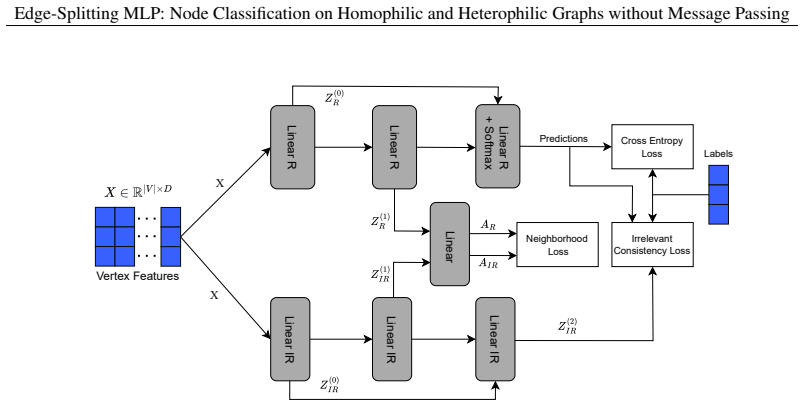
The load-bearing object is the pair of splitting adjacency matrices A_R(i,j)=(1+alpha(i,j))/2 and A_IR(i,j)=(1-alpha(i,j))/2, where alpha(i,j) is a scalar in (-1,1) produced by a tanh-activated linear layer over the concatenated relevant and irrelevant embeddings of nodes i and j. Because A_R+A_IR equals the original adjacency matrix, every edge is partitioned into a task-relevant and a task-irrelevant channel. The r-th powers of these matrices feed a neighborhood contrastive loss computed separately on the Z_R and Z_IR embedding spaces, which is how the model learns from r-hop neighborhoods without message passing; an irrelevant consistency regularization term then minimizes the Z_IR distance of adjacent nodes whose predicted labels differ. At inference only the MLP on Z_R remains, so the adjacency matrix is never needed.
What would settle it
Run ES-MLP on a heterophilic graph whose node features carry no class information while neighbor features do (the Minesweeper setting); its accuracy will remain at chance because edges are absent at inference—and indeed the paper reports roughly 50% AUROC for ES-MLP on Minesweeper versus 88.9% for GraphSAGE.
Extended reading notes
Core claim
ES-MLP's central claim is that the neighborhood structure of a graph can be digested during training, through a loss, and then discarded at inference. The model learns two exclusive splitting matrices A_R and A_IR, with A_R(i,j)+A_IR(i,j)=1 for every edge, by feeding the concatenated task-relevant and task-irrelevant embeddings of both endpoints into a tanh-activated linear layer. The neighborhood contrastive loss of Graph-MLP is then applied separately to the two embedding spaces, using powers of A_R and A_IR, so that task-relevant edges pull relevant representations together while irrelevant edges are handled in the other channel; an irrelevant consistency regularization further suppresses the irrelevant channel on edges whose endpoints are predicted to have different labels. Predictions are made solely from the task-relevant embedding Z_R. The paper demonstrates on seven real-world datasets and one CSBM synthetic family that this scheme yields accuracy on par with or better than GCN, GraphSAGE, ES-GNN, LINKX, and the two MLP baselines, and that the learned matrices separate homophilic from heterophilic edges as intended.
Load-bearing premise
At inference time the node's class must be recoverable from its own feature vector, because edges are used only during training; on any task where labels are determined by neighbor features, as in Minesweeper, the model cannot classify correctly.
Editorial extensions
If this is right
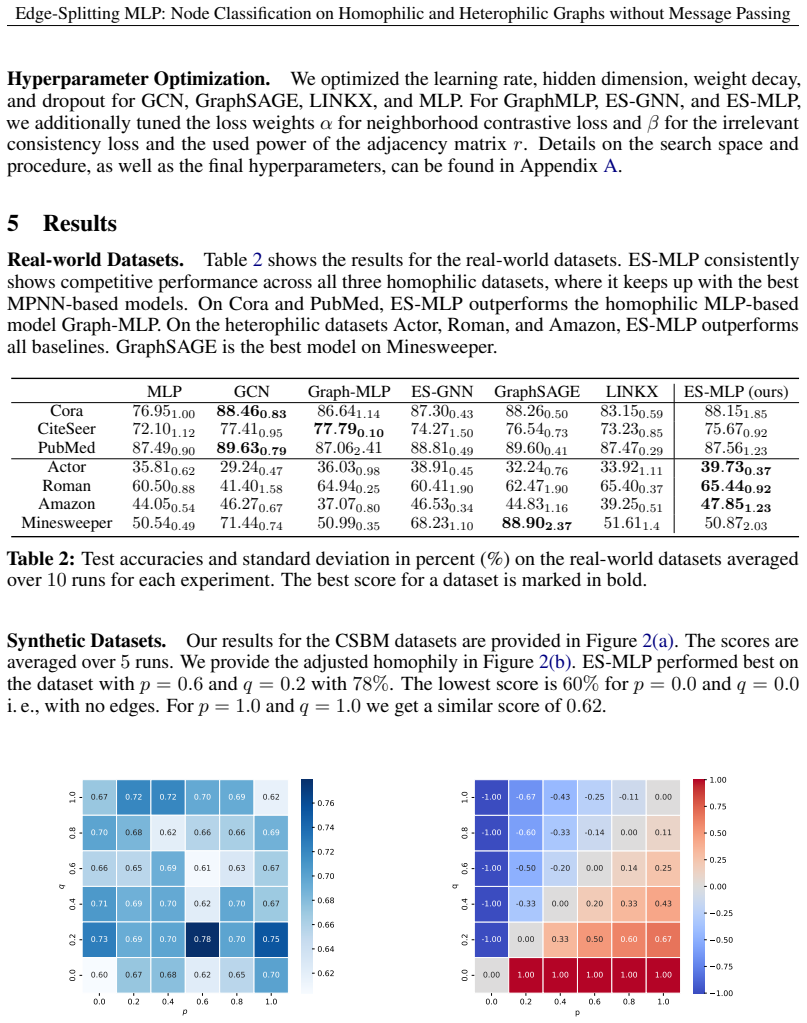
- On the heterophilic datasets Actor, Roman, and Amazon, ES-MLP outperforms all six baselines, including ES-GNN and GraphSAGE.
- On the homophilic citation graphs Cora, CiteSeer, and PubMed, ES-MLP remains within about two accuracy points of the best MPNN, and it beats Graph-MLP on Cora and PubMed.
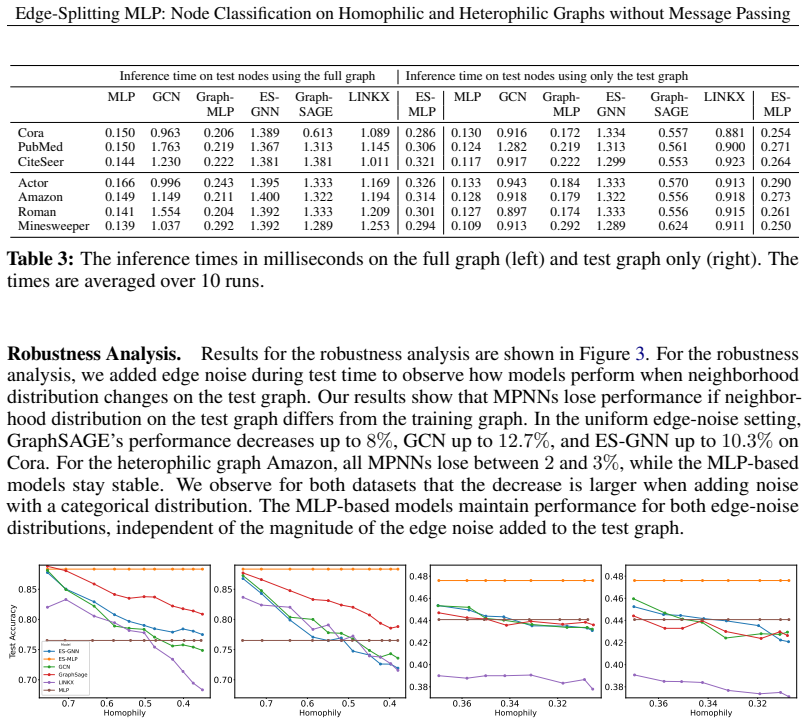
- Injecting uniform or categorical edge noise into the test graph leaves ES-MLP's accuracy unchanged, while GCN, GraphSAGE, and ES-GNN drop by up to 12.7 points on Cora and 2–3 points on Amazon.
- ES-MLP runs two to five times faster than the fastest MPNN baseline at inference and can be fed the test nodes alone without losing accuracy, because edges are absent by design.
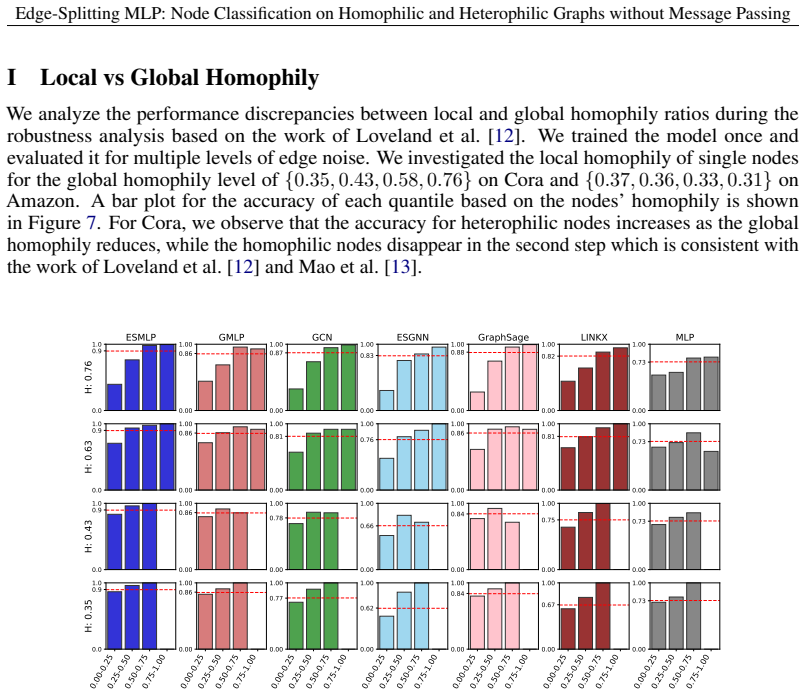
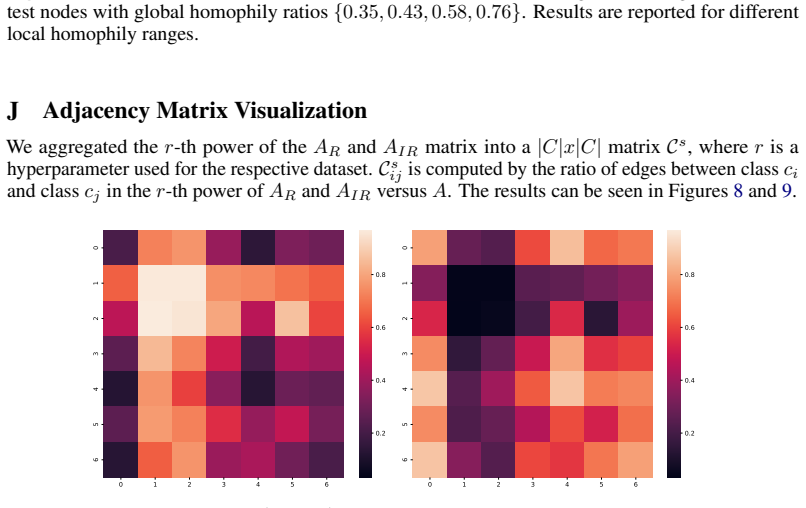
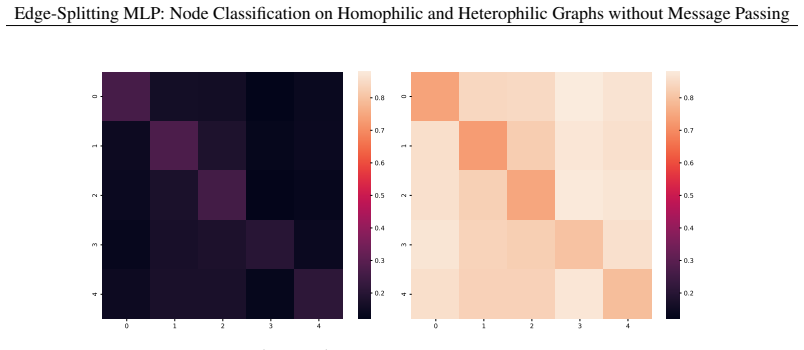
- The learned adjacency matrices separate homophilic from heterophilic edges, with the relevant channel carrying a higher share of same-class edges on Cora and most edges pushed into the irrelevant channel on Actor.
Reading between the lines
- The Minesweeper result marks a hard boundary for all edge-free models, not just ES-MLP: whenever labels are determined by neighbor features rather than the node's own features, dropping edges at inference caps accuracy at chance; homophily level is irrelevant to this boundary.
- Because the splitting coefficients are computed from the endpoints' embeddings, they could serve as a reusable edge-relevance score, for example to prune graphs or to flag distribution shift between training and deployment graphs—uses the paper does not explore.
- The robustness to test-time edge noise follows directly from discarding edges at inference, so a fair comparison against other edge-free models such as LINKX on noisy graphs would be needed to isolate how much of that robustness is due to the edge-splitting loss rather than the absence of edges.
- Extending the splitting to directed edges, which the paper lists as future work, could give the model a way to encode asymmetric neighborhood patterns; directed splitting coefficients would be a natural next experiment on heterophilic benchmarks.
Signed reviews
Editorial analysis
A structured set of objections, weighed in public.
Referee Report
Summary. The paper proposes ES-MLP, a node-classification model that combines the edge-splitting mechanism of ES-GNN with the neighborhood-contrastive training of Graph-MLP. During training, node features are projected into task-relevant and task-irrelevant subspaces, the adjacency matrix is split into two exclusive weighted matrices, and the model is trained with a combined cross-entropy, neighborhood-contrastive, and irrelevant-consistency loss. At inference only the MLP on the task-relevant representation is used, so no adjacency matrix is required. The authors evaluate ES-MLP on seven real-world datasets and CSBM synthetic graphs, compare with six baselines, and report competitive accuracy on the homophilic citation graphs, best results on Actor, Roman, and Amazon, robustness to edge noise, and faster inference than MPNNs.
Significance. ES-MLP is a sensible combination of two existing ideas, and the empirical study includes useful elements: ablations of the two auxiliary losses, hyperparameter sensitivity analysis, robustness experiments, and an inference-time comparison on full-graph versus test-only inputs. If the claims are properly scoped, the paper gives evidence that an MLP trained with edge-splitting can match or exceed message-passing baselines on several heterophilic benchmarks while keeping the inference-time advantages of a pure MLP. The release of source code is a further strength. The main weaknesses are that the headline 'all datasets' claim is false as stated and one baseline appears to be configured in a way that weakens the comparison; both are fixable.
major comments (3)
- [Abstract, Table 2, Section 6] The abstract's statement that ES-MLP 'is on par with homophilic and heterophilic models on all datasets' is contradicted by Table 2 on Minesweeper: ES-MLP obtains 50.87 ± 2.03 AUROC, essentially chance, while GraphSAGE obtains 88.90 ± 2.37. Section 6 itself explains that this is because 'the node features are independent of the class of a node' and MLP-based models have no access to neighbor features at inference. This is a hard boundary of the model class, not a minor benchmark miss, and it should be stated explicitly in the title and abstract, e.g., by scoping the claim to settings where node features carry label information.
- [Appendix A Table 10 vs Table 2 and Section 6] For Actor and Amazon, the reported Graph-MLP configuration sets α_NC = 0, i.e., the neighborhood-contrastive term, which is the component that distinguishes Graph-MLP from an MLP, is disabled on exactly the heterophilic datasets used to argue that Graph-MLP underperforms. The discussion in Section 6 that Graph-MLP 'cannot compete on the heterophilic dataset, since the original neighborhood contrastive loss is based on the homophily assumption' is therefore not supported by the Actor/Amazon experiments. The authors should either report Graph-MLP with a nonzero α_NC on these datasets or explain why α_NC = 0 was chosen and how the Amazon result (Graph-MLP 37.07 vs MLP 44.05) arises under the stated reuse of MLP hyperparameters.
- [Section A.2 and Tables 9, 11] Section A.2 states that the adjacency power r is searched over {1, 2, 3}, but Table 9 reports r = 4 for Cora and Minesweeper. Table 11 also contains a malformed entry ('0.5.7') in the Amazon row. Because the reported results depend on these hyperparameters, the tables must be corrected and the search range reconciled; otherwise the experiments cannot be reproduced from the description.
minor comments (5)
- [References] References [21] and [23] are the same paper (Lim et al., 'Large scale learning on non-homophilous graphs'), which should be merged or cited consistently.
- [Section 3] The word 'seperately' should be 'separately' in the paragraph describing the per-channel forward pass.
- [Appendix C] The text says 'reporter in Table 12' and 'best results are marked in bolt'; these should read 'reported' and 'bold'.
- [Section 6] The sentence 'The difference to the best-performing models GCN and Graph-MLP is between 0.31 and 2.07 points' understates the CiteSeer gap: Graph-MLP achieves 77.79 and ES-MLP 75.67, a difference of 2.12 points.
- [Figure 3] The x-axis labels give homophily values but not the corresponding amount of edge noise; please add the noise levels or describe the mapping in the caption.
Circularity Check
No significant circularity: empirical architecture paper with externally cited components and an honestly stated scope limitation, not a circular derivation.
full rationale
The paper makes no pretense of deriving a prediction from first principles; it is an empirical architecture proposal. The model combines the neighborhood contrastive loss of Graph-MLP (Hu et al.) with the edge-splitting channel and ICR loss of ES-GNN (Guo et al.), both cited as external prior work. None of the authors' own prior work is invoked as load-bearing, and there is no uniqueness theorem or ansatz smuggled in via self-citation. The key empirical claims (test accuracy on seven datasets, inference time, robustness to test-time edge noise) are evaluated against held-out splits and baselines, not generated by the model's defining equations. The only self-referential mechanism is the ICR loss weighting by the model's own predicted label vectors, but that is a training regularizer and does not define the final prediction, so it is not a derivation cycle. The paper also explicitly scopes its own validity: in Section 6 it states that on Minesweeper 'the node features are independent of the class of a node... Since MLP-based models do not have access to these features during inference time, they are unable to classify these nodes correctly,' and the Limitations paragraph repeats that ES-MLP 'cannot be applied to tasks where the class depends on the neighborhood structure during inference time.' That is an honest boundary statement rather than a circular justification. The abstract's 'on par ... on all datasets' is overstated given Table 2 (ES-MLP 50.87 AUROC vs. GraphSAGE 88.90 on Minesweeper), but overclaiming is a correctness and scope issue, not circularity. Accordingly, no circular step can be quoted and the score is 0.
Assumptions & free parameters
free parameters (5)
- adjacency_power_r =
Cora:4, CiteSeer:2, PubMed:2, Actor:3, Amazon:3, Roman:1, Minesweeper:4
- neighborhood_contrastive_weight_alpha_NC =
1 for most datasets; 100 for Minesweeper
- irrelevant_consistency_weight_beta_ICR =
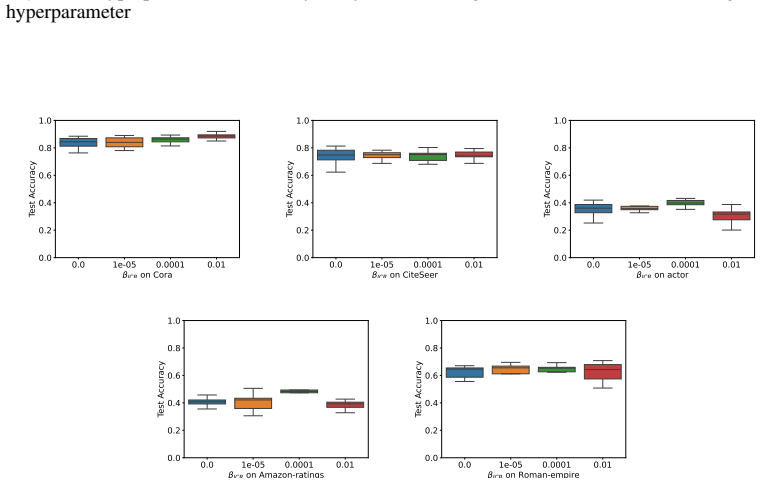
varies: Cora 0.01, CiteSeer 0.0, PubMed 0.0, Actor 0.0001, Amazon 0.0001, Roman 0.00001, Minesweeper 0.01
- skip_connection_weights_epsilon_R_and_epsilon_IR =
varies per dataset, e.g. Cora 0.5/0.5, Actor 0.0/0.7
- base_hyperparameters =
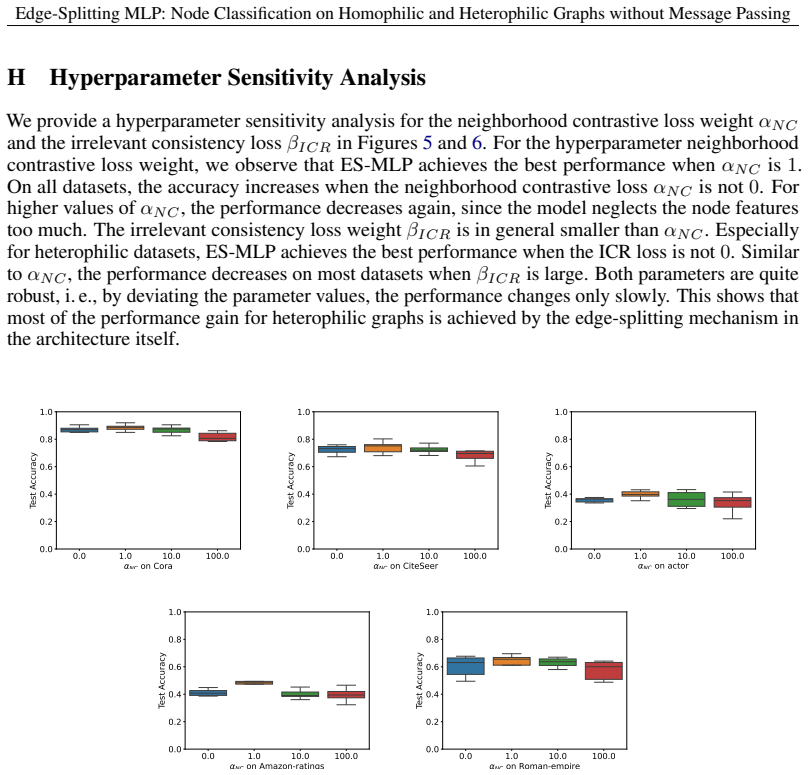
learning rate, hidden dim, dropout, weight decay per dataset (Tables 5-8)
assumptions (4)
- standard math Powers of the adjacency matrix encode r-hop neighborhood reachability.
- domain assumption Transductive setting, with test nodes present during training.
- domain assumption Node labels are recoverable from node features alone at inference time.
- domain assumption Soft labels from the model can be used to weight the irrelevant consistency loss.
Cite this review
Pith. "Pith review of Edge-Splitting MLP: Node Classification on Homophilic and Heterophilic Graphs without Message Passing." pith.science (2026). https://pith.science/paper/ZSNTN2JR
@misc{pith2026241208310,
  author       = {Pith},
  title        = {Pith review of: Edge-Splitting MLP: Node Classification on Homophilic and Heterophilic Graphs without Message Passing},
  year         = {2026},
  howpublished = {\url{https://pith.science/paper/ZSNTN2JR}},
  note         = {Machine review of arXiv:2412.08310}
}
read the original abstract
Message Passing Neural Networks (MPNNs) have demonstrated remarkable success in node classification on homophilic graphs. It has been shown that they do not solely rely on homophily but on neighborhood distributions of nodes, i.e., consistency of the neighborhood label distribution within the same class. MLP-based models do not use message passing, \eg Graph-MLP incorporates the neighborhood in a separate loss function. These models are faster and more robust to edge noise. Graph-MLP maps adjacent nodes closer in the embedding space but is unaware of the neighborhood pattern of the labels, i.e., relies solely on homophily. Edge Splitting GNN (ES-GNN) is a model specialized for heterophilic graphs and splits the edges into task-relevant and task-irrelevant, respectively. To mitigate the limitations of Graph-MLP on heterophilic graphs, we propose ES-MLP that combines Graph-MLP with an edge-splitting mechanism from ES-GNN. It incorporates the edge splitting into the loss of Graph-MLP to learn two separate adjacency matrices based on relevant and irrelevant feature pairs. Our experiments on seven datasets with six baselines show that ES-MLP is on par with homophilic and heterophilic models on all datasets without using edges during inference. We show that ES-MLP is robust to multiple types of edge noise during inference and that its inference time is two to five times faster than that of commonly used MPNNs. The source code is available at https://github.com/MatthiasKohn/ES-MLP.
Figures
Figures from the paper (7 more)
Reference graph
Works this paper leans on
-
[1]
Beyond homophily in graph neural networks: Current limitations and effective designs
Jiong Zhu, Yujun Yan, Lingxiao Zhao, Mark Heimann, Leman Akoglu, and Danai Koutra. Beyond homophily in graph neural networks: Current limitations and effective designs. In Hugo Larochelle, Marc’Aurelio Ranzato, Raia Hadsell, Maria-Florina Balcan, and Hsuan- Tien Lin, editors, Advances in Neural Information Processing Systems 33: Annual Con- ference on Neu...
work page 2020
-
[2]
Xin Zheng, Yixin Liu, Shirui Pan, Miao Zhang, Di Jin, and Philip S. Yu. Graph neural networks for graphs with heterophily: A survey. CoRR, abs/2202.07082, 2022. URL https: //arxiv.org/abs/2202.07082. 1, 2
arXiv 2022
-
[3]
Es-gnn: Generalizing graph neural networks beyond homophily with edge splitting
Jingwei Guo, Kaizhu Huang, Rui Zhang, and Xinping Yi. Es-gnn: Generalizing graph neural networks beyond homophily with edge splitting. IEEE Transactions on Pattern Analysis and Machine Intelligence, pages 1–16, 2024. doi: 10.1109/TPAMI.2024.3459932. 1, 2, 3, 14
-
[4]
Revisiting heterophily for graph neural networks
Sitao Luan, Chenqing Hua, Qincheng Lu, Jiaqi Zhu, Mingde Zhao, Shuyuan Zhang, Xiao-Wen Chang, and Doina Precup. Revisiting heterophily for graph neural networks. In NeurIPS, 2022. URL http://papers.nips.cc/paper_files/paper/2022/hash/ 092359ce5cf60a80e882378944bf1be4-Abstract-Conference.html . 1, 2
work page 2022
-
[5]
Yao Ma, Xiaorui Liu, Neil Shah, and Jiliang Tang. Is homophily a necessity for graph neural networks? In The Tenth International Conference on Learning Representations, ICLR 2022, Virtual Event, April 25-29, 2022. OpenReview.net, 2022. URL https://openreview.net/ forum?id=ucASPPD9GKN. 1, 2, 6, 9, 13
work page 2022
-
[6]
Graph-MLP: Node classification without message passing in graph
Yang Hu, Haoxuan You, Zhecan Wang, Zhicheng Wang, Erjin Zhou, and Yue Gao. Graph-MLP: Node classification without message passing in graph. CoRR, abs/2106.04051, 2021. URL https://arxiv.org/abs/2106.04051. 1, 2, 3, 4, 14
arXiv 2021
-
[7]
Kimon Fountoulakis, Amit Levi, Shenghao Yang, Aseem Baranwal, and Aukosh Jagannath. Graph attention retrospective. J. Mach. Learn. Res. , 24:246:1–246:52, 2023. URL https: //jmlr.org/papers/v24/22-125.html. 2, 6
work page 2023
-
[8]
Thomas N. Kipf and Max Welling. Semi-supervised classification with graph convolutional networks. In 5th International Conference on Learning Representations, ICLR 2017, Toulon, France, April 24-26, 2017, Conference Track Proceedings . OpenReview.net, 2017. URL https://openreview.net/forum?id=SJU4ayYgl. 2, 5
work page 2017
Show all 27 references
-
[9]
Souza Jr., Tianyi Zhang, Christopher Fifty, Tao Yu, and Kilian Q
Felix Wu, Amauri H. Souza Jr., Tianyi Zhang, Christopher Fifty, Tao Yu, and Kilian Q. Weinberger. Simplifying graph convolutional networks. In Kamalika Chaudhuri and Rus- lan Salakhutdinov, editors, Proceedings of the 36th International Conference on Machine Learning, ICML 201...
2019
-
[10]
Graph attention networks
Petar Velickovic, Guillem Cucurull, Arantxa Casanova, Adriana Romero, Pietro Liò, and Yoshua Bengio. Graph attention networks. In 6th International Conference on Learning Representations, ICLR 2018, V ancouver , BC, Canada, April 30 - May 3, 2018, Conference Track Proceedings....
2018
-
[11]
Hamilton, Zhitao Ying, and Jure Leskovec
William L. Hamilton, Zhitao Ying, and Jure Leskovec. Inductive representation learning on large graphs. In Isabelle Guyon, Ulrike von Luxburg, Samy Bengio, Hanna M. Wallach, Rob Fergus, S. V . N. Vishwanathan, and Roman Garnett, editors,Advances in Neural Information Processin...
2017
-
[12]
Schaub, and Danai Koutra
Donald Loveland, Jiong Zhu, Mark Heimann, Benjamin Fish, Michael T. Schaub, and Danai Koutra. On performance discrepancies across local homophily levels in graph neural networks. In Soledad Villar and Benjamin Chamberlain, editors, Learning on Graphs Conference, 27-30 November...
2023
-
[13]
Haitao Mao, Zhikai Chen, Wei Jin, Haoyu Han, Yao Ma, Tong Zhao, Neil Shah, and Jiliang Tang. Demystifying structural disparity in graph neural networks: Can one size fit all? In Alice Oh, Tristan Naumann, Amir Globerson, Kate Saenko, Moritz Hardt, and Sergey Levine, editors, A...
2023
-
[14]
MixHop: Higher-order graph convolutional architectures via sparsified neighborhood mixing
Sami Abu-El-Haija, Bryan Perozzi, Amol Kapoor, Nazanin Alipourfard, Kristina Lerman, Hrayr Harutyunyan, Greg Ver Steeg, and Aram Galstyan. MixHop: Higher-order graph convolutional architectures via sparsified neighborhood mixing. In Kamalika Chaudhuri and Ruslan Salakhutdinov,...
2019
-
[15]
Two sides of the same coin: Heterophily and oversmoothing in graph convolutional neural networks
Yujun Yan, Milad Hashemi, Kevin Swersky, Yaoqing Yang, and Danai Koutra. Two sides of the same coin: Heterophily and oversmoothing in graph convolutional neural networks. In Xingquan Zhu, Sanjay Ranka, My T. Thai, Takashi Washio, and Xindong Wu, editors,IEEE International Conf...
2022
-
[16]
Adaptive universal generalized pagerank graph neural network
Eli Chien, Jianhao Peng, Pan Li, and Olgica Milenkovic. Adaptive universal generalized pagerank graph neural network. In 9th International Conference on Learning Representations, ICLR 2021, Virtual Event, Austria, May 3-7, 2021 . OpenReview.net, 2021. URL https: //openreview.n...
2021
-
[17]
Neighborhood pattern is crucial for graph convolutional networks performing node classification
Gongpei Zhao, Tao Wang, Yidong Li, Yi Jin, Congyan Lang, and Songhe Feng. Neighborhood pattern is crucial for graph convolutional networks performing node classification. IEEE Transactions on Neural Networks and Learning Systems , pages 1–14, 2022. doi: 10.1109/ TNNLS.2022.3229721. 2
2022
-
[18]
Label-wise graph convolutional network for heterophilic graphs
Enyan Dai, Shijie Zhou, Zhimeng Guo, and Suhang Wang. Label-wise graph convolutional network for heterophilic graphs. In Bastian Rieck and Razvan Pascanu, editors, Learning on Graphs Conference, LoG 2022, 9-12 December 2022, Virtual Event , volume 198 of Proceedings of Machine...
2022
-
[19]
GBK-GNN: gated bi-kernel graph neural networks for modeling both homophily and heterophily
Lun Du, Xiaozhou Shi, Qiang Fu, Xiaojun Ma, Hengyu Liu, Shi Han, and Dongmei Zhang. GBK-GNN: gated bi-kernel graph neural networks for modeling both homophily and heterophily. In Frédérique Laforest, Raphaël Troncy, Elena Simperl, Deepak Agarwal, Aristides Gionis, Ivan Herman,...
2022
-
[20]
Bronstein
Emanuele Rossi, Bertrand Charpentier, Francesco Di Giovanni, Fabrizio Frasca, Stephan Günnemann, and Michael M. Bronstein. Edge directionality improves learning on heterophilic graphs. In Soledad Villar and Benjamin Chamberlain, editors, Learning on Graphs Conference, 27-30 No...
2023
-
[21]
Large scale learning on non-homophilous graphs: New benchmarks and strong simple methods
Derek Lim, Felix Hohne, Xiuyu Li, Sijia Linda Huang, Vaishnavi Gupta, Omkar Bhalerao, and Ser-Nam Lim. Large scale learning on non-homophilous graphs: New benchmarks and strong simple methods. In Marc’Aurelio Ranzato, Alina Beygelzimer, Yann N. Dauphin, Percy Liang, and Jennif...
2021
-
[22]
Geom-GCN: Geometric graph convolutional networks
Hongbin Pei, Bingzhe Wei, Kevin Chen-Chuan Chang, Yu Lei, and Bo Yang. Geom-GCN: Geometric graph convolutional networks. In 8th International Conference on Learning Repre- sentations, ICLR 2020, Addis Ababa, Ethiopia, April 26-30, 2020 . OpenReview.net, 2020. URL https://openr...
2020
-
[23]
Large scale learning on non-homophilous graphs: New benchmarks and strong simple methods
Derek Lim, Felix Hohne, Xiuyu Li, Sijia Linda Huang, Vaishnavi Gupta, Omkar Bhalerao, and Ser-Nam Lim. Large scale learning on non-homophilous graphs: New benchmarks and strong simple methods. In Marc’Aurelio Ranzato, Alina Beygelzimer, Yann N. Dauphin, Percy Liang, and Jennif...
2021
-
[24]
Characteriz- ing graph datasets for node classification: Homophily-heterophily dichotomy and beyond
Oleg Platonov, Denis Kuznedelev, Artem Babenko, and Liudmila Prokhorenkova. Characteriz- ing graph datasets for node classification: Homophily-heterophily dichotomy and beyond. In Alice Oh, Tristan Naumann, Amir Globerson, Kate Saenko, Moritz Hardt, and Sergey Levine, editors,...
2023
-
[25]
Collective classification in network data
Prithviraj Sen, Galileo Namata, Mustafa Bilgic, Lise Getoor, Brian Gallagher, and Tina Eliassi- Rad. Collective classification in network data. AI Mag., 29(3):93–106, 2008. URL https: //doi.org/10.1609/aimag.v29i3.2157. 5, 17
2008 doi
-
[26]
Oleg Platonov, Denis Kuznedelev, Michael Diskin, Artem Babenko, and Liudmila Prokhorenkova. A critical look at the evaluation of gnns under heterophily: Are we re- ally making progress? In The Eleventh International Conference on Learning Repre- sentations, ICLR 2023, Kigali, ...
2023
-
[27]
Pitfalls of graph neural network evaluation
Oleksandr Shchur, Maximilian Mumme, Aleksandar Bojchevski, and Stephan Günnemann. Pitfalls of graph neural network evaluation. CoRR, abs/1811.05868, 2018. URL http:// arxiv.org/abs/1811.05868. 6 12 Edge-Splitting MLP: Node Classification on Homophilic and Heterophilic Graphs w...
2018 arXiv
Reviewed August 11, 2026 · model on record in the stance chip above.
Discussion (0). Continue with ORCID to comment.