REVIEW 4 major objections 4 minor 19 references
CIMBA: fast Monte Carlo generation using cubic interpolation
T0 review · 4 major / 4 minor · reviewed 2026-08-14 · deepseek-v4-flash
Pith's one-line read CIMBA claims analytic smooth sampling of minimum-bias grids reproduces Pythia orders of magnitude faster.
desk verdict Useful simulation toolkit with real math and honest limitations; the main gap is unquantified interpolation bias in sparse-bin regions. read the letter →
The pith
A machine-rendered reading of the paper's core claim, the machinery that carries it, and where it could break.
The reading
What carries the argument
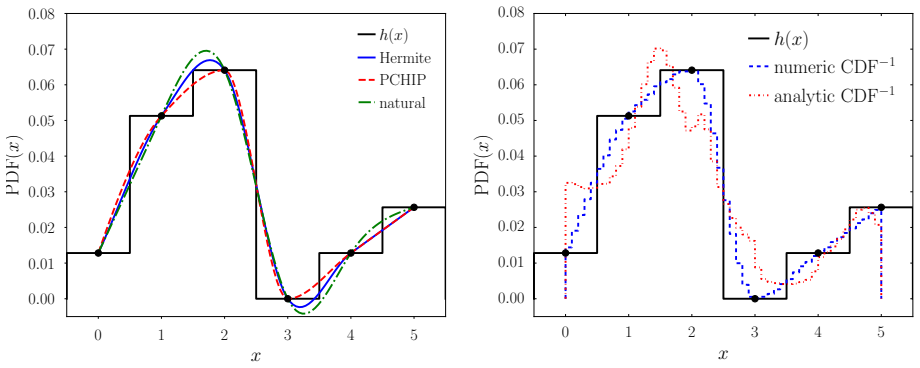
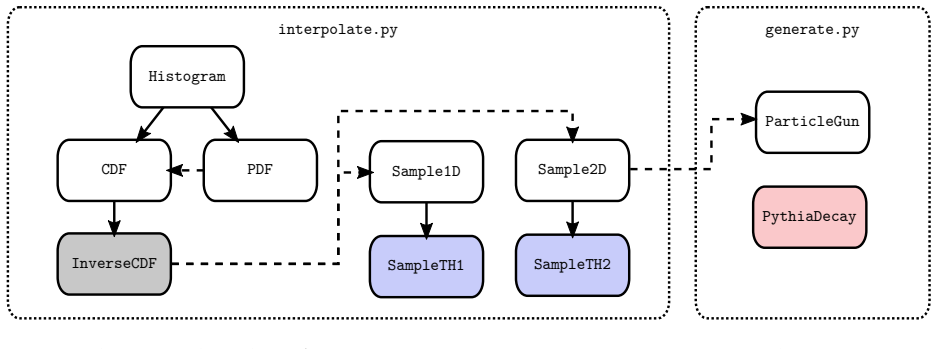
The central object is the piecewise monotone cubic Hermite interpolating polynomial (PCHIP), which turns a sparsely binned histogram into a $C^1$, everywhere-positive PDF without the oscillatory overshoot of natural or plain Hermite cubics. The argument is carried by an analytic inverse-CDF sampler: the CDF of each cubic segment is a quartic polynomial, and CIMBA solves it in closed form, with a companion-matrix fallback when the quartic solver loses numerical stability. For the bivariate grid, a constant bin spacing in the second variable makes the cross terms in the projected PDF vanish, reducing the projection to a single cubic polynomial; the second variable is then sampled from the one-dimensional interpolated conditional distribution. This combination is what makes smooth, fast, and weight-correct sampling possible from stored histograms.
What would settle it
Generate a dedicated Pythia 8 sample much larger than the $10^9$ events used for the shipped grids, restrict to the most sparsely populated region of a provided $(\rho,\eta)$ grid, for example B mesons with $p_T > 5$ GeV, and compare the CIMBA-interpolated $p_T$ spectrum with the direct Pythia spectrum; if the tail differences exceed the spread between plausible generator tunes, the interpolation assumption fails.
Extended reading notes
Core claim
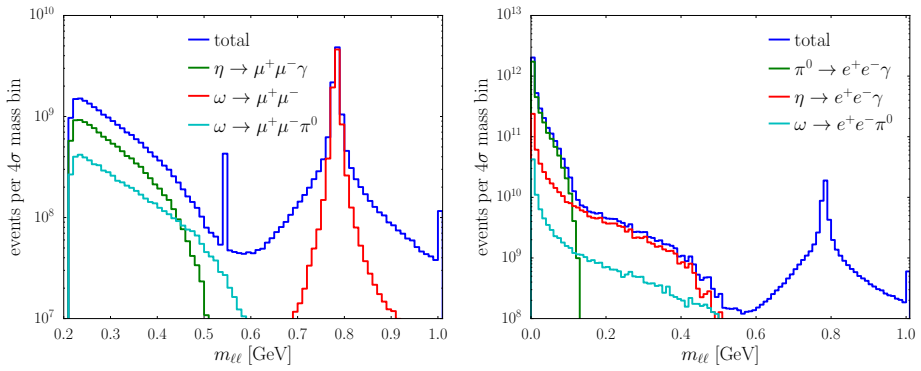
CIMBA's claim is that one never needs to regenerate full minimum-bias events when only the kinematics of a single particle are wanted. For every particle species produced by Pythia 8, the package pre-computes bivariate histograms in pseudorapidity $\eta$ and in the transformed transverse-momentum variable $\rho = 1/(p_T + 1\,\mathrm{GeV} - p_{T,\min})^k$, using $10^9$-event minimum-bias samples. At generation time it converts each histogram into a smooth, everywhere-positive PDF via piecewise monotone cubic Hermite interpolation (PCHIP), factorizes the bivariate PDF into two univariate CDFs, and samples each by analytically inverting the cubic polynomial CDF. Validation against direct Pythia generation for $\pi^+$ and against published dark-photon and true-muonium search proposals shows agreement in shape and absolute normalization. The reported performance is about 25 generated particles per Pythia soft-QCD event, reducing a sample that previously took a week to roughly half an hour.
Load-bearing premise
The load-bearing premise is that the smoothed grid faithfully represents the true underlying kinematic distribution everywhere, including rarely populated high-transverse-momentum tails, so that interpolation bias is negligible compared with the generator's own uncertainties.
Editorial extensions
If this is right
- Any particle species in the supplied grids can be generated as fast single-particle samples with the same shape and absolute normalization as Pythia, without running full minimum-bias event generation.
- Fiducial cross-sections for rare particles, such as the B mesons behind the LHCb dark-photon displaced background, can be obtained with speedups above 2500x, turning week-long sample productions into jobs of roughly half an hour.
- Because grids can be regenerated from any Pythia configuration or another generator, the method extends to beam setups beyond those shipped, including proton-lead or proton-electron collisions.
- Sampling weights let users impose $p_T$ and $\eta$ limits and compute the corresponding fiducial cross-section, so the package behaves like a calibrated particle gun rather than a raw histogram sampler.
- The univariate and bivariate analytic-sampling procedures are general: any histogram requiring smooth sampling could use the same PCHIP CDF-inversion machinery.
Reading between the lines
- If the smoothing bias is truly negligible, CIMBA-style grids could replace full generator output not only for signal extraction but also for background templates in fast simulation, wherever only one particle's kinematics matter.
- The transformed variable $\rho$ is load-bearing: accuracy likely depends on keeping the histogram nearly flat in the sampled variables, so the first place to look for artifacts is a sharply peaked variable such as very low $p_T$.
- The paper's suggested re-binning procedure could be converted into a quantitative systematic by comparing CIMBA output from coarse and fine grids, giving a concrete uncertainty band that the paper leaves unspecified.
Signed reviews
Editorial analysis
A structured set of objections, weighed in public.
Referee Report
Summary. The paper presents CIMBA, a package that samples single-particle kinematics from precomputed histograms of Pythia 8 minimum-bias events, using piecewise cubic Hermite interpolating polynomials (PCHIP) to provide smooth probability densities. The author derives analytic inverse-CDF sampling for univariate cubic interpolants, develops a bivariate sampling method based on projecting the interpolated density onto one variable, and provides grids for several LHC and other beam configurations. Validation compares CIMBA-generated π+ pseudorapidity and pT distributions with Pythia, and two applications are shown: an inclusive di-muon dark photon search and a true muonium search, both at LHCb. The claimed advantages are smoothness over histogram sampling, large speedups for rare final states, and a complete, configurable package.
Significance. If the fidelity claims hold, CIMBA would be a practically useful tool for LHCb-style simulation, where signal candidates are often extracted from expensive minimum-bias event samples. The paper contributes a detailed derivation of sampling from cubic interpolants, including fallback strategies for numerical root finding, and ships an open-source package with precomputed grids and reproduction examples. These are concrete, checkable strengths. The central quantitative claim, however, is broader than the evidence shown: the paper claims faithful reproduction of Pythia single-particle distributions for all particles and kinematic regions, including rare species and high-pT tails, while explicitly declining to quantify interpolation uncertainty and validating in detail only for abundant light particles. The theoretical derivation appears sound under its stated assumptions, but the assumption of constant y-bin spacing in the bivariate projection is not stated as a general grid requirement.
major comments (4)
- [Section 7 (Validation)] The central claim that CIMBA reproduces Pythia's single-particle distributions for all particles and phase-space regions is not yet established because the paper explicitly declines to quantify interpolation uncertainty: 'No explicit attempt has been made at evaluating the uncertainty introduced via the interpolation methods of CIMBA.' The only detailed comparison is for π+ up to pT around 5 GeV (Figure 5), and the statement that 'tests have been performed for other particle species with similar levels of agreement' is not substantiated with results. Since the package is motivated by rare particles such as B mesons, where histogram bins are sparse, a quantitative bias estimate, for example using the re-binning procedure suggested in Section 7, is needed before the 'all particles' and absolute-normalization claims can be accepted.
- [Section 4, Eq. (22)] The bivariate projection in Eq. (22) is derived only under the assumption of constant y-bin spacing Δy, since the ζ terms vanish only in that case. The paper does not state that all provided grids, or all user-supplied grids invited in Section 5, satisfy this condition, nor what happens if they do not. This restriction must be documented and enforced, or the projection method must be generalized, because otherwise the sampling procedure is not well defined for arbitrary input histograms.
- [Section 2 and Section 7] Because PCHIP interpolates bin centres without preserving bin integrals, the sampled interpolant can have local normalization biases relative to the original histogram; the paper itself notes that an 'ideal' modified PCHIP would preserve per-bin integrals. The magnitude of this area mismatch is not quantified, so the good absolute normalization agreement in Figure 5 could be specific to π+ and may not hold for sparsely binned species or high-pT tails. A quantitative study of the interpolation bias, at least for representative rare species and tail regions, is required to support the package's general-purpose claims.
- [Section 3 and Section 6] When the analytic quartic root finder fails, the implementation switches to numpy companion-matrix eigenvalues or, if numpy is unavailable, to linear interpolation (Section 6, step 7). This introduces a mode-dependent sampling distribution precisely in the intervals where the analytic solve is numerically unstable. The paper does not report how often this fallback is triggered for the default grids or what bias it introduces; measuring its frequency and impact is necessary to ensure that the fallback does not distort the generated distributions.
minor comments (4)
- [Section 5, step 6] The formula for cos(θ) appears to have a typo: it reads 'cos(θ) = (e2η−1)(e2η−1)', which is dimensionally inconsistent and should likely be '(e^{2η}−1)/(e^{2η}+1)'.
- [Section 5, bullet list] The first bullet describing the 'all' grid says 'All particles produced in the event, including intermediate states' and then immediately says 'Only the final version of duplicate particles are included'; this wording is confusing and should be clarified to distinguish final-state particles from intermediate resonances.
- [Section 6] Step 7 of the InverseCDF algorithm mentions that if the analytic solution fails, the companion matrix method is used and, if numpy is unavailable, linear interpolation is used; it would be helpful to state whether the linear-interpolation fallback preserves monotonicity and positivity of the inverse CDF.
- [Section 7, Figure 6] The caption of Figure 6 labels the subfigures as '(right)' and '(left)' in the same order as the text, but it may be clearer to explicitly reference the panels as '(a)' and '(b)' to avoid ambiguity in the description of the dark photon and true muonium results.
Circularity Check
No significant circularity: CIMBA's derivation is self-contained as an interpolation/sampling method, and its Pythia comparisons are deliberate fidelity checks rather than disguised predictions.
full rationale
The paper makes no first-principles physics derivation; it presents a compression and sampling layer over Pythia 8.240 grids. The central validation in Section 7 compares CIMBA's output to the same generator that produced the interpolation grids; this is an explicit fidelity test of the interpolation and reweighting machinery, not a scientific prediction from independent inputs. The analytic sampling method in Sections 2-4 is derived from the defining PCHIP constraints and the inverse-CDF construction without importing the paper's conclusions; the rho variable of Eq. (23) is a stated coordinate choice for smoother interpolation, not a renamed known result or an imported uniqueness theorem. The dark-photon and true-muonium examples cite prior work by the author, but these are illustrative applications, and footnote 1 openly notes differences from Ref. [14] arising from scaling, Pythia versions, and smoothing, so the agreement is not forced by construction. The acknowledged limitation in Section 7, 'No explicit attempt has been made at evaluating the uncertainty introduced via the interpolation methods,' weakens the validation for sparse high-pT bins and rare species, but it is a correctness/validation gap, not a circular step. No equation or fitted parameter reduces CIMBA's output to its input by definition.
Assumptions & free parameters
free parameters (3)
- k (power in ρ definition) =
2 (default)
- pTmin =
0.25 GeV
- Histogram binning of interpolation grids =
not specified in text
assumptions (4)
- standard math CDF inversion via solving polynomial roots is valid for a continuous PDF.
- domain assumption For unpolarized beams, particles are produced uniformly in azimuthal angle φ and the mass is independent of momentum.
- domain assumption Pythia 8 with SoftQCD:all=on provides an adequate model for the target distributions in minimum bias events.
- ad hoc to paper The bivariate projection in Eq. (22) is exact only under constant y-bin spacing; the grids are assumed to have constant spacing.
Cite this review
Pith. "Pith review of CIMBA: fast Monte Carlo generation using cubic interpolation." pith.science (2026). https://pith.science/paper/ZSY3HNYF
@misc{pith2026190808353,
  author       = {Pith},
  title        = {Pith review of: CIMBA: fast Monte Carlo generation using cubic interpolation},
  year         = {2026},
  howpublished = {\url{https://pith.science/paper/ZSY3HNYF}},
  note         = {Machine review of arXiv:1908.08353}
}
read the original abstract
Monte Carlo generation of high energy particle collisions is a critical tool for both theoretical and experimental particle physics, connecting perturbative calculations to phenomenological models, and theory predictions to full detector simulation. The generation of minimum bias events can be particularly computationally expensive, where non-perturbative effects play an important role and specific processes and fiducial regions can no longer be well defined. In particular scenarios, particle guns can be used to quickly sample kinematics for single particles produced in minimum bias events. CIMBA (Cubic Interpolation for Minimum Bias Approximation) provides a comprehensive package to smoothly sample predefined kinematic grids, from any general purpose Monte Carlo generator, for all particles produced in minimum bias events. These grids are provided for a number of beam configurations including those of the Large Hadron Collider.
Figures


Figures from the paper (3 more)

Reference graph
Works this paper leans on
-
[1]
Buckley, et al., General-purpose event generators for LHC physics, Phys
A. Buckley, et al., General-purpose event generators for LHC physics, Phys. Rept. 504 (2011) 145–233. arXiv:1101.2599, doi:10.1016/j.physrep.2011.03.005
arXiv 2011
-
[2]
T. Sj¨ ostrand, S. Ask, J. R. Christiansen, R. Corke, N. Desai, P. Ilten, S. Mrenna, S. Prestel, C. O. Rasmussen, P. Z. Skands, An Introduction to PYTHIA 8.2, Comput. Phys. Commun. 191 (2015) 159–177. arXiv:1410.3012, doi:10.1016/j.cpc.2015. 01.024
arXiv 2015
-
[3]
Bothmann, et al., Event Generation with SHERPA 2.2 arXiv:1905.09127
E. Bothmann, et al., Event Generation with SHERPA 2.2 arXiv:1905.09127
arXiv 1905
-
[4]
Bellm, et al., Herwig 7.0/Herwig++ 3.0 release note, Eur
J. Bellm, et al., Herwig 7.0/Herwig++ 3.0 release note, Eur. Phys. J. C76 (4) (2016)
work page 2016
-
[5]
I. Belyaev, et al., Handling of the generation of primary events in Gauss, the LHCb sim- ulation framework, J. Phys. Conf. Ser. 331 (2011) 032047. doi:10.1088/1742-6596/ 331/3/032047
-
[6]
J. R. Thompson, R. A. Tapia, Nonparametric function estimation, modeling, and simulation, Vol. 21, Siam, 1990
work page 1990
-
[7]
C. Runge, ¨Uber empirische Funktionen und die Interpolation zwischen ¨ aquidistanten Ordinaten, Zeitschrift f¨ ur Mathematik und Physik 46 (224-243) (1901) 20
work page 1901
-
[8]
F. N. Fritsch, R. E. Carlson, Monotone piecewise cubic interpolation, SIAM Journal on Numerical Analysis 17 (2) (1980) 238–246
work page 1980
Show all 19 references
-
[9]
W. H. Press, S. A. Teukolsky, W. T. Vetterling, B. P. Flannery, Numerical recipes in C++: the art of scientific computing; 2nd ed., Cambridge Univ. Press, Cambridge, 2002. URL https://cds.cern.ch/record/542667
2002
-
[10]
Herbison-Evans, Solving Quartics and Cubics for Graphics, Academic Press, Boston, 1995
D. Herbison-Evans, Solving Quartics and Cubics for Graphics, Academic Press, Boston, 1995. doi:10.1016/B978-0-12-543457-7.50009-7
1995 doi
-
[11]
Shmakov, A universal method of solving quartic equations, International Journal of Pure and Applied Mathematics 71 (2011) 251
S. Shmakov, A universal method of solving quartic equations, International Journal of Pure and Applied Mathematics 71 (2011) 251
2011
-
[12]
R. A. Horn, C. R. Johnson, Matrix Analysis, 2nd Edition, Cambridge University Press, New York, NY, USA, 2012
2012
-
[13]
R. Brun, F. Rademakers, ROOT: An object oriented data analysis framework, Nucl. Instrum. Meth. A389 (1997) 81–86. doi:10.1016/S0168-9002(97)00048-X
1997 doi
-
[14]
Ilten, Y
P. Ilten, Y. Soreq, J. Thaler, M. Williams, W. Xue, Proposed Inclusive Dark Photon Search at LHCb, Phys. Rev. Lett. 116 (25) (2016) 251803. arXiv:1603.08926, doi: 10.1103/PhysRevLett.116.251803. 16
2016 arXiv
-
[15]
Ilten, Y
P. Ilten, Y. Soreq, M. Williams, W. Xue, Serendipity in dark photon searches, JHEP 06 (2018) 004. arXiv:1801.04847, doi:10.1007/JHEP06(2018)004
2018 arXiv
-
[16]
Cid Vidal, P
X. Cid Vidal, P. Ilten, J. Plews, B. Shuve, Y. Soreq, Discovering True Muonium at LHCbarXiv:1904.08458
1904 arXiv
-
[17]
Aaij, et al., Search for Dark Photons Produced in 13 TeV pp Collisions, Phys
R. Aaij, et al., Search for Dark Photons Produced in 13 TeV pp Collisions, Phys. Rev. Lett. 120 (6) (2018) 061801. arXiv:1710.02867, doi:10.1103/PhysRevLett.120. 061801
2018 arXiv
-
[18]
Faessler, C
A. Faessler, C. Fuchs, M. I. Krivoruchenko, Dilepton spectra from decays of light unflavored mesons, Phys. Rev. C61 (2000) 035206. arXiv:nucl-th/9904024, doi: 10.1103/PhysRevC.61.035206. 17
2000 arXiv
-
[196]
arXiv:1512.01178, doi:10.1140/epjc/s10052-016-4018-8
Reviewed August 14, 2026 · model on record in the stance chip above.
Discussion (0). Continue with ORCID to comment.