Fundamental limitations on entanglement extraction from purity
Pith reviewed 2026-06-29 07:28 UTC · model grok-4.3
The pith
Some absolutely separable states can generate entanglement via probabilistic unital protocols, but completely absolutely separable states cannot.
A machine-rendered reading of the paper's core claim, the machinery that carries it, and where it could break.
Core claim
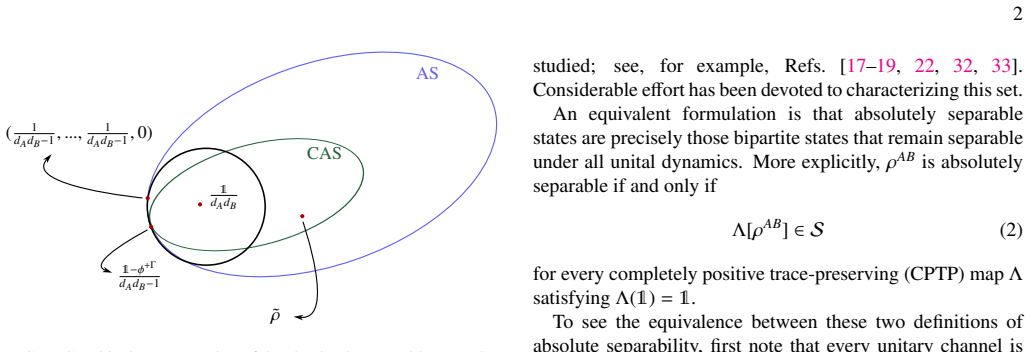
Absolutely separable states remain separable under all deterministic unital channels and thus cannot deterministically generate entanglement. However, some of them can generate entanglement via probabilistic protocols that preserve the unital property. This motivates the class of completely absolutely separable states, which fail to generate entanglement with any non-zero probability under any such protocol. The paper provides a full characterization of this class and a novel sufficient condition for separability that depends only on the largest and smallest eigenvalues, the smallest local dimension, and is independent of all previously known spectral separability criteria.
What carries the argument
The novel sufficient condition for separability depending only on the largest and smallest eigenvalues and the smallest local dimension, which enables the full characterization of completely absolutely separable states.
Load-bearing premise
The allowed operations are restricted to unital channels that do not increase purity.
What would settle it
A concrete counterexample would be any state that the derived characterization labels as completely absolutely separable yet produces entanglement with positive probability under some probabilistic unital protocol.
Figures
read the original abstract
States of sufficiently low purity are separable and cannot be entangled by unital (purity-non-generating) operations. Since high-purity states are experimentally demanding, it is natural to ask how much purity a state must possess to enable entanglement generation. Absolutely separable states remain separable under all deterministic unital channels, and so cannot deterministically generate entanglement in this setting. We show, however, that some absolutely separable states can generate entanglement via probabilistic protocols that do not produce purity. This motivates the study of states that fail to generate entanglement with any non-zero probability, which we call completely absolutely separable; we give a full characterization of this class. Along the way, we derive a novel sufficient condition for separability that depends only on the largest and smallest eigenvalues, along with the smallest local dimension and is independent of all previously known spectral separability criteria.
Editorial analysis
A structured set of objections, weighed in public.
Referee Report
Summary. The manuscript claims that some absolutely separable states remain separable under all deterministic unital channels but can generate entanglement via probabilistic unital protocols that preserve purity. It defines the subclass of completely absolutely separable states (those that cannot generate entanglement with nonzero probability under any such protocol), provides a full characterization of this class, and derives a novel sufficient condition for separability depending only on the largest and smallest eigenvalues together with the smallest local dimension; this criterion is stated to be independent of all previously known spectral separability criteria.
Significance. If the characterization and independence claim hold, the work supplies a complete delineation, within the unital probabilistic setting, of states from which entanglement cannot be extracted without purity increase. This sharpens the resource-theoretic understanding of purity as a prerequisite for entanglement generation and supplies a simple, low-parameter separability test that may be useful in both theoretical analysis and experimental design. The explicit separation between deterministic and probabilistic unital protocols is a useful conceptual clarification.
minor comments (2)
- [Abstract / Introduction] The abstract and introduction should explicitly state the precise definition of the probabilistic protocols considered (e.g., whether they are required to be trace-preserving on average or only on the support of the input) to avoid ambiguity for readers unfamiliar with the unital setting.
- [Section introducing the new criterion] The independence of the new spectral criterion from prior tests (e.g., those based on the PPT criterion or other eigenvalue bounds) is asserted but would benefit from a short explicit comparison table or paragraph listing the functional forms of the earlier criteria.
Simulated Author's Rebuttal
We thank the referee for the positive assessment, the clear summary of our results, and the recommendation of minor revision. No specific major comments or concerns were raised in the report.
Circularity Check
No significant circularity; derivation is self-contained
full rationale
The paper's central results—a full characterization of completely absolutely separable states under unital probabilistic protocols and a novel sufficient separability condition depending only on λ_max, λ_min and local dimension—are presented as direct mathematical derivations from the definitions of absolute separability, unital channels, and probabilistic maps. The abstract explicitly states independence from prior spectral criteria. No self-citations, fitted parameters renamed as predictions, ansatzes smuggled via citation, or renamings of known results appear in the provided claims or abstract. The derivation chain remains independent of the paper's own inputs.
Axiom & Free-Parameter Ledger
axioms (2)
- domain assumption Quantum states are represented by density operators on finite-dimensional Hilbert spaces; separability means the state is a convex combination of product states.
- domain assumption Unital channels are completely positive trace-preserving maps that fix the maximally mixed state and therefore cannot increase purity.
Reference graph
Works this paper leans on
-
[1]
but remains open otherwise. An important structural property of the set of absolutely separable states (which includes the set of completely absolutely separable states) is that it is not closed under tensor products. Every non maximally mixed bipartite stateρ AB fails to remain absolutely separable under sufficiently many tensor powers. Precisely, there ...
2004
-
[2]
Gisin, G
N. Gisin, G. Ribordy, W. Tittel, and H. Zbinden, Quantum cryptography, Rev. Mod. Phys.74, 145 (2002)
2002
-
[3]
C. H. Bennett, G. Brassard, C. Crépeau, R. Jozsa, A. Peres, and W. K. Wootters, Teleporting an unknown quantum state via dual classical and Einstein-Podolsky-Rosen channels, Physical Review Letters70, 1895 (1993)
1993
-
[4]
Giovannetti, S
V . Giovannetti, S. Lloyd, and L. Maccone, Quantum metrology, Phys. Rev. Lett.96, 010401 (2006)
2006
-
[5]
Horodecki, P
R. Horodecki, P. Horodecki, M. Horodecki, and K. Horodecki, Quantum entanglement, Rev. Mod. Phys.81, 865 (2009)
2009
-
[6]
Streltsov, G
A. Streltsov, G. Adesso, and M. B. Plenio, Colloquium: Quantum coherence as a resource, Rev. Mod. Phys.89, 041003 (2017)
2017
-
[7]
Lostaglio, An introductory review of the resource theory approach to thermodynamics, Reports on Progress in Physics 82, 114001 (2019)
M. Lostaglio, An introductory review of the resource theory approach to thermodynamics, Reports on Progress in Physics 82, 114001 (2019)
2019
-
[8]
Veitch, S
V . Veitch, S. A. Hamed Mousavian, D. Gottesman, and J. Emerson, The resource theory of stabilizer quantum computation, New Journal of Physics16, 013009 (2014)
2014
-
[9]
Streltsov, H
A. Streltsov, H. Kampermann, S. Wölk, M. Gessner, and D. Bruß, Maximal coherence and the resource theory of purity, New Journal of Physics20, 053058 (2018)
2018
-
[10]
W. H. Zurek, Decoherence, einselection, and the quantum origins of the classical, Rev. Mod. Phys.75, 715 (2003)
2003
-
[11]
M. S. Anwar, D. Blazina, H. A. Carteret, S. B. Duckett, T. K. Halstead, J. A. Jones, C. M. Kozak, and R. J. K. Taylor, Preparing high purity initial states for nuclear magnetic resonance quantum computing, Phys. Rev. Lett.93, 040501 (2004)
2004
-
[12]
P. Krantz, M. Kjaergaard, F. Yan, T. P. Orlando, S. Gustavsson, and W. D. Oliver, A quantum engineer’s guide to superconducting qubits, Applied Physics Reviews6, 10.1063/1.5089550 (2019)
-
[13]
C. B. Mendl and M. M. Wolf, Unital quantum channels – convex structure and revivals of birkhoff’s theorem, Communications in Mathematical Physics289, 1057–1086 (2009)
2009
-
[14]
G. Gour, M. P. Müller, V . Narasimhachar, R. W. Spekkens, and N. Yunger Halpern, The resource theory of informational nonequilibrium in thermodynamics, Physics Reports583, 1–58 (2015)
2015
-
[15]
Gurvits and H
L. Gurvits and H. Barnum, Largest separable balls around the maximally mixed bipartite quantum state, Phys. Rev. A66, 062311 (2002)
2002
-
[16]
Hildebrand, Entangled states close to the maximally mixed state, Phys
R. Hildebrand, Entangled states close to the maximally mixed state, Phys. Rev. A75, 062330 (2007)
2007
-
[17]
Ku ´s and K
M. Ku ´s and K. ˙Zyczkowski, Geometry of entangled states, Phys. Rev. A63, 032307 (2001)
2001
-
[18]
Patra, A
A. Patra, A. Maity, and A. Sen(De), Resource theory of nonabsolute separability, Phys. Rev. A108, 042402 (2023)
2023
-
[19]
Johnston, Separability from spectrum for qubit-qudit states, Phys
N. Johnston, Separability from spectrum for qubit-qudit states, Phys. Rev. A88, 062330 (2013)
2013
-
[20]
Knill, Separability from spectrum, Open Quantum Problems, IQOQI Vienna, Problem 15 (2003), problem page last updated 2013
E. Knill, Separability from spectrum, Open Quantum Problems, IQOQI Vienna, Problem 15 (2003), problem page last updated 2013
2003
-
[21]
Peres, Separability criterion for density matrices, Phys
A. Peres, Separability criterion for density matrices, Phys. Rev. Lett.77, 1413 (1996)
1996
-
[22]
Horodecki, P
M. Horodecki, P. Horodecki, and R. Horodecki, Separability of mixed states: necessary and sufficient conditions, Physics Letters A223, 1–8 (1996)
1996
-
[23]
Is absolute separability determined by the partial transpose?
S. Arunachalam, N. Johnston, and V . Russo, Is absolute separability determined by the partial transpose? (2015), arXiv:1405.5853 [quant-ph]
work page internal anchor Pith review Pith/arXiv arXiv 2015
-
[24]
M. A. Jivulescu, N. Lupa, I. Nechita, and D. Reeb, Positive reduction from spectra, Linear Algebra and its Applications 469, 276 (2015)
2015
-
[25]
Patro, I
S. Patro, I. Chakrabarty, and N. Ganguly, Non-negativity of conditional von neumann entropy and global unitary operations, Phys. Rev. A96, 062102 (2017)
2017
-
[26]
Abellanet-Vidal, G
J. Abellanet-Vidal, G. Müller-Rigat, G. Rajchel-Mieldzio ´c, and A. Sanpera, Sufficient criteria for absolute separability in arbitrary dimensions via linear map inverses, Reports on Progress in Physics88, 107601 (2025)
2025
-
[27]
M. Lewenstein, R. Augusiak, D. Chru ´sci´nski, S. Rana, and J. Samsonowicz, Sufficient separability criteria and linear maps, Physical Review A93, 10.1103/physreva.93.042335 (2016)
-
[28]
Regula, Probabilistic transformations of quantum resources, Phys
B. Regula, Probabilistic transformations of quantum resources, Phys. Rev. Lett.128, 110505 (2022)
2022
-
[29]
Regula, Tight constraints on probabilistic convertibility of quantum states, Quantum6, 817 (2022)
B. Regula, Tight constraints on probabilistic convertibility of quantum states, Quantum6, 817 (2022)
2022
-
[30]
Regula, L
B. Regula, L. Lami, and M. M. Wilde, Overcoming entropic limitations on asymptotic state transformations through probabilistic protocols, Phys. Rev. A107, 042401 (2023)
2023
-
[31]
B. Regula and L. Lami, Reversibility of quantum resources through probabilistic protocols, Nature Communications15, 10.1038/s41467-024-47243-2 (2024)
-
[32]
Hildebrand, Positive partial transpose from spectra, Phys
R. Hildebrand, Positive partial transpose from spectra, Phys. Rev. A76, 052325 (2007)
2007
-
[33]
Verstraete, K
F. Verstraete, K. Audenaert, and B. De Moor, Maximally entangled mixed states of two qubits, Phys. Rev. A64, 012316 (2001)
2001
-
[34]
Halder, S
S. Halder, S. Mal, and A. Sen(De), Characterizing the boundary of the set of absolutely separable states and their generation via noisy environments, Phys. Rev. A103, 052431 (2021)
2021
-
[35]
G. Gour, M. P. Müller, V . Narasimhachar, R. W. Spekkens, and N. Y . Halpern, The resource theory of informational nonequilibrium in thermodynamics, Physics Reports583, 1–58 (2015)
2015
-
[36]
Z. Song and L. Chen, Spectral characterizations of entanglement witnesses (2025), arXiv:2508.11308 [quant- ph]
-
[37]
Sarbicki, Spectral properties of entanglement witnesses, 6 Journal of Physics A: Mathematical and Theoretical41, 375303 (2008)
G. Sarbicki, Spectral properties of entanglement witnesses, 6 Journal of Physics A: Mathematical and Theoretical41, 375303 (2008)
2008
-
[38]
Champagne, N
G. Champagne, N. Johnston, M. MacDonald, and L. Pipes, Spectral properties of symmetric quantum states and symmetric entanglement witnesses, Linear Algebra and its Applications 649, 273–300 (2022)
2022
-
[39]
Keyl and R
M. Keyl and R. F. Werner, Estimating the spectrum of a density operator, Phys. Rev. A64, 052311 (2001)
2001
-
[40]
Cie ´sli´nski, S
P. Cie ´sli´nski, S. Imai, J. Dziewior, O. Gühne, L. Knips, W. Laskowski, J. Meinecke, T. Paterek, and T. Vértesi, Analysing quantum systems with randomised measurements, Physics Reports1095, 1 (2024), analysing quantum systems with randomised measurements
2024
-
[41]
J. Haah, A. W. Harrow, Z. Ji, X. Wu, and N. Yu, Sample- optimal tomography of quantum states, IEEE Transactions on Information Theory63, 5628 (2017)
2017
-
[42]
S. N. Filippov, K. Y . Magadov, and M. A. Jivulescu, Absolutely separating quantum maps and channels, New Journal of Physics 19, 083010 (2017)
2017
-
[43]
H. P. Dung and V . T. Khoi, On the maximum purity of absolutely separable bipartite states (2025), arXiv:2510.19508 [math-ph]. 7 SUPPLEMENTAL MA TERIAL A. Upper bound on the 1-norm of entanglement witnesses Lemma 1.Let W be a hermitian block-positive operator on HA ⊗ HB withTrW=1. Then ∥W∥1 ≤d.(15) where, d=min{d A,d B}. Proof.Without loss of generality, ...
-
[44]
Set a+ :=TrW +,a − :=TrW −
Write W=W + −W −,W +,W − ≥0,W +W− =0. Set a+ :=TrW +,a − :=TrW −. 8 Since TrW=1, a+ −a − =1. Moreover, by Lemma 1, ∥W∥1 =a + +a − ≤d. Hence a+ ≤ d+1 2 . Now Tr(ρW) =λ max Tr((I−∆)W ) =λ max 1−Tr (∆W) . Since∆≥0, Tr(∆W) =Tr (∆W+) −Tr (∆W−) ≤Tr (∆W+). Using∆≤ ∥∆∥ ∞I, we get Tr(∆W+) ≤ ∥∆∥ ∞ TrW + ≤ 2 d+1 · d+1 2 =1. Therefore Tr(ρW) =λ max 1−Tr (∆W) ≥0. Thus...
discussion (0)
Sign in with ORCID, Apple, or X to comment. Anyone can read and Pith papers without signing in.