REVIEW 2 major objections 2 minor 1 cited by
Inequalities in Fourier analysis on binary cubes
T0 review · 2 major / 2 minor · reviewed 2026-08-06 · deepseek-v4-flash
Pith's one-line read The paper exactly characterizes the exponent ranges in which sharp Hausdorff–Young and Young inequalities hold on binary cubes with constant 1 for every dimension.
desk verdict Theorem 6 is false — the Young convolution half of the paper collapses on a coefficient error, though the Hausdorff-Young half may be sound. read the letter →
The pith
A machine-rendered reading of the paper's core claim, the machinery that carries it, and where it could break.
The reading
What carries the argument
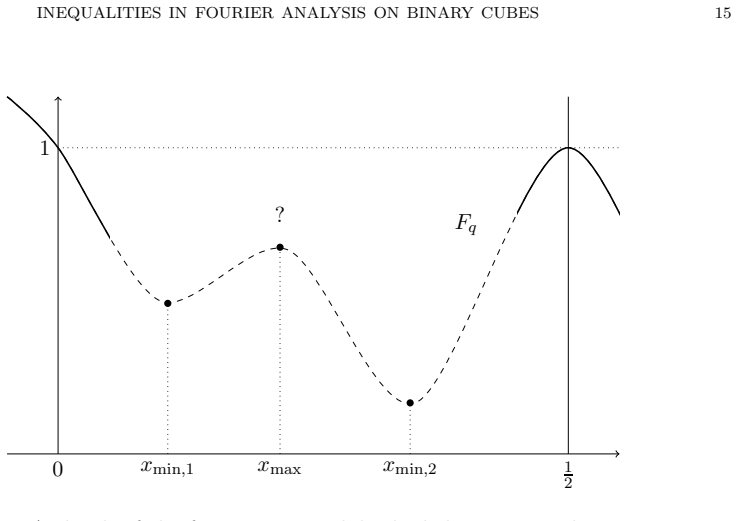
The load-bearing objects are the two-point inequality (Lemma 4) and the four-point inequality (Lemma 8). Lemma 4 is the $d=1$ case of Theorem 1: for $\alpha,\beta\ge 0$ and $p,q$ in the sharp range, $(\int_0^1 |\alpha e^{2\pi i t}+\beta|^q\,dt)^{1/q}\le (\alpha^p+\beta^p)^{1/p}$. Lemma 8 plays the same role for Theorem 6. Lemma 4 is proved by defining $F_q(x)=\int_0^1 |x^{1/p}e^{2\pi i t}+(1-x)^{1/p}|^q\,dt$ and showing $F_q(x)\le 1$ on $[0,1]$ via a second-order ordinary differential equation with coefficients $a_q,b_q,c_q$; the ODE is verified symbolically, and the boundary points $x=0$ and $x=1/2$ are strict local maxima, so any interior maximum would force two zeros in a function that can have only one. Lemma 8 is proved by a two-variable analogue, $G_q(x,y)\le 1$ on the square, with the domain dissected along the curves $y(1-x)/(x(1-y))=a$; along these curves repeated differentiation reduces the count of stationary points to an impossible sign pattern.
What would settle it
Evaluate the residual of the differential equation for $F_q$ at a single non-exceptional point, say $q=3$, $x=1/4$, to high precision; exactly zero is required, so any nonzero residual would falsify Lemma 10 and with it Theorem 1. For Lemma 12, re-evaluate $\partial_q\tilde\Phi(q,u)$ on the claimed $2101\times 901$ grid using exact arithmetic and the stated Lipschitz bounds; any grid value at or below $1/50$ after accounting for the bounds would falsify Lemma 8 and Theorem 6.
Extended reading notes
Core claim
The central discovery is that the classical Fourier inequalities, restricted to functions supported on $\{0,1\}^d$, remain valid with constant $1$ in strictly larger exponent regions than on all of $\mathbb Z^d$, and that the enlarged regions are exactly characterized by the displayed formulas. The Hausdorff–Young inequality holds for all $d$ exactly when $1/p\ge 1/q\log_2\binom{q}{q/2}$ for $q\ge 2$, with the two endpoint regimes $1/p\ge 1/2$ for $q<2$ and $p\le 1$ at $q=\infty$. The equal-exponent Young inequality holds exactly when $1/p\ge (1/(2q))\log_2(2q+2)$ for $q\in[1,\infty)$ and $1/p\ge 1/2$ at $q=\infty$. Both regions are optimal, and because the constants are exactly $1$ in every dimension, the estimates are automatically dimension-free; the dual form is a Fourier restriction estimate to the binary cube with the same exponent range. These characterizations are proved by reducing each inequality to a one- or two-variable pointwise inequality, then proving those inequalities by ODE analysis, monotonicity, and computer-assisted verification.
Load-bearing premise
The whole characterization rests on two computer-assisted checks being exactly right: the symbolic verification that the function $F_q$ satisfies the displayed second-order differential equation, and the grid-plus-Lipschitz verification that a certain derivative is positive on $[1,4]\times[0,3]$; neither set of commands, outputs, or code is included.
Editorial extensions
If this is right
- For every $\kappa\ge 1$ and every $A\subseteq\{0,1\}^d$, the generalized additive energy satisfies $E_\kappa(A)\le |A|^{\log_2\binom{2\kappa}{\kappa}}$, and $A=\{0,1\}^d$ attains equality, so the exponent is optimal.
- The reflected additive energy satisfies $\tilde E_\kappa(A)\le |A|^{\log_2(2\kappa+2)}$, again with equality for the full cube.
- Every $f$ supported on $\{0,1\}^d$ with $\|f\|_2=1$ obeys $H_{\mathbb T^d}(|\hat f|^2)+(\frac{1}{\ln 2}-1)H_{\mathbb Z^d}(|f|^2)\ge 0$, with equality at nonzero entropy for constant $f$ on the cube.
- For independent random variables $X,Y$ valued in $\{0,1\}^d$, $H(X+Y)\ge \frac{3}{4}(H(X)+H(Y))$, and the constant $3/4$ is sharp.
- The Fourier restriction estimate to the binary cube has a dimension-free constant exactly in the region (1.6); outside that region, no dimension-free constant exists.
Reading between the lines
- An extension the authors do not pursue: the same two-point reduction might characterize which finite subsets of $\mathbb Z^d$ admit dimension-free Hausdorff–Young with constant 1, with the binary cube being the case where the two-point inequality has a closed-form boundary.
- The sharp entropy constants can be stress-tested by exhaustive enumeration of probability distributions on $\{0,1\}^d$ for small $d$; the proof is analytic, so such a census would be a verification rather than a substitute.
- Remark 15 indicates that a full three-exponent Young characterization on binary cubes will require new extremal analysis: for $r=2$, the full-cube test function is not always extremal when one exponent is below $4/3$.
- Because the tensor-power argument forces any dimension-free constant to be exactly 1, a numerical violation of either pointwise inequality at any exponent would immediately destroy the restriction corollary as well, making the two computer-assisted checks the natural targets for independent verification.
Signed reviews
Editorial analysis
A structured set of objections, weighed in public.
Referee Report
Summary. This paper studies sharp dimension-free versions of the Hausdorff–Young and equal-exponent Young inequalities for functions supported on the binary cube {0,1}^d. Theorem 1 characterizes the exponent range for ||\hat f||_{L^q} ≤ ||f||_{\ell^p} across all dimensions d, and Theorem 6 gives an analogous characterization for the diagonal Young inequality ||f*g||_{\ell^q} ≤ ||f||_{\ell^p}||g||_{\ell^p}. The proofs reduce to two- and four-point inequalities (Lemmas 4 and 8), which are established via Legendre-function differential equations, one-dimensional monotonicity arguments, and computer-assisted verification. Consequences include generalized additive energy bounds (Corollaries 2 and 7), a binary Beckner–Hirschman entropic uncertainty principle (Corollary 5), an entropy bound for sums of independent binary-cube variables (Corollary 9), and dimension-free Fourier restriction estimates (Corollary 3).
Significance. If correct, Theorem 1 would be a substantial result: it would settle, for all real q, the exact enlarged Hausdorff–Young range on binary cubes, unify and extend the integer-q results of Kane–Tao and de Dios Pont–Greenfeld–Ivanisvili–Madrid, and yield sharp dimension-free restriction estimates with constant 1 through the tensor-power trick. The entropic corollaries with explicit sharp constants (1/ln2 - 1) and 3/4 are attractive, and the equality computations in Corollaries 5 and 9 are genuine. However, Theorem 6 is false as stated, and the proof of the four-point inequality (Lemma 8) contains a concrete algebraic error. Moreover, the computer-assisted verification for Theorem 1 is not shipped, so even the remaining main theorem is not independently auditable from the manuscript.
major comments (2)
- [Section 9, Lemma 13 and Eq. (9.4)] The claimed reduction is algebraically incorrect. The anti-diagonal estimate to be proved is (2 cosh(pt/(2q)))^{2q/p} ≥ (2 cosh(t/q))^q + 2. Rearranging (9.4) gives 2^{2q/p}(cosh(pt/(2q)))^{2q/p} ≥ 2q(cosh(t/q))^q + 2, because (9.1) implies 2^{2q/p} - 2q = 2. The right-hand side has coefficient 2q, not 2^q, so (9.4) cannot imply the displayed estimate. At t=0 the displayed estimate would require 2^{2q/p} ≥ 2^q + 2, i.e. 2q+2 ≥ 2^q+2, which fails for every q>2. Consequently Lemma 13 is false for q>2. A concrete one-dimensional counterexample is f=g=1_{\{0,1\}} with q=3, p=2 (which satisfies (1.17)): ||f*g||_{\ell^3(Z)} = (1+2^3+1)^{1/3} = 10^{1/3} > 2 = ||f||_{\ell^2(Z)}||g||_{\ell^2(Z)}. The same choice with p=1.9, q=3 falsifies Lemma 8 as stated, since p=1.9 lies in its domain. Thus the sufficiency direction of Theorem 6 and Corollary 7 (κ=3 gives \tilde E_3({0,1})=10>8) fail.
- [Section 4 (Lemma 10) and Section 9 (Lemma 12)] The two computer-assisted verifications that are load-bearing for the remaining main theorem are not shipped. Lemma 10's proof consists of the statement that Mathematica's Simplify/FullSimplify verifies the ODE; Lemma 12's final step replaces the desired positivity by a check on a 2101 by 901 grid with 'exact expressions' plus explicit Lipschitz bounds, but no code, commands, or output files are included. The text itself calls Lemma 10 'practically unverifiable without an assistance of a computer.' As a consequence, the endpoint exponent range in Theorem 1 cannot be independently audited from the manuscript. This is a support gap, not a stylistic issue; it would need to be fixed by supplying a complete, machine-readable verification before the remaining claims could be accepted.
minor comments (2)
- [Throughout] Several displayed formulas contain OCR artifacts such as '\bracehtipupleft' and '\bracehtipdownright' (for example, in Corollary 5 and in the induction step of Section 3.2); these should be cleaned up.
- [Section 1.2] The sentence 'random variables ... taking value s in the binary cube' contains a typo; it should read 'taking values'.
Circularity Check
No circularity: endpoint exponents are derived functions, constants emerge from limits, and self-citations are historical rather than load-bearing.
full rationale
The derivation chain is self-contained in the relevant sense. Theorem 1's endpoint function p(q) = q / log_2 binom(q, q/2) is obtained from the d=1 necessity test with f = 1_{0,1}, and the sufficiency direction proves the corresponding two-point inequality from the Legendre ODE in Lemma 10 plus the sign analysis of c_q. Lemma 10 is described as a generalization of [9, Lemma 5], but it is proved here independently via the Legendre integral representation and symbolic differentiation; the self-cited paper [9] is used only for integer-case history and context, not as a load-bearing premise. The constants that drive Corollaries 5 and 9, namely (1/ln 2 - 1) and 3/4, are limits of the derived function p(q) as q -> 2+ and q -> 1+, respectively; they are not fitted parameters, and the sharpness examples verify equality independently. Lemma 12's inequalities are established by explicit monotonicity arguments, with one computer-assisted grid check; the lack of shipped code and commands is a reproducibility or rigor concern, not a circular reduction. The possible coefficient slip in Lemma 13's anti-diagonal reduction raised by the skeptic would, if correct, be a correctness defect rather than a self-referential one: the proof would fail to imply the claimed inequality, but it would not be defining the conclusion into the premise. No imported uniqueness theorem, ansatz-by-self-citation, or renaming of a known result carries the argument. Hence no circular step is present; the score reflects only the minor presence of non-load-bearing self-citations and the unshipped computational verification. Correctness risk from the computational checks and the alleged Lemma 13 algebra is real but outside the circularity score.
Assumptions & free parameters
assumptions (4)
- standard math Legendre function integral representation (DLMF 14.12.7) and Legendre ODE (DLMF 14.2.1) hold for the ranges used.
- ad hoc to paper Mathematica's Simplify, FullSimplify, and exact-arithmetic evaluations over the stated subdivisions correctly verify the algebraic claims in Lemmas 10 and 12.
- standard math The gamma and trigamma duplication identities, and the strict decrease of psi' on (0, infinity), hold as stated.
- standard math Rolle's theorem, the intermediate value theorem, and Minkowski's inequality apply in the claimed regimes.
Cite this review
Pith. "Pith review of Inequalities in Fourier analysis on binary cubes." pith.science (2026). https://pith.science/paper/ZT5MK4W2
@misc{pith2026250701359,
  author       = {Pith},
  title        = {Pith review of: Inequalities in Fourier analysis on binary cubes},
  year         = {2026},
  howpublished = {\url{https://pith.science/paper/ZT5MK4W2}},
  note         = {Machine review of arXiv:2507.01359}
}
abstract
This paper studies two classical inequalities, namely the Hausdorff-Young inequality and equal-exponent Young's convolution inequality, for discrete functions supported in the binary cube $\{0,1\}^d\subset\mathbb{Z}^d$. We characterize the exact ranges of Lebesgue exponents in which sharp versions of these two inequalities hold, and present several immediate consequences. First, if the functions are specialized to be the indicator of some set $A\subseteq\{0,1\}^d$, then we obtain sharp upper bounds on two types of generalized additive energies of $A$, extending the works of Kane-Tao, de Dios Pont-Greenfeld-Ivanisvili-Madrid, and one of the present authors. Second, we obtain a sharp binary variant of the Beckner-Hirschman entropic uncertainty principle, as well as a sharp lower estimate on the entropy of a sum of two independent random variables with values in $\{0,1\}^d$. Finally, the sharp binary Hausdorff-Young inequality also reveals the exact range of dimension-free estimates for the Fourier restriction to the binary cube.
Figures


Figures from the paper (5 more)


Forward citations
Cited by 1 Pith paper
-
Optimal Young's convolutions inequality and its reverse form on the hypercube
Sharp Young's convolution inequality and its reverse on {0,1}^d are proved, with optimal diagonal exponent p_r = 2r/log_2(2+2^r).
Reference graph
Works this paper leans on
-
[1]
Discrete Brunn-Minkowski inequality for subsets of the cube
Lars Becker, Paata Ivanisvili, Dmitry Krachun, and Jos´ e Madrid. Discrete Brunn-Minkowski inequality for subsets of the cube. preprint, 2024. URL: https://arxiv.org/abs/2404.04486
arXiv 2024
-
[2]
Inequalities in Fourier analysis
William Beckner. Inequalities in Fourier analysis. Ann. of Math. (2) , 102(1):159–182, 1975. doi:10.2307/1970980
-
[3]
Sharp estimates for Gowers norms on discrete cubes
Adrian Beker, Ton´ ci Crmari´ c, and Vjekoslav Kovaˇ c. Sharp estimates for Gowers norms on discrete cubes. Proc. Roy. Soc. Edinburgh Sect. A , 2024. Published online, 27 pp. doi:10.1017/prm.2025.10015
-
[4]
Shih Chun Chang and Edward J. Weldon, Jr. Coding for T -user multiple-access channels. IEEE Trans. Inform. Theory , 25(6):684–691, 1979. doi:10.1109/TIT.1979.1056109
-
[5]
Additive energies on discrete cubes
Jaume de Dios Pont, Rachel Greenfeld, Paata Ivanisvili, and Jos´ e Madrid. Additive energies on discrete cubes. Discrete Anal. , pages Paper No. 13, 16, 2023. doi:10.19086/da.84737
-
[6]
A weighted Pr´ ekopa– Leindler inequality and sumsets with quasicubes
Ben Green, D´ avid Matolcsi, Imre Ruzsa, George Shakan, a nd Dmitrii Zhelezov. A weighted Pr´ ekopa– Leindler inequality and sumsets with quasicubes. In Artur A vila, Michael Th. Rassias, and Yakov Sinai, editors, Analysis at Large: Dedicated to the Life and Work of Jean Bour gain, pages 125–129. Springer International Publishing, Cham, 2022. doi:10.1007/...
-
[7]
Isidore Isaac Hirschman, Jr. A note on entropy. Amer. J. Math. , 79:152–156, 1957. doi:10.2307/2372390
-
[8]
A bound on partitioning clus ters
Daniel Kane and Terence Tao. A bound on partitioning clus ters. Electron. J. Combin. , 24(2):Paper No. 2.31, 13, 2017. doi:10.37236/6797
Show all 17 references
-
[9]
On binomial sums, additive energies, and lazy random walks
Vjekoslav Kovaˇ c. On binomial sums, additive energies, and lazy random walks. J. Math. Anal. Appl. , 528(1):Paper No. 127510, 13, 2023. doi:10.1016/j.jmaa.2023.127510
2023
-
[10]
Dimension-free Fourier restriction inequalities
Diogo Oliveira e Silva and Blazej Wr´ obel. Dimension-free Fourier restriction inequalities. Bull. Lond. Math. Soc., 2024. Accepted for publication. URL: https://arxiv.org/abs/2412.03942
2024 arXiv
-
[11]
Frank W. J. Olver, Daniel W. Lozier, Ronald F. Boisvert, and Charles W. Clark, editors. NIST handbook of mathematical functions . U.S. Department of Commerce, National Institute of Standa rds and Technology, Washington, DC; Cambridge University Press, Cambridge, 20 10. URL: ht...
-
[12]
Shkredov
Tomasz Schoen and Ilya D. Shkredov. Higher moments of co nvolutions. J. Number Theory , 133(5):1693– 1737, 2013. doi:10.1016/j.jnt.2012.10.010
2013 doi
-
[13]
Additive energies of subsets of discre te cubes
Xuancheng Shao. Additive energies of subsets of discre te cubes. Proc. Roy. Soc. Edinburgh Sect. A , 2024. Published online, 22 pp. doi:10.1017/prm.2024.126
2024 doi
-
[14]
Energies and structure of additive sets
Ilya Shkredov. Energies and structure of additive sets . Electron. J. Combin. , 21(3):Paper 3.44, 53, 2014. doi:10.37236/4369
2014 doi
-
[15]
Additive combinatorics, volume 105 of Cambridge Studies in Advanced Mathe- matics
Terence Tao and Van Vu. Additive combinatorics, volume 105 of Cambridge Studies in Advanced Mathe- matics. Cambridge University Press, Cambridge, 2006. doi:10.1017/CBO9780511755149
2006 doi
-
[16]
Wave packet analysis , volume 105 of CBMS Regional Conference Series in Mathematics
Christoph Thiele. Wave packet analysis , volume 105 of CBMS Regional Conference Series in Mathematics . AMS, Providence, 2006. doi:10.1090/cbms/105
2006 doi
-
[17]
Mathematica, Version 14.2, 202 5
Wolfram Research, Inc. Mathematica, Version 14.2, 202 5. T. C., Department of Mathematics, F aculty of Science, Unive rsity of Split, Ru ¯dera Boˇskovi´ca 33, 21000 Split, Croatia Email address : tcrmaric@pmfst.hr V. K., Department of Mathematics, F aculty of Science, Unive rs...
Reviewed August 6, 2026 · model on record in the stance chip above.
Discussion (0). Continue with ORCID to comment.