REVIEW 4 major objections 4 minor 25 references
Exploring Decision-Making Capabilities of LLM Agents: An Experimental Study on Jump-Jump Game
T0 review · 4 major / 4 minor · reviewed 2026-08-05 · deepseek-v4-flash
Pith's one-line read An untrained LLM, guided only by a carefully engineered prompt, reaches a 91% success rate on a simple jumping game.
desk verdict The paper's own 'successful' case contradicts its stated physics equations, and the missing experimental protocol makes the reported success rates unverifiable. read the letter →
The pith
A machine-rendered reading of the paper's core claim, the machinery that carries it, and where it could break.
The reading
What carries the argument
The central object is the prompt itself, treated as a tunable decision policy. It converts a numeric state into a force via five textual components: role definition, physics explanation, structured reasoning steps, 3-5 worked examples, and empirically derived calibration along with error warnings. The prompt is the only thing varied across the three compared versions, so it carries the entire causal claim of the experiment.
What would settle it
Run the Complete Version on a held-out set of platform distances that are not represented in the few-shot examples; if the success rate falls back toward the Basic version's 68%, the improvement was recall of prepared scenarios rather than decision-making.
Extended reading notes
Core claim
The paper's central claim is that a pretrained language model can act as a game-playing agent without any gradient updates or game-specific training, provided the prompt encodes the right decision procedure. The agent perceives the state as coordinates and numbers, reasons through a prompted sequence of steps (distance estimation, trajectory check, safety margin, final force), and outputs a single integer. Three prompt versions are compared: Basic (role and physics), Optimized (adds step-by-step reasoning and few-shot examples), and Complete (adds calibration factors and failure warnings). Reported results: 68%, 84%, and 91% success rates, with average scores of 3.2, 7.8, and 12.1. The paper
Load-bearing premise
The claim depends on the evaluation being a fair test of generalization: the few-shot examples in the Complete prompt were constructed from the same game states later used to measure success, and the paper does not report a train/test split, sample size, or model identity.
Editorial extensions
If this is right
- If the central claim is correct, an LLM can serve as a drop-in decision controller for structured games and simulators whose state can be rendered as text.
- Success improves with prompt composition: strategy guidance contributes about 12 percentage points and example learning about 8, per the paper's contribution analysis.
- The same prompt yields longer decision times (45.7 seconds per action for the Complete version), so prompt-rich control is not suitable for real-time games without latency reductions.
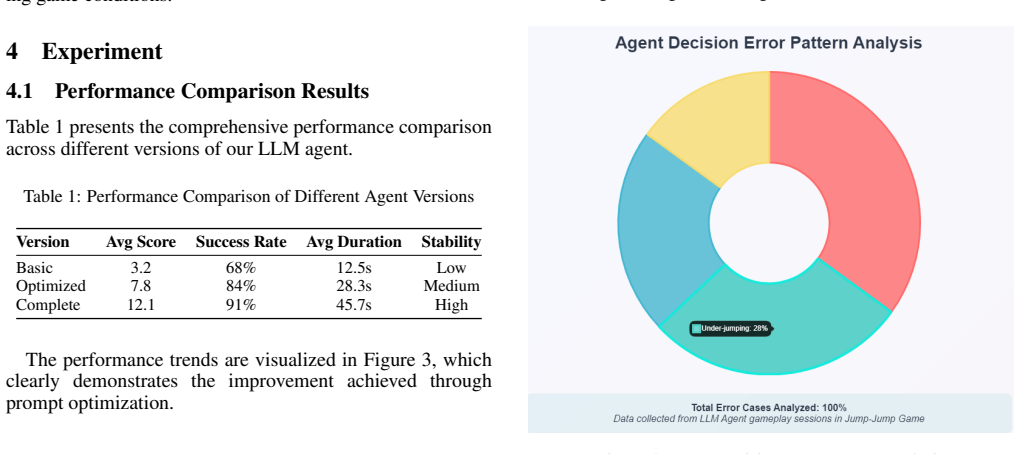
- LLM decision errors are patterned and interpretable: over-jumping dominates (35% of failures), which suggests targeted prompt corrections could further reduce failures.
- LLM agents still need external safeguards for numerical consistency, since identical inputs can produce different outputs.
Reading between the lines
- Inference: because the 3-5 few-shot examples in the Complete prompt were drawn from the same game states later used for evaluation, part of the 91% success rate may reflect retrieval of prepared answers; a held-out set of novel platform configurations would measure true generalization.
- Inference: the calibration factors are fitted to this specific simulator's physics, so the prompt is not model-agnostic; porting to another game would require the same empirical calibration loop, not just text editing.
- Inference: the approach generalizes to any sequential decision task whose state is small and numeric—sliders, trading thresholds, or trajectory planning—as long as a human can articulate the reasoning in a prompt.
- Inference: without naming the underlying LLM version and API temperature, the stability numbers cannot be reproduced or compared across models.
Editorial analysis
A structured set of objections, weighed in public.
Referee Report
Summary. The paper describes an LLM-based agent for the Jump-Jump game, a simple platform-jumping task where the agent must choose a jumping force (0–100) from the current player position and target platform boundaries. The authors propose a prompt-engineering pipeline with three versions: Basic, Optimized, and Complete. Table 1 reports that the Complete version reaches a 91% success rate and an average score of 12.1, up from 68% and 3.2 for the Basic version. The method sections describe role-based prompting, step-by-step reasoning guidance, few-shot examples, and calibration factors. The paper also presents a case study of one successful and one failed decision, and concludes that LLM agents can achieve satisfactory performance in structured game environments through careful prompt engineering.
Significance. If the reported results were reproducible, the work would be a small but useful empirical data point on prompt engineering for LLM agents in a closed, physics-based game environment. The claimed improvements from structured reasoning, few-shot examples, and calibration are plausible and align with general findings in prompt-engineering research. However, the paper's current value is severely limited by three compounding problems: no model identity or experimental protocol is given; the calibration and few-shot examples appear to be derived from the same game states later used for evaluation, raising circularity concerns; and the single successful worked example contradicts the stated physics of the game. As it stands, the paper provides no trustworthy quantitative evidence for its central claim.
major comments (4)
- [§4.3, Listing 1 vs. §2.1, Eqs. (1)–(3)] The successful case study is physically impossible under the stated game mechanics. The input state has player at (150,380), target platform (280,380,360), so the horizontal distance to the platform center is 170. The agent recommends force 85. Using Eqs. (1)–(3), vx = 12.75, vy = -21.25, g = 0.5. The flight time is 2*|vy|/g = 85, so the horizontal distance traveled is 12.75*85 = 1083.75, far beyond the target. Thus either the equations are not the ones used in the actual game, making the experiment unreproducible, or the 'successful landing' is impossible. Since the entire performance table rests on the validity of the environment, this is a load-bearing inconsistency.
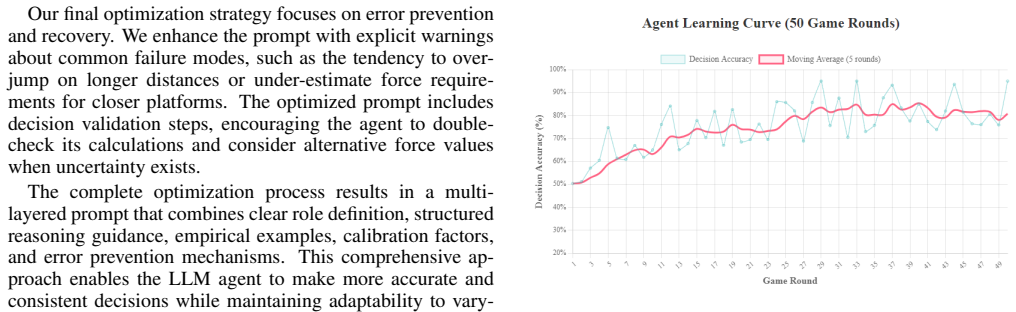
- [§4.1, Table 1; §4.2, Figure 4] No experimental details are given to support the reported numbers. The paper does not state which LLM was used (model name or version), how many game rounds or trials each success rate and average score are based on, whether the 50 rounds in Figure 4 are the same data as Table 1, or any variance, confidence intervals, or significance tests. Without this information, the 68%→91% improvement and the 3.2→12.1 score increase cannot be evaluated or reproduced. Please provide the model, the number of independent runs, and per-condition standard errors or comparable statistics.
- [§3.2, 'few-shot learning' and 'calibration strategy'] The few-shot examples and calibration factors are described as being selected 'through empirical testing' and based on 'observed patterns' from the game. If these examples and adjustments were derived from the same game states later used in the evaluation, then the reported 91% success rate may reflect recall or overfitting to the test set rather than genuine decision-making. The paper needs to specify how the evaluation states were separated from the states used to construct the few-shot examples and calibration rules, or otherwise demonstrate that the method generalizes to unseen states.
- [§4.2, 'Prompt Optimization Effect'] The claimed contributions of individual optimization strategies ('strategy guidance: approximately 12% improvement', 'example learning: approximately 8% improvement') are not tied to any table, figure, or controlled ablation. Table 1 has only three cumulative versions, and the sum of the stated component contributions (12% + 8% = 20%) does not match the total 23-point gap between Basic and Complete (68% to 91%) in an explainable way. Please provide actual ablation results or remove these unsupported quantitative claims.
minor comments (4)
- [General] The paper contains numerous formatting and terminology issues, such as 'platlef t' and 'plattop' in Section 2.1, the misspelling 'GRA VITY', and inconsistent use of 'parabola' vs. the stated linear horizontal motion under zero horizontal acceleration.
- [References] Many references are about library science and AI in libraries (e.g., Ali et al., Andrews et al., Arora et al.) and appear unrelated to the topic of LLM game agents. Please replace with relevant citations or remove them.
- [Figure 4] The learning curve is described as showing 'adaptability during gameplay', but the x-axis label '50 Game Rounds' is the only indication of scale. The figure is not described numerically; a table of round-by-round or binned success rates would be more informative.
- [§4.3, Listing 2] In the failure case, with distance 200 (from 200 to 400), force 100 yields horizontal distance 0.15*100^2 = 1500 under the stated physics. The description 'Over-jumping' is qualitatively consistent, but the analysis does not explain how a force of 100 could miss a platform at distance 200 when the physics model predicts overflight of 1000+ units; this underscores the need to reconcile the case studies with the equations.
Circularity Check
No circularity found; the reported case study is internally inconsistent, but this is a correctness/reproducibility issue, not a self-referential derivation.
full rationale
The paper's central claim is an empirical comparison across prompt versions (Table 1), not a derivation from an input. The few-shot examples and calibration guidelines in Section 3.2 are prompt components tuned to the game environment; the paper never states that evaluation states coincide with those examples, so the reported improvement cannot be shown by construction to be memorization of the examples. The successful case in Section 4.3 is inconsistent with the paper's own physics: Eqs. (1)-(3) imply travel distance d = 0.15*F^2, so force 85 gives d ≈ 1084, far beyond the target platform. That is a serious internal-consistency/reproducibility defect, not a circularity where a prediction reduces to its input. No load-bearing self-citations or imported uniqueness theorems appear. The paper's own Limitations section acknowledges precision and consistency problems, reinforcing that the evidence is unreliable, but unreliability is distinct from circularity. Therefore the circularity score is 0.
Assumptions & free parameters
free parameters (2)
- Calibration fine-tuning factors =
not specified
- Few-shot example scenarios =
3-5 scenarios, contents not disclosed
assumptions (2)
- domain assumption The game physics is exactly vx = F*0.15, vy = F*(-0.25), GRAVITY = 0.5.
- domain assumption The LLM used is capable of following these prompts and performing arithmetic reliably enough to produce useful force values.
Cite this review
Pith. "Pith review of Exploring Decision-Making Capabilities of LLM Agents: An Experimental Study on Jump-Jump Game." pith.science (2026). https://pith.science/paper/ZTYGZSZL
@misc{pith2026250900483,
  author       = {Pith},
  title        = {Pith review of: Exploring Decision-Making Capabilities of LLM Agents: An Experimental Study on Jump-Jump Game},
  year         = {2026},
  howpublished = {\url{https://pith.science/paper/ZTYGZSZL}},
  note         = {Machine review of arXiv:2509.00483}
}
read the original abstract
The Jump-Jump game, as a simple yet challenging casual game, provides an ideal testing environment for studying LLM decision-making capabilities. The game requires players to precisely control jumping force based on current position and target platform distance, involving multiple cognitive aspects including spatial reasoning, physical modeling, and strategic planning. It illustrates the basic gameplay mechanics of the Jump-Jump game, where the player character (red circle) must jump across platforms with appropriate force to maximize score.
Figures


Figures from the paper (2 more)

Reference graph
Works this paper leans on
-
[1]
Artificial intelli- gence (ai) in pakistani university library services
[Ali et al., 2021] Muhammad Yousuf Ali, Salman Bin Naeem, and Rubina Bhatti. Artificial intelli- gence (ai) in pakistani university library services. Library Hi Tech News, 38(8):12–15,
work page 2021
-
[3]
Invigorating libraries with application of artificial intelligence
[Arora et al., 2020] Dipti Arora, Alka Bansal, and Nishant Kumar. Invigorating libraries with application of artificial intelligence. Library Philosophy and Practice, page 3630,
work page 2020
-
[5]
The genesis of ai by ai integrated circuit: Where ai creates ai
[Baungarten-Leon et al., 2024] Emilio Isaac Baungarten- Leon, Susana Ortega-Cisneros, Mohamed Abdelmoneum, et al. The genesis of ai by ai integrated circuit: Where ai creates ai. Electronics, 13(9):1704,
work page 2024
-
[7]
Measuring ai development: A prototype methodol- ogy to inform policy
[Clark et al., 2021] Jack Clark, Kyle Miller, and Rebecca Gelles. Measuring ai development: A prototype methodol- ogy to inform policy. Technical report, Center for Security and Emerging Technology,
work page 2021
-
[8]
[Lund and Ma, 2021] Breanne D. Lund and Jingjing Ma. A review of cluster analysis techniques and their uses in li- brary and information science research: K-means and k- medoids clustering. Performance Measurement and Met- rics, 22(3):161–173,
work page 2021
-
[9]
[Lund and Shamsi, 2023] Breanne D. Lund and Aamir Shamsi. Examining the use of supportive and contrasting citations in different disciplines: A brief study using scite data. Scientometrics, 128(8):4895–4900,
work page 2023
-
[11]
Integrating ai/ml into agile development
[Medavarapu, 2024] Sai Vaibhav Medavarapu. Integrating ai/ml into agile development. International Journal of Sci- ence and Research, 13(8):469–473,
work page 2024
-
[12]
[Okunlaya et al., 2022] Rifqah Olufunmilayo Okunlaya, Norris Syed Abdullah, and Rose Alinda Alias. Artificial intelligence (ai) library services innovative conceptual framework for the digital transformation of university education. Library Hi Tech, 40(6):1869–1892,
work page 2022
Show all 25 references
-
[14]
Artificial intelligence in the library: Gauging the poten- tial application and implications for contemporary library services in nigeria
[Oyetola and others, 2023] Solomon Olusegun Oyetola et al. Artificial intelligence in the library: Gauging the poten- tial application and implications for contemporary library services in nigeria. Data and Metadata, 2:36,
2023
-
[15]
Generative ai for data-centric ai development
[Panda, 2025] Meethun Panda. Generative ai for data-centric ai development. International Journal of Computer Engi- neering and Technology, 16(1):1521–1534,
2025
-
[17]
Shahriar, B
[Shahriar et al., 2024] S. Shahriar, B. D. Lund, N. R. Man- nuru, et al. Putting gpt-4o to the sword: A comprehensive evaluation of language, vision, speech, and multimodal proficiency. Applied Sciences, 14(17):7782,
2024
-
[18]
Secure development practices for generative ai and dual-use foundation ai mod- els
[Souppaya, 2024] Murugiah Souppaya. Secure development practices for generative ai and dual-use foundation ai mod- els. Technical report, National Institute of Standards and Technology,
2024
-
[19]
[Wang and Lund, 2023] Tianyu Wang and Breanne D. Lund. Chatting about chatgpt: How may ai and gpt impact academia and libraries? Library Hi Tech News, 40(3):26– 29,
2023
-
[20]
Chronoselect: Robust learning with noisy labels via dynamics temporal memory
[Wang et al., 2025] Jianchao Wang, Qingfeng Li, Pengcheng Zheng, Xiaorong Pu, and Yazhou Ren. Chronoselect: Robust learning with noisy labels via dynamics temporal memory. arXiv preprint arXiv:2507.18183,
2025
-
[21]
Fcir: Rethink aerial image super resolution with fourier analysis
[Zhang et al., 2023] Yan Zhang, Pengcheng Zheng, Jianan Jiang, Pu Xiao, and Xinbo Gao. Fcir: Rethink aerial image super resolution with fourier analysis. In ICASSP 2023- 2023 IEEE International Conference on Acoustics, Speech and Signal Processing (ICASSP), pages 1–5. IEEE,
2023
-
[22]
Jointly rs image deblurring and super-resolution with adjustable- kernel and multi-domain attention
[Zhang et al., 2024] Yan Zhang, Pengcheng Zheng, Chengx- iao Zeng, Bin Xiao, Zhenghao Li, and Xinbo Gao. Jointly rs image deblurring and super-resolution with adjustable- kernel and multi-domain attention. IEEE Transactions on Geoscience and Remote Sensing ,
2024
-
[23]
Cgc-net: A context-guided constrained network for remote-sensing image super resolution
[Zheng et al., 2023] Pengcheng Zheng, Jianan Jiang, Yan Zhang, Chengxiao Zeng, Chuanchuan Qin, and Zhenghao Li. Cgc-net: A context-guided constrained network for remote-sensing image super resolution. Remote Sensing, 15(12):3171,
2023
-
[24]
Efficient medical image restoration via relia- bility guided learning in frequency domain
[Zheng et al., 2025a] Pengcheng Zheng, Kecheng Chen, Ji- axin Huang, Bohao Chen, Ju Liu, Yazhou Ren, and Xi- aorong Pu. Efficient medical image restoration via relia- bility guided learning in frequency domain. arXiv preprint arXiv:2504.11286,
-
[25]
Joint lossless compression and steganography for medical images via large language models
[Zheng et al., 2025b] Pengcheng Zheng, Xiaorong Pu, Kecheng Chen, Jiaxin Huang, Meng Yang, Bai Feng, Yazhou Ren, and Jianan Jiang. Joint lossless compression and steganography for medical images via large language models. arXiv preprint arXiv:2508.01782, 2025
2025 arXiv
-
[2020]
Intelligent libraries: A review on expert sys- tems, artificial intelligence, and robot
[Asemi et al., 2020] Asefeh Asemi, Andrea Ko, and Mohsen Nowkarizi. Intelligent libraries: A review on expert sys- tems, artificial intelligence, and robot. Library Hi Tech , 39(2):412–434,
2020
-
[2021]
Andrews, Heather Ward, and JungWon Yoon
[Andrews et al., 2021] James E. Andrews, Heather Ward, and JungWon Yoon. Utaut as a model for under- standing intention to adopt ai and related technologies among librarians. The Journal of Academic Librarianship, 47(6):102437,
2021
-
[2022]
[Oyelude, 2021] Adetoun A. Oyelude. Ai and libraries: Trends and projections. Library Hi Tech News, 38(10):1– 4,
2021
-
[2023]
[Lund, 2023] Breanne D. Lund. The prompt engineering li- brarian. Library Hi Tech News, 40(8):6–8,
2023
-
[2024]
Mapping india’s ai potential
[Chahal et al., 2021] Husanjot Chahal, Sara Abdulla, Jonathan Murdick, and Ilya Rahkovsky. Mapping india’s ai potential. Technical report, Center for Security and Emerging Technology,
2021
-
[2025]
Saeidnia, S
[Saeidnia et al., 2024] Hamid R. Saeidnia, S. G. Hashemi Fotami, Breanne D. Lund, and Neda Ghiasi. Ethical con- siderations in artificial intelligence interventions for men- tal health and well-being. Social Sciences , 13(7):381,
2024
Reviewed August 5, 2026 · model on record in the stance chip above.
Discussion (0). Sign in to comment.